7.NS.1b rational number addition
Question 1 of 6
2024 Test A Math, question 1Question
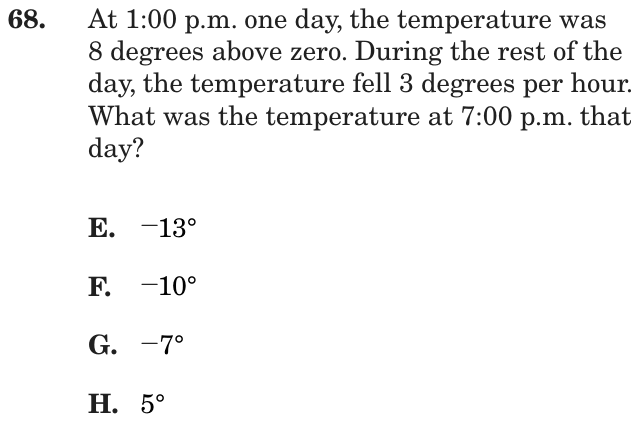
Simplify:
Grid-in question: work out the answer and enter it as a number.
Show the answer
Correct answer: -0.4
Subtracting a negative number is the same as adding a positive number. Rewrite the expression to simplify:
Question analysis
This grid-in asks students to simplify a short expression that mixes negative and positive decimals and ends by subtracting a negative number. It tests adding and subtracting rational numbers in order. The double negative, and keeping track of the sign of the final result, are where errors creep in.
- Grade level
- Grade 7 content, by NYS standard
- Compared with grade 7
- At grade 7 Adding and subtracting negative decimals is core grade 7 content, and this is a routine three-term version. It matches a typical classroom exercise; the only extra demand is gridding a signed decimal correctly.
- Estimated difficulty
- Straightforward: two steps or one careful reading.
- Thinking it demands
- Depth of knowledge 1, recall and reproduction · mainly apply
- What makes it hard
- Error-prone arithmetic moderate
- An answer in an unexpected form minor
- Solution
- 2 steps
- Reading level
- Question and choices: about grade 16+, 2 words.
- Students, last 30 days
- Not enough answers yet to show (it takes 10).
Why it is hard, traps and wrong answers (shows the answer)
Why it is hard
This is a three-term expression with small decimals, so the method is never in doubt; the points are lost on signs. The double negative at the end is the classic place to slip; the other is the result itself, which sits just below zero and is easy to grid without its minus sign. Grouping the positive terms first, 2.3 + 1.1, and comparing that sum with 3.8 settles both the size and the sign.
Error-prone arithmetic moderate Working it out
The last term, − (−1.1), has to turn into + 1.1, and the total then crosses zero, since 2.3 + 1.1 = 3.4 falls just short of the 3.8 below zero. (Brown & Burton, 1978; Junker & Sijtsma, 2001)
An answer in an unexpected form minor Choosing the answer
As a grid-in it shows no choices, so a double negative read as a single one, or a result gridded without its minus sign, gets no warning from the page. (Enright, Morley & Sheehan, 2002)
Strategy: Rewrite subtracting −1.1 as adding 1.1, combine the two positive decimals first, then compare their total with 3.8 to decide the sign and size.
Traps
- Negatives and direction: Arithmetic with negative numbers, the order of a subtraction, or direction on a number line. (Moving a term across the equals sign without changing its sign is a faulty procedure.)
The wrong answers, classified
-2.6 Negatives and direction (Brown & Burton, 1978)
Treats subtracting −1.1 as subtracting 1.1, so it works out −3.8 + 2.3 − 1.1 = −1.5 − 1.1 and moves further below zero.
0.4 Negatives and direction (Brown & Burton, 1978)
Rewrites the double negative correctly and finds the gap 3.8 − 3.4 = 0.4, but drops the minus sign that the larger negative term gives the result.
Worked solution, step by step
Formulas used
- Subtracting a negative number
- a is any number, and b is a positive number, so −b is negative. Taking away a negative number is the same as adding the positive number. Think of money: if someone takes away a debt of b dollars, you are b dollars better off.
- Adding a negative and a positive
- a and b are positive numbers, and a is the larger one. A negative and a positive partly cancel out. So find the difference of their sizes, a − b. The result keeps the sign of the number farther from zero, which here is the negative one.
Sort out the expression
You need to simplify . Simplify means work it out to one number. Two of the numbers are negative: −3.8 and −1.1. One is positive: 2.3. The tricky part is at the end. It says minus negative 1.1. The answer can be negative, so keep track of every sign.
Change minus a negative to plus
Taking away a negative is the same as adding a positive. Use the rule with b = 1.1.
Now only one negative number is left. Watch out: do not just subtract 1.1. That gives , which is wrong.
Add the two positive numbers
Group the positive numbers first. This makes the rest of the work short.
Now the problem is . One number is negative and one is positive.
Combine the negative and the positive
They partly cancel. Use the rule with a = 3.8 and b = 3.4.
The negative number, 3.8, is farther from zero than 3.4 is. So the result is negative. Watch out: keep the minus sign. Dropping it gives 0.4, which is wrong. So you would grid -0.4, with the minus sign in its own column.
Check your answer
Use a number line. Start at −3.8. Adding 2.3 moves you right, to −1.5. Subtracting −1.1 also moves you right, by 1.1, to −0.4. You end just to the left of zero. So a small negative answer makes sense.
More questions like this
The original DOE question
Question 2 of 6
2024 Test B Math, question 7Question
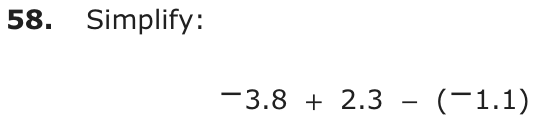
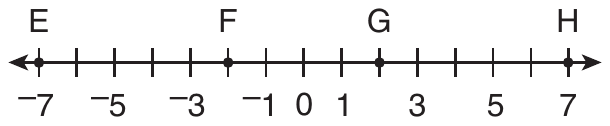
The number line shows points E, F, G, and H.
Which point represents the sum of ?
- Apoint E
- Bpoint F
- Cpoint G
- Dpoint H
Show the answer
Correct answer: B
Find the sum of :
Point F is located at −2.
Question analysis
A number line question with points E, F, G and H marked on a line labeled from −7 to 7. Students add 2.5 and negative 4.5 and find which point shows the sum. It tests adding a positive and a negative decimal, then reading positions on a line whose labels skip some integers.
- Grade level
- Grade 7 content, by NYS standard
- Compared with grade 7
- At grade 7 Adding rational numbers with different signs and showing the sum on a number line is exactly the grade 7 standard. This is one routine sum with simple decimals, a typical classroom exercise.
- Estimated difficulty
- Routine: one familiar step, little to misread.
- Thinking it demands
- Depth of knowledge 1, recall and reproduction · mainly apply
- What makes it hard
- Solution
- 2 steps
- Reading level
- Question and choices: about grade 1, 25 words.
- Students, last 30 days
- Not enough answers yet to show (it takes 10).
Why it is hard, traps and wrong answers (shows the answer)
Why it is hard
This is a one-line sum followed by a lookup, and most students finish quickly. The four points are placed so that each common sign mistake lands on one of them: −7, 2 and 7 all come from mishandling the negative. Picturing the sum as a move of 4.5 units to the left from 2.5 shows both the size and the direction at once.
Error-prone arithmetic minor Working it out
Adding −4.5 to 2.5 means taking 4.5 away from 2.5, and the larger size of −4.5 makes the sum negative, a sign rule that is easy to apply backwards. (Brown & Burton, 1978; Junker & Sijtsma, 2001)
Reading a figure, table or graph minor Understanding the question
Only 0 and the odd numbers are labeled, so point F sits at an unlabeled tick between −3 and −1 and must be found by counting. (Lesh, Post & Behr, 1987; Kirsch & Mosenthal, 1990)
Strategy: Rewrite adding −4.5 as subtracting 4.5, work out the sum, then find it on the line by counting tick marks from a labeled number, one tick per integer.
Traps
- Negatives and direction: Arithmetic with negative numbers, the order of a subtraction, or direction on a number line. (Moving a term across the equals sign without changing its sign is a faulty procedure.)
The wrong answers, classified
A Negatives and direction (Brown & Burton, 1978)
Adds the sizes 2.5 and 4.5 and makes the total negative, treating both numbers as negative, which lands on −7 at point E.
C Negatives and direction (Brown & Burton, 1978)
Subtracts 2.5 from 4.5 to get the right size, 2, but keeps it positive, missing that the negative number has the larger size.
D Negatives and direction (Brown & Burton, 1978)
Ignores the negative sign on 4.5 and adds the two numbers, 2.5 + 4.5 = 7, landing on point H at the far right.
Worked solution, step by step
Formulas used
- Adding a negative number
- a is any number, and −b is a negative number. Adding a negative number is the same as subtracting its size. On a number line, it means moving b steps to the left.
Sort out the question
You need to find . Then find that sum (the answer to the addition) on the number line.
The number line has a tick at every whole number from −7 to 7. Only 0 and the odd numbers have labels.
Turn the addition into subtraction
You are taking 4.5 away from 2.5. You take away more than you have, so the answer will be negative.
Do the subtraction
The two sizes differ by 2, because . The larger size, 4.5, belongs to the negative number. So the sum is negative.
Watch out: the answer is −2, not 2. Point G is at 2.Find −2 on the line
−2 has no label. It is the tick between −3 and −1. Point F sits on that tick.
Watch out: adding 2.5 + 4.5 = 7 lands on point H. Making both numbers negative gives −7, point E.So the answer is B, point F.
Check your answer
Start at 2.5 on the number line and move 4.5 steps to the left. The first 2.5 steps take you to 0. You still have 2 steps to go. Two more steps left of 0 lands on −2, which is point F.
More questions like this
The original DOE question
Question 3 of 6
2024 Test B Math, question 33Question
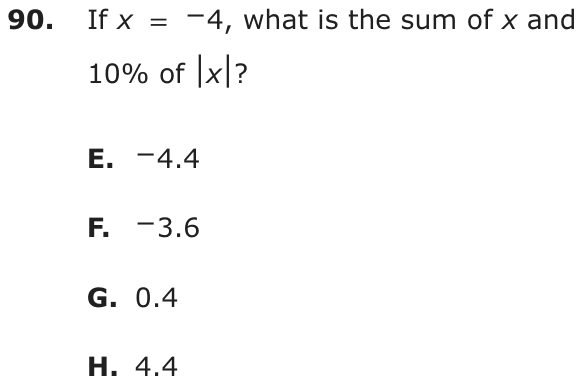
If , what is the sum of x and 10% of ?
- A−4.4
- B−3.6
- C0.4
- D4.4
Show the answer
Correct answer: B
First, determine 10% of .
Then determine the sum of x and 10% of .
The sum is −3.6.
Question analysis
With x equal to a negative number, students find the sum of x and 10 percent of the absolute value of x. It tests absolute value, a simple percent and adding numbers with different signs. The tricky part is keeping track of which term is negative and which is not.
- NYS standards
- Grade level
- Grade 7 content, by NYS standard
- Compared with grade 7
- At grade 7 Grade 7 students add positive and negative decimals and find simple percents. This joins those skills with an absolute value in two short steps, so it matches typical practice, with the sign of each term as the main hazard.
- Estimated difficulty
- Straightforward: two steps or one careful reading.
- Thinking it demands
- Depth of knowledge 1, recall and reproduction · mainly apply
- What makes it hard
- Error-prone arithmetic moderate
- Something you must already know minor
- Solution
- 2 steps
- Reading level
- Question and choices: about grade 5, 11 words.
- Students, last 30 days
- Not enough answers yet to show (it takes 10).
Why it is hard, traps and wrong answers (shows the answer)
Why it is hard
The question is short, but it asks students to treat the same number two ways: x keeps its negative sign while |x| drops it. Each wrong choice gets the sign wrong in one place, by taking 10% of −4, by making both terms positive, or by stopping at the positive 0.4. Writing the two terms separately, −4 and +0.4, before adding prevents each slip.
Error-prone arithmetic moderate Working it out
The sum mixes a negative integer with a positive decimal, −4 + 0.4, and the result has to keep the negative sign while moving 0.4 toward zero. (Brown & Burton, 1978; Junker & Sijtsma, 2001)
Something you must already know minor Working it out
Students must know that |−4| = 4, so the 10% is taken of a positive number even though x itself is negative. (Anderson & Krathwohl, 2001)
Strategy: Evaluate the absolute value first, take 10 percent of that positive number, and then add the result to x itself, keeping x's negative sign.
Traps
- Negatives and direction: Arithmetic with negative numbers, the order of a subtraction, or direction on a number line. (Moving a term across the equals sign without changing its sign is a faulty procedure.)
- Stops one step early: A choice is a number from partway through the solution.
The wrong answers, classified
A Negatives and direction (Brown & Burton, 1978)
Takes 10% of x instead of |x|, getting −0.4, and adds it to −4 to reach −4.4, overlooking the absolute value bars.
C Stops one step early (King et al., 2004; Gierl et al., 2017)
Finds 10% of |x| = 0.4 correctly and stops there, without adding x as the word sum requires.
D Negatives and direction (Brown & Burton, 1978)
Uses 4 for x as well as for |x|, so adds 4 + 0.4 = 4.4 and loses the negative sign of x itself.
Worked solution, step by step
Formulas used
- Absolute value
- The two bars mean absolute value. a is any number. Its absolute value is how far it is from 0 on the number line. A distance is never negative, so |−4| = 4.
- Percent of a number
- The whole is the amount the percent is taken of. The percent tells how many out of every 100. The part is the piece you get. Use it to find a percent of any number.
Sort out the question
You know that x = −4. You need the sum of two things: x itself, and 10% of |x|. A sum means you add.
The bars around x mean absolute value. So the 10% is taken of |x|, not of x.
Find the absolute value
−4 is 4 steps from 0 on the number line. So its absolute value is 4. An absolute value is never negative.
Take 10 percent of it
So 10% of |x| is 0.4.
Watch out: If you take 10% of x instead, you get −0.4. Then −4 + (−0.4) = −4.4, choice A. The bars make the number positive first.
Add x and the result
Now add x, which is still −4. Its own minus sign stays.
Start at −4 on the number line. Move 0.4 to the right, toward 0. You land on −3.6.
Watch out: Stopping at 0.4 gives choice C. Using 4 in place of x gives 4.4, choice D.
So the answer is B, −3.6.
Check your answer
Adding a small positive number should move −4 a little toward 0. The answer −3.6 is just to the right of −4, so that fits. Also, , the amount you added.
More questions like this
The original DOE question
Question 4 of 6
2018 Test A Math, question 36Question
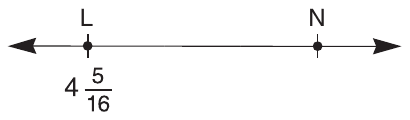
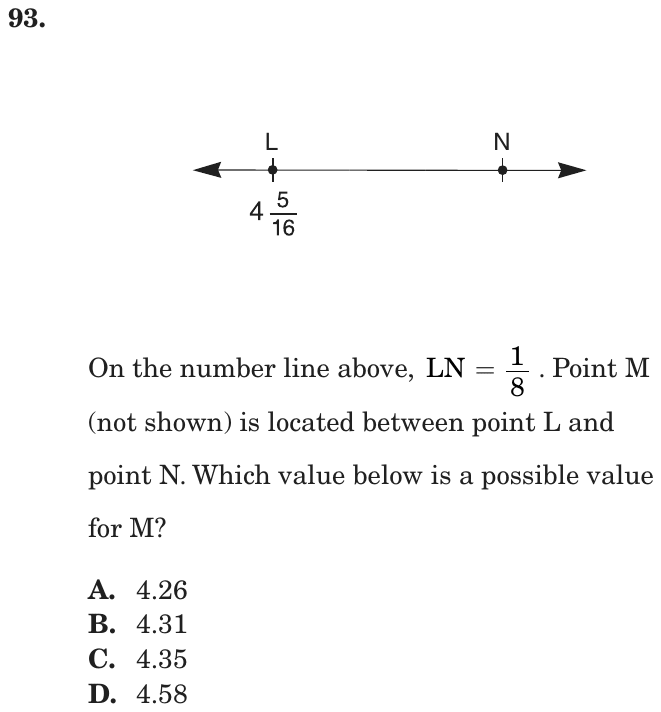
On the number line above, LN = . Point M (not shown) is located between point L and point N. Which value below is a possible value for M?
- A4.26
- B4.31
- C4.35
- D4.58
Show the answer
Correct answer: C
Since , point is located at
.
So must be between point , , and point , . Point can also be written as 4.3125, and point can be written as 4.4375. The only option given that lies between those two points is 4.35.
Question analysis
This number line question says the distance from point L to point N is one eighth and asks which decimal could be the position of a point M between them. Students take L's position, a mixed number in sixteenths, find N, and compare with decimal choices. Converting sixteenths to decimals precisely is the tricky part.
- NYS standards
- Grade level
- Grade 7 content, by NYS standard
- Compared with grade 7
- At grade 7 Grade 7 students convert fractions to decimals and compare them. This item needs an exact conversion of sixteenths and a comparison to the thousandths, where rounding too early can mislead, but it stays within grade 7 content.
- Estimated difficulty
- Moderate: several steps, or a close reading with one strong distractor.
- Thinking it demands
- Depth of knowledge 2, skills and concepts · mainly apply
- What makes it hard
- Error-prone arithmetic moderate
- A very close wrong answer moderate
- Reading a figure, table or graph minor
- Solution
- 3 steps
- Reading level
- Question and choices: about grade 5, 28 words.
- Students, last 30 days
- Not enough answers yet to show (it takes 10).
Why it is hard, traps and wrong answers (shows the answer)
Why it is hard
The interval from L to N is only an eighth wide, and three of the four choices crowd near it, so precision decides the question. Students comfortable working in sixteenths can avoid decimals until the end, since 4.35 lies between 4 5/16 and 4 7/16. Those who convert loosely, or who misread a mixed number as a decimal, are pulled to a neighboring choice.
Error-prone arithmetic moderate Working it out
Converting 4 5/16 to 4.3125 and N to 4.4375 needs four decimal places, while the choices stop at hundredths, so early rounding blurs the left boundary. (Brown & Burton, 1978; Junker & Sijtsma, 2001)
A very close wrong answer moderate Choosing the answer
The choices 4.31 and 4.35 both lie within 0.04 of L, so estimating cannot separate them; only the exact 4.3125 shows 4.31 just outside the interval and 4.35 inside. (Embretson & Wetzel, 1987; Gorin & Embretson, 2006; Ascalon et al., 2007)
Reading a figure, table or graph minor Understanding the question
L's value appears only on the number line, and the picture shows N to the right of L, which fixes which way the one-eighth gap runs. (Lesh, Post & Behr, 1987; Kirsch & Mosenthal, 1990)
Strategy: Add one eighth, or two sixteenths, to L's position to locate N, convert both endpoints to four-place decimals, and keep only a choice strictly between them.
Traps
- Rounds too early: Rounds a value partway through, or rounds the wrong way, so the final answer drifts from the exact one.
- Answer in another form: The right answer is written differently from the way you worked it out.
- A faulty procedure: A systematic but wrong procedure: adding fractions straight across, applying an exponent to each term of a sum, dropping a sign when moving a term.
The wrong answers, classified
A Negatives and direction (Brown & Burton, 1978)
Measures the one-eighth gap to the left of L, giving 4.1875 to 4.3125, an interval that contains 4.26 but contradicts the figure.
B Rounds too early (King et al., 2004)
Rounds L's 4.3125 to 4.31 and treats 4.31 as inside the interval, missing that it lies slightly to the left of L.
D A faulty procedure (Brown & Burton, 1978; Tatsuoka, 1983)
Writes 4 5/16 as 4.516 by placing the fraction's digits after the decimal point, so N becomes about 4.641 and 4.58 appears to fit.
Worked solution, step by step
Formulas used
- Equal fractions
- a is the top number (numerator) and b is the bottom number (denominator). Multiplying both by the same number k gives an equal fraction. It is like cutting each piece into k smaller pieces. Use it to give fractions the same bottom before you add or subtract.
- Fraction to decimal
- A fraction bar means divide. a is the top number and b is the bottom number. Dividing the top by the bottom turns the fraction into a decimal. Then you can compare it with decimal choices.
Sort out what you know
Point L is at . Point N is to the right of L. The distance from L to N, called LN, is .
Point M is somewhere between L and N. You need a choice that fits between them. The choices are decimals, so you will change the fractions into decimals.
Find where N is
N is to the right of L, so add. First give a bottom of 16, to match L:
Watch out: N is to the right of L in the figure. Going left instead gives a gap that holds 4.26, choice A.
Change both points to decimals
Divide the top of each fraction by the bottom:
So L is at 4.3125 and N is at 4.4375.
Test each choice
M must be bigger than 4.3125 and smaller than 4.4375.
- 4.26 is smaller than 4.3125. It is left of L.
- 4.31 is 4.3100, just smaller than 4.3125. It is a hair left of L.
- 4.35 is between them. It fits.
- 4.58 is bigger than 4.4375. It is right of N.
Watch out: if you round L to 4.31, choice B seems to fit. Keep all four decimal places. So the answer is C, 4.35.
Check your answer
Subtract to be sure. 4.35 − 4.3125 = 0.0375, which is more than 0, so 4.35 is right of L. 4.4375 − 4.35 = 0.0875, which is also more than 0, so 4.35 is left of N. It sits between them.
More questions like this
The original DOE question
Question 5 of 6
2018 Test A Math, question 54Question
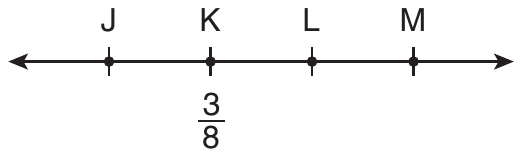
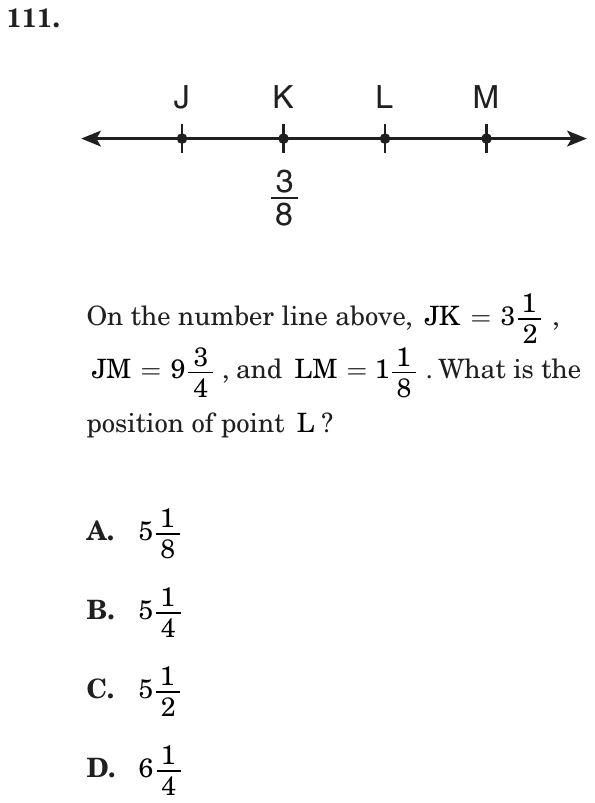
On the number line above, , , and . What is the position of point ?
- A
- B
- C
- D
Show the answer
Correct answer: C
First, use to find the location of :
Now, use to find the location of :
Finally, use to find the location of :
Question analysis
This number line question gives the lengths JK, JM and LM as mixed numbers and asks for the position of point L. Students must chain three distance steps, moving left from K to J, right to M and back to L, with fractions in eighths and a negative position. Losing track of where K sits is the main danger.
- Grade level
- Grade 7 content, by NYS standard
- Compared with grade 7
- Above grade 7 Grade 7 students add and subtract rational numbers and find distances on a number line one at a time. This item chains three such steps with mixed numbers and a negative position, more than typical grade 7 work demands.
- Estimated difficulty
- Among the hardest on the SHSAT: a non-obvious approach, heavy reading, or a well-hidden trap.
- Thinking it demands
- Depth of knowledge 2, skills and concepts · mainly apply
- What makes it hard
- A very close wrong answer major
- Error-prone arithmetic moderate
- Reading a figure, table or graph moderate
- Many steps minor
- Solution
- 4 steps
- Reading level
- Question and choices: about grade 9, 20 words.
- Students, last 30 days
- Not enough answers yet to show (it takes 10).
Why it is hard, traps and wrong answers (shows the answer)
Why it is hard
Every number is a mixed fraction, one position is negative, and the figure's even spacing hides how long KL really is. The distance route, KL = 9 3/4 − 3 1/2 − 1 1/8, avoids the negative entirely but ends one step short of a position unless K's 3/8 is added back. That last step is the one most students skip, which is why the question sits at the top of the scale.
A very close wrong answer major Choosing the answer
The choices 5 1/8, 5 1/4 and 5 1/2 lie within 3/8 of one another, so no estimate separates them; only exact eighths and adding K's 3/8 pick out the right one. (Embretson & Wetzel, 1987; Gorin & Embretson, 2006; Ascalon et al., 2007)
Error-prone arithmetic moderate Working it out
Every step mixes halves, quarters and eighths, and placing J means 3/8 − 3 1/2 = −3 1/8, a subtraction that crosses zero. (Brown & Burton, 1978; Junker & Sijtsma, 2001)
Reading a figure, table or graph moderate Understanding the question
Only K is labeled, and the points are drawn evenly spaced although KL is over four times LM, so the picture gives no help with sizes. (Lesh, Post & Behr, 1987; Kirsch & Mosenthal, 1990)
Many steps minor Working it out
Three linked moves, K to J, J to M and M back to L, each depend on the last, so an early slip carries through. (Daniel & Embretson, 2010; Enright, Morley & Sheehan, 2002)
Strategy: Start from K's labeled position, subtract JK to place J, add JM to place M, then subtract LM, keeping every fraction in eighths.
Traps
- Answers a different question: A choice is right for another quantity: the other unknown, the rest instead of the part, the part instead of the whole.
- Stops one step early: A choice is a number from partway through the solution.
The wrong answers, classified
A Stops one step early (King et al., 2004; Gierl et al., 2017)
Finds KL = 9 3/4 − 3 1/2 − 1 1/8 = 5 1/8 and stops one step short, never adding K's position of 3/8.
B An arithmetic slip (Junker & Sijtsma, 2001)
Rewrites 9 3/4 as 9 4/8 instead of 9 6/8, so M lands at 6 3/8 and L at 6 3/8 − 1 1/8 = 5 1/4.
D Answers a different question (King et al., 2004; Hegarty, Mayer & Monk, 1995)
Finds KM = 9 3/4 − 3 1/2 = 6 1/4, the distance from K to M, and gives it without moving back 1 1/8 to L.
Worked solution, step by step
Formulas used
- Distance on a number line
- d is the distance between two points. b is the point on the right and a is the point on the left. Subtracting left from right always gives a positive distance. It works even when a is negative.
- Equal fractions
- a is the top number (numerator) and b is the bottom number (denominator). Multiplying both by the same number k gives an equal fraction. It is like cutting each piece into k smaller pieces. Use it to give fractions the same bottom before you add or subtract.
Sort out what you know
Only K has a value: . JK means the distance from J to K. You know JK = , JM = and LM = .
You need the position of L, the number where L sits. The points are drawn evenly spaced, but the distances are not equal. So use the numbers, not the picture.
Write the fractions in eighths
The fractions use halves, fourths and eighths. Give them all a bottom of 8:
Watch out: is , not . That slip leads to choice B.
Find the distance from K to M
JM is JK and KM put together. So take JK away from JM:
KM is , or . Watch out: this is a distance, not where L sits. Choice D stops here.
Find the distance from K to L
KM is KL and LM put together. So take LM away:
KL is . Watch out: this is still a distance. Choice A stops here.
Find the position of L
L is to the right of K, and K is at . Add:
So the answer is C, .
Check your answer
Place every point. J is left of K, at . M is right of J, at . L is left of M, at , which is . Same answer.
More questions like this
The original DOE question
Question 6 of 6
2018 Test B Math, question 11Question
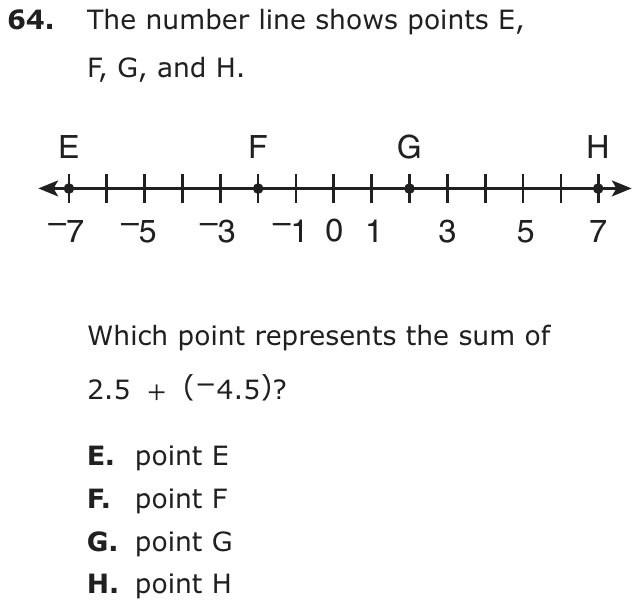
At 1:00 p.m. one day, the temperature was 8 degrees above zero. During the rest of the day, the temperature fell 3 degrees per hour. What was the temperature at 7:00 p.m. that day?
- A−13°
- B−10°
- C−7°
- D5°
Show the answer
Correct answer: B
7:00 p.m. is 6 hours after 1:00 p.m. Calculate the number of degrees the temperature dropped in 6 hours:
3 × 6 = 18 degrees
Subtract that from the starting point (8 degrees) to find the solution:
8 − 18 = −10 degrees
Question analysis
This integer word problem starts with a temperature 8 degrees above zero at 1:00 p.m. and has it fall 3 degrees every hour. Students find the temperature at 7:00 p.m. by counting hours and subtracting into negative numbers. Getting the number of hours between the two times right is the main hurdle.
- Grade level
- Grade 7 content, by NYS standard
- Compared with grade 7
- At grade 7 Grade 7 students use positive and negative numbers for real changes such as temperature. This is a standard three-step example of that skill, with a counting slip as its only real trap.
- Estimated difficulty
- Straightforward: two steps or one careful reading.
- Thinking it demands
- Depth of knowledge 2, skills and concepts · mainly apply
- What makes it hard
- Error-prone arithmetic minor
- Solution
- 3 steps
- Reading level
- Question and choices: about grade 4, 32 words.
- Students, last 30 days
- Not enough answers yet to show (it takes 10).
Why it is hard, traps and wrong answers (shows the answer)
Why it is hard
The arithmetic is light; the question turns on counting the hours from 1:00 to 7:00 correctly. Counting the clock times instead of the gaps between them gives seven hours, starting the drop an hour late gives five, and both errors are built into the choices. Subtracting the times, 7 − 1, is safer than counting on fingers.
Error-prone arithmetic minor Working it out
The total drop of 18 degrees is larger than the starting 8 degrees, so the subtraction crosses zero and the result must be negative. (Brown & Burton, 1978; Junker & Sijtsma, 2001)
Strategy: Count the hours that pass from 1:00 to 7:00 by subtracting the times, multiply by the 3-degree drop, and subtract that total from 8.
Traps
- Counting the ends: Inclusive or exclusive ends, fence posts, consecutive numbers: an answer that is one too many or too few, or an endpoint drawn open where it belongs closed (or the reverse).
The wrong answers, classified
A Counting the ends (Brown & Burton, 1978)
Counts the clock times 1, 2, 3, 4, 5, 6, 7 as seven hours, so subtracts 21 degrees from 8.
C Counting the ends (Brown & Burton, 1978)
Starts the drop at 2:00 instead of 1:00, counting five hours and subtracting 15 degrees from 8.
D Numbers taken from the question (Hegarty, Mayer & Monk, 1995)
Subtracts a single 3-degree drop from 8, combining the two numbers in the question without counting the hours.
Worked solution, step by step
Formulas used
- Total change
- The rate is how much the temperature changes each hour, here 3 degrees down. The time is the number of hours. Multiply them to get the total change, because the same drop happens every hour.
Write down what you know
At 1:00 p.m. it was 8 degrees above zero. Each hour after that, it dropped 3 degrees.
You need the temperature at 7:00 p.m.
Count the hours
Subtract the clock times: 7 − 1 = 6. So 6 hours pass.
Watch out: Do not count the clock numbers 1, 2, 3, 4, 5, 6, 7. That is 7 numbers but only 6 hours. Using 7 hours gives −13°, choice A. Starting the count at 2:00 gives 5 hours and −7°, choice C.
Find the total drop
The temperature drops the same amount each hour, so multiply.
The temperature fell 18 degrees in all.
Subtract from the start
Start at 8 degrees and take away the 18-degree drop.
The drop is bigger than 8, so the temperature goes below zero. A temperature below zero is a negative number. It is 10 degrees below zero.
So the answer is B, −10°.
Check your answer
Count down hour by hour: 8 at 1:00, 5 at 2:00, 2 at 3:00, −1 at 4:00, −4 at 5:00, −7 at 6:00 and −10 at 7:00. You land on −10.
More questions like this
The original DOE question