7.G.1 scale drawings
Question 1 of 11
2026 Practice Test D Math, question 11Question
In a scale drawing of a triangular park, the sides measure 5 inches, 7 inches, and 8 inches. The perimeter of the actual park is 25 miles. What is the actual length of the shortest side of the park?
- A6.25 mi
- B8.75 mi
- C10 mi
- D15.625 mi
Show the answer
Correct answer: A
To find the perimeter of a triangle, add the measures of the three sides. The perimeter of the scale drawing is inches.
Now, use the perimeters to find the scale factor for the scale drawing to the actual perimeter.
The scale factor is 20 inches to 25 miles, which reduces to a scale factor of 4 inches to 5 miles. Note that the scale for the perimeter is the same as the scale for the side lengths.
Since the smallest side on the scale drawing is 5 inches, use the scale factor to find the actual side length of the smallest side:
Question analysis
A scale drawing of a triangular park has sides of 5, 7 and 8 inches, and the real park's perimeter is 25 miles. Students find the actual length of the park's shortest side. It tests scale drawings and proportional reasoning; the scale is not given directly, so it must be worked out from the two perimeters first.
- Grade level
- Grade 7 content, by NYS standard
- Compared with grade 7
- At grade 7 Scale drawings are a grade 7 topic, and this is a standard scale problem. The one twist is that the scale is not stated: it must come from comparing the two perimeters before any side can be converted.
- Estimated difficulty
- Straightforward: two steps or one careful reading.
- Thinking it demands
- Depth of knowledge 2, skills and concepts · mainly apply
- What makes it hard
- Turning words into math minor
- Many steps minor
- Solution
- 3 steps
- Reading level
- Question and choices: about grade 2, 39 words.
- Students, last 30 days
- Not enough answers yet to show (it takes 10).
Why it is hard, traps and wrong answers (shows the answer)
Why it is hard
A scale drawing multiplies every length by one factor, and the perimeter shares that factor, so the work is short once the two perimeters are paired. The common loss is reasoning with differences: the perimeter grows by 5, so a side seems to grow by 5 as well. Converting to miles per inch first, then checking that the three real sides add back to 25 miles, guards against that error and against scaling the wrong side.
Turning words into math minor Understanding the question
The 25 miles is the park's perimeter, not a side, so it must be matched with the drawing's perimeter, 5 + 7 + 8 = 20 inches, before any side can be scaled. (Hegarty, Mayer & Monk, 1995; Koedinger & Nathan, 2004)
Many steps minor Working it out
Three operations in a row, adding the sides, dividing 25 by 20 for 1.25 miles per inch, and multiplying the 5-inch side, each produce a number the next step needs. (Daniel & Embretson, 2010; Enright, Morley & Sheehan, 2002)
Strategy: Add the three drawn sides to get the drawing's perimeter, divide the real perimeter by it to find the miles per inch, then multiply the shortest drawn side by that scale.
Traps
- Answers a different question: A choice is right for another quantity: the other unknown, the rest instead of the part, the part instead of the whole.
- Misreads the question: Misses or misreads a condition or a word in the question: "at least", "each", "remaining", "not".
The wrong answers, classified
B Answers a different question (King et al., 2004; Hegarty, Mayer & Monk, 1995)
Finds the scale of 1.25 miles per inch but applies it to the 7-inch side, the middle one, giving 8.75 miles instead of the shortest side.
C Misunderstands the concept (Smith, diSessa & Roschelle, 1993; De Bock et al., 1998; Ni & Zhou, 2005)
Keeps a constant difference instead of a constant ratio: the perimeter grows by 5, from 20 to 25, so it adds 5 to the 5-inch side.
D Misreads the question (Hegarty, Mayer & Monk, 1995)
Pairs the 25 miles with the longest side, 8 inches, instead of the 20-inch perimeter, so each inch seems to be 3.125 miles and 5 inches 15.625.
Worked solution, step by step
Formulas used
- Perimeter of a triangle
- P is the perimeter, the distance all the way around. a, b and c are the lengths of the three sides. You add them because going once around the triangle covers each side once.
- Using a scale
- The drawing length is measured on the drawing, in inches. Miles per inch is how many real miles each inch stands for. In a scale drawing, every length is multiplied by the same number, so the perimeter and each side use the same scale.
Sort out the question
A scale drawing is a smaller copy, with every length shrunk by the same amount. The drawing’s sides are 5, 7 and 8 inches. The real park’s perimeter, the distance all the way around, is 25 miles. You need the real length of the shortest side.
Find the drawing’s perimeter
Add the three sides of the drawing:
The drawing’s perimeter is 20 inches. It stands for the real perimeter of 25 miles.
Watch out: 25 miles is the whole way around, not one side. Matching it with the 8-inch side gives 15.625 miles, choice D.
Find the scale
20 inches stand for 25 miles. Divide to find how many miles 1 inch stands for:
So each inch on the drawing is 1.25 miles in the park.
Scale the shortest side
The shortest side on the drawing is 5 inches. Multiply it by the scale:
The real shortest side is 6.25 miles.
Watch out: the perimeter grew by 5, from 20 to 25, but you cannot just add 5 to a side. That gives 10 miles, choice C. Scaling multiplies. Also use the 5-inch side, not the 7-inch side, which gives 8.75 miles, choice B.
So the answer is A, 6.25 mi.
Check your answer
Scale all three sides: 5 × 1.25 = 6.25, 7 × 1.25 = 8.75 and 8 × 1.25 = 10. Add them: 6.25 + 8.75 + 10 = 25 miles. That is the park’s perimeter, so the scale is right.
More questions like this
The original DOE question
Question 2 of 11
2024 Test A Math, question 14Question
A museum has a room in the shape of a rectangle. The area of the floor is 960 square feet. In a scale drawing of the museum, 1 inch = 20 feet. If the length of the room is 2 inches in the scale drawing, what is the width of this room in the scale drawing?
- A in.
- B in.
- C24 in.
- D40 in.
Show the answer
Correct answer: A
The scale is 1 inch = 20 feet, and the length in the scale drawing is 2 inches, so the actual length is 40 feet.
The actual width is 24 feet.
Let x equal the width of the scale drawing, in inches.
Question analysis
A scale drawing problem: a museum room has a floor area of 960 square feet, the drawing's scale is 1 inch to 20 feet, and the room is 2 inches long in the drawing. Students find the room's width in the drawing. They must move between drawing inches and real feet, and back again, without mixing them.
- Grade level
- Grade 7 content, by NYS standard
- Compared with grade 7
- At grade 7 Scale drawings are grade 7 content, and grade 7 tasks usually convert one length. This one converts to real size, uses the area to find a second side, and converts back: three steps with a units trap.
- Estimated difficulty
- Moderate: several steps, or a close reading with one strong distractor.
- Thinking it demands
- Depth of knowledge 2, skills and concepts · mainly apply
- What makes it hard
- Combines ideas moderate
- Much to keep track of minor
- Solution
- 3 steps
- Reading level
- Question and choices: about grade 2, 57 words.
- Students, last 30 days
- Not enough answers yet to show (it takes 10).
Why it is hard, traps and wrong answers (shows the answer)
Why it is hard
Scale questions usually convert one length; this one needs a round trip, from the drawing to the real room and back. The real width of 24 feet appears partway through and is a choice, so students who lose track of units stop there. The last conversion, 24/20, then has to be written as a mixed number, and its fraction part is where a hurried student slips.
Combines ideas moderate Working it out
The 960 square feet is a real-world area, so the scale cannot be applied to it directly; the length must go to feet, the width come from the area, and then return to inches. (Embretson, 1998; Daniel & Embretson, 2010)
Much to keep track of minor Working it out
Four lengths in two units are in play, 2 inches, 40 feet, 24 feet and the width on the drawing, and each must stay labeled with its unit. (Sweller, 1988; Carpenter, Just & Shell, 1990)
Strategy: Convert the 2-inch length to real feet, divide the area by it to get the real width, then use the scale to change that width back to inches.
Traps
- Units or scale: The answer is wanted in other units, or a rate or scale must be converted first.
- Answers a different question: A choice is right for another quantity: the other unknown, the rest instead of the part, the part instead of the whole.
The wrong answers, classified
B An arithmetic slip (Junker & Sijtsma, 2001)
Gets the real width of 24 feet and divides by 20 correctly, but writes the remainder 4/20 as 1/4 instead of 1/5.
C Units or scale (King et al., 2004)
Finds the room's real width, 960 ÷ 40 = 24 feet, and gives it as the drawing's width without converting back at 1 inch per 20 feet.
D Answers a different question (King et al., 2004; Hegarty, Mayer & Monk, 1995)
Converts the 2-inch length to the real 40 feet and gives that number, answering for the length instead of the width and in the wrong units.
Worked solution, step by step
Formulas used
- Area of a rectangle
- A is the area, the space the floor covers. l is the length and w is the width. The floor is like rows of 1-foot squares, with w rows and l squares in each row. So you multiply.
- Using the scale
- The scale says 1 inch on the drawing stands for 20 feet in the real room. The drawing length is in inches, and the real length is in feet. To go back from feet to inches, divide by 20.
Sort out the question
The real room is a rectangle with a floor area of 960 square feet. On the drawing, 1 inch stands for 20 feet. The room is 2 inches long on the drawing. You need its width on the drawing, in inches. The area is in real feet, so you must switch between the drawing and the room.
Find the real length
The real room is 40 feet long. Watch out: 40 is the real length, not the width on the drawing. Choosing 40 in., choice D, is wrong.
Find the real width
Use the area of the rectangle. You know the area and the length.
The real room is 24 feet wide. Watch out: this width is in real feet. Choosing 24 in., choice C, skips changing it back to the drawing.
Change the width to the drawing
Every 20 feet is 1 inch on the drawing. So undo the scale: divide the real width by 20.
To simplify , divide the top and bottom by 4. Watch out: it is , not , so choice B is wrong. So the answer is A, in.
Check your answer
Go the other way. On the drawing, the room is 2 inches by inches. In real feet that is 40 by 24, since . And square feet, the real area.
More questions like this
The original DOE question
Question 3 of 11
2024 Test B Math, question 3Question
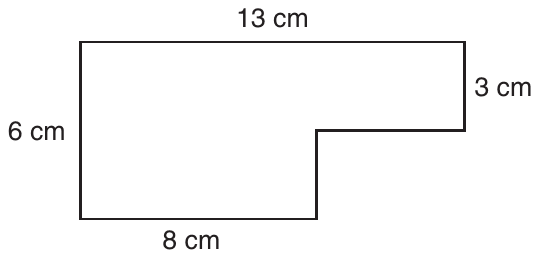
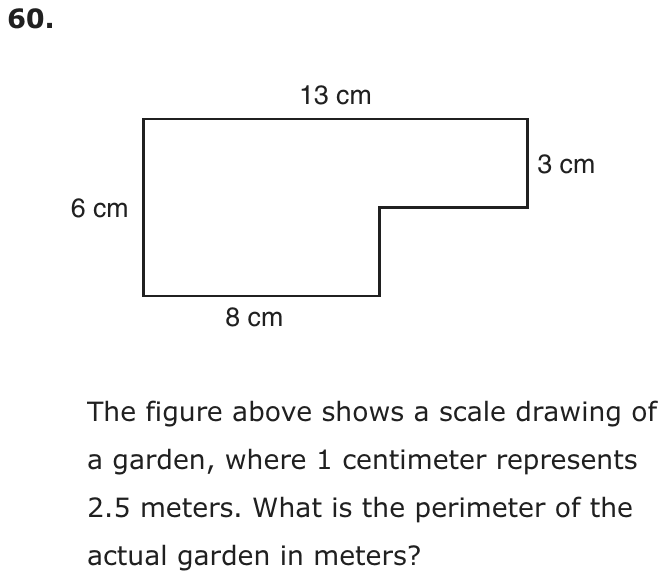
The figure above shows a scale drawing of a garden, where 1 centimeter represents 2.5 meters. What is the perimeter of the actual garden in meters?
Grid-in question: work out the answer and enter it as a number.
Show the answer
Correct answer: 95
First, find the perimeter of the figure.
Two sides do not have labels. The top of the figure measures 13 cm and the bottom shows a length measuring 8 cm, so the horizontal side without a label measures 5 cm .
The left side of the figure measures 6 cm and the right side shows a length measuring 3 cm, so the vertical side without a label measures 3 cm .
So the total perimeter of the scale drawing is
Use the scale to find the perimeter of the actual garden:
Question analysis
A grid-in on a scale drawing of an L-shaped garden, where each centimeter stands for 2.5 meters and two sides carry no labels. Students find the perimeter of the drawing, then convert it to the real garden's perimeter in meters. The unlabeled sides are easy to leave out.
- Grade level
- Grade 7 content, by NYS standard
- Compared with grade 7
- At grade 7 Scale drawings are grade 7 content, and a typical task converts one or two given lengths. Here two missing sides must be worked out and the perimeter assembled before the scale applies, more steps but nothing beyond grade 7.
- Estimated difficulty
- Moderate: several steps, or a close reading with one strong distractor.
- Thinking it demands
- Depth of knowledge 2, skills and concepts · mainly apply
- What makes it hard
- Reading a figure, table or graph moderate
- Combines ideas minor
- An answer in an unexpected form minor
- Solution
- 4 steps
- Reading level
- Question and choices: about grade 9, 24 words.
- Students, last 30 days
- Not enough answers yet to show (it takes 10).
Why it is hard, traps and wrong answers (shows the answer)
Why it is hard
The figure hides the work: it labels four of the six sides, and the missing two are short pieces of the notch that are easy to overlook. Once all six are found, the scale step is a single multiplication, but it must go the right way, since the real garden is larger than the drawing. Tracing the outline and counting six sides guards against the most common loss.
Reading a figure, table or graph moderate Understanding the question
Two sides of the notch carry no labels, so students must find them from the opposite sides: 13 − 8 = 5 cm across and 6 − 3 = 3 cm down. (Lesh, Post & Behr, 1987; Kirsch & Mosenthal, 1990)
Combines ideas minor Working it out
The perimeter of an L-shaped drawing has to be joined to a scale of 2.5 meters per centimeter, two separate skills in one answer. (Embretson, 1998; Daniel & Embretson, 2010)
An answer in an unexpected form minor Choosing the answer
With no choices, nothing flags a perimeter that is missing two sides or still in centimeters; the student must check the six-sided total alone. (Enright, Morley & Sheehan, 2002)
Strategy: Use the opposite sides to work out the two unlabeled lengths, add all six sides of the drawing, then multiply the total in centimeters by 2.5 meters per centimeter.
Traps
- Misreads the figure: Reads a value, label or tick spacing in a figure, table or graph wrongly.
- Stops one step early: A choice is a number from partway through the solution.
- Wrong operation: Adds instead of multiplying, divides the wrong way round, turns a ratio or rate upside down, or undoes a step in the wrong direction (subtracts what should be added back).
The wrong answers, classified
75 Misreads the figure (Lesh, Post & Behr, 1987; Kirsch & Mosenthal, 1990)
Adds only the four labeled sides, 13 + 3 + 8 + 6 = 30 cm, and scales that to 75 m, missing the two unlabeled sides of the notch.
38 Stops one step early (King et al., 2004; Gierl et al., 2017)
Finds the drawing's perimeter, 38 cm, correctly and grids it without applying the scale of 2.5 meters per centimeter.
15.2 Wrong operation (Hegarty, Mayer & Monk, 1995; King et al., 2004)
Divides the 38 cm perimeter by 2.5 instead of multiplying, shrinking the garden though each centimeter of the drawing stands for 2.5 meters.
Worked solution, step by step
Formulas used
- Perimeter
- P is the perimeter, the distance all the way around a shape. Add the length of every side, once each. It works for any shape with straight sides, even one with a corner cut out.
- Using a scale
- s is the scale, the number of meters that 1 centimeter on the drawing stands for. Here s is 2.5. Each centimeter on the drawing is 2.5 meters in real life, so you multiply.
Sort out what you know
The figure is a scale drawing, a small copy of the real garden. Each 1 cm on the drawing stands for 2.5 m in the real garden. You need the perimeter of the real garden in meters. The perimeter is the distance all the way around.
The shape has 6 sides. Four are labeled: 13 cm, 3 cm, 8 cm and 6 cm. The two sides around the cut-out corner have no labels.
Find the missing side across
Look at the top side, 13 cm. Below it, the bottom side (8 cm) and the short unlabeled side across the notch together reach just as far. So the missing side is the difference.
The missing side across is 5 cm.
Find the missing side going down
Now look at the left side, 6 cm. On the right, the 3 cm side and the unlabeled side going down together make the same height.
The missing side going down is 3 cm.
Add all six sides
The perimeter of the drawing is 38 cm. Watch out: adding only the four labeled sides gives 30 cm. That leads to the wrong answer 75.
Change to real meters
Each centimeter stands for 2.5 meters, so multiply by 2.5.
Here and . The real perimeter is 95 meters. Watch out: 38 is still in centimeters, so do not grid it. Dividing by 2.5 gives 15.2, which makes the garden smaller than its drawing.
So you would grid 95.
Check your answer
Slide the two notch sides out to the corner. The distance around stays the same, so it equals a 13 cm by 6 cm rectangle: . Also, 95 meters is more than 38, which fits, because each centimeter stands for more than 1 meter.
More questions like this
The original DOE question
Question 4 of 11
2024 Test B Math, question 48Question
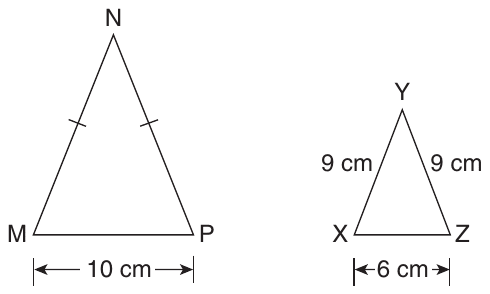
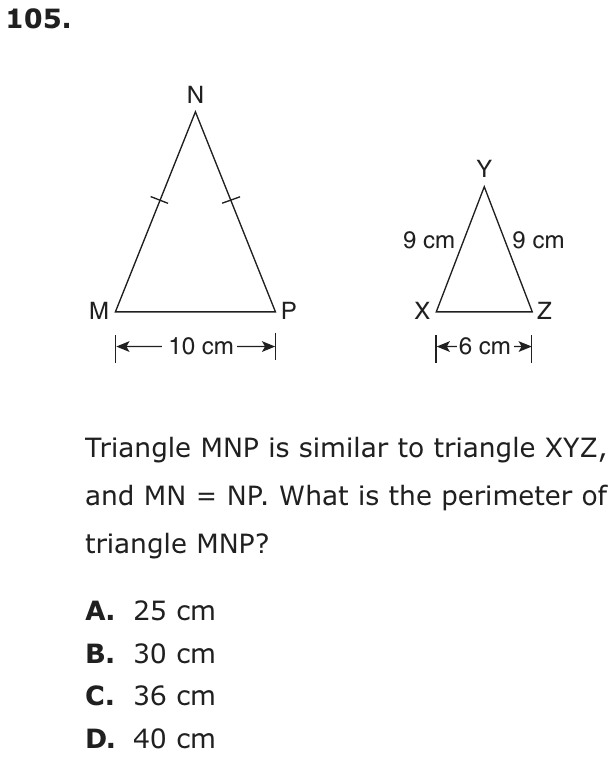
Triangle MNP is similar to triangle XYZ, and . What is the perimeter of triangle MNP?
- A25 cm
- B30 cm
- C36 cm
- D40 cm
Show the answer
Correct answer: D
Similar geometric figures have sides that are proportional.
Because , both unknown sides are equal to 15. Therefore, the three sides of MNP are 15, 15, and 10. The perimeter of a triangle is the sum of its three side lengths.
Question analysis
Two isosceles triangles are drawn, one with all its side lengths labeled and the other with only its base labeled, and the triangles are similar. Students find the perimeter of triangle MNP in centimeters. It tests similar figures and proportional sides, and the catch is that two sides must be found from the scale and the equal-sides marks.
- Grade level
- Grade 8 content, by NYS standard
- Compared with grade 7
- Above grade 7 Similar triangles are grade 8 geometry, though grade 7 scale drawings use the same proportional reasoning. Students also need the equal-sides marks to find a missing side, a combined step beyond routine grade 7 scale work.
- Estimated difficulty
- Moderate: several steps, or a close reading with one strong distractor.
- Thinking it demands
- Depth of knowledge 2, skills and concepts · mainly apply
- What makes it hard
- Solution
- 3 steps
- Reading level
- Question and choices: about grade 3, 20 words.
- Students, last 30 days
- Not enough answers yet to show (it takes 10).
Why it is hard, traps and wrong answers (shows the answer)
Why it is hard
The question chains a scale factor to a perimeter, and both links have a trap. Some students scale by adding, since the base grew by 4, and others find the 15 cm leg correctly but then add only some of the sides. Writing all three sides of the large triangle, 15, 15 and 10, before adding is what the question rewards.
Reading a figure, table or graph moderate Understanding the question
The figure carries every number: tick marks show MN = NP, the base MP is 10 cm, and triangle XYZ has 9 cm legs on a 6 cm base. (Lesh, Post & Behr, 1987; Kirsch & Mosenthal, 1990)
Something you must already know minor Working it out
Students must know that corresponding sides of similar triangles share one scale factor, here 10/6 = 5/3, though the stem never says so. (Anderson & Krathwohl, 2001)
Error-prone arithmetic minor Working it out
The scale factor 5/3 is a fraction, and 9 × 5/3 = 15 is easier to get right by dividing 9 by 3 first. (Brown & Burton, 1978; Junker & Sijtsma, 2001)
Strategy: Compare the two bases to get the scale factor, multiply a leg of the small triangle by it, then use the equal sides to add up the perimeter.
Traps
- Stops one step early: A choice is a number from partway through the solution.
- Misunderstands the concept: A wrong belief about a concept: that percents can be added, that area grows like length, that averages can be averaged, that a bigger denominator means a bigger fraction.
The wrong answers, classified
A Stops one step early (King et al., 2004; Gierl et al., 2017)
Finds a scaled leg of 15 cm but adds only it and the 10 cm base, 15 + 10 = 25, leaving out the second 15 cm side.
B Stops one step early (King et al., 2004; Gierl et al., 2017)
Finds both legs, 15 cm each, but adds only 15 + 15 and leaves out the 10 cm base; calling all three sides 10 cm also gives 30.
C Misunderstands the concept (Smith, diSessa & Roschelle, 1993; De Bock et al., 1998; Ni & Zhou, 2005)
Adds 4 cm to each leg because the base grew from 6 to 10, making the legs 13 cm: 13 + 13 + 10 = 36.
Worked solution, step by step
Formulas used
- Similar triangles
- Similar triangles have the same shape but can differ in size. MN matches XY, and MP matches XZ. Each side of the big triangle is the same number of times as long as its matching side. So these two fractions are equal.
- Perimeter of a triangle
- P is the perimeter, the distance all the way around. a, b and c are the lengths of the three sides. Add them to go once around the shape.
Sort out the question
In triangle MNP, the base MP is 10 cm. The tick marks on MN and NP show those two sides are equal. In triangle XYZ, the base XZ is 6 cm, and XY and YZ are each 9 cm.
Similar means the same shape, with every side scaled by the same amount. You need the perimeter of MNP, the sum of its three sides.
Match the sides
The letters line up in order: M with X, N with Y, and P with Z. So the base MP matches the base XZ. The side MN matches XY, and NP matches YZ.
Find the scale factor
The scale factor is how many times bigger MNP is. Compare the two bases.
Every side of MNP is times as long as its matching side in XYZ.
Find the equal sides
Use the similar triangles formula with XY = 9.
Divide 9 by 3 first to keep the numbers small. MN is 15 cm. Since MN = NP, NP is 15 cm too.
Watch out: The base grew by 4 cm, but adding 4 cm to each side is wrong. That gives 13 cm sides and 36, choice C. Similar shapes grow by multiplying.
Add the three sides
The perimeter is 40 cm. Watch out: Leaving out one 15 cm side gives 25, choice A. Leaving out the base gives 30, choice B.
So the answer is D, 40 cm.
Check your answer
The small triangle’s perimeter is 9 + 9 + 6 = 24 cm. Perimeters grow by the same scale factor as the sides. So . It matches.
More questions like this
The original DOE question
Question 5 of 11
2023 Test A Math, question 49Question
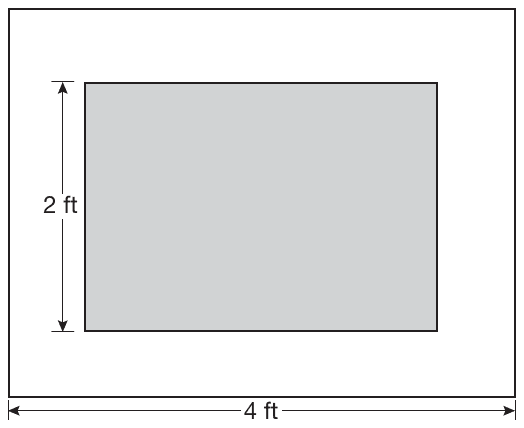
In the figure above, the shaded rectangle is similar to the outer rectangle. The length of the outer rectangle is 4 feet, and the perimeter of the outer rectangle is 14 feet. If the width of the shaded rectangle is 2 feet, what is the area of the shaded rectangle?
- A sq ft
- B6 sq ft
- C sq ft
- D12 sq ft
Show the answer
Correct answer: A
For the outer rectangle, the length is 4 feet and the perimeter is 14 feet. Write and solve an equation to find the width:
| Apply the additive inverse property; subtract 8 from both sides of the equation. | |
| Apply the multiplicative inverse property; divide both sides of the equation by 2. | |
Use that information in a proportion to find the length of the shaded rectangle:
| Cross multiply. | |
| Apply the multiplicative inverse property; divide both sides of the equation by 3. | |
Now find the area of the shaded rectangle:
Question analysis
This geometry question shows a shaded rectangle similar to an outer rectangle that is 4 feet long with a perimeter of 14 feet; the shaded rectangle is 2 feet wide. Students find the shaded area. They must find a missing side, match corresponding sides, and scale by a factor rather than a fixed amount, which makes it a multistep similar-figures problem.
- Grade level
- Grade 8 content, by NYS standard
- Compared with grade 7
- Above grade 7 Similar figures are grade 8 geometry, though grade 7 scale drawings use the same proportions. Students must first find a missing side from the perimeter, match corresponding sides, solve a proportion with a fractional result, and then find an area.
- Estimated difficulty
- Hard: combines ideas, needs a plan, and has more than one tempting wrong answer.
- Thinking it demands
- Depth of knowledge 2, skills and concepts · mainly apply
- What makes it hard
- Combines ideas moderate
- Reading a figure, table or graph minor
- Error-prone arithmetic minor
- Solution
- 4 steps
- Reading level
- Question and choices: about grade 5, 57 words.
- Students, last 30 days
- Not enough answers yet to show (it takes 10).
Why it is hard, traps and wrong answers (shows the answer)
Why it is hard
Each step is familiar, but the three together, perimeter to width, width to scale factor, and sides to area, demand a plan. The strongest pull is scaling by subtraction, shrinking each side by 1 foot because the width drops from 3 to 2, which gives a neat whole-number area. Others stop at the outer rectangle or add the sides instead of multiplying. Checking that 8/3 to 2 matches 4 to 3 confirms the shape is similar.
Combines ideas moderate Working it out
Perimeter, similarity and area are chained: 14 feet gives the outer width of 3 feet, the 2-foot side sets a scale factor of 2/3, and only then can the area be found. (Embretson, 1998; Daniel & Embretson, 2010)
Reading a figure, table or graph minor Understanding the question
The figure marks the shaded rectangle's 2-foot side running up and down and the outer 4-foot length along the bottom, so the 2 feet must be paired with the outer 3-foot side, which is not labeled. (Lesh, Post & Behr, 1987; Kirsch & Mosenthal, 1990)
Error-prone arithmetic minor Working it out
The scale factor 2/3 makes the shaded length 8/3 feet, and the area 2 × 8/3 = 16/3 has to be written as the mixed number 5 1/3. (Brown & Burton, 1978; Junker & Sijtsma, 2001)
Strategy: Use the perimeter to find the outer rectangle's width, match the shaded width of 2 feet to it, scale the 4-foot length by the same factor, then multiply length by width.
Traps
- Misunderstands the concept: A wrong belief about a concept: that percents can be added, that area grows like length, that averages can be averaged, that a bigger denominator means a bigger fraction.
- Wrong formula: Uses a related but wrong formula: perimeter for area, diameter for radius, area for volume, or a misremembered one.
- Answers a different question: A choice is right for another quantity: the other unknown, the rest instead of the part, the part instead of the whole.
The wrong answers, classified
B Misunderstands the concept (Smith, diSessa & Roschelle, 1993; De Bock et al., 1998; Ni & Zhou, 2005)
Shrinks each side by the same amount instead of the same factor: the width drops by 1 foot, from 3 to 2, so the length drops from 4 to 3, giving 6.
C Wrong formula (King et al., 2004)
Finds the shaded sides, 2 and 8/3 feet, correctly but computes the perimeter, 2 × (2 + 8/3) = 28/3 = 9 1/3, instead of the area.
D Answers a different question (King et al., 2004; Hegarty, Mayer & Monk, 1995)
Finds the outer width of 3 feet and gives the outer rectangle's area, 4 × 3 = 12, instead of the smaller shaded one.
Worked solution, step by step
Formulas used
- Perimeter of a rectangle
- P is the perimeter, the distance all the way around. l is the length and w is the width. A rectangle has two lengths and two widths, so you add each one twice.
- Scale factor of similar shapes
- Similar shapes have the same shape but different sizes. Each side of the small shape equals its matching side on the large shape times one number, the scale factor. So one pair of matching sides tells you the scale factor.
- Area of a rectangle
- A is the area, the space inside. l is the length and w is the width. You multiply because the rectangle is made of rows of unit squares: w rows with l squares in each.
Sort out the question
The outer rectangle is 4 feet long, and its perimeter is 14 feet. The shaded rectangle is similar to it, so it has the same shape. The shaded rectangle’s width, its left side, is 2 feet. You need the shaded area, so you also need the shaded length.
Find the outer rectangle’s width
The outer rectangle is 3 feet wide. That is its up-and-down side.
Find the scale factor
The shaded width, 2 feet, matches the outer width, 3 feet.
Every shaded side is of the matching outer side. Watch out: similar shapes shrink by the same factor, not by the same number of feet. Taking 1 foot off each side gives 2 by 3, an area of 6, choice B.
Find the shaded length
Multiply the outer length, 4 feet, by the scale factor.
The shaded rectangle is feet long.
Find the shaded area
Watch out: 4 × 3 = 12 is the outer area, choice D. So the answer is A, sq ft.
Check your answer
Check the shape. For the outer rectangle, length ÷ width is . For the shaded one, it is . They match, so the shapes are similar. Also, square feet is less than the outer 12, as it should be.
More questions like this
The original DOE question
Question 6 of 11
2023 Test B Math, question 2Question
In a scale drawing of a rectangular garden, the length is 15 inches and the width is 9 inches. In the drawing, 2 inches represents 3 yards. What is the width of the actual garden, in yards?
Grid-in question: work out the answer and enter it as a number.
Show the answer
Correct answer: 13.5
Let w represent the width of the actual garden. Set up a proportion based on the information given:
Question analysis
In a scale drawing of a rectangular garden, 2 inches stands for 3 yards, and the drawing measures 15 inches by 9 inches. This grid-in asks for the real width of the garden in yards. Students apply the scale to one side only: the length is given but plays no part, and the scale has to be used the right way round.
- Grade level
- Grade 7 content, by NYS standard
- Compared with grade 7
- At grade 7 Scale drawings are grade 7 content, and this is a typical one: a single length converted with a stated scale. The only extra demand is using the width rather than the length and entering the result with no choices to check.
- Estimated difficulty
- Straightforward: two steps or one careful reading.
- Thinking it demands
- Depth of knowledge 2, skills and concepts · mainly apply
- What makes it hard
- Solution
- 2 steps
- Reading level
- Question and choices: about grade 4, 33 words.
- Students, last 30 days
- Not enough answers yet to show (it takes 10).
Why it is hard, traps and wrong answers (shows the answer)
Why it is hard
The drawing gives two lengths and only the width matters, so the first decision is which number to scale. The second is direction: the real garden must measure more in yards than the drawing’s 9 in inches, which a student can check before entering anything. Errors come from scaling the length, turning the scale over, or treating 2 to 3 as an increase of one.
Turning words into math minor Understanding the question
“2 inches represents 3 yards” must become 1.5 yards for every inch of drawing, so the 9-inch width is multiplied by 3/2, not by 2/3. (Hegarty, Mayer & Monk, 1995; Koedinger & Nathan, 2004)
An answer in an unexpected form minor Choosing the answer
The answer is a decimal entered with no choices to compare, so a result from the 15-inch length or from an upside-down scale looks just as finished. (Enright, Morley & Sheehan, 2002)
Strategy: Find how many yards one inch of the drawing stands for, then multiply the drawing's width, not its length, by that number.
Traps
- Answers a different question: A choice is right for another quantity: the other unknown, the rest instead of the part, the part instead of the whole.
- Wrong operation: Adds instead of multiplying, divides the wrong way round, turns a ratio or rate upside down, or undoes a step in the wrong direction (subtracts what should be added back).
- Information you don't need: The question gives numbers or facts that play no part in the answer.
The wrong answers, classified
22.5 Answers a different question (King et al., 2004; Hegarty, Mayer & Monk, 1995)
Applies the scale to the 15-inch length instead of the 9-inch width: 15 × 3 ÷ 2 = 22.5 yards.
6 Wrong operation (Hegarty, Mayer & Monk, 1995; King et al., 2004)
Turns the scale upside down, multiplying the 9 inches by 2/3 instead of 3/2, so the real garden comes out smaller than the drawing’s number.
10 Misunderstands the concept (Smith, diSessa & Roschelle, 1993; De Bock et al., 1998; Ni & Zhou, 2005)
Reads 2 inches to 3 yards as adding 1, keeping a constant difference instead of a constant ratio, so 9 inches becomes 9 + 1 = 10 yards.
Worked solution, step by step
Formulas used
- Scale proportion
- A scale drawing shrinks everything by the same amount. So real size over drawing size makes the same fraction for every part of the drawing. Keep the real sizes on top on both sides, and the drawing sizes on the bottom.
Sort out the question
The drawing shows a rectangle, a four-sided shape with square corners. On the drawing, the length is 15 inches and the width is 9 inches. The scale says 2 inches on the drawing stand for 3 yards in real life. You need the real width, in yards.
Only the width matters. The 15-inch length is extra.
Find what one inch stands for
If 2 inches stand for 3 yards, then 1 inch stands for half as much.
So each inch on the drawing is 1.5 yards in real life. That means the number of yards will be bigger than the number of inches.
Set up the proportion and solve
Let w be the real width, in yards. Put yards on top and inches on the bottom, on both sides.
To get w alone, multiply both sides by 9.
The real width is 13.5 yards.
Give the answer
Watch out: don’t flip the scale. Using gives 6, which is smaller than the drawing’s number. And don’t use the length: 15 inches would give 22.5 yards. So you would grid 13.5.
Check your answer
Count groups of 2 inches. The 9-inch width holds 4.5 groups of 2 inches. Each group stands for 3 yards, so the real width is yards. That matches.
More questions like this
The original DOE question
Question 7 of 11
2023 Test B Math, question 7Question
On Fran’s map, 2 centimeters represents 3 kilometers. The points on this map that represent Fran’s home and Bryant State Park are 4.5 centimeters apart. How many kilometers apart are Fran’s home and Bryant State Park, to the nearest kilometer?
- A3
- B5
- C7
- D9
Show the answer
Correct answer: C
Let x represent the distance, in kilometers, between Fran’s house and Bryant State Park. Set up a proportion to solve for x:
| Cross multiply. | |
| Apply the multiplicative inverse property; divide both sides of the equation by 2. | |
Question analysis
On Fran's map, 2 centimeters represent 3 kilometers, and her home and Bryant State Park are 4.5 centimeters apart on the map. Students find the real distance to the nearest kilometer. It is a map-scale proportion problem: the scale must be applied in the right direction, and the result rounded.
- Grade level
- Grade 7 content, by NYS standard
- Compared with grade 7
- At grade 7 Map scales are standard grade 7 proportional reasoning, and this problem is typical: one distance, one scale, then rounding. Nothing beyond a single proportion is needed.
- Estimated difficulty
- Straightforward: two steps or one careful reading.
- Thinking it demands
- Depth of knowledge 2, skills and concepts · mainly apply
- What makes it hard
- Turning words into math minor
- Error-prone arithmetic minor
- Solution
- 3 steps
- Reading level
- Question and choices: about grade 8, 37 words.
- Students, last 30 days
- Not enough answers yet to show (it takes 10).
Why it is hard, traps and wrong answers (shows the answer)
Why it is hard
This is a one-proportion map question, and the only judgments are the direction of the scale and when to round. The phrase to the nearest kilometer tempts some students to round the scale itself before multiplying, which lands on a listed answer two kilometers too far. Rounding only the final 6.75 keeps the result right.
Turning words into math minor Understanding the question
“2 centimeters represents 3 kilometers” gives 1.5 kilometers per centimeter; set up the other way round, the scale shrinks the 4.5 centimeters instead of enlarging them. (Hegarty, Mayer & Monk, 1995; Koedinger & Nathan, 2004)
Error-prone arithmetic minor Working it out
The map distance is a decimal, 4.5 × 3 ÷ 2 = 6.75, and the result must then be rounded to the nearest kilometer, two places where a quick estimate drifts. (Brown & Burton, 1978; Junker & Sijtsma, 2001)
Strategy: Work out how many kilometers 1 centimeter on the map stands for, multiply by 4.5, and round only at the very end.
Traps
- Wrong operation: Adds instead of multiplying, divides the wrong way round, turns a ratio or rate upside down, or undoes a step in the wrong direction (subtracts what should be added back).
- Rounds too early: Rounds a value partway through, or rounds the wrong way, so the final answer drifts from the exact one.
- Units or scale: The answer is wanted in other units, or a rate or scale must be converted first.
The wrong answers, classified
A Wrong operation (Hegarty, Mayer & Monk, 1995; King et al., 2004)
Turns the scale upside down, multiplying 4.5 by 2/3 instead of 3/2, so the real distance comes out smaller than the map distance.
B Units or scale (King et al., 2004)
Takes the 4.5 centimeters on the map as kilometers and rounds to 5, never applying the scale that turns each centimeter into 1.5 kilometers.
D Rounds too early (King et al., 2004)
Rounds the scale of 1.5 kilometers per centimeter up to 2 before multiplying, so 4.5 × 2 = 9 instead of 6.75.
Worked solution, step by step
Formulas used
- Scale proportion
- A map shrinks every distance by the same amount. So real distance over map distance makes the same fraction everywhere on the map. Put kilometers on top on both sides and centimeters on the bottom. Then solve for the missing number.
Sort out the question
On Fran’s map, 2 centimeters stand for 3 kilometers in real life. Her home and the park are 4.5 centimeters apart on the map. You need the real distance in kilometers, rounded to the nearest whole kilometer.
Set up the proportion
Let x be the real distance, in kilometers. Put kilometers on top and centimeters on the bottom, on both sides.
Solve for x
To get x alone, multiply both sides by 4.5.
So the real distance is 6.75 kilometers. Watch out: keep the scale exact until the end. Rounding 1.5 kilometers per centimeter up to 2 gives , choice D.
Round to the nearest kilometer
6.75 is between 6 and 7. Its decimal part, 0.75, is more than 0.5, so round up to 7.
Watch out: don’t flip the scale. Multiplying 4.5 by gives 3, choice A. So the answer is C, 7.
Check your answer
Each centimeter stands for kilometers. So 4 centimeters is 6 kilometers, and half a centimeter is 0.75 kilometer. That adds to 6.75, which rounds to 7. The real number should be bigger than 4.5, and it is.
More questions like this
The original DOE question
Question 8 of 11
2023 Test B Math, question 15Question
On a map, the distance between Deshawn’s house and Xin’s house is 5.4 inches. If 2 inches on the map represents 3 miles, what is the distance between these two houses, in miles?
- A2.6
- B3.6
- C7.5
- D8.1
Show the answer
Correct answer: D
Let d represent the distance between the two houses, in miles. Write a proportion to solve for d:
Question analysis
A map shows Deshawn's and Xin's houses 5.4 inches apart, with 2 inches on the map standing for 3 miles. Students find the actual distance between the houses in miles. This scale question uses a decimal map length, so the multiplication must be exact and the inches-to-miles ratio kept the right way up.
- Grade level
- Grade 7 content, by NYS standard
- Compared with grade 7
- At grade 7 Converting a map distance with a given scale is routine grade 7 work. This one needs a single proportion and a decimal multiplication, with no rounding or second step, so it matches a typical classroom exercise.
- Estimated difficulty
- Straightforward: two steps or one careful reading.
- Thinking it demands
- Depth of knowledge 2, skills and concepts · mainly apply
- What makes it hard
- Error-prone arithmetic minor
- A very close wrong answer minor
- Solution
- 2 steps
- Reading level
- Question and choices: about grade 6, 30 words.
- Students, last 30 days
- Not enough answers yet to show (it takes 10).
Why it is hard, traps and wrong answers (shows the answer)
Why it is hard
Unlike most map questions, this one asks for an exact distance, so the decimal 5.4 has to be carried all the way through. The two tempting wrong answers come from opposite places: an upside-down scale shrinks the distance, and a rounded map length gives a result close to the true one. Checking that the answer is one and a half times 5.4 catches both.
Error-prone arithmetic minor Working it out
The map distance is the decimal 5.4, and 5.4 × 3 = 16.2 then halved is a decimal multiplication where rounding 5.4 to make it easier changes the answer. (Brown & Burton, 1978; Junker & Sijtsma, 2001)
A very close wrong answer minor Choosing the answer
7.5 and 8.1 miles are close enough that a rough estimate, 5 × 1.5, lands on the wrong one; only the exact product separates them. (Embretson & Wetzel, 1987; Gorin & Embretson, 2006; Ascalon et al., 2007)
Strategy: Set up miles over inches equal to 3 over 2, then multiply 5.4 by 3 and divide by 2, keeping the decimal exact throughout.
Traps
- Wrong operation: Adds instead of multiplying, divides the wrong way round, turns a ratio or rate upside down, or undoes a step in the wrong direction (subtracts what should be added back).
- Rounds too early: Rounds a value partway through, or rounds the wrong way, so the final answer drifts from the exact one.
The wrong answers, classified
A Little reason to choose it (Haladyna & Downing, 1993; Rodriguez, 2005)
No common working gives 2.6, which sits just below half of 5.4 and matches no step with the scale, so it mostly draws guesses.
B Wrong operation (Hegarty, Mayer & Monk, 1995; King et al., 2004)
Inverts the scale, multiplying 5.4 by 2/3 instead of 3/2, as if each mile took up 1.5 inches on the map.
C Rounds too early (King et al., 2004)
Rounds 5.4 inches down to 5 before scaling, so 5 × 3 ÷ 2 = 7.5 miles instead of the exact distance.
Worked solution, step by step
Formulas used
- Scale proportion
- A map shrinks every distance by the same amount. So real distance over map distance makes the same fraction everywhere on the map. Put miles on top on both sides and inches on the bottom. Then solve for the missing distance.
Sort out the question
On the map, Deshawn’s house and Xin’s house are 5.4 inches apart. The scale says 2 inches on the map stand for 3 miles. You need the real distance between the houses, in miles.
Set up the proportion
Let d be the real distance, in miles. Put miles on top and inches on the bottom, on both sides.
Solve for d
To get d alone, multiply both sides by 5.4.
The houses are 8.1 miles apart. Watch out: keep 5.4 exact. Rounding it to 5 gives 7.5 miles, choice C.
Give the answer
Watch out: don’t flip the scale. Multiplying 5.4 by gives 3.6, choice B. Each inch stands for more than a mile, so the miles must be more than 5.4. So the answer is D, 8.1.
Check your answer
Each inch stands for miles. So 5 inches is 7.5 miles, and 0.4 inch is mile. Together, miles.
More questions like this
The original DOE question
Question 9 of 11
2022 Test A Math, question 16Question
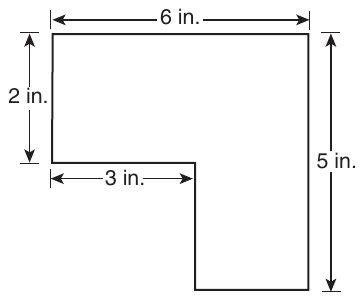
Scale:
A scale drawing of a new pool is shown above. All the corners are right angles. What is the perimeter of the actual pool?
- A550 ft
- B800 ft
- C1,100 ft
- D1,500 ft
Show the answer
Correct answer: C
Determine the two missing side lengths on the scale drawing:
All corners are right angles, so the figure can be divided into rectangles with opposite sides that are congruent in length. This means the sum of the shorter vertical sides on the left and in the center of the figure () must equal the length of the longer vertical side on the right side of the figure (5 in.):
So, the missing vertical side length of the figure is 3 in.
Again, because opposite sides of a rectangular figure are congruent in length, the sum of the shorter horizontal sides in the middle and bottom of the figure () must equal the length of the longer horizontal side on the top of the figure (6 in.):
So, the missing horizontal side length of the figure is 3 in.
Determine the perimeter by adding all the side lengths of the figure:
This is a scale drawing in which . Write a proportion to determine the value of x, the unknown number of feet that is represented by 22 in.:
Cross multiply and solve the equation for x:
Question analysis
A scale drawing shows an L-shaped pool with all right angles, four labeled sides and two unlabeled ones, and a scale of 1/2 inch to 25 feet. Students find the perimeter of the actual pool. It combines the perimeter of a composite figure with a scale given for half an inch, so the missing sides and the fractional scale are both easy to mishandle.
- Grade level
- Grade 7 content, by NYS standard
- Compared with grade 7
- At grade 7 Scale drawings are grade 7 content, and a typical task converts one given length. Here two sides are unlabeled and must be worked out, all six added, and a scale given for half an inch turned into feet per inch.
- Estimated difficulty
- Hard: combines ideas, needs a plan, and has more than one tempting wrong answer.
- Thinking it demands
- Depth of knowledge 2, skills and concepts · mainly apply
- What makes it hard
- Reading a figure, table or graph moderate
- Combines ideas moderate
- Many steps minor
- Solution
- 4 steps
- Reading level
- Question and choices: about grade 2, 30 words.
- Students, last 30 days
- Not enough answers yet to show (it takes 10).
Why it is hard, traps and wrong answers (shows the answer)
Why it is hard
The figure gives four of the six sides and the scale gives feet per half inch, so two conversions hide behind a simple-looking perimeter question. Students who add only the labeled sides, or who read the scale as 25 feet per inch, reach totals that look reasonable for a pool and are listed. Tracing the outline to count six sides, and doubling 25 before multiplying, avoids both.
Reading a figure, table or graph moderate Understanding the question
Two sides of the notch carry no labels, and the 5 in. arrow spans the full right side, so the missing lengths come from 5 − 2 = 3 and 6 − 3 = 3. (Lesh, Post & Behr, 1987; Kirsch & Mosenthal, 1990)
Combines ideas moderate Working it out
The perimeter of an L-shaped drawing has to be joined to a scale in which half an inch, not a whole inch, stands for 25 feet. (Embretson, 1998; Daniel & Embretson, 2010)
Many steps minor Working it out
Four stages follow in order, the two missing sides, the 22-inch perimeter, the feet per inch and the product, and a slip at most of them reaches a listed choice. (Daniel & Embretson, 2010; Enright, Morley & Sheehan, 2002)
Strategy: Use opposite sides to fill in the two missing lengths, add all six sides of the drawing, then double the 25 feet to get the feet one inch stands for, and multiply.
Traps
- Misreads the figure: Reads a value, label or tick spacing in a figure, table or graph wrongly.
- Units or scale: The answer is wanted in other units, or a rate or scale must be converted first.
- Wrong formula: Uses a related but wrong formula: perimeter for area, diameter for radius, area for volume, or a misremembered one.
The wrong answers, classified
A Units or scale (King et al., 2004)
Finds the drawing's 22-inch perimeter but multiplies by 25, using the scale as if 1 inch, not 1/2 inch, stood for 25 feet.
B Misreads the figure (Lesh, Post & Behr, 1987; Kirsch & Mosenthal, 1990)
Adds only the four labeled sides, 6 + 2 + 3 + 5 = 16 inches, and scales that to 800 feet, missing the two unlabeled sides of the notch.
D Wrong formula (King et al., 2004)
Multiplies the 6-inch and 5-inch sides to get 30, the outer rectangle's area, and scales that by 50 feet per inch as if it were a length.
Worked solution, step by step
Formulas used
- Perimeter
- P is the perimeter, the distance all the way around a shape. Add the length of every side, even sides with no label. It is like walking around the edge of the pool and adding up each part of the walk.
- Using a scale
- The drawing length is measured on the drawing, in inches. Feet per inch is how many real feet one inch of the drawing stands for. Multiplying turns a length on the drawing into a real length.
Sort out the question
The drawing is an L shape with six sides. Four sides have labels. The top is 6 in. long, and the right side is 5 in. long. The left side is 2 in. long, and a middle flat side is 3 in. long. Two sides have no label. The scale says 1/2 inch on the drawing stands for 25 feet. You need the perimeter of the real pool, in feet.
Find the missing up-and-down side
Call it s. It runs down from the right end of the 3 in. side to the bottom. The side labeled 2 in. and side s together go from the top to the bottom. All corners are right angles, so they match the full height on the right, 5 in.
Side s is 3 inches.
Find the bottom side
Call the bottom side b. The middle flat side, 3 in., and side b together are as wide as the top, labeled 6 in.
The bottom side is 3 inches.
Add all six sides
Go around the shape: top, right side, bottom, side s, the 3 in. side, then the 2 in. side.
The perimeter on the drawing is 22 inches. Watch out: count the two unlabeled sides. Adding only the four labeled sides gives 16 inches. That leads to 800 feet, choice B.
Find the feet per inch
The scale says 1/2 inch stands for 25 feet. A whole inch is two halves, so 1 inch stands for twice as much.
Each inch of the drawing is 50 real feet. Watch out: don’t use 25 feet per inch. That gives feet, choice A.
Change the perimeter to feet
Call the real perimeter F, for feet. Use the scale formula with 22 inches and 50 feet per inch.
The real pool’s perimeter is 1,100 feet. So the answer is C, 1,100 ft.
Check your answer
Change each side to feet first. At 50 feet per inch, the sides are 300, 250, 150, 150, 150 and 100 feet. . That matches. Choice D, 1,500, comes from . But 6 × 5 is an area, not a distance around.
More questions like this
The original DOE question
Question 10 of 11
2018 Test A Math, question 10Question
In a scale diagram, inch represents feet. How many inches represent foot?
- A
- B
- C
- D
Show the answer
Correct answer: A
Let be the number of inches representing 1 foot. Set up a proportion and solve for :
in.
Question analysis
This scale drawing question uses decimals: on a diagram, 0.125 inch stands for 125 feet. Students find how many inches represent just 1 foot, which is the unit rate of the scale. Dividing a decimal by a large whole number makes the decimal point easy to misplace.
- Grade level
- Grade 7 content, by NYS standard
- Compared with grade 7
- At grade 7 Scale drawings and unit rates are core grade 7 topics, and this is a single division. The demand matches typical grade 7 work, with decimal place value as the only real hurdle.
- Estimated difficulty
- Straightforward: two steps or one careful reading.
- Thinking it demands
- Depth of knowledge 2, skills and concepts · mainly apply
- What makes it hard
- Error-prone arithmetic moderate
- A very close wrong answer moderate
- Solution
- 1 step
- Reading level
- Question and choices: about grade 11, 19 words.
- Students, last 30 days
- Not enough answers yet to show (it takes 10).
Why it is hard, traps and wrong answers (shows the answer)
Why it is hard
A single division settles this question, and the choices are built to punish a misplaced decimal point, since three of them are each a power of ten apart. Students who see that 0.125 is one-thousandth of 125 can answer at once; students who divide by hand often lose a zero. Multiplying the chosen answer back by 125 is a quick check.
Error-prone arithmetic moderate Working it out
The one step is 0.125 ÷ 125, a decimal divided by a large whole number, where the place of the decimal point decides between 0.001, 0.01 and 0.1. (Brown & Burton, 1978; Junker & Sijtsma, 2001)
A very close wrong answer moderate Choosing the answer
0.001 and 0.01 look almost the same, differing by one zero after the decimal point; only exact placement of the point in 0.125 ÷ 125 separates them. (Embretson & Wetzel, 1987; Gorin & Embretson, 2006; Ascalon et al., 2007)
Strategy: Divide the inches by the feet to get inches per foot, then check by multiplying your result by 125 to see whether you get back 0.125.
Traps
- Units or scale: The answer is wanted in other units, or a rate or scale must be converted first.
The wrong answers, classified
B An arithmetic slip (Junker & Sijtsma, 2001)
Divides 0.125 by 125 but loses one zero in placing the decimal point, giving 0.01, ten times too large.
C A faulty procedure (Brown & Burton, 1978; Tatsuoka, 1983)
Sees that 125 ÷ 125 = 1 and puts the 1 in the tenths place, where 0.125 begins, instead of the thousandths place.
D Units or scale (King et al., 2004)
Treats the 0.125 inch as if it already stood for 1 foot, never dividing by the 125 feet it represents, and picks the choice closest to it.
Worked solution, step by step
Formulas used
- Unit rate
- r is the unit rate, the amount that goes with just 1 unit. a is the first amount, here 0.125 inch. b is the matching second amount, here 125 feet. Dividing shares the inches out equally, one share for each foot.
Sort out the scale
A scale diagram is a drawing where small lengths stand for real lengths. Here 0.125 inch on the drawing stands for 125 real feet. You need how many inches stand for just 1 foot. That is a unit rate, an amount for 1 unit.
Set up the division
Divide the inches by the feet. That splits the 0.125 inch into 125 equal shares, one for each foot.
Divide carefully
Write 0.125 as a fraction. It is 125 thousandths.
Now divide by 125. Split 125 thousandths into 125 shares, and each share is 1 thousandth.
So 1 foot is shown by 0.001 inch.
Match the decimal places
0.001 has the 1 in the third place after the decimal point. That place is thousandths. Watch out: 0.01 and 0.1 put the decimal point in the wrong place. They are choices B and C, and each is too big. So the answer is A, 0.001.
Check your answer
Multiply back. inch, which matches the scale. Choice B would give inches. That is ten times too long.
More questions like this
The original DOE question
Question 11 of 11
2018 Test A Math, question 26Question
In a scale drawing of a triangular banner, one side measures 16 centimeters and the other two sides each measure 12 centimeters. On the actual banner, these two sides each measure 36 feet. What is the length of the remaining side of the actual banner?
- A16 ft
- B32 ft
- C40 ft
- D48 ft
Show the answer
Correct answer: D
Let be the remaining side of the actual banner.
Set up a proportion:
ft
Question analysis
A scale drawing word problem about a triangular banner: the drawing's sides are 16 cm, 12 cm and 12 cm, and the two equal sides are 36 feet on the real banner. Students find the actual length of the remaining side. The key is using a scale factor, not adding the difference between lengths.
- Grade level
- Grade 7 content, by NYS standard
- Compared with grade 7
- At grade 7 Scale drawings are a named grade 7 topic, and this is a direct one-factor problem. It matches typical grade 7 work; the only pull away is reasoning by differences instead of by multiplication.
- Estimated difficulty
- Straightforward: two steps or one careful reading.
- Thinking it demands
- Depth of knowledge 2, skills and concepts · mainly apply
- What makes it hard
- Turning words into math minor
- Solution
- 2 steps
- Reading level
- Question and choices: about grade 4, 46 words.
- Students, last 30 days
- Not enough answers yet to show (it takes 10).
Why it is hard, traps and wrong answers (shows the answer)
Why it is hard
A scale drawing multiplies every length by the same factor, here 3 feet per centimeter, and the question checks whether students use that factor or a difference. The 16 cm side is 4 cm longer than the others, and adding 4 to 36 feels natural but treats the scale as an addition. Students who find the factor from the matching sides first have one multiplication left.
Turning words into math minor Understanding the question
"These two sides each measure 36 feet" refers back to the 12 cm sides, so the scale pairs 12 cm with 36 ft, centimeters on the drawing against feet on the banner. (Hegarty, Mayer & Monk, 1995; Koedinger & Nathan, 2004)
Strategy: Find the scale from the matching sides, feet per centimeter, then multiply the 16 cm side by that same factor.
Traps
- Misunderstands the concept: A wrong belief about a concept: that percents can be added, that area grows like length, that averages can be averaged, that a bigger denominator means a bigger fraction.
- Units or scale: The answer is wanted in other units, or a rate or scale must be converted first.
The wrong answers, classified
A Units or scale (King et al., 2004)
Copies the 16 cm from the drawing as 16 feet, without applying the scale that turns each centimeter into 3 feet.
B Misunderstands the concept (Smith, diSessa & Roschelle, 1993; De Bock et al., 1998; Ni & Zhou, 2005)
Reasons with differences instead of a scale factor and also subtracts, 36 − 4 = 32, though the 16 cm side is the longest.
C Misunderstands the concept (Smith, diSessa & Roschelle, 1993; De Bock et al., 1998; Ni & Zhou, 2005)
Adds the 4 cm difference between 16 and 12 to the 36 feet, keeping a constant difference instead of a constant ratio.
Worked solution, step by step
Formulas used
- Scale factor
- k is the scale factor: how many real units match 1 unit on the drawing. Divide a real length by its matching length on the drawing to find it. Every length on the drawing gets multiplied by the same k. That keeps the real shape the same as the drawing.
Sort out the question
A scale drawing is a smaller copy with the same shape. The drawing is a triangle with sides of 16 cm, 12 cm and 12 cm. On the real banner, the two 12 cm sides are 36 feet each. You need the real length of the 16 cm side.
Find the scale factor
Use the matching sides: 12 cm on the drawing is 36 feet on the banner.
So every 1 cm on the drawing stands for 3 feet on the banner.
Scale up the third side
Multiply the 16 cm side by the same scale factor.
The third side is 48 feet. Watch out: a scale multiplies lengths. It does not add to them. 16 is 4 more than 12, but adding 4 to 36 gives 40, choice C. So the answer is D, 48 ft.
Check your answer
The 16 cm side is the longest side on the drawing. So it must be the longest on the banner too, longer than 36 feet. 48 fits. Also, , the same scale as .
More questions like this
The original DOE question