6.NS.7a inequality as relative position
Question 1 of 9
2026 Practice Test C Math, question 7Question
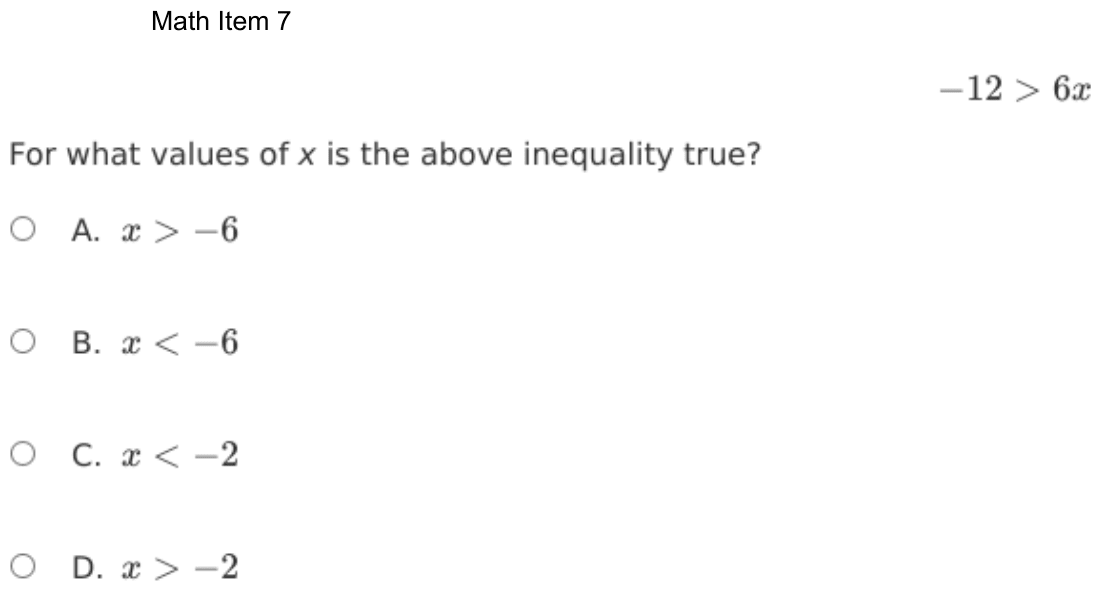
For what values of x is the above inequality true?
- A
- B
- C
- D
Show the answer
Correct answer: C
Divide to solve for x:
Rewriting with the x term first requires reversing the inequality symbol in order to keep the meaning “x is less than ”.
Question analysis
This inequality question asks which values of x make −12 > 6x true. Students solve a one-step inequality by dividing and then state the solution with x written first. A negative number on one side and the variable on the other make the direction of the symbol the main thing to get right.
- Grade level
- Grade 7 content, by NYS standard
- Compared with grade 7
- Below grade 7 Grade 7 inequalities usually take two steps, such as 3x + 4 > 19. This one needs a single division, and the care goes into reading the result correctly when the variable ends up on the right of the symbol.
- Estimated difficulty
- Straightforward: two steps or one careful reading.
- Thinking it demands
- Depth of knowledge 1, recall and reproduction · mainly apply
- What makes it hard
- A very close wrong answer moderate
- Something you must already know minor
- Solution
- 2 steps
- Reading level
- Question and choices: about grade 10, 15 words.
- Students, last 30 days
- Not enough answers yet to show (it takes 10).
Why it is hard, traps and wrong answers (shows the answer)
Why it is hard
One division finds the boundary, so the question is really about direction. Two things pull students the wrong way: the −12 on the left makes the inequality look like one that must be flipped, and the result −2 > x has x on the right, where it is easy to read backward. Testing x = −3, which gives −12 > −18, shows that values below −2 work.
A very close wrong answer moderate Choosing the answer
x < −2 and x > −2 share the boundary −2 and differ only in direction, so finding the right number settles nothing until the direction is read correctly. (Embretson & Wetzel, 1987; Gorin & Embretson, 2006; Ascalon et al., 2007)
Something you must already know minor Working it out
Students must know that the symbol flips only when both sides are multiplied or divided by a negative number, and that −2 > x says the same as x < −2. (Anderson & Krathwohl, 2001)
Strategy: Divide both sides by 6, asking whether you divided by a negative number, then rewrite the result with x on the left so that the symbol still opens toward the larger side.
Traps
- Negatives and direction: Arithmetic with negative numbers, the order of a subtraction, or direction on a number line. (Moving a term across the equals sign without changing its sign is a faulty procedure.)
- Wrong operation: Adds instead of multiplying, divides the wrong way round, turns a ratio or rate upside down, or undoes a step in the wrong direction (subtracts what should be added back).
The wrong answers, classified
A Wrong operation (Hegarty, Mayer & Monk, 1995; King et al., 2004)
Adds 6 to −12 instead of dividing by 6, getting −6, and also reverses the direction, so both the boundary and the symbol are wrong.
B Wrong operation (Hegarty, Mayer & Monk, 1995; King et al., 2004)
Undoes the 6 by adding it to −12 rather than dividing, as if 6x meant x − 6, getting −6 > x and so x < −6.
D Negatives and direction (Brown & Burton, 1978)
Finds −2 > x but flips the symbol because −12 is negative, or reads −2 > x as x > −2, though dividing by a positive 6 keeps the direction.
Worked solution, step by step
Formulas used
- Dividing both sides of an inequality
- a and b are the two sides of an inequality, and c is the number you divide by. If c is positive, the symbol stays the same. It flips only when you multiply or divide both sides by a negative number. Here c is 6, which is positive.
- Reading an inequality the other way
- a and b are any two numbers. Saying a is greater than b is the same as saying b is less than a. When you swap the two sides, turn the symbol around. Its point still aims at the smaller number.
Sort out the question
The inequality is . The symbol > means is greater than. So it says −12 is greater than 6 times x. You need every value of x that makes this true.
Divide both sides by 6
To get x alone, divide both sides by 6:
You divided by 6, which is positive. So the symbol does not flip.
Watch out: −12 is negative, but that does not matter. Only dividing by a negative number flips the symbol.
Put x first
says −2 is greater than x. That means x is less than −2. Swap the sides and turn the symbol around:
Watch out: keeping > when you swap the sides gives choice D, . That is the opposite meaning.
Choose the answer
Choices A and B use −6. That comes from adding 6 to −12 instead of dividing by 6. The right boundary is −2, and x is below it.
So the answer is C, .
Check your answer
Test a number below −2, such as −3. Then , and is true. Now test 0, which is above −2. Then , and is false. So only numbers below −2 work.
More questions like this
The original DOE question
Question 2 of 9
2024 Test A Math, question 12Question
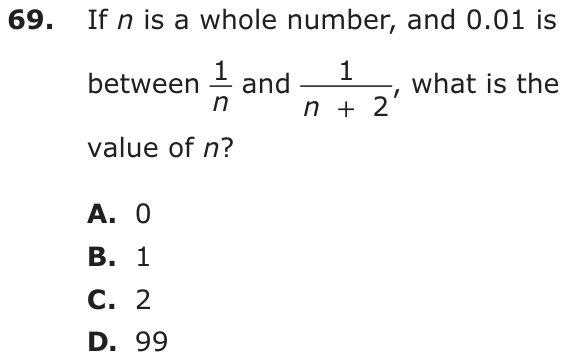
If n is a whole number, and 0.01 is between and , what is the value of n?
- A0
- B1
- C2
- D99
Show the answer
Correct answer: D
, which is between and .
Therefore, and .
Question analysis
A number sense question: 0.01 lies between 1 over n and 1 over n + 2, where n is a whole number, and students find n. It tests comparing a decimal with unit fractions and knowing how a fraction changes as its denominator grows. The unusual form, with n in two denominators, is what slows students down.
- Grade level
- Grade 6 content, by NYS standard
- Compared with grade 7
- At grade 7 Grade 7 students compare fractions and decimals routinely, but not with an unknown in the denominators. The comparison is simple once 0.01 is written as a fraction; the unfamiliar setup is the main demand.
- Estimated difficulty
- Straightforward: two steps or one careful reading.
- Thinking it demands
- Depth of knowledge 2, skills and concepts · mainly apply
- What makes it hard
- Variables instead of numbers moderate
- Something you must already know minor
- Solution
- 2 steps
- Reading level
- Question and choices: about grade 9, 18 words.
- Students, last 30 days
- Not enough answers yet to show (it takes 10).
Why it is hard, traps and wrong answers (shows the answer)
Why it is hard
The setup looks unfamiliar, with n in two denominators, but one rewrite makes it routine: 0.01 is 1/100, so the two denominators must sit on either side of 100. The three small choices fail a quick check, since every fraction from 1/1 to 1/4 is far above 0.01, and 0 cannot be a denominator at all. Students who test the choices instead of rewriting the decimal spend a little longer but reach the same place.
Variables instead of numbers moderate Understanding the question
The unknown sits in two denominators, n and n + 2, so students must reason about which unit fractions lie on either side of 0.01 rather than solve an equation. (Koedinger & Nathan, 2004; Enright, Morley & Sheehan, 2002)
Something you must already know minor Working it out
Two facts are assumed: 0.01 equals 1/100, and a unit fraction shrinks as its denominator grows, so 1/99 is just above 0.01 and 1/101 just below. (Anderson & Krathwohl, 2001)
Strategy: Rewrite 0.01 as a unit fraction, recall that a larger denominator gives a smaller fraction, and test each choice in both 1/n and 1/(n + 2).
Traps
- Misunderstands the concept: A wrong belief about a concept: that percents can be added, that area grows like length, that averages can be averaged, that a bigger denominator means a bigger fraction.
- Numbers taken from the question: Combines the numbers in the question without a model of the situation, or is simply a number that appears in the question.
The wrong answers, classified
A Misunderstands the concept (Smith, diSessa & Roschelle, 1993; De Bock et al., 1998; Ni & Zhou, 2005)
Treats 1/0 as 0, so 0.01 seems to lie between 0 and 1/2; but division by zero is undefined, so n cannot be 0.
B Numbers taken from the question (Hegarty, Mayer & Monk, 1995)
Takes the 1 from 0.01 or from 1/n as the value of n, without checking that 0.01 is far below both 1 and 1/3.
C Numbers taken from the question (Hegarty, Mayer & Monk, 1995)
Takes the 2 from n + 2, or the two decimal places of 0.01, without testing 1/2 and 1/4, which are both far above 0.01.
Worked solution, step by step
Formulas used
- Comparing unit fractions
- A unit fraction has 1 on top, like one fifth. a and b are positive whole numbers on the bottom. A bigger bottom cuts the whole into more pieces, so each piece is smaller. So the fraction with the bigger bottom is the smaller number.
Sort out the question
n is a whole number: 0, 1, 2, 3 and so on. The number 0.01 is between and . Between means one fraction is bigger than 0.01 and the other is smaller. You need the value of n.
Write 0.01 as a fraction
0.01 means one hundredth.
Now all three numbers are fractions with 1 on top. That makes them easy to compare.
Find fractions on each side
With 1 on top, a bigger bottom makes a smaller fraction.
So is a little more than , and is a little less.
The bottoms 99 and 101 are 2 apart, just like n and n + 2.
Match the fractions to n
The smaller bottom is n, and the larger bottom is n + 2.
Both fit. Watch out: small choices do not work. For n = 1, the fractions are 1 and . Both are far bigger than 0.01. For n = 0, is not a number, because you can’t divide by zero. So the answer is D, 99.
Check your answer
Write the fractions as decimals. , a bit more than 0.01. , a bit less. The sign ≈ means about. So 0.01 sits right between them.
More questions like this
The original DOE question
Question 3 of 9
2024 Test B Math, question 21Question
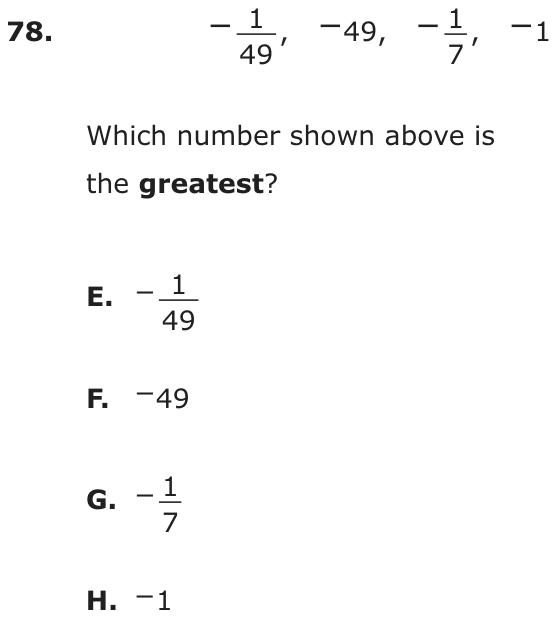
Which number shown above is the greatest?
- A
- B
- C
- D
Show the answer
Correct answer: A
All the numbers are negative, so they are all less than zero. Consider the absolute value of each number and where it falls on a number line. The negative number closest to 0 will be the greatest.
The negative number with the greatest absolute value is −49, so it has the least value.
The negative number with the next greatest absolute value is −1, so it would fall next in order from least to greatest.
Compare the absolute values of and .
Therefore, the numbers listed from least to greatest are:
So the number is the greatest.
Question analysis
Four negative numbers are listed: negative 1/49, negative 49, negative 1/7 and negative 1. Students decide which of them is the greatest. Comparing negative fractions with negative whole numbers tests whether students order numbers by their position on the number line or by their size without the sign.
- Grade level
- Grade 6 content, by NYS standard
- Compared with grade 7
- Below grade 7 Ordering positive and negative rational numbers on a number line is grade 6 content in New York. This is a one-step comparison of four numbers, lighter than typical grade 7 work with signed numbers.
- Estimated difficulty
- Straightforward: two steps or one careful reading.
- Thinking it demands
- Depth of knowledge 1, recall and reproduction · mainly apply
- What makes it hard
- A very close wrong answer moderate
- Something you must already know minor
- Solution
- 2 steps
- Reading level
- Question and choices: about grade 10, 12 words.
- Students, last 30 days
- Not enough answers yet to show (it takes 10).
Why it is hard, traps and wrong answers (shows the answer)
Why it is hard
With no arithmetic to do, the question tests how firmly students picture negative numbers on a line. Comparing sizes without the sign picks the number farthest from 0, and comparing the two fractions by habit picks the wrong one of the pair. Placing all four as points left of 0, with −1 between −49 and the fractions, makes the order plain.
A very close wrong answer moderate Choosing the answer
−1/49 and −1/7 differ only in the denominator, and for negative numbers the larger denominator gives the greater value, the reverse of what their sizes suggest. (Embretson & Wetzel, 1987; Gorin & Embretson, 2006; Ascalon et al., 2007)
Something you must already know minor Working it out
Students must bring the number-line fact that a negative number's value falls as its distance from 0 grows, so −49 is the least of the four, not the greatest. (Anderson & Krathwohl, 2001)
Strategy: Picture each number's place on the number line: among negative numbers, the one closest to 0 is the greatest, so compare their distances from 0.
Traps
- Negatives and direction: Arithmetic with negative numbers, the order of a subtraction, or direction on a number line. (Moving a term across the equals sign without changing its sign is a faulty procedure.)
- Misunderstands the concept: A wrong belief about a concept: that percents can be added, that area grows like length, that averages can be averaged, that a bigger denominator means a bigger fraction.
The wrong answers, classified
B Negatives and direction (Brown & Burton, 1978)
Picks the number with the largest digits, 49, judging its size without the minus sign that puts it farthest below 0.
C Negatives and direction (Brown & Burton, 1978)
Knows 1/7 is greater than 1/49 and keeps that order for the negatives, missing that the order reverses on the left of 0.
D Misunderstands the concept (Smith, diSessa & Roschelle, 1993; De Bock et al., 1998; Ni & Zhou, 2005)
Places −1/7 and −1/49 below −1, as if dividing a negative number made it more negative, so −1 looks like the greatest.
Worked solution, step by step
Formulas used
- Comparing negative numbers
- a and b are positive numbers. Putting a minus sign on both flips their order. The one with the smaller size is closer to 0, so it is greater. For example, 2 is less than 5, but −2 is greater than −5.
Sort out the question
All four numbers are negative, which means less than 0. You need the greatest one, the one with the highest value. On a number line, greater numbers are farther to the right.
Think about distance from 0
For negative numbers, the one closest to 0 is the greatest. The size of a number without its sign is its absolute value. It is the number’s distance from 0. So look for the smallest size.
Compare the sizes
The sizes are 1/49, 49, 1/7 and 1. Both 1/49 and 1/7 have 1 on top. Cutting 1 into 49 pieces gives much smaller pieces than cutting it into 7. So 1/49 is less than 1/7.
So 1/49 is the smallest size. That puts closest to 0.
Put the numbers in order
Flip the order of the sizes to order the negative numbers, from least to greatest.
Watch out: −49 has the biggest digits, but it is the least, so choice B is wrong. Watch out: 1/7 is more than 1/49, but −1/7 is less than −1/49. So choice C is wrong.So the answer is A, .
Check your answer
Change the fractions to decimals: and . Think of money you owe. Owing 2 cents is better than owing 14 cents, $1 or $49. So −1/49 is the greatest.
More questions like this
The original DOE question
Question 4 of 9
2023 Test A Math, question 14Question
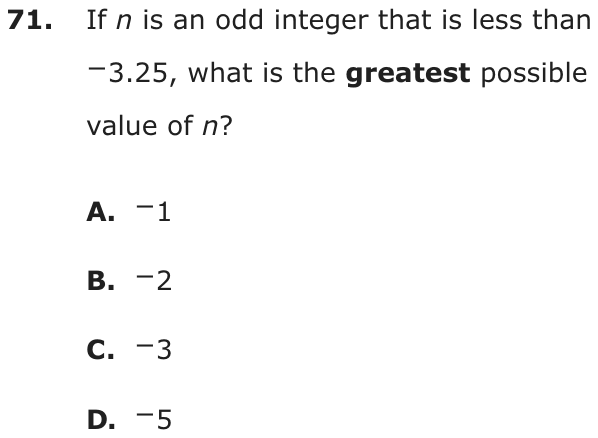
If n is an odd integer that is less than −3.25, what is the greatest possible value of n?
- A−1
- B−2
- C−3
- D−5
Show the answer
Correct answer: D
The two greatest integers less than −3.25 are −4 and −5. Since −4 is even, the answer is −5.
Question analysis
This question asks for the greatest odd integer that is less than −3.25. Students compare negative numbers on a number line and apply two conditions at once, odd and less than. With negatives, the greater number is the one closer to zero, which makes the two conditions easy to misapply.
- Grade level
- Grade 6 content, by NYS standard
- Compared with grade 7
- Below grade 7 Ordering negative numbers is grade 6 content, and the question adds only the condition that the integer be odd. It is lighter than typical grade 7 work, though the order of negatives still trips up students who compare their sizes.
- Estimated difficulty
- Straightforward: two steps or one careful reading.
- Thinking it demands
- Depth of knowledge 1, recall and reproduction · mainly apply
- What makes it hard
- Error-prone arithmetic minor
- Much to keep track of minor
- Solution
- 2 steps
- Reading level
- Question and choices: about grade 7, 18 words.
- Students, last 30 days
- Not enough answers yet to show (it takes 10).
Why it is hard, traps and wrong answers (shows the answer)
Why it is hard
The question is short, but it asks students to reason on the negative side of 0, where greater means closer to 0 and the size of the digits misleads. The integers just below −3.25 are −4 and then −5, and the first of those is even. Sketching a number line, or reading less than as to the left of, keeps the direction straight.
Error-prone arithmetic minor Working it out
On the negative side, less means farther from 0, so the integers below −3.25 run −4, −5, −6; −3, though its digit is closer to 3.25, lies to the right. (Brown & Burton, 1978; Junker & Sijtsma, 2001)
Much to keep track of minor Working it out
Three conditions apply at once, odd, less than −3.25 and the greatest such value, and checking only two of them leads to a listed choice. (Sweller, 1988; Carpenter, Just & Shell, 1990)
Strategy: Picture −3.25 on a number line, list the integers to its left starting with the closest, and take the first one that is odd.
Traps
- Negatives and direction: Arithmetic with negative numbers, the order of a subtraction, or direction on a number line. (Moving a term across the equals sign without changing its sign is a faulty procedure.)
- Misreads the question: Misses or misreads a condition or a word in the question: "at least", "each", "remaining", "not".
The wrong answers, classified
A Misreads the question (Hegarty, Mayer & Monk, 1995)
Picks the greatest odd number offered, −1, without checking the condition that n be less than −3.25; −1 lies to its right on the number line.
B Little reason to choose it (Haladyna & Downing, 1993; Rodriguez, 2005)
The choice −2 is even, so it breaks the condition that n be odd, and it is also greater than −3.25; it mostly catches guesses.
C Negatives and direction (Brown & Burton, 1978)
Looks for the odd integer just past −3.25 but steps toward 0, taking −3, though −3 is greater than −3.25, not less.
Worked solution, step by step
Formulas used
- Comparing negative numbers
- a and b are positive numbers, and a is bigger. On a number line, numbers get smaller as you move left. A negative number farther from 0 is farther left. So it is smaller, even though its digits look bigger.
Sort out the question
n has to pass three tests. It is an integer, a whole number with no decimal part. It is odd, so it is not a multiple of 2. And it is less than −3.25. Of all the numbers that pass, you need the greatest one. That is the one farthest to the right on a number line.
Picture −3.25 on a number line
−3.25 sits between −4 and −3. Less than −3.25 means to the left of it.
So −4 is less than −3.25, but −3 is greater. Watch out: −3 is not less than −3.25. It is to the right, closer to 0. For negative numbers, the one closer to 0 is greater. Picking −3 is choice C.
Find the odd integers to the left
The integers less than −3.25, starting with the closest, are −4, −5, −6 and so on. The greatest one is −4. But −4 is even, since 4 = 2 × 2. So skip it. The next one, −5, is odd. Watch out: −1 is odd, but it is greater than −3.25, so choice A breaks the rule. So the answer is D, −5.
Check your answer
Check all three tests for −5. It is an integer. It is odd. It is to the left of −3.25, so it is less. The only integer between −5 and −3.25 is −4, and it is even. So no greater number works.
More questions like this
The original DOE question
Question 5 of 9
2023 Test A Math, question 16Question
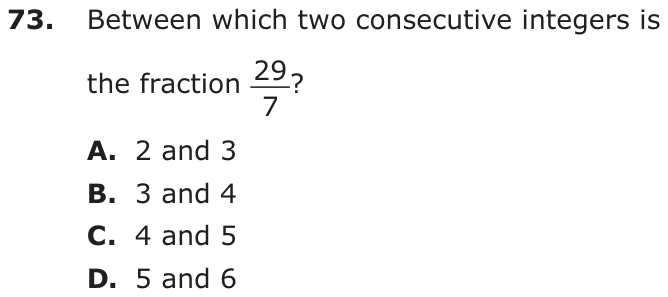
Between which two consecutive integers is the fraction ?
- A2 and 3
- B3 and 4
- C4 and 5
- D5 and 6
Show the answer
Correct answer: C
First, convert to a mixed number: . The two consecutive integers on either side of are 4 and 5.
Question analysis
This question asks between which two consecutive whole numbers the fraction 29/7 lies. Students divide to turn the improper fraction into a mixed number, or compare it with nearby multiples of 7. It is a quick check of number sense with fractions, where a remainder must be read correctly.
- Grade level
- Grade 6 content, by NYS standard
- Compared with grade 7
- Below grade 7 Changing an improper fraction to a mixed number and placing it between whole numbers is review well before grade 7. This takes one division with a small divisor and nothing more.
- Estimated difficulty
- Routine: one familiar step, little to misread.
- Thinking it demands
- Depth of knowledge 1, recall and reproduction · mainly apply
- What makes it hard
- Solution
- 2 steps
- Reading level
- Question and choices: about grade 5, 13 words.
- Students, last 30 days
- Not enough answers yet to show (it takes 10).
Why it is hard, traps and wrong answers (shows the answer)
Why it is hard
Dividing 29 by 7 gives 4 with a remainder of 1, so the fraction is 4 1/7 and lies just past 4. The one decision is which side of 4 the remainder puts it on, and a positive remainder always moves the value up. Writing the mixed number before looking at the choices makes the pair obvious.
A very close wrong answer minor Choosing the answer
The pairs 3 and 4 and 4 and 5 both contain 4, so knowing that 29/7 is about 4 is not enough; only the remainder, 29 − 28 = 1, puts it above 4. (Embretson & Wetzel, 1987; Gorin & Embretson, 2006; Ascalon et al., 2007)
Strategy: Find the largest multiple of 7 that is not more than 29, write the fraction as a mixed number, and read off the whole numbers on each side.
Traps
- Counting the ends: Inclusive or exclusive ends, fence posts, consecutive numbers: an answer that is one too many or too few, or an endpoint drawn open where it belongs closed (or the reverse).
The wrong answers, classified
A Little reason to choose it (Haladyna & Downing, 1993; Rodriguez, 2005)
No division of 29 by 7 lands below 3, since 7 × 3 = 21 is far short of 29; only misreading 29/7 as 2.9 gets there, so it mostly catches guesses.
B Counting the ends (Brown & Burton, 1978)
Finds the whole-number part, 4, but takes it as the upper end of the pair, as if 29/7 fell just short of 4 instead of just past it.
D Little reason to choose it (Haladyna & Downing, 1993; Rodriguez, 2005)
Nothing puts 29/7 above 5, since 7 × 5 = 35 is more than 29; even rounding 4 1/7 up gives 5 as the upper end, so it mostly catches guesses.
Worked solution, step by step
Formulas used
- Fraction to mixed number
- a over b is a fraction whose top is bigger than its bottom. q is the quotient, how many whole times b fits into a. r is the remainder, what is left over. The leftover stays over the same bottom number.
Sort out the question
Consecutive integers are whole numbers that come one right after the other, like 4 and 5. You need the two that falls between. So find the whole number just below it and the one just above it.
Divide 29 by 7
A fraction bar means divide. How many 7s fit in 29?
28 is the biggest multiple of 7 that is not more than 29. A multiple of 7 is 7 times a whole number. Then . So 29 ÷ 7 is 4 with 1 left over.
Write it as a mixed number
is a little more than 4 and less than 5. Watch out: it is just past 4, not just short of it. So 4 is the lower number of the pair. Picking 3 and 4 is choice B. So the answer is C, 4 and 5.
Check your answer
Multiply each end by 7. and . The top of the fraction, 29, is between 28 and 35. So is between 4 and 5. As a decimal it is about 4.14.
More questions like this
The original DOE question
Question 6 of 9
2023 Test A Math, question 23Question
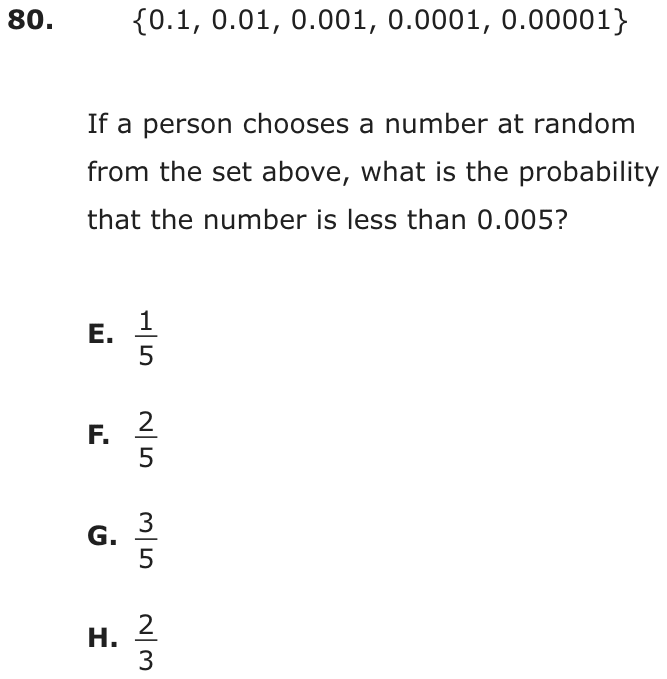
If a person chooses a number at random from the set above, what is the probability that the number is less than 0.005?
- A
- B
- C
- D
Show the answer
Correct answer: C
Three of the five numbers listed (0.001, 0.0001, and 0.00001) are less than 0.005. So, the probability of a person selecting a number less than 0.005 is .
Question analysis
A set holds five decimals, from one tenth down to one hundred-thousandth, and one number is chosen at random. Students find the probability that the number is less than 0.005. Comparing decimals with many zeros is the real task here, along with putting the count over the right total.
- Grade level
- Grade 6 content, by NYS standard
- Compared with grade 7
- Below grade 7 Probability with equally likely outcomes is grade 6 content in New York, and this needs one comparison per number and one fraction. The only real demand is comparing decimals with many zeros correctly.
- Estimated difficulty
- Straightforward: two steps or one careful reading.
- Thinking it demands
- Depth of knowledge 2, skills and concepts · mainly apply
- What makes it hard
- Error-prone arithmetic moderate
- Something you must already know minor
- Solution
- 2 steps
- Reading level
- Question and choices: about grade 6, 27 words.
- Students, last 30 days
- Not enough answers yet to show (it takes 10).
Why it is hard, traps and wrong answers (shows the answer)
Why it is hard
Each number in the set is a tenth of the one before, so only the three smallest fall below 0.005, which lies between 0.01 and 0.001. Students lose the point either by counting the numbers above 0.005 instead of below it or by writing the count over the wrong total. Lining the decimals up with the same number of places makes every comparison easy.
Error-prone arithmetic moderate Working it out
0.005 has to be compared with decimals from 0.1 down to 0.00001; written to five places, 0.00500 against 0.01000 and 0.00100, the order becomes a comparison of whole numbers. (Brown & Burton, 1978; Junker & Sijtsma, 2001)
Something you must already know minor Working it out
The probability is the count of numbers below 0.005 over all 5 numbers in the set; the stem leaves that part-to-whole rule to the student. (Anderson & Krathwohl, 2001)
Strategy: Write each number with five decimal places, compare it with 0.00500, count those that are smaller, and divide by the five numbers in the set.
Traps
- Answers a different question: A choice is right for another quantity: the other unknown, the rest instead of the part, the part instead of the whole.
- Misunderstands the concept: A wrong belief about a concept: that percents can be added, that area grows like length, that averages can be averaged, that a bigger denominator means a bigger fraction.
The wrong answers, classified
A Answers a different question (King et al., 2004; Hegarty, Mayer & Monk, 1995)
Gives 1/5, the chance of picking any one particular number from the set, without counting how many of the five are below 0.005.
B Answers a different question (King et al., 2004; Hegarty, Mayer & Monk, 1995)
Counts the 2 numbers greater than 0.005, 0.1 and 0.01, instead of those less than it, finding the chance of the opposite event.
D Misunderstands the concept (Smith, diSessa & Roschelle, 1993; De Bock et al., 1998; Ni & Zhou, 2005)
Writes a part-to-part ratio, the 2 numbers above 0.005 over the 3 below it, instead of dividing by all 5 numbers in the set.
Worked solution, step by step
Formulas used
- Probability
- P is the probability, the chance that something happens. Possible results are all the results that are equally likely. Wanted results are the ones you are looking for. The chance is the fraction of all the results that you want.
- Adding zeros to a decimal
- Zeros added to the right end of a decimal don’t change its value. One tenth is the same as ten hundredths. Giving every number the same number of decimal places lets you compare them like whole numbers.
Sort out the question
The set has five numbers. A person picks one at random, so each number has the same chance. You need the probability, or chance, that the number picked is less than 0.005.
Give every number five decimal places
Decimals are easier to compare with the same number of places. Add zeros to the end of each.
Number With five places 0.1 0.10000 0.01 0.01000 0.001 0.00100 0.0001 0.00010 0.00001 0.00001 0.005 0.00500 Count the numbers below 0.005
Compare each number with 0.00500 like whole numbers: 10000, 1000, 100, 10 and 1 against 500. Two numbers are bigger: 0.1 and 0.01. Three are smaller: 0.001, 0.0001 and 0.00001. Watch out: 0.01 has fewer digits than 0.005, but it is bigger. Counting the 2 bigger numbers gives , choice B.
Write the probability
Watch out: divide by all 5 numbers in the set. Comparing the 2 bigger numbers with the 3 smaller ones gives , choice D. So the answer is C, .
Check your answer
The numbers below 0.005 and the numbers above it make up the whole set: 3 + 2 = 5. So the two chances, and , add up to 1, as they should.
More questions like this
The original DOE question
Question 7 of 9
2023 Test A Math, question 26Question
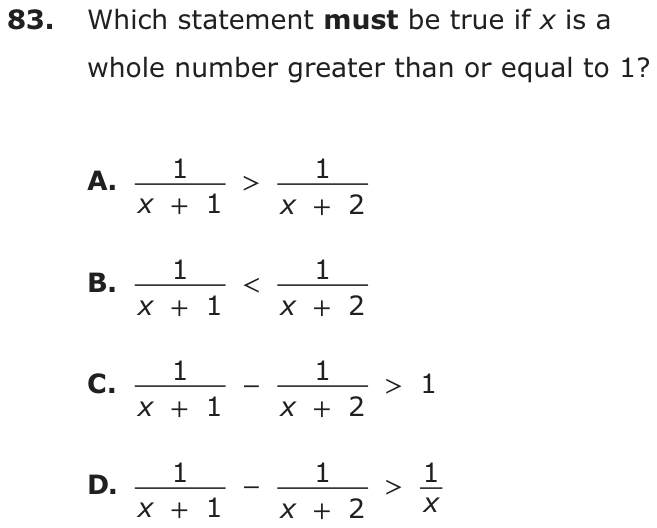
Which statement must be true if x is a whole number greater than or equal to 1?
- A
- B
- C
- D
Show the answer
Correct answer: A
Let , and substitute that value for x in each inequality to determine which one is correct:
Option A:
. This is true.
Option B:
. This is false.
Option C:
, or . This is false.
Option D:
, or . This is false.
Option A is the only true inequality.
Question analysis
This question asks which of four inequalities must be true when x is a whole number of at least 1. The inequalities compare fractions with denominators x + 1 and x + 2, or their difference. Students reason about how the size of a fraction changes as its denominator grows, and must be sure a statement holds for every allowed value.
- Grade level
- Grade 6 content, by NYS standard
- Compared with grade 7
- At grade 7 Comparing fractions is familiar, but these fractions have variable denominators and the question asks what must be true for every whole number from 1 up. That abstraction makes it as demanding as typical grade 7 work, though the arithmetic is light.
- Estimated difficulty
- Moderate: several steps, or a close reading with one strong distractor.
- Thinking it demands
- Depth of knowledge 2, skills and concepts · mainly analyze
- What makes it hard
- Variables instead of numbers moderate
- Every choice must be checked moderate
- Error-prone arithmetic minor
- Solution
- 2 steps
- Reading level
- Question and choices: about grade 6, 20 words.
- Students, last 30 days
- Not enough answers yet to show (it takes 10).
Why it is hard, traps and wrong answers (shows the answer)
Why it is hard
Choosing a small value, such as x = 1 or 2, and testing every statement settles this quickly, because three of the four fail for any value tried. The trap is the belief that a bigger denominator makes a bigger fraction, which turns the true comparison around. Students unsure of fraction subtraction lose time on the two difference statements, though both differences are tiny, never more than 1/6.
Variables instead of numbers moderate Understanding the question
All four statements are about the unknown x, and the bold must means each has to hold for every whole number from 1 up, not just for a single test value. (Koedinger & Nathan, 2004; Enright, Morley & Sheehan, 2002)
Every choice must be checked moderate Choosing the answer
The statements are four separate inequalities, two comparisons and two differences, so each has to be tested; one counterexample is enough to rule a statement out. (Embretson & Wetzel, 1987)
Error-prone arithmetic minor Working it out
Testing the differences means subtracting unlike fractions, such as 1/3 − 1/4 = 1/12 when x = 2, and comparing the result with 1 and with 1/x. (Brown & Burton, 1978; Junker & Sijtsma, 2001)
Strategy: Substitute a small whole number such as 1 or 2 for x in all four statements, rule out any that fail, and confirm the survivor by thinking about larger denominators.
Traps
- Misunderstands the concept: A wrong belief about a concept: that percents can be added, that area grows like length, that averages can be averaged, that a bigger denominator means a bigger fraction.
- A faulty procedure: A systematic but wrong procedure: adding fractions straight across, applying an exponent to each term of a sum, dropping a sign when moving a term.
The wrong answers, classified
B Misunderstands the concept (Smith, diSessa & Roschelle, 1993; De Bock et al., 1998; Ni & Zhou, 2005)
Believes a bigger denominator makes a bigger fraction, so 1/(x + 2) seems larger than 1/(x + 1), the comparison turned around.
C Little reason to choose it (Haladyna & Downing, 1993; Rodriguez, 2005)
Both fractions are at most 1/2, so their difference can never exceed 1, and no common working makes it do so; this choice mostly draws guesses.
D A faulty procedure (Brown & Burton, 1978; Tatsuoka, 1983)
Subtracts over a common denominator but keeps only the numerator, (x + 2) − (x + 1) = 1, so the difference looks like 1, larger than 1/x once x is 2.
Worked solution, step by step
Formulas used
- Comparing unit fractions
- a and b are positive numbers, and b is bigger. One over a means one whole cut into a equal pieces. Cutting the same whole into more pieces makes each piece smaller. So the fraction with the bigger bottom is smaller.
- Subtracting fractions
- a and b are the bottoms of the two fractions. Rewrite both fractions over the common bottom a × b. Then subtract the tops. The bottom stays a × b.
Sort out the question
x is a whole number that is 1 or more, so x can be 1, 2, 3 and so on. You need the statement that must be true. That means it is true for every such x. One x that makes a statement false rules it out.
Test x = 1 in each statement
With x = 1, x + 1 is 2 and x + 2 is 3.
- A: . True.
- B: . False.
- C: , which is not more than 1. False.
- D: is not more than . False.
Only A is true when x = 1. So B, C and D are out.
Make sure A is always true
Must means A has to work for every x, not just 1. In and , both tops are 1. The bottom x + 2 is always 1 more than x + 1. Cutting a whole into more pieces makes each piece smaller. So A is always true. Watch out: a bigger bottom makes a smaller fraction, not a bigger one. Thinking the other way gives choice B.
See why C and D always fail
Use the subtracting rule with a = x + 1 and b = x + 2.
The bottom is at least 2 × 3 = 6, so the difference is at most . That is less than 1. Its bottom is also bigger than x, so it is less than . Watch out: keep the bottom when you subtract. Keeping only the top, 1, leads to choice D. So the answer is A.
Check your answer
Try a bigger number, x = 9. A tenth of a pizza is more than an eleventh, so . The difference, , is tiny. It is less than 1 and less than . A still holds, and C and D still fail.
More questions like this
The original DOE question
Question 8 of 9
2023 Test A Math, question 56Question

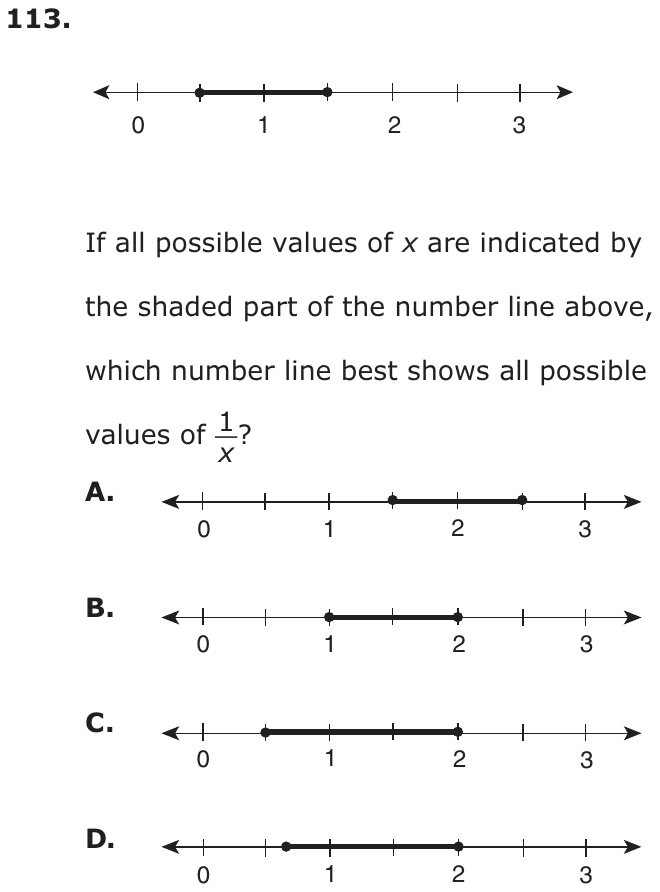
If all possible values of x are indicated by the shaded part of the number line above, which number line best shows all possible values of ?
- A

- B

- C

- D

Show the answer
Correct answer: D
The shaded region goes from to . So, the possible values of would be between the reciprocal of and the reciprocal of , which are 2 and , respectively. Find the number line in the answer options that has a shaded region that ranges from to 2, which is option D.
Question analysis
This number line question shades all possible values of x from one half to three halves and asks which number line shows all possible values of 1/x. Students find reciprocals of fractions and work out how a whole range of values changes. Keeping track of what happens to each end of the range, and placing fractions accurately on the line, makes it tricky.
- NYS standards
- Grade level
- Grade 6 content, by NYS standard
- Compared with grade 7
- Above grade 7 Reciprocals of single fractions are grade 6 work. Applying them to every value in a shaded range at once, and working out where the new range begins and ends, is reasoning about a whole set of numbers that grade 7 classes rarely practice.
- Estimated difficulty
- Hard: combines ideas, needs a plan, and has more than one tempting wrong answer.
- Thinking it demands
- Depth of knowledge 2, skills and concepts · mainly apply
- What makes it hard
- Reading a figure, table or graph moderate
- A very close wrong answer moderate
- Variables instead of numbers minor
- Solution
- 3 steps
- Reading level
- Question and choices: about grade 12, 27 words.
- Students, last 30 days
- Not enough answers yet to show (it takes 10).
Why it is hard, traps and wrong answers (shows the answer)
Why it is hard
Few students have flipped an interval before, so the question rewards testing its two ends and noticing that the order reverses. The harder part comes at the end: 2/3 falls between the tick marks, and a graph ending at the nearby 1/2 tick looks right at a glance. Students who believe a reciprocal is always at least 1, or who shift the interval instead of flipping it, reach the other graphs.
Reading a figure, table or graph moderate Understanding the question
The shaded segment's ends sit on unlabeled half-unit ticks, 1/2 and 3/2, and each choice must be read the same way, with 2/3 falling between ticks rather than on one. (Lesh, Post & Behr, 1987; Kirsch & Mosenthal, 1990)
A very close wrong answer moderate Choosing the answer
The graph from 1/2 to 2 matches the right graph's right end and differs at the left end by only a sixth of a unit, 1/2 against 2/3. (Embretson & Wetzel, 1987; Gorin & Embretson, 2006; Ascalon et al., 2007)
Variables instead of numbers minor Understanding the question
The question asks about 1/x for every x in a range, so a whole interval must be transformed, and its ends swap: the smallest x gives the largest 1/x. (Koedinger & Nathan, 2004; Enright, Morley & Sheehan, 2002)
Strategy: Take the reciprocal of each end of the shaded part, ask whether a bigger x gives a bigger or a smaller 1/x, and look for the graph whose endpoints are exactly those values.
Traps
- Misreads the figure: Reads a value, label or tick spacing in a figure, table or graph wrongly.
- Misunderstands the concept: A wrong belief about a concept: that percents can be added, that area grows like length, that averages can be averaged, that a bigger denominator means a bigger fraction.
- Wrong operation: Adds instead of multiplying, divides the wrong way round, turns a ratio or rate upside down, or undoes a step in the wrong direction (subtracts what should be added back).
The wrong answers, classified
A Wrong operation (Hegarty, Mayer & Monk, 1995; King et al., 2004)
Adds 1 to each endpoint instead of taking reciprocals, sliding the shaded part from 1/2–3/2 one unit right, to 3/2–5/2.
B Misunderstands the concept (Smith, diSessa & Roschelle, 1993; De Bock et al., 1998; Ni & Zhou, 2005)
Gets 2 from 1/2 but assumes a reciprocal cannot be less than 1, as flipping a proper fraction suggests, so it starts the shading at 1 instead of 2/3.
C Misreads the figure (Lesh, Post & Behr, 1987; Kirsch & Mosenthal, 1990)
Finds the reciprocals 2/3 and 2 but places 2/3 at the half-unit tick, 1/2, though 2/3 lies a third of the way from that tick toward 1.
Worked solution, step by step
Formulas used
- Reciprocal
- a and b are the top and bottom of a fraction. The reciprocal flips the fraction upside down. The number 1 over x is the reciprocal of x. A number times its reciprocal always makes 1.
Sort out the question
x can be any number in the shaded part of the first number line. You need the number line that shows every possible value of , the reciprocal of x. The reciprocal is the number flipped upside down, like for 2.
Read the shaded part
The ticks come every half unit. The shading starts at the tick halfway between 0 and 1, which is . It ends halfway between 1 and 2, which is , or . Both dots are filled in, so both ends count.
Find the reciprocals of the ends
Flip each end of the shaded part.
So the ends of the new shading are 2 and .
Notice that the ends swap
When x gets bigger, gets smaller. So the smallest x, , gives the biggest value, 2. The biggest x, , gives the smallest, . So runs from to 2, ends included.
Find the matching number line
lies between the half tick and 1, a third of the way from to 1. Line D starts there and ends at 2. Watch out: line C starts at the half tick, , not at . Line B starts at 1.
So the answer is D, the line shaded from to 2.
Check your answer
Test a value in the middle. x = 1 is shaded, and . On line D, 1 is shaded too. Test an end: , so really is the reciprocal of .
More questions like this
The original DOE question
Question 9 of 9
2018 Test A Math, question 36Question
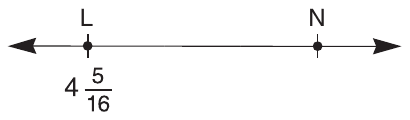
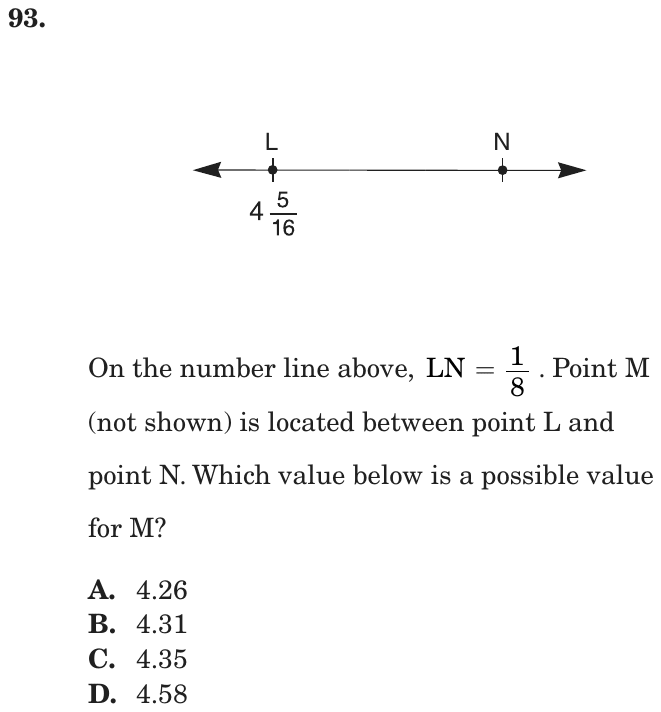
On the number line above, LN = . Point M (not shown) is located between point L and point N. Which value below is a possible value for M?
- A4.26
- B4.31
- C4.35
- D4.58
Show the answer
Correct answer: C
Since , point is located at
.
So must be between point , , and point , . Point can also be written as 4.3125, and point can be written as 4.4375. The only option given that lies between those two points is 4.35.
Question analysis
This number line question says the distance from point L to point N is one eighth and asks which decimal could be the position of a point M between them. Students take L's position, a mixed number in sixteenths, find N, and compare with decimal choices. Converting sixteenths to decimals precisely is the tricky part.
- NYS standards
- Grade level
- Grade 7 content, by NYS standard
- Compared with grade 7
- At grade 7 Grade 7 students convert fractions to decimals and compare them. This item needs an exact conversion of sixteenths and a comparison to the thousandths, where rounding too early can mislead, but it stays within grade 7 content.
- Estimated difficulty
- Moderate: several steps, or a close reading with one strong distractor.
- Thinking it demands
- Depth of knowledge 2, skills and concepts · mainly apply
- What makes it hard
- Error-prone arithmetic moderate
- A very close wrong answer moderate
- Reading a figure, table or graph minor
- Solution
- 3 steps
- Reading level
- Question and choices: about grade 5, 28 words.
- Students, last 30 days
- Not enough answers yet to show (it takes 10).
Why it is hard, traps and wrong answers (shows the answer)
Why it is hard
The interval from L to N is only an eighth wide, and three of the four choices crowd near it, so precision decides the question. Students comfortable working in sixteenths can avoid decimals until the end, since 4.35 lies between 4 5/16 and 4 7/16. Those who convert loosely, or who misread a mixed number as a decimal, are pulled to a neighboring choice.
Error-prone arithmetic moderate Working it out
Converting 4 5/16 to 4.3125 and N to 4.4375 needs four decimal places, while the choices stop at hundredths, so early rounding blurs the left boundary. (Brown & Burton, 1978; Junker & Sijtsma, 2001)
A very close wrong answer moderate Choosing the answer
The choices 4.31 and 4.35 both lie within 0.04 of L, so estimating cannot separate them; only the exact 4.3125 shows 4.31 just outside the interval and 4.35 inside. (Embretson & Wetzel, 1987; Gorin & Embretson, 2006; Ascalon et al., 2007)
Reading a figure, table or graph minor Understanding the question
L's value appears only on the number line, and the picture shows N to the right of L, which fixes which way the one-eighth gap runs. (Lesh, Post & Behr, 1987; Kirsch & Mosenthal, 1990)
Strategy: Add one eighth, or two sixteenths, to L's position to locate N, convert both endpoints to four-place decimals, and keep only a choice strictly between them.
Traps
- Rounds too early: Rounds a value partway through, or rounds the wrong way, so the final answer drifts from the exact one.
- Answer in another form: The right answer is written differently from the way you worked it out.
- A faulty procedure: A systematic but wrong procedure: adding fractions straight across, applying an exponent to each term of a sum, dropping a sign when moving a term.
The wrong answers, classified
A Negatives and direction (Brown & Burton, 1978)
Measures the one-eighth gap to the left of L, giving 4.1875 to 4.3125, an interval that contains 4.26 but contradicts the figure.
B Rounds too early (King et al., 2004)
Rounds L's 4.3125 to 4.31 and treats 4.31 as inside the interval, missing that it lies slightly to the left of L.
D A faulty procedure (Brown & Burton, 1978; Tatsuoka, 1983)
Writes 4 5/16 as 4.516 by placing the fraction's digits after the decimal point, so N becomes about 4.641 and 4.58 appears to fit.
Worked solution, step by step
Formulas used
- Equal fractions
- a is the top number (numerator) and b is the bottom number (denominator). Multiplying both by the same number k gives an equal fraction. It is like cutting each piece into k smaller pieces. Use it to give fractions the same bottom before you add or subtract.
- Fraction to decimal
- A fraction bar means divide. a is the top number and b is the bottom number. Dividing the top by the bottom turns the fraction into a decimal. Then you can compare it with decimal choices.
Sort out what you know
Point L is at . Point N is to the right of L. The distance from L to N, called LN, is .
Point M is somewhere between L and N. You need a choice that fits between them. The choices are decimals, so you will change the fractions into decimals.
Find where N is
N is to the right of L, so add. First give a bottom of 16, to match L:
Watch out: N is to the right of L in the figure. Going left instead gives a gap that holds 4.26, choice A.
Change both points to decimals
Divide the top of each fraction by the bottom:
So L is at 4.3125 and N is at 4.4375.
Test each choice
M must be bigger than 4.3125 and smaller than 4.4375.
- 4.26 is smaller than 4.3125. It is left of L.
- 4.31 is 4.3100, just smaller than 4.3125. It is a hair left of L.
- 4.35 is between them. It fits.
- 4.58 is bigger than 4.4375. It is right of N.
Watch out: if you round L to 4.31, choice B seems to fit. Keep all four decimal places. So the answer is C, 4.35.
Check your answer
Subtract to be sure. 4.35 − 4.3125 = 0.0375, which is more than 0, so 4.35 is right of L. 4.4375 − 4.35 = 0.0875, which is also more than 0, so 4.35 is left of N. It sits between them.
More questions like this
The original DOE question