6.NS.2 multi-digit division
Question 1 of 8
2026 Practice Test D Math, question 32Question
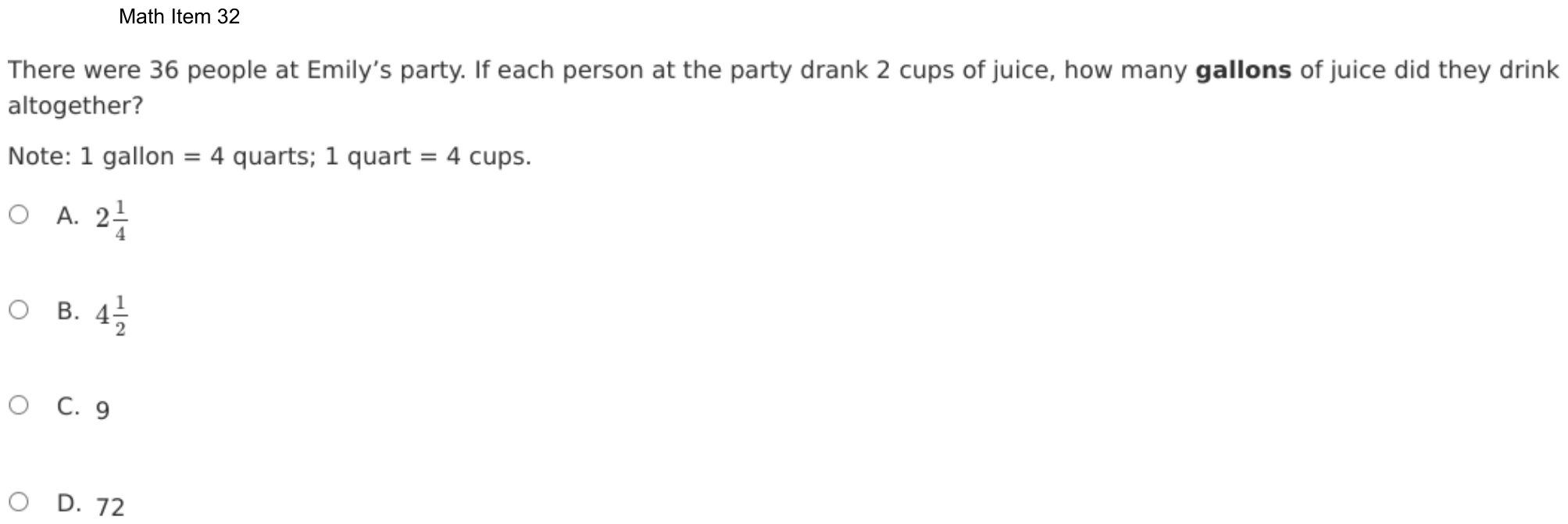
There were 36 people at Emily’s party. If each person at the party drank 2 cups of juice, how many gallons of juice did they drink altogether?
Note: 1 gallon = 4 quarts; 1 quart = 4 cups.
- A
- B
- C9
- D72
Show the answer
Correct answer: B
Since 36 people each drank 2 cups of juice, the total amount of juice they drank was cups.
Convert 72 cups to gallons:
Question analysis
At Emily's party 36 people each drank 2 cups of juice, and this unit conversion question asks how many gallons they drank in all, given 4 quarts to a gallon and 4 cups to a quart. Students multiply to get the total in cups, then convert through quarts to gallons, and the bold word gallons sets the unit of the answer.
- Grade level
- Grade 6 content, by NYS standard
- Compared with grade 7
- Below grade 7 Converting units with given factors is grade 6 work. This adds a first step, the total number of cups, and a two-stage conversion through quarts, but the numbers are friendly and the path is routine for grade 7 students.
- Estimated difficulty
- Straightforward: two steps or one careful reading.
- Thinking it demands
- Depth of knowledge 2, skills and concepts · mainly apply
- What makes it hard
- Many steps minor
- Turning words into math minor
- Solution
- 3 steps
- Reading level
- Question and choices: about grade 5, 32 words.
- Corrected from the DOE handbook
- A stray word at the end of the explanation was removed.
- Students, last 30 days
- Not enough answers yet to show (it takes 10).
Why it is hard, traps and wrong answers (shows the answer)
Why it is hard
With both conversion facts printed, the question is mainly about keeping the units straight. Students who skip the word each convert 36 cups instead of 72, and those who stop at cups find a total that is right in the wrong unit. Working out that a gallon is 4 × 4 = 16 cups before dividing turns two conversions into one and avoids adding the 4s.
Many steps minor Working it out
A multiplication, 36 × 2, comes before two divisions by 4, cups to quarts and quarts to gallons, and stopping after the first step leaves a believable 72. (Daniel & Embretson, 2010; Enright, Morley & Sheehan, 2002)
Turning words into math minor Understanding the question
The word “each” turns 36 people into 72 cups, and the bold word gallons sets the unit of the answer, a change the note supplies in two steps. (Hegarty, Mayer & Monk, 1995; Koedinger & Nathan, 2004)
Strategy: Find the total number of cups first, then divide by 4 to get quarts and by 4 again to get gallons, or work out how many cups make a gallon and divide once.
Traps
- Units or scale: The answer is wanted in other units, or a rate or scale must be converted first.
- Misreads the question: Misses or misreads a condition or a word in the question: "at least", "each", "remaining", "not".
The wrong answers, classified
A Misreads the question (Hegarty, Mayer & Monk, 1995)
Converts 36 cups to gallons, 36 ÷ 16 = 2 1/4, missing the word each, so every person’s second cup of juice is left out.
C Units or scale (King et al., 2004)
Uses 8 cups to a gallon, adding the two 4s in the note instead of multiplying them, so 72 cups become 72 ÷ 8 = 9 gallons.
D Units or scale (King et al., 2004)
Finds the 72 cups of juice and stops, giving the amount in cups though the bold word gallons asks for it in gallons.
What was corrected from the DOE handbook, and why
- Explanation: The DOE’s explanation ends with a line that reads only “lineExtend”, a formatting code left in the document by mistake. The site leaves it out.
Worked solution, step by step
Formulas used
- Total amount
- When every person has the same amount, multiply the number of people by the amount each one has. The word each tells you to multiply.
- Cups in a gallon
- A gallon holds 4 quarts, and each quart holds 4 cups. So a gallon holds 4 groups of 4 cups. You multiply, not add, because each of the 4 quarts has its own 4 cups.
- Changing cups to gallons
- It takes 16 cups to make 1 gallon. Dividing by 16 finds how many groups of 16 cups there are. A gallon is bigger than a cup, so the number of gallons is smaller.
Sort out the question
You know:
- 36 people were at the party.
- Each person drank 2 cups of juice.
- 1 gallon = 4 quarts, and 1 quart = 4 cups.
You need the total amount of juice in gallons. The bold word tells you the unit of the answer.
Find the total in cups
Each of the 36 people drank 2 cups:
They drank 72 cups in all.
Watch out: skipping the word each uses only 36 cups. Then gallons, choice A.
Find the cups in a gallon
A gallon is 4 quarts, and each quart is 4 cups:
So 1 gallon holds 16 cups.
Watch out: adding the two 4s gives 8 cups in a gallon. Then , choice C.
Change cups to gallons
Divide the cups by 16. Simplify the fraction by dividing the top and bottom by 8:
They drank gallons of juice.
Watch out: 72 is the amount in cups. The question asks for gallons, so 72, choice D, is in the wrong unit.
So the answer is B, .
Check your answer
Work backward. gallons is quarts. 18 quarts is cups. Shared among 36 people, that is cups each. It matches.
More questions like this
The original DOE question
Question 2 of 8
2024 Test A Math, question 24Question
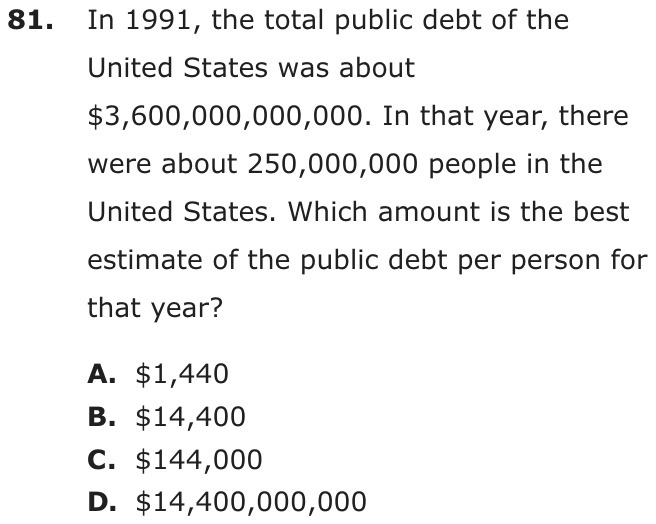
In 1991, the total public debt of the United States was about $3,600,000,000,000. In that year, there were about 250,000,000 people in the United States. Which amount is the best estimate of the public debt per person for that year?
- A$1,440
- B$14,400
- C$144,000
- D$14,400,000,000
Show the answer
Correct answer: B
The question asks for the amount of the public debt per person, so divide the total public debt by the number of people.
The amount of the public debt per person was about $14,400.
Question analysis
An estimation question with very large numbers: the 1991 United States public debt of about 3.6 trillion dollars and a population of about 250 million. Students find the debt per person. The choices differ by powers of ten, so cancelling zeros and keeping track of place value is the whole challenge.
- Grade level
- Grade 6 content, by NYS standard
- Compared with grade 7
- Below grade 7 Dividing large whole numbers and using place value are grade 5 and 6 skills. Grade 7 work goes further with rational numbers; this asks only for one careful division, with counting zeros as the main risk.
- Estimated difficulty
- Straightforward: two steps or one careful reading.
- Thinking it demands
- Depth of knowledge 2, skills and concepts · mainly apply
- What makes it hard
- Error-prone arithmetic moderate
- A very close wrong answer minor
- Solution
- 2 steps
- Reading level
- Question and choices: about grade 5, 37 words.
- Corrected from the DOE handbook
- A misprinted number in the explanation was corrected.
- Students, last 30 days
- Not enough answers yet to show (it takes 10).
Why it is hard, traps and wrong answers (shows the answer)
Why it is hard
The division itself is easy once the zeros are handled, and the question is built to punish miscounting them. Three choices carry the same digits, 144, at different sizes, so a student who loses or gains one zero still finds a match. A quick estimate in powers of ten, 3.6 trillion over a quarter of a billion, confirms that the answer is in the tens of thousands.
Error-prone arithmetic moderate Working it out
The debt has 13 digits and the population 9; cancelling seven zeros from each leaves 360,000 ÷ 25, and losing or adding one zero shifts the answer tenfold. (Brown & Burton, 1978; Junker & Sijtsma, 2001)
A very close wrong answer minor Choosing the answer
Three choices share the digits 144 and differ only by powers of ten, so getting the digits right does not settle it; only exact place value does. (Embretson & Wetzel, 1987; Gorin & Embretson, 2006; Ascalon et al., 2007)
Strategy: Cancel the same number of zeros from the debt and the population, then divide the smaller numbers that remain; check the size by estimating with powers of ten.
Traps
- An arithmetic slip: The right method with a plausible arithmetic error: a digit, a place value or a times-table fact.
- A faulty procedure: A systematic but wrong procedure: adding fractions straight across, applying an exponent to each term of a sum, dropping a sign when moving a term.
The wrong answers, classified
A An arithmetic slip (Junker & Sijtsma, 2001)
Cancels one zero too many while dividing and ends with $1,440, a per-person amount ten times too small.
C An arithmetic slip (Junker & Sijtsma, 2001)
Cancels one zero too few from the debt and ends with $144,000, a per-person amount ten times too large.
D A faulty procedure (Brown & Burton, 1978; Tatsuoka, 1983)
Divides the debt by 250 alone, dropping the six zeros that follow 250 in the population without removing any from the debt.
What was corrected from the DOE handbook, and why
- Explanation: The handbook’s first division writes the debt as “3,6000,000,000,000”, with an extra zero. The question gives $3,600,000,000,000, and the handbook’s next line (where the zeros are cancelled) uses 3,600,000,000,000, so the site now reads 3,600,000,000,000 ÷ 250,000,000. The answer, $14,400, is unchanged.
Worked solution, step by step
Formulas used
- Amount per person
- The total is the whole amount, here the debt in dollars. Dividing by the number of people shares it out equally. The result is how much goes with each one person.
- Canceling zeros
- a and b are any numbers, and b is not zero. Dividing the top and bottom of a fraction by 10 does not change its value. So you can cross off a zero at the end of the top and one at the end of the bottom, as a pair.
Sort out the question
The debt was about $3,600,000,000,000, which is 3.6 trillion dollars. There were about 250,000,000 people, which is 250 million. You need the debt per person. Per person means the amount for each one person.
Set up the division
Share the debt equally by dividing it by the number of people. The debt goes on top, and the people go on the bottom.
Cancel zeros in pairs
Count the zeros at the end of each number. The debt ends in 11 zeros. The population ends in 7. Cross off 7 zeros from each. Each pair you cross off divides the top and bottom by 10.
Watch out: cross off the same number from each. One too many from the debt gives $1,440, choice A. One too few gives $144,000, choice C.
Divide what is left
Dividing by 25 is the same as dividing by 100 and then multiplying by 4. That is because 4 groups of 25 make 100.
The debt was about $14,400 per person. Watch out: choice D divides by 250 only and forgets the zeros after it. So the answer is B, $14,400.
Check your answer
Multiply back. First, . Then put back the 7 zeros you crossed off: 3,600,000,000,000. That is the debt, so $14,400 is right.
More questions like this
The original DOE question
Question 3 of 8
2024 Test B Math, question 15Question
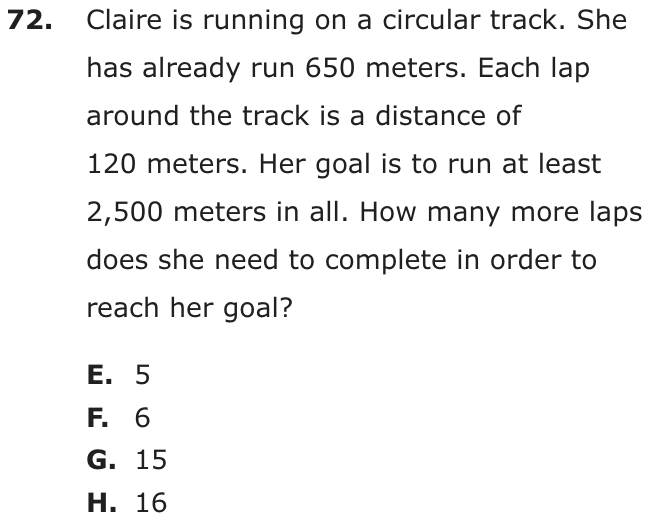
Claire is running on a circular track. She has already run 650 meters. Each lap around the track is a distance of 120 meters. Her goal is to run at least 2,500 meters in all. How many more laps does she need to complete in order to reach her goal?
- A5
- B6
- C15
- D16
Show the answer
Correct answer: D
Claire’s goal is to run at least 2,500 meters, and she has already run 650 meters.
Claire has at least 1,850 meters left to run. Divide by the distance around the track to find the number of laps she needs to complete:
Since she wants to run at least 2,500 meters, round 15.417 up to 16. Claire needs to run 16 laps to meet her goal.
Question analysis
A word problem about running laps: Claire has already run 650 meters on a 120-meter track and wants to run at least 2,500 meters in all. Students find how many more laps she must complete. Subtracting and dividing are straightforward; deciding what to do with the leftover part of a lap is the real test.
- Grade level
- Grade 7 content, by NYS standard
- Compared with grade 7
- At grade 7 Grade 7 students solve word problems that lead to inequalities like px + q ≥ r and interpret the solution in context. This is a typical three-step example, where the solution must be turned into a whole number of laps.
- Estimated difficulty
- Moderate: several steps, or a close reading with one strong distractor.
- Thinking it demands
- Depth of knowledge 2, skills and concepts · mainly apply
- What makes it hard
- Turning words into math moderate
- A very close wrong answer moderate
- Error-prone arithmetic minor
- Solution
- 3 steps
- Reading level
- Question and choices: about grade 3, 47 words.
- Students, last 30 days
- Not enough answers yet to show (it takes 10).
Why it is hard, traps and wrong answers (shows the answer)
Why it is hard
The arithmetic leads to about 15.4 laps, and the question is entirely about what to do with the fraction of a lap. Rounding to the nearest whole number is a habit that fails here, because the goal must be met or passed. Multiplying back, 15 × 120 = 1,800 and 16 × 120 = 1,920, shows which count actually covers the 1,850 meters still to run.
Turning words into math moderate Understanding the question
“At least 2,500 meters in all” means a part lap must still be run in full, so 1,850 ÷ 120 ≈ 15.4 has to be rounded up, against the usual rounding rule. (Hegarty, Mayer & Monk, 1995; Koedinger & Nathan, 2004)
A very close wrong answer moderate Choosing the answer
15 and 16 laps are one apart and both sit next to the quotient 15.4, so estimating cannot decide between them; only the condition that the goal be reached can. (Embretson & Wetzel, 1987; Gorin & Embretson, 2006; Ascalon et al., 2007)
Error-prone arithmetic minor Working it out
Dividing 1,850 by 120 by hand does not come out even, and long division by a three-digit number invites slips in placing the quotient. (Brown & Burton, 1978; Junker & Sijtsma, 2001)
Strategy: Subtract what she has run from 2,500, divide by 120, and check your whole number by multiplying it back: those laps must cover all of the remaining distance.
Traps
- Rounds too early: Rounds a value partway through, or rounds the wrong way, so the final answer drifts from the exact one.
- Answers a different question: A choice is right for another quantity: the other unknown, the rest instead of the part, the part instead of the whole.
The wrong answers, classified
A Answers a different question (King et al., 2004; Hegarty, Mayer & Monk, 1995)
Divides the 650 meters already run by 120 and rounds down to 5, counting laps finished so far instead of laps still needed.
B Answers a different question (King et al., 2004; Hegarty, Mayer & Monk, 1995)
Divides the 650 meters already run by 120, about 5.4, and rounds up as the goal requires, but for the distance done rather than the distance left.
C Rounds too early (King et al., 2004)
Finds 1,850 ÷ 120 ≈ 15.4 and rounds down to 15 by the usual rule, but 15 more laps leave her 50 meters short of the goal.
Worked solution, step by step
Formulas used
- Distance left
- Goal is the distance she wants to reach in all. Done is the distance she has already run. Subtract to find how far she still has to go.
- Number of laps
- Distance is how far she still has to run. One lap is the length of the track, 120 meters. Dividing tells how many laps fit into that distance. If it does not come out even, part of a lap is left over.
Sort out what you know
Claire has run 650 meters. One lap is 120 meters. Her goal is “at least 2,500 meters in all”. At least means 2,500 or more, so she must not fall short. You need how many more laps she must run.
Find the distance left
She still needs 1,850 meters. Watch out: divide the distance left, not the 650 meters she already ran. Dividing 650 by 120 leads to 5 or 6, choices A and B.
Divide by the length of a lap
The sign ≈ means about. Check with whole laps: . That leaves meters still to go. So 15 laps are not quite enough.
Round up to reach the goal
She needs part of one more lap. She has to complete whole laps, so she runs a 16th lap. Here you round up, even though 15.4 would usually round down. Watch out: 15 laps leave her 50 meters short, so choice C is wrong.
So the answer is D, 16.
Check your answer
Add up her total. With 15 more laps: meters, which is short of 2,500. With 16 more laps: meters. That reaches the goal.
More questions like this
The original DOE question
Question 4 of 8
2024 Test B Math, question 37Question
Raoul gave two musical performances. His second performance occurred 86 days after his first performance. If Raoul’s second performance was on a Tuesday, on what day of the week was his first performance?
- ASunday
- BMonday
- CWednesday
- DThursday
Show the answer
Correct answer: A
The total number of days (86) is divided by the number of days in a week (7).
The 2 days are counted back from Tuesday, so the first performance was on a Sunday.
Question analysis
Raoul's second musical performance came 86 days after his first and fell on a Tuesday. Students work out the day of the week of the first performance. It tests division with remainders in a repeating weekly cycle, and the traps are counting in the wrong direction or miscounting the leftover days.
- NYS standards
- 6.NS.2 multi-digit division
- Grade level
- Grade 6 content, by NYS standard
- Compared with grade 7
- At grade 7 Dividing with a remainder is grade 6 arithmetic, but using the remainder to step through a seven-day cycle, and counting backward, is less routine than grade 7 classwork. It needs care with direction rather than new content.
- Estimated difficulty
- Moderate: several steps, or a close reading with one strong distractor.
- Thinking it demands
- Depth of knowledge 2, skills and concepts · mainly apply
- What makes it hard
- No obvious method moderate
- Turning words into math minor
- Solution
- 2 steps
- Reading level
- Question and choices: about grade 5, 36 words.
- Students, last 30 days
- Not enough answers yet to show (it takes 10).
Why it is hard, traps and wrong answers (shows the answer)
Why it is hard
Counting 86 days one at a time is hopeless in the time allowed, so the question rewards seeing that whole weeks return to the same weekday. Two decisions remain after that, and each has a listed wrong answer: which way to count, and whether Tuesday itself is one of the 2 days. Saying the days aloud, Monday is 1 back and Sunday is 2 back, avoids both.
No obvious method moderate Working it out
Nothing in the stem says to divide by 7; the key is that 84 of the 86 days are exactly 12 weeks, which leaves only 2 days to count. (Schoenfeld, 1985)
Turning words into math minor Understanding the question
"His second performance occurred 86 days after his first" puts the unknown day before the Tuesday, so the leftover days are counted backward. (Hegarty, Mayer & Monk, 1995; Koedinger & Nathan, 2004)
Strategy: Remove whole weeks from the 86 days, since each full week lands on the same weekday, then count the leftover days backward from Tuesday.
Traps
- Negatives and direction: Arithmetic with negative numbers, the order of a subtraction, or direction on a number line. (Moving a term across the equals sign without changing its sign is a faulty procedure.)
- Counting the ends: Inclusive or exclusive ends, fence posts, consecutive numbers: an answer that is one too many or too few, or an endpoint drawn open where it belongs closed (or the reverse).
The wrong answers, classified
B Counting the ends (Brown & Burton, 1978)
Counts Tuesday itself as the first of the 2 leftover days, so moves back only one day, to Monday.
C Negatives and direction (Brown & Burton, 1978)
Counts forward from Tuesday instead of back and also counts Tuesday as one of the 2 days, landing on Wednesday.
D Negatives and direction (Brown & Burton, 1978)
Counts the 2 leftover days forward from Tuesday, finding the day 86 days after the second performance instead of before it.
Worked solution, step by step
Formulas used
- Weeks and leftover days
- days is the total number of days. weeks is the number of full weeks inside it. leftover is the days that remain, from 0 to 6. The day of the week repeats every 7 days, so only the leftover days change it.
Sort out the question
The second show was on a Tuesday. It came 86 days after the first show. So the first show was 86 days before that Tuesday.
You need the day of the week of the first show. So you count back 86 days from Tuesday.
Take out the full weeks
Counting back 86 days one at a time is slow. Here is a shortcut. Every 7 days, the same weekday comes back. So divide 86 by 7.
That is 12 full weeks and 2 extra days. Going back 12 weeks from a Tuesday lands on a Tuesday again.
Count back the 2 extra days
Start on Tuesday and go back one day at a time. One day back is Monday. Two days back is Sunday.
Watch out: Do not count Tuesday itself as one of the 2 days. That lands on Monday, choice B. And count backward, not forward. Counting forward 2 days gives Thursday, choice D.
So the answer is A, Sunday.
Check your answer
Count forward to be sure. Start on a Sunday. After 84 days, which is 12 weeks, it is Sunday again. Two more days are Monday and Tuesday. That is day 86, a Tuesday. It matches.
More questions like this
The original DOE question
Question 5 of 8
2023 Test A Math, question 31Question
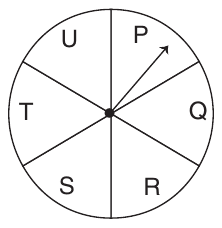
The arrow starts on Space P and moves clockwise around the circle. It moves through one space each minute. What space will the arrow point to in 100 minutes?
- AR
- BS
- CT
- DU
Show the answer
Correct answer: C
There are 6 spaces, so first divide 100 by 6: , remainder 4. So, the arrow goes around 16 full times and then 4 more spaces. Four spaces from Space P is Space T.
Question analysis
This patterns question shows a circle split into six lettered spaces, with an arrow that starts on P and moves one space clockwise each minute, and asks where it points after 100 minutes. Students use division with a remainder to skip the full trips around. Counting the leftover moves without including the starting space, and in the right direction, is the tricky part.
- NYS standards
- 6.NS.2 multi-digit division
- Grade level
- Grade 6 content, by NYS standard
- Compared with grade 7
- At grade 7 Division with a remainder is grade 6 arithmetic, but using that remainder to step around a six-part circle is a pattern task that grade 7 classes seldom practice. It needs careful counting rather than new content.
- Estimated difficulty
- Straightforward: two steps or one careful reading.
- Thinking it demands
- Depth of knowledge 2, skills and concepts · mainly apply
- What makes it hard
- Solution
- 2 steps
- Reading level
- Question and choices: about grade 1, 32 words.
- Students, last 30 days
- Not enough answers yet to show (it takes 10).
Why it is hard, traps and wrong answers (shows the answer)
Why it is hard
The division is short; the points are lost in turning the remainder into a space. The arrow starts on P, so the 4 leftover moves land on Q, R, S and T, and counting P itself as a move stops one space short. Going around the wrong way, or one move too far, gives the other two choices. Checking a small case first, such as 7 minutes landing on Q, fixes the rule before it is used.
No obvious method minor Working it out
The stem never mentions division; the step that unlocks it is seeing that every 6 minutes brings the arrow back to P, so only the remainder of 100 ÷ 6 matters. (Schoenfeld, 1985)
Reading a figure, table or graph minor Understanding the question
The six spaces and their clockwise order, P, Q, R, S, T, U, appear only in the circle diagram, so the cycle length and the direction of counting both come from the figure. (Lesh, Post & Behr, 1987; Kirsch & Mosenthal, 1990)
Strategy: Divide 100 by 6: every full trip around the circle brings the arrow back to P, so only the remainder matters; count that many moves clockwise, starting with the space after P.
Traps
- Counting the ends: Inclusive or exclusive ends, fence posts, consecutive numbers: an answer that is one too many or too few, or an endpoint drawn open where it belongs closed (or the reverse).
- Negatives and direction: Arithmetic with negative numbers, the order of a subtraction, or direction on a number line. (Moving a term across the equals sign without changing its sign is a faulty procedure.)
The wrong answers, classified
A Negatives and direction (Brown & Burton, 1978)
Counts the 4 leftover moves counterclockwise from P, through U, T and S to R, instead of clockwise as the stem says the arrow moves.
B Counting the ends (Brown & Burton, 1978)
Counts Space P itself as the first of the 4 leftover moves, P, Q, R, S, so the arrow stops one space short of where it really points.
D Counting the ends (Brown & Burton, 1978)
Makes 5 moves past P instead of the 4 left after 16 full turns, overshooting by one space, the fence-post slip in the other direction.
Worked solution, step by step
Formulas used
- Division with a remainder
- a is the number you divide, here the minutes. b is the number you divide by, here the spaces in one trip around. q is how many whole groups of b fit into a. r is the remainder, the amount left over. The remainder is always less than b.
Sort out the question
The circle has 6 spaces. Going clockwise, the way a clock’s hands turn, they are P, Q, R, S, T and U. The arrow starts on P and moves one space each minute. You need the space it points to after 100 minutes.
Notice that the pattern repeats
After 6 minutes, the arrow has gone all the way around and points to P again. After 12 minutes it is back on P again, and so on. So full trips of 6 minutes don’t change where it points. Only the leftover minutes matter.
Divide 100 by 6
The arrow makes 16 full trips. That takes minutes, and it is back on P. There are 4 minutes left over.
Count the last 4 moves
From P, move one space each minute: Q (minute 97), R (minute 98), S (minute 99), T (minute 100).
Watch out: don’t count P itself as the first move. That stops on S, choice B. Also count clockwise. Counting the other way lands on R, choice A.
So the answer is C, T.
Check your answer
Use a smaller number with the same remainder. 100 − 96 = 4, and 96 minutes is a whole number of trips. So after 100 minutes the arrow points where it does after 4 minutes. Four moves from P are Q, R, S, T. That is T again.
More questions like this
The original DOE question
Question 6 of 8
2023 Test A Math, question 54Question
A train travels 2,200 miles from Phoenix to New York City. The train covers the first 240 miles in 5 hours. If the train continues to travel at this rate, how many more hours will it take to reach New York City? Round your answer to the nearest whole hour.
- A46
- B45
- C43
- D41
Show the answer
Correct answer: D
First, find the speed of the train in miles per hour: .
The number of miles left to travel is .
To find the number of hours left, use the equation :
| Apply the multiplicative inverse property; divide both sides of the equation by 48. | |
That number rounded to the nearest whole hour is 41 hours.
Question analysis
This rate word problem describes a 2,200-mile train trip from Phoenix to New York City in which the first 240 miles take 5 hours, and asks how many more hours the rest will take, rounded to the nearest hour. Students find a unit rate and the remaining distance. The choices are close together, so the time for the whole trip is a tempting trap.
- Grade level
- Grade 6 content, by NYS standard
- Compared with grade 7
- At grade 7 Unit rates are grade 6 content, but this chains four steps: a speed, the distance left, a long division that does not come out even, and rounding. The word more must be read closely, which puts it at typical grade 7 demand.
- Estimated difficulty
- Moderate: several steps, or a close reading with one strong distractor.
- Thinking it demands
- Depth of knowledge 2, skills and concepts · mainly apply
- What makes it hard
- Many steps moderate
- Turning words into math minor
- Error-prone arithmetic minor
- Solution
- 4 steps
- Reading level
- Question and choices: about grade 4, 47 words.
- Students, last 30 days
- Not enough answers yet to show (it takes 10).
Why it is hard, traps and wrong answers (shows the answer)
Why it is hard
Each step is routine, but the question has a long chain and asks for only part of the trip. Dividing the whole 2,200 miles by the speed is the natural shortcut and gives a listed choice, and the rounding instruction adds a second place to go wrong. Checking that 41 hours at 48 miles per hour covers about 1,970 miles, close to the 1,960 left, confirms the answer.
Many steps moderate Working it out
Four steps follow in order, the speed 240 ÷ 5 = 48, the miles left 2,200 − 240 = 1,960, the time 1,960 ÷ 48, and the rounding, and an early slip carries through. (Daniel & Embretson, 2010; Enright, Morley & Sheehan, 2002)
Turning words into math minor Understanding the question
The bold more in “how many more hours” limits the question to the 1,960 miles still ahead, though 2,200, the whole trip, is the distance the stem names first. (Hegarty, Mayer & Monk, 1995; Koedinger & Nathan, 2004)
Error-prone arithmetic minor Working it out
Dividing 1,960 by 48 leaves 40 with a remainder of 40, so the time, 40 5/6 hours, must be rounded up to the nearest hour rather than cut short. (Brown & Burton, 1978; Junker & Sijtsma, 2001)
Strategy: Find the train's speed from the first 240 miles, subtract those miles from the total to get the distance left, divide by the speed, and round only at the end.
Traps
- Answers a different question: A choice is right for another quantity: the other unknown, the rest instead of the part, the part instead of the whole.
- An arithmetic slip: The right method with a plausible arithmetic error: a digit, a place value or a times-table fact.
- Rounds too early: Rounds a value partway through, or rounds the wrong way, so the final answer drifts from the exact one.
The wrong answers, classified
A Answers a different question (King et al., 2004; Hegarty, Mayer & Monk, 1995)
Divides the whole 2,200 miles by 48 miles per hour, about 45.8, or 46 hours, the time for the entire trip rather than the hours still to go.
B Rounds too early (King et al., 2004)
Divides the whole 2,200 miles by 48 and then cuts 45.8 down to 45 instead of rounding to the nearest hour, two errors at once.
C An arithmetic slip (Junker & Sijtsma, 2001)
Subtracts 240 from 2,200 without reducing the hundreds after borrowing, getting 2,060 instead of 1,960, and 2,060 ÷ 48 ≈ 42.9 rounds to 43.
Worked solution, step by step
Formulas used
- Distance, rate and time
- d is the distance, r is the rate or speed, and t is the time. If you know two of them, you can find the third. To find the speed, divide the distance by the time. To find the time, divide the distance by the speed.
Sort out the question
The whole trip is 2,200 miles. The train goes the first 240 miles in 5 hours, and it keeps that speed. You need how many more hours it takes, rounded to the nearest whole hour. “More” means the time after the first 240 miles.
Find the train’s speed
Divide the 240 miles by the 5 hours. The train goes 48 miles per hour.
Find the miles still to go
There are 1,960 miles left. Watch out: use the miles left, not the whole trip. Dividing 2,200 by 48 gives about 45.8 hours, which leads to 46 or 45, choices A and B.
Find the hours still to go
Here 48 × 40 = 1,920, and 40 miles are left over. That leftover is of an hour.
Round to the nearest hour
of an hour is more than half an hour, so round up to 41. Watch out: don’t just drop the fraction.
So the answer is D, 41 hours.
Check your answer
At 48 miles per hour, 41 hours covers miles. That is just a bit more than 1,960, as it should be after rounding up. In 40 hours, the train would cover only 1,920 miles, which is not enough.
More questions like this
The original DOE question
Question 7 of 8
2023 Test B Math, question 51Question
A number, n, is divided by 25. If the quotient is 10 with a remainder of 5, what is the quotient expressed as a decimal?
- A10.20
- B10.25
- C10.50
- D10.75
Show the answer
Correct answer: A
A quotient of 10 with a remainder of 5 means the quotient is
Question analysis
A number is divided by 25, giving a quotient of 10 with a remainder of 5, and students write the quotient as a decimal. It tests what a remainder means and how it becomes part of a decimal quotient. Connecting the remainder to the decimal part of the answer is the key idea.
- Grade level
- Grade 6 content, by NYS standard
- Compared with grade 7
- Below grade 7 Division with remainders and decimal quotients are grade 6 skills. This takes two short steps, with no word problem to translate, though students must know what a remainder means once a quotient is written as a decimal.
- Estimated difficulty
- Straightforward: two steps or one careful reading.
- Thinking it demands
- Depth of knowledge 1, recall and reproduction · mainly apply
- What makes it hard
- Something you must already know moderate
- Solution
- 2 steps
- Reading level
- Question and choices: about grade 5, 22 words.
- Students, last 30 days
- Not enough answers yet to show (it takes 10).
Why it is hard, traps and wrong answers (shows the answer)
Why it is hard
The question checks one idea: a remainder is a fraction of the divisor, not a string of digits to place after the point. Students who write the remainder 5 as tenths, or set the divisor 25 after the point, land on listed choices. Rebuilding n = 25 × 10 + 5 = 255 and dividing by 25 confirms the decimal.
Something you must already know moderate Working it out
A remainder of 5 means 5 out of the 25 needed for another whole, so it becomes 5/25 = 0.2, a link between remainders and decimals the question assumes. (Anderson & Krathwohl, 2001)
Strategy: Rebuild n from the quotient and the remainder, then divide it by 25 to a decimal; or write the remainder as a fraction of the divisor.
Traps
- Misunderstands the concept: A wrong belief about a concept: that percents can be added, that area grows like length, that averages can be averaged, that a bigger denominator means a bigger fraction.
- Numbers taken from the question: Combines the numbers in the question without a model of the situation, or is simply a number that appears in the question.
The wrong answers, classified
B Numbers taken from the question (Hegarty, Mayer & Monk, 1995)
Writes the divisor, 25, after the decimal point, setting the stem’s numbers 10 and 25 side by side instead of turning the remainder into a fraction.
C Misunderstands the concept (Smith, diSessa & Roschelle, 1993; De Bock et al., 1998; Ni & Zhou, 2005)
Writes the remainder 5 as the tenths digit, 10.5, believing a remainder becomes the digits after the decimal point.
D Little reason to choose it (Haladyna & Downing, 1993; Rodriguez, 2005)
No common working gives 10.75; it treats the remainder as three quarters of the divisor, which nothing in the stem suggests, so it mostly draws guesses.
Worked solution, step by step
Formulas used
- Quotient with a remainder
- d is the divisor, the number you divide by. q is the whole-number part of the quotient, the answer to the division. r is the remainder, what is left over. The leftover still has to be divided by d, so it becomes the fraction r over d.
Sort out the words
n is divided by 25. So 25 is the divisor, the number you divide by. The quotient is the answer to a division. Here it is 10 with a remainder of 5. The remainder is the amount left over. You need the exact quotient as a decimal.
Turn the remainder into a fraction
The 5 left over still has to be divided by 25. So it becomes the fraction . Use the formula.
Change the fraction to a decimal
Simplify first. Divide the top and bottom by 5. Then write the fraction in hundredths.
So the quotient is 10 + 0.20 = 10.20.
Give the answer
Watch out: A remainder is not the digits after the decimal point. Writing the 5 after the point gives 10.50, choice C. Writing the 25 after it gives 10.25, choice B.
So the answer is A, 10.20.
Check your answer
Rebuild n. Ten 25s plus the 5 left over is . Now divide: . That matches 10.20.
More questions like this
The original DOE question
Question 8 of 8
2018 Test A Math, question 48Question
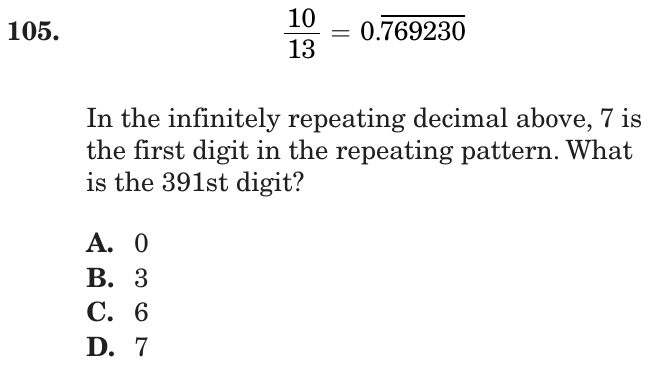
In the infinitely repeating decimal above, 7 is the first digit in the repeating pattern. What is the 391st digit?
- A0
- B3
- C6
- D7
Show the answer
Correct answer: D
There are 6 digits in the repeating decimal (769230), so 7 would be the first, seventh, thirteenth digit and so on.
To find the 391st digit, divide 391 by 6.
391 ÷ 6 = 65 R1
Since the remainder is 1, that means the 391st digit is the same as the 1st digit, which is 7.
Question analysis
This repeating decimal question shows the six-digit repeating pattern of 10/13 and asks for the 391st digit after the decimal point. Students must use the length of the repeating block and division with a remainder to find the position within the cycle. Matching the remainder to the right digit is where students slip.
- Grade level
- Grade 7 content, by NYS standard
- Compared with grade 7
- Above grade 7 Seventh graders learn that fractions have repeating decimals. Using the length of the repeating block and a remainder to find a digit hundreds of places away is a pattern-reasoning step beyond typical seventh-grade classwork.
- Estimated difficulty
- Hard: combines ideas, needs a plan, and has more than one tempting wrong answer.
- Thinking it demands
- Depth of knowledge 2, skills and concepts · mainly apply
- What makes it hard
- No obvious method moderate
- Solution
- 2 steps
- Reading level
- Question and choices: about grade 8, 20 words.
- Students, last 30 days
- Not enough answers yet to show (it takes 10).
Why it is hard, traps and wrong answers (shows the answer)
Why it is hard
Once the cycle length is used, the arithmetic is a single division, 391 ÷ 6 = 65 remainder 1. The difficulty is turning the remainder into a position: remainder 1 is the first digit of a new block, not the last digit of the previous one or the second of the new one. Checking the rule on small positions, the 1st and 7th digits are both 7, removes the doubt.
No obvious method moderate Working it out
Nothing in the stem mentions division; students must see that the six-digit block 769230 repeats, so position 391 depends only on the remainder of 391 divided by 6. (Schoenfeld, 1985)
Strategy: Divide 391 by the length of the repeating block and look only at the remainder; a remainder of r points to the r-th digit of the block.
Traps
- Counting the ends: Inclusive or exclusive ends, fence posts, consecutive numbers: an answer that is one too many or too few, or an endpoint drawn open where it belongs closed (or the reverse).
The wrong answers, classified
A Counting the ends (Brown & Burton, 1978)
Sees that 65 blocks fill 390 places and lands on the 390th digit, the 0 that ends a block, one place short.
B A faulty procedure (Brown & Burton, 1978; Tatsuoka, 1983)
Uses the quotient 65 instead of the remainder, takes its last digit 5, and reads the fifth digit of 769230, which is 3.
C Counting the ends (Brown & Burton, 1978)
Treats the remainder 1 as one step past the block's first digit, moving from 7 to the second digit, 6.
Worked solution, step by step
Formulas used
- Division with a remainder
- n is the number you divide. d is what you divide by. q is the quotient, the number of whole groups. r is the remainder, what is left over. Here it tells how many full blocks of digits fit, and where you land after them.
Sort out what you know
The bar over 769230 means those six digits repeat forever: 769230769230 and so on. The 7 is digit number 1. You need digit number 391.
Spot the pattern
The block 769230 has 6 digits, so the pattern starts over every 6 digits. Digit 1 is 7, and so are digits 7, 13, 19 and so on. Each full block ends with a 0, at digits 6, 12, 18 and so on.
Divide 391 by 6
Find how many full blocks fit into 391 digits, and what is left:
So 65 full blocks use up 6 × 65 = 390 digits. The remainder is 1. That means digit 391 is the 1st digit of the next block.
Read the digit
The 1st digit of the block is 7. Watch out: digit 390 is the last digit of a full block, which is 0. That is choice A. Digit 391 is one step past it, so it starts a new block.
So the answer is D, 7.
Check your answer
Test the idea on a small number. Digit 7: 7 = 6 × 1 + 1, so the remainder is 1 and the digit should be 7. Write it out: 7692307. The 7th digit is indeed 7. The rule works.
More questions like this
The original DOE question