3 English and 3 math
Here are 6 random questions to try. Takers earning below 75% are unlikely to receive an offer. You have 1 minute 48 seconds per question on the real exam.
Question 1 of 6
2024 Test A English, question 46Passage Excerpt from The Highest Tide
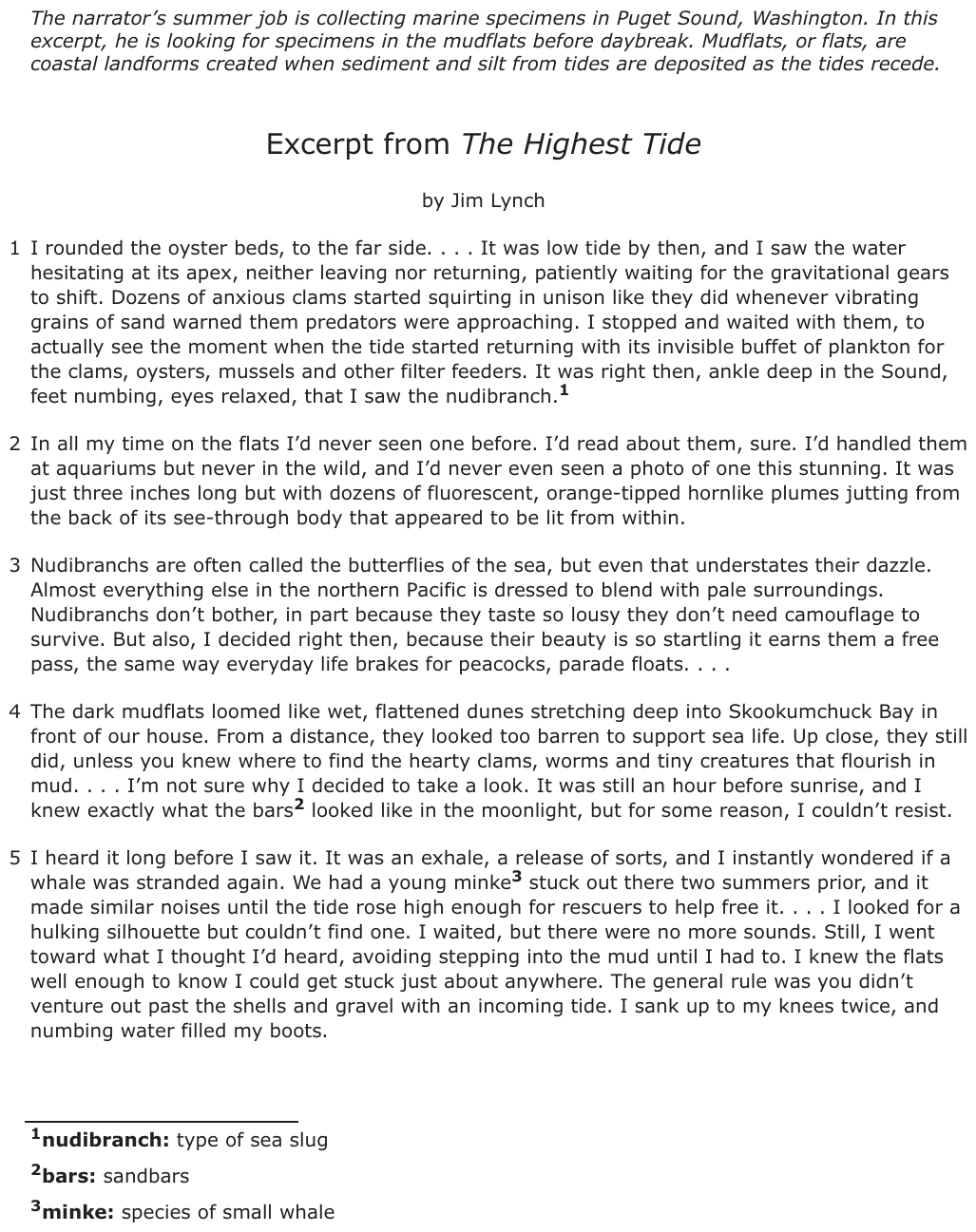
Excerpt from The Highest Tide
by Jim Lynch
The narrator’s summer job is collecting marine specimens in Puget Sound, Washington. In this excerpt, he is looking for specimens in the mudflats before daybreak. Mudflats, or flats, are coastal landforms created when sediment and silt from tides are deposited as the tides recede.
I rounded the oyster beds, to the far side. . . . It was low tide by then, and I saw the water hesitating at its apex, neither leaving nor returning, patiently waiting for the gravitational gears to shift. Dozens of anxious clams started squirting in unison like they did whenever vibrating grains of sand warned them predators were approaching. I stopped and waited with them, to actually see the moment when the tide started returning with its invisible buffet of plankton for the clams, oysters, mussels and other filter feeders. It was right then, ankle deep in the Sound, feet numbing, eyes relaxed, that I saw the nudibranch.1
In all my time on the flats I’d never seen one before. I’d read about them, sure. I’d handled them at aquariums but never in the wild, and I’d never even seen a photo of one this stunning. It was just three inches long but with dozens of fluorescent, orange-tipped hornlike plumes jutting from the back of its see-through body that appeared to be lit from within.
Nudibranchs are often called the butterflies of the sea, but even that understates their dazzle. Almost everything else in the northern Pacific is dressed to blend with pale surroundings. Nudibranchs don’t bother, in part because they taste so lousy they don’t need camouflage to survive. But also, I decided right then, because their beauty is so startling it earns them a free pass, the same way everyday life brakes for peacocks, parade floats. . . .
The dark mudflats loomed like wet, flattened dunes stretching deep into Skookumchuck Bay in front of our house. From a distance, they looked too barren to support sea life. Up close, they still did, unless you knew where to find the hearty clams, worms and tiny creatures that flourish in mud. . . . I’m not sure why I decided to take a look. It was still an hour before sunrise, and I knew exactly what the bars2 looked like in the moonlight, but for some reason, I couldn’t resist.
I heard it long before I saw it. It was an exhale, a release of sorts, and I instantly wondered if a whale was stranded again. We had a young minke3 stuck out there two summers prior, and it made similar noises until the tide rose high enough for rescuers to help free it. . . . I looked for a hulking silhouette but couldn’t find one. I waited, but there were no more sounds. Still, I went toward what I thought I’d heard, avoiding stepping into the mud until I had to. I knew the flats well enough to know I could get stuck just about anywhere. The general rule was you didn’t venture out past the shells and gravel with an incoming tide. I sank up to my knees twice, and numbing water filled my boots.
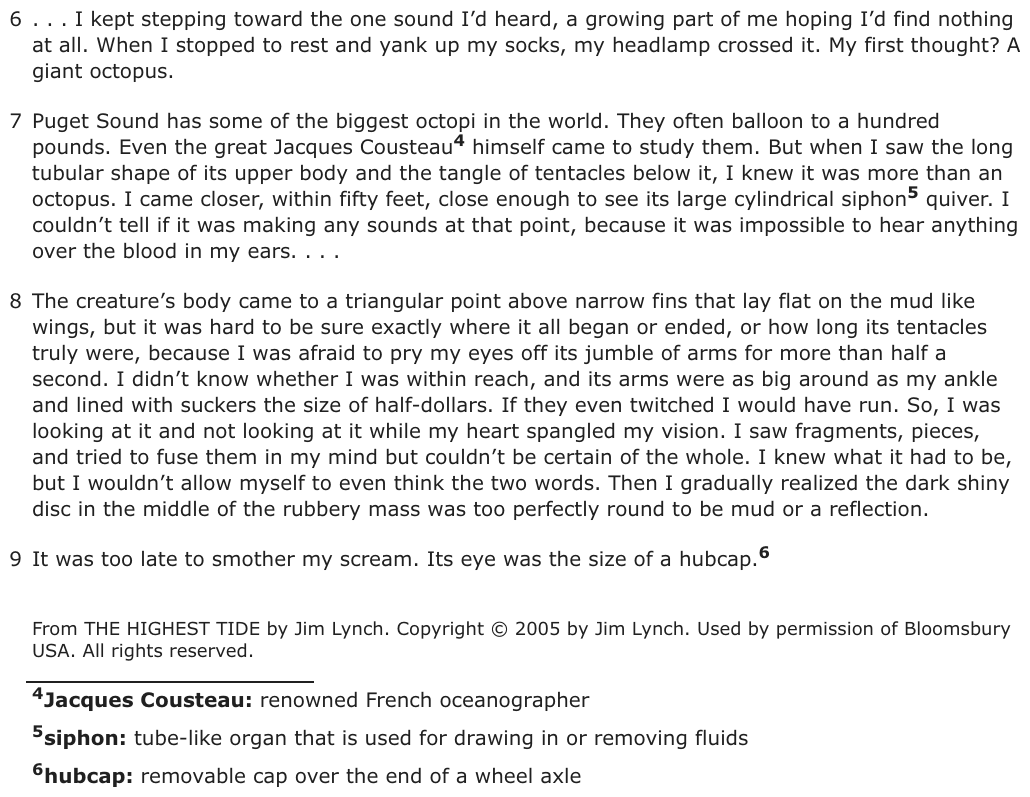
. . . I kept stepping toward the one sound I’d heard, a growing part of me hoping I’d find nothing at all. When I stopped to rest and yank up my socks, my headlamp crossed it. My first thought? A giant octopus.
Puget Sound has some of the biggest octopi in the world. They often balloon to a hundred pounds. Even the great Jacques Cousteau4 himself came to study them. But when I saw the long tubular shape of its upper body and the tangle of tentacles below it, I knew it was more than an octopus. I came closer, within fifty feet, close enough to see its large cylindrical siphon5 quiver. I couldn’t tell if it was making any sounds at that point, because it was impossible to hear anything over the blood in my ears. . . .
The creature’s body came to a triangular point above narrow fins that lay flat on the mud like wings, but it was hard to be sure exactly where it all began or ended, or how long its tentacles truly were, because I was afraid to pry my eyes off its jumble of arms for more than half a second. I didn’t know whether I was within reach, and its arms were as big around as my ankle and lined with suckers the size of half-dollars. If they even twitched I would have run. So, I was looking at it and not looking at it while my heart spangled my vision. I saw fragments, pieces, and tried to fuse them in my mind but couldn’t be certain of the whole. I knew what it had to be, but I wouldn’t allow myself to even think the two words. Then I gradually realized the dark shiny disc in the middle of the rubbery mass was too perfectly round to be mud or a reflection.
It was too late to smother my scream. Its eye was the size of a hubcap.6
From THE HIGHEST TIDE by Jim Lynch. Copyright © 2005 by Jim Lynch. Used by permission of Bloomsbury USA. All rights reserved.
1nudibranch: type of sea slug
2bars: sandbars
3minke: species of small whale
4Jacques Cousteau: renowned French oceanographer
5siphon: tube-like organ that is used for drawing in or removing fluids
6hubcap: removable cap over the end of a wheel axle
Question
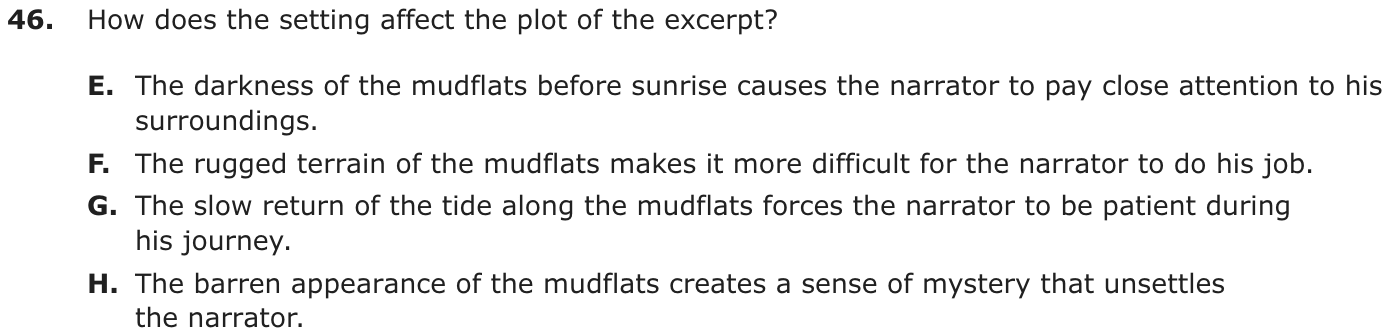
How does the setting affect the plot of the excerpt?
- AThe darkness of the mudflats before sunrise causes the narrator to pay close attention to his surroundings.
- BThe rugged terrain of the mudflats makes it more difficult for the narrator to do his job.
- CThe slow return of the tide along the mudflats forces the narrator to be patient during his journey.
- DThe barren appearance of the mudflats creates a sense of mystery that unsettles the narrator.
Show the answer
Correct answer: A
The question asks how the setting affects the plot of the excerpt.
A. CORRECT. In paragraph 4, the narrator says that it is an hour before sunrise. It is difficult to see because the mudflats are dark, so the narrator, while familiar with the terrain of the mudflats, is cautious.
B. Incorrect. While the terrain of the mudflats is challenging because of the “wet, flattened dunes” (paragraph 4), the narrator is familiar with the terrain and moves carefully. In addition, the excerpt focuses on the narrator’s curiosity and enjoyment as he explores the mudflats, not on his work collecting specimens.
C. Incorrect. In paragraph 1, the narrator watches the water “hesitating at its apex” and “patiently waiting for the gravitational gears to shift.” This illustrates that the narrator is already familiar with the changes in his surroundings, that the tide is slow to move in, and that he can move carefully through the mudflats without the threat of rising water.
D. Incorrect. While the narrator is on the mudflats for the entire excerpt, the phrase “eyes relaxed” in paragraph 1 indicates that the narrator feels comfortable there. The narrator does not show fear until paragraph 6, when a growing fear about the unknown creature arises.
Question analysis
Set on the mudflats of Puget Sound before daybreak, this excerpt from the novel The Highest Tide is the basis for a question about how setting affects plot. Students must link features of the place and time to what the narrator does across the whole excerpt, and each choice pairs a real feature of the setting with an effect that may or may not be in the text.
- Grade level
- Grade 8 reading and task
- Compared with grade 7
- Above grade 7 Analyzing how setting shapes plot is a grade 7 literary standard, but the excerpt never states the link: the effect must be inferred from scattered details, and every choice names a genuine feature of the flats, which is beyond typical work.
- Estimated difficulty
- Hard: combines ideas, needs a plan, and has more than one tempting wrong answer.
- Thinking it demands
- Depth of knowledge 3, strategic thinking · mainly analyze
- What makes it hard
- Reading between the lines major
- The right answer is reworded moderate
- Evidence in several places moderate
- Evidence
- Answered from the whole text
- Reading level
- Passage: about grade 6, 902 words; question and choices: about grade 8, 77 words.
- Corrected from the DOE handbook
- A statement in the explanation that contradicted the excerpt’s introduction was corrected.
- Students, last 30 days
- Not enough answers yet to show (it takes 10).
Why it is hard, traps and wrong answers (shows the answer)
Why it is hard
Every choice names a real feature of the mudflats, so the question turns on which feature the excerpt actually shows shaping events. The darkness never gets a sentence of its own; it is felt in a sound heard before anything is seen, a silhouette that cannot be found and a headlamp beam. The barren look of the flats is the strongest pull, because the scene is eerie, but the narrator knows life hides in the mud and his unease comes from the creature.
Reading between the lines major Working it out
The excerpt never says the darkness changes anything; the effect must be assembled from the hour before sunrise, the sound heard “long before I saw it”, the missing silhouette and the headlamp that finally finds the creature. (Graesser, Singer & Trabasso, 1994; Kintsch, 1998)
The right answer is reworded moderate Choosing the answer
The right choice uses no words from the text, while the wrong ones echo it: the “barren” look of the flats, the water “patiently waiting”, the narrator's summer job. (Freedle & Kostin, 1993; Kirsch & Mosenthal, 1990)
Evidence in several places moderate Working it out
The darkness is established in paragraph 4 and felt in paragraphs 5, 6 and 8, so no single passage shows the setting at work. (Kirsch & Mosenthal, 1990; Gorin & Embretson, 2006)
Strategy: Collect the details of time, place and conditions across the excerpt, then for each choice ask whether the text shows that feature of the setting actually changing what the narrator does.
Traps
- Twists what the text says: Uses the text's topic and ideas but changes what it says: who did it, how much, when, or why.
- Reads too much in: A reasonable-sounding conclusion that goes further than the text allows.
The wrong answers, classified
B Reads too much in (Graesser, Singer & Trabasso, 1994)
Combines the introduction's specimen job with his sinking to his knees to infer a harder workday, though the excerpt follows a strange sound and never shows his work suffering.
C Twists what the text says (King et al., 2004)
Borrows paragraph 1's water “patiently waiting” at low tide and has the tide force the narrator to wait, when he chose to stop and watch it turn.
D Twists what the text says (King et al., 2004)
Joins the flats' barren look from a distance to his later fear, but he knows life hides in the mud, and what unsettles him is the creature, not the landscape.
What was corrected from the DOE handbook, and why
- Explanation: In rejecting choice B, the handbook says “the excerpt shows that the narrator explores the mudflats for curiosity and enjoyment, not work.” But the introduction says the narrator’s summer job is collecting marine specimens and that “in this excerpt, he is looking for specimens in the mudflats before daybreak.” The explanation now says the excerpt focuses on his curiosity and enjoyment as he explores the mudflats, not on his work collecting specimens. That keeps the handbook’s point (the excerpt is not about the terrain making his job harder) without contradicting the introduction.
Working it out, step by step
Know what setting and plot mean
The setting is where and when a story happens. The plot is the chain of events. This asks which part of the setting changes what happens or what the narrator does.
Find the time of day
Paragraph 4 says, “It was still an hour before sunrise.” The narrator is out on the mudflats in the dark. The only light comes from the moon and his headlamp.
See how the dark shapes events
Because it is dark, he must rely on sounds and small clues. He says, “I heard it long before I saw it.” He looks for “a hulking silhouette,” a dark outline, but can’t find one. He spots the creature only when “my headlamp crossed it.” Then he stares hard, trying to make out its shape. The darkness keeps him alert and watching closely.
Check each choice
- A fits: the dark makes him pay close attention to everything around him.
- B is wrong because the excerpt follows a strange sound and never shows the ground making his job harder.
- C is wrong because in paragraph 1 he chooses to stop and watch the tide, and nothing forces him.
- D is wrong because he knows life hides in the mud, and what scares him is the creature.
Watch out: D feels right because the scene is eerie. But the flats’ empty look never troubles him.
Choose the answer
The darkness before sunrise is what keeps the narrator listening and looking so carefully. So the answer is A.
Why this answer and not the closest wrong one
D comes closest, because the dark flats do feel spooky. But the narrator says they only look “too barren to support sea life” from far away, and he knows better. His fear comes from the creature. The darkness, though, shapes every step: he hears before he sees and must watch closely.
More questions like this
The original DOE question
The passage “Excerpt from The Highest Tide” as printed (pages 64–65)
Question 2 of 6
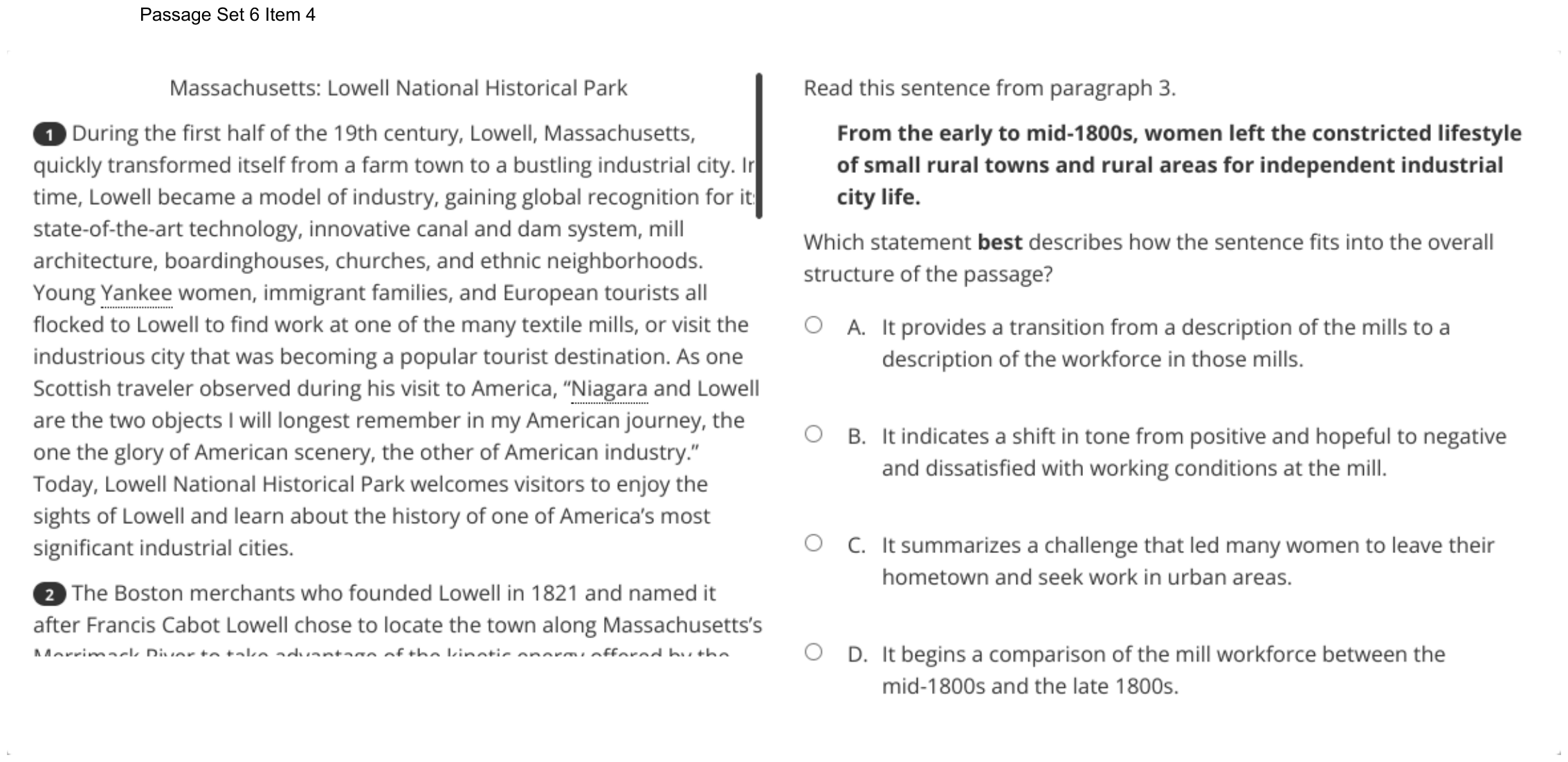
2026 Practice Test A English, question 39Passage Massachusetts: Lowell National Historical Park
Massachusetts: Lowell National Historical Park
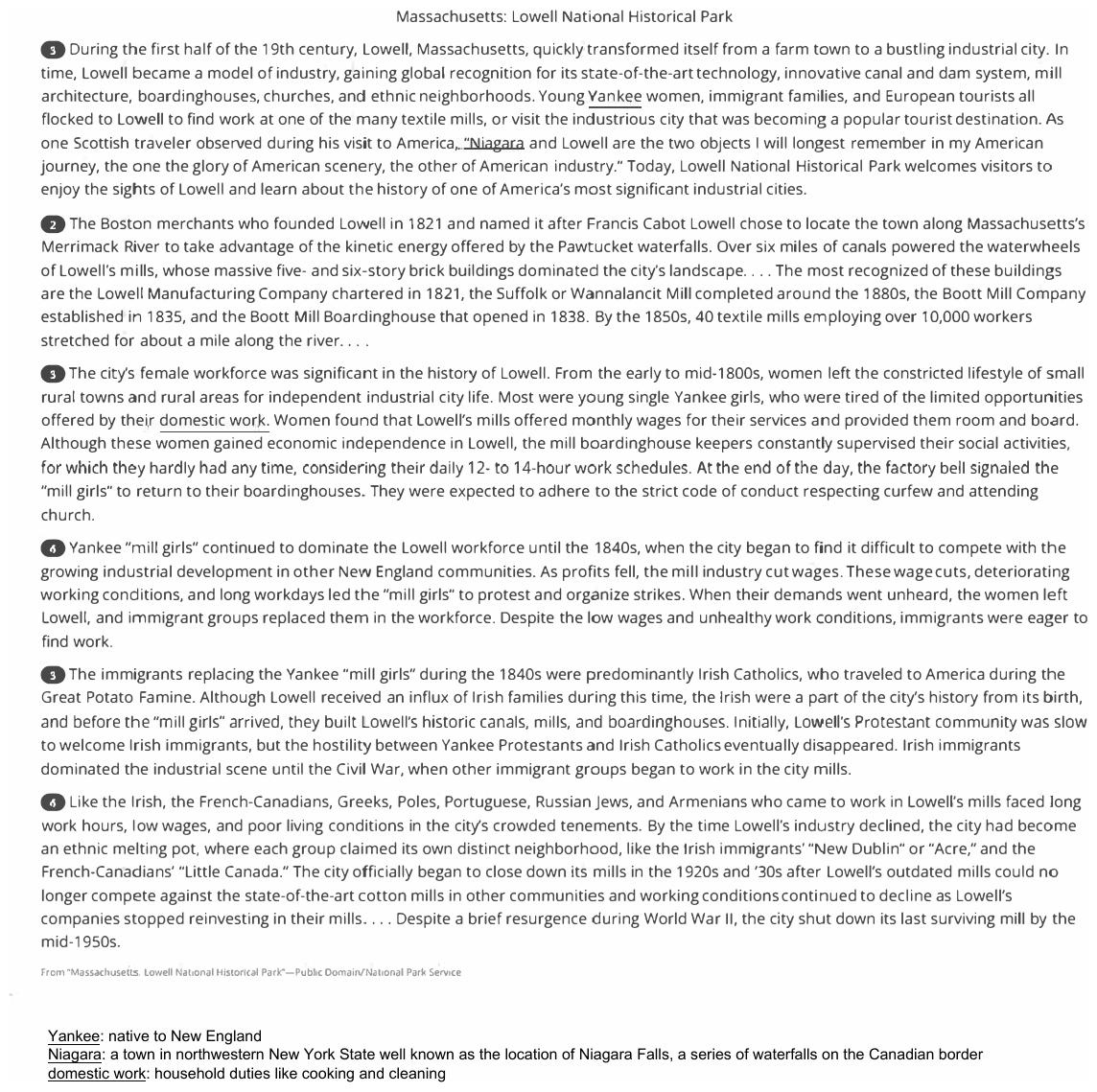
During the first half of the 19th century, Lowell, Massachusetts, quickly transformed itself from a farm town to a bustling industrial city. In time, Lowell became a model of industry, gaining global recognition for its state-of-the-art technology, innovative canal and dam system, mill architecture, boardinghouses, churches, and ethnic neighborhoods. Young Yankee women, immigrant families, and European tourists all flocked to Lowell to find work at one of the many textile mills, or visit the industrious city that was becoming a popular tourist destination. As one Scottish traveler observed during his visit to America, “Niagara and Lowell are the two objects I will longest remember in my American journey, the one the glory of American scenery, the other of American industry.” Today, Lowell National Historical Park welcomes visitors to enjoy the sights of Lowell and learn about the history of one of America’s most significant industrial cities.
The Boston merchants who founded Lowell in 1821 and named it after Francis Cabot Lowell chose to locate the town along Massachusetts’s Merrimack River to take advantage of the kinetic energy offered by the Pawtucket waterfalls. Over six miles of canals powered the waterwheels of Lowell’s mills, whose massive five- and six-story brick buildings dominated the city’s landscape. . . . The most recognized of these buildings are the Lowell Manufacturing Company chartered in 1821, the Suffolk or Wannalancit Mill completed around the 1880s, the Boott Mill Company established in 1835, and the Boott Mill Boardinghouse that opened in 1838. By the 1850s, 40 textile mills employing over 10,000 workers stretched for about a mile along the river. . . .
The city’s female workforce was significant in the history of Lowell. From the early to mid-1800s, women left the constricted lifestyle of small rural towns and rural areas for independent industrial city life. Most were young single Yankee girls, who were tired of the limited opportunities offered by their domestic work. Women found that Lowell’s mills offered monthly wages for their services and provided them room and board. Although these women gained economic independence in Lowell, the mill boardinghouse keepers constantly supervised their social activities, for which they hardly had any time, considering their daily 12- to 14-hour work schedules. At the end of the day, the factory bell signaled the “mill girls” to return to their boardinghouses. They were expected to adhere to the strict code of conduct respecting curfew and attending church.
Yankee “mill girls” continued to dominate the Lowell workforce until the 1840s, when the city began to find it difficult to compete with the growing industrial development in other New England communities. As profits fell, the mill industry cut wages. These wage cuts, deteriorating working conditions, and long workdays led the “mill girls” to protest and organize strikes. When their demands went unheard, the women left Lowell, and immigrant groups replaced them in the workforce. Despite the low wages and unhealthy work conditions, immigrants were eager to find work.
The immigrants replacing the Yankee “mill girls” during the 1840s were predominantly Irish Catholics, who traveled to America during the Great Potato Famine. Although Lowell received an influx of Irish families during this time, the Irish were a part of the city’s history from its birth, and before the “mill girls” arrived, they built Lowell’s historic canals, mills, and boardinghouses. Initially, Lowell’s Protestant community was slow to welcome Irish immigrants, but the hostility between Yankee Protestants and Irish Catholics eventually disappeared. Irish immigrants dominated the industrial scene until the Civil War, when other immigrant groups began to work in the city mills.
Like the Irish, the French-Canadians, Greeks, Poles, Portuguese, Russian Jews, and Armenians who came to work in Lowell’s mills faced long work hours, low wages, and poor living conditions in the city’s crowded tenements. By the time Lowell’s industry declined, the city had become an ethnic melting pot, where each group claimed its own distinct neighborhood, like the Irish immigrants’ “New Dublin” or “Acre,” and the French-Canadians’ “Little Canada.” The city officially began to close down its mills in the 1920s and ’30s after Lowell’s outdated mills could no longer compete against the state-of-the-art cotton mills in other communities and working conditions continued to decline as Lowell’s companies stopped reinvesting in their mills. . . . Despite a brief resurgence during World War II, the city shut down its last surviving mill by the mid-1950s.
From “Massachusetts: Lowell National Historical Park”—Public Domain/National Park Service
Yankee: native to New England
Niagara: a town in northwestern New York State well known as the location of Niagara Falls, a series of waterfalls on the Canadian border
domestic work: household duties like cooking and cleaning
Question
Read this sentence from paragraph 3.
From the early to mid-1800s, women left the constricted lifestyle of small rural towns and rural areas for independent industrial city life.
Which statement best describes how the sentence fits into the overall structure of the passage?
- AIt provides a transition from a description of the mills to a description of the workforce in those mills.
- BIt indicates a shift in tone from positive and hopeful to negative and dissatisfied with working conditions at the mill.
- CIt summarizes a challenge that led many women to leave their hometown and seek work in urban areas.
- DIt begins a comparison of the mill workforce between the mid-1800s and the late 1800s.
Show the answer
Correct answer: A
The question asks which statement best describes how the sentence in paragraph 3 fits into the overall structure of the passage.
A. CORRECT. The sentence in paragraph 3 provides a transition from the overall description of the city and the mills to a description of the women who made up the workforce in the mills. The idea that women left domestic life in favor of working in the mills is important in the passage, and the sentence serves to connect that idea to the previous discussion about the mills.
B. Incorrect. While the mill girls’ dissatisfaction with their working conditions is addressed later in the passage (“These wage cuts, deteriorating working conditions, and long workdays led the ‘mill girls’ to protest and organize strikes” [paragraph 4]), the sentence in paragraph 3 does not indicate a shift in tone from positive to negative. The sentence provides a transition to the discussion of the women who worked in the mills.
C. Incorrect. Although the sentence in paragraph 3 mentions that women became interested in working in the mills because of the “constricted lifestyle of small rural towns,” structurally the sentence does not function as a summary because, instead of expanding on the idea of the difficulties or challenges of life in small rural towns and rural areas, the paragraph goes on to describe the advantages and disadvantages of life in the city for these women.
D. Incorrect. The sentence in paragraph 3 focuses on the choices women made to leave rural towns to work in the city in the early to mid-1800s, not the mid-1800s to the late 1800s. The sentence does not create a comparison between the workforce in the mid-1800s and that in the late 1800s.
Question analysis
A sentence from the start of paragraph 3 of the Lowell article, about women leaving the limited life of rural towns for the city, is the focus of this text-structure question. Students decide how it fits into the structure of the passage as a whole, so they must place it within the order of all six paragraphs instead of judging it by itself.
- NYS standards
- 7R5 structure and genre features
- Grade level
- Grade 8 reading and task
- Compared with grade 7
- Above grade 7 Grade 7 structure questions often ask what a paragraph does. This one asks how a single sentence serves a six-paragraph history and offers four abstract roles, so the student must hold the passage's whole plan in mind, more than typical grade 7 work.
- Estimated difficulty
- Hard: combines ideas, needs a plan, and has more than one tempting wrong answer.
- Thinking it demands
- Depth of knowledge 3, strategic thinking · mainly analyze
- What makes it hard
- How, not what moderate
- Evidence in several places moderate
- Reading between the lines minor
- Evidence
- Answered from the whole text
- Reading level
- Passage: about grade 15, 764 words; question and choices: about grade 9, 116 words.
- Students, last 30 days
- Not enough answers yet to show (it takes 10).
Why it is hard, traps and wrong answers (shows the answer)
Why it is hard
The answer depends on seeing the passage's plan, mills first and then the people who ran them, and placing this sentence at the seam. Its wording invites a content answer instead, since it really does describe a hardship that drove women to the city, and the later strikes tempt students to see a darker tone beginning here. The fit of the key is also imperfect, because the paragraph's opening sentence starts the turn, so students must choose the best description rather than an exact one.
How, not what moderate Working it out
The question asks what the sentence does in the passage, and its content, women escaping a “constricted lifestyle,” is easy to restate, which makes a summary of that content feel like an answer. (Anderson & Krathwohl, 2001)
Evidence in several places moderate Working it out
The sentence's role shows only from its neighbors: paragraph 2 ends with 40 mills and 10,000 workers, and paragraph 3 then follows the women who left rural towns to work in them. (Kirsch & Mosenthal, 1990; Gorin & Embretson, 2006)
Reading between the lines minor Working it out
Paragraph 3's first sentence, “The city's female workforce was significant,” already names the new subject, so students must see this second sentence as part of the turn rather than a fresh point. (Graesser, Singer & Trabasso, 1994; Kintsch, 1998)
Strategy: Sum up each paragraph in a few words, then look at what comes just before and just after this sentence and decide what role it plays at that point in the passage.
Traps
- Wrong purpose or structure: Names a purpose, structure or effect that the part does not serve, or describes what a part says when the question asks what it does.
- Wrong tone or attitude: Misjudges the tone, attitude or point of view, such as reading admiration as criticism, or taking a character's or subject's feelings for the author's.
The wrong answers, classified
B Wrong tone or attitude (Graesser, Singer & Trabasso, 1994)
Expects a turn toward complaint because the mill girls later strike, but this sentence is hopeful about “independent industrial city life,” and the protests wait until paragraph 4.
C Wrong purpose or structure (Anderson & Krathwohl, 2001)
Restates what the sentence says, women escaping a “constricted lifestyle,” instead of what it does, and the paragraph goes on to life in Lowell rather than rural hardship.
D Wrong purpose or structure (Anderson & Krathwohl, 2001)
Sees the dates “early to mid-1800s” and expects a then-and-later contrast, though the sentence opens the mill girls' story and the passage sets up no such comparison.
Working it out, step by step
Figure out what the question asks
This is a structure question. Structure is how a passage is put together. You need to say what job this sentence does in the whole passage. Don’t just restate what it says. Ask what comes before it and what comes after it.
Look at what comes before
Paragraph 2 is all about the mills. It ends with “40 textile mills employing over 10,000 workers.” Then paragraph 3 begins: “The city’s female workforce was significant in the history of Lowell.” Workforce means the people who do the work. The sentence in the question comes right after that: “From the early to mid-1800s, women left the constricted lifestyle of small rural towns and rural areas for independent industrial city life.”
Look at what comes after
Constricted means tight and limited. So women left small, limited farm towns to live on their own in the city. After this, the passage stays with the workers. Paragraphs 3 and 4 tell about the mill girls’ wages, rules, strikes and leaving. Paragraphs 5 and 6 tell about the immigrants who replaced them. So the passage turns here, from the mills to the people who worked in them.
Check each choice
- A is right. The sentence helps carry the reader from the mills to the workforce in those mills.
- B is wrong. The tone isn’t negative here. “Independent industrial city life” sounds hopeful. The protests and strikes don’t come until paragraph 4.
- C is wrong. It tells what the sentence says, not what it does. And the paragraph goes on to life in Lowell, not to more about hard times back home.
- D is wrong. The passage never compares workers of the mid-1800s with workers of the late 1800s.
Watch out: C sounds right because the sentence really does describe a limited life that women wanted to leave. But the question asks about its role, not its content.
Choose the answer
Paragraph 3’s first sentence names the new subject. This sentence carries it forward by telling where the workers came from. Together they move the passage from mills to people. So the answer is A.
Why this answer and not the closest wrong one
C is the closest wrong answer. It is true that women wanted to escape a “constricted lifestyle.” But C describes what the sentence says, not the job it does. The paragraph then moves on to life in Lowell. A names the job: the sentence links the story of the mills to the story of the mill workers.
More questions like this
The original DOE question
The passage “Massachusetts: Lowell National Historical Park” as printed (page 50)
Question 3 of 6
2024 Test A English, question 55Passage Excerpt from “It’s Time to Stop Thinking That All Non-Native Species Are Evil”
Excerpt from “It’s Time to Stop Thinking That All Non-Native Species Are Evil”
by Emma Marris
The author of this opinion article attended a symposium, or conference, in Missoula, Montana, at which biologists and other scientists discussed species of plants and animals that are not native to the areas in which they live.
Invasive species are scary. It was ecologist Charles Elton, back in the 1950s, who introduced the militaristic “invasion” metaphor to describe exotic plants and animals—but there’s no question some can be extremely destructive.
The brown tree snake has eaten a dozen kinds of forest birds in Guam to extinction; zebra mussels clog pipes around the Great Lakes; the common house cat turns out to be, in Australia, a mercilessly effective killer of cute, fluffy marsupials like the bilby and the numbat.
As scientists have sounded the alarm about these pests, the public has gotten the message. Citizen groups rip out non-native plants. Native gardens have become increasingly popular, both as ways to celebrate the unique flora of each region and as tiny hot spots of diversity. Native trees provide food for native bugs, which feed native birds. Food chains developed over thousands of years of co-evolution unfold in our backyards. . . .
So we’ve learned, scientists and laypeople alike, that native species are good and non-natives are bad.
Julian Olden, a biologist at the University of Washington, Seattle, who co-organized the symposium, recently polled nearly 2,000 ecologists. Among his findings: a substantial number of them said they would immediately eradicate a hypothetical non-native forest plant, even if it were shown to have no effect on the forest. Olden calls this the “guilty even when proven innocent” approach.
That kind of approach is not very useful on a rapidly changing planet.
Exotics Are Everywhere
Climate change is making it harder even to decide who the invaders are.
How, scientists at the symposium wondered, do you define “native” on a warming planet, when plants and animals are already moving toward the poles or up mountainsides in search of climate conditions they can tolerate? Should we consider them “invasive” in their new homes? Regardless of what we label them, conservationists will be reluctant to remove them from their new environs—to do so would stymie1 their chances of adapting to the warmer future we’re creating.
And then there are the non-natives that we actually like. Most domestic crops are exotic in most of the places they’re grown, but there are even wild exotics that “do good,” forming useful relationships with native species.
Edwin Grosholz of the University of California, Davis, told the recent symposium about one such relationship. On beaches in his state, non-native spartina grass has become important habitat for the endangered California clapper rail, a plump shorebird with a downward curving bill more at home on land than in the air. A project to rip out and poison the spartina—which grows in dense swaths that exclude many other shorebirds—saw clapper rail numbers go tumbling downward.
There are other examples like that. The endangered southwestern willow flycatcher nests in “invasive” tamarisk shrubs. Many native (and beautiful) Hawaiian flowers are now pollinated by the Japanese white-eye bird—because the native pollinators have been driven extinct by other non-native species.
Should we impose further risk on already endangered natives by severing these relationships? Or should we admire the resilience of nature and let such “well-behaved” exotics stay? . . .
Leave them alone, more and more conservationists are arguing, and stop focusing obsessively on categorizing species as native or non-native. Mark Davis, an ecologist at Macalester College in St. Paul, Minnesota, once considered himself an “invasion biologist”—but not anymore. “I am actively trying to get the field to retire the invader narrative,” he said in Missoula.
A Good Thing, Not the Only Thing
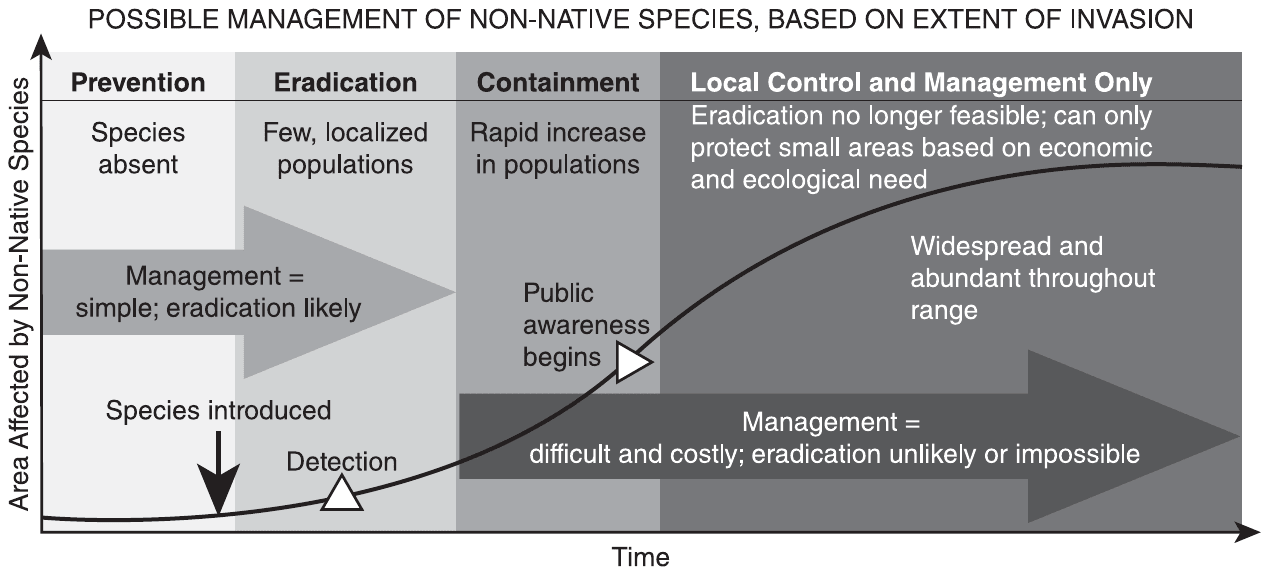
After all, nativeness is just one environmental value, and arguably not as important as preventing extinctions and preserving biodiversity. In some cases we can best serve biodiversity by leaving the non-natives alone or even—brace yourself, now—introducing them on purpose.
This is the thinking behind, for example, installing the Aldabra tortoise on the islands of Mauritius. The islands lost their own large tortoises, and the fruiting plants that formerly had their seeds moved around by these fruit-loving reptiles have been on the decline. A tortoise that’s related to the island’s large tortoises—a non-native from the Seychelles in the Indian Ocean that was intentionally introduced in 2004—is now handling some of that work.
Most of the time, for the time being, conserving species still means focusing on supporting them in their historical habitats, planting natives and removing non-natives. We can and should do that in places where it is feasible and important to us.
From “It’s Time to Stop Thinking That All Non-Native Species Are Evil” by Emma Marris from NATIONAL GEOGRAPHIC MAGAZINE, July 24, 2014. Copyright © 2014 by National Geographic Society.
1stymie: hinder or interfere with
Question
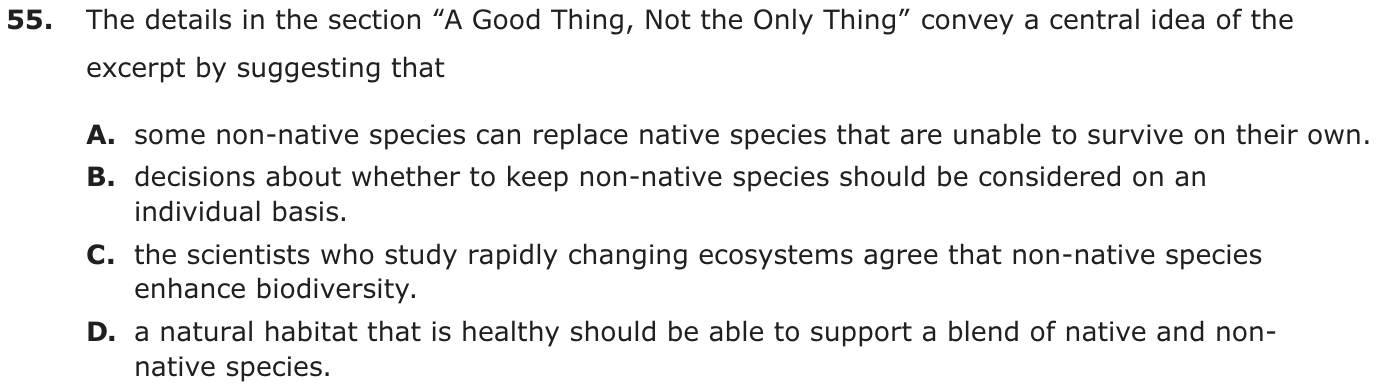
The details in the section “A Good Thing, Not the Only Thing” convey a central idea of the excerpt by suggesting that
- Asome non-native species can replace native species that are unable to survive on their own.
- Bdecisions about whether to keep non-native species should be considered on an individual basis.
- Cthe scientists who study rapidly changing ecosystems agree that non-native species enhance biodiversity.
- Da natural habitat that is healthy should be able to support a blend of native and non-native species.
Show the answer
Correct answer: B
The question asks how the details in the section “A Good Thing, Not the Only Thing” convey a central idea of the excerpt.
A. Incorrect. While paragraph 15 does discuss introducing non-native Aldabra tortoises to replace native tortoises that no longer exist, the real point of this section is to show that non-native species can sometimes help support native species that still exist but are struggling. In this case, the Aldabra tortoises are now moving seeds around for the fruiting plants on the islands where the tortoises have been introduced.
B. CORRECT. This section discusses situations in which non-native species should be kept (as in the example of the Aldabra tortoises in paragraph 15) but also asserts that “most of the time . . . conserving species still means focusing on supporting them in their historical habitats, planting natives and removing non-natives” (paragraph 16). This section makes the point that the issue of non-natives needs to be considered on a case-by-case basis.
C. Incorrect. This section does not claim that non-native species always or even usually enhance biodiversity; rather, it states that “in some cases we can best serve biodiversity by leaving the non-natives alone or even—brace yourself, now—introducing them on purpose” (paragraph 14), later adding that “most of the time . . . conserving species still means focusing on supporting them in their historical habitats, planting natives and removing non-natives” (paragraph 16).
D. Incorrect. While the section happens to give a good example of a habitat that supports both native and non-native species (the islands of Mauritius), it never suggests that being able to do so is a defining characteristic of healthy habitats.
Question analysis
This central-idea question asks how the details in the final section of an article on non-native species, titled “A Good Thing, Not the Only Thing,” convey a central idea of the excerpt. Students must sum up the section as a whole, including its example of a tortoise brought to the islands of Mauritius, and match it to the article's larger argument.
- Grade level
- Grade 8 reading and task
- Compared with grade 7
- Above grade 7 Explaining how a section conveys a central idea is grade 7 work, but this section mixes an argument, an example and a closing paragraph, and the choices differ in how far they generalize from it, which demands more than typical.
- Estimated difficulty
- Hard: combines ideas, needs a plan, and has more than one tempting wrong answer.
- Thinking it demands
- Depth of knowledge 3, strategic thinking · mainly understand
- What makes it hard
- The right answer is reworded moderate
- Evidence in several places moderate
- Evidence
- Answered from several paragraphs or stanzas
- Reading level
- Passage: about grade 11, 815 words; question and choices: about grade 11, 82 words.
- Students, last 30 days
- Not enough answers yet to show (it takes 10).
Why it is hard, traps and wrong answers (shows the answer)
Why it is hard
The section's most memorable content is an example, the Aldabra tortoise doing the work of the islands' lost tortoises, and a choice built on it is the strongest pull. The central idea sits instead in the qualifiers at the start and end of the section: some cases favor non-natives, most still call for removing them. Students who summarize all three paragraphs in a sentence, including the last, arrive at the case-by-case reading.
The right answer is reworded moderate Choosing the answer
The right choice's “on an individual basis” appears nowhere in the section, while the wrong choices echo it: a non-native standing in for natives, “biodiversity”, natives alongside non-natives. (Freedle & Kostin, 1993; Kirsch & Mosenthal, 1990)
Evidence in several places moderate Working it out
The case-by-case idea comes only from joining paragraph 14's “In some cases” to paragraph 16's “Most of the time” and “where it is feasible and important to us”. (Kirsch & Mosenthal, 1990; Gorin & Embretson, 2006)
Strategy: Sum up the section's three paragraphs in one sentence of your own, including its example and its final paragraph, then compare that sentence with each choice.
Traps
- Too narrow: A single detail offered as the central idea or a summary, or a summary that keeps minor details and leaves out an essential part.
- Too broad or too strong: A choice overstates, generalizes, or uses absolute words the text does not support.
- Reads too much in: A reasonable-sounding conclusion that goes further than the text allows.
The wrong answers, classified
A Too narrow (King et al., 2004)
Builds on the Aldabra tortoise standing in for Mauritius's lost tortoises, a single example, and misses the closing point that most conservation still means removing non-natives.
C Too broad or too strong (King et al., 2004)
Turns “In some cases” into a consensus that non-natives enhance biodiversity, though the section limits the claim and the article shows ecologists divided over it.
D Reads too much in (Graesser, Singer & Trabasso, 1994)
Draws a rule about healthy habitats from the Mauritius example, though the section never defines a healthy habitat or says it should hold a mix of species.
Working it out, step by step
Know what the question asks
A section is a part of an article under its own heading. This one runs from paragraph 14 to paragraph 16. You need to sum up the whole section, including its last paragraph. Then match that summary to a central idea.
Read paragraph 14
It says that “in some cases” we help nature most “by leaving the non-natives alone.” We might even bring them in “on purpose.” The words “in some cases” are the key. They mean sometimes, not always.
Read the example and the ending
Paragraph 15 gives an example. A non-native tortoise was brought to Mauritius to spread the seeds of fruiting plants. Then paragraph 16 says that “most of the time,” saving species still means “planting natives and removing non-natives.” We should do that “where it is feasible and important to us.” Feasible means possible.
Put the section together
Sometimes it is best to keep a non-native species. Most of the time it is best to remove it. So each case has to be judged on its own. That is what “on an individual basis” means.
Check each choice
- B fits: deciding case by case matches both “in some cases” and “most of the time.”
- A is wrong because the tortoise is one example, and the section ends by saying removal is still the usual choice.
- C is wrong because the section never says scientists agree, and “in some cases” is far from always.
- D is wrong because the section never says what a healthy habitat should hold.
Watch out: A is built on the section’s most memorable detail. But the main idea comes from the words that limit the claim.
Choose the answer
The section says to keep non-natives in some cases and remove them in others. So the answer is B.
Why this answer and not the closest wrong one
A comes closest, because the Aldabra tortoise really does take over work the lost tortoises once did. But that is one case. The section ends by saying that most of the time we still remove non-natives. B covers both sides: some cases call for keeping them, and others call for removing them.
More questions like this
The original DOE question
The passage “Excerpt from “It’s Time to Stop Thinking That All Non-Native Species Are Evil”” as printed (pages 68–70)
Question 4 of 6
2018 Test B Math, question 50Question
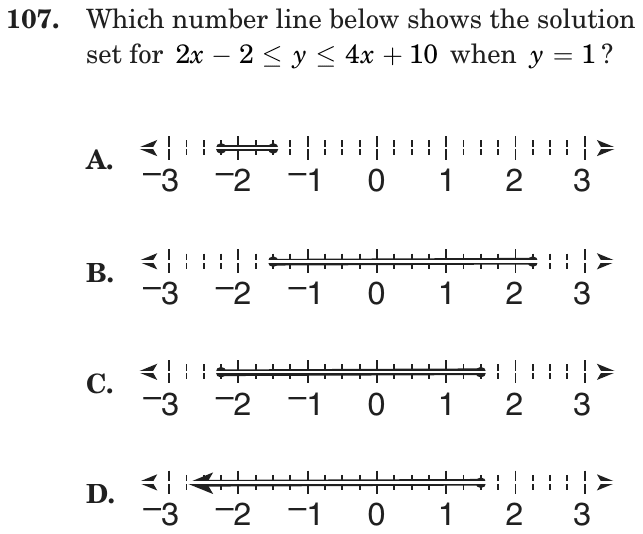
Which number line below shows the solution set for when ?
- A

- B

- C

- D

Show the answer
Correct answer: C
Separate the compound inequality into two pieces:
and
Substitute into each inequality and solve for :
The solution is the number line that shows that is greater than or equal to and less than or equal to .
Question analysis
Students substitute y = 1 into the compound inequality 2x − 2 ≤ y ≤ 4x + 10 and pick the number line that shows the values of x that work. It tests solving two-step inequalities and graphing the solution. The four graphs differ in their endpoints and in whether the shading is closed off on both sides, so each endpoint has to be found exactly.
- Grade level
- Grade 7 content, by NYS standard
- Compared with grade 7
- Above grade 7 Grade 7 students solve and graph one two-step inequality. This compound inequality in two variables requires substituting, solving two inequalities and combining them into one interval, a step toward algebra 1.
- Estimated difficulty
- Hard: combines ideas, needs a plan, and has more than one tempting wrong answer.
- Thinking it demands
- Depth of knowledge 2, skills and concepts · mainly apply
- What makes it hard
- Many steps moderate
- Error-prone arithmetic moderate
- Reading a figure, table or graph moderate
- A very close wrong answer minor
- Solution
- 4 steps
- Reading level
- Question and choices: about grade 9, 12 words.
- Students, last 30 days
- Not enough answers yet to show (it takes 10).
Why it is hard, traps and wrong answers (shows the answer)
Why it is hard
Substituting y = 1 is easy; the work is solving two inequalities and matching a fractional interval to a graph. Students who solve only the left inequality find a matching ray, and sign slips on either endpoint produce intervals that shift or flip across zero. The graphs differ by quarter-unit ticks, so reading them carefully matters as much as the algebra.
Many steps moderate Working it out
The compound inequality must be split into 2x − 2 ≤ 1 and 1 ≤ 4x + 10, each solved for x, and the two results joined into one interval. (Daniel & Embretson, 2010; Enright, Morley & Sheehan, 2002)
Error-prone arithmetic moderate Working it out
Both endpoints are fractions, 3/2 and −9/4, and the second comes from dividing −9 by 4, where a lost sign moves the endpoint across zero. (Brown & Burton, 1978; Junker & Sijtsma, 2001)
Reading a figure, table or graph moderate Understanding the question
The graphs are marked in quarter units, so −2 1/4 and 1 1/2 have to be found by counting small ticks between the labeled integers. (Lesh, Post & Behr, 1987; Kirsch & Mosenthal, 1990)
A very close wrong answer minor Choosing the answer
The ray ending at 1 1/2 looks almost like the right segment, sharing its right end; only the left end, an arrow instead of a closed dot at −2 1/4, separates them. (Embretson & Wetzel, 1987; Gorin & Embretson, 2006; Ascalon et al., 2007)
Strategy: Split the compound inequality into two separate inequalities, solve each for x after putting 1 in for y, then combine the two results into a single interval and match it to a graph.
Traps
- Negatives and direction: Arithmetic with negative numbers, the order of a subtraction, or direction on a number line. (Moving a term across the equals sign without changing its sign is a faulty procedure.)
- Stops one step early: A choice is a number from partway through the solution.
The wrong answers, classified
A Negatives and direction (Brown & Burton, 1978)
Gets the left endpoint −2 1/4 right but gives the right endpoint the wrong sign, ending the segment at −1 1/2 instead of 1 1/2.
B Negatives and direction (Brown & Burton, 1978)
Gives both endpoints the opposite sign, so the segment runs from −1 1/2 to 2 1/4, the true interval reflected across 0.
D Stops one step early (King et al., 2004; Gierl et al., 2017)
Solves only 2x − 2 ≤ 1 and graphs every x up to 1 1/2, leaving out the lower bound that 1 ≤ 4x + 10 sets.
Worked solution, step by step
Formulas used
- Solving an inequality
- a, b and c are numbers. The sign ≤ means is less than or equal to. Adding or subtracting the same number c on both sides keeps it true. Dividing both sides by the same positive number also keeps it true.
Sort out the question
The sign means is less than or equal to. An inequality compares two amounts that may not be equal. The statement is two inequalities joined together. You put 1 in place of . Then you need every that makes both parts true.
Split it into two parts
With , the statement becomes two inequalities.
The answer must make both of them true at the same time.
Solve the first part
Add 2 to both sides. Then divide both sides by 2.
So is at most . This is the right end of the answer.
Watch out: the right end is a positive number. Choice A ends its bar at instead.
Solve the second part
Subtract 10 from both sides. Then divide both sides by 4.
So is at least . This is the left end.
Watch out: keep the minus sign. Choice B uses the opposite signs and ends at .
Put the two parts together
The answer is every number from to , with both ends included. On the graph, that is a solid bar with a dot at each end. The small ticks are quarters. So count 1 tick left of −2 and 2 ticks right of 1.
Watch out: choice D uses only the first part. Its arrow goes left forever.
Give the answer
Choice C shows a bar from to , with dots at both ends. So the answer is C.
Check your answer
Test a number on the bar, like . Then and , and 1 is between them. Now test , which is off the bar. Then , and 1 is not less than −2. So the bar must stop on the left, which rules out D.
More questions like this
The original DOE question
Question 5 of 6
2024 Test A Math, question 6Question
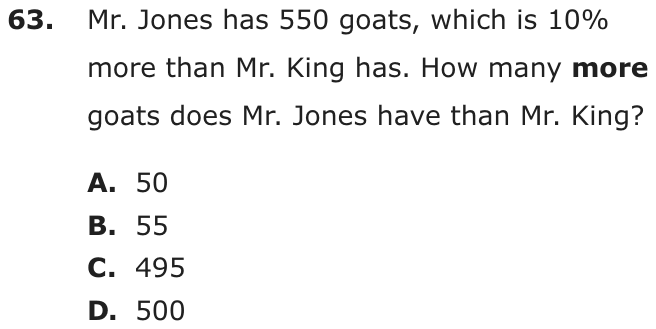
Mr. Jones has 550 goats, which is 10% more than Mr. King has. How many more goats does Mr. Jones have than Mr. King?
- A50
- B55
- C495
- D500
Show the answer
Correct answer: A
First, set up a proportion to determine x, the number of goats Mr. King has.
Then solve the proportion for x.
Finally, determine the difference between the number of goats Mr. Jones has, 550, and the number of goats Mr. King has, 500.
Mr. Jones has 50 more goats than Mr. King.
Question analysis
A percent word problem: Mr. Jones has 550 goats, which is 10% more than Mr. King has, and students find how many more goats Mr. Jones has. It asks students to work with a percent increase when only the larger amount is known. The tricky part is deciding which amount the 10% is taken of.
- Grade level
- Grade 7 content, by NYS standard
- Compared with grade 7
- Above grade 7 Grade 7 students usually find a percent increase from a known original amount. This runs the task backward: the increased amount is given, and the original must be recovered before the difference can be found, a step many do not expect.
- Estimated difficulty
- Hard: combines ideas, needs a plan, and has more than one tempting wrong answer.
- Thinking it demands
- Depth of knowledge 2, skills and concepts · mainly apply
- What makes it hard
- Turning words into math major
- A very close wrong answer moderate
- Solution
- 2 steps
- Reading level
- Question and choices: about grade 1, 22 words.
- Students, last 30 days
- Not enough answers yet to show (it takes 10).
Why it is hard, traps and wrong answers (shows the answer)
Why it is hard
The arithmetic is one division and one subtraction, so the question is really about the base of a percent. The sentence gives the bigger number and calls it 10% more, and the reflex is to take 10% of the number on the page. That shortcut lands on a listed choice five goats from the answer. Students who find King's herd first, 550 ÷ 1.1, still have to remember that the question wants the difference, not the herd.
Turning words into math major Understanding the question
The clause "which is 10% more than" makes King's unknown herd the base of the 10%, so 550 is 110% of his number rather than the amount the 10% is taken of. (Hegarty, Mayer & Monk, 1995; Koedinger & Nathan, 2004)
A very close wrong answer moderate Choosing the answer
The choices 50 and 55 are only 5 goats apart, and both are 10% of a herd; only taking the percent of King's 500 rather than of 550 separates them. (Embretson & Wetzel, 1987; Gorin & Embretson, 2006; Ascalon et al., 2007)
Strategy: Mr. Jones's 550 is 110% of Mr. King's number, so divide 550 by 1.10 to find Mr. King's goats, then subtract that from 550.
Traps
- Percent of the wrong amount: Finding the whole from a part, or a percent change measured from the wrong starting amount.
- Stops one step early: A choice is a number from partway through the solution.
The wrong answers, classified
B Percent of the wrong amount (Parker & Leinhardt, 1995)
Takes 10% of 550, measuring the increase from Jones's herd instead of from King's smaller herd, which is the amount the 10% is based on.
C Percent of the wrong amount (Parker & Leinhardt, 1995)
Takes 10% off 550 to get King's herd, 550 − 55 = 495, using the wrong base, then gives that herd instead of the difference.
D Stops one step early (King et al., 2004; Gierl et al., 2017)
Finds King's herd correctly, 550 ÷ 1.1 = 500, then stops there instead of subtracting it from 550 to get how many more.
Worked solution, step by step
Formulas used
- Percent increase
- The original is the amount you start from, the one the percent is taken of. p is the percent of increase. The new amount is all of the original, which is 100%, plus p% more. For 10% more, you multiply by 1.10.
Sort out the question
Mr. Jones has 550 goats. That is “10% more than Mr. King has”. You need how many more goats Mr. Jones has than Mr. King. That is the difference between the two herds, not the size of a herd.
Decide what the 10% is of
The words “10% more than Mr. King” mean the 10% is a part of Mr. King’s herd. So Mr. King’s herd is the original. Mr. Jones has all of Mr. King’s goats, 100%, plus 10% more. That is 110% of Mr. King’s herd. Watch out: do not take 10% of 550. That gives 55, choice B. It uses the wrong herd. Taking those 55 away from 550 gives 495, choice C, which is also wrong.
Find Mr. King’s herd
Call Mr. King’s number of goats K. Use the percent increase formula with p = 10. The new amount is 550.
Mr. King has 500 goats. Watch out: 500 is Mr. King’s herd, choice D. It is not the difference.
Find the difference
Mr. Jones has 50 more goats than Mr. King. So the answer is A, 50.
Check your answer
Check the 10%. 10% of 500 is , and , Mr. Jones’s herd. So 550 really is 10% more than 500. If King had 495, then 10% more would be about 545, not 550.
More questions like this
The original DOE question
Question 6 of 6
2024 Test B Math, question 41Question
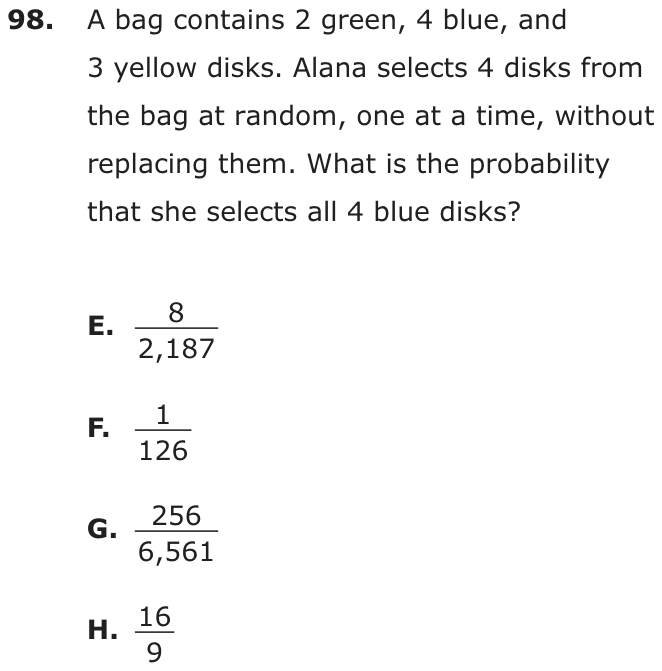
A bag contains 2 green, 4 blue, and 3 yellow disks. Alana selects 4 disks from the bag at random, one at a time, without replacing them. What is the probability that she selects all 4 blue disks?
- A
- B
- C
- D
Show the answer
Correct answer: B
If Alana picks 4 blue disks in a row, the number of blue disks and the total number of disks will both decrease by 1 after each selection.
For the first selection, there are 4 blue disks out of 9 total disks, so the probability of selecting the first blue disk is .
The probabilities of selecting blue for the next three selections are , , and .
Question analysis
A bag holds green, blue and yellow disks, and Alana draws four of them one at a time without putting any back. Students find the probability that all four disks are blue. It tests the probability of dependent events, and the difficulty is keeping track of how the bag changes after each draw.
- NYS standards
- Grade level
- Grade 7 content, by NYS standard
- Compared with grade 7
- Above grade 7 Grade 7 compound probability is usually found with lists or tree diagrams for two stages. Four dependent draws, each changing the counts, are too many to list and need the multiplication rule, which grade 7 does not formally teach.
- Estimated difficulty
- Hard: combines ideas, needs a plan, and has more than one tempting wrong answer.
- Thinking it demands
- Depth of knowledge 2, skills and concepts · mainly apply
- What makes it hard
- Something you must already know moderate
- Error-prone arithmetic moderate
- Solution
- 3 steps
- Reading level
- Question and choices: about grade 5, 37 words.
- Students, last 30 days
- Not enough answers yet to show (it takes 10).
Why it is hard, traps and wrong answers (shows the answer)
Why it is hard
Students who know the multiplication rule for successive draws still have two adjustments to make on every draw, and each wrong choice skips at least one of them. Leaving the bag at 9 disks, or putting each disk back, both produce fractions over 6,561 that look as exact as the right one. Writing the four fractions in a row before multiplying, and cancelling as you go, keeps the arithmetic small.
Something you must already know moderate Working it out
The rule for successive draws without replacement is assumed: each draw's chance is multiplied in, with both the blue count and the total lowered by one. (Anderson & Krathwohl, 2001)
Error-prone arithmetic moderate Working it out
The product 4/9 × 3/8 × 2/7 × 1/6 = 24/3,024 has to be reduced to 1/126, and two wrong choices hide behind 9 to the fourth power, 6,561. (Brown & Burton, 1978; Junker & Sijtsma, 2001)
Strategy: Write the chance of blue for each of the four draws in turn, lowering both the blue count and the total by one each time, and multiply.
Traps
- Without replacement: In a second pick there is one fewer item, which changes the probability.
- Wrong operation: Adds instead of multiplying, divides the wrong way round, turns a ratio or rate upside down, or undoes a step in the wrong direction (subtracts what should be added back).
The wrong answers, classified
A Without replacement (Fischbein & Schnarch, 1997)
Lowers the blue count on each draw but keeps all 9 disks in the bag, 4 × 3 × 2 × 1 over 9 × 9 × 9 × 9, which is 24/6,561 = 8/2,187.
C Without replacement (Fischbein & Schnarch, 1997)
Uses 4/9 for every draw, (4/9) to the fourth power = 256/6,561, as if each disk were put back before the next draw.
D Wrong operation (Hegarty, Mayer & Monk, 1995; King et al., 2004)
Adds the first draw's 4/9 four times, or multiplies it by 4, instead of multiplying the draws' chances, and misses that a probability cannot exceed 1.
Worked solution, step by step
Formulas used
- Probability
- P is the probability, the chance that something happens. It is a number from 0 to 1. The top counts the results you want. The bottom counts all the results that can happen. It works when every result is equally likely.
- Chance of events in a row
- A and B are two events that happen one after the other. P(A) is the chance of the first. P(B after A) is the chance of the second, counting only what is left after the first. You multiply because the second must also happen inside the share of times the first did.
Sort out the question
The bag holds 2 green, 4 blue and 3 yellow disks. That is 9 disks in all. Alana takes 4 disks, one at a time.
“Without replacing them” means a disk she takes does not go back in the bag. You need the chance that all 4 disks are blue.
Find the chance for each pick
For all 4 to be blue, each pick must be blue. After each blue pick, one blue disk is gone. One disk is gone from the total, too. So the top and the bottom each go down by 1.
Pick Blue disks left Disks left Chance of blue 1st 4 9 2nd 3 8 3rd 2 7 4th 1 6 Multiply the four chances
All four picks must go right, one after another. Use the rule for events in a row and multiply.
Simplify the fraction
Divide the top and the bottom by 24. That keeps the value the same.
Watch out: Using for every pick gives , choice C. That is right only if each disk goes back in. Keeping 9 on the bottom each time gives , choice A. Choice D is more than 1, and no chance can be more than 1.
So the answer is B, .
Check your answer
Cancel before you multiply. On top, cancels the 8 on the bottom. That leaves . Divide the top and bottom by 3 to get again.
More questions like this
The original DOE question