3 English and 3 math
Here are 6 random questions to try. Takers earning below 75% are unlikely to receive an offer. You have 1 minute 48 seconds per question on the real exam.
Question 1 of 6
2024 Test A English, question 16Passage Excerpt from “Impressions of an Indian Childhood”
Excerpt from “Impressions of an Indian Childhood”
by Zitkala-Sa
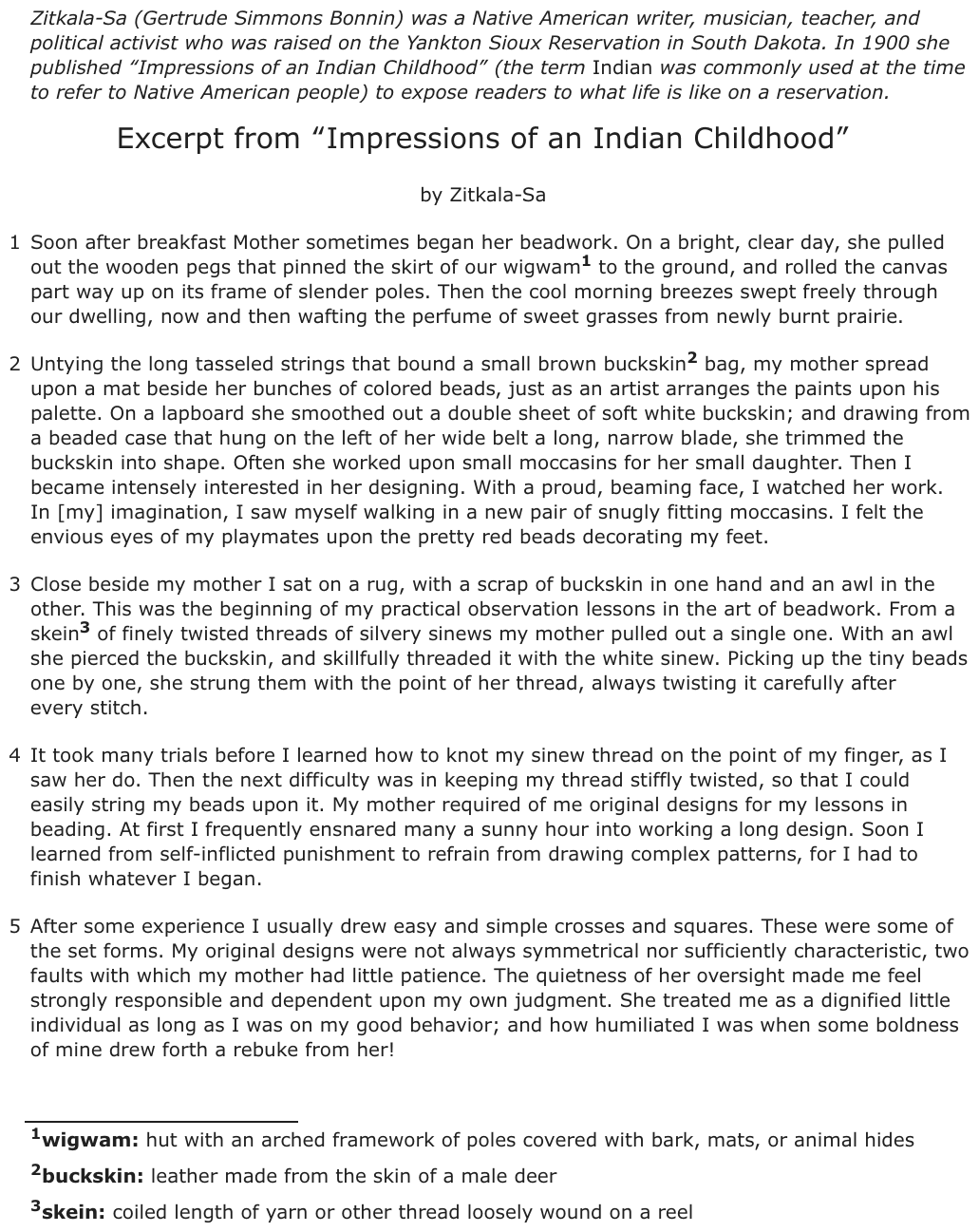
Zitkala-Sa (Gertrude Simmons Bonnin) was a Native American writer, musician, teacher, and political activist who was raised on the Yankton Sioux Reservation in South Dakota. In 1900 she published “Impressions of an Indian Childhood” (the term Indian was commonly used at the time to refer to Native American people) to expose readers to what life is like on a reservation.
Soon after breakfast Mother sometimes began her beadwork. On a bright, clear day, she pulled out the wooden pegs that pinned the skirt of our wigwam1 to the ground, and rolled the canvas part way up on its frame of slender poles. Then the cool morning breezes swept freely through our dwelling, now and then wafting the perfume of sweet grasses from newly burnt prairie.
Untying the long tasseled strings that bound a small brown buckskin2 bag, my mother spread upon a mat beside her bunches of colored beads, just as an artist arranges the paints upon his palette. On a lapboard she smoothed out a double sheet of soft white buckskin; and drawing from a beaded case that hung on the left of her wide belt a long, narrow blade, she trimmed the buckskin into shape. Often she worked upon small moccasins for her small daughter. Then I became intensely interested in her designing. With a proud, beaming face, I watched her work. In [my] imagination, I saw myself walking in a new pair of snugly fitting moccasins. I felt the envious eyes of my playmates upon the pretty red beads decorating my feet.
Close beside my mother I sat on a rug, with a scrap of buckskin in one hand and an awl in the other. This was the beginning of my practical observation lessons in the art of beadwork. From a skein3 of finely twisted threads of silvery sinews my mother pulled out a single one. With an awl she pierced the buckskin, and skillfully threaded it with the white sinew. Picking up the tiny beads one by one, she strung them with the point of her thread, always twisting it carefully after every stitch.
It took many trials before I learned how to knot my sinew thread on the point of my finger, as I saw her do. Then the next difficulty was in keeping my thread stiffly twisted, so that I could easily string my beads upon it. My mother required of me original designs for my lessons in beading. At first I frequently ensnared many a sunny hour into working a long design. Soon I learned from self-inflicted punishment to refrain from drawing complex patterns, for I had to finish whatever I began.
After some experience I usually drew easy and simple crosses and squares. These were some of the set forms. My original designs were not always symmetrical nor sufficiently characteristic, two faults with which my mother had little patience. The quietness of her oversight made me feel strongly responsible and dependent upon my own judgment. She treated me as a dignified little individual as long as I was on my good behavior; and how humiliated I was when some boldness of mine drew forth a rebuke from her!
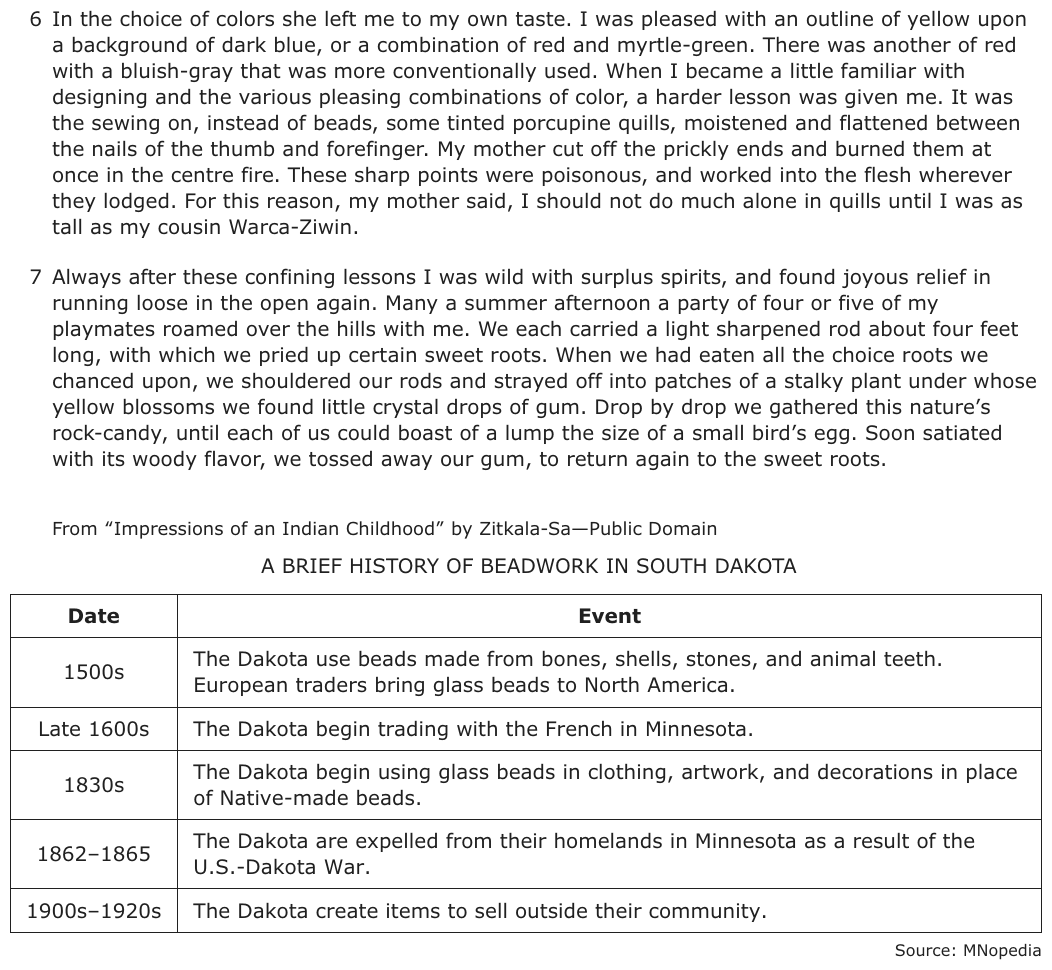
In the choice of colors she left me to my own taste. I was pleased with an outline of yellow upon a background of dark blue, or a combination of red and myrtle-green. There was another of red with a bluish-gray that was more conventionally used. When I became a little familiar with designing and the various pleasing combinations of color, a harder lesson was given me. It was the sewing on, instead of beads, some tinted porcupine quills, moistened and flattened between the nails of the thumb and forefinger. My mother cut off the prickly ends and burned them at once in the centre fire. These sharp points were poisonous, and worked into the flesh wherever they lodged. For this reason, my mother said, I should not do much alone in quills until I was as tall as my cousin Warca-Ziwin.
Always after these confining lessons I was wild with surplus spirits, and found joyous relief in running loose in the open again. Many a summer afternoon a party of four or five of my playmates roamed over the hills with me. We each carried a light sharpened rod about four feet long, with which we pried up certain sweet roots. When we had eaten all the choice roots we chanced upon, we shouldered our rods and strayed off into patches of a stalky plant under whose yellow blossoms we found little crystal drops of gum. Drop by drop we gathered this nature’s rock-candy, until each of us could boast of a lump the size of a small bird’s egg. Soon satiated with its woody flavor, we tossed away our gum, to return again to the sweet roots.
From “Impressions of an Indian Childhood” by Zitkala-Sa—Public Domain
A BRIEF HISTORY OF BEADWORK IN SOUTH DAKOTA
| Date | Event |
|---|---|
| 1500s | The Dakota use beads made from bones, shells, stones, and animal teeth. European traders bring glass beads to North America. |
| Late 1600s | The Dakota begin trading with the French in Minnesota. |
| 1830s | The Dakota begin using glass beads in clothing, artwork, and decorations in place of Native-made beads. |
| 1862–1865 | The Dakota are expelled from their homelands in Minnesota as a result of the U.S.-Dakota War. |
| 1900s–1920s | The Dakota create items to sell outside their community. |
Source: MNopedia
1wigwam: hut with an arched framework of poles covered with bark, mats, or animal hides
2buckskin: leather made from the skin of a male deer
3skein: coiled length of yarn or other thread loosely wound on a reel
Question
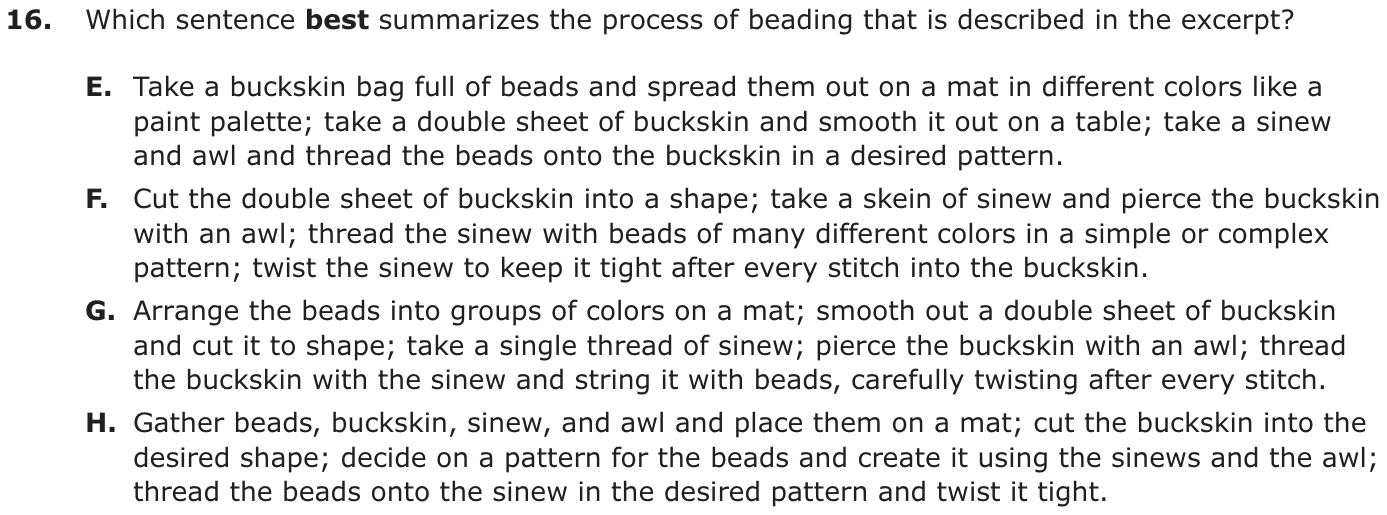
Which sentence best summarizes the process of beading that is described in the excerpt?
- ATake a buckskin bag full of beads and spread them out on a mat in different colors like a paint palette; take a double sheet of buckskin and smooth it out on a table; take a sinew and awl and thread the beads onto the buckskin in a desired pattern.
- BCut the double sheet of buckskin into a shape; take a skein of sinew and pierce the buckskin with an awl; thread the sinew with beads of many different colors in a simple or complex pattern; twist the sinew to keep it tight after every stitch into the buckskin.
- CArrange the beads into groups of colors on a mat; smooth out a double sheet of buckskin and cut it to shape; take a single thread of sinew; pierce the buckskin with an awl; thread the buckskin with the sinew and string it with beads, carefully twisting after every stitch.
- DGather beads, buckskin, sinew, and awl and place them on a mat; cut the buckskin into the desired shape; decide on a pattern for the beads and create it using the sinews and the awl; thread the beads onto the sinew in the desired pattern and twist it tight.
Show the answer
Correct answer: C
The question asks which sentence best summarizes the process of beading that is described in the excerpt.
A. Incorrect. In paragraphs 2 and 3, the author describes how at the beginning of the process her mother “smoothed out a double sheet of soft white buckskin” on a lapboard (paragraph 2) and how she strings the beads into a pattern. However, this sentence does not describe the steps that take place between the preparation and the stringing of the beads. Thus, this sentence does not best summarize the beading process.
B. Incorrect. In paragraphs 2 and 3, the author describes the process her mother uses to string the beads with “the point of her thread, always twisting it carefully after every stitch” (paragraph 3). While this sentence includes some of the steps in the beading process, it does not describe the necessary preparation, namely spreading the beads out on a mat and smoothing out the buckskin on a lapboard. Thus, this sentence does not best summarize the beading process.
C. CORRECT. This sentence best summarizes the process of beading that is described in the excerpt because it includes details about each step in the process. In paragraph 2, the author explains how her mother “spread upon a mat beside her bunches of colored beads” and how “on a lapboard she smoothed out a double sheet of soft white buckskin; and drawing from a beaded case that hung on the left of her wide belt a long, narrow blade, she trimmed the buckskin into shape.” The author continues her description in paragraph 3, stating, “From a skein of finely twisted threads of silvery sinews my mother pulled out a single one. With an awl she pierced the buckskin, and skillfully threaded it with the white sinew. Picking up the tiny beads one by one, she strung them with the point of her thread, always twisting it carefully after every stitch.”
D. Incorrect. In paragraphs 2 and 3, the author describes the process her mother uses as she “smoothed out a double sheet of soft white buckskin” (paragraph 2) on a lapboard before stringing the beads. While this sentence includes most of the steps in the beading process, it excludes the step of piercing the buckskin. This sentence also provides few details about the process of beading and uses vague wording to describe each step. Therefore, the sentence does not best summarize the beading process.
Question analysis
This reading question asks which sentence best summarizes the beadwork process Zitkala-Sa watches her mother carry out, from laying out the materials to stringing the beads. Each choice is a long list of steps, so students must compare them detail by detail with the excerpt and notice what each one adds, leaves out or misplaces.
- Grade level
- Grade 8 reading and task
- Compared with grade 7
- Above grade 7 Summarizing a process is grade 7 reading, but the four summaries are long and nearly alike, and checking them against two paragraphs of 1900 prose with words like awl, sinew and skein is heavier than usual.
- Estimated difficulty
- Hard: combines ideas, needs a plan, and has more than one tempting wrong answer.
- Thinking it demands
- Depth of knowledge 2, skills and concepts · mainly understand
- What makes it hard
- Every choice must be checked major
- A lot to read moderate
- Hard words minor
- Evidence
- Answered from several paragraphs or stanzas
- Reading level
- Passage: about grade 8, 946 words; question and choices: about grade 16+, 212 words.
- Corrected from the DOE handbook
- An inaccurate detail about the excerpt in the explanation was corrected.
- Students, last 30 days
- Not enough answers yet to show (it takes 10).
Why it is hard, traps and wrong answers (shows the answer)
Why it is hard
This question is won by bookkeeping, not insight: list the mother's steps from the two paragraphs, then hold each long summary against the list. The most tempting wrong summary reads like a sensible craft routine in a sensible order, yet it never has the buckskin pierced and puts every tool on the mat. Others open with a familiar image or close with precise stitching while skipping steps, so students who check only the beginning or only the end are caught.
Every choice must be checked major Choosing the answer
Each summary is a chain of four to six steps, so all four must be checked step by step against paragraphs 2 and 3 for steps missing, added or out of order. (Embretson & Wetzel, 1987)
A lot to read moderate Understanding the question
The four choices together run to about 200 words of semicolon-linked steps, and the text they summarize is two paragraphs of dense 1900 prose. (Kintsch, 1998; Gorin & Embretson, 2006; Freedle & Kostin, 1993)
Hard words minor Understanding the question
Words like awl, sinew, skein and lapboard name the tools and materials, and a student unsure of them cannot tell which steps a summary has dropped. (Perfetti, 2007; Freedle & Kostin, 1993)
Strategy: List the mother's steps from paragraphs 2 and 3 in order, then check each choice against your list for a missing step, an invented detail or a step out of place.
Traps
- Too narrow: A single detail offered as the central idea or a summary, or a summary that keeps minor details and leaves out an essential part.
The wrong answers, classified
A Too narrow (King et al., 2004)
Keeps the familiar palette image but leaves out trimming the buckskin, piercing it with the awl and twisting the thread, and even moves the smoothing onto a table.
B Too narrow (King et al., 2004)
Matches paragraph 3's piercing and twisting closely but leaves out the preparation, laying out the beads and smoothing the buckskin, and starts the process with cutting.
D Too narrow (King et al., 2004)
Accepts a tidy, well-ordered outline that keeps most steps but leaves out smoothing the buckskin and piercing it with the awl, and piles every tool onto the mat.
What was corrected from the DOE handbook, and why
- Explanation: In rejecting choice B, the handbook says the choice leaves out the preparation, “namely spreading the beads and the buckskin out on a table.” The excerpt mentions no table: in paragraph 2 the mother spreads the beads on a mat and smooths out the buckskin on a lapboard. The explanation now says so. (Choice A’s “on a table” is part of a wrong answer and is left as printed.)
Working it out, step by step
Figure out what the question asks
You need the summary that best matches the beading steps in the excerpt. A summary is a short retelling of the main points. The best one keeps every main step, in order, and adds nothing new.
List the steps from paragraphs 2 and 3
Paragraphs 2 and 3 give the mother’s steps in order. The last one ends with her “always twisting it carefully after every stitch.”
- Spread the beads on a mat.
- Smooth out a double sheet of buckskin on a lapboard (a board held on the lap).
- Trim the buckskin into shape with a blade.
- Pull out a single sinew, a strong thread.
- Pierce (poke a hole in) the buckskin with an awl, a pointed tool.
- Thread the sinew through the buckskin.
- String the beads, twisting the thread after every stitch.
Check each choice against the list
- A is wrong. It skips trimming, piercing and twisting. It also says “on a table,” but she used a lapboard.
- B is wrong. It starts with cutting. It skips spreading the beads and smoothing the buckskin.
- C is right. It has every step, in the same order.
- D is wrong. It never says to smooth the buckskin or pierce it. It also puts every tool on the mat, but only the beads went there.
Watch out: D sounds like a sensible plan in a sensible order. But a summary must match the excerpt, not just sound right. Check it step by step.
Choose the answer
Only C follows the mother’s steps from start to finish. So the answer is C.
Why this answer and not the closest wrong one
D is the closest wrong answer. It is neat and keeps most of the steps. But it skips smoothing the buckskin and never says to pierce it with the awl. It also piles every tool onto the mat. C matches the excerpt step for step, so it is the best summary.
More questions like this
The original DOE question
The passage “Excerpt from “Impressions of an Indian Childhood”” as printed (pages 42–43)
Question 2 of 6
2024 Test B English, question 8Passage Find Time to Volunteer
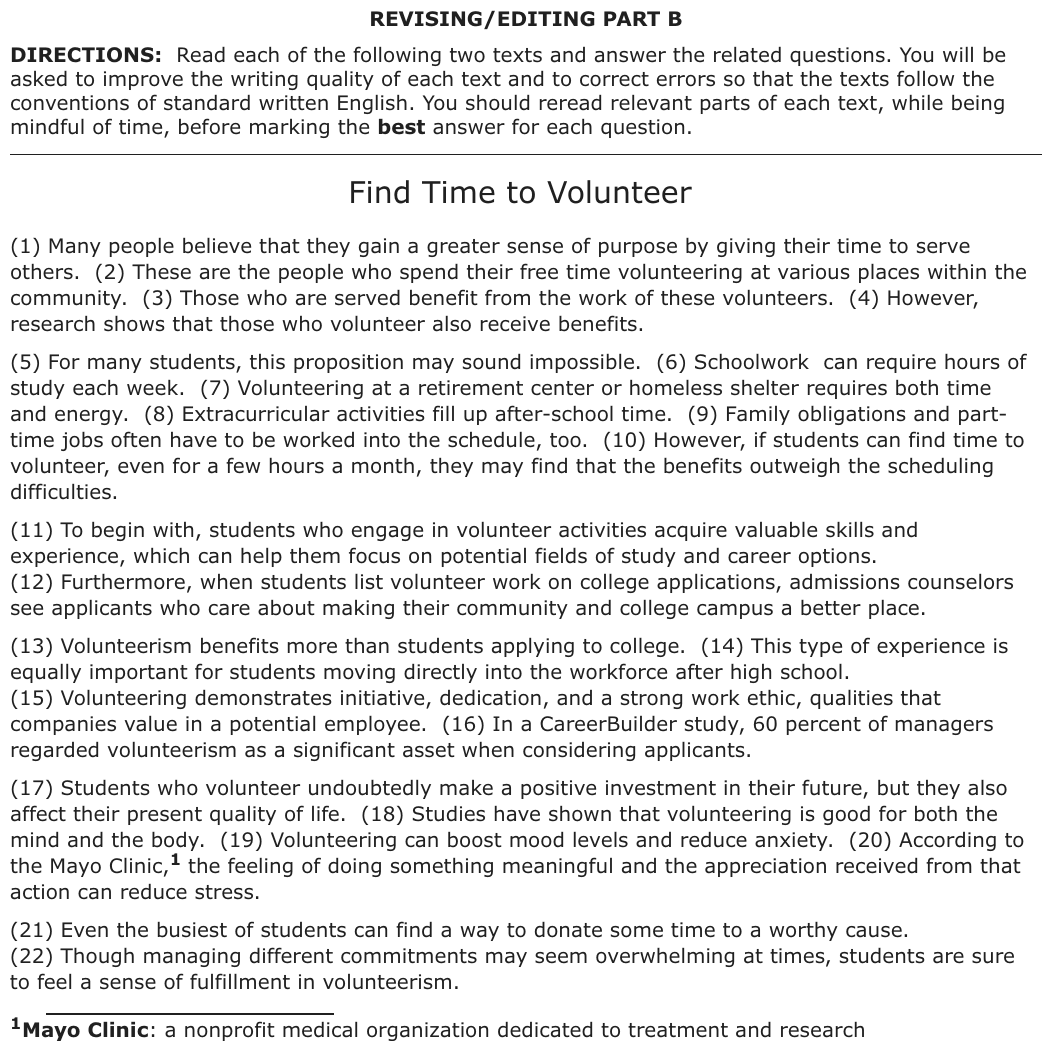
Find Time to Volunteer
(1) Many people believe that they gain a greater sense of purpose by giving their time to serve others. (2) These are the people who spend their free time volunteering at various places within the community. (3) Those who are served benefit from the work of these volunteers. (4) However, research shows that those who volunteer also receive benefits.
(5) For many students, this proposition may sound impossible. (6) Schoolwork can require hours of study each week. (7) Volunteering at a retirement center or homeless shelter requires both time and energy. (8) Extracurricular activities fill up after-school time. (9) Family obligations and part-time jobs often have to be worked into the schedule, too. (10) However, if students can find time to volunteer, even for a few hours a month, they may find that the benefits outweigh the scheduling difficulties.
(11) To begin with, students who engage in volunteer activities acquire valuable skills and experience, which can help them focus on potential fields of study and career options. (12) Furthermore, when students list volunteer work on college applications, admissions counselors see applicants who care about making their community and college campus a better place.
(13) Volunteerism benefits more than students applying to college. (14) This type of experience is equally important for students moving directly into the workforce after high school. (15) Volunteering demonstrates initiative, dedication, and a strong work ethic, qualities that companies value in a potential employee. (16) In a CareerBuilder study, 60 percent of managers regarded volunteerism as a significant asset when considering applicants.
(17) Students who volunteer undoubtedly make a positive investment in their future, but they also affect their present quality of life. (18) Studies have shown that volunteering is good for both the mind and the body. (19) Volunteering can boost mood levels and reduce anxiety. (20) According to the Mayo Clinic,1 the feeling of doing something meaningful and the appreciation received from that action can reduce stress.
(21) Even the busiest of students can find a way to donate some time to a worthy cause. (22) Though managing different commitments may seem overwhelming at times, students are sure to feel a sense of fulfillment in volunteerism.
1Mayo Clinic: a nonprofit medical organization dedicated to treatment and research
Question
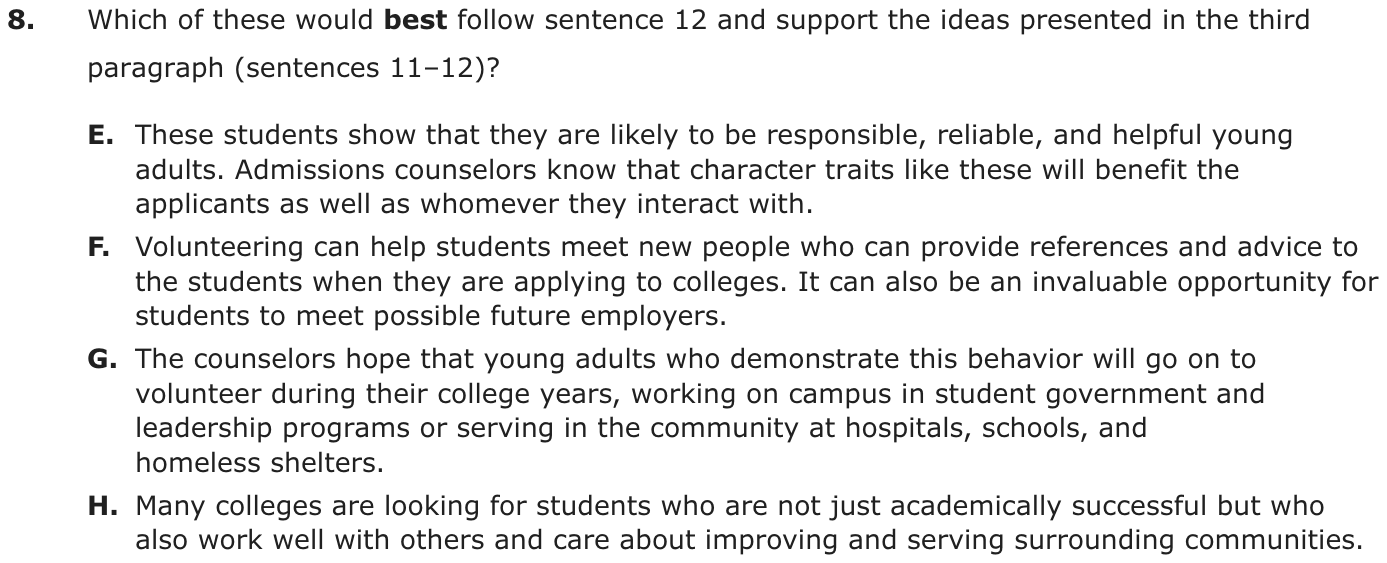
Which of these would best follow sentence 12 and support the ideas presented in the third paragraph (sentences 11–12)?
- AThese students show that they are likely to be responsible, reliable, and helpful young adults. Admissions counselors know that character traits like these will benefit the applicants as well as whomever they interact with.
- BVolunteering can help students meet new people who can provide references and advice to the students when they are applying to colleges. It can also be an invaluable opportunity for students to meet possible future employers.
- CThe counselors hope that young adults who demonstrate this behavior will go on to volunteer during their college years, working on campus in student government and leadership programs or serving in the community at hospitals, schools, and homeless shelters.
- DMany colleges are looking for students who are not just academically successful but who also work well with others and care about improving and serving surrounding communities.
Show the answer
Correct answer: D
The question asks which option would best follow sentence 12 to support the ideas presented in the third paragraph (sentences 11–12).
A. Incorrect. The subject of the main clause in sentence 12 is “admissions counselors.” Although the second sentence in the option mentions “admissions counselors,” it does not support the ideas in the paragraph, because the statement that “admissions counselors know that character traits like these will benefit the applicants” focuses on how students benefit, while sentence 12 focuses on how these traits benefit the community.
B. Incorrect. While sentence 11 discusses the potential academic and professional connections that can be made through volunteering, sentence 12 moves on to the topic of college admissions. Since the sentences in the option revert back to the topic of connections, they do not support and logically follow a sentence about how college admissions counselors view students with volunteering experience.
C. Incorrect. Although the sentence in the option continues on the subject of admissions counselors and follows the idea in sentence 12 that these counselors tend to favor students who “care about making their community and college campus a better place,” the sentence focuses on what students will do while in college rather than on how volunteering helps them get into college. Therefore, the sentence does not best follow sentence 12 and support the ideas presented in the third paragraph.
D. CORRECT. In sentence 12, the author states that college admissions counselors view students who list volunteer work on admissions applications as “applicants who care about making their community and college campus a better place.” The sentence in the option best follows sentence 12 and supports the ideas in the third paragraph because it provides additional details about why admissions counselors look beyond academics when considering students for admissions and the positive qualities assigned to those who have volunteering experience.
Question analysis
This supporting-details question asks which addition would best follow the volunteering essay’s sentence about how college admissions counselors view applicants who list volunteer work. Every option mentions college and sounds reasonable on its own, so students must decide which one develops the paragraph’s point rather than drifting to a related idea.
- NYS standards
- 7W1b supporting claims with evidence
- Grade level
- Grade 8 reading and task
- Compared with grade 7
- Above grade 7 Grade 7 students choose evidence that supports a claim. Here the options are one or two full sentences, all of them about college, and the right fit depends on the precise idea in sentence 12, a finer judgment than usual.
- Estimated difficulty
- Hard: combines ideas, needs a plan, and has more than one tempting wrong answer.
- Thinking it demands
- Depth of knowledge 2, skills and concepts · mainly evaluate
- What makes it hard
- A very close wrong answer major
- How sentences fit together moderate
- A lot to read minor
- Evidence
- Answered from one paragraph or stanza
- Reading level
- Passage: about grade 11, 354 words; question and choices: about grade 13, 153 words.
- Students, last 30 days
- Not enough answers yet to show (it takes 10).
Why it is hard, traps and wrong answers (shows the answer)
Why it is hard
Every option stays on the subject of college, so the work is matching sentence 12’s exact idea: counselors see applicants who care about making their community a better place. The near miss also explains what counselors value, but it swaps caring for the community for a new set of traits and ends on what those traits do for the applicants. Students who restate sentence 12 before reading the options can hear that the right one simply widens it, from community service to what colleges want beyond grades.
A very close wrong answer major Choosing the answer
The right sentence and the two-sentence option about responsible, reliable, helpful students both explain why volunteers impress admissions; only the right one keeps sentence 12’s point, caring about improving communities. (Embretson & Wetzel, 1987; Gorin & Embretson, 2006; Ascalon et al., 2007)
How sentences fit together moderate Working it out
The new sentence must extend sentence 12’s specific idea, what admissions counselors see in volunteers, rather than return to sentence 11’s skills and careers or move on to college life. (Halliday & Hasan, 1976)
A lot to read minor Understanding the question
The options run 27 to 39 words, two of them two sentences long, and all four are about college, so topic alone rules none of them out. (Kintsch, 1998; Gorin & Embretson, 2006; Freedle & Kostin, 1993)
Strategy: Restate sentence 12 in your own words, then ask of each option whether it explains or extends that exact point about what admissions counselors value.
Traps
- Off the point: Adds or keeps something that does not support the paragraph's or the passage's focus, or an introduction or conclusion that misses the main point.
The wrong answers, classified
A Off the point (Halliday & Hasan, 1976)
Follows the admissions counselors from sentence 12 but replaces caring for the community with new traits, responsibility and reliability, and turns to how those traits help the applicants.
B Off the point (Halliday & Hasan, 1976)
Is drawn by “applying to colleges,” but networking for references and future employers is a new benefit that neither sentence 11 nor sentence 12 develops.
C Off the point (Halliday & Hasan, 1976)
Stays with the counselors and picks up “college campus” from sentence 12, but jumps ahead to what students might do in college instead of explaining admission decisions.
Working it out, step by step
Figure out what the question asks
You need the sentence that best follows sentence 12. A good next sentence adds to the same idea. It does not jump to a new point. Example: after Dogs make loyal pets, the sentence They stay by their owners’ side fits. Dogs come in many colors drifts away. So first put sentence 12 in your own words.
Restate sentence 12
Sentence 12 says that “when students list volunteer work on college applications, admissions counselors see applicants who care about making their community and college campus a better place.” Admissions counselors are the people who choose which students get into a college. So the idea is this: colleges like volunteers because volunteers care about their communities.
Check each choice
- D says colleges want students who are “not just academically successful.” That means more than good grades. They also want students who “care about improving and serving surrounding communities.” That explains sentence 12 and builds on it.
- A swaps in new traits: “responsible, reliable, and helpful.” Then it says those traits help the applicants and the people around them. It drops caring for the community.
- B brings in a new benefit: meeting people who can give advice or jobs. Neither sentence 11 nor sentence 12 talks about that.
- C jumps ahead to what students might do in college. It doesn’t explain how volunteering helps them get in.
Pick the answer
Watch out: A is the most tempting. It is about what counselors value, just like the right answer. But it changes the reason they value it. Only D keeps sentence 12’s idea of caring for the community. So the answer is D.
Why this answer and not the closest wrong one
A is the closest wrong answer. Like D, it explains why admissions counselors like volunteers. But A’s reasons are new ones, such as being responsible and reliable. D keeps sentence 12’s exact idea, caring about the community, and adds that colleges want more than good grades. So D supports the paragraph best.
More questions like this
The original DOE question
The passage “Find Time to Volunteer” as printed (page 163)
Question 3 of 6
2026 Practice Test B English, question 32Passage Using Fire to Keep a Prairie Healthy
Using Fire to Keep a Prairie Healthy
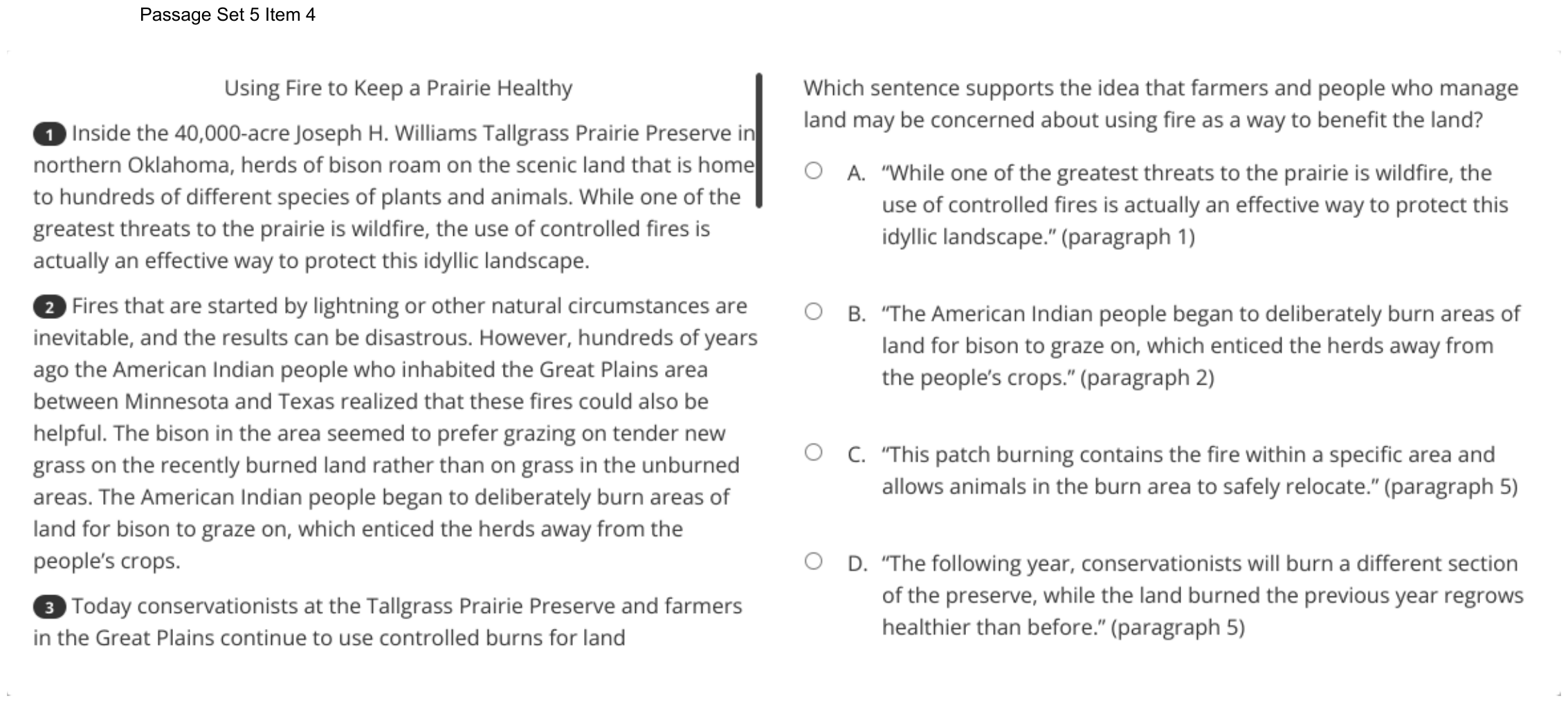
Inside the 40,000-acre Joseph H. Williams Tallgrass Prairie Preserve in northern Oklahoma, herds of bison roam on the scenic land that is home to hundreds of different species of plants and animals. While one of the greatest threats to the prairie is wildfire, the use of controlled fires is actually an effective way to protect this idyllic landscape.
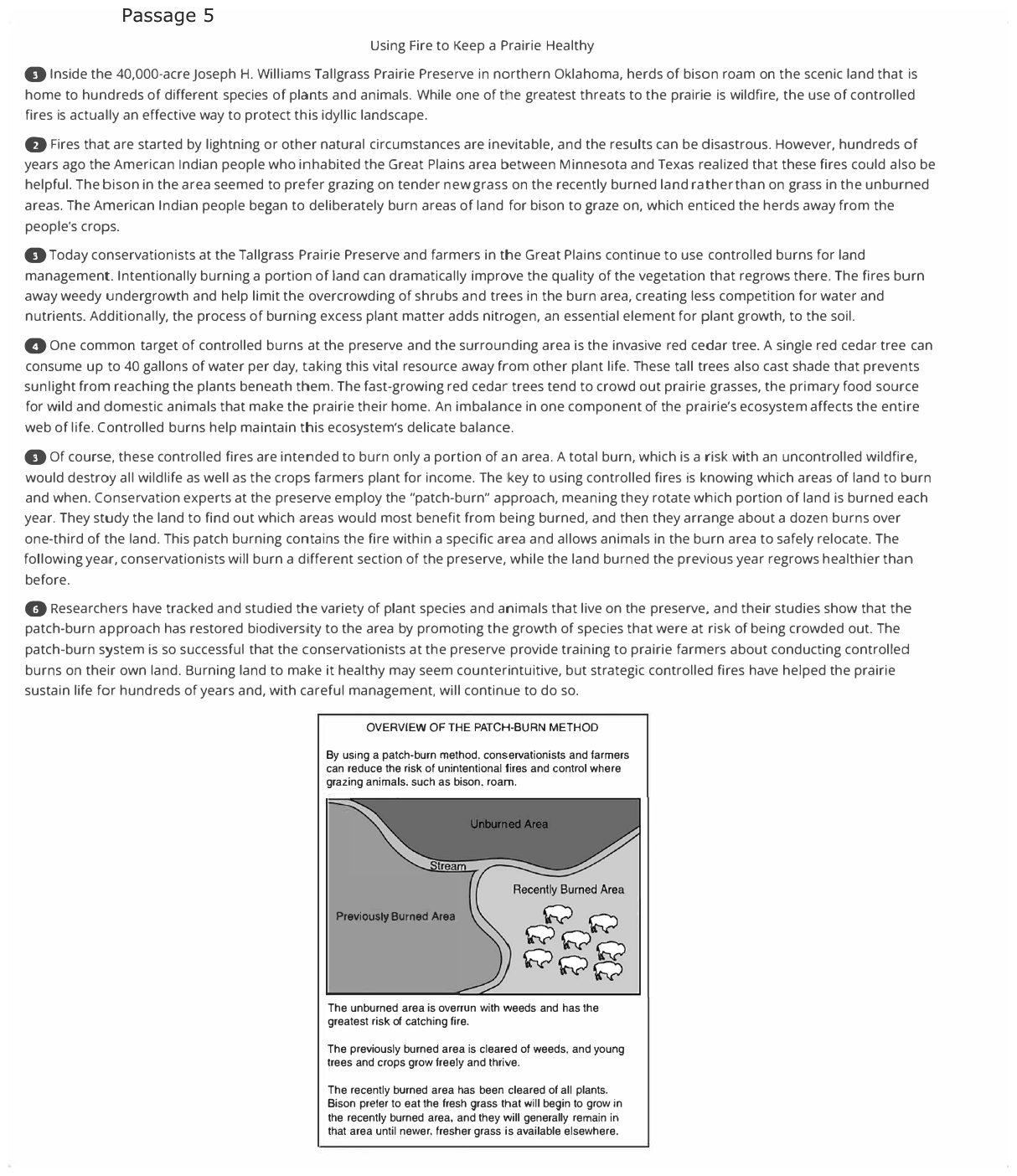
Fires that are started by lightning or other natural circumstances are inevitable, and the results can be disastrous. However, hundreds of years ago the American Indian people who inhabited the Great Plains area between Minnesota and Texas realized that these fires could also be helpful. The bison in the area seemed to prefer grazing on tender new grass on the recently burned land rather than on grass in the unburned areas. The American Indian people began to deliberately burn areas of land for bison to graze on, which enticed the herds away from the people’s crops.
Today conservationists at the Tallgrass Prairie Preserve and farmers in the Great Plains continue to use controlled burns for land management. Intentionally burning a portion of land can dramatically improve the quality of the vegetation that regrows there. The fires burn away weedy undergrowth and help limit the overcrowding of shrubs and trees in the burn area, creating less competition for water and nutrients. Additionally, the process of burning excess plant matter adds nitrogen, an essential element for plant growth, to the soil.
One common target of controlled burns at the preserve and the surrounding area is the invasive red cedar tree. A single red cedar tree can consume up to 40 gallons of water per day, taking this vital resource away from other plant life. These tall trees also cast shade that prevents sunlight from reaching the plants beneath them. The fast-growing red cedar trees tend to crowd out prairie grasses, the primary food source for wild and domestic animals that make the prairie their home. An imbalance in one component of the prairie’s ecosystem affects the entire web of life. Controlled burns help maintain this ecosystem’s delicate balance.
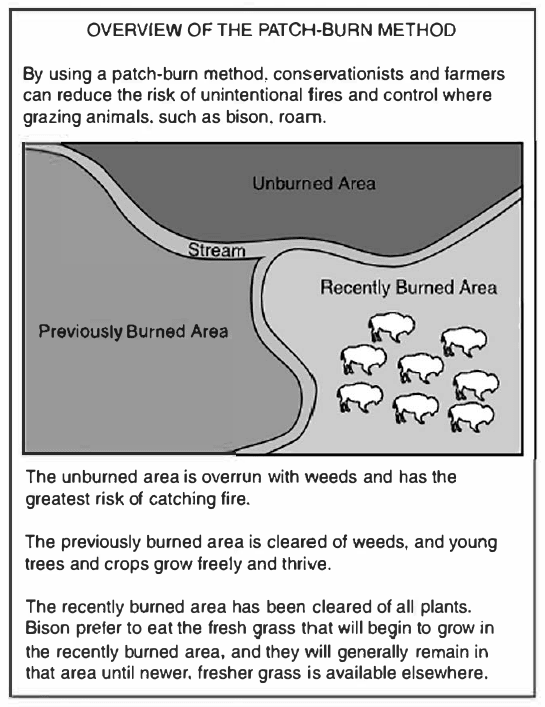
Of course, these controlled fires are intended to burn only a portion of an area. A total burn, which is a risk with an uncontrolled wildfire, would destroy all wildlife as well as the crops farmers plant for income. The key to using controlled fires is knowing which areas of land to burn and when. Conservation experts at the preserve employ the “patch-burn” approach, meaning they rotate which portion of land is burned each year. They study the land to find out which areas would most benefit from being burned, and then they arrange about a dozen burns over one-third of the land. This patch burning contains the fire within a specific area and allows animals in the burn area to safely relocate. The following year, conservationists will burn a different section of the preserve, while the land burned the previous year regrows healthier than before.
Researchers have tracked and studied the variety of plant species and animals that live on the preserve, and their studies show that the patch-burn approach has restored biodiversity to the area by promoting the growth of species that were at risk of being crowded out. The patch-burn system is so successful that the conservationists at the preserve provide training to prairie farmers about conducting controlled burns on their own land. Burning land to make it healthy may seem counterintuitive, but strategic controlled fires have helped the prairie sustain life for hundreds of years and, with careful management, will continue to do so.
Question
Which sentence supports the idea that farmers and people who manage land may be concerned about using fire as a way to benefit the land?
- A“While one of the greatest threats to the prairie is wildfire, the use of controlled fires is actually an effective way to protect this idyllic landscape.” (paragraph 1)
- B“The American Indian people began to deliberately burn areas of land for bison to graze on, which enticed the herds away from the people’s crops.” (paragraph 2)
- C“This patch burning contains the fire within a specific area and allows animals in the burn area to safely relocate.” (paragraph 5)
- D“The following year, conservationists will burn a different section of the preserve, while the land burned the previous year regrows healthier than before.” (paragraph 5)
Show the answer
Correct answer: A
The question asks which sentence supports the idea that farmers and people who manage land may be concerned about using fire as a way to benefit the land.
A. CORRECT. The sentence from paragraph 1 supports the idea that farmers and people who manage land may be concerned about using fire as a way to benefit the land because it acknowledges that “one of the greatest threats to the prairie is wildfire.”
B. Incorrect. Although the sentence from paragraph 2 relates how American Indians “began to deliberately burn areas of land for bison to graze on” and to protect people’s crops, the sentence does not support the idea that farmers and people who manage land may be concerned about using fire as a way to benefit the land. Instead, it focuses on the cause-and-effect relationship between bison and newly burned areas.
C. Incorrect. The sentence from paragraph 5 provides details about how “patch burning contains the fire” and “allows animals in the burn area to safely relocate,” but it does not adequately support the idea that farmers and people who manage land may be concerned about using fire as a way to benefit the land, because it does not mention that wildfires can be a threat to the prairie.
D. Incorrect. While the sentence from paragraph 5 does explain how “conservationists will burn a different section of the preserve” in order to rotate the process year after year so that the burned land has time to regrow, the sentence does not support the idea that farmers and people who manage land may be concerned about using fire as a way to benefit the land because it does not mention the potential for total burns.
Question analysis
This evidence question asks which sentence from the article on controlled prairie burns supports the idea that farmers and others who manage land may be concerned about using fire to benefit it. The passage never states that concern directly, so students must infer it, and all four quoted sentences, taken from across the article, talk about burning land in some way.
- Grade level
- Grade 8 reading and task
- Compared with grade 7
- Above grade 7 Grade 7 evidence questions usually ask for support of an idea the text states. This idea, that people who manage land may worry about using fire, is never stated outright, so students must infer which sentence implies it, more than typical.
- Estimated difficulty
- Hard: combines ideas, needs a plan, and has more than one tempting wrong answer.
- Thinking it demands
- Depth of knowledge 3, strategic thinking · mainly evaluate
- What makes it hard
- Reading between the lines major
- A very close wrong answer moderate
- Every choice must be checked minor
- Evidence
- Answered from one sentence or line
- Reading level
- Passage: about grade 11, 598 words; question and choices: about grade 13, 123 words.
- Students, last 30 days
- Not enough answers yet to show (it takes 10).
Why it is hard, traps and wrong answers (shows the answer)
Why it is hard
The idea to support is about people’s feelings, yet none of the four sentences mentions farmers worrying, so students have to decide what would justify such worry. The opening sentence does it by naming wildfire as a great threat before praising controlled fire, a concession many students read past as background. The strongest pull is the sentence on containing the fire, which implies caution but presents patch burning as the answer, not the concern.
Reading between the lines major Working it out
No sentence mentions worry; students must see that calling wildfire “one of the greatest threats to the prairie” gives landowners a reason to fear fire, and that “actually” answers that fear. (Graesser, Singer & Trabasso, 1994; Kintsch, 1998)
A very close wrong answer moderate Choosing the answer
The patch-burn sentence about containing the fire “within a specific area” also hints at fire’s danger; it differs from the right one by describing the safeguard without ever naming a threat. (Embretson & Wetzel, 1987; Gorin & Embretson, 2006; Ascalon et al., 2007)
Every choice must be checked minor Choosing the answer
The four sentences come from paragraphs 1, 2 and 5, and each is about burning land, so each must be tested for a hint of risk rather than for its topic. (Embretson & Wetzel, 1987)
Strategy: Before rereading the choices, decide what a sentence would need to say to show that landowners have reason to be wary of fire, then test each quoted sentence for exactly that.
Traps
- Supports only part of the claim: In a question about evidence: a line that backs one half of the claim but not the other, or a related point rather than the claim itself.
- True but not the answer: A choice says something accurate about the text that does not answer this question.
The wrong answers, classified
B True but not the answer (King et al., 2004; Embretson & Wetzel, 1987)
Links “the people’s crops” to farmers, but the sentence tells how early burns drew bison away from the crops and shows no worry about fire itself.
C Supports only part of the claim (King et al., 2004; Thissen, Steinberg & Fitzpatrick, 1989)
Sees caution in containing the fire “within a specific area,” but the sentence explains how patch burning keeps animals safe and never says fire threatens the land.
D Supports only part of the claim (King et al., 2004; Thissen, Steinberg & Fitzpatrick, 1989)
Takes the yearly rotation as a careful precaution, but the sentence describes the schedule and land that “regrows healthier than before,” which backs the benefit, not the worry.
Working it out, step by step
Figure out what the question asks
This is an evidence question. Evidence is the words in a text that back up an idea. The idea here is that farmers might worry about using fire to help land. No sentence says farmers are worried. So look for a sentence that gives them a reason to fear fire.
Decide what the evidence needs
A sentence that supports this idea must show that fire can be dangerous. If fire can harm land, people have a reason to be careful with it. So test each sentence with one question: does it say fire is a threat?
Look closely at paragraph 1
Choice A quotes paragraph 1. Its first half says “one of the greatest threats to the prairie is wildfire.” That is a reason to fear fire. Its second half says controlled fires are “actually” helpful. The word “actually” pushes back against that fear. It means: you might expect fire to hurt the land, but here it helps.
Check each choice
- A is right. It names wildfire as a great threat. That gives farmers a reason to worry about fire.
- B is wrong. It tells how early burns drew bison away from crops. It shows no danger from fire.
- C is wrong. It tells how patch burning keeps the fire in one area. It describes a safety step but never names a threat.
- D is wrong. It describes burning a new section each year. It shows a benefit: land that “regrows healthier than before.”
Watch out: C hints that fire must be contained, or kept in, so it sounds careful. But it describes the solution, not the danger.
Choose the answer
Only one sentence names fire as a danger. So the answer is A, the sentence from paragraph 1: “While one of the greatest threats to the prairie is wildfire, the use of controlled fires is actually an effective way to protect this idyllic landscape.” Idyllic means peaceful and lovely.
Why this answer and not the closest wrong one
C is the closest wrong answer, because keeping fire “within a specific area” suggests caution. But C only explains how patch burning works. It never says fire can harm the prairie. A does, by calling wildfire one of the greatest threats.
More questions like this
The original DOE question
The passage “Using Fire to Keep a Prairie Healthy” as printed (page 41)
Question 4 of 6
2024 Test A Math, question 18Question
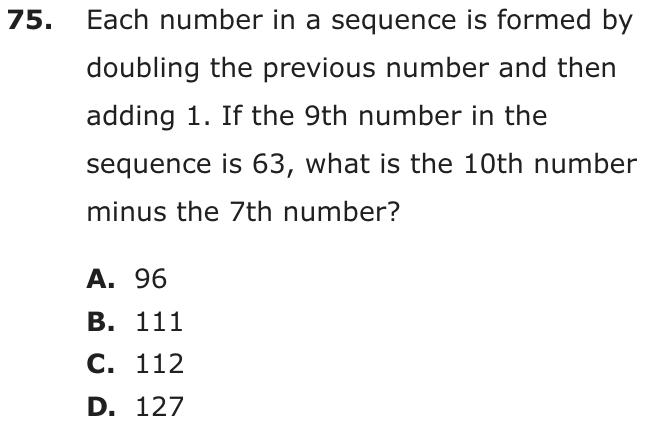
Each number in a sequence is formed by doubling the previous number and then adding 1. If the 9th number in the sequence is 63, what is the 10th number minus the 7th number?
- A96
- B111
- C112
- D127
Show the answer
Correct answer: C
First, write an equation based on the rule described in the item. Let x be the previous number in the sequence and y be the number in the sequence. The ninth number in the sequence is 63.
Determine the 10th number in the sequence, y, by making and solving:
Determine the 8th number in the sequence, x, by making and solving:
Subtract one from both sides of the equation.
Determine the 7th number in the sequence, x, by making and solving:
Subtract the 7th number in the sequence from the 10th number:
The difference is 112.
Question analysis
A sequence question: each number is found by doubling the one before it and adding 1, and the 9th number is 63. Students find the 10th number minus the 7th. That means running the rule forward once and backward twice, while keeping track of which position each number holds.
- Grade level
- Grade 7 content, by NYS standard
- Compared with grade 7
- Above grade 7 Grade 7 students solve two-step equations but rarely have to run a rule backward through a sequence. This mixes forward and backward steps with position counting, so it asks for more planning than a typical grade 7 task.
- Estimated difficulty
- Hard: combines ideas, needs a plan, and has more than one tempting wrong answer.
- Thinking it demands
- Depth of knowledge 2, skills and concepts · mainly apply
- What makes it hard
- No obvious method moderate
- Many steps moderate
- Much to keep track of minor
- Solution
- 4 steps
- Reading level
- Question and choices: about grade 7, 32 words.
- Corrected from the DOE handbook
- A misplaced parenthesis in the explanation’s working was corrected.
- Students, last 30 days
- Not enough answers yet to show (it takes 10).
Why it is hard, traps and wrong answers (shows the answer)
Why it is hard
Applying the rule forward is routine; running it backward is not, and the question needs both. Students must also count positions carefully, since the 9th number is given and the 7th is two steps back, not one. Each listed wrong answer stops or slips at a different stage, so writing the four numbers in a row, 15, 31, 63 and 127, before subtracting is the reliable way.
No obvious method moderate Working it out
The rule is stated only forward, double and add 1, but the 7th and 8th numbers come before the given 9th, so the rule must be undone: subtract 1, then halve. (Schoenfeld, 1985)
Many steps moderate Working it out
One forward step reaches the 10th number, 127, two backward steps reach the 8th and 7th, 31 and 15, and a final subtraction finishes. (Daniel & Embretson, 2010; Enright, Morley & Sheehan, 2002)
Much to keep track of minor Working it out
Four positions and their values, 7th to 10th, have to be kept straight, and the 8th number is easy to mistake for the 7th. (Sweller, 1988; Carpenter, Just & Shell, 1990)
Strategy: Apply the rule to 63 to get the 10th number; to go back a position, subtract 1 and halve, doing it twice to reach the 7th; then subtract.
Traps
- Counting the ends: Inclusive or exclusive ends, fence posts, consecutive numbers: an answer that is one too many or too few, or an endpoint drawn open where it belongs closed (or the reverse).
- Stops one step early: A choice is a number from partway through the solution.
The wrong answers, classified
A Counting the ends (Brown & Burton, 1978)
Steps back only once from the 9th number and subtracts the 8th, 127 − 31 = 96, one position short of the 7th.
B Misreads the question (Hegarty, Mayer & Monk, 1995)
Doubles 63 to 126 but forgets to add 1 on that step, then subtracts the correct 7th number: 126 − 15 = 111.
D Stops one step early (King et al., 2004; Gierl et al., 2017)
Finds the 10th number, 2 × 63 + 1 = 127, and stops without subtracting the 7th number from it.
What was corrected from the DOE handbook, and why
- Explanation: Finding the 7th number, the handbook writes “2x + (1 − 1 = 31 − 1)”, with the closing parenthesis after the whole equation, so the line reads as an equation inside an expression (and 1 − 1 = 31 − 1 is false). The site now reads 2x + (1 − 1) = 31 − 1, the same step the handbook writes correctly for the 8th number (2x + (1 − 1) = 63 − 1). It leads to 2x = 30 and x = 15 as before.
Worked solution, step by step
Formulas used
- The sequence rule
- A sequence is a list of numbers that follows a rule. x is a number in the list, and y is the next number. To get the next number, double x and then add 1.
- Going back one number
- y is a number in the list, and x is the one just before it. To go back, undo the rule in reverse order. The rule doubles and then adds 1. So first subtract 1, then divide by 2.
Sort out the question
Each number is “formed by doubling the previous number and then adding 1”. Previous means the one just before. The 9th number is 63. You need the 10th number minus the 7th number. So you go forward one number and back two numbers.
Find the 10th number
Use the rule with x = 63.
The 10th number is 127. Watch out: remember to add 1. Doubling only gives 126 and leads to 111, choice B.
Plan how to go back
The 7th number comes before the 9th, so you must undo the rule. The rule doubled, then added 1. Undo the last step first: subtract 1. Then undo the doubling: divide by 2.
Find the 8th number
The 8th number is 31. Watch out: 31 is the 8th number, not the 7th. Using it gives , choice A.
Find the 7th number
Step back once more, from the 8th number. Use the same rule with y = 31.
The 7th number is 15.
Subtract the 7th from the 10th
Watch out: 127 alone is choice D. You still have to subtract the 7th number. So the answer is C, 112.
Check your answer
Go forward from 15 using the rule. , then , then . You land on 63 as the 9th number, so the list is right. And .
More questions like this
The original DOE question
Question 5 of 6
2018 Test B Math, question 50Question
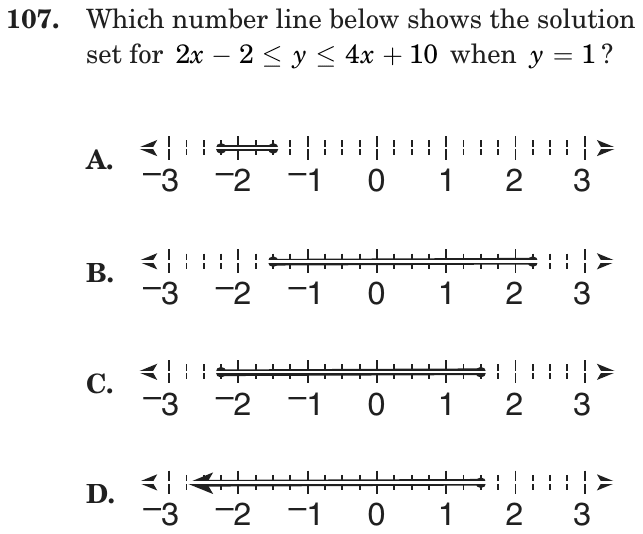
Which number line below shows the solution set for when ?
- A

- B

- C

- D

Show the answer
Correct answer: C
Separate the compound inequality into two pieces:
and
Substitute into each inequality and solve for :
The solution is the number line that shows that is greater than or equal to and less than or equal to .
Question analysis
Students substitute y = 1 into the compound inequality 2x − 2 ≤ y ≤ 4x + 10 and pick the number line that shows the values of x that work. It tests solving two-step inequalities and graphing the solution. The four graphs differ in their endpoints and in whether the shading is closed off on both sides, so each endpoint has to be found exactly.
- Grade level
- Grade 7 content, by NYS standard
- Compared with grade 7
- Above grade 7 Grade 7 students solve and graph one two-step inequality. This compound inequality in two variables requires substituting, solving two inequalities and combining them into one interval, a step toward algebra 1.
- Estimated difficulty
- Hard: combines ideas, needs a plan, and has more than one tempting wrong answer.
- Thinking it demands
- Depth of knowledge 2, skills and concepts · mainly apply
- What makes it hard
- Many steps moderate
- Error-prone arithmetic moderate
- Reading a figure, table or graph moderate
- A very close wrong answer minor
- Solution
- 4 steps
- Reading level
- Question and choices: about grade 9, 12 words.
- Students, last 30 days
- Not enough answers yet to show (it takes 10).
Why it is hard, traps and wrong answers (shows the answer)
Why it is hard
Substituting y = 1 is easy; the work is solving two inequalities and matching a fractional interval to a graph. Students who solve only the left inequality find a matching ray, and sign slips on either endpoint produce intervals that shift or flip across zero. The graphs differ by quarter-unit ticks, so reading them carefully matters as much as the algebra.
Many steps moderate Working it out
The compound inequality must be split into 2x − 2 ≤ 1 and 1 ≤ 4x + 10, each solved for x, and the two results joined into one interval. (Daniel & Embretson, 2010; Enright, Morley & Sheehan, 2002)
Error-prone arithmetic moderate Working it out
Both endpoints are fractions, 3/2 and −9/4, and the second comes from dividing −9 by 4, where a lost sign moves the endpoint across zero. (Brown & Burton, 1978; Junker & Sijtsma, 2001)
Reading a figure, table or graph moderate Understanding the question
The graphs are marked in quarter units, so −2 1/4 and 1 1/2 have to be found by counting small ticks between the labeled integers. (Lesh, Post & Behr, 1987; Kirsch & Mosenthal, 1990)
A very close wrong answer minor Choosing the answer
The ray ending at 1 1/2 looks almost like the right segment, sharing its right end; only the left end, an arrow instead of a closed dot at −2 1/4, separates them. (Embretson & Wetzel, 1987; Gorin & Embretson, 2006; Ascalon et al., 2007)
Strategy: Split the compound inequality into two separate inequalities, solve each for x after putting 1 in for y, then combine the two results into a single interval and match it to a graph.
Traps
- Negatives and direction: Arithmetic with negative numbers, the order of a subtraction, or direction on a number line. (Moving a term across the equals sign without changing its sign is a faulty procedure.)
- Stops one step early: A choice is a number from partway through the solution.
The wrong answers, classified
A Negatives and direction (Brown & Burton, 1978)
Gets the left endpoint −2 1/4 right but gives the right endpoint the wrong sign, ending the segment at −1 1/2 instead of 1 1/2.
B Negatives and direction (Brown & Burton, 1978)
Gives both endpoints the opposite sign, so the segment runs from −1 1/2 to 2 1/4, the true interval reflected across 0.
D Stops one step early (King et al., 2004; Gierl et al., 2017)
Solves only 2x − 2 ≤ 1 and graphs every x up to 1 1/2, leaving out the lower bound that 1 ≤ 4x + 10 sets.
Worked solution, step by step
Formulas used
- Solving an inequality
- a, b and c are numbers. The sign ≤ means is less than or equal to. Adding or subtracting the same number c on both sides keeps it true. Dividing both sides by the same positive number also keeps it true.
Sort out the question
The sign means is less than or equal to. An inequality compares two amounts that may not be equal. The statement is two inequalities joined together. You put 1 in place of . Then you need every that makes both parts true.
Split it into two parts
With , the statement becomes two inequalities.
The answer must make both of them true at the same time.
Solve the first part
Add 2 to both sides. Then divide both sides by 2.
So is at most . This is the right end of the answer.
Watch out: the right end is a positive number. Choice A ends its bar at instead.
Solve the second part
Subtract 10 from both sides. Then divide both sides by 4.
So is at least . This is the left end.
Watch out: keep the minus sign. Choice B uses the opposite signs and ends at .
Put the two parts together
The answer is every number from to , with both ends included. On the graph, that is a solid bar with a dot at each end. The small ticks are quarters. So count 1 tick left of −2 and 2 ticks right of 1.
Watch out: choice D uses only the first part. Its arrow goes left forever.
Give the answer
Choice C shows a bar from to , with dots at both ends. So the answer is C.
Check your answer
Test a number on the bar, like . Then and , and 1 is between them. Now test , which is off the bar. Then , and 1 is not less than −2. So the bar must stop on the left, which rules out D.
More questions like this
The original DOE question
Question 6 of 6
2026 Practice Test C Math, question 10Question
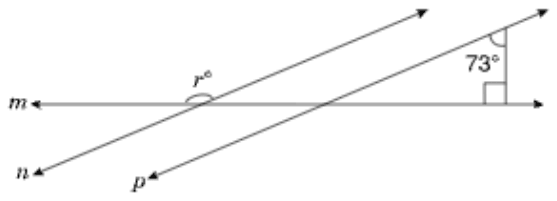
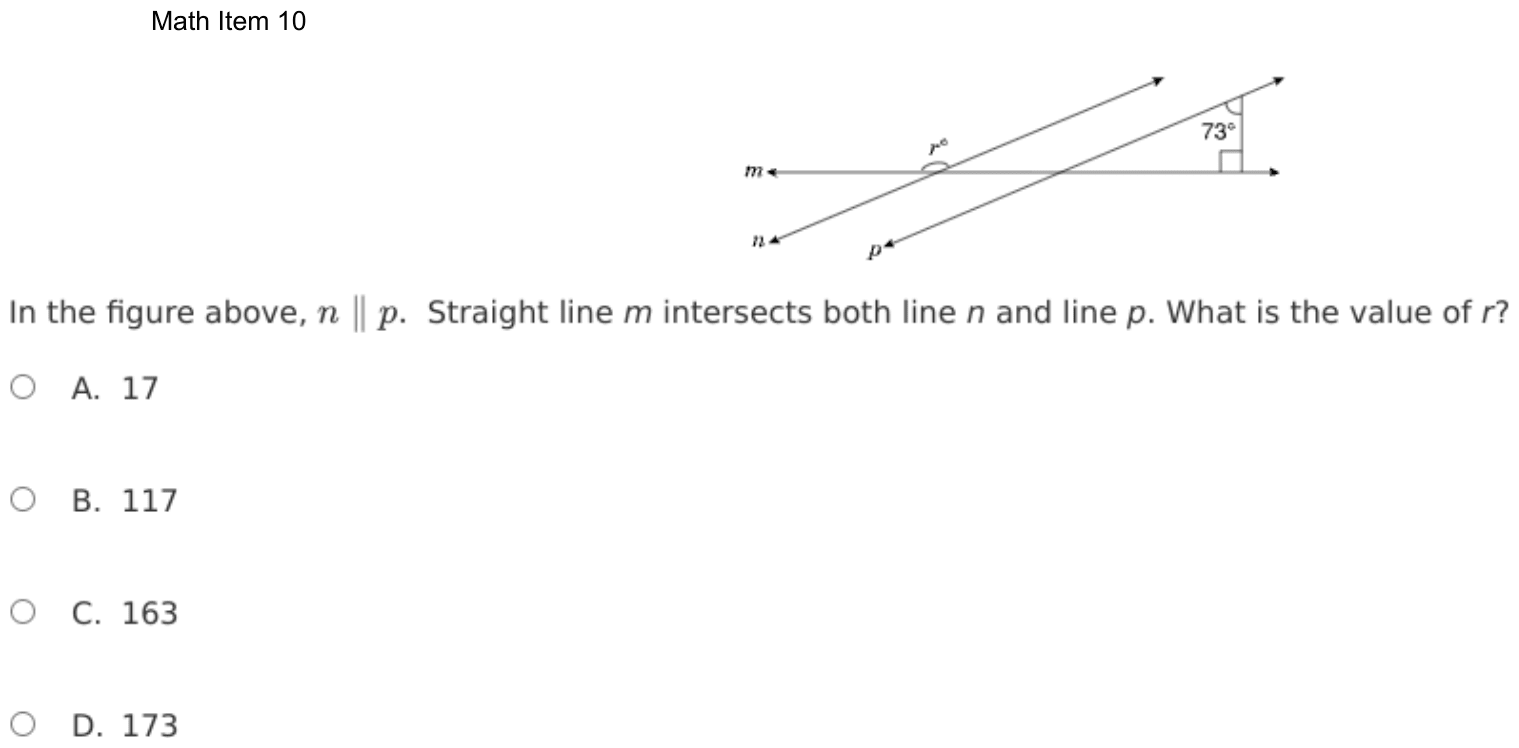
In the figure above, . Straight line m intersects both line n and line p. What is the value of r?
- A17
- B117
- C163
- D173
Show the answer
Correct answer: C
The triangle formed by line p, line m, and the line segment connecting the two contains a 73° angle, a right angle (90°), and a missing angle measuring x°. The sum of the interior angles of a triangle is 180°, so begin by finding the value of x:
Line m is a straight line, so it has a measure of 180°. The 17° angle from the triangle and the adjacent angle outside the triangle are supplementary, so they have a sum of 180°. Let s represent the measure of the adjacent angle outside the triangle. The value of s can be determined by subtracting:
Given that n and p are parallel lines and that they have been cut by a transversal, line m, then corresponding angles are congruent. Angles r and s are corresponding angles, so the value of r is congruent to the value of s, which is 163°.
Question analysis
Two parallel lines, n and p, cross a straight line m, and a segment drawn at a right angle to m forms a small triangle with lines m and p, where a 73° angle is marked. Students find the angle r at line n. It combines a triangle's angle sum, a straight angle and parallel lines, and the angle wanted sits away from the marked ones.
- NYS standards
- Grade level
- Grade 8 content, by NYS standard
- Compared with grade 7
- Above grade 7 Grade 7 angle problems use supplementary, vertical and adjacent angles. This one also needs the angle sum of a triangle and the angles formed by parallel lines and a transversal, grade 8 facts, chained across a busy figure.
- Estimated difficulty
- Hard: combines ideas, needs a plan, and has more than one tempting wrong answer.
- Thinking it demands
- Depth of knowledge 2, skills and concepts · mainly apply
- What makes it hard
- Reading a figure, table or graph moderate
- Combines ideas moderate
- Something you must already know minor
- Solution
- 3 steps
- Reading level
- Question and choices: about grade 3, 21 words.
- Students, last 30 days
- Not enough answers yet to show (it takes 10).
Why it is hard, traps and wrong answers (shows the answer)
Why it is hard
Each fact needs only a subtraction, but the student has to plan a route from the 73° angle at line p over to r at line n. The first number the route gives, the triangle's 17° angle, is listed, and it is the acute partner of r rather than r itself. The figure helps here: r is drawn plainly obtuse, and 163 is also 90 + 73, the triangle's exterior angle, which confirms it.
Reading a figure, table or graph moderate Understanding the question
The 73° sits between line p and the vertical segment, not between p and m, and r is the obtuse angle above m on the left of line n, far from every marked angle. (Lesh, Post & Behr, 1987; Kirsch & Mosenthal, 1990)
Combines ideas moderate Working it out
Three facts chain together: the triangle's angles sum to 180°, the angles along straight line m sum to 180°, and corresponding angles at the parallel lines n and p are equal. (Embretson, 1998; Daniel & Embretson, 2010)
Something you must already know minor Working it out
The angle pairs formed by a line crossing two parallel lines are a grade 8 topic, and the question uses them without naming them. (Anderson & Krathwohl, 2001)
Strategy: Find the third angle of the right triangle, use the straight line m to get the angle beside it, then carry that angle over to line n using the parallel lines.
Traps
- Stops one step early: A choice is a number from partway through the solution.
- An arithmetic slip: The right method with a plausible arithmetic error: a digit, a place value or a times-table fact.
The wrong answers, classified
A Stops one step early (King et al., 2004; Gierl et al., 2017)
Finds the triangle's third angle, 180 − 90 − 73 = 17, and stops, though r is the obtuse angle next to the 17° angle, not that angle itself.
B Little reason to choose it (Haladyna & Downing, 1993; Rodriguez, 2005)
No angle fact in the figure gives 117; even 180 − 73 is 107, so this choice mostly catches guesses at an obtuse angle.
D An arithmetic slip (Junker & Sijtsma, 2001)
Finds the 17° angle and subtracts it from 180 but borrows without reducing the 8, so 180 − 17 comes out as 173.
Worked solution, step by step
Formulas used
- Angles of a triangle
- a, b and c are the three angles inside any triangle. They always add up to 180°. If you know two of them, subtract their sum from 180° to find the third.
- Angles on a straight line
- a and b are two angles side by side on a straight line. Together they make a half turn, which is 180°. Use it to find the angle next to one you already know.
- Corresponding angles
- The symbol ∥ means is parallel to. When line m crosses two parallel lines, it makes the same angles at each crossing. Angles in the same position at the two crossings are called corresponding angles. They are equal.
Sort out the question
Lines n and p are parallel, and line m crosses both. Near line p, a straight-up segment meets line m. The small square shows a right angle, 90°. Line p, line m and that segment make a small triangle. Its top angle is 73°.
You need r, the wide angle where line n crosses line m.
Find the triangle’s third angle
The third angle is where line p crosses line m. Call it x. Use the triangle rule:
So that angle is 17°.
Watch out: this is not r. Stopping here gives choice A, 17.
Use the straight line m
The 17° angle sits above line m, on the right of line p. Beside it, on the left of line p, is a wide angle. Call it s. The two angles fill the straight line m, so they add to 180°:
So s is 163°.
Watch out: borrow carefully. 180 − 17 is 163, not 173, choice D.
Carry the angle to line n
Angle s is above line m and to the left of line p. Angle r is above line m and to the left of line n. They are in the same position, so they are corresponding angles. Since n and p are parallel:
So the answer is C, 163.
Check your answer
Look at the figure. Angle r is wider than a right angle, so it must be more than 90°. That rules out 17. Also, the narrow angle beside r, on the right of line n, matches the 17° angle at line p. And , as it should on a straight line.
More questions like this
The original DOE question