3 English and 3 math
Here are 6 random questions to try. Takers earning below 75% are unlikely to receive an offer. You have 1 minute 48 seconds per question on the real exam.
Question 1 of 6
2026 Practice Test A English, question 41Passage Massachusetts: Lowell National Historical Park
Massachusetts: Lowell National Historical Park
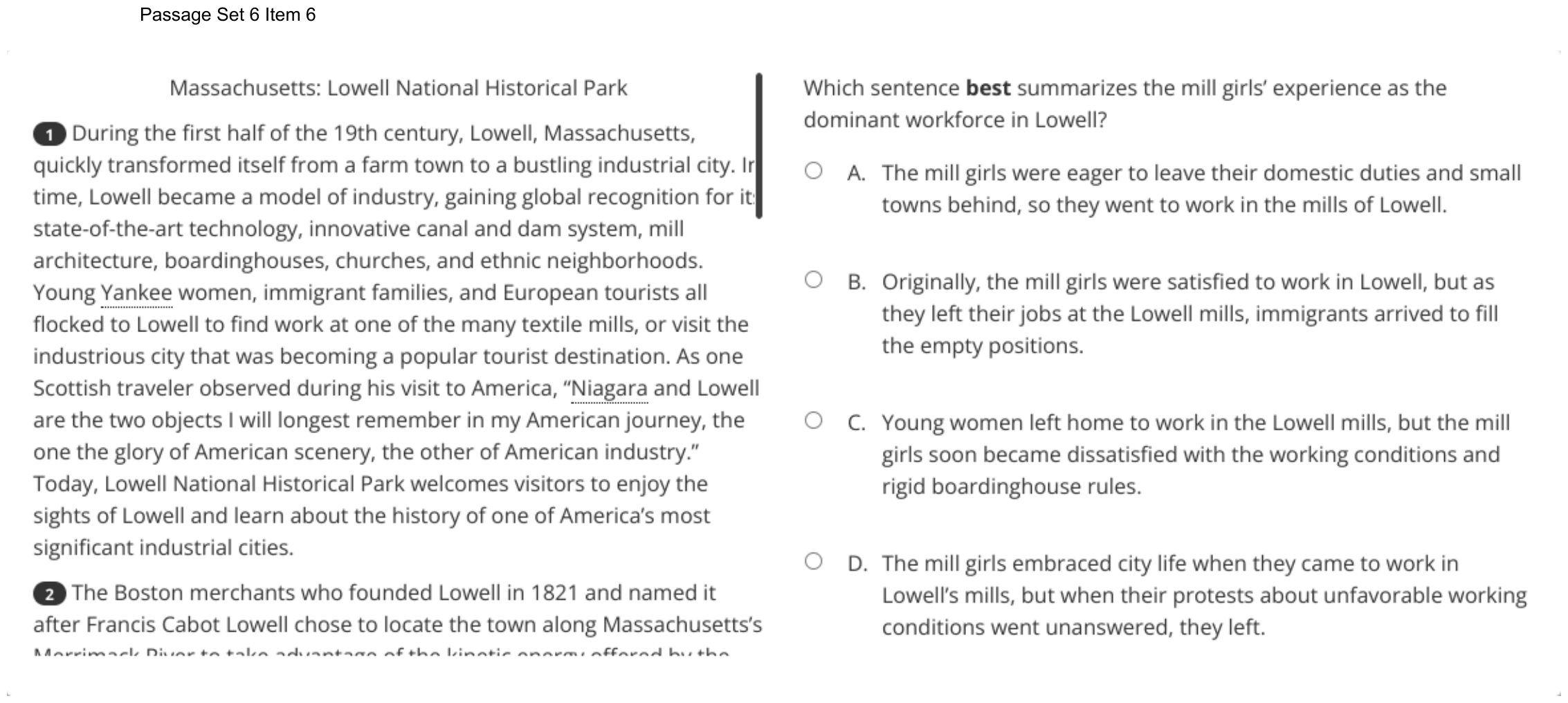
During the first half of the 19th century, Lowell, Massachusetts, quickly transformed itself from a farm town to a bustling industrial city. In time, Lowell became a model of industry, gaining global recognition for its state-of-the-art technology, innovative canal and dam system, mill architecture, boardinghouses, churches, and ethnic neighborhoods. Young Yankee women, immigrant families, and European tourists all flocked to Lowell to find work at one of the many textile mills, or visit the industrious city that was becoming a popular tourist destination. As one Scottish traveler observed during his visit to America, “Niagara and Lowell are the two objects I will longest remember in my American journey, the one the glory of American scenery, the other of American industry.” Today, Lowell National Historical Park welcomes visitors to enjoy the sights of Lowell and learn about the history of one of America’s most significant industrial cities.
The Boston merchants who founded Lowell in 1821 and named it after Francis Cabot Lowell chose to locate the town along Massachusetts’s Merrimack River to take advantage of the kinetic energy offered by the Pawtucket waterfalls. Over six miles of canals powered the waterwheels of Lowell’s mills, whose massive five- and six-story brick buildings dominated the city’s landscape. . . . The most recognized of these buildings are the Lowell Manufacturing Company chartered in 1821, the Suffolk or Wannalancit Mill completed around the 1880s, the Boott Mill Company established in 1835, and the Boott Mill Boardinghouse that opened in 1838. By the 1850s, 40 textile mills employing over 10,000 workers stretched for about a mile along the river. . . .
The city’s female workforce was significant in the history of Lowell. From the early to mid-1800s, women left the constricted lifestyle of small rural towns and rural areas for independent industrial city life. Most were young single Yankee girls, who were tired of the limited opportunities offered by their domestic work. Women found that Lowell’s mills offered monthly wages for their services and provided them room and board. Although these women gained economic independence in Lowell, the mill boardinghouse keepers constantly supervised their social activities, for which they hardly had any time, considering their daily 12- to 14-hour work schedules. At the end of the day, the factory bell signaled the “mill girls” to return to their boardinghouses. They were expected to adhere to the strict code of conduct respecting curfew and attending church.
Yankee “mill girls” continued to dominate the Lowell workforce until the 1840s, when the city began to find it difficult to compete with the growing industrial development in other New England communities. As profits fell, the mill industry cut wages. These wage cuts, deteriorating working conditions, and long workdays led the “mill girls” to protest and organize strikes. When their demands went unheard, the women left Lowell, and immigrant groups replaced them in the workforce. Despite the low wages and unhealthy work conditions, immigrants were eager to find work.
The immigrants replacing the Yankee “mill girls” during the 1840s were predominantly Irish Catholics, who traveled to America during the Great Potato Famine. Although Lowell received an influx of Irish families during this time, the Irish were a part of the city’s history from its birth, and before the “mill girls” arrived, they built Lowell’s historic canals, mills, and boardinghouses. Initially, Lowell’s Protestant community was slow to welcome Irish immigrants, but the hostility between Yankee Protestants and Irish Catholics eventually disappeared. Irish immigrants dominated the industrial scene until the Civil War, when other immigrant groups began to work in the city mills.
Like the Irish, the French-Canadians, Greeks, Poles, Portuguese, Russian Jews, and Armenians who came to work in Lowell’s mills faced long work hours, low wages, and poor living conditions in the city’s crowded tenements. By the time Lowell’s industry declined, the city had become an ethnic melting pot, where each group claimed its own distinct neighborhood, like the Irish immigrants’ “New Dublin” or “Acre,” and the French-Canadians’ “Little Canada.” The city officially began to close down its mills in the 1920s and ’30s after Lowell’s outdated mills could no longer compete against the state-of-the-art cotton mills in other communities and working conditions continued to decline as Lowell’s companies stopped reinvesting in their mills. . . . Despite a brief resurgence during World War II, the city shut down its last surviving mill by the mid-1950s.
From “Massachusetts: Lowell National Historical Park”—Public Domain/National Park Service
Yankee: native to New England
Niagara: a town in northwestern New York State well known as the location of Niagara Falls, a series of waterfalls on the Canadian border
domestic work: household duties like cooking and cleaning
Question
Which sentence best summarizes the mill girls’ experience as the dominant workforce in Lowell?
- AThe mill girls were eager to leave their domestic duties and small towns behind, so they went to work in the mills of Lowell.
- BOriginally, the mill girls were satisfied to work in Lowell, but as they left their jobs at the Lowell mills, immigrants arrived to fill the empty positions.
- CYoung women left home to work in the Lowell mills, but the mill girls soon became dissatisfied with the working conditions and rigid boardinghouse rules.
- DThe mill girls embraced city life when they came to work in Lowell’s mills, but when their protests about unfavorable working conditions went unanswered, they left.
Show the answer
Correct answer: D
The question asks for the sentence that best summarizes the mill girls’ time as the dominant workforce in Lowell.
A. Incorrect. While the passage explains that mill girls were initially eager to leave the domestic duties of life in rural areas, the summary sentence does not address the details about the mill girls’ time working in the mills or the changes that led the mill girls to leave the industry.
B. Incorrect. Mill girls initially found satisfaction in the mill work and lifestyle, and when they did leave, immigrants filled the empty jobs. This summary sentence, however, does not address the details about the mill girls’ time as the primary workforce in Lowell or the circumstances that led them to leave their jobs in the mid-1800s.
C. Incorrect. Mill girls did leave home to work in the Lowell mills, and they did grow dissatisfied over time, but this summary sentence does not include details about the mill girls’ actions to improve the working conditions.
D. CORRECT. This sentence summary best captures the mill girls’ experience as outlined in paragraphs 3 and 4. The sentence concisely summarizes both the women’s initial excitement about the opportunity to live independently (“Women found that Lowell’s mills offered monthly wages for their services and provided them room and board” [paragraph 3]) and their eventual inability to secure better working conditions (“When their demands went unheard, the women left Lowell, and immigrant groups replaced them in the workforce” [paragraph 4]).
Question analysis
This summary question asks which sentence best sums up the experience of the Yankee mill girls during the years they were Lowell's main workforce. Students must pull together the account spread over paragraphs 3 and 4, and every choice is a two-part sentence that sounds accurate, so each must be checked for what it includes, what it leaves out and what it gets slightly wrong.
- Grade level
- Grade 8 reading and task
- Compared with grade 7
- Above grade 7 Summarizing part of a text is a grade 7 standard, usually tested with one clearly complete choice. Here all four summaries are long, two-part and largely accurate, so ranking them by completeness and precision asks more than typical grade 7 work.
- Estimated difficulty
- Hard: combines ideas, needs a plan, and has more than one tempting wrong answer.
- Thinking it demands
- Depth of knowledge 2, skills and concepts · mainly understand
- What makes it hard
- Every choice must be checked moderate
- A very close wrong answer moderate
- Evidence in several places minor
- Evidence
- Answered from several paragraphs or stanzas
- Reading level
- Passage: about grade 15, 764 words; question and choices: about grade 11, 116 words.
- Students, last 30 days
- Not enough answers yet to show (it takes 10).
Why it is hard, traps and wrong answers (shows the answer)
Why it is hard
This is a completeness question: every summary is built from true pieces of paragraphs 3 and 4, and the right one is the only one that runs from arrival to departure with the cause in between. Students who stop at dissatisfaction feel they have the whole arc, because the turn against working conditions is the story's middle. Writing a one-line summary first, with a beginning, a turning point and an end, makes the gaps in the others easy to see.
Every choice must be checked moderate Choosing the answer
All four summaries are two-part sentences of 24 to 27 words that sound accurate, so each has to be checked for what it leaves out: the arrival, the wage cuts and protests, or the departure. (Embretson & Wetzel, 1987)
A very close wrong answer moderate Choosing the answer
The dissatisfaction summary shares the key's shape, women coming to the mills and then turning against their working conditions; it differs only in the ending, where the key has unanswered protests and the women leaving. (Embretson & Wetzel, 1987; Gorin & Embretson, 2006; Ascalon et al., 2007)
Evidence in several places minor Working it out
The mill girls' story runs from paragraph 3, on why they came and how they lived, to paragraph 4, on wage cuts, strikes and their departure in the 1840s. (Kirsch & Mosenthal, 1990; Gorin & Embretson, 2006)
Strategy: Write your own one-sentence summary of paragraphs 3 and 4 before reading the choices, then compare each choice with it claim by claim, including its words about timing and cause.
Traps
- Too narrow: A single detail offered as the central idea or a summary, or a summary that keeps minor details and leaves out an essential part.
The wrong answers, classified
A Too narrow (King et al., 2004)
Covers only why the women came, leaving domestic work and small towns behind, and stops before their years as the workforce, the wage cuts and their leaving.
B Too narrow (King et al., 2004)
Gets the start and the replacement by immigrants right but drops the wage cuts, protests and strikes that paragraph 4 gives as the reason the women left.
C Too narrow (King et al., 2004)
Keeps the arrival and the growing discontent, adding the minor boardinghouse rules, but leaves out the protests and the women leaving, and “soon” skips the years before the 1840s wage cuts.
Working it out, step by step
Figure out what the question asks
This question asks for the best summary. A summary retells the main events in a few words. It covers the beginning, the middle and the end. Here you sum up the mill girls’ time as Lowell’s main workforce. Their story is in paragraphs 3 and 4.
Find the beginning of their story
Paragraph 3 says the women came for “independent industrial city life.” They found that the mills “offered monthly wages for their services and provided them room and board.” Room and board means a place to live and meals. So at first, they were glad to come. Their days were long, though, and the rules were strict.
Find the middle and the end
Paragraph 4 gives the turning point. In the 1840s, profits fell and the mills cut wages. “These wage cuts, deteriorating working conditions, and long workdays” led the women to protest and strike. Deteriorating means getting worse. Then comes the end: “When their demands went unheard, the women left Lowell.”
Check each choice
- A is wrong. It tells only why they came. It stops before their years at work and their leaving.
- B is wrong. It has the start and the end. But it skips the middle: the wage cuts and protests that made them leave.
- C is wrong. It has the start and the unhappy middle, but no protests and no leaving. Also, “soon” is off, since the trouble came years later, in the 1840s.
- D is right. It covers all three parts: they embraced city life, protested bad conditions, and left when no one listened. Embraced means happily welcomed.
Watch out: C feels complete because it ends with the women unhappy. But their story doesn’t end there. They protested, and then they left.
Choose the answer
Only one summary runs from the mill girls’ arrival to their leaving, with the cause in between. So the answer is D.
Why this answer and not the closest wrong one
C is the closest wrong answer. Like D, it starts with the women coming to the mills and then growing unhappy. But it stops there. It leaves out the protests and the women leaving Lowell, which is how their time as the main workforce ended. D tells the whole story.
More questions like this
The original DOE question
The passage “Massachusetts: Lowell National Historical Park” as printed (page 50)
Question 2 of 6
2026 Practice Test C English, question 31Passage Serpent Mound
Serpent Mound
The Great Serpent Mound, located in Adams County, Ohio, is a human-made mound of earth that researchers believe was created between 300 B.C. and A.D. 1100 by an indigenous culture.
Ohio, 1846
Brush Creek stood low when the museum men came
with their measuring tapes and sketchbooks.
It was winter. Fringed with ice,
the creek doubled back on itself
as if it had forgotten something.
Pa was in Cincinnati, or else on his way home,
so Ma told me to lead the men
into the marshy low grounds. It being winter,
there was little underbrush to speak of—
in the summer there would have been
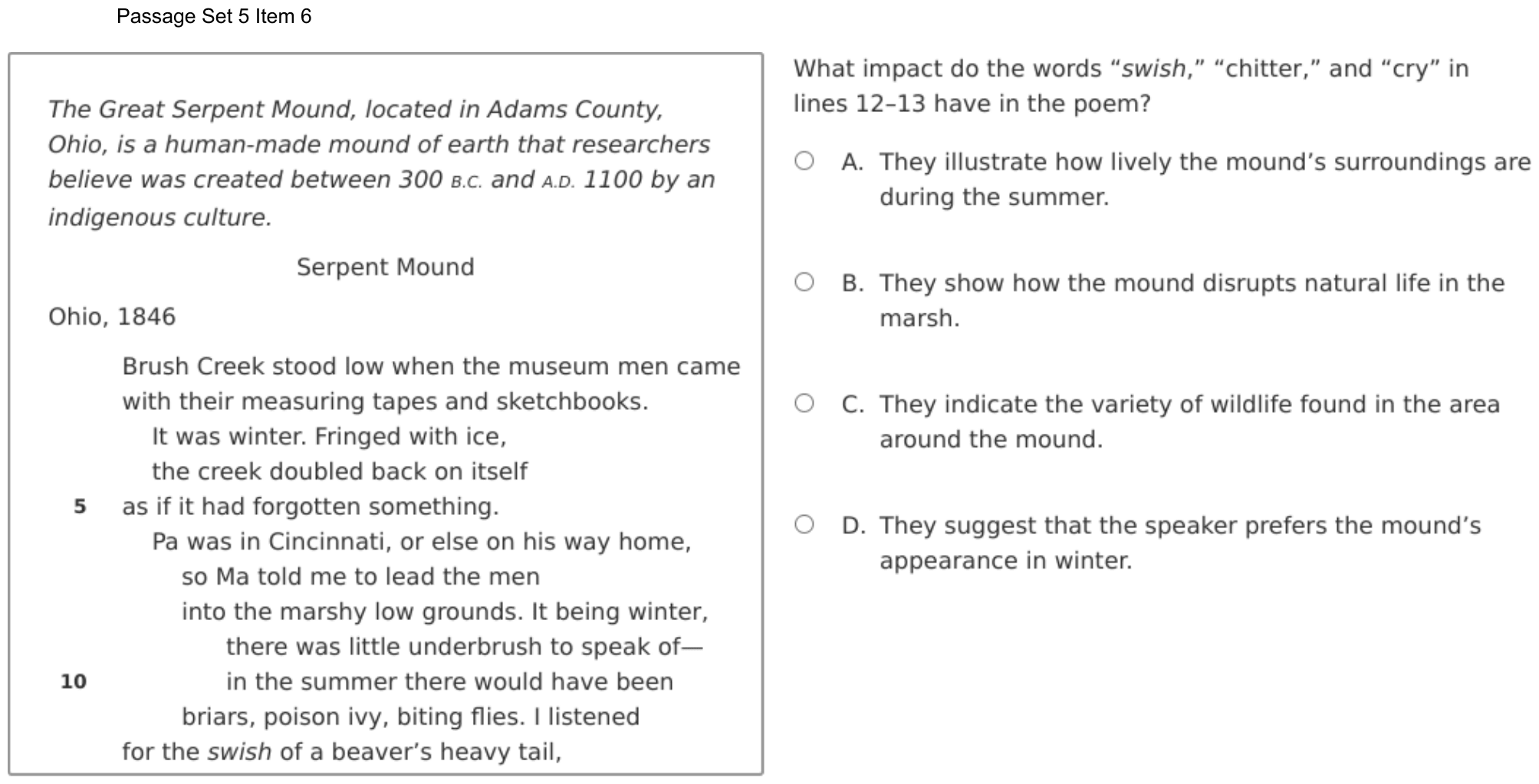
briars, poison ivy, biting flies. I listened
for the swish of a beaver’s heavy tail,
the chitter of a chickadee, or the cry of a hawk,
but the winter silence of the creek pressed
down on all of us like a weight.
The humps in the ground were all but
invisible until you were right up on them. The figure
was even less obvious: the sinuous body,
the tail coiled three times around,
and at the other end, the mouth wide open.
In the summer the creek bottom was crowded
with so much life that you could trip over
the ridges of earth before you saw
anything at all. In winter you could climb
a tree and get some idea of the whole thing:
the serpent’s body undulating, slithering
silently across the ancient
earth. At the mouth end, there was an oval mound
as if the snake were about to swallow an egg—
as snakes sometimes did in our rickety
henhouse—my Pa always said, or
as if swallowing the sun, one of the museum
men suggested, taking notes with his quill pen,
an old-style inkhorn slung at his side.
I liked that: swallowing the sun,
just the sort of thing a snake might do,
might want to do. When, later, I told my sister Ruth,
she disagreed. It is singing to the sun,
she insisted. That is why its mouth
is wide open. She said, “Sometimes I think
I hear it on summer nights. Not swallowing, singing.”
Question
What impact do the words “swish,” “chitter,” and “cry” in lines 12–13 have in the poem?
- AThey illustrate how lively the mound’s surroundings are during the summer.
- BThey show how the mound disrupts natural life in the marsh.
- CThey indicate the variety of wildlife found in the area around the mound.
- DThey suggest that the speaker prefers the mound’s appearance in winter.
Show the answer
Correct answer: A
The question asks what impact the words “swish,” “chitter,” and “cry” in lines 12–13 have in the poem.
A. CORRECT. The words highlight the sounds of the animals that visit the mound in the summer: the “swish of a beaver’s heavy tail” (line 12), the “chitter of a chickadee” (line 13), and the “cry of a hawk” (line 13). These words help contrast the quiet stillness of the setting around the mound in the winter.
B. Incorrect. While the words in lines 12–13 convey the sounds certain animals make in the summer, the sounds of the animals that live near the mound are a natural part of life in the area, not a disruption.
C. Incorrect. The speaker is contrasting the sounds of the animals around the mound during the rest of the year with the silence of the winter months, not merely indicating the variety of wildlife.
D. Incorrect. The speaker expresses the idea that the mound is more visible in the winter because of the lack of brush (“It being winter, / there was little underbrush to speak of” [lines 8–9]). Then lines 12–13 describe sounds, not the appearance of the mound in winter.
Question analysis
This question about word choice asks what impact the sound words “swish,” “chitter” and “cry” in lines 12–13 of “Serpent Mound” have in the poem. They belong to a beaver, a chickadee and a hawk near the creek, and more than one choice sounds like a fair account of them, so students must read the surrounding lines closely.
- Grade level
- Grade 8 reading and task
- Compared with grade 7
- Above grade 7 Grade 7 students often explain what sensory words add to a description. These three words sit inside a long sentence that runs across several lines, so their effect has to be worked out from the lines around them, beyond typical grade 7 work.
- Estimated difficulty
- Hard: combines ideas, needs a plan, and has more than one tempting wrong answer.
- Thinking it demands
- Depth of knowledge 2, skills and concepts · mainly analyze
- What makes it hard
- A very close wrong answer major
- Reading between the lines moderate
- Complex sentences minor
- Evidence
- Answered from one paragraph or stanza
- Reading level
- Passage: 354 words (a poem; reading level not measured); question and choices: about grade 6, 61 words.
- Students, last 30 days
- Not enough answers yet to show (it takes 10).
Why it is hard, traps and wrong answers (shows the answer)
Why it is hard
Three vivid animal sounds invite the easy reading that the poem is showing off the creek’s wildlife, and that choice is true as far as it goes. The words matter because they are missing: the speaker listens for them, and “the winter silence” answers. Students must also accept that the key’s “during the summer” comes from the poem’s later picture of a crowded summer creek, not from lines 12–13 themselves.
A very close wrong answer major Choosing the answer
The variety choice is literally true, since a beaver, a chickadee and a hawk are three kinds of animal; it differs from the key in missing why the sounds are named, as a contrast with winter. (Embretson & Wetzel, 1987; Gorin & Embretson, 2006; Ascalon et al., 2007)
Reading between the lines moderate Working it out
The speaker listens for these sounds and does not hear them, so students must infer that they stand for the creek’s life in warmer months, which lines 21–22 call “crowded / with so much life.” (Graesser, Singer & Trabasso, 1994; Kintsch, 1998)
Complex sentences minor Understanding the question
The three words sit in one sentence that runs from “I listened” in line 11 to “like a weight” in line 15 and turns on “but,” so their point arrives only at its end. (Abedi & Lord, 2001; Freedle & Kostin, 1993; Messick, 1989)
Strategy: Read the full sentence that holds these words, from “I listened” in line 11 to the end of line 15, then decide what the three sound words add to the scene.
Traps
- True but not the answer: A choice says something accurate about the text that does not answer this question.
- Wrong part of the text: A choice is true of another paragraph, stanza or speaker than the one asked about.
The wrong answers, classified
B Twists what the text says (King et al., 2004)
Notices that the beaver, chickadee and hawk go unheard but blames the mound for the hush, though line 14 calls it “the winter silence of the creek.”
C True but not the answer (King et al., 2004; Embretson & Wetzel, 1987)
Rightly counts three different animals in lines 12–13, but the speaker listens for them in vain, so the point is their absence in winter, not the range of species.
D Wrong part of the text (Kirsch & Mosenthal, 1990)
Remembers from lines 8–9 and 24–25 that winter makes the mound easier to see, but lines 12–13 are about sounds and state no preference for either season.
Working it out, step by step
Figure out what the question asks
This asks what three sound words do in the poem. They are “swish,” “chitter” and “cry,” in lines 12–13. Read the whole sentence they sit in. It starts at “I listened” in line 11 and ends with “like a weight” in line 15.
Read the full sentence
Lines 11–15 say “I listened / for the swish of a beaver’s heavy tail, / the chitter of a chickadee, or the cry of a hawk, / but the winter silence of the creek pressed / down on all of us like a weight.” A chickadee is a small bird, and a chitter is its quick, chirping sound. The speaker listens for these sounds. But the word “but” tells you they never come. Only silence answers.
Work out why the sounds are named
A beaver, a chickadee and a hawk are signs of a creek full of life. The speaker hears none of them in winter. Later lines tell you when the creek is lively. Lines 21–22 say “In the summer the creek bottom was crowded / with so much life.” So the missing sounds remind you how lively the place is in summer. They also make the winter silence feel even emptier.
Check each choice
- A fits. The sounds stand for the busy life around the mound in the warm months.
- B does not fit. The quiet comes from the season: “the winter silence of the creek.” The mound does not cause it.
- C does not fit. There are three kinds of animals, but the point is that their sounds are missing.
- D does not fit. These lines are about sounds. The speaker says nothing about liking how the mound looks in winter.
Watch out: C is true as far as it goes. But it misses why the speaker names the sounds at all: to set them against the silence.
Choose the answer
The sounds the speaker listens for, and doesn’t hear, show how lively the creek is in summer. So the answer is A, “They illustrate how lively the mound’s surroundings are during the summer.”
Why this answer and not the closest wrong one
C is the closest wrong choice, because a beaver, a chickadee and a hawk really are three kinds of wildlife. But the speaker listens for them and hears nothing. The word “but” turns the sentence to “the winter silence.” The sounds matter because they are missing. They show the creek in its lively season, which line 21 names as summer.
More questions like this
The original DOE question
The passage “Serpent Mound” as printed (page 40)
Question 3 of 6
2026 Practice Test D English, question 12Passage Excerpt from “How We Made the First Flight”
Excerpt from “How We Made the First Flight”
by Orville Wright
In 1903 brothers Wilbur and Orville Wright conducted experiments related to flying machines. These experiments would eventually lead to air travel becoming a reliable form of transportation.
During the night of December 16, 1903, a strong cold wind blew from the north. When we arose on the morning of the 17th, the puddles of water, which had been standing about camp since the recent rains, were covered with ice. The wind had a velocity of 10 to 12 meters per second (22 to 27 miles an hour). We thought it would die down before long, and so remained indoors the early part of the morning. But when ten o’clock arrived, and the wind was as brisk as ever, we decided that we had better get the machine out and attempt a flight. We hung out the signal for the men of the Life Saving Station.1 We thought that by facing the flyer into a strong wind, there ought to be no trouble in launching it from the level ground about camp. We realized the difficulties of flying in so high a wind, but estimated that the added dangers in flight would be partly compensated for by the slower speed in landing.
Final Preparations
We laid the track on a smooth stretch of ground about one hundred feet north of the new building. The biting cold wind made work difficult, and we had to warm up frequently in our living room, where we had a good fire in an improvised stove made of a large carbide2 can. By the time all was ready, J. T. Daniels, W. S. Dough and A. D. Etheridge, members of the Kill Devil3 Life Saving Station; W. C. Brinkley of Manteo, and Johnny Moore, a boy from Nags Head,4 had arrived.
We had a “Richard” hand anemometer with which we measured the velocity of the wind. Measurements made just before starting the first flight showed velocities of 11 to 12 meters per second, or 24 to 27 miles per hour. . . .
Audacity—and Calculation
Wilbur having used his turn in the unsuccessful attempt on the 14th, the right to the first trial now belonged to me. After running the motor a few minutes to heat it up, I released the wire that held the machine to the track, and the machine started forward in the wind. Wilbur ran at the side of the machine, holding the wing to balance it on the track. Unlike the start on the 14th, made in a calm, the machine, facing a 27-mile wind, started very slowly. Wilbur was able to stay with it till it lifted from the track after a forty-foot run. One of the Life Saving men snapped the camera for us, taking a picture just as the machine had reached the end of the track and had risen to a height of about two feet. The slow forward speed of the machine over the ground is clearly shown in the picture by Wilbur’s attitude. He stayed along beside the machine without any effort.
Flight
The course of the flight up and down was exceedingly erratic, partly due to the irregularity of the air, and partly to lack of experience in handling this machine. The control of the front rudder was difficult on account of its being balanced too near the center. This gave it a tendency to turn itself when started; so that it turned too far on one side and then too far on the other. As a result the machine would rise suddenly to about ten feet, and then as suddenly dart for the ground. A sudden dart when a little over a hundred feet from the end of the track, or a little over 120 feet from the point at which it rose into the air, ended the flight. As the velocity of the wind was over 35 feet per second and the speed of the machine over the ground against this wind ten feet per second, the speed of the machine relative to the air was over 45 feet per second, and the length of the flight was equivalent to a flight of 540 feet made in calm air. This flight lasted only 12 seconds, but it was nevertheless the first in the history of the world in which a machine carrying a man had raised itself by its own power into the air in full flight, had sailed forward without reduction of speed and had finally landed at a point as high as that from which it started.
From “How We Made the First Flight” by Orville Wright—Public Domain/Federal Aviation Administration
1Life Saving Station: one of the rescue stations along the Atlantic coastline that provided assistance to mariners in distress
2carbide: a very hard material composed of carbon and other heavy metals
3Kill Devil: the town of Kill Devil Hills in eastern North Carolina
4Nags Head: a town in eastern North Carolina
Question
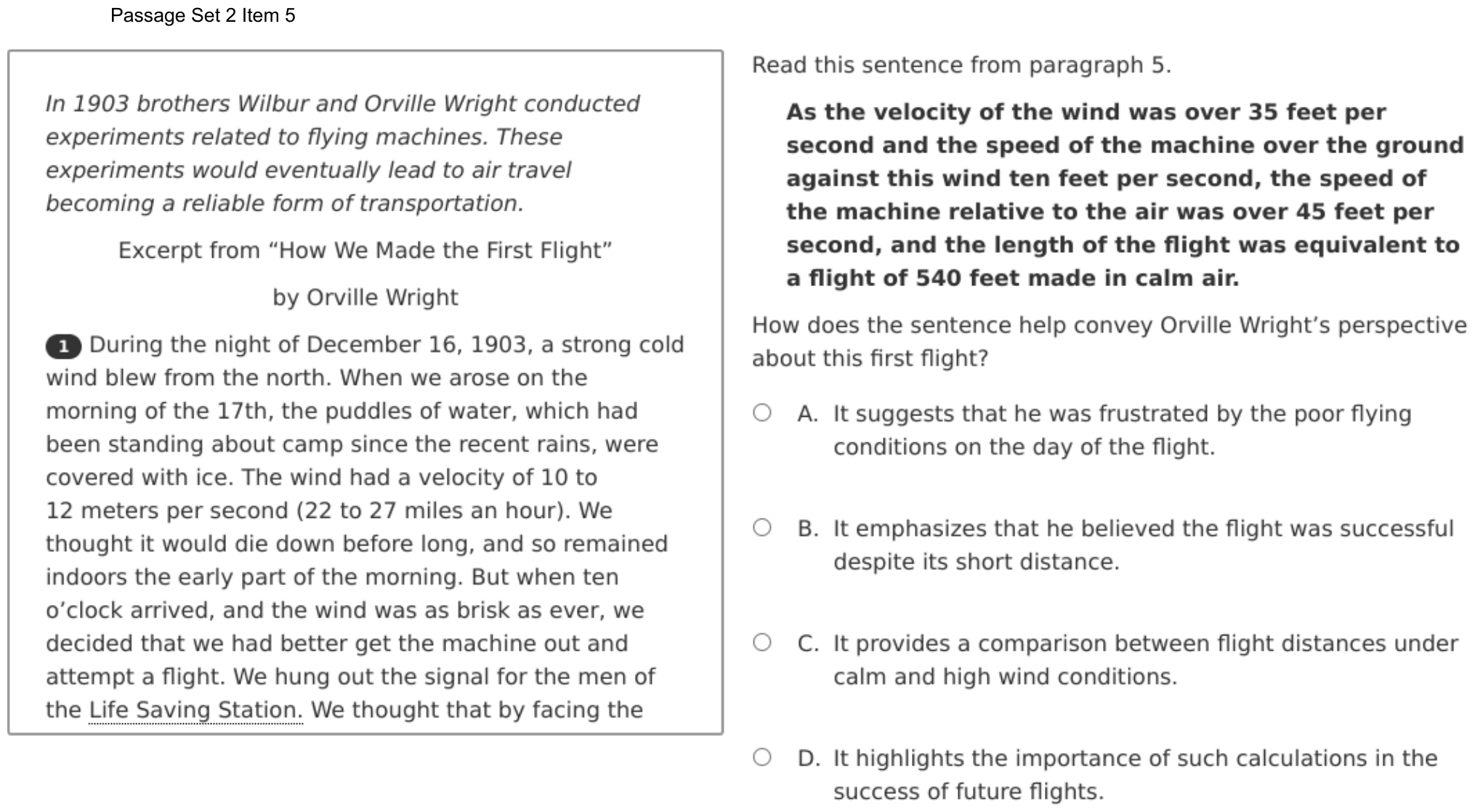
Read this sentence from paragraph 5.
As the velocity of the wind was over 35 feet per second and the speed of the machine over the ground against this wind ten feet per second, the speed of the machine relative to the air was over 45 feet per second, and the length of the flight was equivalent to a flight of 540 feet made in calm air.
How does the sentence help convey Orville Wright’s perspective about this first flight?
- AIt suggests that he was frustrated by the poor flying conditions on the day of the flight.
- BIt emphasizes that he believed the flight was successful despite its short distance.
- CIt provides a comparison between flight distances under calm and high wind conditions.
- DIt highlights the importance of such calculations in the success of future flights.
Show the answer
Correct answer: B
The question asks how the sentence from paragraph 5 helps convey Orville Wright’s perspective about the first flight.
A. Incorrect. Although the sentence from paragraph 5 refers to the velocity of the wind during the flight, there is no indication that Orville felt a sense of frustration with the windy conditions. Instead, the sentence emphasizes the “speed of the machine relative to the air” and presents the equivalent flight length if the machine had flown through calm air (“the length of the flight was equivalent to a flight of 540 feet made in calm air”), details that emphasize the importance of the Wrights’ accomplishment.
B. CORRECT. In the sentence from paragraph 5, Orville uses the wind velocity and the machine speed to highlight the distance that the plane covered while in the air and to determine the distance that it would have flown on a day with calm winds, which emphasizes the magnitude of the accomplishment.
C. Incorrect. Since Orville does not suggest in the sentence from paragraph 5 how far the plane traveled under the actual conditions of high winds, the comparison is incomplete. Additionally, this statement does not address the reason that he would make such a comparison, which allowed him to describe the flight in more impressive terms (540 feet versus 120 feet).
D. Incorrect. Unlike the wind velocity calculations made in preparation for the flight, which might help in determining the success of future flights, the comparative calculations that Orville provides in the sentence from paragraph 5 help interpret the results of the first flight (by describing how fast and far the machine flew relative to the flying conditions) and thereby communicate its success. The calculations of the first flight’s relative speed and equivalent distance would not affect the success of future flights, but the information does provide context for understanding the Wright brothers’ accomplishment.
Question analysis
This point-of-view question quotes the long sentence from paragraph 5 in which Orville Wright works out the machine’s speed through the air and the length of an equivalent flight in calm air. Students must decide how this sentence helps convey his perspective on the first flight. The sentence is mostly numbers, from 35 feet per second to 540 feet, which makes its purpose easy to miss.
- Grade level
- Grade 8 reading and task
- Compared with grade 7
- Above grade 7 Grade 7 point-of-view questions usually rest on words that show feeling. This sentence is a chain of speeds and distances with no feeling words, so students must work out why Orville bothers with the arithmetic, a step beyond typical grade 7 work.
- Estimated difficulty
- Hard: combines ideas, needs a plan, and has more than one tempting wrong answer.
- Thinking it demands
- Depth of knowledge 3, strategic thinking · mainly analyze
- What makes it hard
- How, not what moderate
- Reading between the lines moderate
- Complex sentences minor
- Evidence
- Answered from one paragraph or stanza
- Reading level
- Passage: about grade 7, 816 words; question and choices: about grade 9, 132 words.
- Students, last 30 days
- Not enough answers yet to show (it takes 10).
Why it is hard, traps and wrong answers (shows the answer)
Why it is hard
Point-of-view questions usually turn on feeling words, and this sentence has none, only speeds and a distance. Students must ask why Orville bothers with the arithmetic, and the answer is that 540 feet in calm air makes a 12-second hop look like the achievement he believed it was. The strongest pull describes the sentence’s content accurately, a comparison of calm and windy flight, without saying what it reveals, so students who answer what instead of why lose the point.
How, not what moderate Working it out
The question asks why Orville includes this calculation, so students must see that converting a short hop into “a flight of 540 feet made in calm air” is his way of showing that it counted. (Anderson & Krathwohl, 2001)
Reading between the lines moderate Working it out
The sentence holds no word of feeling or judgment; his view that the flight succeeded must be read from his choice to restate about 120 feet over the ground as 540 feet through the air. (Graesser, Singer & Trabasso, 1994; Kintsch, 1998)
Complex sentences minor Understanding the question
The 61-word sentence chains four measurements, a wind over 35 feet per second, a ground speed of ten, an airspeed over 45 and the 540-foot equivalent, joined by “As,” “and” and commas. (Abedi & Lord, 2001; Freedle & Kostin, 1993; Messick, 1989)
Strategy: Work out what the speeds and distances in the sentence describe, then ask why Orville includes them at this point and what that choice tells you about his view of the flight.
Traps
- Wrong purpose or structure: Names a purpose, structure or effect that the part does not serve, or describes what a part says when the question asks what it does.
- Wrong tone or attitude: Misjudges the tone, attitude or point of view, such as reading admiration as criticism, or taking a character's or subject's feelings for the author's.
- Outside knowledge: A choice is plausible in the real world but not supported by this text.
The wrong answers, classified
A Wrong tone or attitude (Graesser, Singer & Trabasso, 1994)
Links the high wind to the cold, hard morning of paragraphs 1 and 2 and assumes Orville resented it, though here he uses the wind’s speed to make the flight count for more.
C Wrong purpose or structure (Anderson & Krathwohl, 2001)
Describes what the sentence contains, a flight measured against one in calm air, without saying what that comparison shows about Orville’s view of the flight, which is what the question asks.
D Outside knowledge (King et al., 2004; Recht & Leslie, 1988)
Assumes careful calculations must be meant to guide later flights, a reasonable idea about early aviation, but this sentence measures the flight just made and looks no further ahead.
Working it out, step by step
Figure out what the question asks
This asks about Orville Wright’s perspective, or point of view. How did he feel about the first flight? The quoted sentence is full of numbers, not feelings. So ask why Orville bothered to do this math.
Sort out the numbers
The wind blew against the machine at over 35 feet per second. The machine moved over the ground at 10 feet per second. It was flying into the wind, so the air rushed past it even faster. Add them: it moved through the air at over 45 feet per second. The flight lasted 12 seconds. Over the ground, that is 10 × 12 = 120 feet. Through the air, it is 45 × 12 = 540 feet. That is how Orville gets “a flight of 540 feet made in calm air.”
Ask why Orville does this math
Paragraph 5 says the flight ended “a little over 120 feet from the point at which it rose into the air.” That sounds short. But Orville shows it was really much more. In calm air, the same flight would have gone 540 feet. He wants you to see that the short hop was a real flight. So his view is that the flight was a success.
Check each choice
- A does not fit. There is no sign of frustration. Orville uses the wind to make the flight count for more.
- B fits. The math turns a short flight into an impressive one.
- C does not fit. The sentence does compare calm and windy air. But that only says what the sentence contains, not what Orville thinks.
- D does not fit. The math measures the flight that just happened. It does not look ahead to future flights.
Watch out: C is tempting because it describes the sentence correctly. But the question asks about his perspective. C never says how he felt about the flight.
Choose the answer
Orville does the math to show that his short flight was a real success. So the answer is B, “It emphasizes that he believed the flight was successful despite its short distance.”
Why this answer and not the closest wrong one
C is the closest wrong choice. It is true that the sentence compares a windy flight with one “made in calm air.” But C only tells what the sentence says. The question asks why Orville says it. He turns about 120 feet into 540 feet to show the flight was a real achievement. B gives that reason.
More questions like this
The original DOE question
The passage “Excerpt from “How We Made the First Flight”” as printed (pages 13–14)
Question 4 of 6
2024 Test A Math, question 18Question
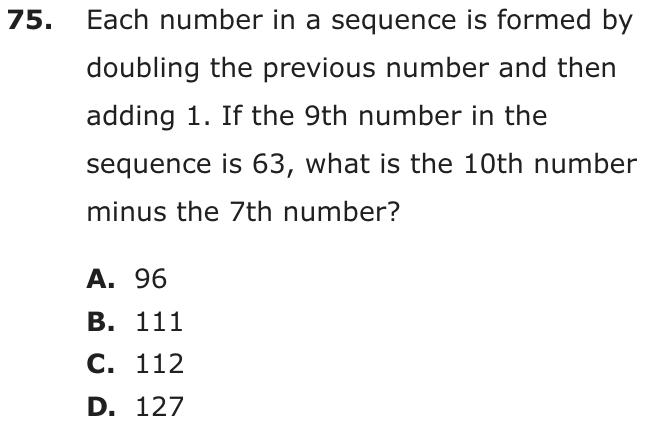
Each number in a sequence is formed by doubling the previous number and then adding 1. If the 9th number in the sequence is 63, what is the 10th number minus the 7th number?
- A96
- B111
- C112
- D127
Show the answer
Correct answer: C
First, write an equation based on the rule described in the item. Let x be the previous number in the sequence and y be the number in the sequence. The ninth number in the sequence is 63.
Determine the 10th number in the sequence, y, by making and solving:
Determine the 8th number in the sequence, x, by making and solving:
Subtract one from both sides of the equation.
Determine the 7th number in the sequence, x, by making and solving:
Subtract the 7th number in the sequence from the 10th number:
The difference is 112.
Question analysis
A sequence question: each number is found by doubling the one before it and adding 1, and the 9th number is 63. Students find the 10th number minus the 7th. That means running the rule forward once and backward twice, while keeping track of which position each number holds.
- Grade level
- Grade 7 content, by NYS standard
- Compared with grade 7
- Above grade 7 Grade 7 students solve two-step equations but rarely have to run a rule backward through a sequence. This mixes forward and backward steps with position counting, so it asks for more planning than a typical grade 7 task.
- Estimated difficulty
- Hard: combines ideas, needs a plan, and has more than one tempting wrong answer.
- Thinking it demands
- Depth of knowledge 2, skills and concepts · mainly apply
- What makes it hard
- No obvious method moderate
- Many steps moderate
- Much to keep track of minor
- Solution
- 4 steps
- Reading level
- Question and choices: about grade 7, 32 words.
- Corrected from the DOE handbook
- A misplaced parenthesis in the explanation’s working was corrected.
- Students, last 30 days
- Not enough answers yet to show (it takes 10).
Why it is hard, traps and wrong answers (shows the answer)
Why it is hard
Applying the rule forward is routine; running it backward is not, and the question needs both. Students must also count positions carefully, since the 9th number is given and the 7th is two steps back, not one. Each listed wrong answer stops or slips at a different stage, so writing the four numbers in a row, 15, 31, 63 and 127, before subtracting is the reliable way.
No obvious method moderate Working it out
The rule is stated only forward, double and add 1, but the 7th and 8th numbers come before the given 9th, so the rule must be undone: subtract 1, then halve. (Schoenfeld, 1985)
Many steps moderate Working it out
One forward step reaches the 10th number, 127, two backward steps reach the 8th and 7th, 31 and 15, and a final subtraction finishes. (Daniel & Embretson, 2010; Enright, Morley & Sheehan, 2002)
Much to keep track of minor Working it out
Four positions and their values, 7th to 10th, have to be kept straight, and the 8th number is easy to mistake for the 7th. (Sweller, 1988; Carpenter, Just & Shell, 1990)
Strategy: Apply the rule to 63 to get the 10th number; to go back a position, subtract 1 and halve, doing it twice to reach the 7th; then subtract.
Traps
- Counting the ends: Inclusive or exclusive ends, fence posts, consecutive numbers: an answer that is one too many or too few, or an endpoint drawn open where it belongs closed (or the reverse).
- Stops one step early: A choice is a number from partway through the solution.
The wrong answers, classified
A Counting the ends (Brown & Burton, 1978)
Steps back only once from the 9th number and subtracts the 8th, 127 − 31 = 96, one position short of the 7th.
B Misreads the question (Hegarty, Mayer & Monk, 1995)
Doubles 63 to 126 but forgets to add 1 on that step, then subtracts the correct 7th number: 126 − 15 = 111.
D Stops one step early (King et al., 2004; Gierl et al., 2017)
Finds the 10th number, 2 × 63 + 1 = 127, and stops without subtracting the 7th number from it.
What was corrected from the DOE handbook, and why
- Explanation: Finding the 7th number, the handbook writes “2x + (1 − 1 = 31 − 1)”, with the closing parenthesis after the whole equation, so the line reads as an equation inside an expression (and 1 − 1 = 31 − 1 is false). The site now reads 2x + (1 − 1) = 31 − 1, the same step the handbook writes correctly for the 8th number (2x + (1 − 1) = 63 − 1). It leads to 2x = 30 and x = 15 as before.
Worked solution, step by step
Formulas used
- The sequence rule
- A sequence is a list of numbers that follows a rule. x is a number in the list, and y is the next number. To get the next number, double x and then add 1.
- Going back one number
- y is a number in the list, and x is the one just before it. To go back, undo the rule in reverse order. The rule doubles and then adds 1. So first subtract 1, then divide by 2.
Sort out the question
Each number is “formed by doubling the previous number and then adding 1”. Previous means the one just before. The 9th number is 63. You need the 10th number minus the 7th number. So you go forward one number and back two numbers.
Find the 10th number
Use the rule with x = 63.
The 10th number is 127. Watch out: remember to add 1. Doubling only gives 126 and leads to 111, choice B.
Plan how to go back
The 7th number comes before the 9th, so you must undo the rule. The rule doubled, then added 1. Undo the last step first: subtract 1. Then undo the doubling: divide by 2.
Find the 8th number
The 8th number is 31. Watch out: 31 is the 8th number, not the 7th. Using it gives , choice A.
Find the 7th number
Step back once more, from the 8th number. Use the same rule with y = 31.
The 7th number is 15.
Subtract the 7th from the 10th
Watch out: 127 alone is choice D. You still have to subtract the 7th number. So the answer is C, 112.
Check your answer
Go forward from 15 using the rule. , then , then . You land on 63 as the 9th number, so the list is right. And .
More questions like this
The original DOE question
Question 5 of 6
2018 Test A Math, question 21Question
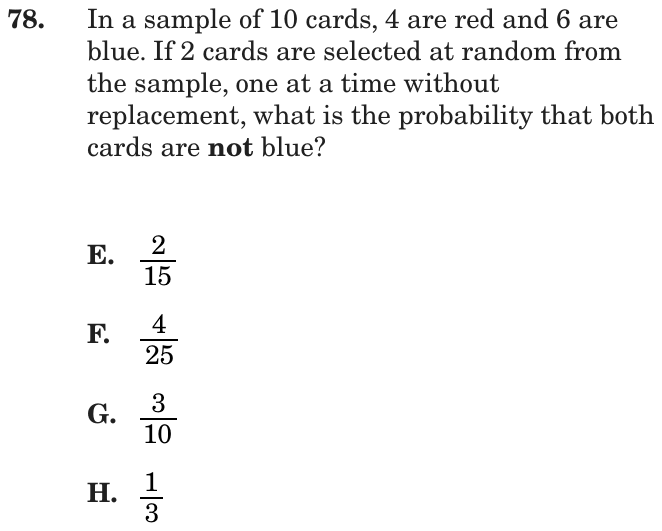
In a sample of 10 cards, 4 are red and 6 are blue. If 2 cards are selected at random from the sample, one at a time without replacement, what is the probability that both cards are not blue?
- A
- B
- C
- D
Show the answer
Correct answer: A
The probability that both cards are not blue is the same as the probability that both cards are red. There are 4 red cards out of the 10, so the probability of the first card being red is
Now there are 9 cards left, and 3 of those are red, so the probability of the second card being red is
Multiply the two probabilities to find the probability that both cards are red (not blue):
Question analysis
This probability question draws 2 cards, one at a time and without replacement, from 10 cards: 4 red and 6 blue. Students find the chance that neither card drawn is blue. The second draw has one fewer card, and the word not changes which color to count.
- NYS standards
- Grade level
- Grade 7 content, by NYS standard
- Compared with grade 7
- Above grade 7 Grade 7 compound probability is usually found with a list or tree of equally likely outcomes. Dependent draws without replacement, plus a negative phrasing to translate, go beyond that typical work.
- Estimated difficulty
- Hard: combines ideas, needs a plan, and has more than one tempting wrong answer.
- Thinking it demands
- Depth of knowledge 2, skills and concepts · mainly apply
- What makes it hard
- Something you must already know moderate
- A very close wrong answer moderate
- Turning words into math minor
- An answer in an unexpected form minor
- Solution
- 3 steps
- Reading level
- Question and choices: about grade 5, 39 words.
- Students, last 30 days
- Not enough answers yet to show (it takes 10).
Why it is hard, traps and wrong answers (shows the answer)
Why it is hard
Two ideas stack here: restating not blue as red, and changing the second draw's numbers after a card is removed. Students who know to multiply but forget the removal reach a listed choice, and so do students who compute both blue. Writing the second fraction explicitly as 3 red out of 9 cards, before multiplying, is what separates right from nearly right.
Something you must already know moderate Working it out
Multiplying the first draw's chance by the second draw's, with the second adjusted for the card already taken, is a rule the test assumes and does not give. (Anderson & Krathwohl, 2001)
A very close wrong answer moderate Choosing the answer
2/15 and 4/25 are about 0.13 and 0.16, too close to tell apart by estimate; only the second draw's fraction, 3 red of 9 cards rather than 4 of 10, separates them. (Embretson & Wetzel, 1987; Gorin & Embretson, 2006; Ascalon et al., 2007)
Turning words into math minor Understanding the question
"Both cards are not blue" has to be restated as both cards red, and the bold not also invites computing the chance that both are blue. (Hegarty, Mayer & Monk, 1995; Koedinger & Nathan, 2004)
An answer in an unexpected form minor Choosing the answer
The product comes out as 12/90, and it has to be reduced to lowest terms before it matches any of the listed fractions. (Enright, Morley & Sheehan, 2002)
Strategy: Restate not blue as red, then multiply the chance of red on the first draw by the chance of red on the second, with one card fewer.
Traps
- Without replacement: In a second pick there is one fewer item, which changes the probability.
- Misreads the question: Misses or misreads a condition or a word in the question: "at least", "each", "remaining", "not".
The wrong answers, classified
B Without replacement (Fischbein & Schnarch, 1997)
Multiplies 4/10 × 4/10 = 16/100 = 4/25, as if the first red card were put back before the second draw.
C Little reason to choose it (Haladyna & Downing, 1993; Rodriguez, 2005)
No standard working gives 3/10: it is not the chance of red or of blue on one draw or on two, so it mostly catches guesses.
D Misreads the question (Hegarty, Mayer & Monk, 1995)
Computes the chance that both cards are blue, 6/10 × 5/9 = 30/90 = 1/3, missing the bold word not.
Worked solution, step by step
Formulas used
- Probability
- P is the probability, the chance that something happens. Favorable is the number of ways to get what you want, here a red card. Total is the number of all possible picks, here all the cards you can pick from. It works when every pick is equally likely.
- Two events in a row
- A is the first event and B is the second. P( ) means the probability of what is inside. The chance that both happen is the first chance times the second. For the second chance, count only what is left after the first event.
Sort out the question
There are 10 cards: 4 red and 6 blue. You pick 2 cards “one at a time without replacement”. That means the first card is not put back. “Both cards are not blue” means both are red, since red is the only other color. You need the probability, or chance, of that.
Find the chance the first card is red
4 of the 10 cards are red. Each card is equally likely to be picked. Use the probability formula.
Find the chance the second card is red
One red card is gone now, and it is not put back. So 9 cards are left, and 3 of them are red.
Watch out: using 4/10 again acts as if the card went back. That gives 4/25, choice B.
Multiply the two chances
Both cards must be red. So multiply the first chance by the second. To multiply fractions, multiply the tops, then multiply the bottoms.
Simplify the fraction
None of the choices is 12/90, so simplify it. Divide the top and the bottom by 6, the biggest number that goes into both.
Watch out: the chance that both are blue is , choice D. The question says not blue. So the answer is A, .
Check your answer
Count the ways. There are ways to pick two cards in order. Red then red has ways. That gives 12/90, or 2/15. The answer is small, which makes sense, because there are fewer red cards than blue ones.
More questions like this
The original DOE question
Question 6 of 6
2026 Practice Test C Math, question 15Question
A grocery store sells 1-gallon containers of milk for $3.99. The store also sells orange juice in a 6-pack of 5.5-fluid-ounce bottles for $1.79. Suppose the store wants to sell its orange juice in gallon containers instead. To the nearest dollar, how much more would a gallon of orange juice cost than a gallon of milk?
Enter your answer in the space.
Fill-in question: work out the answer and type it as a number.
Show the answer
Correct answer: 3
To determine the cost of a gallon of orange juice, begin by finding the total number of ounces in the 6-pack of bottles:
So, 33 oz of orange juice costs $1.79.
There are 128 oz in 1 gallon. Set up a proportion using the $1.79 cost per 33 oz of orange juice and the unknown cost (x) per 1 gallon of orange juice:
Cross multiply to solve for x in the proportion:
So, the orange juice costs $6.94 per gallon, and the milk costs $3.99 per gallon.
Subtract the cost per gallon of milk from the cost per gallon of orange juice.
Round the difference to the nearest dollar.
$2.95 rounds to $3.
Question analysis
A store sells milk by the gallon for $3.99 and orange juice in six-packs of 5.5-fluid-ounce bottles for $1.79. Students work out what a gallon of the juice would cost at the same price per ounce and how much more that is than the milk, to the nearest dollar. The ounces in a gallon must be known, and several steps involve decimals.
- Grade level
- Grade 7 content, by NYS standard
- Compared with grade 7
- Above grade 7 Unit prices are grade 6 and 7 work, but this chains five steps with decimals and needs a fact the question does not give, the number of fluid ounces in a gallon. Typing a rounded difference, with no choices, adds risk.
- Estimated difficulty
- Hard: combines ideas, needs a plan, and has more than one tempting wrong answer.
- Thinking it demands
- Depth of knowledge 2, skills and concepts · mainly apply
- What makes it hard
- Something you must already know moderate
- Many steps moderate
- Error-prone arithmetic minor
- An answer in an unexpected form minor
- Solution
- 5 steps
- Reading level
- Question and choices: about grade 5, 60 words.
- Corrected from the DOE handbook
- A rounded value in the explanation is now marked as approximate (≈ instead of =).
- Students, last 30 days
- Not enough answers yet to show (it takes 10).
Why it is hard, traps and wrong answers (shows the answer)
Why it is hard
The calculation is long, and its key fact is missing from the page. Students who know the 128 fluid ounces still face a division by 33 that does not come out evenly, which tempts them to round the price per ounce to 5 cents and lose about 50 cents a gallon. Keeping the exact quotient to the end, or scaling 33 ounces up by about 3.9, keeps the difference near $2.95, which rounds to 3.
Something you must already know moderate Working it out
The question never says that a gallon holds 128 fluid ounces, yet the whole comparison depends on it; the 6-pack holds only 6 × 5.5 = 33 ounces. (Anderson & Krathwohl, 2001)
Many steps moderate Working it out
Five moves follow one another: the ounces in a pack, the scale-up to 128 ounces, the division by 33, the subtraction of $3.99 and the rounding to a whole dollar. (Daniel & Embretson, 2010; Enright, Morley & Sheehan, 2002)
Error-prone arithmetic minor Working it out
1.79 × 128 = 229.12 and 229.12 ÷ 33 are long decimal calculations without a calculator, and a slip in either moves the price of a gallon. (Brown & Burton, 1978; Junker & Sijtsma, 2001)
An answer in an unexpected form minor Choosing the answer
The rounded difference is typed with no choices, so an unrounded $2.95, or a figure rounded too soon, looks just as finished as the whole-dollar answer. (Enright, Morley & Sheehan, 2002)
Strategy: Find the ounces in one six-pack, scale its price up to the 128 fluid ounces in a gallon, subtract the milk's price, and round only at the end.
Traps
- Stops one step early: A choice is a number from partway through the solution.
- Rounds too early: Rounds a value partway through, or rounds the wrong way, so the final answer drifts from the exact one.
- Misreads the question: Misses or misreads a condition or a word in the question: "at least", "each", "remaining", "not".
The wrong answers, classified
7 Stops one step early (King et al., 2004; Gierl et al., 2017)
Finds the juice's cost per gallon, about $6.94, rounds it to $7, and enters that without subtracting the $3.99 price of the milk.
2 Rounds too early (King et al., 2004)
Rounds the price per ounce, 1.79 ÷ 33 ≈ 0.054, to $0.05, so a gallon costs $6.40 and the difference, $2.41, rounds to 2.
2.95 Misreads the question (Hegarty, Mayer & Monk, 1995)
Works out the difference of $2.95 correctly but enters it as it stands, though the question asks for it to the nearest dollar.
What was corrected from the DOE handbook, and why
- Explanation: The DOE’s explanation goes from 33x = $229.12 to “x = $6.94”. But 229.12 ÷ 33 = 6.9430…, so $6.94 is the cost per gallon rounded to the cent. The site writes x ≈ $6.94. Nothing else changes: $6.94 − $3.99 = $2.95, which rounds to $3, and the unrounded cost gives the same answer.
Worked solution, step by step
Formulas used
- Fluid ounces in a gallon
- A gallon holds 128 fluid ounces. This is a fact you must know, because the question does not give it. A fluid ounce measures an amount of liquid. Multiply gallons by 128 to change them into fluid ounces.
- Cross-multiplying a proportion
- A proportion says two ratios are equal. Here each ratio is ounces over dollars. a and c are the tops, and b and d are the bottoms. Multiply each top by the other bottom, and the two products are equal. That turns the proportion into an equation.
Sort out the question
Milk costs $3.99 for 1 gallon. Orange juice comes in a 6-pack of 5.5-fluid-ounce bottles for $1.79. You need how much more a gallon of juice would cost than a gallon of milk. Round to the nearest dollar.
The question doesn’t say how big a gallon is. You must know this fact: 1 gallon is 128 fluid ounces.
Find the ounces in a 6-pack
Each of the 6 bottles holds 5.5 fluid ounces:
So $1.79 buys 33 fluid ounces of juice.
Set up a proportion
Let x be the cost in dollars of a gallon, 128 fluid ounces, of juice. The price per ounce stays the same. So ounces over dollars is the same for the pack and the gallon:
Cross-multiply:
Find the cost of a gallon
Divide both sides by 33:
The sign ≈ means about equal. The exact value is 6.943…, so a gallon of juice costs about $6.94.
Watch out: don’t round too early. One ounce costs about $0.054. Rounding that to $0.05 makes a gallon $6.40, and your answer becomes 2.
Subtract the milk’s price
Find how much more the juice costs:
A gallon of juice costs $2.95 more than a gallon of milk.
Watch out: entering 7, the juice’s price, forgets to subtract the milk.
Round and enter it
The question asks for the nearest dollar. $2.95 is between $2 and $3. Its cents, 95, are 50 or more, so it rounds up to $3. Do not enter 2.95.
Type only the number in the box. So you would enter 3.
Check your answer
Estimate. 128 ounces is almost 4 packs, since . Four packs cost dollars, so a gallon costs a bit less than that. Milk costs about $4. About $7 minus $4 is $3, which matches.
More questions like this
The original DOE question
