Question
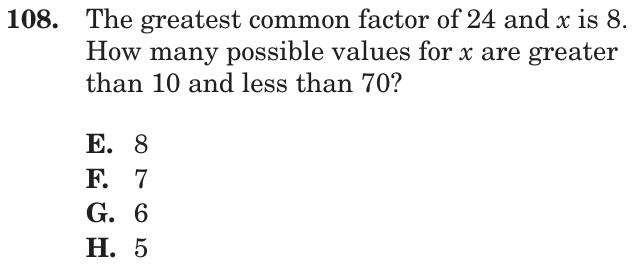
The greatest common factor of 24 and x is 8. How many possible values for x are greater than 10 and less than 70?
- A8
- B7
- C6
- D5
Show the answer
Correct answer: D
First find the multiples of 8 that fall between 10 and 70:
16, 24, 32, 40, 48, 56, 64
Since the greatest common factor of 24 and x is 8, x cannot be 24 or 48 (otherwise the GCF would be 24, not 8).
There are 5 remaining values: 16, 32, 40, 56, and 64.
Question analysis
This number properties question gives the greatest common factor of 24 and an unknown number x as 8, and asks how many possible values of x are greater than 10 and less than 70. It runs the usual GCF task in reverse. Each candidate has to meet the range and the GCF condition exactly, so a quick count is risky.
- NYS standards
- 6.NS.4 common factors and multiples
- Grade level
- Grade 6 content, by NYS standard
- Compared with grade 7
- Above grade 7 Greatest common factors are grade 6 content, usually found for two given numbers. Here the factor is given and every number producing it in a range must be found and checked, a longer and less familiar task than grade 7 classwork.
- Estimated difficulty
- Hard: combines ideas, needs a plan, and has more than one tempting wrong answer.
- Thinking it demands
- Depth of knowledge 2, skills and concepts · mainly apply
- What makes it hard
- No obvious method moderate
- Much to keep track of moderate
- A very close wrong answer minor
- Solution
- 3 steps
- Reading level
- Question and choices: about grade 5, 20 words.
- Students, last 30 days
- Not enough answers yet to show (it takes 10).
Why it is hard, traps and wrong answers (shows the answer)
Why it is hard
The question runs the familiar GCF task backward, and the method has to be built: list the multiples of 8 in range, then strike those whose GCF with 24 is larger than 8. The strike-out is where points are lost, because 24 is plainly out but 48, a multiple of 24, looks like any other multiple of 8. Each wrong count is one step of that process left undone, so a student who skips a single check still finds a matching choice.
No obvious method moderate Working it out
The usual task finds the GCF of two given numbers; here the GCF is given and x is not, so students must see that x is a multiple of 8 and then test each candidate. (Schoenfeld, 1985)
Much to keep track of moderate Working it out
A candidate must be a multiple of 8, lie strictly between 10 and 70, and share no larger factor with 24, a test that 24 and 48 fail with a GCF of 24. (Sweller, 1988; Carpenter, Just & Shell, 1990)
A very close wrong answer minor Choosing the answer
The four choices are the consecutive counts 5 to 8, so keeping a single bad value, most often 48, still lands on a listed answer that looks right. (Embretson & Wetzel, 1987; Gorin & Embretson, 2006; Ascalon et al., 2007)
Strategy: List the multiples of 8 between 10 and 70, then test each one: its greatest common factor with 24 must be exactly 8, so cross out any that 24 divides.
Traps
- Stops one step early: A choice is a number from partway through the solution.
- Misreads the question: Misses or misreads a condition or a word in the question: "at least", "each", "remaining", "not".
The wrong answers, classified
A Misreads the question (Hegarty, Mayer & Monk, 1995)
Counts all eight multiples of 8 below 70, from 8 to 64, ignoring both the lower limit of 10 and the GCF check that removes 24 and 48.
B Stops one step early (King et al., 2004; Gierl et al., 2017)
Lists the seven multiples of 8 between 10 and 70 and stops, keeping 24 and 48, whose greatest common factor with 24 is 24, not 8.
C Stops one step early (King et al., 2004; Gierl et al., 2017)
Strikes out 24, plainly a bad value, but keeps 48, missing that 24 divides 48 too, so their greatest common factor is 24 and six values seem to remain.
Worked solution, step by step
Formulas used
- Greatest common factor
- A factor divides a number with nothing left over. The greatest common factor, or GCF, is the biggest number that is a factor of both numbers. A prime number has only two factors, 1 and itself, like 2 or 3. Write each number as primes multiplied together, then multiply the primes they share.
Sort out the question
A factor of a number divides it with nothing left over. The greatest common factor (GCF) of two numbers is the biggest number that is a factor of both. Here the GCF of 24 and x is exactly 8. You need to count the values x can have. “Greater than 10 and less than 70” means 10 and 70 themselves don’t count.
List the multiples of 8
8 is a factor of x, so x must be a multiple of 8. A multiple of 8 is 8 times a whole number. These multiples of 8 are greater than 10 and less than 70:
16, 24, 32, 40, 48, 56, 64
Leave out 8 itself, since it is less than 10. Counting 8 as well makes 8 numbers, choice A.
Watch out: stopping here gives 7, choice B. Each of these has 8 as a factor, but the GCF must be exactly 8, not more.
Break 24 into prime factors
Write 24 as primes multiplied together.
Use the GCF formula. Every multiple of 8 shares the three 2s with 24. That shared part is 8. If x also has a factor of 3, it shares the 3 too.
Then the GCF is 24, not 8. 24 has no other primes to share. So the GCF is exactly 8 when x is a multiple of 8 but not a multiple of 3.
Test each number for a factor of 3
A number is a multiple of 3 when its digits add up to a multiple of 3.
x Digit sum Multiple of 3? GCF with 24 16 7 no 8 24 6 yes 24 32 5 no 8 40 4 no 8 48 12 yes 24 56 11 no 8 64 10 no 8 Watch out: 48 is easy to miss. It is , so its GCF with 24 is 24. Keeping 48 gives 6, choice C.
Count the numbers left
Cross out 24 and 48. Five numbers are left: 16, 32, 40, 56 and 64. Each one has a GCF of exactly 8 with 24. So the answer is D, 5.
Check your answer
Test one number the long way. The factors of 32 are 1, 2, 4, 8, 16 and 32. The factors of 24 are 1, 2, 3, 4, 6, 8, 12 and 24. The greatest number in both lists is 8. For 48, the number 24 is in both lists, so 48 is out.
More questions like this
The original DOE question