Information you don't need
Question 1 of 11
2026 Practice Test C Math, question 22Question
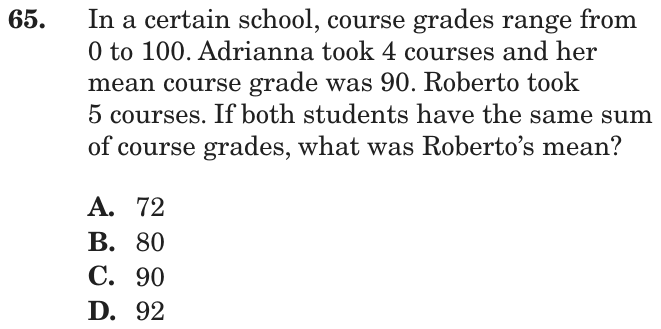
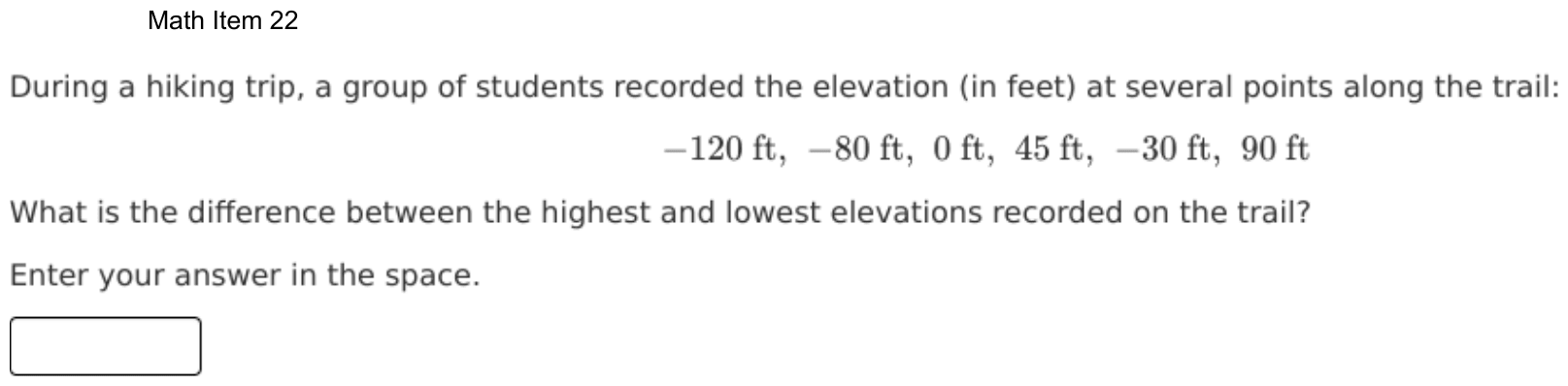
During a hiking trip, a group of students recorded the elevation (in feet) at several points along the trail:
What is the difference between the highest and lowest elevations recorded on the trail?
Enter your answer in the space.
Fill-in question: work out the answer and type it as a number.
Show the answer
Correct answer: 210
Determine the difference between the highest and lowest elevations:
Determine the highest elevation:
Of −120, −80, 0, 45, −30, and 90, the greatest value is 90 because its location is farthest to the right on a number line.
Highest elevation
Determine the lowest elevation:
Of −120, −80, 0, 45, −30, and 90, the lowest value is −120 because its location is farthest to the left on a number line.
Lowest elevation
Determine the difference between the two elevations:
Question analysis
A group of students on a hiking trip records six elevations in feet, some below zero and some above, and finds the difference between the highest and the lowest, typing the result. It tests ordering positive and negative numbers and subtracting integers. Spotting the lowest reading among several negatives and subtracting a negative number correctly are where errors creep in.
- Grade level
- Grade 7 content, by NYS standard
- Compared with grade 7
- At grade 7 Finding the gap between a positive and a negative value by subtracting is core grade 7 work with integers. Picking the extremes from six readings is quick, so the demand is the subtraction of a negative number.
- Estimated difficulty
- Straightforward: two steps or one careful reading.
- Thinking it demands
- Depth of knowledge 2, skills and concepts · mainly apply
- What makes it hard
- Error-prone arithmetic moderate
- An answer in an unexpected form minor
- Solution
- 2 steps
- Reading level
- Question and choices: about grade 7, 40 words.
- Students, last 30 days
- Not enough answers yet to show (it takes 10).
Why it is hard, traps and wrong answers (shows the answer)
Why it is hard
Picking the highest and lowest of six readings is quick, though −120 must be recognized as lower than −80 and −30. The points are lost in the subtraction: the span runs 120 feet up to zero and 90 more above it, and students who treat the readings as plain sizes find only 30. Picturing the two readings on a vertical number line shows the whole span.
Error-prone arithmetic moderate Working it out
The difference is 90 − (−120), and subtracting a negative means adding 120, so the part of the trail below zero is easy to leave out. (Brown & Burton, 1978; Junker & Sijtsma, 2001)
An answer in an unexpected form minor Choosing the answer
The difference is typed with no choices, so 30 or −30, the results of mishandling the negative, gets no warning that the two readings lie on opposite sides of zero. (Enright, Morley & Sheehan, 2002)
Strategy: Pick the greatest and the least elevation by their places on a number line, then subtract the least from the greatest, turning the subtraction of a negative into an addition.
Traps
- Negatives and direction: Arithmetic with negative numbers, the order of a subtraction, or direction on a number line. (Moving a term across the equals sign without changing its sign is a faulty procedure.)
- Wrong operation: Adds instead of multiplying, divides the wrong way round, turns a ratio or rate upside down, or undoes a step in the wrong direction (subtracts what should be added back).
- Information you don't need: The question gives numbers or facts that play no part in the answer.
The wrong answers, classified
30 Negatives and direction (Brown & Burton, 1978)
Subtracts the sizes, 120 − 90 = 30, as if both readings were on the same side of zero, leaving out the stretch below zero.
-30 Wrong operation (Hegarty, Mayer & Monk, 1995; King et al., 2004)
Combines the two extremes by adding, 90 + (−120) = −30, the net of the readings, instead of subtracting the lowest from the highest.
-210 Negatives and direction (Brown & Burton, 1978)
Subtracts in the reverse order, lowest minus highest, −120 − 90 = −210, and enters a negative difference.
Worked solution, step by step
Formulas used
- Difference between highest and lowest
- The difference between the highest and lowest values is how far apart they are. Subtract the lowest from the highest, so the answer is never negative.
- Subtracting a negative
- a and b are numbers. Subtracting a negative is the same as adding a positive. On a number line, it means moving to the right.
Sort out the question
Elevation is height above or below a starting level, here 0 feet. Negative elevations are below 0. The six readings are −120, −80, 0, 45, −30 and 90 feet. You need the difference between the highest and the lowest.
Find the highest and the lowest
Picture the readings on a number line. The highest is farthest right: 90 feet. The lowest is farthest left: −120 feet.
For negative numbers, the bigger the number after the minus sign, the lower it is. So −120 is lower than −80.
Subtract the lowest from the highest
Use the difference formula. Subtracting a negative is the same as adding:
So the two readings are 210 feet apart.
Watch out: treats both readings as if they were above 0. Adding them, , is wrong too.
Enter the answer
A difference like this is a distance, so it is positive. Subtracting in the other order gives −210, which is wrong. Type only the number, with no units.
So you would enter 210.
Check your answer
Count the distance in two parts. From −120 feet up to 0 is 120 feet. From 0 up to 90 is 90 more feet. Together, feet. That matches.
More questions like this
The original DOE question
Question 2 of 11
2026 Practice Test C Math, question 23Question
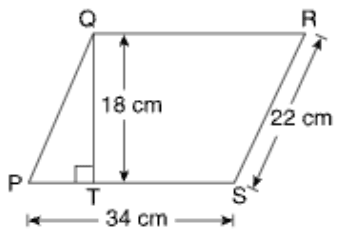
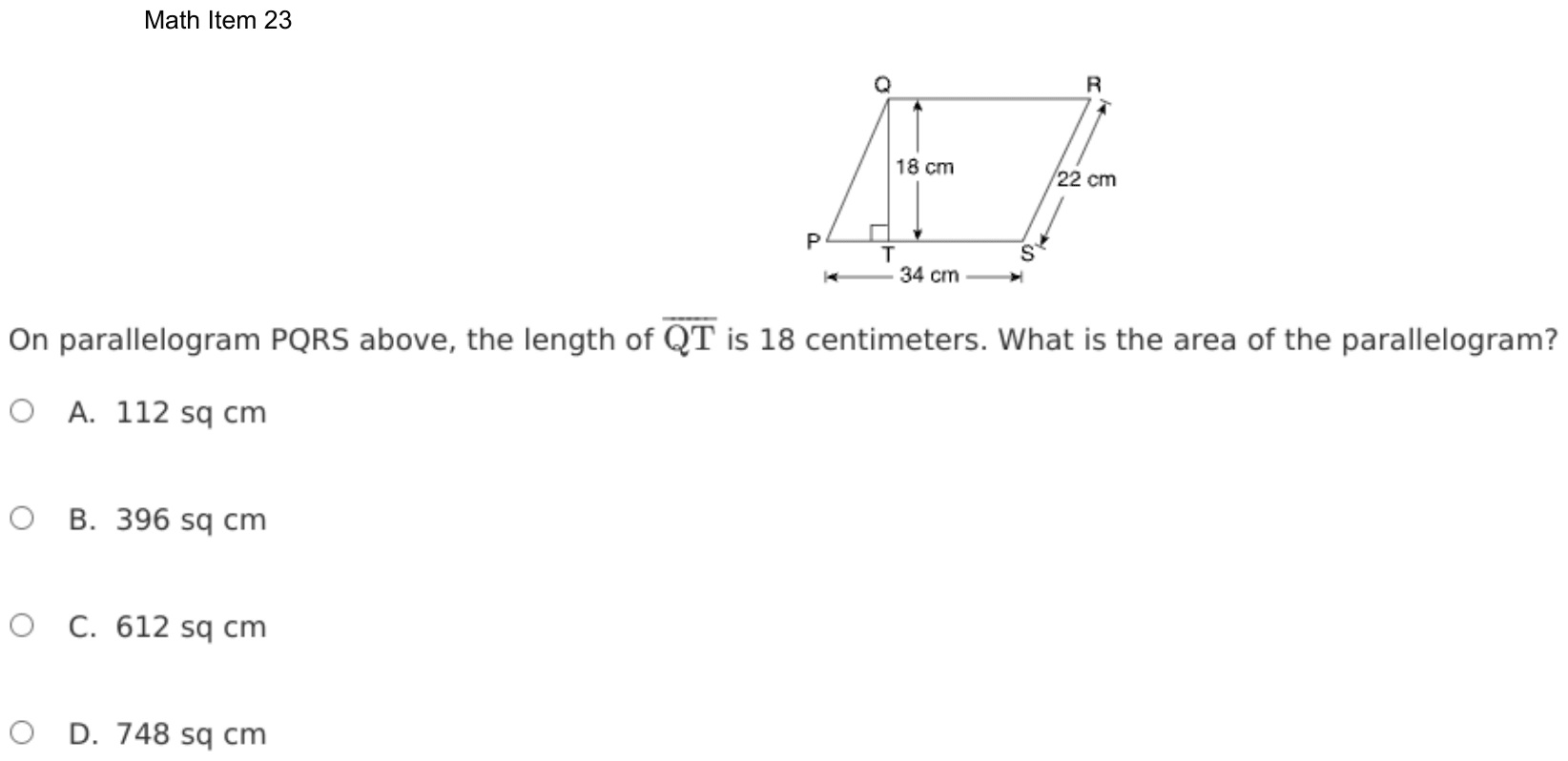
On parallelogram PQRS above, the length of is 18 centimeters. What is the area of the parallelogram?
- A112 sq cm
- B396 sq cm
- C612 sq cm
- D748 sq cm
Show the answer
Correct answer: C
PQRS is a parallelogram in which PS is a base and QT is an altitude. The base is 34 cm in length, and the height is the length of the altitude, so the height is 18 cm.
To determine the area of a parallelogram, multiply the base × the height:
Question analysis
Parallelogram PQRS is drawn with a 34 cm base PS, a 22 cm slanted side and an 18 cm segment QT at a right angle to the base, and students find its area. It tests the area formula for a parallelogram. One labeled length is not needed, so the base and height that go together have to be chosen.
- NYS standards
- 6.G.1 area of polygons
- Grade level
- Grade 6 content, by NYS standard
- Compared with grade 7
- Below grade 7 The area of a parallelogram is grade 6 content, used here once with the height already drawn and labeled. Grade 7 area tasks usually involve circles, composite shapes or scale drawings, so this is easier.
- Estimated difficulty
- Routine: one familiar step, little to misread.
- Thinking it demands
- Depth of knowledge 1, recall and reproduction · mainly apply
- What makes it hard
- Solution
- 1 step
- Reading level
- Question and choices: about grade 5, 25 words.
- Students, last 30 days
- Not enough answers yet to show (it takes 10).
Why it is hard, traps and wrong answers (shows the answer)
Why it is hard
One multiplication answers the question once the right pair of lengths is chosen. Each wrong choice pairs or combines the labeled lengths in another way: the two sides as for a rectangle, the height with the slanted side, or all four sides as a perimeter. Following the right-angle mark at T from QT down to PS identifies the base and height that belong together.
Reading a figure, table or graph minor Understanding the question
Three lengths are labeled, 34 cm, 18 cm and 22 cm, but only the base PS and the height QT meet at the right-angle mark; the slanted side RS is not needed. (Lesh, Post & Behr, 1987; Kirsch & Mosenthal, 1990)
Something you must already know minor Working it out
The formula, base times height, is not given, and the height must be the perpendicular distance between two sides, not the length of a slanted side. (Anderson & Krathwohl, 2001)
Strategy: Multiply the base by the height measured at a right angle to it, and check that the length you use as the height meets that base at a right-angle mark.
Traps
- Wrong formula: Uses a related but wrong formula: perimeter for area, diameter for radius, area for volume, or a misremembered one.
- Information you don't need: The question gives numbers or facts that play no part in the answer.
The wrong answers, classified
A Wrong formula (King et al., 2004)
Adds all four sides, 2 × (34 + 22) = 112, finding the perimeter of the parallelogram instead of its area.
B Misreads the figure (Lesh, Post & Behr, 1987; Kirsch & Mosenthal, 1990)
Multiplies the 18 cm height by the 22 cm slanted side, a pair that does not meet at a right angle, getting 396.
D Wrong formula (King et al., 2004)
Multiplies the two side lengths, 34 × 22 = 748, as if a parallelogram's area were side times side like a rectangle's.
Worked solution, step by step
Formulas used
- Area of a parallelogram
- A is the area. b is the base, the side the shape sits on. h is the height, the straight-up distance from the base to the opposite side, at a right angle to the base. It works because you can cut a triangle off one end, move it to the other end, and make a rectangle.
Sort out the question
PQRS is a parallelogram, a four-sided shape whose opposite sides are parallel. The figure shows three lengths. Side PS, the bottom, is 34 cm. Segment QT goes straight down from Q to PS and is 18 cm. Side RS is slanted and is 22 cm. You need the area, in square centimeters.
Pick the base and the height
The base is PS, 34 cm. The height must meet the base at a right angle. The small square at T shows that QT does. So the height is QT, 18 cm.
Watch out: the 22 cm side is slanted, so it is not the height. Multiplying 22 × 18 gives 396, choice B.
Multiply the base by the height
Use the area formula:
Break it up to multiply:
The area is 612 square centimeters.
Choose the answer
Watch out: 34 × 22 = 748, choice D, treats the shape like a rectangle. Adding all four sides gives 112, choice A. That is the perimeter, the distance around.
So the answer is C, 612 sq cm.
Check your answer
Estimate: 34 is about 30 and 18 is about 20, and . 612 is close. Also, the area must be less than , because the height is shorter than the slanted side.
More questions like this
The original DOE question
Question 3 of 11
2026 Practice Test D Math, question 7Question
A middle school library has a shelf with 40 books, each labeled with a different number from 201 to 240. One book is selected at random. What is the probability, as a percentage, of selecting book number 223?
Enter your answer in the space provided.
Fill-in question: work out the answer and type it as a number.
Show the answer
Correct answer: 2.5%
The probability that book number 223 will be selected at random from 40 books is 1 out of 40. To find the probability as a percentage, convert the fraction to a decimal.
The chance of selecting one specific book is .
Convert the decimal to a percentage:
Question analysis
A library shelf holds 40 books numbered 201 to 240, and one is picked at random. Students find the probability of picking one particular book and type it as a percentage. It tests simple probability and converting a fraction to a percent; the book numbers play no part, and the decimal point needs care.
- Grade level
- Grade 6 content, by NYS standard
- Compared with grade 7
- Below grade 7 Finding the probability of one equally likely outcome is grade 6 content. The only further step is rewriting the fraction as a percent, which needs care with place value, so it is lighter than grade 7 compound probability.
- Estimated difficulty
- Straightforward: two steps or one careful reading.
- Thinking it demands
- Depth of knowledge 1, recall and reproduction · mainly apply
- What makes it hard
- An answer in an unexpected form moderate
- Error-prone arithmetic minor
- Solution
- 2 steps
- Reading level
- Question and choices: about grade 6, 41 words.
- Students, last 30 days
- Not enough answers yet to show (it takes 10).
Why it is hard, traps and wrong answers (shows the answer)
Why it is hard
The book numbers, 201 to 240, and the chosen number 223 play no part, since every book is equally likely and the shelf holds 40. The chance is 1 in 40, and the real demand is the form: changing it to a percent means a decimal with a zero in the tenths place, then a shift of two places. Students who know that 1/4 is 25% can check that 1/40 must be a tenth of that.
An answer in an unexpected form moderate Choosing the answer
Only the bold word percentage sets the form, since the empty box shows no % sign, so the probability 1/40 must be turned into 2.5, not entered as the fraction or as 0.025. (Enright, Morley & Sheehan, 2002)
Error-prone arithmetic minor Working it out
Dividing 1 by 40 gives 0.025, with a zero right after the decimal point, and losing that zero turns the percent into 25. (Brown & Burton, 1978; Junker & Sijtsma, 2001)
Strategy: Count the books, write the chance of picking one particular book as a fraction, then turn the fraction into a decimal and multiply by 100 to get the percent.
Traps
- Stops one step early: A choice is a number from partway through the solution.
- Misreads the question: Misses or misreads a condition or a word in the question: "at least", "each", "remaining", "not".
- Information you don't need: The question gives numbers or facts that play no part in the answer.
The wrong answers, classified
0.025 Stops one step early (King et al., 2004; Gierl et al., 2017)
Finds the probability as a decimal, 1 ÷ 40 = 0.025, and enters it without multiplying by 100, though the box asks for a percentage.
25 An arithmetic slip (Junker & Sijtsma, 2001)
Loses the zero after the decimal point when dividing, taking 1 ÷ 40 as 0.25, as 1 ÷ 4 would be, and so enters 25.
1/40 Misreads the question (Hegarty, Mayer & Monk, 1995)
Enters the probability as the fraction 1/40, the form it was found in, overlooking the bold word percentage in the question.
Worked solution, step by step
Formulas used
- Probability of one outcome
- P is the probability, the chance of an event. The top counts the outcomes you want. The bottom counts all the equally likely outcomes. Use it when each outcome has the same chance, like picking one book at random.
- Changing a fraction to a percent
- a/b is the fraction. Percent means out of 100. Multiplying by 100 tells you how many out of 100 the fraction is. For example, 1/2 × 100 = 50, so 1/2 is 50%.
Sort out the question
The shelf has 40 books, numbered 201 to 240. One book is picked at random, so every book has the same chance. You need the chance of picking book 223, written as a percentage. Book 223 is on the shelf, since 223 is between 201 and 240.
Write the probability as a fraction
Only 1 book is number 223, and there are 40 books in all:
The numbers on the labels do not matter beyond this. They just give each book its own name.
Change the fraction to a decimal
Divide 1 by 40. It helps to start from 1/4 = 0.25. Since 40 is ten times 4, 1/40 is one tenth of 1/4:
Watch out: there is a 0 right after the decimal point. Losing it gives 0.25 and then 25, which is wrong.
Change the decimal to a percent
Multiply by 100 to get a percent. That moves the decimal point two places to the right:
So the chance is 2.5%.
Watch out: 0.025 is the probability as a decimal, and 1/40 is the same chance as a fraction. The question asks for a percentage, so neither one is the answer here.
Enter the number
The box shows no % sign. Type 2.5. Adding the sign, as 2.5%, also counts.
So you would enter 2.5.
Check your answer
2.5% means 2.5 out of every 100. Out of 40 books, that is 40 × 0.025 = 1 book, the one numbered 223. Also, one book out of 40 should be a small chance, and 2.5% is small.
More questions like this
The original DOE question

Question 4 of 11
2026 Practice Test D Math, question 12Question
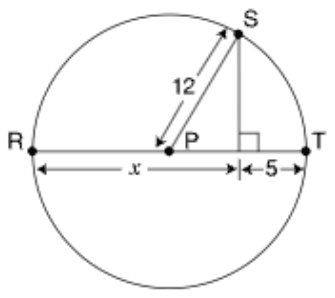
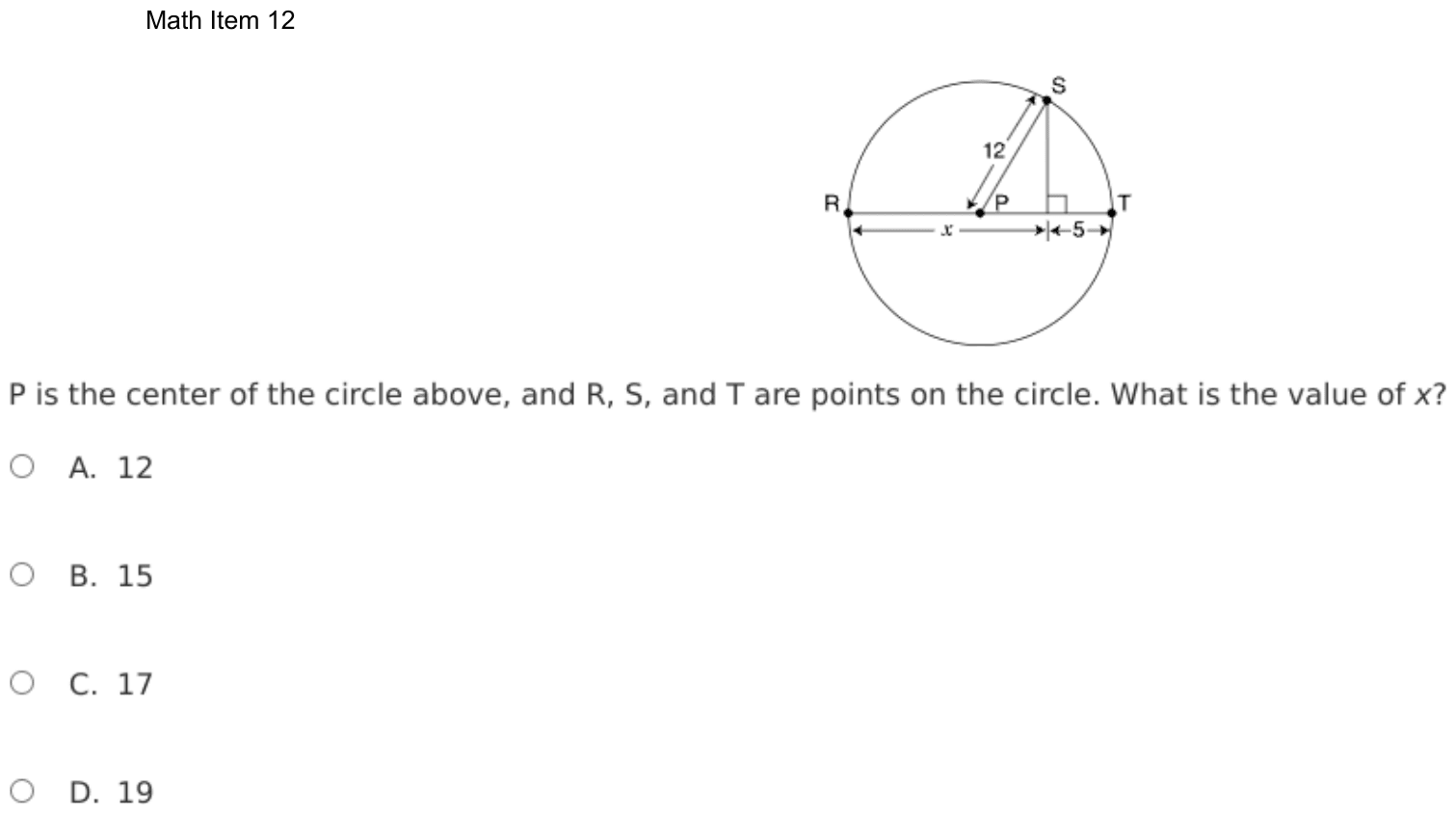
P is the center of the circle above, and R, S, and T are points on the circle. What is the value of x?
- A12
- B15
- C17
- D19
Show the answer
Correct answer: D
represents the radius of the circle and has length 12.
Both and are radii and also have length 12.
Therefore, the length of , which is a diameter, is 24 and is also represented by .
Question analysis
A circle with center P has points R, S and T on it, a segment SP labeled 12, and a vertical segment from S that splits RT into a piece labeled x and a piece labeled 5. Students find the value of x. It tests basic circle facts, and the challenge is seeing which lengths in the figure must be equal.
- Grade level
- Grade 7 content, by NYS standard
- Compared with grade 7
- At grade 7 Grade 7 circle work centers on area and circumference formulas. This needs only the fact that every radius has the same length, but spotting which segments are radii in a figure with extra markings is less routine than using a formula.
- Estimated difficulty
- Moderate: several steps, or a close reading with one strong distractor.
- Thinking it demands
- Depth of knowledge 2, skills and concepts · mainly apply
- What makes it hard
- Reading a figure, table or graph moderate
- No obvious method minor
- Solution
- 2 steps
- Reading level
- Question and choices: about grade 3, 24 words.
- Students, last 30 days
- Not enough answers yet to show (it takes 10).
Why it is hard, traps and wrong answers (shows the answer)
Why it is hard
The figure gives one measurement on a slanted radius and two labels on the diameter, and the right angle at the foot of the vertical segment is a decoy. Once RP and PT are seen as radii, RT is 24, and x is that diameter less the 5. Students who never connect the slanted 12 to the horizontal line fall back on the labeled numbers, adding 12 and 5, or take x to end at the center.
Reading a figure, table or graph moderate Understanding the question
The 12 labels the slanted segment SP, not the horizontal one, and the arrow for x runs from R past the center P to the foot of the vertical segment, so x is neither a radius nor a whole diameter. (Lesh, Post & Behr, 1987; Kirsch & Mosenthal, 1990)
No obvious method minor Working it out
The right-angle mark and the triangle under S suggest the Pythagorean theorem, which is no help; the way in is seeing that RP and PT are radii as well. (Schoenfeld, 1985)
Strategy: Mark every segment from P to the circle as 12, notice that R and T are the ends of a diameter, then write an equation for that diameter using x and the 5.
Traps
- Misreads the figure: Reads a value, label or tick spacing in a figure, table or graph wrongly.
- Information you don't need: The question gives numbers or facts that play no part in the answer.
- Numbers taken from the question: Combines the numbers in the question without a model of the situation, or is simply a number that appears in the question.
The wrong answers, classified
A Misreads the figure (Lesh, Post & Behr, 1987; Kirsch & Mosenthal, 1990)
Reads x as the radius RP, as if its arrow ended at the center P, though it runs past P to the foot of the vertical segment.
B Trusting the picture (Lesh, Post & Behr, 1987)
Judges x from the drawing, where it looks about three times as long as the piece labeled 5, instead of working from the radius of 12.
C Numbers taken from the question (Hegarty, Mayer & Monk, 1995)
Adds the two labeled numbers, 12 + 5 = 17, without placing the 12 on the diameter, as if x were a radius plus the 5.
Worked solution, step by step
Formulas used
- Radius and diameter
- r is the radius, the distance from the center to any point on the circle. d is the diameter, the distance straight across the circle through the center. A diameter is two radii laid end to end, one on each side of the center, so it is twice as long.
Sort out the question
P is the center of the circle, and R, S and T are on the circle. Segment SP is 12. Segment RT goes straight across through P. A short line from S meets RT at a right angle. It splits RT into x, from R to that point, and 5, from that point to T. You need x.
See that SP is a radius
SP runs from the center P to the point S on the circle. So SP is a radius, and the radius is 12. Every radius of a circle has the same length. RP and PT also run from the center to the circle, so RP = 12 and PT = 12.
Find the diameter RT
RT passes through the center, so it is a diameter. Use the formula with r = 12:
RT is 24 long. It is the radius RP plus the radius PT.
Solve for x
RT is also split into x and 5, so:
Subtract 5 from both sides:
Watch out: x runs from R past the center P, so it is longer than a radius. Reading it as 12, choice A, stops at P. Adding 12 + 5 = 17, choice C, puts the 12 in the wrong place.
Work from the numbers, not the picture
The figure is not drawn to scale. In it, x looks about three times as long as 5, which suggests 15, choice B. Trust the labels instead. The right triangle under S is not needed at all.
So the answer is D, 19.
Check your answer
The point where the short line meets RT is 19 from R. P is 12 from R, so that point is 19 − 12 = 7 past the center. Then 7 + 5 = 12, which is PT, a radius. Everything fits.
More questions like this
The original DOE question
Question 5 of 11
2024 Test A Math, question 26Question
What is the area of the parallelogram shown above?
- A750 sq ft
- B600 sq ft
- C500 sq ft
- D300 sq ft
Show the answer
Correct answer: B
To find the area of a parallelogram, multiply the length of a side by the altitude for that side.
One property of parallelograms is that opposite sides are the same length.
So the bottom side of the parallelogram is 30 feet long and has an altitude of 20 feet.
Therefore, the area of the parallelogram, in square feet, is .
Question analysis
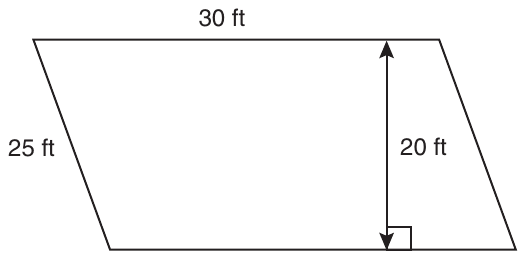
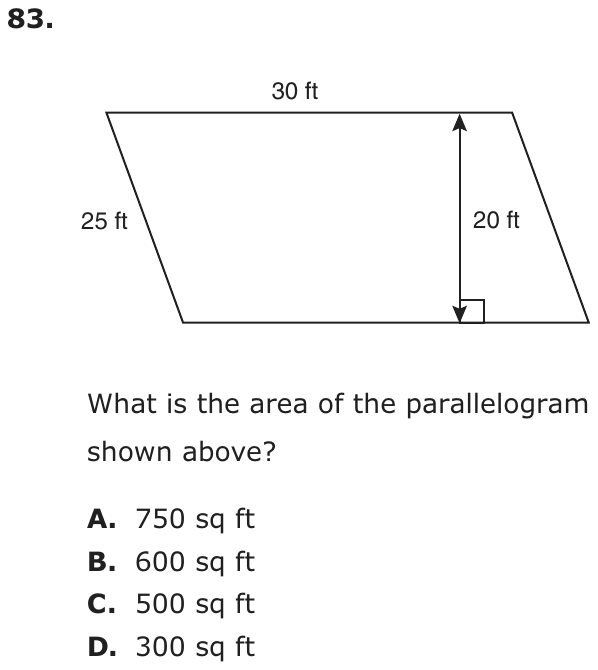
A geometry question with a figure: a parallelogram is labeled with a 30-foot top side, a 25-foot slanted side and a 20-foot height drawn at a right angle. Students find its area. The figure gives one length that is not needed, so students must pick the base and height that belong together.
- NYS standards
- 6.G.1 area of polygons
- Grade level
- Grade 6 content, by NYS standard
- Compared with grade 7
- Below grade 7 Area of a parallelogram is grade 6 content, and this is a one-step use of the formula. It is easier than typical grade 7 area work, which involves composite figures, circles or scale drawings.
- Estimated difficulty
- Routine: one familiar step, little to misread.
- Thinking it demands
- Depth of knowledge 1, recall and reproduction · mainly apply
- What makes it hard
- Solution
- 1 step
- Reading level
- Question and choices: about grade 2, 17 words.
- Students, last 30 days
- Not enough answers yet to show (it takes 10).
Why it is hard, traps and wrong answers (shows the answer)
Why it is hard
This is a one-step formula question with whole numbers, made slightly harder by one length too many. A student who multiplies the two side lengths, as for a rectangle, or brings in a triangle's one half, finds a listed choice. Matching the base to the height marked with a right angle is all it takes.
Reading a figure, table or graph minor Understanding the question
The figure labels three lengths, but only the 30-foot side and the 20-foot height drawn at a right angle to it belong together; the slanted 25-foot side is extra. (Lesh, Post & Behr, 1987; Kirsch & Mosenthal, 1990)
Something you must already know minor Working it out
The parallelogram area formula, base times height, is not given, and its height must be the perpendicular distance, not the slanted side. (Anderson & Krathwohl, 2001)
Strategy: Use base times height, where the height is the perpendicular distance between the two parallel sides chosen as bases.
Traps
- Wrong formula: Uses a related but wrong formula: perimeter for area, diameter for radius, area for volume, or a misremembered one.
- Information you don't need: The question gives numbers or facts that play no part in the answer.
The wrong answers, classified
A Wrong formula (King et al., 2004)
Multiplies the two side lengths, 30 × 25 = 750, as if a parallelogram's area were side times side like a rectangle's.
C Misreads the figure (Lesh, Post & Behr, 1987; Kirsch & Mosenthal, 1990)
Pairs the 20-foot height with the slanted 25-foot side, 25 × 20 = 500, though the height is drawn at a right angle to the 30-foot sides.
D Wrong formula (King et al., 2004)
Uses the triangle formula, 1/2 × 30 × 20 = 300, halving the base times the height.
Worked solution, step by step
Formulas used
- Area of a parallelogram
- A is the area. b is the base, one of the two parallel sides. h is the height: the straight distance between the two parallel sides, at a right angle to the base. It works because you can cut a triangle off one end, move it to the other end and make a rectangle.
Sort out the figure
A parallelogram is a four-sided shape whose opposite sides are parallel. Parallel means they never meet. The figure shows three lengths. The top side is 30 ft. The slanted left side is 25 ft. The arrow from top to bottom is 20 ft, and the small square shows a right angle. You need the area, in square feet.
Choose the base and height
The height must make a right angle with the base. The 20 ft arrow meets the bottom side at a right angle. Opposite sides of a parallelogram are equal, so the bottom side is 30 ft too. So the base is 30 ft and the height is 20 ft. Watch out: the slanted 25 ft side is not needed. Using gives choice C.
Find the area
The area is 600 sq ft. Watch out: do not multiply the two sides, . That is choice A. Do not take half either, which is for triangles and gives 300, choice D. So the answer is B, 600 sq ft.
Check your answer
Picture cutting the triangle off the left end and sliding it to the right end. The shape becomes a rectangle 30 ft long and 20 ft tall, with an area of 600 sq ft. 750 is too big, because the shape is only 20 ft tall, not 25 ft.
More questions like this
The original DOE question
Question 6 of 11
2024 Test A Math, question 32Question
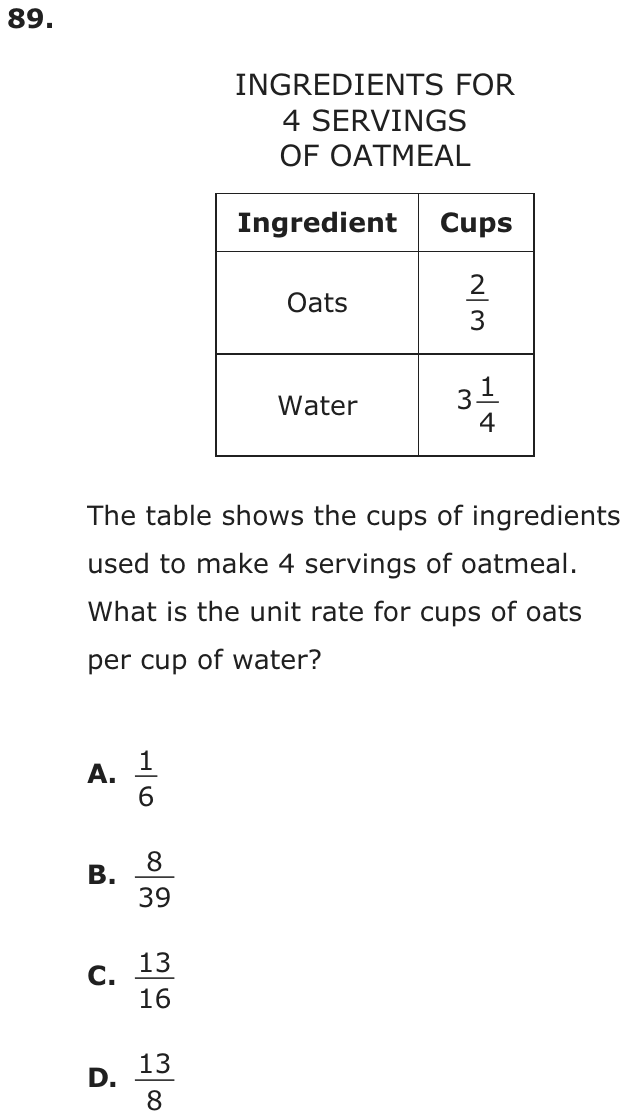
INGREDIENTS FOR 4 SERVINGS OF OATMEAL
| Ingredient | Cups |
|---|---|
| Oats | |
| Water |
The table shows the cups of ingredients used to make 4 servings of oatmeal. What is the unit rate for cups of oats per cup of water?
- A
- B
- C
- D
Show the answer
Correct answer: B
The unit rate for cups of oats per cup of water can be found by dividing the number of cups of oats by the number of cups of water:
The denominator can be rewritten as .
The quotient can be rewritten as:
Therefore, the unit rate for cups of oats per cup of water is .
Question analysis
This unit rate question uses a recipe table for 4 servings of oatmeal, with 2/3 cup of oats and 3 1/4 cups of water, and asks for cups of oats per cup of water. Students divide one fraction by another, including a mixed number. Deciding which quantity goes on top, and whether the number of servings matters, is the tricky part.
- Grade level
- Grade 7 content, by NYS standard
- Compared with grade 7
- At grade 7 Unit rates from fractions, such as 1/2 mile in 1/4 hour, are exactly grade 7 work. This one adds a mixed number, a fraction divided by a fraction, and a table titled for 4 servings, so students must decide which numbers the rate uses.
- Estimated difficulty
- Moderate: several steps, or a close reading with one strong distractor.
- Thinking it demands
- Depth of knowledge 2, skills and concepts · mainly apply
- What makes it hard
- Error-prone arithmetic moderate
- Turning words into math moderate
- Reading a figure, table or graph minor
- Solution
- 3 steps
- Reading level
- Question and choices: about grade 6, 40 words.
- Students, last 30 days
- Not enough answers yet to show (it takes 10).
Why it is hard, traps and wrong answers (shows the answer)
Why it is hard
The question rewards reading the rate's wording exactly and then carrying out a fraction division without slips. The 4 servings in the title is the hook: dividing by 4 gives a per-serving amount that sounds like a unit rate and is listed. Students who write oats over water as one fraction, convert the mixed number and multiply by the reciprocal finish in a few lines.
Error-prone arithmetic moderate Working it out
The rate is a fraction over a mixed number, 2/3 ÷ 3 1/4, so 3 1/4 must become 13/4 and the division a multiplication by 4/13. (Brown & Burton, 1978; Junker & Sijtsma, 2001)
Turning words into math moderate Understanding the question
In "cups of oats per cup of water" the quantity before "per" goes on top; reading the phrase loosely puts water over oats or brings in servings. (Hegarty, Mayer & Monk, 1995; Koedinger & Nathan, 2004)
Reading a figure, table or graph minor Understanding the question
The table's title, "for 4 servings", supplies the only other number on the page, and it plays no part in a rate of oats to water. (Lesh, Post & Behr, 1987; Kirsch & Mosenthal, 1990)
Strategy: Write the rate as cups of oats over cups of water, change the mixed number to an improper fraction, and divide by multiplying by its reciprocal.
Traps
- Information you don't need: The question gives numbers or facts that play no part in the answer.
- Answers a different question: A choice is right for another quantity: the other unknown, the rest instead of the part, the part instead of the whole.
- Wrong operation: Adds instead of multiplying, divides the wrong way round, turns a ratio or rate upside down, or undoes a step in the wrong direction (subtracts what should be added back).
The wrong answers, classified
A Answers a different question (King et al., 2004; Hegarty, Mayer & Monk, 1995)
Divides the 2/3 cup of oats by the 4 servings, 2/3 ÷ 4 = 1/6, giving oats per serving instead of oats per cup of water.
C Answers a different question (King et al., 2004; Hegarty, Mayer & Monk, 1995)
Divides the 3 1/4 cups of water by the 4 servings, 13/4 ÷ 4 = 13/16, leaving the oats out altogether.
D Wrong operation (Hegarty, Mayer & Monk, 1995; King et al., 2004)
Turns the rate upside down, water over oats, and also drops the 3 of 2/3, dividing 13/4 by 2 to get 13/8.
Worked solution, step by step
Formulas used
- Unit rate
- A unit rate tells how much of the first amount goes with 1 of the second amount. The word per means for each. The amount named before per goes on top, and the amount after it goes on the bottom.
- Mixed number to fraction
- a is the whole number part, b is the top of the fraction, and c is the bottom. Each whole holds c pieces, so a wholes hold a times c pieces. Then add the b extra pieces.
- Dividing by a fraction
- a over b is the number you divide. c over d is the number you divide by. To divide by a fraction, multiply by its reciprocal, the fraction flipped upside down. This works because dividing by a number undoes multiplying by it.
Sort out the question
The table shows cup of oats and cups of water. You need the unit rate for “cups of oats per cup of water.” That is how many cups of oats go with 1 cup of water.
Watch out: the 4 servings play no part here. Dividing the oats by 4 servings gives cup for each serving, choice A.Set up the rate
Oats comes before per, so oats goes on top. Water goes on the bottom.
Watch out: water over oats flips the rate. That gives a number bigger than 1, like choice D.Change the mixed number
A mixed number is a whole number plus a fraction. Change to a fraction so you can divide.
So 3 and one quarter cups is 13 quarters of a cup.
Divide by multiplying
To divide by , multiply by its reciprocal, .
No whole number bigger than 1 divides both 8 and 39, so the fraction can’t be made simpler. The rate is cup of oats per cup of water.
So the answer is B, .
Check your answer
There is much more water than oats. So the oats for 1 cup of water should be small, and is about 0.2. Also multiply back: . That is the cups of oats in the table.
More questions like this
The original DOE question
Question 7 of 11
2024 Test A Math, question 39Question
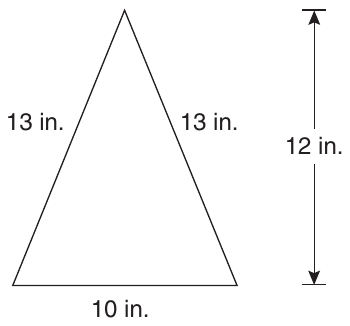
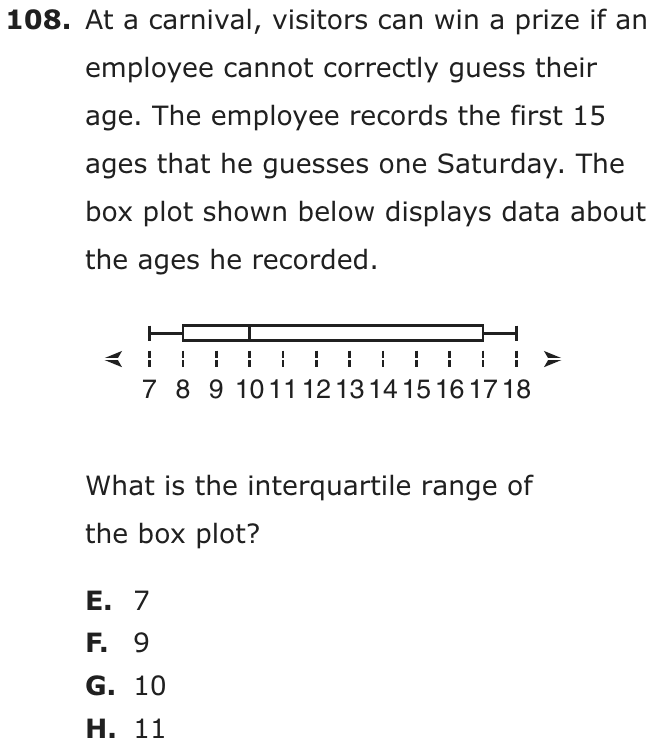
Raquel is cutting out pieces of cardboard to make a pyramid. She will use a square piece for the base and identical triangular pieces for the sides. The figure above shows the dimensions of the triangle for each side. What will be the total surface area, in square inches, of the pyramid, including the square base?
- A280
- B295
- C340
- D360
Show the answer
Correct answer: C
Surface area is found by calculating the area of each side, including the base, and adding them all together.
The base of the pyramid measures 10 inches on each side, so the area of the base is
Each triangular face has a base of 10 inches and a height of 12 inches, so the area of each face is
There are 4 triangular faces (because the square base has 4 edges, each of which will have a triangular face). So the total surface area of the pyramid is the sum of the areas of 4 triangles and 1 square.
So the total surface area is 340 square inches.
Question analysis
This surface area word problem shows one triangular face, with sides of 13 inches, a base of 10 inches and a height of 12 inches, that Raquel will use to build a cardboard pyramid with a square base. Students find the total area of the base and all the triangular sides. Picturing the solid and choosing the right measurements from the figure are the tricky parts.
- Grade level
- Grade 7 content, by NYS standard
- Compared with grade 7
- Above grade 7 Grade 7 students find the surface area of a pyramid from a drawn net or solid. Here only one triangular face is shown, so students must picture the whole pyramid, count its faces, and choose which labeled length belongs in the area formula.
- Estimated difficulty
- Hard: combines ideas, needs a plan, and has more than one tempting wrong answer.
- Thinking it demands
- Depth of knowledge 2, skills and concepts · mainly apply
- What makes it hard
- Reading a figure, table or graph moderate
- Combines ideas moderate
- Something you must already know minor
- Solution
- 4 steps
- Reading level
- Question and choices: about grade 6, 56 words.
- Corrected from the DOE handbook
- A wrong unit in the explanation was corrected.
- Students, last 30 days
- Not enough answers yet to show (it takes 10).
Why it is hard, traps and wrong answers (shows the answer)
Why it is hard
Students have to build the pyramid in their heads from one flat triangle, then choose the right measurement from three labels. The 13-inch sides look like the natural height, and using them gives a listed total; picturing a pyramid with three sloping faces gives another. Sketching the square base with a triangle on each edge, and marking 12 as the height, settles both the face count and the formula.
Reading a figure, table or graph moderate Understanding the question
The figure gives one triangle with three length labels, 13, 13 and 10, and puts its height, 12, on a separate arrow beside it, where it is easy to overlook. (Lesh, Post & Behr, 1987; Kirsch & Mosenthal, 1990)
Combines ideas moderate Working it out
The solid is never drawn: students must see that the square's side equals the triangle's 10-inch base, count four triangles, and add triangle and square areas. (Embretson, 1998; Daniel & Embretson, 2010)
Something you must already know minor Working it out
A triangle's area uses its perpendicular height, not a slanted side, and a pyramid on a square base has four triangular faces; neither fact is given. (Anderson & Krathwohl, 2001)
Strategy: Sketch the pyramid: a square base whose side is the triangle's base, and one triangular face on each side of the square. Find each area with the matching formula, then add them all.
Traps
- Misreads the figure: Reads a value, label or tick spacing in a figure, table or graph wrongly.
- Information you don't need: The question gives numbers or facts that play no part in the answer.
- Misunderstands the concept: A wrong belief about a concept: that percents can be added, that area grows like length, that averages can be averaged, that a bigger denominator means a bigger fraction.
The wrong answers, classified
A Misunderstands the concept (Smith, diSessa & Roschelle, 1993; De Bock et al., 1998; Ni & Zhou, 2005)
Counts only three triangular faces, as if the pyramid had a triangular base, so 3 × 60 + 100 = 280.
B Misunderstands the concept (Smith, diSessa & Roschelle, 1993; De Bock et al., 1998; Ni & Zhou, 2005)
Counts three faces and also uses the 13-inch side as each triangle's height: 3 × 65 + 100 = 295.
D Misreads the figure (Lesh, Post & Behr, 1987; Kirsch & Mosenthal, 1990)
Takes the 13-inch slanted side as each triangle's height instead of the 12-inch arrow beside it, so 4 × 65 + 100 = 360.
What was corrected from the DOE handbook, and why
- Explanation: The handbook ends “So the total surface area is 340 square feet.” The triangle’s dimensions are in inches and the question asks for square inches, so the site now reads “340 square inches.”
Worked solution, step by step
Formulas used
- Area of a triangle
- A is the area. b is the base, the side the triangle sits on. h is the height: the straight-up distance from the base to the top corner, at a right angle to the base. You take half because a triangle is half of a rectangle with the same base and height.
- Area of a square
- A is the area and s is the length of one side. All four sides of a square are equal, so the area is side times side.
- Surface area
- A face is one flat side of a solid shape. The surface area is the total area of the outside. Picture unfolding the solid into flat pieces. Then add up the area of every piece.
Sort out the question
Raquel’s pyramid has a square base. Each side is a triangle like the one in the figure. The triangle’s base is 10 in. Its two slanted sides are 13 in. Its height, the arrow beside it, is 12 in. You need the total surface area, including the square base, in square inches.
Picture the pyramid
Surface area is the total area of all the flat sides, called faces. Each triangle stands on one edge of the square. So each edge of the square is 10 inches, the same as the triangle’s base. A square has 4 edges, so the pyramid has 4 triangles.
Here that is 4 triangles plus 1 square. Watch out: counting only 3 triangles gives 280, choice A.
Find the area of one triangle
Each triangle is 60 square inches. Watch out: the height is 12 in., the straight-up arrow. It is not 13 in., the slanted side. Using 13 gives 65 for each triangle and 360 in all, choice D.
Find the area of the base
The base is a square with sides of 10 inches, the same as each triangle’s base.
The square base is 100 square inches.
Add all five faces
The four triangles and the square together cover 340 square inches.
So the answer is C, 340 square inches.
Check your answer
Each triangle is half of a 10 by 12 rectangle, which has an area of 120. So two triangles make 120, and four make 240. Add the base: . The units fit too: inches times inches gives square inches.
More questions like this
The original DOE question
Question 8 of 11
2023 Test A Math, question 51Question
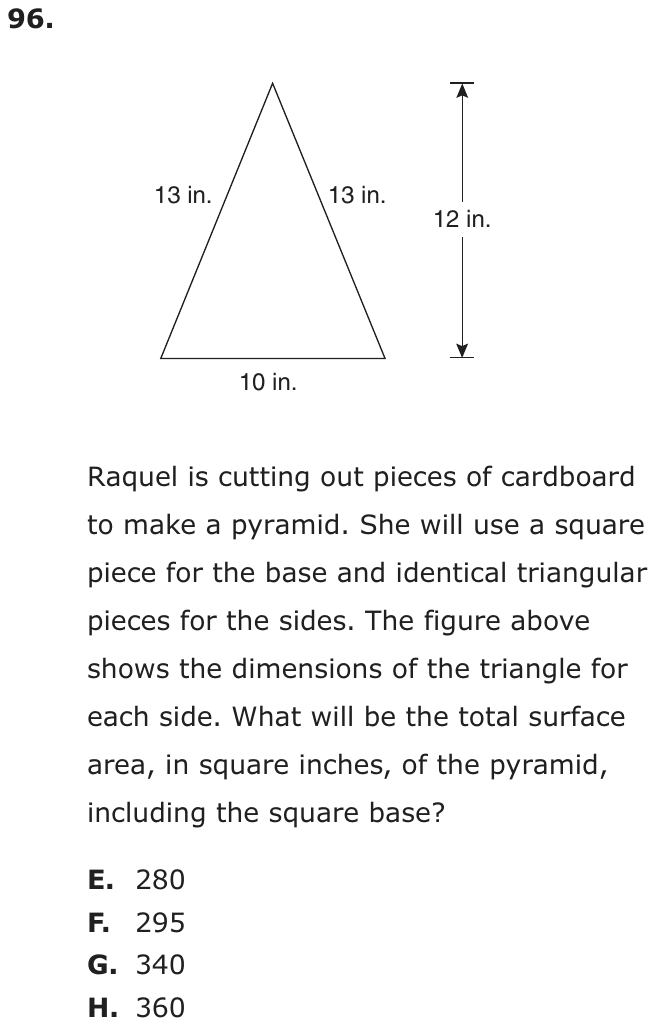
At a carnival, visitors can win a prize if an employee cannot correctly guess their age. The employee records the first 15 ages that he guesses one Saturday. The box plot shown below displays data about the ages he recorded.

What is the interquartile range of the box plot?
- A7
- B9
- C10
- D11
Show the answer
Correct answer: B
Quartile 1 is the median of the lower half of the data, 8.
Quartile 3 is the median of the upper half of the data, 17.
The interquartile range is 9.
Question analysis
This statistics question shows a box plot of 15 ages that a carnival employee guessed and asks for its interquartile range. Students read the quartiles from the edges of the box and subtract. Confusing the interquartile range with the full range, or using the median line in place of a quartile, gives the wrong choices.
- NYS standards
- 7.SP.1 box plots and interquartile range
- Grade level
- Grade 7 content, by NYS standard
- Compared with grade 7
- At grade 7 Reading a box plot and finding its interquartile range is a grade 7 standard in New York. The values sit on labeled whole-number ticks and one subtraction is needed, a routine grade 7 task once the box's edges are known as the quartiles.
- Estimated difficulty
- Straightforward: two steps or one careful reading.
- Thinking it demands
- Depth of knowledge 2, skills and concepts · mainly apply
- What makes it hard
- Solution
- 2 steps
- Reading level
- Question and choices: about grade 6, 48 words.
- Students, last 30 days
- Not enough answers yet to show (it takes 10).
Why it is hard, traps and wrong answers (shows the answer)
Why it is hard
The arithmetic is one subtraction, so the question tests whether students know which parts of a box plot to use. The whiskers' ends give the range, the line inside the box gives the median, and both are easy to grab in place of the quartiles. The story about the carnival and the 15 ages plays no part in the answer.
Something you must already know minor Working it out
The plot shows five values with no labels, so students must know that the box's ends mark the quartiles and that the interquartile range is the box's width, not the whiskers'. (Anderson & Krathwohl, 2001)
Reading a figure, table or graph minor Understanding the question
The values 7, 8, 10, 17 and 18 are read off a scale ticked at every whole number, with the box's ends at 8 and 17 and the median line at 10. (Lesh, Post & Behr, 1987; Kirsch & Mosenthal, 1990)
Strategy: Find the first and third quartiles on the plot by recalling which parts of a box plot mark them, then subtract the smaller quartile from the larger.
Traps
- Wrong formula: Uses a related but wrong formula: perimeter for area, diameter for radius, area for volume, or a misremembered one.
- Misunderstands the concept: A wrong belief about a concept: that percents can be added, that area grows like length, that averages can be averaged, that a bigger denominator means a bigger fraction.
- Information you don't need: The question gives numbers or facts that play no part in the answer.
The wrong answers, classified
A Wrong formula (King et al., 2004)
Subtracts the median from the third quartile, 17 − 10 = 7, measuring only the part of the box right of the middle line.
C Misunderstands the concept (Smith, diSessa & Roschelle, 1993; De Bock et al., 1998; Ni & Zhou, 2005)
Gives the median, 10, read off the line inside the box, taking a single value on the plot for the spread between the quartiles.
D Wrong formula (King et al., 2004)
Subtracts the minimum from the maximum, 18 − 7 = 11, which is the range shown by the whiskers, not the width of the box.
Worked solution, step by step
Formulas used
- Interquartile range
- Q1, the first quartile, is the middle of the lower half of the data. Q3, the third quartile, is the middle of the upper half. In a box plot, Q1 is the left end of the box and Q3 is the right end. So the IQR is the width of the box.
Sort out the question
A box plot shows five numbers. The whiskers, the lines sticking out, end at the smallest and largest values. The box covers the middle half of the data. The line inside the box is the median, the middle value. You need the interquartile range of the ages.
Read the five numbers
Read each one off the number line below the plot.
- Smallest age, the left whisker: 7
- Q1, the left end of the box: 8
- Median, the line inside the box: 10
- Q3, the right end of the box: 17
- Largest age, the right whisker: 18
Find the interquartile range
The interquartile range is 9 years. Watch out: 18 − 7 = 11 is the range, the whole spread from whisker to whisker. That is choice D. The median, 10, is choice C.
So the answer is B, 9.
Check your answer
Count the spaces across the box. From 8 to 17 there are 9 spaces of 1 year each, so the box is 9 years wide. The answer is also less than the whole range, 11, as it must be.
More questions like this
The original DOE question
Question 9 of 11
2023 Test B Math, question 1Question
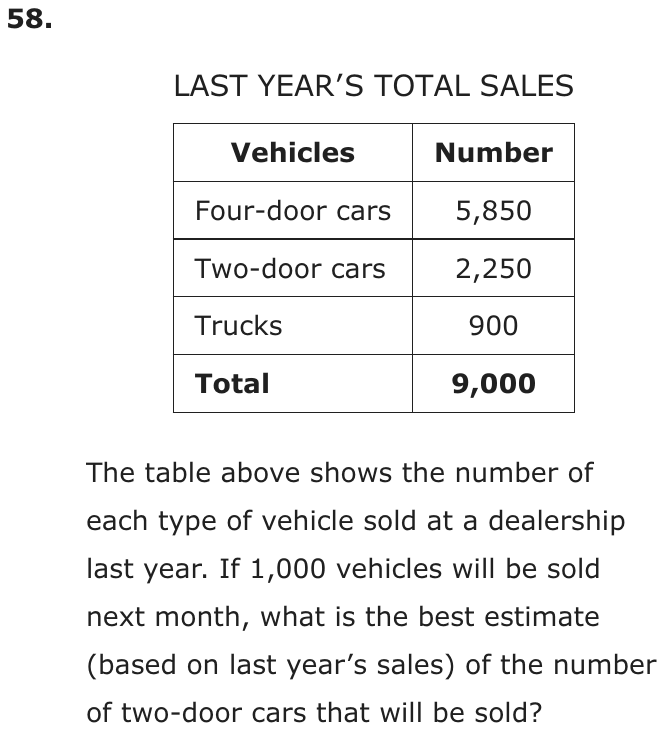
LAST YEAR’S TOTAL SALES
| Vehicles | Number |
|---|---|
| Four-door cars | 5,850 |
| Two-door cars | 2,250 |
| Trucks | 900 |
| Total | 9,000 |
The table above shows the number of each type of vehicle sold at a dealership last year. If 1,000 vehicles will be sold next month, what is the best estimate (based on last year’s sales) of the number of two-door cars that will be sold?
Grid-in question: work out the answer and enter it as a number.
Show the answer
Correct answer: 250
Let x represent the number of two-door cars that will be sold next month. Use the information in the table to set up a proportion:
Question analysis
A table shows last year's sales at a car dealership: four-door cars, two-door cars and trucks, 9,000 vehicles in all. This grid-in asks for the best estimate of how many two-door cars will be sold next month if 1,000 vehicles are sold. Students set up a proportion from the table; most of its rows are not needed.
- Grade level
- Grade 6 content, by NYS standard
- Compared with grade 7
- Below grade 7 Grade 7 proportion problems often take several steps or awkward numbers. This one scales a single share from a table to a new total, with numbers that divide cleanly, which is closer to grade 6 ratio work.
- Estimated difficulty
- Straightforward: two steps or one careful reading.
- Thinking it demands
- Depth of knowledge 2, skills and concepts · mainly apply
- What makes it hard
- Solution
- 2 steps
- Reading level
- Question and choices: about grade 4, 55 words.
- Students, last 30 days
- Not enough answers yet to show (it takes 10).
Why it is hard, traps and wrong answers (shows the answer)
Why it is hard
Once the share is seen as 2,250 out of 9,000, a quarter, the arithmetic is light, which makes this one of the easier grid-ins. Points are lost by entering the share itself as a percent, by reading the wrong row of the table, or by building a monthly average when the question supplies next month’s total. With no choices to compare, checking that the entry is a quarter of 1,000 is the only safeguard.
Turning words into math minor Understanding the question
The phrase “best estimate (based on last year’s sales)” has to become a proportion: two-door cars keep the same share of next month’s 1,000 vehicles as of last year’s 9,000. (Hegarty, Mayer & Monk, 1995; Koedinger & Nathan, 2004)
Reading a figure, table or graph minor Understanding the question
The table lists three vehicle types and a total; only the two-door row, 2,250, and the 9,000 total are needed, so the four-door and truck rows are distractions. (Lesh, Post & Behr, 1987; Kirsch & Mosenthal, 1990)
Strategy: Find what fraction of last year's 9,000 vehicles were two-door cars, simplify it, then take that fraction of the 1,000 vehicles expected next month.
Traps
- Stops one step early: A choice is a number from partway through the solution.
- Information you don't need: The question gives numbers or facts that play no part in the answer.
The wrong answers, classified
25 Stops one step early (King et al., 2004; Gierl et al., 2017)
Finds that 2,250 of 9,000 sales is 25 percent and enters that percent, stopping before taking a quarter of next month’s 1,000 vehicles.
650 Misreads the figure (Lesh, Post & Behr, 1987; Kirsch & Mosenthal, 1990)
Reads the four-door row instead of the two-door row and scales it correctly: 5,850 of 9,000 is 650 of 1,000.
187.5 Misreads the question (Hegarty, Mayer & Monk, 1995)
Divides last year’s 2,250 two-door sales by 12 months, a monthly average that ignores the stated 1,000 vehicles for next month.
Worked solution, step by step
Formulas used
- Proportion
- A proportion says two fractions are equal. Each fraction here is a part over its whole: two-door cars over all vehicles sold. Use it when a share stays the same while the total changes. Then you can find the missing part.
Sort out the question
The table shows last year’s sales. In all, 9,000 vehicles were sold, and 2,250 of them were two-door cars. Next month, 1,000 vehicles will be sold. You need about how many of them will be two-door cars.
“Based on last year’s sales” means two-door cars keep the same share of all sales. A share is a part out of a whole. The four-door and truck rows don’t matter here.
Find last year’s share of two-door cars
Last year, 2,250 out of 9,000 vehicles were two-door cars. Write that as a fraction and simplify it.
This works because . So 1 out of every 4 vehicles sold was a two-door car.
Set up the proportion and solve
Let x be the number of two-door cars next month. Next month’s share must match last year’s share.
To get x alone, multiply both sides by 1,000.
So about 250 two-door cars will be sold.
Give the answer
Watch out: one fourth is the same as 25%. Gridding 25 gives the percent, not the number of cars. Also be sure to use the two-door row. The four-door row would give 650. So you would grid 250.
Check your answer
Try it another way. Next month’s 1,000 vehicles are of last year’s 9,000. So take of the 2,250 two-door cars: . Both ways give 250 cars.
More questions like this
The original DOE question
Question 10 of 11
2023 Test B Math, question 2Question
In a scale drawing of a rectangular garden, the length is 15 inches and the width is 9 inches. In the drawing, 2 inches represents 3 yards. What is the width of the actual garden, in yards?
Grid-in question: work out the answer and enter it as a number.
Show the answer
Correct answer: 13.5
Let w represent the width of the actual garden. Set up a proportion based on the information given:
Question analysis
In a scale drawing of a rectangular garden, 2 inches stands for 3 yards, and the drawing measures 15 inches by 9 inches. This grid-in asks for the real width of the garden in yards. Students apply the scale to one side only: the length is given but plays no part, and the scale has to be used the right way round.
- Grade level
- Grade 7 content, by NYS standard
- Compared with grade 7
- At grade 7 Scale drawings are grade 7 content, and this is a typical one: a single length converted with a stated scale. The only extra demand is using the width rather than the length and entering the result with no choices to check.
- Estimated difficulty
- Straightforward: two steps or one careful reading.
- Thinking it demands
- Depth of knowledge 2, skills and concepts · mainly apply
- What makes it hard
- Solution
- 2 steps
- Reading level
- Question and choices: about grade 4, 33 words.
- Students, last 30 days
- Not enough answers yet to show (it takes 10).
Why it is hard, traps and wrong answers (shows the answer)
Why it is hard
The drawing gives two lengths and only the width matters, so the first decision is which number to scale. The second is direction: the real garden must measure more in yards than the drawing’s 9 in inches, which a student can check before entering anything. Errors come from scaling the length, turning the scale over, or treating 2 to 3 as an increase of one.
Turning words into math minor Understanding the question
“2 inches represents 3 yards” must become 1.5 yards for every inch of drawing, so the 9-inch width is multiplied by 3/2, not by 2/3. (Hegarty, Mayer & Monk, 1995; Koedinger & Nathan, 2004)
An answer in an unexpected form minor Choosing the answer
The answer is a decimal entered with no choices to compare, so a result from the 15-inch length or from an upside-down scale looks just as finished. (Enright, Morley & Sheehan, 2002)
Strategy: Find how many yards one inch of the drawing stands for, then multiply the drawing's width, not its length, by that number.
Traps
- Answers a different question: A choice is right for another quantity: the other unknown, the rest instead of the part, the part instead of the whole.
- Wrong operation: Adds instead of multiplying, divides the wrong way round, turns a ratio or rate upside down, or undoes a step in the wrong direction (subtracts what should be added back).
- Information you don't need: The question gives numbers or facts that play no part in the answer.
The wrong answers, classified
22.5 Answers a different question (King et al., 2004; Hegarty, Mayer & Monk, 1995)
Applies the scale to the 15-inch length instead of the 9-inch width: 15 × 3 ÷ 2 = 22.5 yards.
6 Wrong operation (Hegarty, Mayer & Monk, 1995; King et al., 2004)
Turns the scale upside down, multiplying the 9 inches by 2/3 instead of 3/2, so the real garden comes out smaller than the drawing’s number.
10 Misunderstands the concept (Smith, diSessa & Roschelle, 1993; De Bock et al., 1998; Ni & Zhou, 2005)
Reads 2 inches to 3 yards as adding 1, keeping a constant difference instead of a constant ratio, so 9 inches becomes 9 + 1 = 10 yards.
Worked solution, step by step
Formulas used
- Scale proportion
- A scale drawing shrinks everything by the same amount. So real size over drawing size makes the same fraction for every part of the drawing. Keep the real sizes on top on both sides, and the drawing sizes on the bottom.
Sort out the question
The drawing shows a rectangle, a four-sided shape with square corners. On the drawing, the length is 15 inches and the width is 9 inches. The scale says 2 inches on the drawing stand for 3 yards in real life. You need the real width, in yards.
Only the width matters. The 15-inch length is extra.
Find what one inch stands for
If 2 inches stand for 3 yards, then 1 inch stands for half as much.
So each inch on the drawing is 1.5 yards in real life. That means the number of yards will be bigger than the number of inches.
Set up the proportion and solve
Let w be the real width, in yards. Put yards on top and inches on the bottom, on both sides.
To get w alone, multiply both sides by 9.
The real width is 13.5 yards.
Give the answer
Watch out: don’t flip the scale. Using gives 6, which is smaller than the drawing’s number. And don’t use the length: 15 inches would give 22.5 yards. So you would grid 13.5.
Check your answer
Count groups of 2 inches. The 9-inch width holds 4.5 groups of 2 inches. Each group stands for 3 yards, so the real width is yards. That matches.
More questions like this
The original DOE question
Question 11 of 11
2018 Test A Math, question 8Question
In a certain school, course grades range from 0 to 100. Adrianna took 4 courses and her mean course grade was 90. Roberto took 5 courses. If both students have the same sum of course grades, what was Roberto’s mean?
- A72
- B80
- C90
- D92
Show the answer
Correct answer: A
The sum of Adrianna’s course grades equals 4 times the mean (average) of her grades:
90 × 4 = 360
Roberto has the same sum (360) as Adrianna. Find the mean of his course grades:
360 ÷ 5 = 72
Question analysis
This averages word problem compares two students' course grades. One student's number of courses and mean grade are given, and a second student has the same total over a different number of courses. Students work back from a mean to a sum, then find a new mean, while the stated grade range plays no part.
- Grade level
- Grade 6 content, by NYS standard
- Compared with grade 7
- Below grade 7 Finding a mean is grade 6 content, and this needs only the step back from a mean to a total and one division. Typical grade 7 statistics work compares two data sets, which asks more.
- Estimated difficulty
- Straightforward: two steps or one careful reading.
- Thinking it demands
- Depth of knowledge 2, skills and concepts · mainly apply
- What makes it hard
- Turning words into math moderate
- Something you must already know minor
- Solution
- 2 steps
- Reading level
- Question and choices: about grade 2, 35 words.
- Students, last 30 days
- Not enough answers yet to show (it takes 10).
Why it is hard, traps and wrong answers (shows the answer)
Why it is hard
The question turns on one idea, that a mean times the number of items gives the total, and the numbers are easy. Students who skim "the same sum" as "the same mean" carry Adrianna's 90 straight across, and the 0-to-100 range in the first sentence offers a second number to misuse. Converting to the shared total of 360 first makes the rest a single division.
Turning words into math moderate Understanding the question
"Both students have the same sum of course grades" is the bridge: Adrianna's mean of 90 must be turned into a total, 4 × 90, before it says anything about Roberto. (Hegarty, Mayer & Monk, 1995; Koedinger & Nathan, 2004)
Something you must already know minor Working it out
The link between a mean and a total, sum = mean × number of courses, is not given and has to be used in both directions. (Anderson & Krathwohl, 2001)
Strategy: Multiply the first student's mean by her number of courses to get the shared total, then divide that total by Roberto's number of courses.
Traps
- Misunderstands the concept: A wrong belief about a concept: that percents can be added, that area grows like length, that averages can be averaged, that a bigger denominator means a bigger fraction.
- Information you don't need: The question gives numbers or facts that play no part in the answer.
The wrong answers, classified
B Numbers taken from the question (Hegarty, Mayer & Monk, 1995)
Uses 100, the top of the grade range, in place of Adrianna's mean of 90: 4 × 100 = 400, and 400 ÷ 5 = 80.
C Misunderstands the concept (Smith, diSessa & Roschelle, 1993; De Bock et al., 1998; Ni & Zhou, 2005)
Assumes an equal sum means an equal mean and gives Adrianna's 90, ignoring that Roberto's 360 points are spread over 5 courses, not 4.
D Numbers taken from the question (Hegarty, Mayer & Monk, 1995)
Adds a fifth grade of 100, the top of the stated range, to Adrianna's total: (360 + 100) ÷ 5 = 92.
Worked solution, step by step
Formulas used
- Mean (average)
- M is the mean, also called the average. S is the sum, all the values added together. n is how many values there are. Dividing shares the total out equally, so the mean is what each value would be if they were all the same.
- Sum from the mean
- This is the mean formula turned around. S is the sum, M is the mean, and n is how many values there are. If n values were each equal to the mean, they would add up to M times n. That is the same as the real sum.
Sort out the question
Adrianna took 4 courses, and her mean grade was 90. The mean is the average. Roberto took 5 courses. The key fact is that both have “the same sum of course grades”. The sum is all the grades added together. You need Roberto’s mean. The 0 to 100 range is not needed.
Find Adrianna’s total
You know her mean and her number of courses. Use the sum formula.
Her grades add up to 360 points.
Find Roberto’s mean
Roberto’s grades also add up to 360 points. But he spreads them over 5 courses. Use the mean formula.
His mean is 72.
Avoid the traps and answer
Watch out: the same sum does not mean the same mean. Roberto has more courses sharing the points, so his mean is lower. Choosing 90 is choice C. Watch out: don’t use 100, the top grade, in place of 90. That leads to 80, choice B. So the answer is A, 72.
Check your answer
More courses share the same 360 points, so Roberto’s mean must be lower than 90. 72 is lower. Multiply back: , which matches Adrianna’s total.
More questions like this
The original DOE question