7.NS.2d fractions to decimals by long division
Question 1 of 7
2026 Practice Test C Math, question 8Question
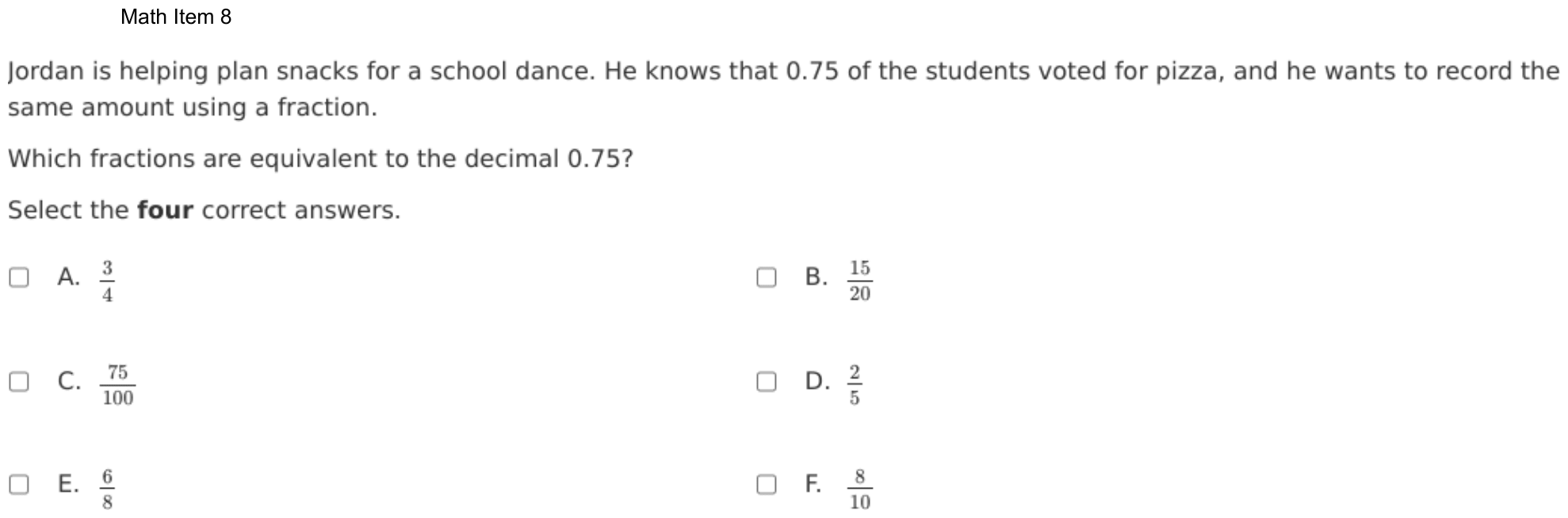
Jordan is helping plan snacks for a school dance. He knows that 0.75 of the students voted for pizza, and he wants to record the same amount using a fraction.
Which fractions are equivalent to the decimal 0.75?
Select the four correct answers.
Choose every answer that is correct, then check. The DOE has not published how answers with several parts are scored; this site counts one right only when every part is right.
- A
- B
- C
- D
- E
- F
Show the answer
Correct answer: A, B, C, and E
Check each fraction to determine whether it is equal to 0.75 when simplified or converted to a decimal.
This is the most common fraction equal to 0.75.
Simplifies to 3/4, because 15 and 20 can both be divided by 5.
This is a direct match to 0.75 when written as a decimal.
, which is less than 0.75.
Simplifies to because both 6 and 8 can be divided by 2.
, which is more than 0.75.
Question analysis
Jordan wants to record 0.75 of the students' pizza votes as a fraction, and students select the four fractions, out of six, that equal 0.75. It tests converting between decimals and fractions and recognizing equivalent fractions. Each choice has to be checked by its value, not by how its numbers look.
- NYS standards
- 7.NS.2d fractions to decimals by long division
- Grade level
- Grade 7 content, by NYS standard
- Compared with grade 7
- Below grade 7 Matching fractions to a decimal such as 0.75 builds on grade 4 to 6 work, and the denominators here divide easily. The added demand is the format: four of the six must be chosen, and one wrong or missing pick loses the item.
- Estimated difficulty
- Straightforward: two steps or one careful reading.
- Thinking it demands
- Depth of knowledge 1, recall and reproduction · mainly apply
- What makes it hard
- Every choice must be checked moderate
- A very close wrong answer minor
- Much to keep track of minor
- Solution
- 2 steps
- Reading level
- Question and choices: about grade 5, 47 words.
- Students, last 30 days
- Not enough answers yet to show (it takes 10).
Why it is hard, traps and wrong answers (shows the answer)
Why it is hard
Three of the four right fractions, 3/4, 75/100 and 6/8, are familiar forms of 0.75, so the item comes down to the fourth. Students who stop after the familiar ones must decide between 15/20, which needs dividing by 5 to recognize, and 8/10, which sits close to 0.75 on a number line. Dividing each numerator by its denominator, or scaling 3/4 up by 5, settles it.
Every choice must be checked moderate Choosing the answer
Six fractions with six different denominators have to be tested one by one, by dividing or by simplifying, since 15/20 and 8/10 cannot be judged by how they look. (Embretson & Wetzel, 1987)
A very close wrong answer minor Choosing the answer
8/10 is 0.8, only 0.05 above 0.75, and it follows 6/8 by adding 2 to the top and the bottom, so it looks like one more member of the family. (Embretson & Wetzel, 1987; Gorin & Embretson, 2006; Ascalon et al., 2007)
Much to keep track of minor Working it out
Four of the six must be chosen and all four must be right for the item to count, so each verdict has to be kept while the remaining fractions are tested. (Sweller, 1988; Carpenter, Just & Shell, 1990)
Strategy: Turn each choice into a decimal by dividing its numerator by its denominator, or reduce it to lowest terms, and keep only the ones whose value is exactly the decimal given.
Traps
- Misunderstands the concept: A wrong belief about a concept: that percents can be added, that area grows like length, that averages can be averaged, that a bigger denominator means a bigger fraction.
The wrong answers, classified
D Little reason to choose it (Haladyna & Downing, 1993; Rodriguez, 2005)
No usual working links 2/5 to 0.75, since 2 ÷ 5 = 0.4, so it mostly catches students filling the fourth slot by guessing.
F Misunderstands the concept (Smith, diSessa & Roschelle, 1993; De Bock et al., 1998; Ni & Zhou, 2005)
Builds 8/10 from 6/8 by adding 2 to the top and the bottom, as if equal additions kept a fraction's value, or accepts 0.8 as close enough.
Worked solution, step by step
Formulas used
- Changing a fraction to a decimal
- a is the numerator, the top. b is the denominator, the bottom. A fraction bar means divide. So dividing the top by the bottom gives the fraction’s value as a decimal.
- Equivalent fractions
- a is the top and b is the bottom. n is a number that goes evenly into both. Dividing the top and the bottom by the same number gives an equal fraction. Equivalent fractions name the same amount in different ways.
Sort out the question
Six fractions are given, A to F. You need the four that equal the decimal 0.75. Equivalent means equal in value. Test every choice, because some fractions look alike but are not equal.
Write 0.75 as a fraction
0.75 means 75 hundredths:
So choice C works. Now simplify it. 25 goes into both 75 and 100:
So choice A, 3/4, works too.
Test choices B and E
Simplify each one to see if it becomes 3/4:
- B: 5 goes into 15 and 20. . It works.
- E: 2 goes into 6 and 8. . It works.
Test choices D and F
Divide the top by the bottom:
- D: . That is less than 0.75.
- F: . That is more than 0.75.
Watch out: F looks like 6/8 with 2 added to the top and the bottom. Adding the same number to both changes the value. Only multiplying or dividing both keeps it.
Name the four answers
A, B, C and E all equal 0.75. On the test, you check the box beside each of them. On this site, you choose all four, then check your answer.
So the answers are A, B, C and E.
Check your answer
Turn each answer into a decimal. , , and all give 0.75. Exactly four choices passed, and the question asks for four. So none were missed.
More questions like this
The original DOE question
Question 2 of 7
2026 Practice Test D Math, question 18Question
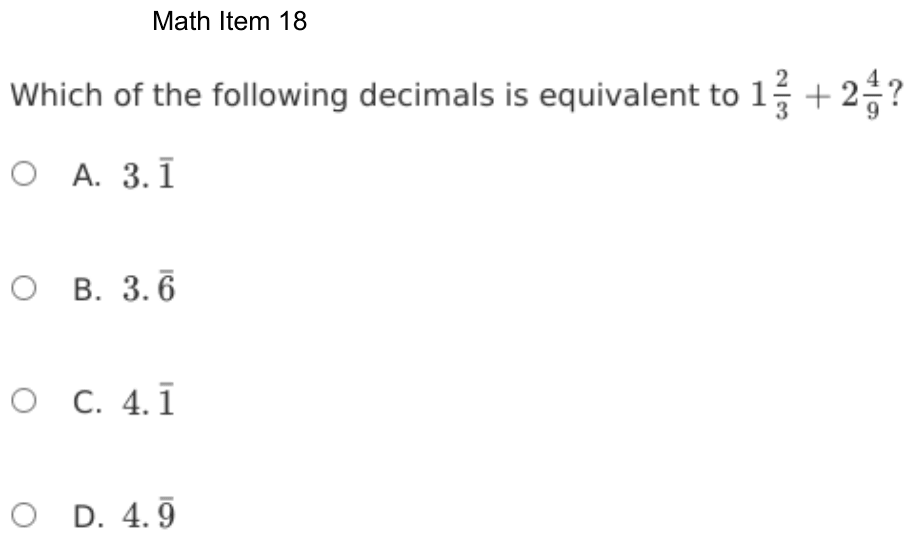
Which of the following decimals is equivalent to ?
- A
- B
- C
- D
Show the answer
Correct answer: C
First, add the mixed numbers. Then, convert the fraction to a decimal.
Question analysis
This question asks which repeating decimal equals the sum of the mixed numbers 1 2/3 and 2 4/9. Students rename the fractions with a common denominator, add, and convert the fraction part to a decimal with a bar over its repeating digit. The choices differ in both the whole number and the repeating digit, so each step has to be right.
- NYS standards
- Grade level
- Grade 7 content, by NYS standard
- Compared with grade 7
- At grade 7 Adding mixed numbers and writing a fraction as a repeating decimal are standard grade 7 skills. This combines them in three short steps; renaming a fraction and reading the bar notation are the only places that need care.
- Estimated difficulty
- Straightforward: two steps or one careful reading.
- Thinking it demands
- Depth of knowledge 1, recall and reproduction · mainly apply
- What makes it hard
- Error-prone arithmetic moderate
- An answer in an unexpected form minor
- Solution
- 3 steps
- Reading level
- Question and choices: about grade 13, 13 words.
- Students, last 30 days
- Not enough answers yet to show (it takes 10).
Why it is hard, traps and wrong answers (shows the answer)
Why it is hard
Two fraction moves and one conversion stand between the sum and the choices. The carry is the main hazard: 10/9 has to become 1 1/9, and students who keep only the 1/9 land on a choice with the wrong whole number. Estimating first, about 1.7 + 2.4 = 4.1, rules out both choices that begin with 3 and the one that equals 5.
Error-prone arithmetic moderate Working it out
Adding 2/3 and 4/9 needs 2/3 renamed as 6/9, and the sum 10/9 is more than 1, so a whole must be carried into the 3 before converting. (Brown & Burton, 1978; Junker & Sijtsma, 2001)
An answer in an unexpected form minor Choosing the answer
The choices are repeating decimals with bars, so a mixed number in ninths has to be recognized as a digit repeating forever; knowing that ninths repeat their numerator makes the match quick. (Enright, Morley & Sheehan, 2002)
Strategy: Rename 2/3 as ninths, add the whole numbers and the fractions separately, regroup any fraction of 9/9 or more as a whole, then divide the leftover numerator by 9.
Traps
- A faulty procedure: A systematic but wrong procedure: adding fractions straight across, applying an exponent to each term of a sum, dropping a sign when moving a term.
- Answer in another form: The right answer is written differently from the way you worked it out.
The wrong answers, classified
A An arithmetic slip (Junker & Sijtsma, 2001)
Adds the fractions to 10/9 but keeps only the 1/9 left over, forgetting to carry the whole 1 into the 3, so the sum becomes 3 1/9.
B A faulty procedure (Brown & Burton, 1978; Tatsuoka, 1983)
Adds the numerators 2 and 4 over 9 without renaming 2/3 as 6/9, so gets 3 6/9, which is 3.666…
D A faulty procedure (Brown & Burton, 1978; Tatsuoka, 1983)
Reaches 4 1/9 but repeats the denominator's 9 instead of the numerator's 1, as if one ninth were 0.999… rather than 0.111…
Worked solution, step by step
Formulas used
- Equivalent fractions
- a/b is a fraction, and n is any number except 0. Multiplying the top and the bottom by the same n gives an equal fraction, because n/n is 1. Use it to give two fractions the same bottom before you add them.
- Ninths as repeating decimals
- 1 divided by 9 is 0.111…, with 1s that go on forever. The bar over a digit means that digit repeats forever. Ninths from 1/9 to 8/9 repeat their top digit, so 4/9 is 0.444… and 2/9 is 0.222…
Sort out the question
You need to add two mixed numbers, 1 2/3 and 2 4/9. A mixed number is a whole number plus a fraction. Then write the sum as a decimal. The choices are repeating decimals, where the bar over a digit means it repeats forever.
Rename two thirds as ninths
The fractions 2/3 and 4/9 have different bottoms. Since 3 × 3 = 9, multiply the top and bottom of 2/3 by 3:
So 1 2/3 is the same as 1 6/9.
Watch out: adding the tops 2 and 4 over 9 without renaming gives 3 6/9, choice B.
Add the mixed numbers
Add the whole numbers, then add the fractions:
10/9 is more than 1. It is 9/9 plus 1/9, or 1 1/9. Carry the 1 into the whole number:
Watch out: forgetting to carry the 1 gives 3 1/9, choice A.
Change it to a decimal
One ninth is 0.111…, with the 1 repeating forever. So:
Watch out: ninths repeat the top digit, not the 9. Choice D, 4.999…, does not match 4 1/9.
So the answer is C, .
Check your answer
Use rough decimals. 1 2/3 is about 1.667, and 2 4/9 is about 2.444. Their sum is about 4.111. That matches 4.111… and rules out both choices that start with 3. And 4.999… is almost 5, which is too big.
More questions like this
The original DOE question
Question 3 of 7
2024 Test B Math, question 22Question
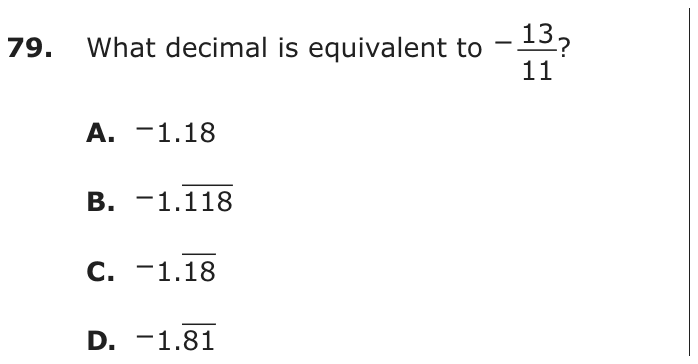
What decimal is equivalent to ?
- A
- B
- C
- D
Show the answer
Correct answer: C
Calculate the decimal equivalent of :
Question analysis
A fractions and decimals question asks which decimal equals negative 13/11. The choices differ in which digits repeat and how the repetition is marked. Students divide 13 by 11, spot the block of digits that repeats, and read the bar notation carefully.
- NYS standards
- 7.NS.2d fractions to decimals by long division
- Grade level
- Grade 7 content, by NYS standard
- Compared with grade 7
- At grade 7 Converting a fraction to a repeating decimal by long division is a named grade 7 skill. This is one short division, typical of grade 7 work, with care needed only in reading the bar notation.
- Estimated difficulty
- Straightforward: two steps or one careful reading.
- Thinking it demands
- Depth of knowledge 1, recall and reproduction · mainly apply
- What makes it hard
- A very close wrong answer moderate
- Something you must already know minor
- Error-prone arithmetic minor
- Solution
- 2 steps
- Reading level
- Question and choices: about grade 15, 10 words.
- Students, last 30 days
- Not enough answers yet to show (it takes 10).
Why it is hard, traps and wrong answers (shows the answer)
Why it is hard
Dividing 13 by 11 is quick; the question is really about reading and writing repeating decimals. Three choices differ only in where the bar goes, so students who know the digits run 1.1818… can still pick the wrong bar. Writing out each barred choice for a few digits and comparing it with the quotient is a fast, sure check.
A very close wrong answer moderate Choosing the answer
The bars over 18 and over 81 cover the same two digits, so only checking which digit comes right after the decimal point, 1 before 8, tells them apart. (Embretson & Wetzel, 1987; Gorin & Embretson, 2006; Ascalon et al., 2007)
Something you must already know minor Working it out
Reading bar notation is assumed: the bar marks exactly the block of digits that repeats, and the whole-number 1 never belongs under it. (Anderson & Krathwohl, 2001)
Error-prone arithmetic minor Working it out
The long division 13 ÷ 11 has to run until the remainder 2 comes back, which is where the repeating pair is confirmed. (Brown & Burton, 1978; Junker & Sijtsma, 2001)
Strategy: Do the long division of 13 by 11 until a remainder comes back, note which digits repeat from that point, and match that block to the bar in each choice.
Traps
- A faulty procedure: A systematic but wrong procedure: adding fractions straight across, applying an exponent to each term of a sum, dropping a sign when moving a term.
- Rounds too early: Rounds a value partway through, or rounds the wrong way, so the final answer drifts from the exact one.
- Answer in another form: The right answer is written differently from the way you worked it out.
The wrong answers, classified
A Rounds too early (King et al., 2004)
Stops the division after two decimal places and treats −1.18 as exact, missing that the digits 1 and 8 go on repeating.
B A faulty procedure (Brown & Burton, 1978; Tatsuoka, 1983)
Counts the whole-number 1 into the block, seeing 1, 18, 18 … as 118 repeating, and bars 118, which means −1.118118… rather than −1.1818….
D A faulty procedure (Brown & Burton, 1978; Tatsuoka, 1983)
Bars 81, the pair in the wrong order, which gives −1.8181…, equal to −1 9/11 rather than the −1 2/11 that −13/11 is.
Worked solution, step by step
Formulas used
- Fraction as division
- a is the top number, the numerator. b is the bottom number, the denominator. A fraction bar means divide. To turn a fraction into a decimal, divide the top by the bottom.
- Bar for repeating digits
- The bar sits over the digits that repeat forever, in the order they repeat. The dots mean the pattern goes on and on. Digits that are not under the bar show up only once.
Sort out the question
You need the decimal equal to . The fraction is negative, so the decimal will be negative too. Work with first. Then put the minus sign back.
Divide 13 by 11
Use long division for .
- 11 goes into 13 once, with 2 left over. Write 1 and a decimal point.
- Bring down a 0 to make 20. 11 goes into 20 once, with 9 left over. Write 1.
- Bring down a 0 to make 90. 11 goes into 90 eight times, with 2 left over. Write 8.
So far you have 1.18.
Spot the repeating pattern
The remainder (the amount left over) is 2 again. That is where you were after the first step. So the same digits come back: 1, 8, 1, 8, and so on forever.
Watch out: −1.18, choice A, stops too soon. The digits never end.Write it with a bar
A bar goes over only the digits that repeat. Here 18 repeats, starting right after the decimal point. The whole number 1 does not repeat, so it is not under the bar. Put the minus sign back.
Watch out: a bar over 81, choice D, means −1.8181…. A bar over 118, choice B, means −1.118118….So the answer is C, .
Check your answer
Multiply back: . That is almost exactly 13, and more 18s bring it even closer. Also, 13/11 is a bit more than 1, so a decimal between 1 and 2 makes sense.
More questions like this
The original DOE question
Question 4 of 7
2024 Test B Math, question 42Question
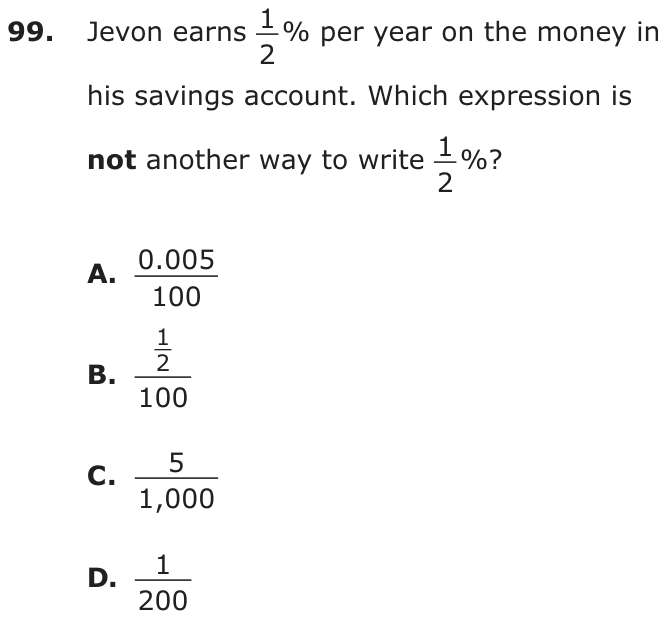
Jevon earns per year on the money in his savings account. Which expression is not another way to write ?
- A
- B
- C
- D
Show the answer
Correct answer: A
Rewrite the percent as a decimal:
So the correct answer must not equal 0.005:
Option A
Option B
Option C
Option D
All answer options except Option A equal 0.005. Therefore, Option A is the correct answer.
Question analysis
Jevon's savings account earns one-half percent a year, and students must find the expression that is not another way to write one-half percent. It tests converting a percent less than 1 into fractions and decimals. Reading the word not carefully, and evaluating each stacked or unfamiliar fraction correctly, are what make it tricky.
- Grade level
- Grade 7 content, by NYS standard
- Compared with grade 7
- At grade 7 Converting between percents, fractions and decimals is grade 6 and 7 work. A percent smaller than 1 is less familiar, and the question asks which form is not equal, so all four must be checked, which keeps it at typical grade 7 demand.
- Estimated difficulty
- Moderate: several steps, or a close reading with one strong distractor.
- Thinking it demands
- Depth of knowledge 1, recall and reproduction · mainly apply
- What makes it hard
- A question in the negative moderate
- Every choice must be checked moderate
- Error-prone arithmetic minor
- Solution
- 3 steps
- Reading level
- Question and choices: about grade 7, 25 words.
- Students, last 30 days
- Not enough answers yet to show (it takes 10).
Why it is hard, traps and wrong answers (shows the answer)
Why it is hard
Every expression is built from the same idea, so the question tests whether students can convert a percent smaller than 1 without losing track of decimal places. The odd one out, 0.005 over 100, looks like a correct form, because 0.005 is one-half percent and dividing by 100 seems to turn it into a percent. Converting one-half percent to 0.005 once and comparing each expression with it beats reasoning about each form.
A question in the negative moderate Understanding the question
The bold word not asks for the one expression unequal to one-half percent, so the three expressions that check out are exactly the ones to reject. (Haladyna, Downing & Rodriguez, 2002)
Every choice must be checked moderate Choosing the answer
Three of the four forms are equal, so each has to be converted to a decimal and compared with 0.005 before the odd one out can be named. (Embretson & Wetzel, 1987)
Error-prone arithmetic minor Working it out
One-half percent is 0.5 with the point moved two places, 0.005, and dividing that by 100 moves it two more places, to 0.00005. (Brown & Burton, 1978; Junker & Sijtsma, 2001)
Strategy: Write one-half percent as a single decimal by dividing one half by 100, then evaluate each expression as a decimal and compare it with that value.
Traps
- NOT, LEAST or EXCEPT: The question asks for the exception, the least, or what is not true.
- Answer in another form: The right answer is written differently from the way you worked it out.
The wrong answers, classified
B Misreads the question (Hegarty, Mayer & Monk, 1995)
Misses the bold not and picks the expression that equals one-half percent most plainly, one half over 100, the literal meaning of percent.
C Misunderstands the concept (Smith, diSessa & Roschelle, 1993; De Bock et al., 1998; Ni & Zhou, 2005)
Believes a percent must be written over 100, so 5 over 1,000 looks like a different number, though both equal 0.005.
D An arithmetic slip (Junker & Sijtsma, 2001)
Divides 1 by 200 and misplaces the decimal point, getting 0.05 instead of 0.005, so 1/200 seems not to equal one-half percent.
Worked solution, step by step
Formulas used
- Percent as a fraction
- p is any number. The % sign means out of 100. So p percent is p divided by 100. Dividing by 100 moves the decimal point two places to the left.
Sort out the question
The question asks which expression is not equal to . So three choices are equal to it, and one is different. You need the odd one out.
Write the percent as a decimal
One half is 0.5. A percent means out of 100, so divide by 100.
So is 0.005. It is half of one percent, a very small amount.
Test each choice
Turn each choice into a decimal. Then compare it with 0.005.
Choice Work it out Equal to 0.005? A No B Yes C Yes D Yes Pick the one that is different
Choice A divides by 100 twice. The 0.005 was already divided by 100 once. Dividing again makes it 100 times too small.
Watch out: Choice B is the plainest way to write : one half over 100. Picking it means missing the word “not.” Also, 1 ÷ 200 is 0.005, not 0.05, so D is equal too.
So the answer is A, .
Check your answer
Use fractions instead. Half of one hundredth is , which is choice D. And simplifies to too. Only A is a different amount.
More questions like this
The original DOE question
Question 5 of 7
2023 Test B Math, question 55Question
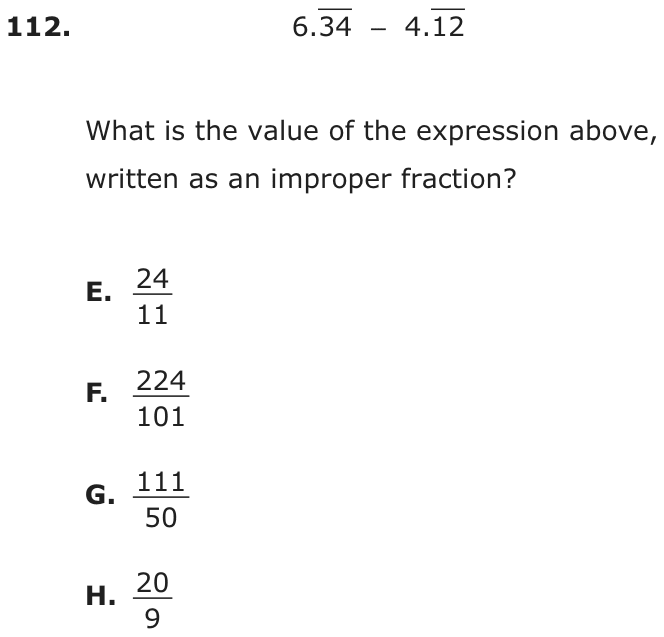
What is the value of the expression above, written as an improper fraction?
- A
- B
- C
- D
Show the answer
Correct answer: D
| Set x equal to the repeating decimal. | |
| Multiply both sides by 10. | |
| Subtract 10x and x. | |
| Apply the multiplicative inverse property; divide both sides by 9. | |
Question analysis
Two repeating decimals are subtracted, and students write the difference as an improper fraction. It tests subtracting repeating decimals and converting a repeating decimal into a fraction, a grade 8 skill. The repeating part has to be handled exactly, so a careful method matters more than speed.
- NYS standards
- Grade level
- Grade 8 content, by NYS standard
- Compared with grade 7
- Above grade 7 Grade 7 students change fractions into repeating decimals by long division. Going the other way, from a repeating decimal to a fraction, is grade 8 work, though the subtraction that comes first here is simple.
- Estimated difficulty
- Moderate: several steps, or a close reading with one strong distractor.
- Thinking it demands
- Depth of knowledge 1, recall and reproduction · mainly apply
- What makes it hard
- A very close wrong answer moderate
- Something you must already know moderate
- Solution
- 3 steps
- Reading level
- Question and choices: about grade 9, 18 words.
- Students, last 30 days
- Not enough answers yet to show (it takes 10).
Why it is hard, traps and wrong answers (shows the answer)
Why it is hard
The subtraction is easy, since the repeating digits line up and give 2.222…; the conversion is the test. Every choice sits within a few hundredths of the answer, so rounding or estimating cannot separate them, and the exact 2.22 of 111/50 is the strongest pull. Students who know that 0.222… is 2/9 can write 2 2/9 = 20/9 directly.
A very close wrong answer moderate Choosing the answer
All four choices lie between 2.18 and 2.23: 111/50 is exactly 2.22 and 224/101 is about 2.218, so only 20/9 equals the repeating 2.222… exactly. (Embretson & Wetzel, 1987; Gorin & Embretson, 2006; Ascalon et al., 2007)
Something you must already know moderate Working it out
Turning 2.222… into a fraction, by setting x equal to it and subtracting x from 10x, is grade 8 work that the question does not explain. (Anderson & Krathwohl, 2001)
Strategy: Subtract the decimals digit by digit to see which digits repeat, then turn that repeating decimal into a fraction, or divide each choice's numerator by its denominator and compare.
Traps
- A faulty procedure: A systematic but wrong procedure: adding fractions straight across, applying an exponent to each term of a sum, dropping a sign when moving a term.
- Rounds too early: Rounds a value partway through, or rounds the wrong way, so the final answer drifts from the exact one.
The wrong answers, classified
A A faulty procedure (Brown & Burton, 1978; Tatsuoka, 1983)
Sets x = 2.222… but adds 10x and x instead of subtracting, then drops the repeating part as if it had cancelled, so 11x = 22 + 2 = 24.
B A faulty procedure (Brown & Burton, 1978; Tatsuoka, 1983)
Multiplies by 100 for two-digit blocks, then adds x instead of subtracting it and drops the repeating part, so 101x = 222 + 2 = 224.
C Rounds too early (King et al., 2004)
Drops the repeating bar and treats the difference as exactly 2.22, which is 222/100 = 111/50, slightly less than the true repeating value.
Worked solution, step by step
Formulas used
- Repeating decimal to fraction
- x is the repeating decimal. Multiplying by 10 moves the decimal point one place to the right. The endless repeating digits still line up after the point. So when you subtract x from 10x, they cancel, and only whole numbers are left.
Sort out the bars
A bar over digits means they repeat forever. So means 6.343434… and means 4.121212… with no end. You need the difference as an improper fraction. That is a fraction whose top is bigger than its bottom.
Subtract the decimals
Line up the digits. Each block of 34 minus 12 gives 22. The whole numbers give 6 − 4 = 2.
The difference is 2.222…, with the 2 repeating forever. You can write it .
Name the decimal x
Let x be the repeating decimal. Then multiply both sides by 10. This moves the decimal point one place to the right.
Subtract to remove the repeats
Subtract the first line from the second. The repeating 2s after the point match up, so they cancel.
Divide to find x
Divide both sides by 9.
Watch out: is exactly 2.22, which stops. The real difference never stops. That trap is choice C. Every choice is close to 2.2, so estimating won’t help.
So the answer is D, .
Check your answer
Divide 20 by 9. 9 goes into 20 two times, with 2 left over. Each next step leaves 2 again, so you get 2.222… forever. That matches the difference. Choice A, , is 2.1818… instead.
More questions like this
The original DOE question
Question 6 of 7
2018 Test A Math, question 36Question
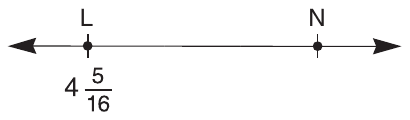
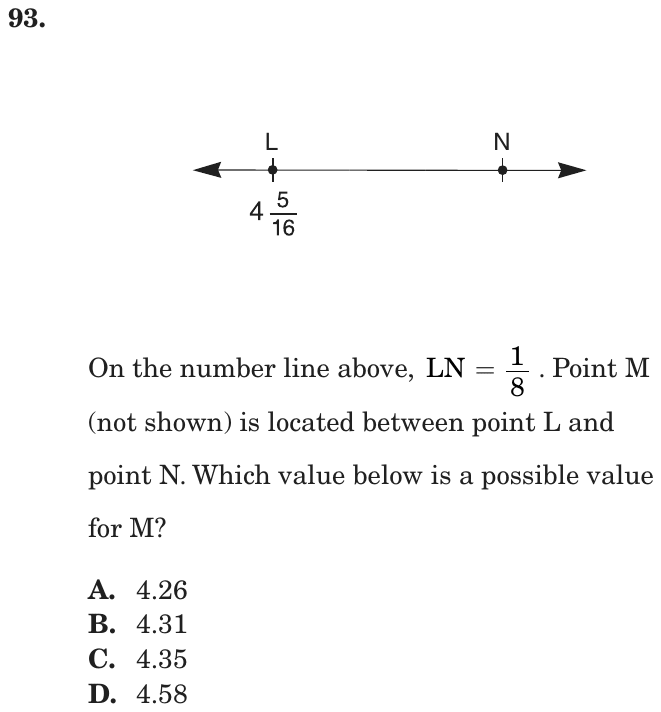
On the number line above, LN = . Point M (not shown) is located between point L and point N. Which value below is a possible value for M?
- A4.26
- B4.31
- C4.35
- D4.58
Show the answer
Correct answer: C
Since , point is located at
.
So must be between point , , and point , . Point can also be written as 4.3125, and point can be written as 4.4375. The only option given that lies between those two points is 4.35.
Question analysis
This number line question says the distance from point L to point N is one eighth and asks which decimal could be the position of a point M between them. Students take L's position, a mixed number in sixteenths, find N, and compare with decimal choices. Converting sixteenths to decimals precisely is the tricky part.
- NYS standards
- Grade level
- Grade 7 content, by NYS standard
- Compared with grade 7
- At grade 7 Grade 7 students convert fractions to decimals and compare them. This item needs an exact conversion of sixteenths and a comparison to the thousandths, where rounding too early can mislead, but it stays within grade 7 content.
- Estimated difficulty
- Moderate: several steps, or a close reading with one strong distractor.
- Thinking it demands
- Depth of knowledge 2, skills and concepts · mainly apply
- What makes it hard
- Error-prone arithmetic moderate
- A very close wrong answer moderate
- Reading a figure, table or graph minor
- Solution
- 3 steps
- Reading level
- Question and choices: about grade 5, 28 words.
- Students, last 30 days
- Not enough answers yet to show (it takes 10).
Why it is hard, traps and wrong answers (shows the answer)
Why it is hard
The interval from L to N is only an eighth wide, and three of the four choices crowd near it, so precision decides the question. Students comfortable working in sixteenths can avoid decimals until the end, since 4.35 lies between 4 5/16 and 4 7/16. Those who convert loosely, or who misread a mixed number as a decimal, are pulled to a neighboring choice.
Error-prone arithmetic moderate Working it out
Converting 4 5/16 to 4.3125 and N to 4.4375 needs four decimal places, while the choices stop at hundredths, so early rounding blurs the left boundary. (Brown & Burton, 1978; Junker & Sijtsma, 2001)
A very close wrong answer moderate Choosing the answer
The choices 4.31 and 4.35 both lie within 0.04 of L, so estimating cannot separate them; only the exact 4.3125 shows 4.31 just outside the interval and 4.35 inside. (Embretson & Wetzel, 1987; Gorin & Embretson, 2006; Ascalon et al., 2007)
Reading a figure, table or graph minor Understanding the question
L's value appears only on the number line, and the picture shows N to the right of L, which fixes which way the one-eighth gap runs. (Lesh, Post & Behr, 1987; Kirsch & Mosenthal, 1990)
Strategy: Add one eighth, or two sixteenths, to L's position to locate N, convert both endpoints to four-place decimals, and keep only a choice strictly between them.
Traps
- Rounds too early: Rounds a value partway through, or rounds the wrong way, so the final answer drifts from the exact one.
- Answer in another form: The right answer is written differently from the way you worked it out.
- A faulty procedure: A systematic but wrong procedure: adding fractions straight across, applying an exponent to each term of a sum, dropping a sign when moving a term.
The wrong answers, classified
A Negatives and direction (Brown & Burton, 1978)
Measures the one-eighth gap to the left of L, giving 4.1875 to 4.3125, an interval that contains 4.26 but contradicts the figure.
B Rounds too early (King et al., 2004)
Rounds L's 4.3125 to 4.31 and treats 4.31 as inside the interval, missing that it lies slightly to the left of L.
D A faulty procedure (Brown & Burton, 1978; Tatsuoka, 1983)
Writes 4 5/16 as 4.516 by placing the fraction's digits after the decimal point, so N becomes about 4.641 and 4.58 appears to fit.
Worked solution, step by step
Formulas used
- Equal fractions
- a is the top number (numerator) and b is the bottom number (denominator). Multiplying both by the same number k gives an equal fraction. It is like cutting each piece into k smaller pieces. Use it to give fractions the same bottom before you add or subtract.
- Fraction to decimal
- A fraction bar means divide. a is the top number and b is the bottom number. Dividing the top by the bottom turns the fraction into a decimal. Then you can compare it with decimal choices.
Sort out what you know
Point L is at . Point N is to the right of L. The distance from L to N, called LN, is .
Point M is somewhere between L and N. You need a choice that fits between them. The choices are decimals, so you will change the fractions into decimals.
Find where N is
N is to the right of L, so add. First give a bottom of 16, to match L:
Watch out: N is to the right of L in the figure. Going left instead gives a gap that holds 4.26, choice A.
Change both points to decimals
Divide the top of each fraction by the bottom:
So L is at 4.3125 and N is at 4.4375.
Test each choice
M must be bigger than 4.3125 and smaller than 4.4375.
- 4.26 is smaller than 4.3125. It is left of L.
- 4.31 is 4.3100, just smaller than 4.3125. It is a hair left of L.
- 4.35 is between them. It fits.
- 4.58 is bigger than 4.4375. It is right of N.
Watch out: if you round L to 4.31, choice B seems to fit. Keep all four decimal places. So the answer is C, 4.35.
Check your answer
Subtract to be sure. 4.35 − 4.3125 = 0.0375, which is more than 0, so 4.35 is right of L. 4.4375 − 4.35 = 0.0875, which is also more than 0, so 4.35 is left of N. It sits between them.
More questions like this
The original DOE question
Question 7 of 7
2018 Test A Math, question 48Question
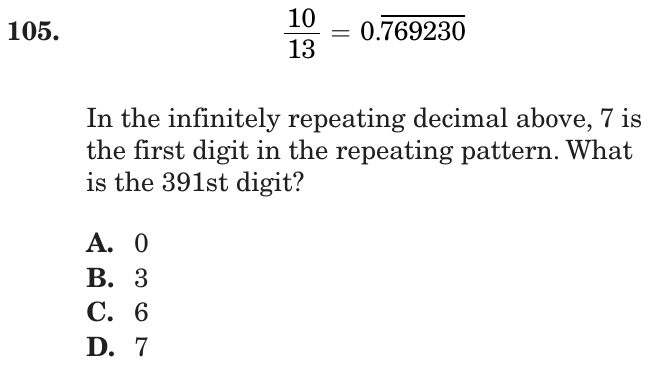
In the infinitely repeating decimal above, 7 is the first digit in the repeating pattern. What is the 391st digit?
- A0
- B3
- C6
- D7
Show the answer
Correct answer: D
There are 6 digits in the repeating decimal (769230), so 7 would be the first, seventh, thirteenth digit and so on.
To find the 391st digit, divide 391 by 6.
391 ÷ 6 = 65 R1
Since the remainder is 1, that means the 391st digit is the same as the 1st digit, which is 7.
Question analysis
This repeating decimal question shows the six-digit repeating pattern of 10/13 and asks for the 391st digit after the decimal point. Students must use the length of the repeating block and division with a remainder to find the position within the cycle. Matching the remainder to the right digit is where students slip.
- Grade level
- Grade 7 content, by NYS standard
- Compared with grade 7
- Above grade 7 Seventh graders learn that fractions have repeating decimals. Using the length of the repeating block and a remainder to find a digit hundreds of places away is a pattern-reasoning step beyond typical seventh-grade classwork.
- Estimated difficulty
- Hard: combines ideas, needs a plan, and has more than one tempting wrong answer.
- Thinking it demands
- Depth of knowledge 2, skills and concepts · mainly apply
- What makes it hard
- No obvious method moderate
- Solution
- 2 steps
- Reading level
- Question and choices: about grade 8, 20 words.
- Students, last 30 days
- Not enough answers yet to show (it takes 10).
Why it is hard, traps and wrong answers (shows the answer)
Why it is hard
Once the cycle length is used, the arithmetic is a single division, 391 ÷ 6 = 65 remainder 1. The difficulty is turning the remainder into a position: remainder 1 is the first digit of a new block, not the last digit of the previous one or the second of the new one. Checking the rule on small positions, the 1st and 7th digits are both 7, removes the doubt.
No obvious method moderate Working it out
Nothing in the stem mentions division; students must see that the six-digit block 769230 repeats, so position 391 depends only on the remainder of 391 divided by 6. (Schoenfeld, 1985)
Strategy: Divide 391 by the length of the repeating block and look only at the remainder; a remainder of r points to the r-th digit of the block.
Traps
- Counting the ends: Inclusive or exclusive ends, fence posts, consecutive numbers: an answer that is one too many or too few, or an endpoint drawn open where it belongs closed (or the reverse).
The wrong answers, classified
A Counting the ends (Brown & Burton, 1978)
Sees that 65 blocks fill 390 places and lands on the 390th digit, the 0 that ends a block, one place short.
B A faulty procedure (Brown & Burton, 1978; Tatsuoka, 1983)
Uses the quotient 65 instead of the remainder, takes its last digit 5, and reads the fifth digit of 769230, which is 3.
C Counting the ends (Brown & Burton, 1978)
Treats the remainder 1 as one step past the block's first digit, moving from 7 to the second digit, 6.
Worked solution, step by step
Formulas used
- Division with a remainder
- n is the number you divide. d is what you divide by. q is the quotient, the number of whole groups. r is the remainder, what is left over. Here it tells how many full blocks of digits fit, and where you land after them.
Sort out what you know
The bar over 769230 means those six digits repeat forever: 769230769230 and so on. The 7 is digit number 1. You need digit number 391.
Spot the pattern
The block 769230 has 6 digits, so the pattern starts over every 6 digits. Digit 1 is 7, and so are digits 7, 13, 19 and so on. Each full block ends with a 0, at digits 6, 12, 18 and so on.
Divide 391 by 6
Find how many full blocks fit into 391 digits, and what is left:
So 65 full blocks use up 6 × 65 = 390 digits. The remainder is 1. That means digit 391 is the 1st digit of the next block.
Read the digit
The 1st digit of the block is 7. Watch out: digit 390 is the last digit of a full block, which is 0. That is choice A. Digit 391 is one step past it, so it starts a new block.
So the answer is D, 7.
Check your answer
Test the idea on a small number. Digit 7: 7 = 6 × 1 + 1, so the remainder is 1 and the digit should be 7. Write it out: 7692307. The 7th digit is indeed 7. The rule works.
More questions like this
The original DOE question