7.NS.1d properties for adding and subtracting
Question 1 of 6
2026 Practice Test D Math, question 15Question
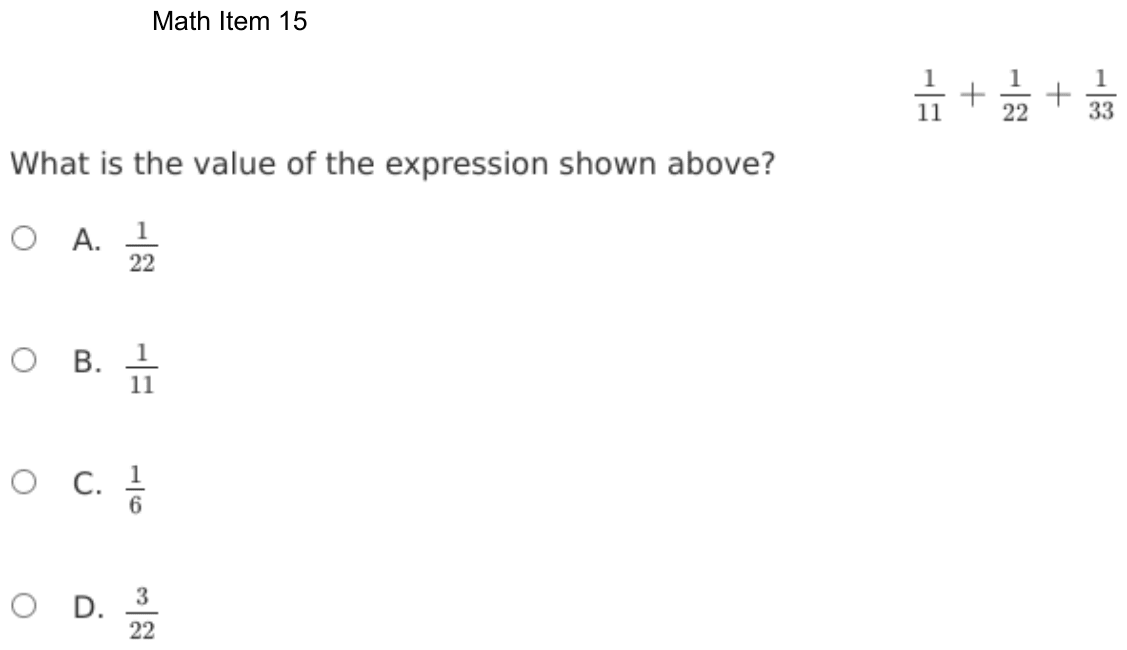
What is the value of the expression shown above?
- A
- B
- C
- D
Show the answer
Correct answer: C
To add fractions, find a common denominator and rename the fractions using the common denominator. The least common denominator for 11, 22, and 33 is 66. After adding the fractions, the final fraction can be reduced to lowest terms.
Question analysis
This fractions question asks for the value of 1/11 + 1/22 + 1/33. Students find a common denominator for three fractions, rename each one, add and simplify. The denominators are all multiples of 11, and adding the tops and bottoms straight across, or forgetting to rename a numerator, leads to tempting wrong choices.
- Grade level
- Grade 7 content, by NYS standard
- Compared with grade 7
- Below grade 7 Adding fractions with unlike denominators is taught before grade 7. Finding a common denominator for three related numbers and simplifying is short, routine work, lighter than typical grade 7 problems with signed rational numbers.
- Estimated difficulty
- Straightforward: two steps or one careful reading.
- Thinking it demands
- Depth of knowledge 1, recall and reproduction · mainly apply
- What makes it hard
- Error-prone arithmetic moderate
- An answer in an unexpected form minor
- Solution
- 3 steps
- Reading level
- Question and choices: about grade 9, 14 words.
- Students, last 30 days
- Not enough answers yet to show (it takes 10).
Why it is hard, traps and wrong answers (shows the answer)
Why it is hard
The question checks whether students rename fractions before adding, and each wrong choice comes from a shortcut that skips that step or stops early. Seeing that 22 and 33 are multiples of 11 points to 66 as the common denominator. A size check helps too: the sum must be more than 1/11, its largest term, which rules out two of the wrong choices at once.
Error-prone arithmetic moderate Working it out
Three unlike denominators must be renamed over 66, not over the product of all three, and the numerators 6, 3 and 2 have to be found one by one before adding. (Brown & Burton, 1978; Junker & Sijtsma, 2001)
An answer in an unexpected form minor Choosing the answer
The sum comes out as 11/66, which must be reduced to match a choice; its simplest form has a denominator, 6, unlike any in the expression. (Enright, Morley & Sheehan, 2002)
Strategy: Notice that 22 and 33 are multiples of 11, rename all three fractions over their least common multiple, add the numerators, and simplify the result.
Traps
- A faulty procedure: A systematic but wrong procedure: adding fractions straight across, applying an exponent to each term of a sum, dropping a sign when moving a term.
- Stops one step early: A choice is a number from partway through the solution.
The wrong answers, classified
A A faulty procedure (Brown & Burton, 1978; Tatsuoka, 1983)
Adds the numerators and the denominators straight across, 3 over 11 + 22 + 33 = 66, and simplifies 3/66 to 1/22.
B A faulty procedure (Brown & Burton, 1978; Tatsuoka, 1983)
Puts the three 1s over the largest denominator, 33, without renaming the other two fractions, so 3/33 simplifies to 1/11.
D Stops one step early (King et al., 2004; Gierl et al., 2017)
Adds the first two fractions correctly, 2/22 + 1/22 = 3/22, and stops before adding the third fraction, 1/33.
Worked solution, step by step
Formulas used
- Equivalent fractions
- a/b is a fraction, and n is any number except 0. Multiplying the top and the bottom by the same n gives an equal fraction. It works because n/n is 1, and multiplying by 1 changes nothing. Use it to give fractions the same bottom.
- Adding fractions with the same denominator
- d is the denominator, the bottom number, which tells the size of each piece. a, b and c are the numerators, the top numbers, which count the pieces. When the pieces are the same size, add the tops and keep the bottom.
Sort out the question
You need to add three fractions: 1/11, 1/22 and 1/33. Their denominators (bottom numbers) are all different. You can only add fractions when the pieces are the same size. So first give all three the same denominator.
Find a common denominator
A common denominator is a number that 11, 22 and 33 all divide into. Notice that 22 = 2 × 11 and 33 = 3 × 11. So the smallest number that all three divide into is:
Rename each fraction
Multiply the top and bottom of each fraction by the number that makes the bottom 66:
Add the tops
Now every piece is a sixty-sixth. Add the tops and keep the bottom:
Watch out: never add the bottoms. Adding straight across gives 3/66 = 1/22, choice A. Putting the three 1s over 33 gives 3/33 = 1/11, choice B.
Simplify the fraction
To simplify, divide the top and bottom by a number that goes into both. Here 11 goes into 11 and into 66:
Watch out: add all three fractions. Stopping after the first two gives 3/22, choice D.
So the answer is C, .
Check your answer
Estimate with decimals. 1/11 is about 0.091, 1/22 is about 0.045 and 1/33 is about 0.030. They add to about 0.166. And 1/6 is 0.1666…, a match. The other choices are all 0.136 or less.
More questions like this
The original DOE question
Question 2 of 6
2026 Practice Test D Math, question 18Question
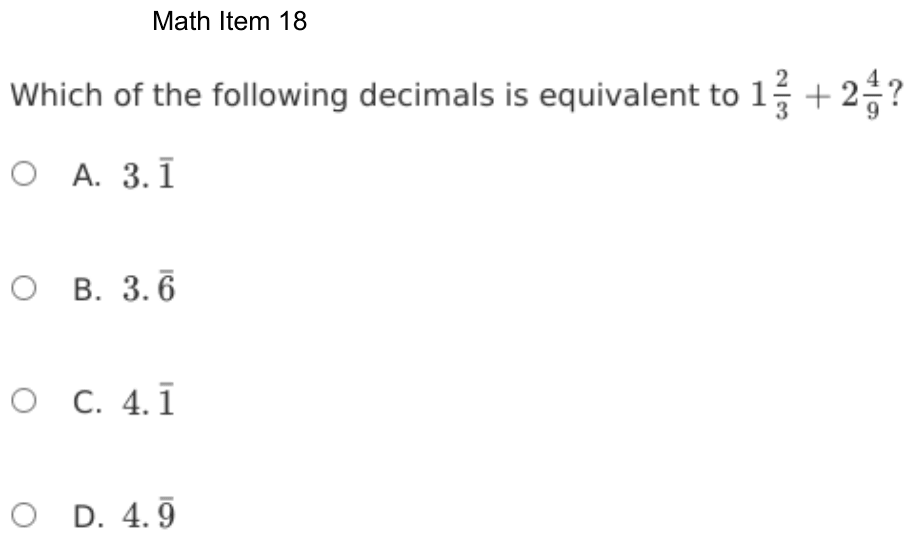
Which of the following decimals is equivalent to ?
- A
- B
- C
- D
Show the answer
Correct answer: C
First, add the mixed numbers. Then, convert the fraction to a decimal.
Question analysis
This question asks which repeating decimal equals the sum of the mixed numbers 1 2/3 and 2 4/9. Students rename the fractions with a common denominator, add, and convert the fraction part to a decimal with a bar over its repeating digit. The choices differ in both the whole number and the repeating digit, so each step has to be right.
- NYS standards
- Grade level
- Grade 7 content, by NYS standard
- Compared with grade 7
- At grade 7 Adding mixed numbers and writing a fraction as a repeating decimal are standard grade 7 skills. This combines them in three short steps; renaming a fraction and reading the bar notation are the only places that need care.
- Estimated difficulty
- Straightforward: two steps or one careful reading.
- Thinking it demands
- Depth of knowledge 1, recall and reproduction · mainly apply
- What makes it hard
- Error-prone arithmetic moderate
- An answer in an unexpected form minor
- Solution
- 3 steps
- Reading level
- Question and choices: about grade 13, 13 words.
- Students, last 30 days
- Not enough answers yet to show (it takes 10).
Why it is hard, traps and wrong answers (shows the answer)
Why it is hard
Two fraction moves and one conversion stand between the sum and the choices. The carry is the main hazard: 10/9 has to become 1 1/9, and students who keep only the 1/9 land on a choice with the wrong whole number. Estimating first, about 1.7 + 2.4 = 4.1, rules out both choices that begin with 3 and the one that equals 5.
Error-prone arithmetic moderate Working it out
Adding 2/3 and 4/9 needs 2/3 renamed as 6/9, and the sum 10/9 is more than 1, so a whole must be carried into the 3 before converting. (Brown & Burton, 1978; Junker & Sijtsma, 2001)
An answer in an unexpected form minor Choosing the answer
The choices are repeating decimals with bars, so a mixed number in ninths has to be recognized as a digit repeating forever; knowing that ninths repeat their numerator makes the match quick. (Enright, Morley & Sheehan, 2002)
Strategy: Rename 2/3 as ninths, add the whole numbers and the fractions separately, regroup any fraction of 9/9 or more as a whole, then divide the leftover numerator by 9.
Traps
- A faulty procedure: A systematic but wrong procedure: adding fractions straight across, applying an exponent to each term of a sum, dropping a sign when moving a term.
- Answer in another form: The right answer is written differently from the way you worked it out.
The wrong answers, classified
A An arithmetic slip (Junker & Sijtsma, 2001)
Adds the fractions to 10/9 but keeps only the 1/9 left over, forgetting to carry the whole 1 into the 3, so the sum becomes 3 1/9.
B A faulty procedure (Brown & Burton, 1978; Tatsuoka, 1983)
Adds the numerators 2 and 4 over 9 without renaming 2/3 as 6/9, so gets 3 6/9, which is 3.666…
D A faulty procedure (Brown & Burton, 1978; Tatsuoka, 1983)
Reaches 4 1/9 but repeats the denominator's 9 instead of the numerator's 1, as if one ninth were 0.999… rather than 0.111…
Worked solution, step by step
Formulas used
- Equivalent fractions
- a/b is a fraction, and n is any number except 0. Multiplying the top and the bottom by the same n gives an equal fraction, because n/n is 1. Use it to give two fractions the same bottom before you add them.
- Ninths as repeating decimals
- 1 divided by 9 is 0.111…, with 1s that go on forever. The bar over a digit means that digit repeats forever. Ninths from 1/9 to 8/9 repeat their top digit, so 4/9 is 0.444… and 2/9 is 0.222…
Sort out the question
You need to add two mixed numbers, 1 2/3 and 2 4/9. A mixed number is a whole number plus a fraction. Then write the sum as a decimal. The choices are repeating decimals, where the bar over a digit means it repeats forever.
Rename two thirds as ninths
The fractions 2/3 and 4/9 have different bottoms. Since 3 × 3 = 9, multiply the top and bottom of 2/3 by 3:
So 1 2/3 is the same as 1 6/9.
Watch out: adding the tops 2 and 4 over 9 without renaming gives 3 6/9, choice B.
Add the mixed numbers
Add the whole numbers, then add the fractions:
10/9 is more than 1. It is 9/9 plus 1/9, or 1 1/9. Carry the 1 into the whole number:
Watch out: forgetting to carry the 1 gives 3 1/9, choice A.
Change it to a decimal
One ninth is 0.111…, with the 1 repeating forever. So:
Watch out: ninths repeat the top digit, not the 9. Choice D, 4.999…, does not match 4 1/9.
So the answer is C, .
Check your answer
Use rough decimals. 1 2/3 is about 1.667, and 2 4/9 is about 2.444. Their sum is about 4.111. That matches 4.111… and rules out both choices that start with 3. And 4.999… is almost 5, which is too big.
More questions like this
The original DOE question
Question 3 of 6
2024 Test A Math, question 52Question
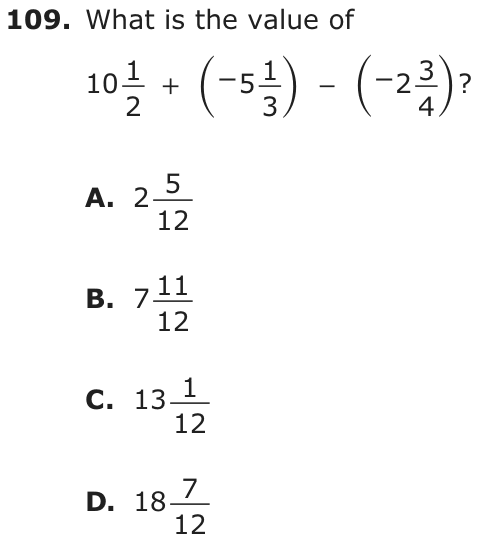
What is the value of ?
- A
- B
- C
- D
Show the answer
Correct answer: B
Rewrite the mixed numbers so that they all have equivalent denominators.
Subtracting a negative is the same as adding.
Group the whole numbers together and the fractions together.
Question analysis
This signed-number question asks for the value of 10 1/2 plus negative 5 1/3 minus negative 2 3/4. It tests adding and subtracting negative mixed numbers with unlike denominators. Turning each sign combination into a plain addition or subtraction, and then working in twelfths, is where students most often go wrong.
- Grade level
- Grade 7 content, by NYS standard
- Compared with grade 7
- At grade 7 Adding and subtracting negative mixed numbers is central grade 7 work. This three-term expression is typical in length, but it needs a common denominator of 12 and two different sign rules: adding a negative and subtracting one.
- Estimated difficulty
- Moderate: several steps, or a close reading with one strong distractor.
- Thinking it demands
- Depth of knowledge 1, recall and reproduction · mainly apply
- What makes it hard
- Error-prone arithmetic moderate
- Many steps minor
- Solution
- 4 steps
- Reading level
- Question and choices: about grade 10, 10 words.
- Students, last 30 days
- Not enough answers yet to show (it takes 10).
Why it is hard, traps and wrong answers (shows the answer)
Why it is hard
The expression is short, but it packs both sign rules for negative numbers into one line, and each misapplication has its own choice. Subtracting a negative is the rule most often broken, and the result is a reasonable-looking mixed number. Estimating with decimals, 10.5 − 5.3 + 2.8 is about 8, separates the answer from every wrong choice.
Error-prone arithmetic moderate Working it out
Two different sign rules meet: adding −5 1/3 means subtracting 5 1/3, while subtracting −2 3/4 means adding 2 3/4, and mixing them up gives a listed value. (Brown & Burton, 1978; Junker & Sijtsma, 2001)
Many steps minor Working it out
After the signs, halves, thirds and quarters become twelfths, and the wholes, 10 − 5 + 2, are combined apart from the fractions, 6/12 − 4/12 + 9/12. (Daniel & Embretson, 2010; Enright, Morley & Sheehan, 2002)
Strategy: Rewrite adding a negative as subtraction and subtracting a negative as addition, convert the fractions to twelfths, then combine the whole numbers and the fractions separately.
Traps
- Negatives and direction: Arithmetic with negative numbers, the order of a subtraction, or direction on a number line. (Moving a term across the equals sign without changing its sign is a faulty procedure.)
The wrong answers, classified
A Negatives and direction (Brown & Burton, 1978)
Handles the added negative but treats subtracting −2 3/4 as subtracting 2 3/4, so 5 1/6 − 2 3/4 = 2 5/12.
C Negatives and direction (Brown & Burton, 1978)
Drops the negative signs inside the parentheses and keeps the operations, 10 1/2 + 5 1/3 − 2 3/4 = 13 1/12.
D Negatives and direction (Brown & Burton, 1978)
Ignores every sign and adds all three mixed numbers, 10 1/2 + 5 1/3 + 2 3/4 = 18 7/12.
Worked solution, step by step
Formulas used
- Adding and subtracting negatives
- a is any number, and b is a positive number, so −b is negative. Adding a negative moves you left on the number line, just like subtracting. Subtracting a negative is like taking away a debt, so you end up with more. It is the same as adding.
- Equivalent fractions
- a is the top of a fraction and b is the bottom. n is any number except 0. Multiplying the top and bottom by the same number gives an equal fraction, cut into smaller pieces. Use it to give two fractions the same bottom before you add or subtract.
Sort out the expression
You need . There are three mixed numbers, and two of them are negative. A mixed number is a whole number plus a fraction. Plan: fix the signs, give the fractions the same bottom, then work with the whole numbers and the fractions one group at a time.
Fix the signs
Adding means subtracting . Subtracting means adding .
Watch out: subtracting a negative is adding. Subtracting instead gives , choice A. Dropping the minus signs gives C or D.Use twelfths for the fractions
The bottoms are 2, 3 and 4. All three go into 12, so change each fraction to twelfths.
Now the problem is .
Combine whole numbers, then fractions
Work with the whole numbers and the fractions one group at a time. Keep each sign.
The fraction part is less than 1, so just put them together: .
So the answer is B, .
Check your answer
Estimate with decimals. is about 7.92. And is also about 7.92, since is almost 1. They match.
More questions like this
The original DOE question
Question 4 of 6
2023 Test A Math, question 7Question
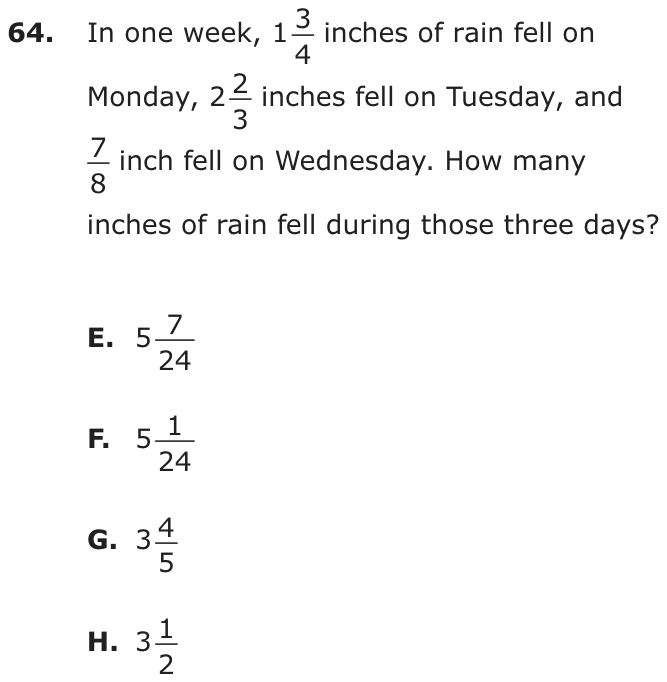
In one week, inches of rain fell on Monday, inches fell on Tuesday, and inch fell on Wednesday. How many inches of rain fell during those three days?
- A
- B
- C
- D
Show the answer
Correct answer: A
To solve, add the three given fractions:
The common denominator is 24:
Question analysis
A rainfall word problem gives the inches of rain on Monday, Tuesday and Wednesday as two mixed numbers and a fraction, and asks for the total over the three days. Students add fractions with unlike denominators. Finding a common denominator for fourths, thirds and eighths, and regrouping the fractional part into wholes, is where errors come in.
- NYS standards
- Grade level
- Grade 7 content, by NYS standard
- Compared with grade 7
- Below grade 7 Adding fractions and mixed numbers with unlike denominators is taught before grade 7, and this is a direct word problem. It takes more care than a typical exercise only because three different denominators must be rewritten over a common one.
- Estimated difficulty
- Straightforward: two steps or one careful reading.
- Thinking it demands
- Depth of knowledge 2, skills and concepts · mainly apply
- What makes it hard
- Error-prone arithmetic moderate
- Many steps minor
- Solution
- 3 steps
- Reading level
- Question and choices: about grade 5, 35 words.
- Students, last 30 days
- Not enough answers yet to show (it takes 10).
Why it is hard, traps and wrong answers (shows the answer)
Why it is hard
The setup is plain addition, so the difficulty is all in the fractions. Students who know to rename over a common denominator rarely miss it, while those who add the fraction parts straight across, or put the numerators over 24 without scaling them, reach choices with a whole part of 3. Since 1 3/4 + 2 2/3 alone is more than 4, any total below 4 can be ruled out at a glance.
Error-prone arithmetic moderate Working it out
The fractional parts have denominators 4, 3 and 8, so they must be renamed as 18, 16 and 21 twenty-fourths, and their sum, 55/24, regrouped as 2 7/24 before the wholes are added. (Brown & Burton, 1978; Junker & Sijtsma, 2001)
Many steps minor Working it out
Renaming, adding the numerators, regrouping the improper fraction and adding the whole numbers are four separate moves, and losing the 2 carried from 55/24 drops the total by two inches. (Daniel & Embretson, 2010; Enright, Morley & Sheehan, 2002)
Strategy: Rewrite the three fractional parts over a common denominator of 24, add the whole numbers and the fractions separately, and regroup any extra twenty-fourths as a whole.
Traps
- A faulty procedure: A systematic but wrong procedure: adding fractions straight across, applying an exponent to each term of a sum, dropping a sign when moving a term.
The wrong answers, classified
B Little reason to choose it (Haladyna & Downing, 1993; Rodriguez, 2005)
No single renaming mistake gives 49 twenty-fourths; this choice sits exactly 1/4 below the right total, so it mostly catches guesses near it.
C A faulty procedure (Brown & Burton, 1978; Tatsuoka, 1983)
Adds the whole numbers to get 3, then adds the fractions straight across, (3 + 2 + 7)/(4 + 3 + 8) = 12/15 = 4/5.
D A faulty procedure (Brown & Burton, 1978; Tatsuoka, 1983)
Finds the common denominator 24 but adds the numerators without renaming them, (3 + 2 + 7)/24 = 1/2, and adds that to the wholes, 3.
Worked solution, step by step
Formulas used
- Equivalent fractions
- a over b is a fraction, and k is any whole number except 0. Multiplying the top and the bottom by the same number gives an equal fraction. You cut each piece into k smaller pieces. So you have k times as many pieces, each k times smaller.
- Adding fractions with the same bottom
- d is the denominator, the bottom number. It tells the size of the pieces. a, b and c are the numerators, the top numbers. They count the pieces. When the pieces are the same size, add the counts. The bottom stays the same.
- Fraction to mixed number
- a over b is a fraction whose top is bigger than its bottom. q is the quotient, how many whole times b fits into a. r is the remainder, what is left over. The leftover stays over the same bottom number.
Sort out the question
Rain fell on three days: inches, inches and inch. You need the total rain, in inches. So add the three amounts. Add the whole numbers and the fractions separately. The whole numbers are 1 and 2, so they add to 3 inches.
Find a common denominator
The fractions have denominators, or bottom numbers, 4, 3 and 8. You can only add pieces of the same size. So find the smallest number that 4, 3 and 8 all divide into. Count by 8s: 8, 16, 24. 24 works, since 24 = 4 × 6 and 24 = 3 × 8. So use 24ths.
Rename each fraction in 24ths
Multiply the top and the bottom by the same number.
Watch out: change the tops too. Keeping 3, 2 and 7 over 24 gives and a total of , choice D.
Add the fractions
Now the pieces are the same size, so add the tops.
That is more than 1 whole. 24 goes into 55 twice, with 7 left over.
Watch out: never add the bottoms. Adding straight across gives and a total of , choice C.
Put the parts together
Add the 3 whole inches from before.
So the answer is A, inches.
Check your answer
Use decimals. is 1.75, is about 2.67, and is 0.875. They add to about 5.29. And is about 0.29. So fits, and is too small.
More questions like this
The original DOE question
Question 5 of 6
2023 Test B Math, question 6Question
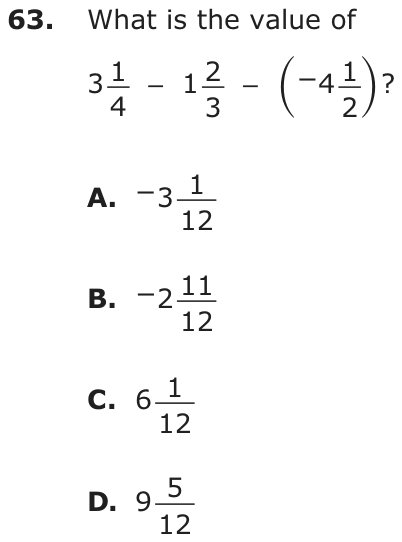
What is the value of ?
- A
- B
- C
- D
Show the answer
Correct answer: C
The first step is to rewrite the problem replacing all subtraction with adding the opposite:
Then, rewrite all the fractions using a common denominator of 12, which is the least common multiple of the fractions’ denominators, 4, 3, and 2:
Next, combine the positive numbers and, finally, add the negative number to the sum by subtracting the number with the least absolute value from the number with the greatest absolute value and using the sign of the number with the greatest absolute value:
Question analysis
What is 3 1/4 − 1 2/3 − (−4 1/2)? This question on rational-number arithmetic combines mixed numbers with denominators of 4, 3 and 2 and ends by subtracting a negative number. Students must turn that last subtraction into an addition and find a common denominator before combining.
- Grade level
- Grade 7 content, by NYS standard
- Compared with grade 7
- At grade 7 Subtracting negative mixed numbers is core grade 7 content. This expression is typical in length, but it needs a common denominator of 12 and careful handling of the rule for subtracting a negative.
- Estimated difficulty
- Moderate: several steps, or a close reading with one strong distractor.
- Thinking it demands
- Depth of knowledge 1, recall and reproduction · mainly apply
- What makes it hard
- Error-prone arithmetic moderate
- Many steps minor
- Solution
- 4 steps
- Reading level
- Question and choices: about grade 10, 10 words.
- Students, last 30 days
- Not enough answers yet to show (it takes 10).
Why it is hard, traps and wrong answers (shows the answer)
Why it is hard
The expression is short, but it mixes a subtraction that stays a subtraction with one that becomes an addition, and that difference is what most wrong answers miss. The fractions add a second load, since twelfths are needed before anything combines. Estimating first, 3 − 1.7 + 4.5 is about 6, shows the result is positive, which rules out both negative values.
Error-prone arithmetic moderate Working it out
Three mixed numbers with denominators 4, 3 and 2 must become twelfths, and the last term, −(−4 1/2), changes sign while the middle subtraction does not. (Brown & Burton, 1978; Junker & Sijtsma, 2001)
Many steps minor Working it out
Rewriting the double negative, renaming each fraction, adding 3 1/4 and 4 1/2, then taking away 1 2/3 are four steps, each able to carry a slip forward. (Daniel & Embretson, 2010; Enright, Morley & Sheehan, 2002)
Strategy: Change subtracting −4 1/2 into adding 4 1/2, rename every fraction in twelfths, add the two positive numbers, then take away 1 2/3.
Traps
- Negatives and direction: Arithmetic with negative numbers, the order of a subtraction, or direction on a number line. (Moving a term across the equals sign without changing its sign is a faulty procedure.)
The wrong answers, classified
A Little reason to choose it (Haladyna & Downing, 1993; Rodriguez, 2005)
No single error gives −3 1/12; it needs subtracting 4 1/2 and also miswriting 3 1/4 as 3 1/12, two errors at once, so it mostly draws guesses.
B Negatives and direction (Brown & Burton, 1978)
Treats subtracting −4 1/2 as subtracting 4 1/2, so 3 1/4 − 1 2/3 − 4 1/2 = −2 11/12.
D Negatives and direction (Brown & Burton, 1978)
Drops both minus signs and adds the three mixed numbers, 3 1/4 + 1 2/3 + 4 1/2 = 9 5/12, as if every operation were addition.
Worked solution, step by step
Formulas used
- Subtracting a negative number
- a and b stand for any numbers. Taking away a negative number is the same as adding its opposite, the same number with the other sign. Think of it this way: taking away a debt leaves you richer.
- Equivalent fractions
- a is the top and b is the bottom of a fraction. Multiplying both by the same number n does not change its value. Use it to give fractions the same bottom number, so you can add or subtract them.
Sort out the question
You need the value of . Each number is a mixed number, a whole number plus a fraction. There are two subtractions. The second one takes away a negative number.
Change the double negative
Use the rule for subtracting a negative. Taking away is the same as adding .
The first minus sign stays as it is. Watch out: if you subtract instead, you get , choice B.
Give the fractions one denominator
The denominator is the bottom number of a fraction. Here they are 4, 3 and 2. The smallest number all three divide into is 12. So change each fraction to twelfths.
The problem is now:
Add the two positive numbers
You may add and subtract in any order, as long as each number keeps its sign. Add the two positive numbers first.
That is 3 + 4 = 7 wholes and 3 + 6 = 9 twelfths.
Take away the last number
That is 7 − 1 = 6 wholes and 9 − 8 = 1 twelfth. So the answer is C, .
Check your answer
Estimate with decimals: . And is about 6.08 too. The answer must be positive, so A and B are out. Choice D comes from adding all three numbers.
More questions like this
The original DOE question
Question 6 of 6
2018 Test A Math, question 28Question
What is the value of the expression shown above?
- A
- B
- C
- D
Show the answer
Correct answer: D
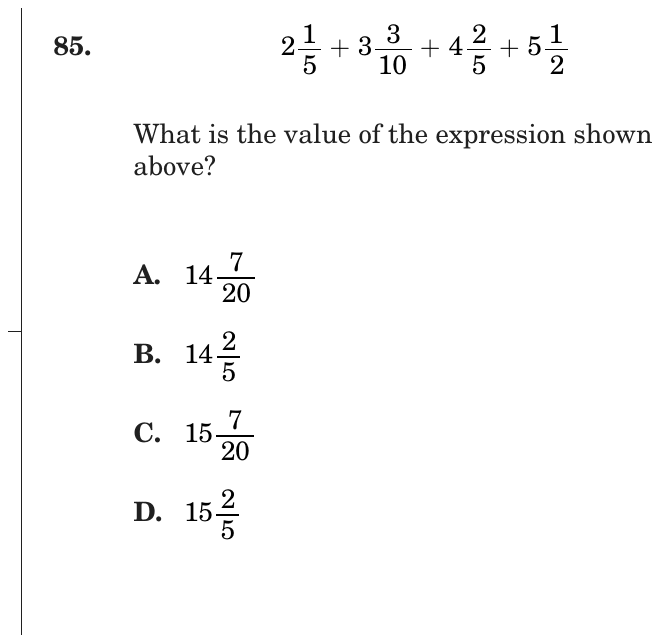
Convert all the fractions to a common denominator (10):
Question analysis
A fractions question: add four mixed numbers whose fractions have denominators of 5, 10, 5 and 2. Students rewrite the fractions over a common denominator, add the whole numbers and the fractions, regroup any extra whole, and simplify. Regrouping and lowest terms both matter, since the choices differ in exactly those places.
- NYS standards
- Grade level
- Grade 7 content, by NYS standard
- Compared with grade 7
- Below grade 7 Adding mixed numbers with unlike denominators is grade 5 content. With four terms and a regrouping step it takes care, but it asks less than typical grade 7 work with negative rational numbers.
- Estimated difficulty
- Straightforward: two steps or one careful reading.
- Thinking it demands
- Depth of knowledge 1, recall and reproduction · mainly apply
- What makes it hard
- Error-prone arithmetic moderate
- A very close wrong answer moderate
- An answer in an unexpected form minor
- Solution
- 3 steps
- Reading level
- Question and choices: about grade 9, 14 words.
- Students, last 30 days
- Not enough answers yet to show (it takes 10).
Why it is hard, traps and wrong answers (shows the answer)
Why it is hard
The numbers are friendly: every fraction converts to tenths, and the whole parts add to 14. The risk is in the bookkeeping, either forgetting to carry the extra whole from the fractions or adding numerators over a made-up denominator. Converting to decimals, 2.2 + 3.3 + 4.4 + 5.5, is a fast check that avoids both.
Error-prone arithmetic moderate Working it out
Four mixed numbers with denominators 5, 10, 5 and 2 must be rewritten as tenths, 2 + 3 + 4 + 5 tenths, and the 14/10 regrouped into a whole and a fraction. (Brown & Burton, 1978; Junker & Sijtsma, 2001)
A very close wrong answer moderate Choosing the answer
15 2/5 and 14 2/5 are written alike and share the fraction 2/5; only the whole carried from 14/10 separates them, so a missed carry is invisible at a glance. (Embretson & Wetzel, 1987; Gorin & Embretson, 2006; Ascalon et al., 2007)
An answer in an unexpected form minor Choosing the answer
The fractions total 1 4/10, but every choice is in lowest terms, so the 4/10 has to be reduced to 2/5 before it matches. (Enright, Morley & Sheehan, 2002)
Strategy: Convert each mixed number to a decimal, since these fractions all convert exactly, add them, and turn the decimal part back into a fraction in lowest terms.
Traps
- Answer in another form: The right answer is written differently from the way you worked it out.
The wrong answers, classified
A A faulty procedure (Brown & Burton, 1978; Tatsuoka, 1983)
Adds the numerators straight across, 1 + 3 + 2 + 1 = 7, and puts them over 20, a common denominator (10 × 2), without rescaling them, so nothing carries.
B An arithmetic slip (Junker & Sijtsma, 2001)
Adds the fractions to 14/10 but keeps only the 4/10 = 2/5 left over, forgetting to carry the whole 1 into 14.
C Little reason to choose it (Haladyna & Downing, 1993; Rodriguez, 2005)
Pairs a correct carry into 15 with the 7/20 from adding numerators, two steps no single line of working combines; it mostly catches guesses.
Worked solution, step by step
Formulas used
- Equal fractions
- a is the top number, called the numerator. b is the bottom number, called the denominator. n is any whole number except zero. Multiplying the top and bottom by the same n gives an equal fraction. Use it to give fractions the same denominator so you can add them.
Sort out the question
You need to add four mixed numbers. A mixed number is a whole number plus a fraction, like . The fractions have different denominators, or bottom numbers: 5, 10, 5 and 2. To add fractions, they need the same denominator.
Add the whole numbers
Add the whole numbers first. You will add the fractions on their own after that.
The whole numbers make 14.
Rewrite each fraction in tenths
Use 10 as the denominator, since 5 and 2 both go into 10.
is already in tenths. Watch out: when you change a bottom number, change the top too. Adding the old tops, 1 + 3 + 2 + 1 = 7, and putting them over 20 gives 7/20. That is in choices A and C.
Add the fractions
14 tenths is more than 1 whole. Ten tenths make 1, so 14 tenths is 1 whole and 4 tenths.
To simplify 4/10, divide the top and bottom by 2.
Put it all together
Add the 14 wholes to the sum of the fractions.
Watch out: carry the extra whole into the 14. Missing it gives , choice B. So the answer is D, .
Check your answer
Change each mixed number to a decimal: . The 0.4 is 4 tenths, which is 2/5. So the sum is .
More questions like this
The original DOE question