6.EE.2b parts of an expression
Question 1 of 3
2024 Test B Math, question 1Question
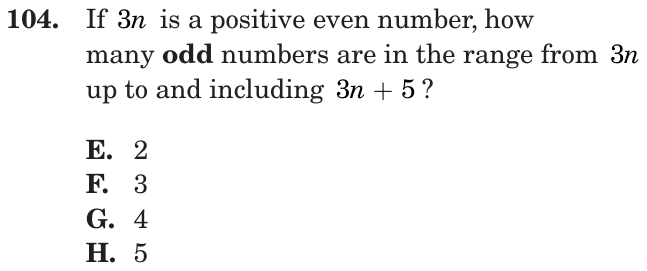
After the expression above is simplified, what is the coefficient of x, expressed as a decimal?
Grid-in question: work out the answer and enter it as a number.
Show the answer
Correct answer: -0.8
First, distribute over to get the expression .
Express as and then add like terms:
.
The coefficient of x is .
When expressed as a decimal,
.
Question analysis
An algebra grid-in on simplifying an expression: three fifths times the quantity 2x + 5, minus 2x. Students distribute a fraction, combine the x terms and report the coefficient of x as a decimal. Multiplying by a fraction, the subtraction that follows, and gridding the decimal correctly all leave room for slips.
- Grade level
- Grade 7 content, by NYS standard
- Compared with grade 7
- At grade 7 Expanding and simplifying linear expressions with fraction coefficients is a core grade 7 skill, and this is a typical short example. Writing the coefficient as a decimal in the grid adds care but no new idea.
- Estimated difficulty
- Straightforward: two steps or one careful reading.
- Thinking it demands
- Depth of knowledge 1, recall and reproduction · mainly apply
- What makes it hard
- Error-prone arithmetic moderate
- An answer in an unexpected form minor
- Solution
- 3 steps
- Reading level
- Question and choices: about grade 9, 17 words.
- Students, last 30 days
- Not enough answers yet to show (it takes 10).
Why it is hard, traps and wrong answers (shows the answer)
Why it is hard
The distribution itself is routine; points are lost after it. Students who stop at 6/5x forget the −2x outside the parentheses, and those who combine the x terms correctly can still drop the sign of a negative result. Rewriting 2x as 10/5x keeps the subtraction in fifths, and substituting x = 1 into both forms confirms the coefficient before gridding.
Error-prone arithmetic moderate Working it out
Multiplying 2x by 3/5 gives 6/5x, and taking away 2x means rewriting it as 10/5x; the result is a negative fraction that must then become a decimal with its sign. (Brown & Burton, 1978; Junker & Sijtsma, 2001)
An answer in an unexpected form minor Choosing the answer
There are no choices to check against, and the coefficient must be gridded as a decimal with its minus sign, so −4/5 has to become −0.8. (Enright, Morley & Sheehan, 2002)
Strategy: Multiply both terms inside the parentheses by 3/5, rewrite 2x in fifths so the x terms share a denominator, combine them, and convert that fraction to a decimal.
Traps
- Negatives and direction: Arithmetic with negative numbers, the order of a subtraction, or direction on a number line. (Moving a term across the equals sign without changing its sign is a faulty procedure.)
- Stops one step early: A choice is a number from partway through the solution.
- A faulty procedure: A systematic but wrong procedure: adding fractions straight across, applying an exponent to each term of a sum, dropping a sign when moving a term.
The wrong answers, classified
0.8 Negatives and direction (Brown & Burton, 1978)
Combines 6/5x and −2x to a coefficient of the right size, 4/5, but drops the minus sign, or subtracts 6/5 from 2, and grids 0.8.
1.2 Stops one step early (King et al., 2004; Gierl et al., 2017)
Distributes 3/5 to get 6/5x + 3 and grids 6/5 = 1.2, stopping before the −2x outside the parentheses is combined with it.
-1.4 A faulty procedure (Brown & Burton, 1978; Tatsuoka, 1983)
Multiplies 3/5 by 2 as 6/10, doubling the denominator along with the numerator, so the coefficient comes out 0.6 − 2 = −1.4.
Worked solution, step by step
Formulas used
- Distributive property
- a is the number outside the parentheses. b and c are the terms inside. A term is a number, a letter, or a number times a letter. To multiply out the parentheses, multiply each term inside by a. It works because a groups of b + c is a groups of b plus a groups of c.
- Multiplying a fraction by a whole number
- a over b is the fraction, and c is the whole number. Multiply only the top number, the numerator, by c. The bottom number, the denominator, stays the same. The size of each piece does not change. You just have more pieces.
Sort out the question
You start with this expression. An expression is a math phrase with numbers, letters and signs, but no equals sign.
To simplify it means to write it in its shortest form. The coefficient of x is the number multiplied by x. In 7x, the coefficient is 7. You need the coefficient of x, written as a decimal.
Multiply out the parentheses
The 3/5 multiplies everything inside the parentheses. Use the distributive property.
Multiply only the top of 3/5 by 2: . Also, . Now the whole expression is:
Watch out: do not double the bottom number too. Writing 6/10 leads to −1.4.Write 2x in fifths
There are now two x terms: and . To combine them, they need the same denominator (bottom number). One whole is 5/5, so 2 wholes are 10/5.
Watch out: the −2x is outside the parentheses, but it still counts. Stopping at 6/5 and gridding 1.2 is a common mistake.Combine the x terms
Six fifths take away ten fifths leaves negative four fifths.
The 3 has no x, so it stays as it is. The simplified expression is . So the coefficient of x is . Watch out: 6 − 10 is negative. Dropping the minus sign gives 0.8.
Change it to a decimal
A fraction means the top divided by the bottom: . Keep the minus sign.
So you would grid -0.8, with the minus sign in its own column.
Check your answer
Pick an easy value, x = 1, and put it into both forms. The first form: . The simplified form: . Both give 2.2, so the simplifying worked.
More questions like this
The original DOE question
Question 2 of 3
2024 Test B Math, question 8Question
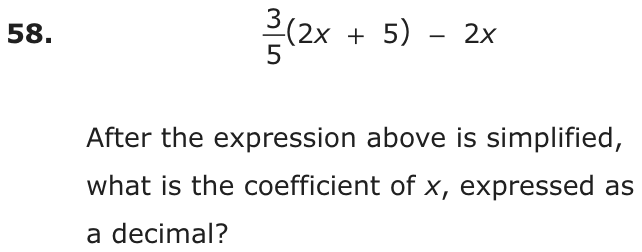
If , where and , what is the product of x and y?
- A4
- B6
- C12
- D16
Show the answer
Correct answer: C
Question analysis
An algebra question gives a proportion with x in one denominator and y in one numerator, 9 over 2x equal to 3y over 8, and asks for the product of x and y. Neither variable can be found on its own, so students must clear the fractions and treat the product as a single quantity.
- Grade level
- Grade 8 content, by NYS standard
- Compared with grade 7
- Above grade 7 Grade 7 students cross-multiply numeric proportions to find one unknown. Here two variables sit in the proportion and the question wants their product, a literal-equation idea from grade 8 that many grade 7 students have not met.
- Estimated difficulty
- Moderate: several steps, or a close reading with one strong distractor.
- Thinking it demands
- Depth of knowledge 2, skills and concepts · mainly apply
- What makes it hard
- No obvious method moderate
- Variables instead of numbers minor
- Solution
- 3 steps
- Reading level
- Question and choices: about grade 8, 14 words.
- Students, last 30 days
- Not enough answers yet to show (it takes 10).
Why it is hard, traps and wrong answers (shows the answer)
Why it is hard
The question looks harder than it is, because it asks for a product rather than for x or y. Cross-multiplying turns the proportion into 72 = 6xy, and dividing by 6 finishes it, so the only real hurdle is trusting that xy can be solved for as one quantity. The wrong choices come from grabbing numbers along the way, not from a nearly complete solution.
No obvious method moderate Working it out
Neither x nor y can be found alone, so students must see that cross-multiplying gives 72 = 6xy, where the product xy appears as one block to solve for. (Schoenfeld, 1985)
Variables instead of numbers minor Understanding the question
Both unknowns stay letters and only their product is asked for, so there is no value of x or y to check a result against. (Koedinger & Nathan, 2004; Enright, Morley & Sheehan, 2002)
Strategy: Cross-multiply to clear both fractions, collect the numbers on one side and x and y together on the other, then divide so that only the product is left.
Traps
- Numbers taken from the question: Combines the numbers in the question without a model of the situation, or is simply a number that appears in the question.
- Answers a different question: A choice is right for another quantity: the other unknown, the rest instead of the part, the part instead of the whole.
The wrong answers, classified
A Answers a different question (King et al., 2004; Hegarty, Mayer & Monk, 1995)
Matches the denominators, 2x = 8, to get x = 4 and gives the value of x instead of the product of x and y.
B Numbers taken from the question (Hegarty, Mayer & Monk, 1995)
Takes the 6 in 72 = 6xy, the product of the coefficients 2 and 3, as the answer without dividing 72 by it.
D Numbers taken from the question (Hegarty, Mayer & Monk, 1995)
Multiplies the 2 and the 8 from the two denominators, combining numbers in the equation instead of cross-multiplying.
Worked solution, step by step
Formulas used
- Cross-multiplying
- a, b, c and d are numbers or letters, and b and d are not zero. When two fractions are equal, multiply each top by the other bottom. The two products are equal. It works because it is the same as multiplying both sides by b and by d.
Sort out the question
The equation says that two fractions are equal:
Here 2x means 2 times x, and 3y means 3 times y. You need the product of x and y. A product is the answer to a multiplication. So you need , written xy. You do not need x or y alone.
Cross-multiply the fractions
An equation without fractions is easier to work with. So cross-multiply.
Watch out: do not just set the bottoms equal. Writing 2x = 8 gives x = 4, choice A. That is x, not the product.Multiply out both sides
On the left, . On the right, multiply the numbers and keep the letters together.
So the equation is now:
The xy is the product you want, all in one piece.
Divide both sides by 6
xy is being multiplied by 6. To undo that, divide both sides by 6.
Watch out: 6 is just the number in front of xy. Choosing it gives B.So the answer is C, 12.
Check your answer
Pick x = 4. Then y must be 3, so that xy = 12. Left side: . Right side: . The two sides match, so a product of 12 works.
More questions like this
The original DOE question
Question 3 of 3
2018 Test A Math, question 47Question
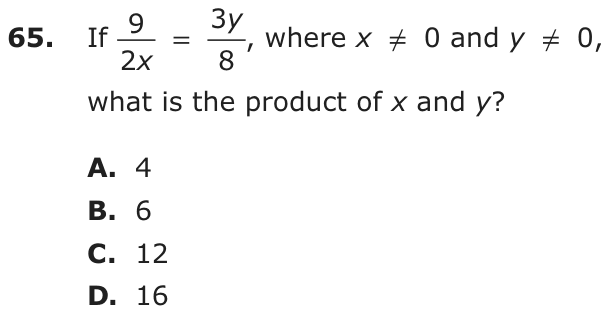
If is a positive even number, how many odd numbers are in the range from up to and including ?
- A2
- B3
- C4
- D5
Show the answer
Correct answer: B
Since is even, then must be odd.
Thus and are also odd.
So there are a total of 3 numbers in this range that are odd.
Question analysis
This number properties question says 3n is a positive even number and asks how many odd numbers lie from 3n up to and including 3n + 5. Students must decide which integers in that span are odd. The coefficient in 3n is a distraction; only the fact that 3n is even matters.
- Grade level
- Grade 6 content, by NYS standard
- Compared with grade 7
- At grade 7 Grade 7 students work with expressions like 3n + 5 but rarely reason about whether they are even or odd. The idea is simple once the integers are written out, so the demand is about typical for grade 7.
- Estimated difficulty
- Straightforward: two steps or one careful reading.
- Thinking it demands
- Depth of knowledge 2, skills and concepts · mainly apply
- What makes it hard
- Variables instead of numbers moderate
- Something you must already know minor
- A very close wrong answer minor
- Solution
- 2 steps
- Reading level
- Question and choices: about grade 12, 22 words.
- Students, last 30 days
- Not enough answers yet to show (it takes 10).
Why it is hard, traps and wrong answers (shows the answer)
Why it is hard
Writing the six integers from 3n to 3n + 5 and marking them even, odd, even, odd, even, odd answers the question in seconds. The traps come from not writing them: dropping the last one, which "up to and including" keeps in, or reading the 5 in 3n + 5 as a count. Picking any even value for 3n, such as 6, makes the check concrete.
Variables instead of numbers moderate Understanding the question
No value of n is given, so students must reason about parity: since 3n is even, 3n + 1, 3n + 3 and 3n + 5 are the odd ones. (Koedinger & Nathan, 2004; Enright, Morley & Sheehan, 2002)
Something you must already know minor Working it out
The parity rules, even plus odd is odd and even plus even is even, are assumed; the coefficient 3 is a distraction once 3n is said to be even. (Anderson & Krathwohl, 2001)
A very close wrong answer minor Choosing the answer
The choices 2, 3, 4 and 5 are consecutive counts, so 2 and 3 cannot be told apart by sizing up; only checking whether 3n + 5 is inside the range separates them. (Embretson & Wetzel, 1987; Gorin & Embretson, 2006; Ascalon et al., 2007)
Strategy: Write out every integer from 3n to 3n + 5, mark 3n as even, alternate even and odd from there, and count the odd ones.
Traps
- Counting the ends: Inclusive or exclusive ends, fence posts, consecutive numbers: an answer that is one too many or too few, or an endpoint drawn open where it belongs closed (or the reverse).
The wrong answers, classified
A Counting the ends (Brown & Burton, 1978)
Leaves out 3n + 5, stopping before the last number although "up to and including" keeps it, and counts only 3n + 1 and 3n + 3.
C Misunderstands the concept (Smith, diSessa & Roschelle, 1993; De Bock et al., 1998; Ni & Zhou, 2005)
Counts 3n itself as odd because its coefficient 3 is odd, ignoring the stem's statement that 3n is even, and adds it to the three.
D Numbers taken from the question (Hegarty, Mayer & Monk, 1995)
Takes the 5 in 3n + 5 as the count, subtracting the ends instead of listing the six integers and picking out the odd ones.
Worked solution, step by step
Formulas used
- Even plus odd
- An even number splits into pairs. An odd number has one left over. Adding them keeps that one left over, so the sum is odd. So adding 1, 3 or 5 to an even number gives an odd number.
- Even plus even
- Two numbers that each split into pairs still split into pairs when you add them. So adding 2 or 4 to an even number gives an even number.
Sort out what you know
You are told that 3n is even. You do not need to know n itself. You need to count the odd numbers from 3n to 3n + 5.
“Up to and including” means 3n + 5 counts too.
List all the numbers
Go up by 1 each time, from 3n to 3n + 5. That gives six numbers:
Mark each as even or odd
3n is even. Adding 1, 3 or 5 makes it odd. Adding 2 or 4 keeps it even.
Number Even or odd even odd even odd even odd Watch out: 3n is even because the question says so. The 3 being odd does not matter. Counting 3n as odd gives choice C, 4.
Count the odd numbers
The odd ones are 3n + 1, 3n + 3 and 3n + 5. That is 3 numbers.
Watch out: leaving out 3n + 5 gives 2, choice A. It is the last number, and it is included. So the answer is B, 3.
Check your answer
Try a real number. If n = 2, then 3n = 6, which is even. The numbers from 6 to 11 are 6, 7, 8, 9, 10 and 11. The odd ones are 7, 9 and 11. That is 3.
More questions like this
The original DOE question