Table grid
Question 1 of 3
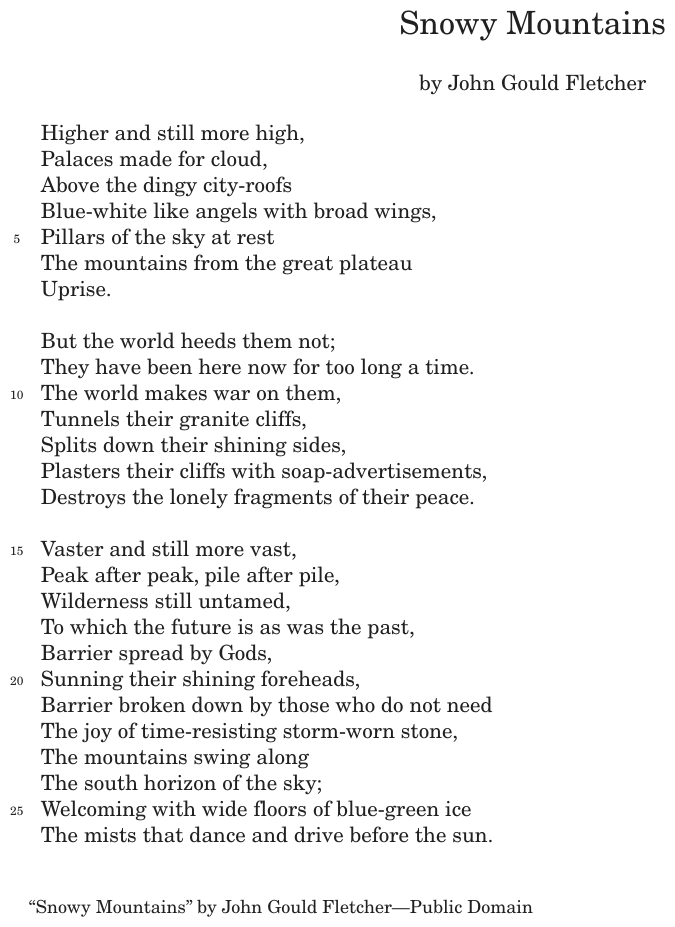
2026 Practice Test A English, question 7Passage Snowy Mountains
Snowy Mountains
by John Gould Fletcher
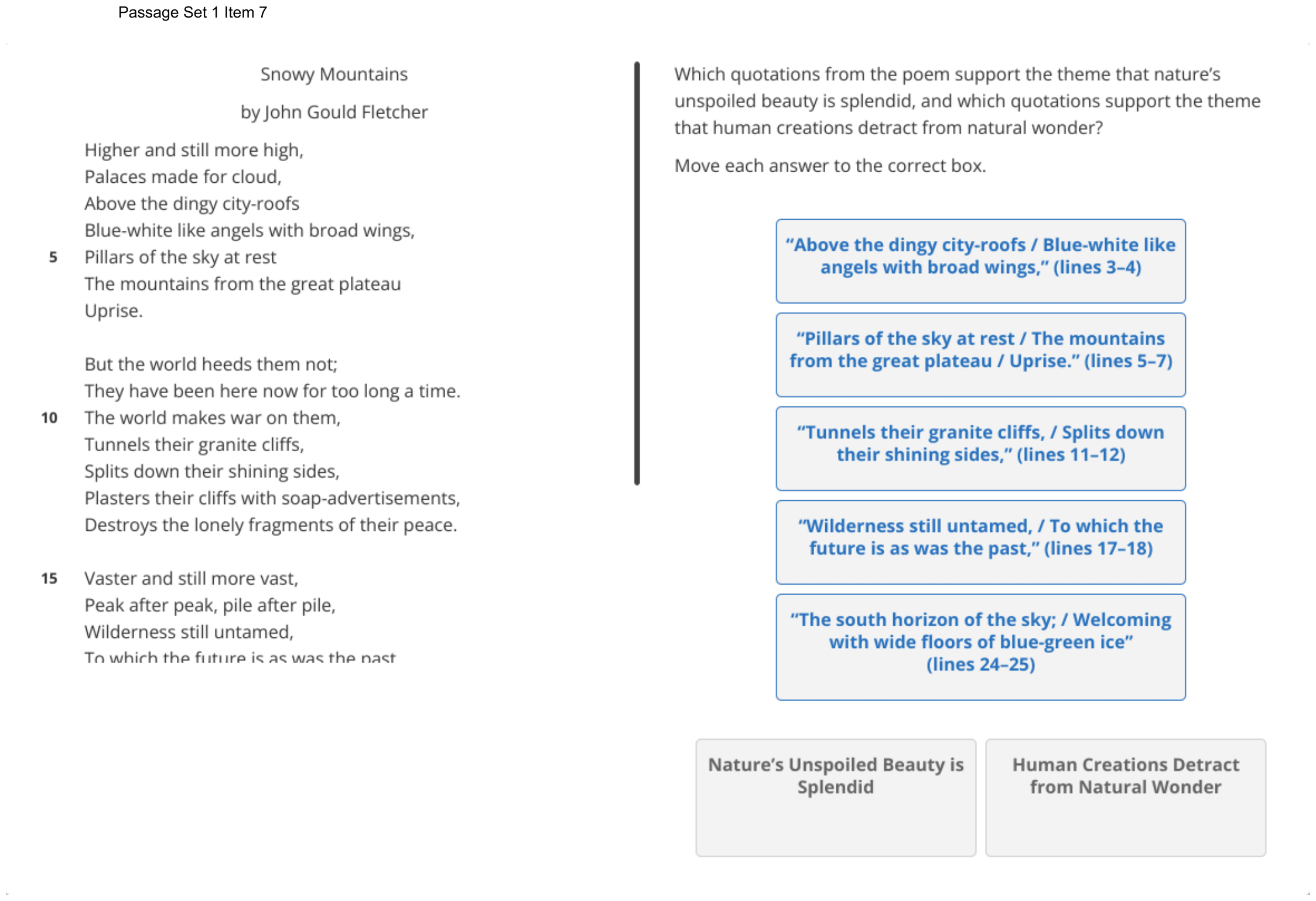
Higher and still more high,
Palaces made for cloud,
Above the dingy city-roofs
Blue-white like angels with broad wings,
Pillars of the sky at rest
The mountains from the great plateau
Uprise.
But the world heeds them not;
They have been here now for too long a time.
The world makes war on them,
Tunnels their granite cliffs,
Splits down their shining sides,
Plasters their cliffs with soap-advertisements,
Destroys the lonely fragments of their peace.
Vaster and still more vast,
Peak after peak, pile after pile,
Wilderness still untamed,
To which the future is as was the past,
Barrier spread by Gods,
Sunning their shining foreheads,
Barrier broken down by those who do not need
The joy of time-resisting storm-worn stone,
The mountains swing along
The south horizon of the sky;
Welcoming with wide floors of blue-green ice
The mists that dance and drive before the sun.
“Snowy Mountains” by John Gould Fletcher—Public Domain
Question
Which quotations from the poem support the theme that nature’s unspoiled beauty is splendid, and which quotations support the theme that human creations detract from natural wonder?
Move each answer to the correct box.
Choose one answer in each row, then check. The DOE has not published how answers with several parts are scored; this site counts one right only when every part is right.
| Nature’s Unspoiled Beauty is Splendid | Human Creations Detract from Natural Wonder | |
|---|---|---|
| “Above the dingy city-roofs / Blue-white like angels with broad wings,” (lines 3–4) | ||
| “Pillars of the sky at rest / The mountains from the great plateau / Uprise.” (lines 5–7) | ||
| “Tunnels their granite cliffs, / Splits down their shining sides,” (lines 11–12) | ||
| “Wilderness still untamed, / To which the future is as was the past,” (lines 17–18) | ||
| “The south horizon of the sky; / Welcoming with wide floors of blue-green ice” (lines 24–25) |
Show the answer
Correct answer: “Above the dingy city-roofs / Blue-white like angels with broad wings,” (lines 3–4): Human Creations Detract from Natural Wonder; “Pillars of the sky at rest / The mountains from the great plateau / Uprise.” (lines 5–7): Nature’s Unspoiled Beauty is Splendid; “Tunnels their granite cliffs, / Splits down their shining sides,” (lines 11–12): Human Creations Detract from Natural Wonder; “Wilderness still untamed, / To which the future is as was the past,” (lines 17–18): Nature’s Unspoiled Beauty is Splendid; “The south horizon of the sky; / Welcoming with wide floors of blue-green ice” (lines 24–25): Nature’s Unspoiled Beauty is Splendid
The question identifies two themes and asks which quotations from the poem support each theme. Each quotation should be moved to one of the two boxes: “Nature’s Unspoiled Beauty is Splendid” or “Human Creations Detract from Natural Wonder.”
“Above the dingy city-roofs / Blue-white like angels with broad wings,” (lines 3–4)
This quotation supports the theme that human creations detract from natural wonder. The lines describe the city-roofs as “dingy,” suggesting that they mar the lovely background of the blue-white mountains, which are compared to angels, a simile that vividly conveys the wonder of nature. The description in the lines primarily serves to create a contrast between the city’s unsightly appearance and the beauty of the mountains, thereby providing support for the theme that human creations (i.e. the city) detract from natural wonder.
“Pillars of the sky at rest / The mountains from the great plateau / Uprise.” (lines 5–7)
This quotation supports the theme that nature’s unspoiled beauty is splendid. By describing the mountains as “pillars of the sky” that “uprise” dramatically from a large plateau, the lines primarily convey a sense of the mountains’ dramatic and impressive size. The description suggests that the mountains are holding up the sky, a powerful image of an unspoiled, natural landscape.
“Tunnels their granite cliffs, / Splits down their shining sides,” (lines 11–12)
The quotation supports the theme that human creations detract from natural wonder. The words “tunnels” and “splits” emphasize that human intervention in nature is destructive, breaking apart the “shining sides” of the mountain. These lines suggest that human creations—such as building a tunnel through a mountain—detract from natural wonder, diminishing its beauty and serenity.
“Wilderness still untamed, / To which the future is as was the past,” (lines 17–18)
The quotation supports the theme that nature’s unspoiled beauty is splendid by indicating that the natural mountainous landscape is both splendid and unspoiled (“wilderness still untamed”). The phrase “to which the future is as was the past” suggests that nature in its unspoiled state is timeless or eternal, further supporting the theme.
“The south horizon of the sky; / Welcoming with wide floors of blue-green ice” (lines 24–25)
The quotation supports the theme that nature’s unspoiled beauty is splendid. The reference to the “wide floors of blue-green ice” emphasizes that the landscape is beautiful, and the description in the lines conveys the grandiose splendor of nature, conveying an image of the “south horizon of the sky” majestically “welcoming” one’s eye, inviting appreciation of its unspoiled beauty.
Question analysis
This sorting question on the poem “Snowy Mountains” gives two themes, the splendor of unspoiled nature and the way human creations detract from natural wonder, and asks students to place five quotations under them. The quotations come from all three stanzas. Students make five separate judgments, and a line’s most vivid image is not always the best guide to where it belongs.
- Grade level
- Grade 7 reading and task
- Compared with grade 7
- At grade 7 Matching quotations to a stated theme is routine grade 7 evidence work, and both themes are given. The added demand is volume: five separate judgments on lines from all three stanzas of old-fashioned verse, each of which must land in the right box.
- Estimated difficulty
- Moderate: several steps, or a close reading with one strong distractor.
- Thinking it demands
- Depth of knowledge 2, skills and concepts · mainly analyze
- What makes it hard
- Much to keep track of moderate
- Reading between the lines moderate
- Figurative or literary language minor
- Evidence
- Answered from several paragraphs or stanzas
- Reading level
- Passage: 161 words (a poem; reading level not measured); question and choices: about grade 9, 34 words.
- Students, last 30 days
- Not enough answers yet to show (it takes 10).
Why it is hard, traps and wrong answers (shows the answer)
Why it is hard
Most tiles sort quickly once a student asks whether people appear in the lines. The first tile is the hard one: its angel simile is pure splendor, yet the “dingy city-roofs” beneath it set the city against the peaks, and only that contrast fits the second theme. The tunneling lines hide their human actor outside the tile. With five placements that must all be right, one hasty tile loses the question.
Much to keep track of moderate Working it out
Five tiles from all three stanzas go into two boxes and every placement must be right, so a student holds both themes in mind while judging each quotation on its own. (Sweller, 1988; Carpenter, Just & Shell, 1990)
Reading between the lines moderate Working it out
Two tiles name no person: in lines 3–4 the human presence is only the “dingy city-roofs,” and in lines 11–12 the subject, “The world,” sits back in line 10, outside the tile. (Graesser, Singer & Trabasso, 1994; Kintsch, 1998)
Figurative or literary language minor Understanding the question
The splendor is carried by images rather than statements, the mountains as “angels,” “Pillars of the sky” and “wide floors of blue-green ice,” which students must read as praise of untouched nature. (Graesser, Singer & Trabasso, 1994; Kintsch, 1998)
Strategy: Read each quotation to the end and ask whether it shows something people have made or done; then sort it by what the lines as a whole are about, not by one word.
Traps
- Supports only part of the claim: In a question about evidence: a line that backs one half of the claim but not the other, or a related point rather than the claim itself.
- Taking figurative language literally: A choice reads a figure of speech or image at face value.
- Word match: Repeats striking words or phrases from the text, so it looks supported, but its meaning does not fit the question.
The wrong answers, classified
1:A Supports only part of the claim (King et al., 2004; Thissen, Steinberg & Fitzpatrick, 1989)
Files the lines under splendor for the angel simile, which shows beauty but not beauty unspoiled; the “dingy city-roofs” put a human creation right beneath it.
2:B Taking figurative language literally (Graesser, Singer & Trabasso, 1994)
Takes “Pillars” as something people build, a human structure, when the metaphor makes the mountains themselves the columns that hold up the sky.
3:A Word match (Freedle & Kostin, 1993)
Is drawn by “granite cliffs” and “shining sides,” words of admiration, and misses that “Tunnels” and “Splits” are what “The world” of line 10 does to the mountains.
4:B Reads too much in (Graesser, Singer & Trabasso, 1994)
Reads “still untamed” as a sign that people are trying to tame the land, though the lines praise a wilderness that people have not changed and that time leaves as it was.
5:B Wrong part of the text (Kirsch & Mosenthal, 1990)
Remembers that the last stanza blames those who broke down the “Barrier” in lines 21–22 and carries that charge to lines 24–25, which only picture ice and sky.
Working it out, step by step
Figure out what the question asks
This is a sorting question. You get two themes. A theme is a big idea a poem keeps coming back to. The first theme says nature that people have not spoiled is splendid, which means grand and beautiful. The second says things people make detract from nature, which means they take away from its wonder. For each quotation, ask: does it show something people made or did?
Sort the lines about the city
Lines 3 and 4 say “Above the dingy city-roofs / Blue-white like angels with broad wings.” The angel picture is beautiful. But right under the mountains are “dingy city-roofs.” Dingy means dirty and dull. City roofs are something people built. The lines set the dirty city against the shining mountains. So this quotation shows a human creation taking away from nature’s wonder.
Sort the lines about the pillars
Lines 5 to 7 say “Pillars of the sky at rest / The mountains from the great plateau / Uprise.” Pillars are tall posts that hold something up. A plateau is a high, flat stretch of land. The mountains rise up like giant posts holding up the sky. No people appear here. This quotation shows how splendid untouched nature is.
Sort the lines about tunnels
Lines 11 and 12 say “Tunnels their granite cliffs, / Splits down their shining sides.” These lines do not say who does this. Look back at line 10: “The world makes war on them.” So “the world,” meaning people, cuts tunnels and splits the mountains. The cliffs shine, but people are breaking them. This quotation shows human creations hurting nature.
Sort the last two quotations
Lines 17 and 18 say “Wilderness still untamed, / To which the future is as was the past.” Untamed means not controlled or changed by people. The second line means the mountains will stay as they always were. Lines 24 and 25 say “The south horizon of the sky; / Welcoming with wide floors of blue-green ice.” That is a picture of sky and ice, with no people in it. Both praise unspoiled nature.
Place each quotation in its box
- Lines 3–4 (the city roofs): Human Creations Detract from Natural Wonder
- Lines 5–7 (the pillars): Nature’s Unspoiled Beauty is Splendid
- Lines 11–12 (the tunnels): Human Creations Detract from Natural Wonder
- Lines 17–18 (the wilderness): Nature’s Unspoiled Beauty is Splendid
- Lines 24–25 (the ice): Nature’s Unspoiled Beauty is Splendid
Drag each tile into its box. All five must be right to get the point.
Why this answer and not the closest wrong one
Lines 3 and 4 are the hardest tile. The angel image alone would fit the first box. But that box is about beauty that is unspoiled. These lines put the dingy city right under the shining peaks. The dirty roofs spoil the view, so the tile belongs in the second box.
More questions like this
The original DOE question
The passage “Snowy Mountains” as printed (page 142)
Question 2 of 3
2026 Practice Test C Math, question 20Question
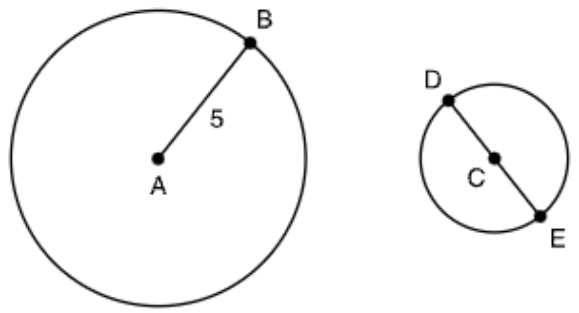
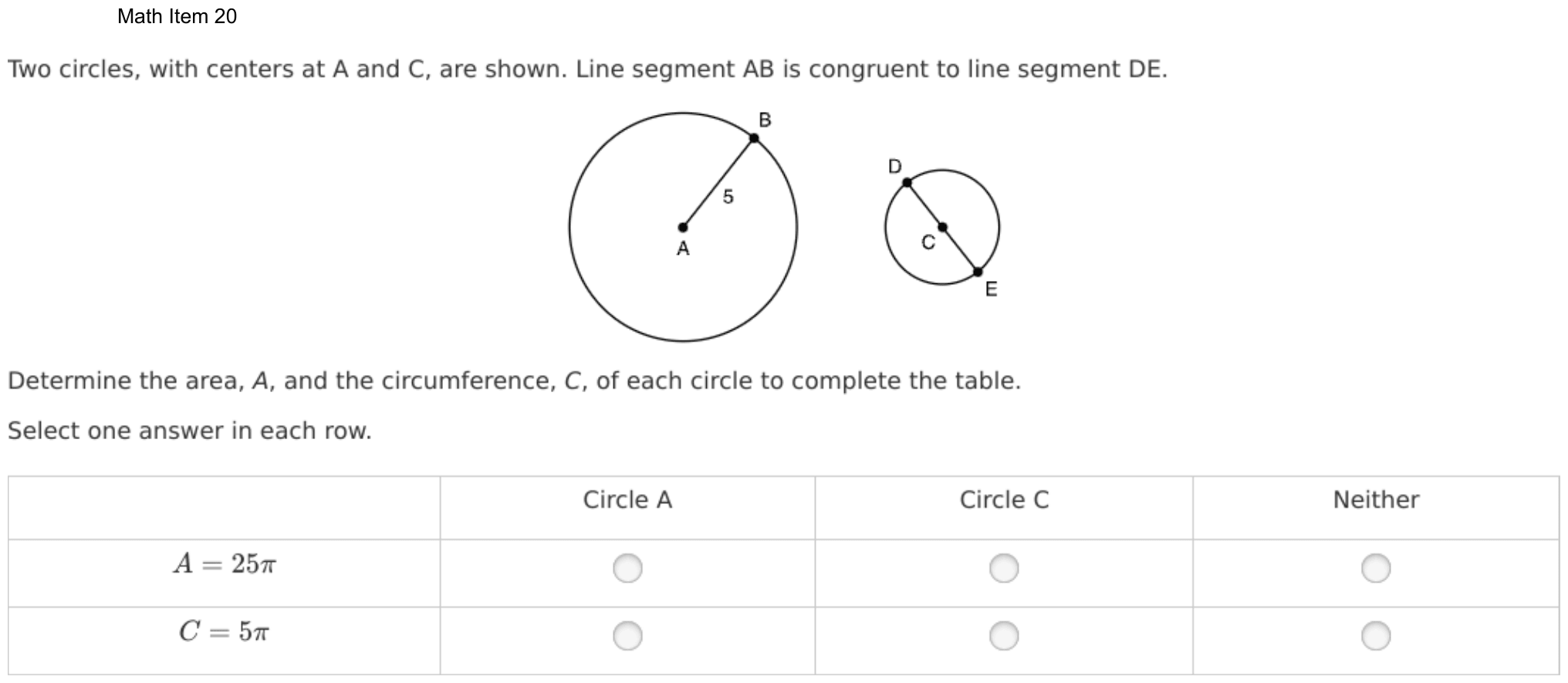
Two circles, with centers at A and C, are shown. Line segment AB is congruent to line segment DE.
Determine the area, A, and the circumference, C, of each circle to complete the table.
Select one answer in each row.
Choose one answer in each row, then check. The DOE has not published how answers with several parts are scored; this site counts one right only when every part is right.
| Circle A | Circle C | Neither | |
|---|---|---|---|
Show the answer
Correct answer: A = 25π: Circle A; C = 5π: Circle C
: Circle A
: Circle C
As shown in the illustration, AB (the radius of Circle A) is 5 units in length. Since DE (the diameter of Circle C) is congruent to AB, we know it is also 5 units in length.
Circle A:
We know the radius of Circle A is 5 so the answer to row 1 is A.
Circle C:
We have to look for the circle with a diameter of 5. That is circle C.
Question analysis
Two circles centered at A and C are shown: radius AB of Circle A is labeled 5, and segment DE, drawn through C, is congruent to AB. Students decide whether an area of 25π and a circumference of 5π each belong to Circle A, Circle C or neither. Keeping radius and diameter apart, and area and circumference, is the challenge.
- NYS standards
- 7.G.4 circle area and circumference
- Grade level
- Grade 7 content, by NYS standard
- Compared with grade 7
- At grade 7 Applying the area and circumference formulas is the grade 7 circle standard. This gives a radius for one circle and, for the other, a segment known only through congruence, and both rows of the table must be right.
- Estimated difficulty
- Moderate: several steps, or a close reading with one strong distractor.
- Thinking it demands
- Depth of knowledge 2, skills and concepts · mainly apply
- What makes it hard
- Reading a figure, table or graph moderate
- Something you must already know moderate
- Much to keep track of minor
- Solution
- 4 steps
- Reading level
- Question and choices: about grade 5, 40 words.
- Students, last 30 days
- Not enough answers yet to show (it takes 10).
Why it is hard, traps and wrong answers (shows the answer)
Why it is hard
Circle A is direct: its labeled radius of 5 gives an area of 25π. Circle C is where points are lost, since its size comes from a sentence rather than a label, and the segment through its center is a diameter, so its circumference is 5π while its area is only 6.25π. The row labels favor guessers, because the A and C in A = 25π and C = 5π match the circles' names, though they stand for area and circumference.
Reading a figure, table or graph moderate Understanding the question
Circle C's size is shown only by segment DE, drawn through center C with no label, and only the stem's sentence that DE is congruent to AB makes it a diameter of 5. (Lesh, Post & Behr, 1987; Kirsch & Mosenthal, 1990)
Something you must already know moderate Working it out
Neither A = πr² nor C = πd is given, and one circle is measured by a radius and the other by a diameter, so each formula needs the right length. (Anderson & Krathwohl, 2001)
Much to keep track of minor Working it out
Four values are in play, areas of 25π and 6.25π and circumferences of 10π and 5π, and both rows must be matched correctly for the item to count. (Sweller, 1988; Carpenter, Just & Shell, 1990)
Strategy: Write down the radius and the diameter of each circle, compute both circles' areas and circumferences in terms of π, then match each value in the table.
Traps
- Wrong formula: Uses a related but wrong formula: perimeter for area, diameter for radius, area for volume, or a misremembered one.
- Misreads the question: Misses or misreads a condition or a word in the question: "at least", "each", "remaining", "not".
- A formula you must know: Needs a formula the test does not give: area, circumference, volume, probability rules.
The wrong answers, classified
1:B Wrong formula (King et al., 2004)
Squares the diameter instead of the radius, so Circle C's area seems to be π × 5² = 25π while Circle A's becomes 100π.
1:C Wrong formula (King et al., 2004)
Uses 2πr for the area, so Circle A seems to have an area of 10π and Circle C one of 5π, and no circle seems to have 25π.
2:A Wrong formula (King et al., 2004)
Uses π times the radius for the circumference, so Circle A's radius of 5 seems to give a circumference of 5π.
2:C Misreads the question (Hegarty, Mayer & Monk, 1995)
Overlooks that DE is congruent to AB, so Circle C has no known size, and with Circle A's circumference at 10π picks Neither.
Worked solution, step by step
Formulas used
- Area of a circle
- A is the area, the space inside the circle. r is the radius, the distance from the center to the edge. π (pi) is a fixed number, a little more than 3. Square the radius, then multiply by π.
- Circumference of a circle
- C is the circumference, the distance around the circle. d is the diameter, the distance across the circle through its center. A diameter is twice as long as a radius. Multiply the diameter by π.
Sort out the question
Circle A has its center at A. Its radius, AB, is 5. Circle C has its center at C. Segment DE goes through C, so it is a diameter. Congruent means the same length, so DE is 5 too.
Careful: in the table, A means area and C means circumference. Circle A and Circle C are just names.
Find each radius and diameter
Circle A: the radius is 5, so the diameter is .
Circle C: the diameter is 5, so the radius is .
Watch out: without the sentence about DE, Circle C seems to have no size. Then you might pick Neither for the second row.
Check the area row
Use the area formula for each circle. For Circle A:
For Circle C:
Only Circle A has an area of 25π.
Watch out: squaring Circle C’s diameter instead of its radius gives 25π by mistake.
Check the circumference row
Use the circumference formula for each circle. For Circle A:
For Circle C:
Only Circle C has a circumference of 5π.
Watch out: π times the radius is not the circumference. It would give Circle A 5π.
Fill in the table
Choose one button in each row. In the row for A = 25π, choose the Circle A column. In the row for C = 5π, choose the Circle C column. Neither stays empty.
So the answers are A = 25π: Circle A and C = 5π: Circle C.
Check your answer
Compare sizes. Circle A’s radius, 5, is twice Circle C’s radius, 2.5. So the distance around Circle C should be half of Circle A’s 10π. Half of 10π is 5π, which matches. And the bigger circle has the bigger area, 25π.
More questions like this
The original DOE question
Question 3 of 3
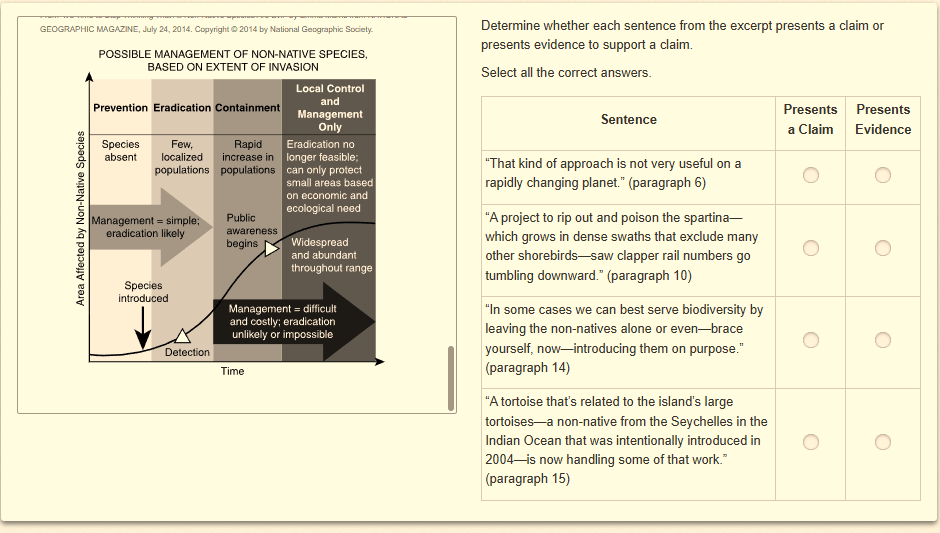
2025 Practice Test B English, question 8Passage Excerpt from “It’s Time to Stop Thinking That All Non-Native Species Are Evil”
Excerpt from “It’s Time to Stop Thinking That All Non-Native Species Are Evil”
by Emma Marris
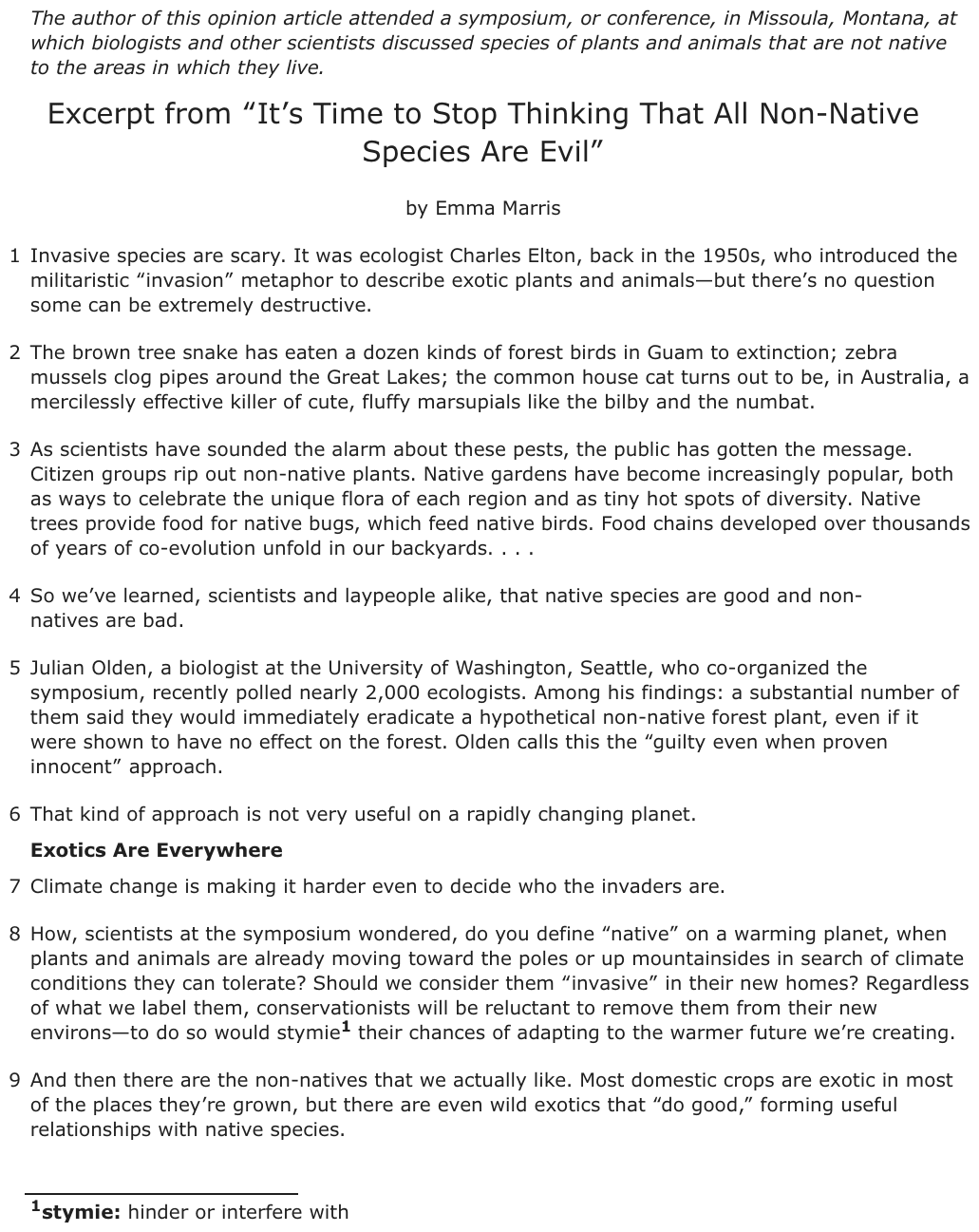
The author of this opinion article attended a symposium, or conference, in Missoula, Montana, at which biologists and other scientists discussed species of plants and animals that are not native to the areas in which they live.
Invasive species are scary. It was ecologist Charles Elton, back in the 1950s, who introduced the militaristic “invasion” metaphor to describe exotic plants and animals—but there’s no question some can be extremely destructive.
The brown tree snake has eaten a dozen kinds of forest birds in Guam to extinction; zebra mussels clog pipes around the Great Lakes; the common house cat turns out to be, in Australia, a mercilessly effective killer of cute, fluffy marsupials like the bilby and the numbat.
As scientists have sounded the alarm about these pests, the public has gotten the message. Citizen groups rip out non-native plants. Native gardens have become increasingly popular, both as ways to celebrate the unique flora of each region and as tiny hot spots of diversity. Native trees provide food for native bugs, which feed native birds. Food chains developed over thousands of years of co-evolution unfold in our backyards. . . .
So we’ve learned, scientists and laypeople alike, that native species are good and non-natives are bad.
Julian Olden, a biologist at the University of Washington, Seattle, who co-organized the symposium, recently polled nearly 2,000 ecologists. Among his findings: a substantial number of them said they would immediately eradicate a hypothetical non-native forest plant, even if it were shown to have no effect on the forest. Olden calls this the “guilty even when proven innocent” approach.
That kind of approach is not very useful on a rapidly changing planet.
Exotics Are Everywhere
Climate change is making it harder even to decide who the invaders are.
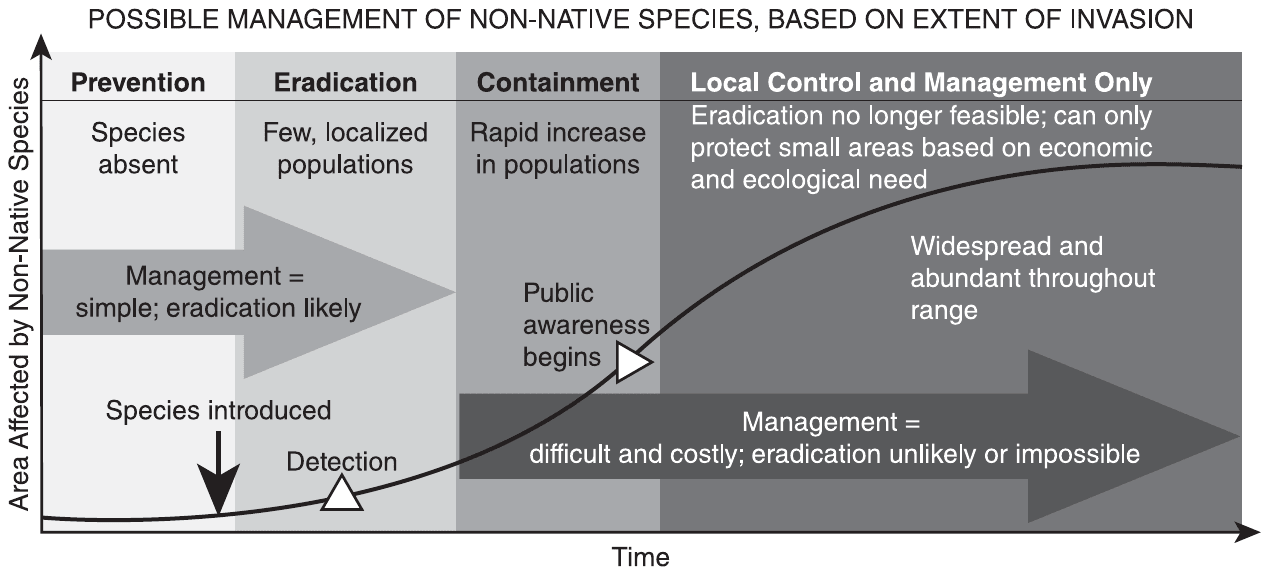
How, scientists at the symposium wondered, do you define “native” on a warming planet, when plants and animals are already moving toward the poles or up mountainsides in search of climate conditions they can tolerate? Should we consider them “invasive” in their new homes? Regardless of what we label them, conservationists will be reluctant to remove them from their new environs—to do so would stymie1 their chances of adapting to the warmer future we’re creating.
And then there are the non-natives that we actually like. Most domestic crops are exotic in most of the places they’re grown, but there are even wild exotics that “do good,” forming useful relationships with native species.
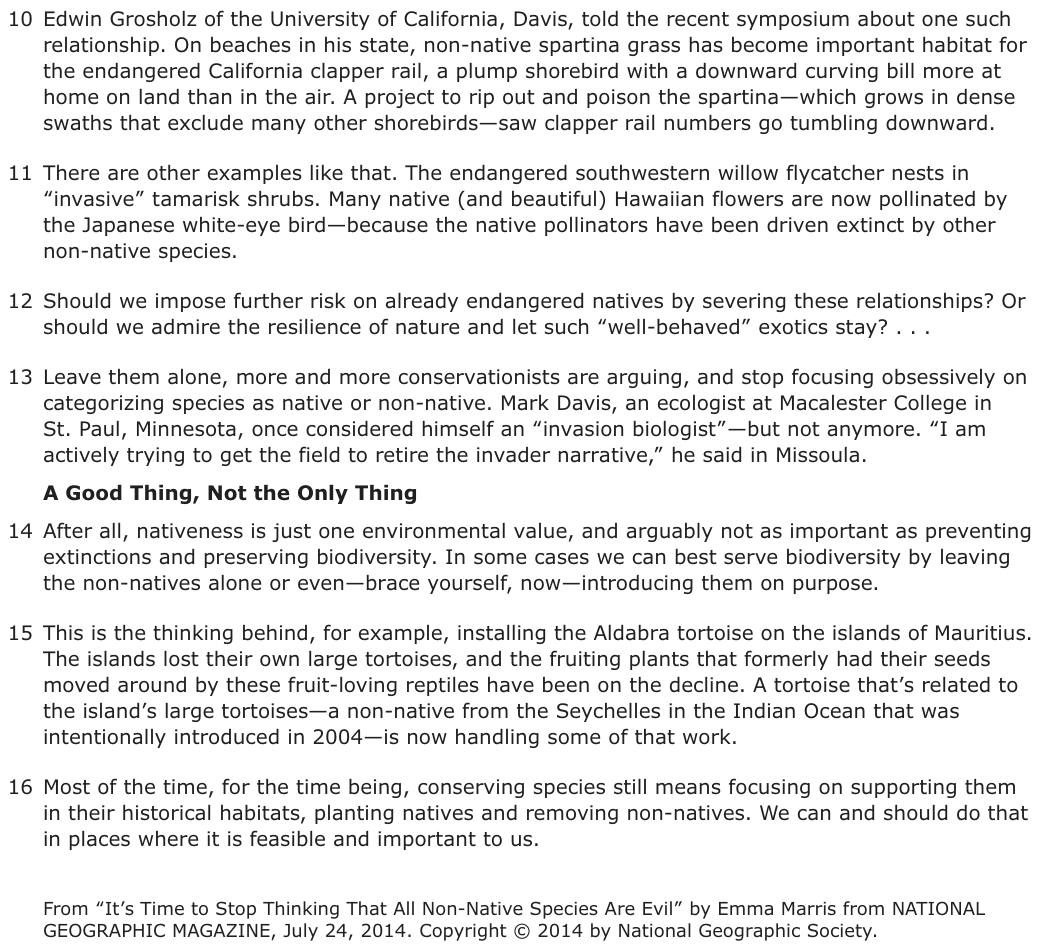
Edwin Grosholz of the University of California, Davis, told the recent symposium about one such relationship. On beaches in his state, non-native spartina grass has become important habitat for the endangered California clapper rail, a plump shorebird with a downward curving bill more at home on land than in the air. A project to rip out and poison the spartina—which grows in dense swaths that exclude many other shorebirds—saw clapper rail numbers go tumbling downward.
There are other examples like that. The endangered southwestern willow flycatcher nests in “invasive” tamarisk shrubs. Many native (and beautiful) Hawaiian flowers are now pollinated by the Japanese white-eye bird—because the native pollinators have been driven extinct by other non-native species.
Should we impose further risk on already endangered natives by severing these relationships? Or should we admire the resilience of nature and let such “well-behaved” exotics stay? . . .
Leave them alone, more and more conservationists are arguing, and stop focusing obsessively on categorizing species as native or non-native. Mark Davis, an ecologist at Macalester College in St. Paul, Minnesota, once considered himself an “invasion biologist”—but not anymore. “I am actively trying to get the field to retire the invader narrative,” he said in Missoula.
A Good Thing, Not the Only Thing
After all, nativeness is just one environmental value, and arguably not as important as preventing extinctions and preserving biodiversity. In some cases we can best serve biodiversity by leaving the non-natives alone or even—brace yourself, now—introducing them on purpose.
This is the thinking behind, for example, installing the Aldabra tortoise on the islands of Mauritius. The islands lost their own large tortoises, and the fruiting plants that formerly had their seeds moved around by these fruit-loving reptiles have been on the decline. A tortoise that’s related to the island’s large tortoises—a non-native from the Seychelles in the Indian Ocean that was intentionally introduced in 2004—is now handling some of that work.
Most of the time, for the time being, conserving species still means focusing on supporting them in their historical habitats, planting natives and removing non-natives. We can and should do that in places where it is feasible and important to us.
From “It’s Time to Stop Thinking That All Non-Native Species Are Evil” by Emma Marris from NATIONAL GEOGRAPHIC MAGAZINE, July 24, 2014. Copyright © 2014 by National Geographic Society.
1stymie: hinder or interfere with
Question
Determine whether each sentence from the excerpt presents a claim or presents evidence to support a claim.
Select all the correct answers.
Choose one answer in each row, then check. The DOE has not published how answers with several parts are scored; this site counts one right only when every part is right.
| Presents a Claim | Presents Evidence | |
|---|---|---|
| “That kind of approach is not very useful on a rapidly changing planet.” (paragraph 6) | ||
| “A project to rip out and poison the spartina—which grows in dense swaths that exclude many other shorebirds—saw clapper rail numbers go tumbling downward.” (paragraph 10) | ||
| “In some cases we can best serve biodiversity by leaving the non-natives alone or even—brace yourself, now—introducing them on purpose.” (paragraph 14) | ||
| “A tortoise that’s related to the island’s large tortoises—a non-native from the Seychelles in the Indian Ocean that was intentionally introduced in 2004—is now handling some of that work.” (paragraph 15) |
Show the answer
Correct answer: “That kind of approach is not very useful on a rapidly changing planet.” (paragraph 6): Presents a Claim; “A project to rip out and poison the spartina—which grows in dense swaths that exclude many other shorebirds—saw clapper rail numbers go tumbling downward.” (paragraph 10): Presents Evidence; “In some cases we can best serve biodiversity by leaving the non-natives alone or even—brace yourself, now—introducing them on purpose.” (paragraph 14): Presents a Claim; “A tortoise that’s related to the island’s large tortoises—a non-native from the Seychelles in the Indian Ocean that was intentionally introduced in 2004—is now handling some of that work.” (paragraph 15): Presents Evidence
The question asks which quotations from the excerpt present a claim and which present evidence in support of a claim. (A claim is a statement made as part of an argument that can be supported or proved with evidence. Supporting evidence can include facts, figures, details, quotations, or other sources of data and information that can be evaluated by others.)
Row 1: Presents a claim [“That kind of approach is not very useful on a rapidly changing planet.” (paragraph 6)]. The phrase “is not very useful” indicates that the sentence expresses a claim—an arguable statement, or in this case an opinion, for which the author must provide proof.
Row 2: Presents evidence [“A project to rip out and poison the spartina—which grows in dense swaths that exclude many other shorebirds—saw clapper rail numbers go tumbling downward.” (paragraph 10)]. Despite its figurative language (“tumbling downward”), this sentence does not present a claim that must be supported by evidence. Instead, the sentence provides factual information—that numbers of clapper rail birds decreased when spartina grass was removed—that is evidence for another claim, that non-native plants can be welcome sometimes.
Row 3: Presents a claim [“In some cases we can best serve biodiversity by leaving the non-natives alone or even—brace yourself, now—introducing them on purpose.” (paragraph 14)]. The wording “we can best serve” signals that this sentence presents a claim—a statement being made as part of an argument that needs proof in order to be accepted—regarding the best way to achieve biodiversity.
Row 4: Presents evidence [“A tortoise that’s related to the island’s large tortoises—a non-native from the Seychelles in the Indian Ocean that was intentionally introduced in 2004—is now handling some of that work.” (paragraph 15)]. Although this sentence does not provide statistics, quotations, or other obvious markers that signal evidence, it does provide a factual example—non-native tortoises are now moving the seeds of fruiting plants in a way that preserves the diversity of plant life on the islands of Mauritius—that is used to support the author’s claim that non-native species can help preserve diversity.
Question analysis
This table-grid question on the opinion article about non-native species gives four sentences, from paragraphs 6, 10, 14 and 15, and asks whether each presents a claim or presents evidence to support a claim. Students make four separate decisions, and credit comes only when every row is right, so each sentence must be judged by the job it does in the author’s argument.
- Grade level
- Grade 7 reading and task
- Compared with grade 7
- At grade 7 Telling a claim from the evidence for it is core grade 7 argument work. The four sentences come labeled with their paragraphs, but they are long and broken by dashes and asides, and all four must be sorted correctly, a typical demand overall.
- Estimated difficulty
- Moderate: several steps, or a close reading with one strong distractor.
- Thinking it demands
- Depth of knowledge 2, skills and concepts · mainly analyze
- What makes it hard
- Much to keep track of moderate
- How, not what minor
- Complex sentences minor
- Figurative or literary language minor
- Evidence
- Answered from several paragraphs or stanzas
- Reading level
- Passage: about grade 11, 815 words; question and choices: about grade 8, 22 words.
- Students, last 30 days
- Not enough answers yet to show (it takes 10).
Why it is hard, traps and wrong answers (shows the answer)
Why it is hard
The two claims carry the author’s judgment in a few words, “not very useful” and “we can best serve,” while the two evidence rows report what happened. Students go wrong when they sort by surface: dramatic wording makes the spartina report sound like opinion, and the tortoise sentence, with no number or quotation, can pass for the author’s assertion. Asking whether a sentence judges or reports settles each row, but all four must be right for credit.
Much to keep track of moderate Working it out
Sentences from paragraphs 6, 10, 14 and 15 are judged one at a time, and the question is scored right only when all four rows are, so one doubtful row costs the point. (Sweller, 1988; Carpenter, Just & Shell, 1990)
How, not what minor Working it out
Each row asks what a sentence does in the argument, not what it is about: rows 3 and 4 both concern bringing in non-natives on purpose, but one argues for it and one reports it. (Anderson & Krathwohl, 2001)
Complex sentences minor Understanding the question
In the two evidence rows, 17 and 22 words separate the subject from its verb, “A project … saw” and “A tortoise … is now handling,” most of them inside dashes. (Abedi & Lord, 2001; Freedle & Kostin, 1993; Messick, 1989)
Figurative or literary language minor Understanding the question
Row 2 reports a result in vivid words, a project to “rip out and poison” the grass and clapper rail numbers that “go tumbling downward,” so a report can sound like an opinion. (Graesser, Singer & Trabasso, 1994; Kintsch, 1998)
Strategy: For each sentence, ask whether it states a judgment the author must argue for or reports something that happened or was found, and sort it by that test alone.
Traps
- Wrong purpose or structure: Names a purpose, structure or effect that the part does not serve, or describes what a part says when the question asks what it does.
- Wrong tone or attitude: Misjudges the tone, attitude or point of view, such as reading admiration as criticism, or taking a character's or subject's feelings for the author's.
The wrong answers, classified
1:B Wrong purpose or structure (Anderson & Krathwohl, 2001)
Takes “a rapidly changing planet” as plain fact, the climate change the next section describes, and misses that “not very useful” is the author’s own verdict on the approach Olden describes.
2:A Wrong tone or attitude (Graesser, Singer & Trabasso, 1994)
Hears opinion in the vivid “rip out and poison” and “go tumbling downward,” though the sentence reports what happened to clapper rail numbers once a project removed the spartina.
3:B Wrong purpose or structure (Anderson & Krathwohl, 2001)
Sees that the sentence backs the case for leaving non-natives alone and so calls it support, missing that “we can best serve” is itself a claim, which the tortoise example then backs.
4:A Wrong purpose or structure (Anderson & Krathwohl, 2001)
Expects evidence to come as numbers, studies or quotations, so takes the plain report that a tortoise brought in during 2004 “is now handling some of that work” as an assertion.
Working it out, step by step
Figure out what the question asks
Decide the job each of the four sentences does in the argument. A claim is a statement the author wants you to accept, such as an opinion or a judgment. People could disagree with it, so it needs support. Evidence is a fact, an example or an event that backs up a claim. Ask: does the sentence judge, or does it report what happened?
Sort the sentence from paragraph 6
Row 1 says “That kind of approach is not very useful on a rapidly changing planet.” The approach is the one in paragraph 5. There, many ecologists said they would wipe out a non-native plant even if it had no effect on the forest. The words “not very useful” are the author’s judgment. Someone could disagree, so the article has to argue for it. This sentence presents a claim.
Watch out: “A rapidly changing planet” sounds like a fact. But the point of the sentence is the judgment about the approach.
Sort the sentence from paragraph 10
Row 2 is long, so set aside the part between the dashes. What is left says “A project to rip out and poison the spartina” saw clapper rail numbers fall. Spartina is a grass that is not native to California. The clapper rail is an endangered shorebird that lives in it. So the sentence reports what happened: the grass was removed, and the birds declined. It backs the claim in paragraph 9 that some non-natives “do good.” This row presents evidence.
Watch out: Vivid words like “go tumbling downward” can sound like an opinion. But they only mean the numbers fell fast. Strong wording does not turn a report into a claim.
Sort the sentence from paragraph 14
Row 3 says “In some cases we can best serve biodiversity by leaving the non-natives alone or even—brace yourself, now—introducing them on purpose.” Biodiversity is the variety of living things in a place. The words “we can best serve” show the author’s judgment about what is best. “Brace yourself” shows she expects you to be surprised. A surprising idea needs proof. This sentence presents a claim.
Sort the sentence from paragraph 15
Row 4 also has a long part between dashes. Without it, the sentence says “A tortoise that’s related to the island’s large tortoises” is “now handling some of that work.” The sentence before explains the work. The islands lost their own large tortoises, which used to spread the seeds of fruiting plants. Now a non-native tortoise, brought in on purpose in 2004, does part of that job. It is a real example. It backs row 3’s claim. This row presents evidence.
Watch out: Evidence does not need numbers or quotations. An example of what happened counts.
Fill in the table
- Row 1 (paragraph 6): Presents a Claim
- Row 2 (paragraph 10): Presents Evidence
- Row 3 (paragraph 14): Presents a Claim
- Row 4 (paragraph 15): Presents Evidence
On the test and on this site, click one circle in each row. All four rows must be right to get the point.
Why this answer and not the closest wrong one
Row 2 is the hardest. “Rip out and poison” and “tumbling downward” sound strong, like an opinion. But the sentence reports a project and its result: the bird numbers fell. Nobody judges what is best. So it is evidence for the claim that some non-natives “do good.”
More questions like this
The original DOE question
The passage “Excerpt from “It’s Time to Stop Thinking That All Non-Native Species Are Evil”” as printed (pages 68–70)