Equation editor
Question 1 of 10
2026 Practice Test A Math, question 32Question
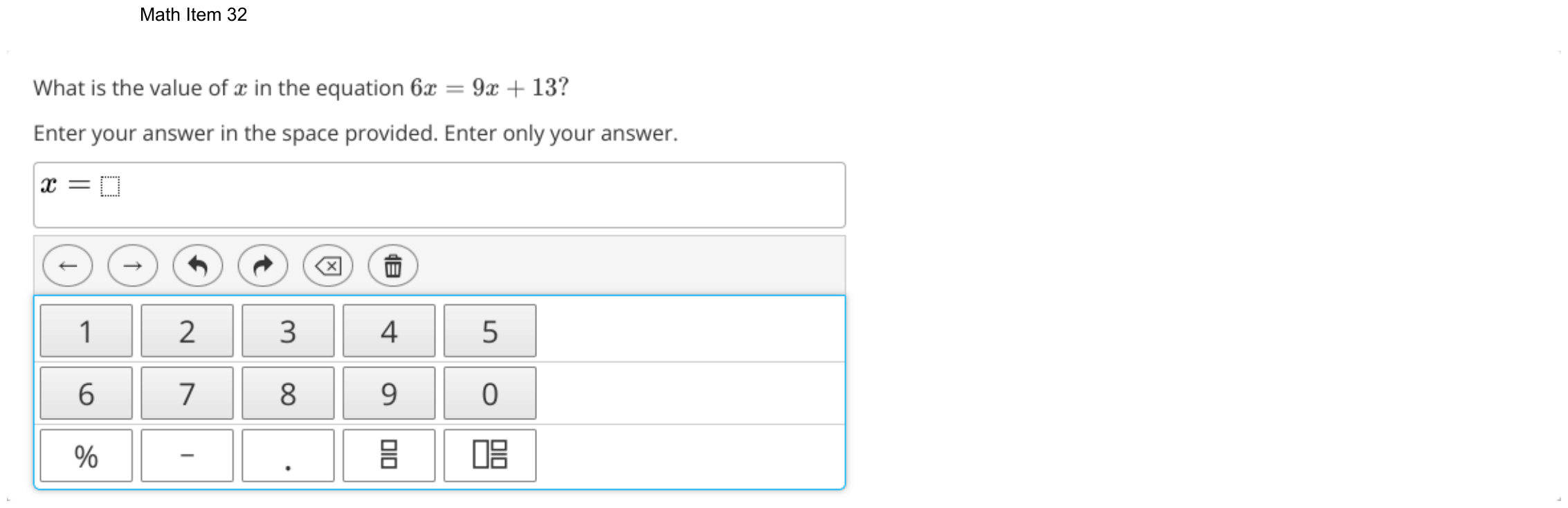
What is the value of x in the equation ?
Enter your answer in the space provided. Enter only your answer.
On the test you build the answer on an on-screen keypad; here, type it. Use ^ for a power, sqrt( ) or √ for a root, pi for π, and <= or >= for ≤ and ≥.
Show the answer
Correct answer: x = -13/3
Solution:
Start with .
Subtract from both sides to move all terms involving x to one side.
Combine like terms.
Divide both sides by −3 to solve for x.
Question analysis
This equation question asks for the value of x when 6x equals 9x plus 13, typed into a box after "x =". Students solve a linear equation with the variable on both sides by gathering the x terms and dividing. With no answer choices to check against, keeping the sign of each moved term is the main challenge.
- Grade level
- Grade 8 content, by NYS standard
- Compared with grade 7
- At grade 7 The variable appears on both sides, a grade 8 topic, yet collecting it takes one subtraction and one division, much like a grade 7 two-step equation. The typed answer, with no choices to compare, adds some risk.
- Estimated difficulty
- Straightforward: two steps or one careful reading.
- Thinking it demands
- Depth of knowledge 1, recall and reproduction · mainly apply
- What makes it hard
- Error-prone arithmetic moderate
- An answer in an unexpected form minor
- Solution
- 2 steps
- Reading level
- Question and choices: about grade 5, 21 words.
- Students, last 30 days
- Not enough answers yet to show (it takes 10).
Why it is hard, traps and wrong answers (shows the answer)
Why it is hard
Two moves solve the equation, so the method is not in doubt; the points are lost in the result. Subtracting 6x instead, which gives 0 = 3x + 13, works as well but moves the sign onto the 13, and either route ends in a division that must keep the negative. The answer is not a whole number, which unsettles students who expect one, and a switch to decimals leads to a rounded entry that is not exact.
Error-prone arithmetic moderate Working it out
Collecting the x terms gives 6x − 9x = −3x, a negative coefficient, and 13 ÷ (−3) is a negative fraction that does not come out whole, so both the sign and the fraction must survive. (Brown & Burton, 1978; Junker & Sijtsma, 2001)
An answer in an unexpected form minor Choosing the answer
The answer is typed after the printed x =, with no choices to compare, and its decimal form, −4.333…, repeats forever, so only a fraction or mixed number is exact. (Enright, Morley & Sheehan, 2002)
Strategy: Subtract 9x from both sides so that x appears once, divide both sides by the coefficient left on x, and check by substituting the result into both sides of the original equation.
Traps
- Negatives and direction: Arithmetic with negative numbers, the order of a subtraction, or direction on a number line. (Moving a term across the equals sign without changing its sign is a faulty procedure.)
- Wrong operation: Adds instead of multiplying, divides the wrong way round, turns a ratio or rate upside down, or undoes a step in the wrong direction (subtracts what should be added back).
- Rounds too early: Rounds a value partway through, or rounds the wrong way, so the final answer drifts from the exact one.
The wrong answers, classified
13/3 Negatives and direction (Brown & Burton, 1978)
Reaches −3x = 13 correctly but drops the negative when dividing 13 by −3, entering a positive 13/3.
-4.33 Rounds too early (King et al., 2004)
Solves correctly but turns −13/3 into a decimal and rounds it to −4.33, which is close to the exact value but not equal to it.
-3/13 Wrong operation (Hegarty, Mayer & Monk, 1995; King et al., 2004)
Gets to −3x = 13 but divides the wrong way round, putting the coefficient −3 over the constant 13 instead of 13 over −3.
Worked solution, step by step
Formulas used
- Doing the same to both sides
- a and b are the two sides of an equation, and c is any number or term (not zero when you divide). Taking the same thing away from both sides, or dividing both by the same number, keeps the sides equal. That is how you get x by itself.
- Dividing by a negative number
- a and b are positive numbers, so −b is negative. A positive number divided by a negative number is negative. You can write the minus sign in front of the whole fraction.
- Changing a fraction to a mixed number
- Use this when the top of a fraction is bigger than the bottom. Divide a by b. q is the number of whole times b fits into a. r is the remainder, what is left over. The remainder goes on top of the leftover fraction.
Sort out the question
You need the value of x that makes true. The letter x appears on both sides, so first gather the x terms on one side. There are no choices to check against, so work carefully.
Move the x terms to one side
Subtract 9x from both sides. This clears the x term off the right side:
Since 6 − 9 = −3, the left side is −3 times x.
Divide both sides by −3
x is multiplied by −3, so divide both sides by −3:
A positive divided by a negative is negative, so x is negative.
Watch out: dropping the minus sign gives 13/3, which is wrong. Also, the number you divide by goes on the bottom. Writing −3/13 turns the fraction upside down.
Write it as a mixed number
A mixed number is a whole number with a fraction, like 4 1/3. Divide 13 by 3. The 3 fits 4 times, with 1 left over.
So .
Watch out: as a decimal, −13/3 is −4.333…, and the 3s never end. Rounding to −4.33 is close, but it is not exact. Keep the fraction.
Enter the answer
The box already shows x =, so you enter only the number. On the test, press the minus key first. Then press the fraction key, a small box over a small box. Type 13 in the top box and 3 in the bottom box. On this site, type −13/3 or −4 1/3.
So the finished answer reads x = −13/3. You type only the −13/3, which is the same as −4 1/3.
Check your answer
Put into both sides. The left side is . The right side is . Both sides equal −26, so the answer is right.
More questions like this
The original DOE question
Question 2 of 10
2026 Practice Test A Math, question 50Question
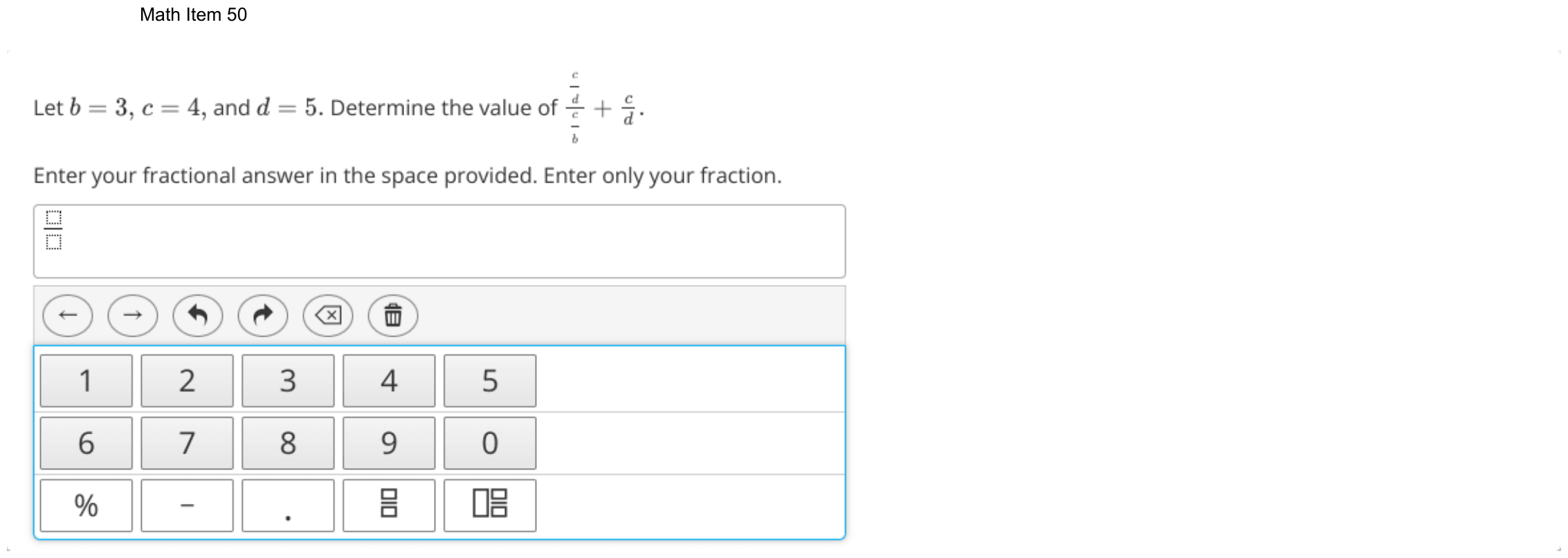
Let , , and . Determine the value of .
Enter your fractional answer in the space provided. Enter only your fraction.
On the test you build the answer on an on-screen keypad; here, type it. Use ^ for a power, sqrt( ) or √ for a root, pi for π, and <= or >= for ≤ and ≥.
Show the answer
Correct answer: 7/5
Solution:
Substitute , , and in : .
Then simplify the complex fraction by multiplying the complex fraction by a form of 1, : .
Simplify after multiplying by a form of 1: .
Then simplify again and add the two fractions: .
Question analysis
This substitution question gives values for b, c and d and asks for the value of an expression made of a fraction divided by a fraction, plus another fraction. Students substitute, simplify the complex fraction and add, then type the result. Dividing fractions in the stacked form is the main hurdle, and the item wants a fraction, not a decimal.
- NYS standards
- Grade level
- Grade 7 content, by NYS standard
- Compared with grade 7
- At grade 7 Grade 7 students evaluate expressions and divide and add fractions. A fraction stacked over another fraction looks unfamiliar and there are no choices to check, but with these values the work is three short steps.
- Estimated difficulty
- Moderate: several steps, or a close reading with one strong distractor.
- Thinking it demands
- Depth of knowledge 1, recall and reproduction · mainly apply
- What makes it hard
- Error-prone arithmetic moderate
- Something you must already know minor
- An answer in an unexpected form minor
- Solution
- 3 steps
- Reading level
- Question and choices: about grade 9, 22 words.
- Students, last 30 days
- Not enough answers yet to show (it takes 10).
Why it is hard, traps and wrong answers (shows the answer)
Why it is hard
Once the values are in, the work is one fraction division and one addition, but the division is printed as a fraction over a fraction, in small type. Multiplying the two fractions, or flipping the top one, gives a sum in fifteenths that looks as finished as the right one. Noticing that the 4s cancel, so the stacked part is simply 3/5, turns the last step into adding fifths.
Error-prone arithmetic moderate Working it out
Dividing 4/5 by 4/3 means multiplying by 3/4, giving 3/5, which is then added to 4/5; multiplying straight across or flipping the top fraction instead both lead to fifteenths. (Brown & Burton, 1978; Junker & Sijtsma, 2001)
Something you must already know minor Working it out
Nothing on the page says that a fraction over a fraction is a division, or that dividing by 4/3 means multiplying by its reciprocal, and the stacked form is rare in grade 7 work. (Anderson & Krathwohl, 2001)
An answer in an unexpected form minor Choosing the answer
The value is typed into a fraction box with no choices to check against, and the item asks for a fraction, so the equal decimal 1.4 is not accepted. (Enright, Morley & Sheehan, 2002)
Strategy: Substitute the values, rewrite the stacked fraction as the top fraction times the reciprocal of the bottom one, where the 4s cancel, then add the last fraction and leave the result as a fraction.
Traps
- Wrong operation: Adds instead of multiplying, divides the wrong way round, turns a ratio or rate upside down, or undoes a step in the wrong direction (subtracts what should be added back).
- A faulty procedure: A systematic but wrong procedure: adding fractions straight across, applying an exponent to each term of a sum, dropping a sign when moving a term.
- Misreads the question: Misses or misreads a condition or a word in the question: "at least", "each", "remaining", "not".
The wrong answers, classified
28/15 Wrong operation (Hegarty, Mayer & Monk, 1995; King et al., 2004)
Multiplies 4/5 by 4/3 instead of dividing, getting 16/15, then adds 4/5, or 12/15, to reach 28/15.
37/15 A faulty procedure (Brown & Burton, 1978; Tatsuoka, 1983)
Flips the top fraction instead of the bottom one, so the stacked part becomes 5/4 × 4/3 = 5/3, and 5/3 + 4/5 = 37/15.
1.4 Misreads the question (Hegarty, Mayer & Monk, 1995)
Finds the right value but works in decimals, 0.6 + 0.8 = 1.4, and enters that, though the item asks for a fraction.
Worked solution, step by step
Formulas used
- Dividing fractions
- a, b, c and d are numbers that are not zero. To divide by a fraction, multiply by its reciprocal, the fraction flipped upside down. Flip only the fraction you divide by. It works because a fraction times its reciprocal is 1, so the reciprocal undoes the fraction, just as dividing does.
- Adding fractions with the same bottom
- d is the denominator, the bottom number, which tells the size of each piece. a and b are the numerators, the top numbers, which count the pieces. When the pieces are the same size, add the tops and keep the bottom.
Sort out the question
You know , and . You need the value of:
The first part is a fraction on top of a fraction. A fraction bar means divide, so this part is . The answer must be typed as a fraction.
Put in the numbers
Replace each letter with its value. Look closely: the bottom fraction has b under the c, not d.
So the expression becomes:
Divide the two fractions
Use the rule for dividing fractions. The reciprocal of 4/3 is 3/4. To multiply fractions, multiply the tops and multiply the bottoms:
To simplify 12/20, divide its top and bottom by 4.
Watch out: flip only the bottom fraction. Multiplying without flipping gives 16/15 and a total of 28/15. Flipping the top one gives 5/3 and a total of 37/15.
Add the last fraction
Both fractions are now fifths, so add the tops and keep the bottom:
The value is 7/5.
Enter it as a fraction
The item asks for a fraction. 7/5 equals the decimal 1.4, but 1.4 is not accepted. On the test, the answer box already holds a fraction template, a small box over a small box. Type 7 in the top box. Then click the bottom box and type 5. On this site, type 7/5.
So you would enter 7/5.
Check your answer
Check with decimals. , and 4/3 is about 1.33. Then is about 0.6, which is 3/5. Last, , and 1.4 is the same as 7/5.
More questions like this
The original DOE question
Question 3 of 10
2026 Practice Test B Math, question 28Question
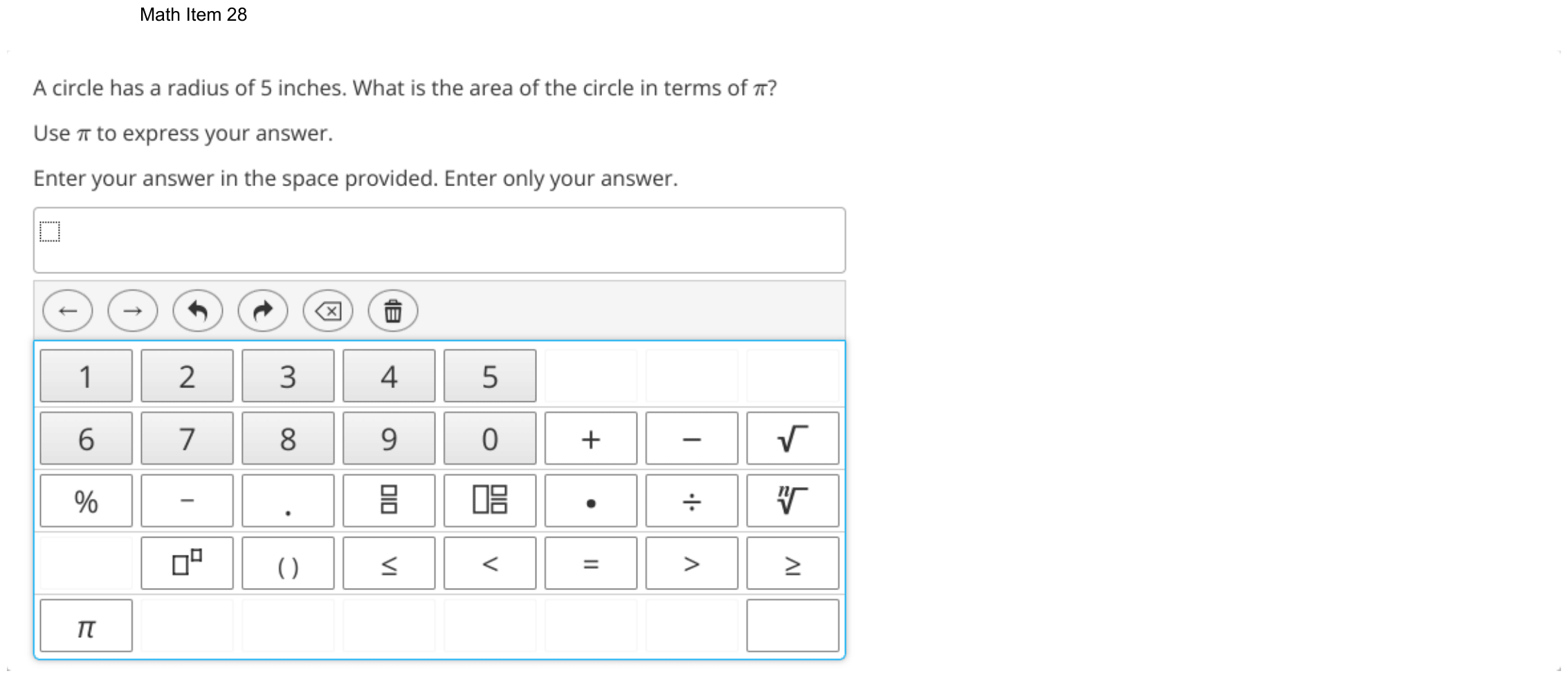
A circle has a radius of 5 inches. What is the area of the circle in terms of ?
Use to express your answer.
Enter your answer in the space provided. Enter only your answer.
On the test you build the answer on an on-screen keypad; here, type it. Use ^ for a power, sqrt( ) or √ for a root, pi for π, and <= or >= for ≤ and ≥.
Show the answer
Correct answer: 25π
Solution:
The area of a circle is its radius squared times .
Question analysis
This circle question gives a radius of 5 inches and asks for the area in terms of π, typed into a box rather than chosen. Students recall and apply the formula for the area of a circle. The formula is not printed on the test, and the area and circumference formulas are easy to mix up.
- NYS standards
- 7.G.4 circle area and circumference
- Grade level
- Grade 7 content, by NYS standard
- Compared with grade 7
- At grade 7 Finding the area of a circle from its radius is the grade 7 circle standard applied directly, in one routine calculation. Typing the answer in terms of π, with no choices to compare, adds a little risk.
- Estimated difficulty
- Straightforward: two steps or one careful reading.
- Thinking it demands
- Depth of knowledge 1, recall and reproduction · mainly apply
- What makes it hard
- Solution
- 2 steps
- Reading level
- Question and choices: about grade 4, 35 words.
- Students, last 30 days
- Not enough answers yet to show (it takes 10).
Why it is hard, traps and wrong answers (shows the answer)
Why it is hard
This is one formula and one square, so the question comes down to recall and to the form of the answer. The area and circumference formulas both pair π with the radius, and 2πr gives a tidy value with π in it that looks just as right. The other losses are about form: replacing π with 3.14, which the instructions rule out twice, or dropping π after squaring 5.
Something you must already know moderate Working it out
The formula A = πr² is not printed with the question, and the circumference formula 2πr uses the same r and π, so recalling the wrong one gives a value that looks just as finished. (Anderson & Krathwohl, 2001)
An answer in an unexpected form minor Choosing the answer
The answer is built on a keypad with a π key and must keep π as a symbol; a decimal worked out with 3.14 is not accepted, and no choices show the expected form. (Enright, Morley & Sheehan, 2002)
Strategy: Recall the area formula rather than the circumference formula, square the radius before multiplying, and leave π as a symbol instead of replacing it with 3.14.
Traps
- Wrong formula: Uses a related but wrong formula: perimeter for area, diameter for radius, area for volume, or a misremembered one.
- A formula you must know: Needs a formula the test does not give: area, circumference, volume, probability rules.
- Misreads the question: Misses or misreads a condition or a word in the question: "at least", "each", "remaining", "not".
The wrong answers, classified
10π Wrong formula (King et al., 2004)
Uses the circumference formula 2πr, or doubles the radius instead of squaring it, so 2 × 5 gives 10π, the distance around the circle.
78.5 Misreads the question (Hegarty, Mayer & Monk, 1995)
Finds the area correctly but replaces π with 3.14, 25 × 3.14 = 78.5, though the question asks for the area in terms of π.
25 Stops one step early (King et al., 2004; Gierl et al., 2017)
Squares the radius, 5 × 5 = 25, and stops before multiplying by π, so the entry leaves out the π the instructions ask for.
Worked solution, step by step
Formulas used
- Area of a circle
- A is the area, the space inside the circle. r is the radius, the distance from the center to the edge. π (pi) is a fixed number, a little more than 3. r² means r times r. Square the radius first, then multiply by π. The area is in square units.
- Circumference of a circle
- C is the circumference, the distance around the circle. r is the radius, and π is the same number as above. This formula measures a length, not the space inside. It is here so you can tell the two formulas apart.
Sort out the question
The circle has a radius of 5 inches. The radius is the distance from the center to the edge. You need the area, the space inside the circle. In terms of π means π stays in the answer as a symbol. Do not change it to 3.14.
Choose the area formula
The area formula is . It uses the radius squared.
Watch out: the circumference formula, , also uses π and the radius. It gives , the distance around the circle in inches. That is not the area.
Square the radius
Squaring a number means multiplying it by itself:
Watch out: squaring is not doubling. would lead to 10π again.
Multiply by π
Put 25 into the formula in place of r²:
The area is 25π square inches. Write the number first and then π, the way you write 3x for 3 times x.
Watch out: leave π as π. Using 3.14 gives 78.5, which is not accepted. Dropping π leaves 25, which is not the area.
Enter it with the π key
On the test, the keypad has a π key in its bottom left corner. Press 2, then 5, then the π key. You do not need a times sign. Enter only the answer, with no A = and no units. On this site, type 25π or 25pi.
So you would enter 25π.
Check your answer
Estimate. π is a little more than 3, so 25π is a little more than 75 square inches. A square drawn around the circle is 10 inches on each side, so its area is 100 square inches. The circle fits inside that square, so its area must be less than 100. It is.
More questions like this
The original DOE question
Question 4 of 10
2026 Practice Test B Math, question 46Question
Amiya subscribes to an online streaming service. She pays a onetime setup fee of $50, plus $20 per month for service.
Write an equation that can be used to determine the total amount Amiya will pay, y, for x months of service.
Enter your equation in the space provided. Enter only the equation.
On the test you build the answer on an on-screen keypad; here, type it. Use ^ for a power, sqrt( ) or √ for a root, pi for π, and <= or >= for ≤ and ≥.
Show the answer
Correct answer: y = 20x + 50
Solution:
An equation of the form can be used to represent the total amount Amiya will pay.
Using the information from the scenario, the onetime setup fee of $50 is the constant term (q), and the $20 per month of service is the coefficient (p) of the number of months (x).
So, the equation that can be used to determine the total amount Amiya will pay, y, for x months of service is .
Question analysis
Amiya pays a one-time setup fee plus a monthly charge for a streaming service, and students type an equation for her total cost y after x months. It tests writing a linear equation from a word problem with a starting amount and a rate. The two dollar amounts play different roles, so which one goes with x has to be thought through.
- NYS standards
- Grade level
- Grade 7 content, by NYS standard
- Compared with grade 7
- At grade 7 Writing an equation for a fixed fee plus a steady monthly charge is a familiar grade 7 task, and the numbers are whole. Typing the full equation, with both variables and no choices to compare, makes it less forgiving.
- Estimated difficulty
- Straightforward: two steps or one careful reading.
- Thinking it demands
- Depth of knowledge 2, skills and concepts · mainly apply
- What makes it hard
- Turning words into math moderate
- An answer in an unexpected form minor
- Solution
- 2 steps
- Reading level
- Question and choices: about grade 6, 51 words.
- Students, last 30 days
- Not enough answers yet to show (it takes 10).
Why it is hard, traps and wrong answers (shows the answer)
Why it is hard
The numbers are small and whole, so the work is in the roles. The $50 is paid once and the $20 every month, and a student who places them in the order they appear writes the fee as the monthly rate; others leave the fee out entirely. Checking the equation at x = 1 and x = 2, where Amiya has paid $70 and then $90, shows at once whether each amount is in the right place.
Turning words into math moderate Understanding the question
Only the words “onetime setup fee” and “per month” tell which amount is multiplied by x and which is added once, and the $50 comes first in the sentence. (Hegarty, Mayer & Monk, 1995; Koedinger & Nathan, 2004)
An answer in an unexpected form minor Choosing the answer
The whole equation, with y, an equals sign and x, is built on a keypad with no choices, so a reversed or incomplete equation looks as finished as the right one. (Enright, Morley & Sheehan, 2002)
Strategy: Work out Amiya's total for 1 month and for 2 months by hand, see which amount is added again each month, and build an equation that gives both totals.
Traps
- Misunderstands the concept: A wrong belief about a concept: that percents can be added, that area grows like length, that averages can be averaged, that a bigger denominator means a bigger fraction.
- Stops one step early: A choice is a number from partway through the solution.
- Numbers taken from the question: Combines the numbers in the question without a model of the situation, or is simply a number that appears in the question.
The wrong answers, classified
y = 20x Stops one step early (King et al., 2004; Gierl et al., 2017)
Multiplies the $20 monthly charge by x months but never adds the one-time $50 setup fee, so the equation gives only the cost of service.
y = 50x + 20 Misunderstands the concept (Smith, diSessa & Roschelle, 1993; De Bock et al., 1998; Ni & Zhou, 2005)
Attaches x to the $50 fee and adds the $20 once, putting the numbers into y = mx + b in the order they appear rather than by which one repeats.
y = 70x Numbers taken from the question (Hegarty, Mayer & Monk, 1995)
Adds the $50 fee and the $20 charge into $70 and multiplies by the months, which would charge the setup fee again every month.
Worked solution, step by step
Formulas used
- Total cost with a fee and a rate
- y is the total cost in dollars, and x is the number of months. The rate is the amount paid every month. You multiply it by x because it is paid once for each month. The fee is paid only once, so you add it once, no matter how many months.
Sort out the question
Amiya pays two kinds of charges:
- a setup fee of $50, paid one time only;
- a charge of $20 for every month of service.
y is her total cost in dollars, and x is the number of months. You need an equation that links them. The answer is an equation, not a number.
Work out a few totals
Find the total for a few months by hand. Each month adds one more $20:
Months Monthly charges ($) Total ($) 1 2 3 The $50 shows up once in every total. The $20 shows up once for each month.
Match each number to its job
Use the fee-and-rate model, . The rate is the amount that repeats each month, $20. It multiplies the months, so it becomes 20x. The fee, $50, is paid once, so it is added once.
Watch out: the $50 comes first in the question, but it is not the rate. charges $50 a month. charges the fee every month. forgets the fee.
Write the equation
Put the rate and the fee into the model:
Here 20x means 20 times x. An equal form is fine too, such as , because you can add in either order.
Enter it on the keypad
Type the whole equation, including y =. Without it, you have an expression, not an equation. On the test, the keypad has x, y and = keys. Press y, =, 2, 0, x, +, 5, 0. You do not need a times sign or dollar signs. On this site, type it the same way.
So you would enter y = 20x + 50.
Check your answer
Test the equation with the totals you found. For 1 month, , and Amiya pays $50 + $20 = $70. For 2 months, . Both match. For 0 months, y = 50, just the setup fee.
More questions like this
The original DOE question
Question 5 of 10
2026 Practice Test C Math, question 5Question
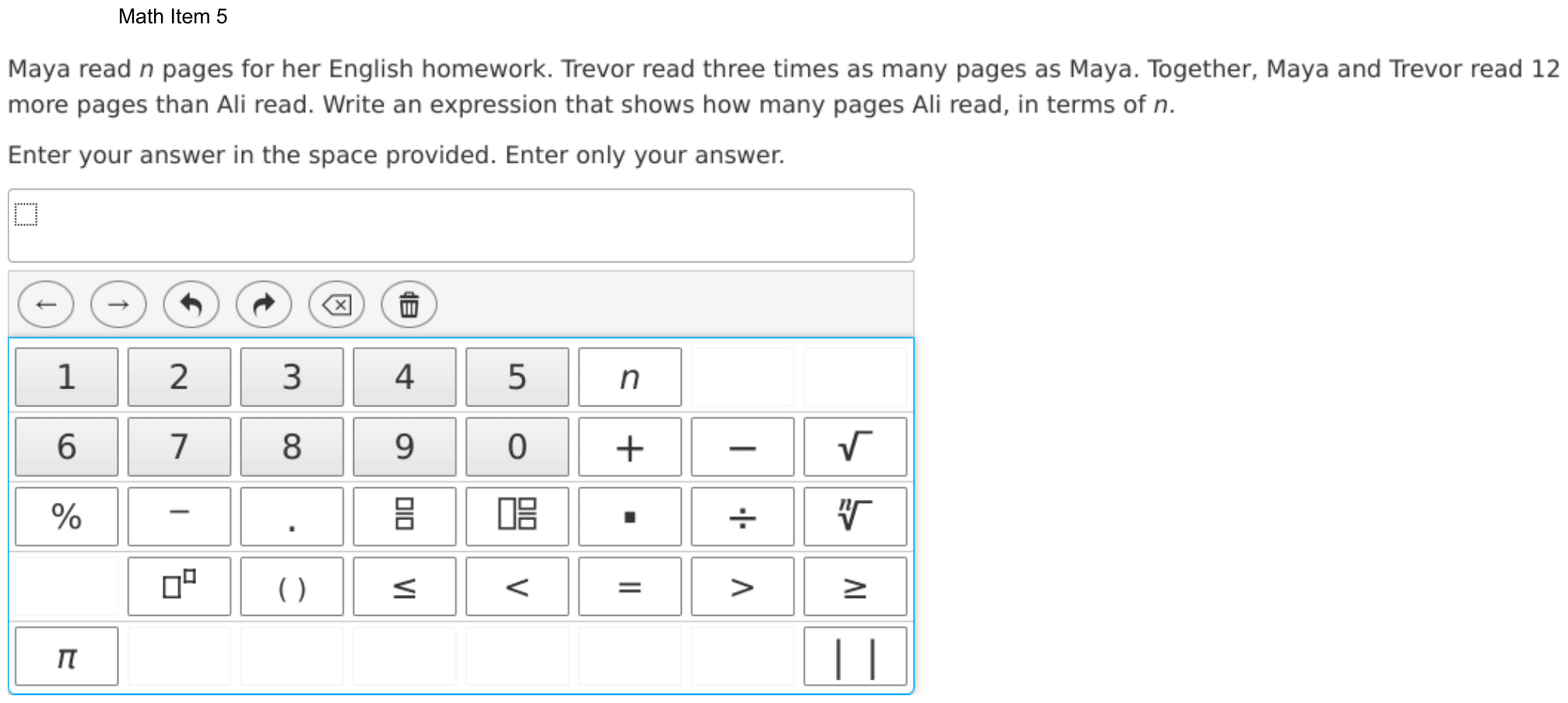
Maya read n pages for her English homework. Trevor read three times as many pages as Maya. Together, Maya and Trevor read 12 more pages than Ali read. Write an expression that shows how many pages Ali read, in terms of n.
Enter your answer in the space provided. Enter only your answer.
On the test you build the answer on an on-screen keypad; here, type it. Use ^ for a power, sqrt( ) or √ for a root, pi for π, and <= or >= for ≤ and ≥.
Show the answer
Correct answer: 4n – 12
Let n represent the number of pages that Maya read.
Trevor read three times as many pages as Maya: Trevor’s pages
To find how many pages they read together, add Maya’s and Trevor’s pages:
This means that together, they read pages.
Ali read 12 fewer pages than Maya and Trevor read together. So 12 should be subtracted from the total:
Ali’s pages
Question analysis
Maya reads n pages, Trevor reads three times as many, and together they read 12 more pages than Ali. Students type an expression in n for the number of pages Ali read. It tests writing and simplifying expressions from words, and the comparison with Ali has to be translated with care.
- NYS standards
- Grade level
- Grade 6 content, by NYS standard
- Compared with grade 7
- At grade 7 Writing an expression from words is grade 6 content, but this chains three relationships, and the last compares the pair with Ali rather than describing Ali directly. Typing the answer with no choices to compare adds risk.
- Estimated difficulty
- Moderate: several steps, or a close reading with one strong distractor.
- Thinking it demands
- Depth of knowledge 2, skills and concepts · mainly apply
- What makes it hard
- Turning words into math moderate
- Variables instead of numbers minor
- An answer in an unexpected form minor
- Solution
- 3 steps
- Reading level
- Question and choices: about grade 3, 52 words.
- Students, last 30 days
- Not enough answers yet to show (it takes 10).
Why it is hard, traps and wrong answers (shows the answer)
Why it is hard
Building the pair's total, n + 3n = 4n, is quick; the question turns on the direction of the last comparison. The pair read more than Ali, so Ali's count is the smaller one, yet the word more pulls toward adding 12. Testing n = 10 settles it: Maya and Trevor read 40 pages together, so Ali must have read 28, not 52.
Turning words into math moderate Understanding the question
“Together, Maya and Trevor read 12 more pages than Ali read” compares the pair with Ali, so Ali read 12 fewer than 4n, though the word more invites adding 12. (Hegarty, Mayer & Monk, 1995; Koedinger & Nathan, 2004)
Variables instead of numbers minor Understanding the question
Every count is written in terms of n, so there is no page total to check an expression against unless the student picks a value for n and tests it. (Koedinger & Nathan, 2004; Enright, Morley & Sheehan, 2002)
An answer in an unexpected form minor Choosing the answer
The expression is typed into a box with no choices to compare, so an entry such as 4n + 12 gets no warning that the comparison was read backward. (Enright, Morley & Sheehan, 2002)
Strategy: Write Trevor's pages and the pair's total in terms of n, then test your expression with a value such as n = 10 to check that the pair really read 12 more than Ali.
Traps
- Follows a key word: Picks the operation from a single word rather than the situation: "removed" so subtract, "of" so multiply, "more" so add, when the situation needs something else.
- Answers a different question: A choice is right for another quantity: the other unknown, the rest instead of the part, the part instead of the whole.
- Negatives and direction: Arithmetic with negative numbers, the order of a subtraction, or direction on a number line. (Moving a term across the equals sign without changing its sign is a faulty procedure.)
The wrong answers, classified
4n + 12 Follows a key word (Hegarty, Mayer & Monk, 1995)
Follows the word more and adds 12 to the pair's 4n, though the sentence says the pair read 12 more than Ali, so Ali read fewer.
3n – 12 Answers a different question (King et al., 2004; Hegarty, Mayer & Monk, 1995)
Takes Trevor's 3n as the pair's total, leaving out Maya's own n pages, then subtracts the 12 correctly.
12 – 4n Negatives and direction (Brown & Burton, 1978)
Sees that 12 and 4n must be subtracted but writes the subtraction in the wrong order, 12 − 4n, which is negative for most values of n.
Worked solution, step by step
Formulas used
- Adding like terms
- n is the number of pages Maya read. Terms with the same letter are called like terms. Add them by adding the numbers in front: 1 n plus 3 n is 4 n. It works because 1 group of n pages and 3 more groups make 4 groups.
- Turning a more-than fact around
- T is the pages Maya and Trevor read together. A is the pages Ali read. The pair read 12 more than Ali, so Ali read 12 fewer than the pair. Subtracting 12 undoes adding 12.
Sort out the question
Maya read n pages. n is a variable, a letter that stands for a number you don’t know. Trevor read 3 times as many pages as Maya. Together they read 12 more pages than Ali. You need Ali’s pages, written with n.
Write Trevor’s pages
Three times as many as n is 3 times n:
A number written next to a letter means multiply. So 3n means 3 × n pages.
Add Maya’s and Trevor’s pages
Together means add. Maya read 1 group of n, and Trevor read 3 groups:
Together they read 4n pages.
Watch out: do not leave Maya out. Using only Trevor’s 3n gives 3n − 12, which is wrong.
Decide who read more
The pair read 12 more than Ali. So Ali read 12 fewer than the pair. Take 12 away from their total:
Watch out: the word more tempts you to add 12. But 4n + 12 would mean Ali read more than the pair. And 12 − 4n subtracts in the wrong order.
Enter the expression
On the test, the keypad has an n key. Press 4, then n. Then press the minus key beside the plus key, then 1 and 2. You don’t need a times sign. On this site, type 4n-12.
So you would enter 4n − 12. Any expression equal to it, such as −12 + 4n, is also right.
Check your answer
Pick a number for n, such as 10. Maya read 10 pages and Trevor read 30, so together they read 40. Your expression gives Ali pages. Is 40 twelve more than 28? Yes, . So the expression works.
More questions like this
The original DOE question
Question 6 of 10
2026 Practice Test C Math, question 28Question
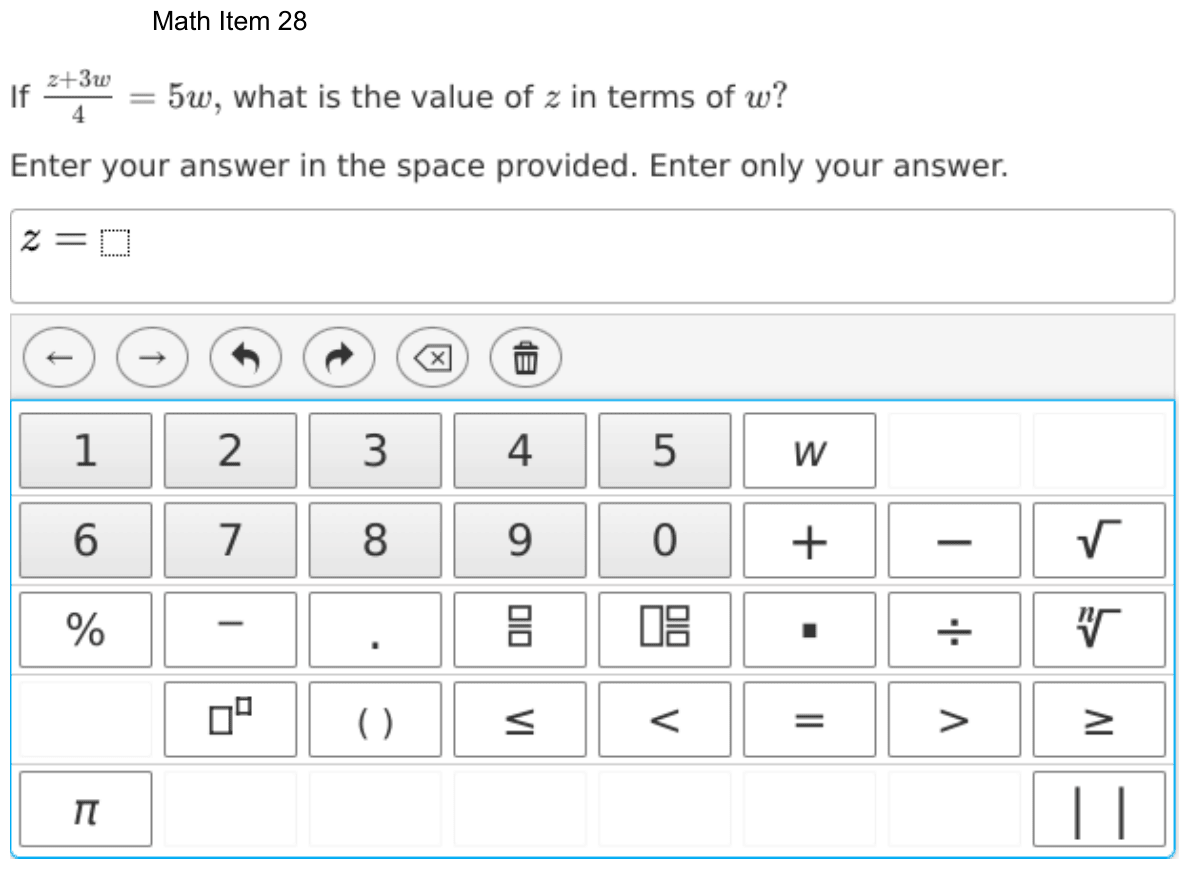
If , what is the value of z in terms of w?
Enter your answer in the space provided. Enter only your answer.
On the test you build the answer on an on-screen keypad; here, type it. Use ^ for a power, sqrt( ) or √ for a root, pi for π, and <= or >= for ≤ and ≥.
Show the answer
Correct answer: z = 17w
The goal is to isolate the variable z by using inverse operations.
First, multiply both sides by 4:
Then subtract from both sides:
Question analysis
This algebra question gives an equation in which z plus 3w, all divided by 4, equals 5w, and students type z in terms of w after a printed "z =". It tests solving a literal equation with inverse operations. The 4 divides the whole sum, so undoing the steps in the right order, with the right signs, is the tricky part.
- Grade level
- Grade 8 content, by NYS standard
- Compared with grade 7
- Above grade 7 Grade 7 students solve two-step equations with numbers, such as (x + 3)/4 = 5. Solving for one letter in terms of another is grade 8 work, and the typed answer gives no choices to check against.
- Estimated difficulty
- Moderate: several steps, or a close reading with one strong distractor.
- Thinking it demands
- Depth of knowledge 1, recall and reproduction · mainly apply
- What makes it hard
- Variables instead of numbers moderate
- An answer in an unexpected form minor
- Solution
- 2 steps
- Reading level
- Question and choices: about grade 4, 23 words.
- Students, last 30 days
- Not enough answers yet to show (it takes 10).
Why it is hard, traps and wrong answers (shows the answer)
Why it is hard
The equation takes only two inverse operations, but their order is the trap: the 4 divides the whole sum z + 3w, so it has to be cleared first. Students who subtract 3w from 5w straight away, or who move 3w to the right without changing its sign, reach a tidy multiple of w that looks as finished as the right one. Substituting w = 1, which needs z = 17 to make (z + 3)/4 equal 5, checks any entry.
Variables instead of numbers moderate Understanding the question
With w on both sides and no numbers to substitute, the result has to stay a multiple of w, and a slip such as 23w gives no sign that it is wrong. (Koedinger & Nathan, 2004; Enright, Morley & Sheehan, 2002)
An answer in an unexpected form minor Choosing the answer
The answer is typed after a printed “z =”, with no choices to compare, so the entry must be a single term in w, not an equation or a number. (Enright, Morley & Sheehan, 2002)
Strategy: Treat w like a known number: undo the division by 4 first, multiplying the whole of each side, then undo the added 3w, keeping the terms in w together.
Traps
- A faulty procedure: A systematic but wrong procedure: adding fractions straight across, applying an exponent to each term of a sum, dropping a sign when moving a term.
- Order of operations: Working left to right, or distributing a minus sign wrongly, gives a choice.
- Wrong operation: Adds instead of multiplying, divides the wrong way round, turns a ratio or rate upside down, or undoes a step in the wrong direction (subtracts what should be added back).
The wrong answers, classified
8w Order of operations (Brown & Burton, 1978)
Undoes the + 3w before the ÷ 4, subtracting 3w from 5w as if only z were divided by 4, so z/4 = 2w and z = 8w.
23w A faulty procedure (Brown & Burton, 1978; Tatsuoka, 1983)
Multiplies correctly to get z + 3w = 20w, then moves 3w to the right side without changing its sign, so z = 20w + 3w = 23w.
-1.75w Wrong operation (Hegarty, Mayer & Monk, 1995; King et al., 2004)
Divides 5w by 4 instead of multiplying, undoing a division with another division, so z + 3w = 1.25w and z = 1.25w − 3w = −1.75w.
Worked solution, step by step
Formulas used
- Doing the same thing to both sides
- A and B are the two sides of an equation, so they are equal. C is any amount. An equation is like a balanced scale. If you multiply both sides by the same number, or take the same amount from both, it stays balanced. That is how you get one letter alone.
Sort out the question
The equation is . You need z in terms of w. That means getting z alone on one side. The other side will use only w and numbers.
Treat w like a number you do not know yet. The answer box already shows z =, so you type only what comes after it.
Undo the division first
The fraction bar means the whole top, z + 3w, is divided by 4. So undo that first. Multiply both sides by 4, because multiplying undoes dividing:
Watch out: do not subtract 3w first. The 3w sits inside the fraction, so it is divided by 4 too. Subtracting it from 5w first leads to the wrong answer 8w.
Undo the adding
Now 3w is added to z. Subtract 3w from both sides:
Think of w as a thing, like apples. 20 apples take away 3 apples leaves 17 apples.
Watch out: moving 3w to the other side without changing its sign gives . That is wrong.
Enter it after the printed z =
On the test, the box already shows z =. Press 1, then 7, then the w key. You do not need a times sign between 17 and w. Do not type z = again. On this site, type 17w in the box.
So you would enter 17w, which makes z = 17w.
Check your answer
Pick a number for w, such as w = 1. Then z = 17. Put both into the first equation. The left side is . The right side is . The two sides match, so 17w works.
More questions like this
The original DOE question
Question 7 of 10
2026 Practice Test C Math, question 35Question
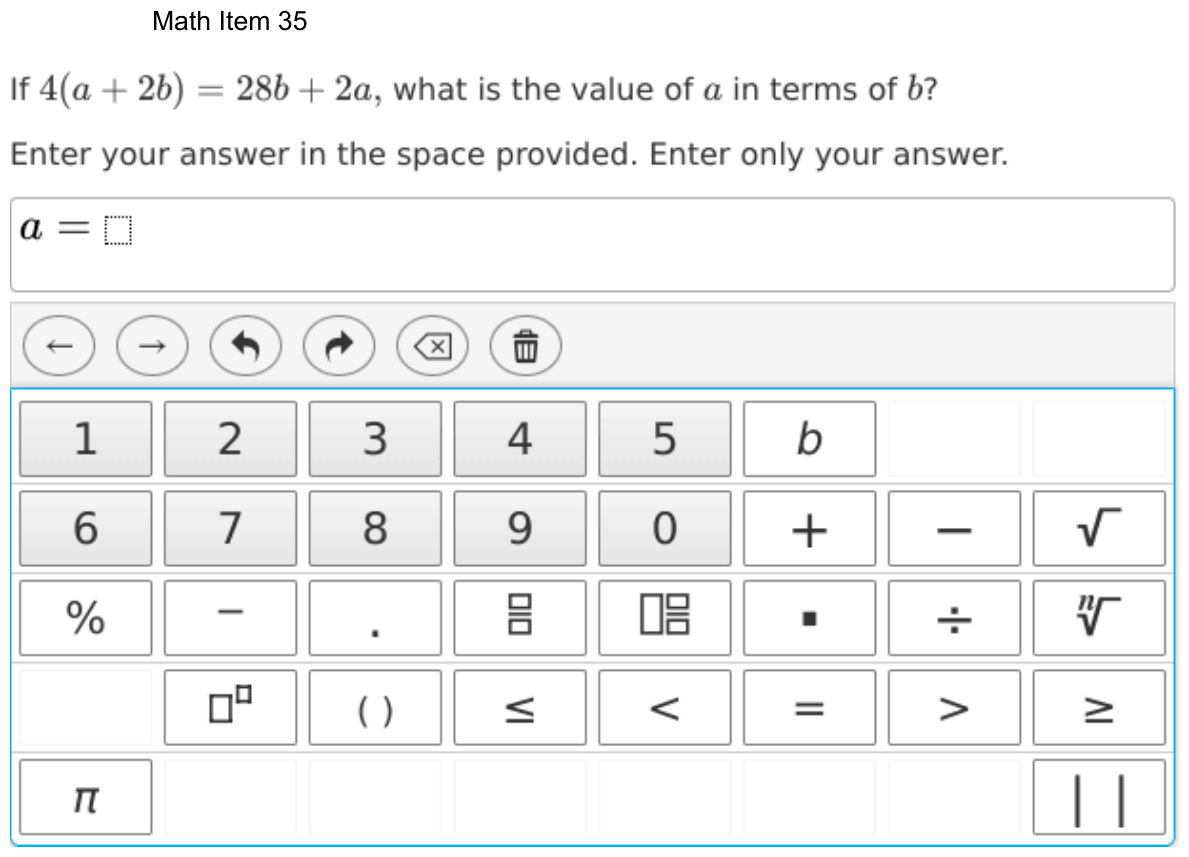
If , what is the value of a in terms of b?
Enter your answer in the space provided. Enter only your answer.
On the test you build the answer on an on-screen keypad; here, type it. Use ^ for a power, sqrt( ) or √ for a root, pi for π, and <= or >= for ≤ and ≥.
Show the answer
Correct answer: a = 10b
To find the value of a in terms of b, solve for a. Begin by distributing 4 on the left side of the equation:
Then, get the a terms on one side and the b terms on the other:
Solve for the value of a in terms of b by combining like terms and then dividing each side by 2:
Question analysis
An algebra question gives an equation with a and b on both sides, one side written as 4 times a sum in parentheses, and students type a in terms of b after a printed "a =". It tests the distributive property and solving linear equations. The answer is typed, so a slip in distributing or moving terms is not caught by any choices.
- NYS standards
- Grade level
- Grade 8 content, by NYS standard
- Compared with grade 7
- Above grade 7 Grade 7 students solve equations like 4(x + 2) = 28 with numbers. This one has letters on both sides, needs the distributive property and like terms, and asks for a in terms of b, which is grade 8 algebra.
- Estimated difficulty
- Hard: combines ideas, needs a plan, and has more than one tempting wrong answer.
- Thinking it demands
- Depth of knowledge 1, recall and reproduction · mainly apply
- What makes it hard
- Variables instead of numbers moderate
- Many steps moderate
- An answer in an unexpected form minor
- Solution
- 3 steps
- Reading level
- Question and choices: about grade 4, 23 words.
- Students, last 30 days
- Not enough answers yet to show (it takes 10).
Why it is hard, traps and wrong answers (shows the answer)
Why it is hard
Every step is routine, yet there are four of them, each with a classic slip, and the typed answer catches none. Multiplying the 4 into only the a, or carrying 8b across without changing its sign, gives another whole multiple of b that looks finished. Testing b = 1, where 4(a + 2) and 28 + 2a must come out equal, confirms an entry quickly.
Variables instead of numbers moderate Understanding the question
Both letters appear on both sides, and the answer must stay a multiple of b, so there is no number to check an entry against unless students invent one. (Koedinger & Nathan, 2004; Enright, Morley & Sheehan, 2002)
Many steps moderate Working it out
Four moves run in a chain, distributing the 4, gathering the a terms, gathering the b terms and dividing by 2, and an error at any one carries into the typed result. (Daniel & Embretson, 2010; Enright, Morley & Sheehan, 2002)
An answer in an unexpected form minor Choosing the answer
The answer is typed after a printed “a =”, with no choices, so 20b, the line before dividing by 2, can be entered without anything on screen questioning it. (Enright, Morley & Sheehan, 2002)
Strategy: Distribute the 4 to both terms in the parentheses, gather the a terms on one side and the b terms on the other, then divide by the coefficient of a.
Traps
- A faulty procedure: A systematic but wrong procedure: adding fractions straight across, applying an exponent to each term of a sum, dropping a sign when moving a term.
- Stops one step early: A choice is a number from partway through the solution.
The wrong answers, classified
13b A faulty procedure (Brown & Burton, 1978; Tatsuoka, 1983)
Multiplies only the a by 4, writing 4a + 2b = 28b + 2a, so 2a = 26b and a = 13b.
18b A faulty procedure (Brown & Burton, 1978; Tatsuoka, 1983)
Distributes correctly but moves 8b to the right without changing its sign, so 2a = 28b + 8b = 36b and a = 18b.
20b Stops one step early (King et al., 2004; Gierl et al., 2017)
Reaches 2a = 20b correctly and enters 20b, stopping before dividing both sides by 2 to get a alone.
Worked solution, step by step
Formulas used
- Distributive property
- k is the number outside the parentheses. x and y are the terms inside. The number outside multiplies every term inside, not just the first one. It works because 4 groups of (x + y) hold 4 x’s and 4 y’s.
- Doing the same thing to both sides
- A and B are the two equal sides of an equation. C is any amount. Taking the same amount from both sides, or dividing both by the same number, keeps them equal, like a balanced scale.
Sort out the question
The equation is . You need a in terms of b. That means a alone on one side, with only b and numbers on the other.
The answer box already shows a =, so you type only what comes after it.
Multiply out the parentheses
Use the distributive property. The 4 multiplies both terms inside:
Watch out: multiplying only the a by 4 gives 4a + 2b. That leads to the wrong answer 13b.
Gather the a terms
Like terms are terms with the same letter, such as 4a and 2a. Put the a terms on the left. Subtract 2a from both sides:
Gather the b terms
Now subtract 8b from both sides:
Watch out: moving 8b without changing its sign gives . That leads to 18b, which is wrong.
Divide both sides by 2
2a means 2 times a. Divide both sides by 2 to get a alone:
Watch out: 20b is equal to 2a, not a. Do not stop there.
Enter it after the printed a =
On the test, the box already shows a =. Press 1, then 0, then the b key. You do not need a times sign. Do not type a = again. On this site, type 10b in the box.
So you would enter 10b, which makes a = 10b.
Check your answer
Pick b = 1, so a = 10. The left side is . The right side is . The sides match, so 10b works.
More questions like this
The original DOE question
Question 8 of 10
2026 Practice Test C Math, question 41Question
Elijah is at the school bookstore. He wants to buy a water bottle for $12.50 and some notebooks that cost $4.75 each. He has at most $35.00 to spend. Write an inequality that represents the number of notebooks, n, Elijah can purchase.
Enter your answer in the space provided. Enter only your answer.
On the test you build the answer on an on-screen keypad; here, type it. Use ^ for a power, sqrt( ) or √ for a root, pi for π, and <= or >= for ≤ and ≥.
Show the answer
Correct answer: 12.50 + 4.75n ≤ 35.00
The question uses the phrase “at most,” which means “less than or equal to” (≤).
Since notebooks cost $4.75 each and Elijah will buy n notebooks, the total cost just for the notebooks is found by multiplying $4.75 by n, or .
Combining the cost of a water bottle ($12.50) with the cost of n notebooks, the inequality is .
This may also be written as .
Question analysis
Elijah has at most $35.00 to buy one water bottle and some notebooks at the school bookstore, with a price given for each. Students type an inequality for the number of notebooks, n, he can buy. It tests writing an inequality from a word problem. The two prices play different roles, and the phrase "at most" decides the inequality symbol.
- Grade level
- Grade 7 content, by NYS standard
- Compared with grade 7
- At grade 7 Writing an inequality for a budget with a one-time cost and a cost per item is typical grade 7 work. The answer is typed, so both the symbol for "at most" and the role of each price must be right.
- Estimated difficulty
- Straightforward: two steps or one careful reading.
- Thinking it demands
- Depth of knowledge 2, skills and concepts · mainly apply
- What makes it hard
- Turning words into math moderate
- An answer in an unexpected form minor
- Solution
- 2 steps
- Reading level
- Question and choices: about grade 5, 50 words.
- Students, last 30 days
- Not enough answers yet to show (it takes 10).
Why it is hard, traps and wrong answers (shows the answer)
Why it is hard
The prices are given in the order they are used, so the expression for the total is the easier half. The points are lost on the symbol: “at most” has to be heard as no more than, with equality allowed, and the keypad offers all four inequality signs side by side. Pricing one and two notebooks with the bottle, $17.25 and $22.00, shows which amount repeats and confirms the total.
Turning words into math moderate Understanding the question
The $12.50 bottle is bought once and the $4.75 is paid for each of n notebooks, and “at most $35.00” has to become ≤, which allows a total of exactly $35.00. (Hegarty, Mayer & Monk, 1995; Koedinger & Nathan, 2004)
An answer in an unexpected form minor Choosing the answer
The whole inequality, with n, its symbol and both prices, is built on a keypad offering ≤, <, ≥ and >, so a wrong symbol looks as complete as the right one. (Enright, Morley & Sheehan, 2002)
Strategy: Price a few cases by hand, such as 1 and 2 notebooks with the water bottle, to see which amount repeats, then decide whether a total of exactly $35.00 is allowed.
Traps
- Misreads the question: Misses or misreads a condition or a word in the question: "at least", "each", "remaining", "not".
- Counting the ends: Inclusive or exclusive ends, fence posts, consecutive numbers: an answer that is one too many or too few, or an endpoint drawn open where it belongs closed (or the reverse).
- Numbers taken from the question: Combines the numbers in the question without a model of the situation, or is simply a number that appears in the question.
The wrong answers, classified
12.50 + 4.75n ≥ 35.00 Misreads the question (Hegarty, Mayer & Monk, 1995)
Builds the total correctly but reads “at most” as at least, writing ≥, which would mean Elijah must spend $35.00 or more.
12.50 + 4.75n < 35.00 Counting the ends (Brown & Burton, 1978)
Builds the total correctly but uses a strict less-than sign, leaving out a total of exactly $35.00, which “at most” allows.
17.25n ≤ 35.00 Numbers taken from the question (Hegarty, Mayer & Monk, 1995)
Adds the bottle’s price to each notebook’s, $12.50 + $4.75 = $17.25, and multiplies by n, as if a bottle came with every notebook.
Worked solution, step by step
Formulas used
- Total cost with a one-time cost
- The one-time cost is paid once, no matter what. The price each is paid once for every item. n is the number of items. You multiply the price each by n because you pay it n times.
- At most
- The sign ≤ means less than or equal to. The total can be under the limit or exactly equal to it, but never over it. Use it for words like at most and no more than.
Sort out the question
Elijah buys one water bottle for $12.50. He also buys n notebooks at $4.75 each. He can spend at most $35.00.
You need an inequality for n. An inequality compares two amounts with a sign such as ≤ instead of =.
Price a few cases
Work out the cost for a few numbers of notebooks:
Notebooks Total ($) 1 2 3 The $12.50 shows up once. The $4.75 shows up once for each notebook.
Write the total cost
Use the total cost formula. The bottle is the one-time cost, and each notebook costs $4.75:
Here 4.75n means 4.75 times n.
Watch out: do not add the two prices first. charges for a new bottle with every notebook.
Choose the sign
At most $35.00 means the total can be less than $35.00 or exactly $35.00. It cannot be more. So use ≤:
Watch out: ≥ means at least, the opposite. And < leaves out a total of exactly $35.00, which Elijah is allowed to spend.
Enter it on the keypad
Type the whole inequality. Nothing is printed before the box. On the test, press 1, 2, ., 5, 0, +, 4, ., 7, 5, the n key, the ≤ key, then 3, 5, ., 0, 0. The ≤ key is in the fourth row. Skip the dollar signs. On this site, type <= for ≤.
So you would enter 12.50 + 4.75n ≤ 35.00. An equal form, such as 4.75n + 12.50 ≤ 35.00, counts too.
Check your answer
Test some numbers. For 4 notebooks, , which is not over 35.00. For 5 notebooks, , which is too much. So Elijah can buy up to 4 notebooks. That makes sense for a budget of $35.00.
More questions like this
The original DOE question
Question 9 of 10
2026 Practice Test D Math, question 5Question
In a school raffle, 1 out of every 25 students wins a prize. Each prize includes a randomly selected trading card from a set of 100 different cards, labeled C1 through C100, with each card equally likely to be chosen. If one student is selected at random, what is the probability that the student both wins a prize and receives Card C17?
Write an expression that represents the probability that a student wins the prize and receives Card C17.
Enter your answer in the space provided. Enter only your answer.
On the test you build the answer on an on-screen keypad; here, type it. Use ^ for a power, sqrt( ) or √ for a root, pi for π, and <= or >= for ≤ and ≥.
Show the answer
Correct answer: 1/25 · 1/100
To calculate the joint probability, first determine the probability of each independent event.
The probability that a randomly selected student wins the prize is .
The probability that a randomly selected student will receive Card C17 is , because Card C17 is 1 card out of 100 labeled cards.
The probability that a student wins the prize and receives Card C17 is the product of those two probabilities, .
Question analysis
In a school raffle, 1 out of every 25 students wins a prize, and each prize includes one of 100 equally likely trading cards. Students type an expression for the probability that a randomly chosen student both wins and gets one particular card. It tests the probability of two independent events, and combining the two chances correctly is the main hurdle.
- Grade level
- Grade 7 content, by NYS standard
- Compared with grade 7
- At grade 7 Grade 7 students find compound probabilities, usually by listing outcomes for coins or number cubes. These two stages have 25 and 100 outcomes, far too many pairs to list, so a rule must be used, and the answer is typed as an expression.
- Estimated difficulty
- Straightforward: two steps or one careful reading.
- Thinking it demands
- Depth of knowledge 2, skills and concepts · mainly apply
- What makes it hard
- Solution
- 2 steps
- Reading level
- Question and choices: about grade 8, 87 words.
- Students, last 30 days
- Not enough answers yet to show (it takes 10).
Why it is hard, traps and wrong answers (shows the answer)
Why it is hard
Each chance is stated almost directly, 1 out of 25 and 1 out of 100, so the question tests one rule: both events must happen, and the chances multiply. The word “and” pulls students toward adding, which gives a result larger than either chance, a sign that something is wrong. Others write only the card's chance and forget that the student must first win a prize.
Something you must already know moderate Working it out
The question never says that the chance of two independent events both happening is the product of their chances, so students must bring that rule to the 1/25 and the 1/100 themselves. (Anderson & Krathwohl, 2001)
An answer in an unexpected form minor Choosing the answer
The answer is typed as an expression with no choices to compare, so a sum of the two chances, which looks just as finished, gets no warning on screen. (Enright, Morley & Sheehan, 2002)
Strategy: Write each event's chance as a fraction, then apply the rule for two independent events that must both happen, and check that the result is smaller than either chance alone.
Traps
- Follows a key word: Picks the operation from a single word rather than the situation: "removed" so subtract, "of" so multiply, "more" so add, when the situation needs something else.
- Stops one step early: A choice is a number from partway through the solution.
- A faulty procedure: A systematic but wrong procedure: adding fractions straight across, applying an exponent to each term of a sum, dropping a sign when moving a term.
The wrong answers, classified
1/25 + 1/100 Follows a key word (Hegarty, Mayer & Monk, 1995)
Reads “both wins a prize and receives Card C17” as a cue to add, so sums the chances, though needing both events must be less likely than either.
1/100 Stops one step early (King et al., 2004; Gierl et al., 2017)
Writes only the chance of receiving Card C17 and leaves out that the student must first be one of the 1 in 25 who win a prize.
1/125 A faulty procedure (Brown & Burton, 1978; Tatsuoka, 1983)
Combines “1 out of 25” and “1 out of 100” by adding the totals, 25 + 100, a faulty rule that gives neither the sum nor the product.
Worked solution, step by step
Formulas used
- Probability of one outcome
- P is the probability, the chance that something happens, from 0 to 1. The top counts the outcomes you want. The bottom counts all the outcomes that could happen. Use it when every outcome is equally likely, like one card picked from 100.
- Probability that two independent events both happen
- A and B are two events. Independent means one does not change the chance of the other. P(A) is the chance of A, and P(B) is the chance of B. Multiply them to get the chance that both happen. The result is smaller than either chance, since both things must happen.
Sort out the question
Two things must both happen. First, the student wins a prize. Second, the card in that prize is Card C17. You need an expression for that chance. An expression is a math phrase made of numbers and signs, with no equal sign. You do not have to work it out to one number.
Find the chance of winning
The question says “1 out of every 25 students wins a prize.” One student is the part that wins, and 25 is the whole group. So:
Find the chance of Card C17
Each prize has one card, picked at random from 100 cards. Every card is equally likely. Card C17 is 1 of those 100 cards:
Multiply the two chances
Winning a prize does not change which card is inside it. So the two events are independent. To find the chance that both happen, multiply:
The dot · means times. Worked out, this is 1/2500.
Watch out: the word and does not mean add here. 1/25 + 1/100 is bigger than either chance, but needing both things must be less likely. Writing only 1/100 forgets that the student must win a prize first.
Enter the expression
On the test, press the fraction key, a small box over a small box. Type 1 on top and 25 on the bottom. Move the cursor out of the fraction with the → key. Press the dot key for times. Then use the fraction key again for 1 over 100. On this site, type 1/25 * 1/100 or 1/25 · 1/100. The value 1/2500 also counts.
So you would enter 1/25 · 1/100.
Check your answer
Picture 2,500 students. 1 in 25 wins, so about 100 students win a prize. Of those 100, about 1 gets Card C17. That is 1 student out of 2,500, which matches 1/25 · 1/100 = 1/2500. It is smaller than 1/25 and 1/100, as it should be.
More questions like this
The original DOE question
Question 10 of 10
2026 Practice Test D Math, question 26Question
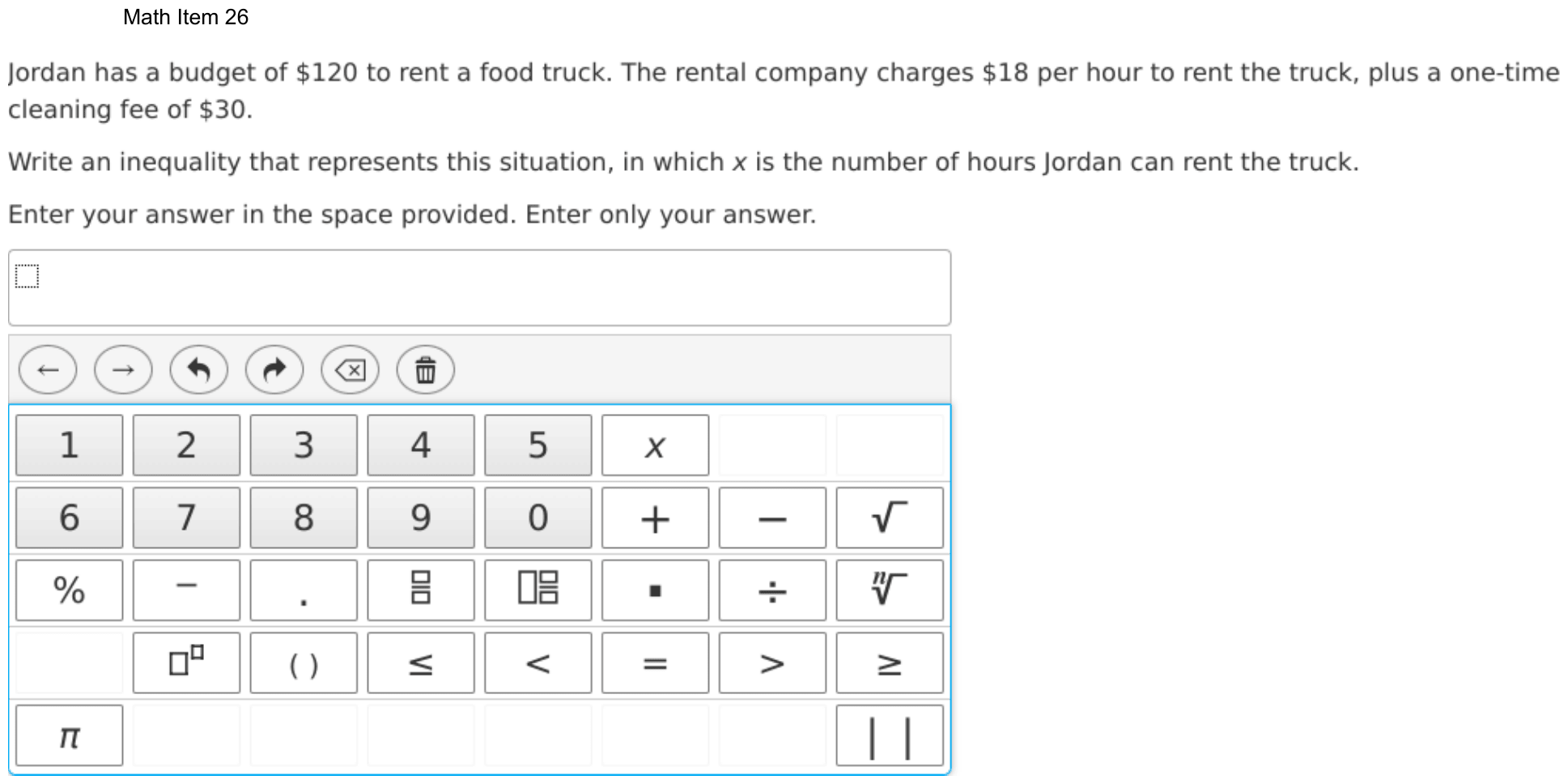
Jordan has a budget of $120 to rent a food truck. The rental company charges $18 per hour to rent the truck, plus a one-time cleaning fee of $30.
Write an inequality that represents this situation, in which x is the number of hours Jordan can rent the truck.
Enter your answer in the space provided. Enter only your answer.
On the test you build the answer on an on-screen keypad; here, type it. Use ^ for a power, sqrt( ) or √ for a root, pi for π, and <= or >= for ≤ and ≥.
Show the answer
Correct answer: 30 + 18x ≤ 120
Let x represent the number of hours Jordan can rent the truck.
The hourly rental cost can be represented as , written as .
The one-time cleaning fee of $30 is added to the hourly cost to obtain the total cost.
The sum of the cleaning fee and the hourly rental cost is represented as .
As Jordan has $120 to spend, the total cost must be less than or equal to $120.
This is represented as or .
Question analysis
Jordan has $120 to rent a food truck that costs $18 an hour plus a one-time $30 cleaning fee, and students type an inequality for x, the number of hours. It tests writing a two-step inequality from a word problem. Matching each dollar amount to its role and choosing the symbol that fits a spending limit are the tricky parts.
- Grade level
- Grade 7 content, by NYS standard
- Compared with grade 7
- At grade 7 Writing a two-step inequality from a word problem is the grade 7 standard itself. Nothing is offered to choose from: students type the whole inequality, so the numbers, the variable term and the symbol are all theirs to get right.
- Estimated difficulty
- Moderate: several steps, or a close reading with one strong distractor.
- Thinking it demands
- Depth of knowledge 2, skills and concepts · mainly apply
- What makes it hard
- Turning words into math moderate
- An answer in an unexpected form minor
- Solution
- 3 steps
- Reading level
- Question and choices: about grade 6, 57 words.
- Corrected from the DOE handbook
- A spelling error in the explanation was corrected.
- Students, last 30 days
- Not enough answers yet to show (it takes 10).
Why it is hard, traps and wrong answers (shows the answer)
Why it is hard
The arithmetic is small, so the points ride on two decisions the keypad leaves open: which symbol, and whether to stop before solving. A budget means Jordan may spend all $120 but no more, so the total cost must stay at or under it, and a strict < leaves out the five-hour rental that costs exactly $120. Testing x = 5 and x = 6 in the typed inequality confirms both the symbol and the setup.
Turning words into math moderate Understanding the question
The stem never says “at most”: the limit comes only from “a budget of $120”, while “$18 per hour” must multiply x and the “one-time cleaning fee of $30” is added just once. (Hegarty, Mayer & Monk, 1995; Koedinger & Nathan, 2004)
An answer in an unexpected form minor Choosing the answer
The whole inequality is typed on a keypad that offers <, ≤, > and ≥ side by side, with no choices to compare, and the solved form x ≤ 5 is not accepted. (Enright, Morley & Sheehan, 2002)
Strategy: Work out what 1 hour and 2 hours would cost Jordan in all, see which amount repeats each hour, build the total for x hours, then compare it with the budget and test a few values.
Traps
- Counting the ends: Inclusive or exclusive ends, fence posts, consecutive numbers: an answer that is one too many or too few, or an endpoint drawn open where it belongs closed (or the reverse).
- Misreads the question: Misses or misreads a condition or a word in the question: "at least", "each", "remaining", "not".
The wrong answers, classified
30 + 18x < 120 Counting the ends (Brown & Burton, 1978)
Builds the cost 30 + 18x correctly but uses a strict less-than sign, which shuts out a five-hour rental costing exactly the $120 Jordan has.
30 + 18x ≥ 120 Misreads the question (Hegarty, Mayer & Monk, 1995)
Builds the cost correctly but points the symbol the wrong way, treating the $120 budget as an amount Jordan must spend at least instead of a limit.
x ≤ 5 Misreads the question (Hegarty, Mayer & Monk, 1995)
Writes and solves the inequality correctly, then enters its solution, x ≤ 5, though the item asks for the inequality showing the fee, the hourly charge and the budget.
What was corrected from the DOE handbook, and why
- Explanation: The DOE’s explanation says “The onetime cleaning fee of $30 is added to the hourly cost …”. “Onetime” means “former”; a fee charged once is a “one-time” fee, as the question itself spells it. The site now says “one-time”.
Worked solution, step by step
Formulas used
- Total cost with a fee and a rate
- The fee is a charge paid only once, so you add it once. The rate is the charge for each hour. x is the number of hours. You multiply the rate by x because it is paid again for every hour.
- Staying within a budget
- The sign ≤ means is less than or equal to. A budget is the most money you can spend. You may spend all of it, or less, but never more. So the total cost must be less than or equal to the budget.
Sort out the question
You know three facts:
- Jordan can spend at most $120. That is the budget.
- The truck costs $18 for each hour.
- A cleaning fee of $30 is paid one time only.
x is the number of hours. You need an inequality. That is a math sentence that compares two amounts with a sign such as < or ≤. It must show all three facts.
Work out a few totals
Find the total cost for a few hours. Each hour adds one more $18:
Hours Hourly charges ($) Total cost ($) 1 2 x The $30 shows up once in every total. The $18 shows up once for each hour. So x hours cost 30 + 18x dollars. Here 18x means 18 times x.
Choose the right sign
The total cost must fit inside the budget. Jordan may spend exactly $120, or less, but not more. That is less than or equal to, the sign ≤. So:
Watch out: the sign < means less than, but not equal. leaves out spending exactly $120. The sign ≥ is backward too. It says Jordan must spend at least $120. Also keep each number in its place. charges $30 an hour.
Stop before you solve
You could solve the inequality. Subtract 30 from both sides to get . Then divide both sides by 18 to get . So Jordan can rent the truck for at most 5 hours.
Watch out: the question asks for an inequality that models the situation. To model means to show the facts of the story in math. The solved form, x ≤ 5, is true, but it hides the $18, the $30 and the $120. So x ≤ 5 is not accepted. Enter the inequality before you solve it.
Enter it on the keypad
On the test, build the inequality on the keypad. Press 3, 0, +, 1, 8 and the x key. Then press the ≤ key, in the fourth row of keys. Then press 1, 2, 0. You need no dollar signs and no times sign. On this site, type it, with <= for ≤: 30 + 18x <= 120.
So you would enter 30 + 18x ≤ 120. The same inequality written the other way round, 120 ≥ 30 + 18x, is also right. The solved form, x ≤ 5, is not accepted, because it does not model the situation.
Check your answer
Test two numbers of hours. For 5 hours, . Is 120 ≤ 120? Yes, so 5 hours fit the budget. For 6 hours, . Is 138 ≤ 120? No, and $138 is over budget. The inequality gets both right.
More questions like this
The original DOE question