3 English and 3 math
Here are 6 random questions to try. Takers earning below 75% are unlikely to receive an offer. You have 1 minute 48 seconds per question on the real exam.
Question 1 of 6
2018 Test B English, question 52Passage Invention of the Telegraph
Samuel Morse, an American inventor, is credited with creating the electronic telegraph, a communication device that allows users to send messages using a system of short and long pulses that represent letters, numbers, and punctuation. In 1843 the United States Congress passed the Telegraph Bill, which provided Morse with the funds to build an electric telegraph system.
Invention of the Telegraph
Earlier Signal Systems
Long before Samuel F. B. Morse electrically transmitted his famous message “What hath God wrought?” from Washington to Baltimore on May 24, 1844, there were signaling systems that enabled people to communicate over distances. Most were visual or “semaphore” systems using flags or lights. In the eighteenth century, such systems used an observer who would decipher a signal from a high tower on a distant hill and then send it on to the next station. The young American republic wanted just such a system along its entire Atlantic coast and offered a prize of $30,000 for a workable proposal. The framers of this legislation had no way of knowing that when they used the word “telegraph” to refer to this visual semaphore system, they would be offered an entirely new and revolutionary means of communication—electricity.
The Growth of an Idea
The idea of using electricity to communicate over distance is said to have occurred to Morse during a conversation aboard ship when he was returning from Europe in 1832. Michael Faraday’s recently invented electromagnet was much discussed by the ship’s passengers, and when Morse came to understand how it worked, he speculated that it might be possible to send a coded message over a wire. While a student at Yale College years before, he had written his parents a letter about how interesting he found the lectures on electricity. Despite what he had learned at Yale, Morse found when he began to develop his idea that he had little real understanding of the nature of electricity, and after sporadic attempts to work with batteries, magnets, and wires, he finally turned for help to a colleague at the University of the City of New York, Leonard D. Gale.
Gale was a professor of chemistry and familiar with the electrical work of Princeton’s Joseph Henry, a true pioneer in the new field. Well before Morse had his shipboard idea about a telegraph, Henry rang a bell at a distance by opening and closing an electric circuit. In 1831, he had published an article, of which Morse was unaware, that contained details suggesting the idea of an electric telegraph. Gale’s help and his knowledge of this article proved crucial to Morse’s telegraph system because Gale not only pointed out flaws in the system but showed Morse how he could regularly boost the strength of a signal and overcome the distance problems he had encountered by using a relay system Henry had invented. Henry’s experiments, Gale’s assistance, and, soon after, hiring the young technician Alfred Vail were keys to Morse’s success.
Obstacles and Opportunities
By December 1837, Morse had enough confidence in his new system to apply for the federal government’s appropriation, and during the next year he conducted demonstrations of his telegraph both in New York and Washington.
However, when the economic disaster known as the Panic of 1837 took hold of the nation and caused a long depression, Morse was forced to wait for better times. It was during this period that Morse visited Europe again and tried not only to secure patent protection overseas but to examine competing telegraph systems in England. . . .
By 1843, the country was beginning to recover economically, and Morse again asked Congress for the $30,000 that would allow him to build a telegraph line from Washington to Baltimore, forty miles away. The House of Representatives eventually passed the bill containing the Morse appropriation, and the Senate approved it in the final hours of that Congress’s last session. With President Tyler’s signature, Morse received the cash he needed and began to carry out plans for an underground telegraph line.
Realizing a Great Invention
Morse had hired the ingenious construction engineer Ezra Cornell to lay the pipe carrying the wire, and although Cornell did his job superbly, one of Morse’s partners, Congressman F. O. J. Smith, had purchased wire with defective insulation. Too much time had been wasted laying bad wire, and with the project on a rigid deadline, something had to be done quickly. Cornell suggested that the fastest and cheapest way of connecting Washington and Baltimore was to string wires overhead on trees and poles. The desperate Morse gave the go-ahead, and the line was completed in time for the dramatic and spectacularly successful link between the Supreme Court chamber of the Capitol building and the railroad station in Baltimore.
Soon, as overhead wires connected cities up and down the Atlantic coast, the dots-and-dashes method that recorded messages on a long moving strip of paper was replaced by the operator’s ability to interpret the code in real time. . . . Telegraph lines soon extended westward, and within Morse’s own lifetime they connected the continents of Europe and America.
“Invention of the Telegraph”—Public Domain/Library of Congress
legislation: Telegraph Bill
dots-and-dashes method: the short and long pulses of Morse code that are sent and received by telegraph operators
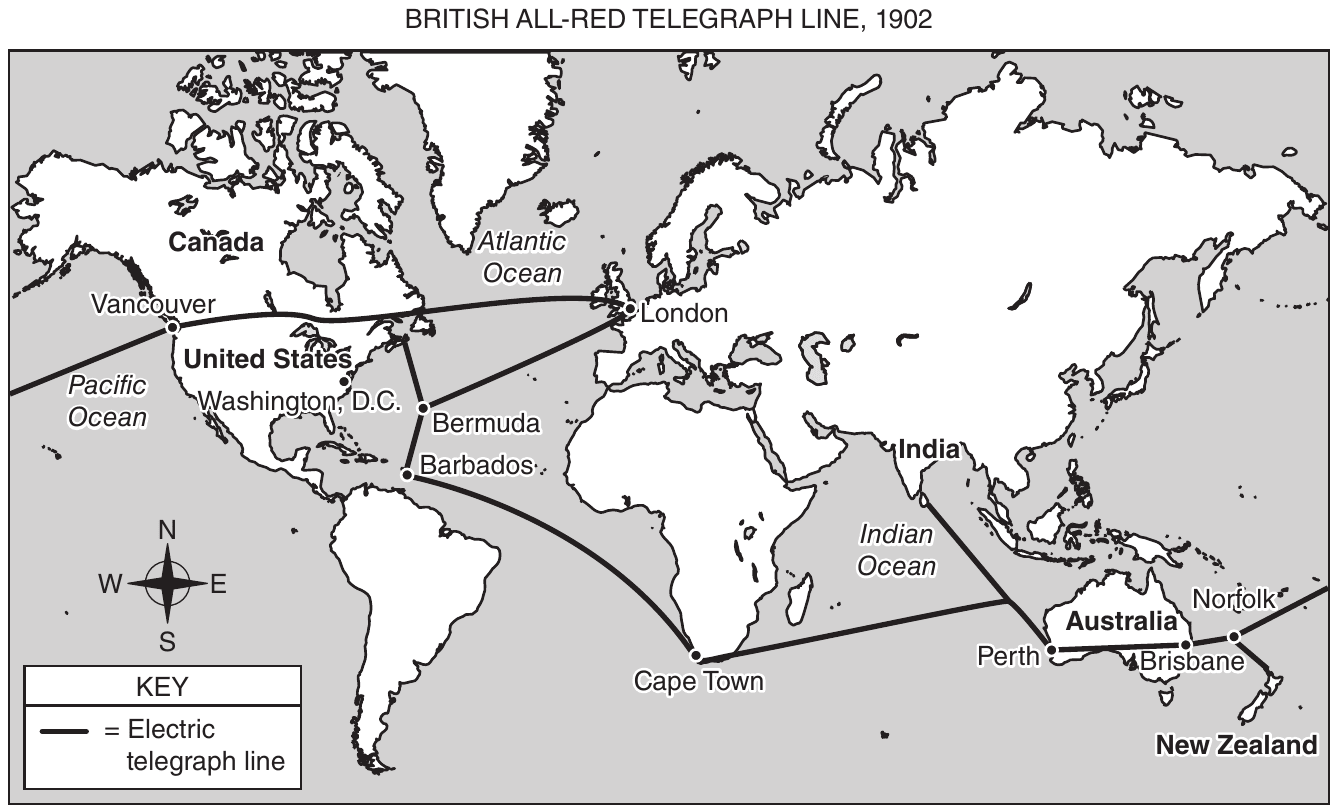
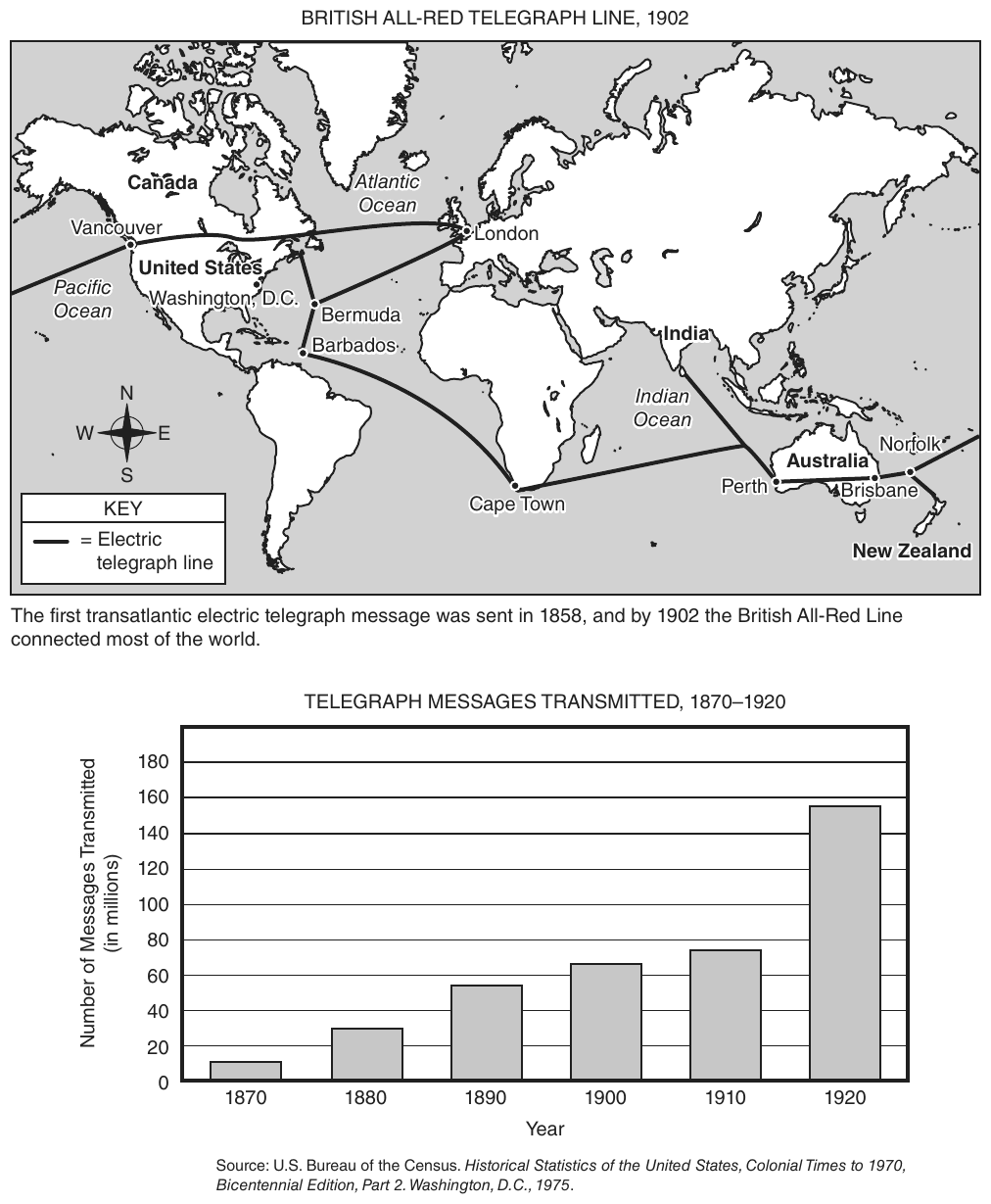
The first transatlantic electric telegraph message was sent in 1858, and by 1902 the British All-Red Line connected most of the world.
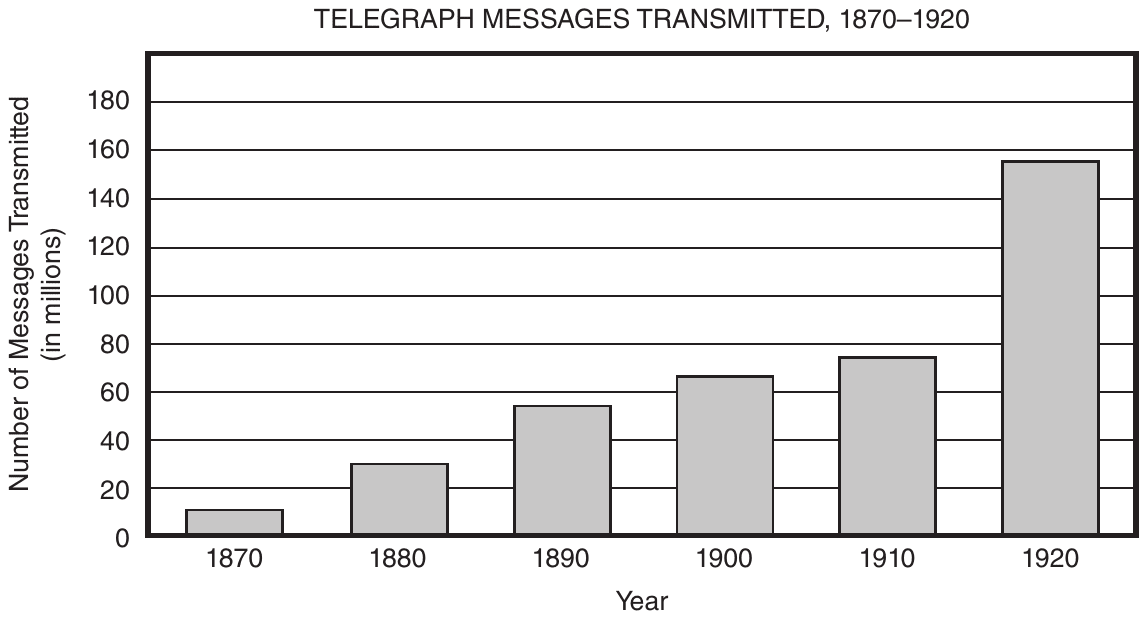
Source: U.S. Bureau of the Census. Historical Statistics of the United States, Colonial Times to 1970, Bicentennial Edition, Part 2. Washington, D.C., 1975.
Question
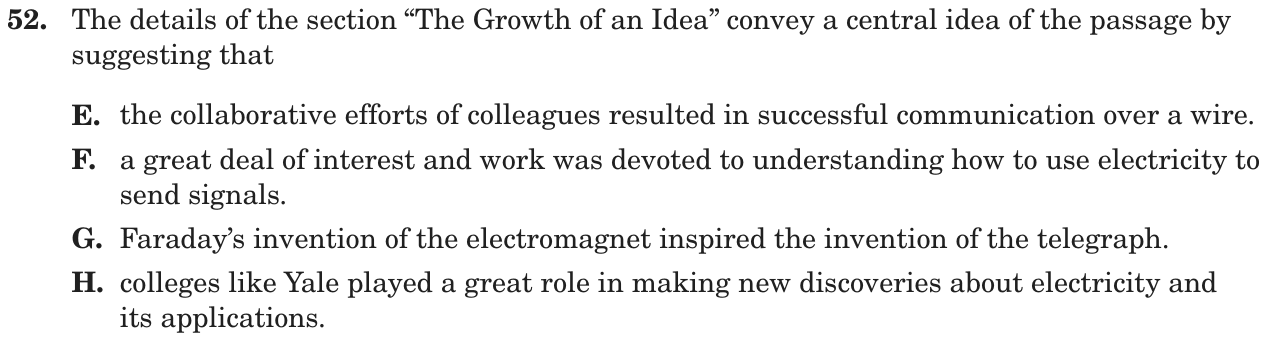
The details of the section “The Growth of an Idea” convey a central idea of the passage by suggesting that
- Athe collaborative efforts of colleagues resulted in successful communication over a wire.
- Ba great deal of interest and work was devoted to understanding how to use electricity to send signals.
- CFaraday’s invention of the electromagnet inspired the invention of the telegraph.
- Dcolleges like Yale played a great role in making new discoveries about electricity and its applications.
Show the answer
Correct answer: B
The question asks how a passage section helps convey a central idea of the passage. Paragraph 3 states that “Henry’s experiments, Gale’s assistance, and, soon after, hiring the young technician Alfred Vail were keys to Morse’s success.” The level of interest inspired Morse and others to work together to find a way to use electricity to send long-distance messages.
Option B is correct; the section helps convey a central idea because, overall, the section focuses on what fascinated Morse enough to begin his work and how others were just as interested and willing to work to achieve this goal.
Option A is incorrect because, although the word collaborative suggests that multiple people contributed to the telegraph’s success, the option does not clarify the research and effort needed in order to understand how to use electricity to send signals.
Option C is incorrect because when Morse came to understand how Faraday’s electromagnet worked, Morse wondered if it might be possible to send a coded message over a wire, but that thought later evolved into the telegraph only after more research and experimentation.
Option D is incorrect because the influence of what Morse learned at Yale was only a minor factor in his development of the telegraph.
Question analysis
This central idea question asks what the details in the section “The Growth of an Idea” suggest about the passage “Invention of the Telegraph.” The section covers Faraday’s electromagnet, Morse’s Yale lectures, and help from Gale, Henry and Vail, so students must judge which statement those details support as a group, and more than one choice sounds right.
- Grade level
- Grade 8 reading and task
- Compared with grade 7
- Above grade 7 Grade 7 central-idea questions usually have one clearly best summary. Here two paragraphs of names and events must be weighed, and several choices restate true details, so judging which fits the whole section is unusually demanding.
- Estimated difficulty
- Among the hardest on the SHSAT: a non-obvious approach, heavy reading, or a well-hidden trap.
- Thinking it demands
- Depth of knowledge 3, strategic thinking · mainly understand
- What makes it hard
- A very close wrong answer major
- Evidence in several places moderate
- The right answer is reworded moderate
- Evidence
- Answered from several paragraphs or stanzas
- Reading level
- Passage: about grade 11, 910 words; question and choices: about grade 12, 77 words.
- Students, last 30 days
- Not enough answers yet to show (it takes 10).
Why it is hard, traps and wrong answers (shows the answer)
Why it is hard
This is among the hardest questions in the set because the most tempting wrong choice reads like a paraphrase of the section’s final sentence. Rejecting it means noticing that the section never shows a message getting through and never shows Henry working with Morse, who had not even read his article. The right choice is vague by design, and only a summary of both paragraphs together shows that it fits better.
A very close wrong answer major Choosing the answer
The colleagues choice and the interest-and-work choice both describe effort spent on sending signals by wire; they part on one claim, that the effort “resulted in successful communication,” which the section never shows, the working line arriving in paragraph 7. (Embretson & Wetzel, 1987; Gorin & Embretson, 2006; Ascalon et al., 2007)
Evidence in several places moderate Working it out
The idea emerges only from details across two paragraphs, passengers discussing the electromagnet, Morse’s Yale letter, his failed attempts, Henry’s bell and article, Gale’s relay advice, taken together. (Kirsch & Mosenthal, 1990; Gorin & Embretson, 2006)
The right answer is reworded moderate Choosing the answer
The key names none of the section’s people, while the wrong choices echo its “colleague,” “over a wire,” Faraday’s electromagnet and Yale, and so look more firmly rooted in the text. (Freedle & Kostin, 1993; Kirsch & Mosenthal, 1990)
Strategy: Summarize paragraphs 2 and 3 together in one sentence of your own before reading the choices, then choose the statement closest to your summary, checking that every part of it is true of this section.
Traps
- Half right: One half of a two-part choice is right and the other is not.
- Too narrow: A single detail offered as the central idea or a summary, or a summary that keeps minor details and leaves out an essential part.
- Too broad or too strong: A choice overstates, generalizes, or uses absolute words the text does not support.
The wrong answers, classified
A Half right (King et al., 2004; Thissen, Steinberg & Fitzpatrick, 1989)
Rightly sees teamwork in the section’s close, but successful communication over Morse’s wire comes later, under “Realizing a Great Invention,” and the passage never shows Henry working with Morse.
C Too narrow (King et al., 2004)
Treats the spark as the whole story: Faraday’s electromagnet gave Morse the idea, but the section goes on to years of failed attempts and help from others.
D Too broad or too strong (King et al., 2004)
Inflates a passing mention: Morse’s Yale lectures appear once, and the section notes that despite them he had “little real understanding of the nature of electricity.”
Working it out, step by step
Figure out what the question asks
This asks what the section “The Growth of an Idea” says about a central idea, or main message. The section is paragraphs 2 and 3. Sum up both paragraphs together before you look at the choices.
List the section’s details
On the ship, Faraday’s electromagnet “was much discussed by the ship’s passengers.” Morse had found the electricity lectures at Yale interesting. He made “sporadic attempts” on his own. In paragraph 3, Henry “rang a bell at a distance by opening and closing an electric circuit.” Gale showed Morse how to use Henry’s relay system.
Find what the details share
Look at what links these details. Passengers talked about electricity. Morse was curious and kept trying. Henry ran tests and wrote an article. Gale gave advice. All of it is people taking an interest in electricity and working to send signals with it. That is the section’s main point. A working telegraph line does not appear until paragraph 7.
Check each choice
- A is close but wrong. Morse’s telegraph does not send a message until paragraph 7. Also, Henry never worked with Morse. At first, Morse did not even know about Henry’s article.
- B fits. It covers the interest and the work in both paragraphs.
- C is wrong. The electromagnet gave Morse the idea, but that is only the start of the section.
- D is wrong. Yale is only a small part of paragraph 2. And “Despite what he had learned at Yale,” Morse still knew little.
Choose the answer
The section shows lots of interest and effort aimed at sending signals with electricity. So the answer is B, “a great deal of interest and work was devoted to understanding how to use electricity to send signals.”
Why this answer and not the closest wrong one
A sounds like a summary of the section’s last sentence, which is why it tempts. But it claims the teamwork “resulted in successful communication,” and that only happens in a later section. B claims less, so every detail in paragraphs 2 and 3 fits it.
More questions like this
The original DOE question
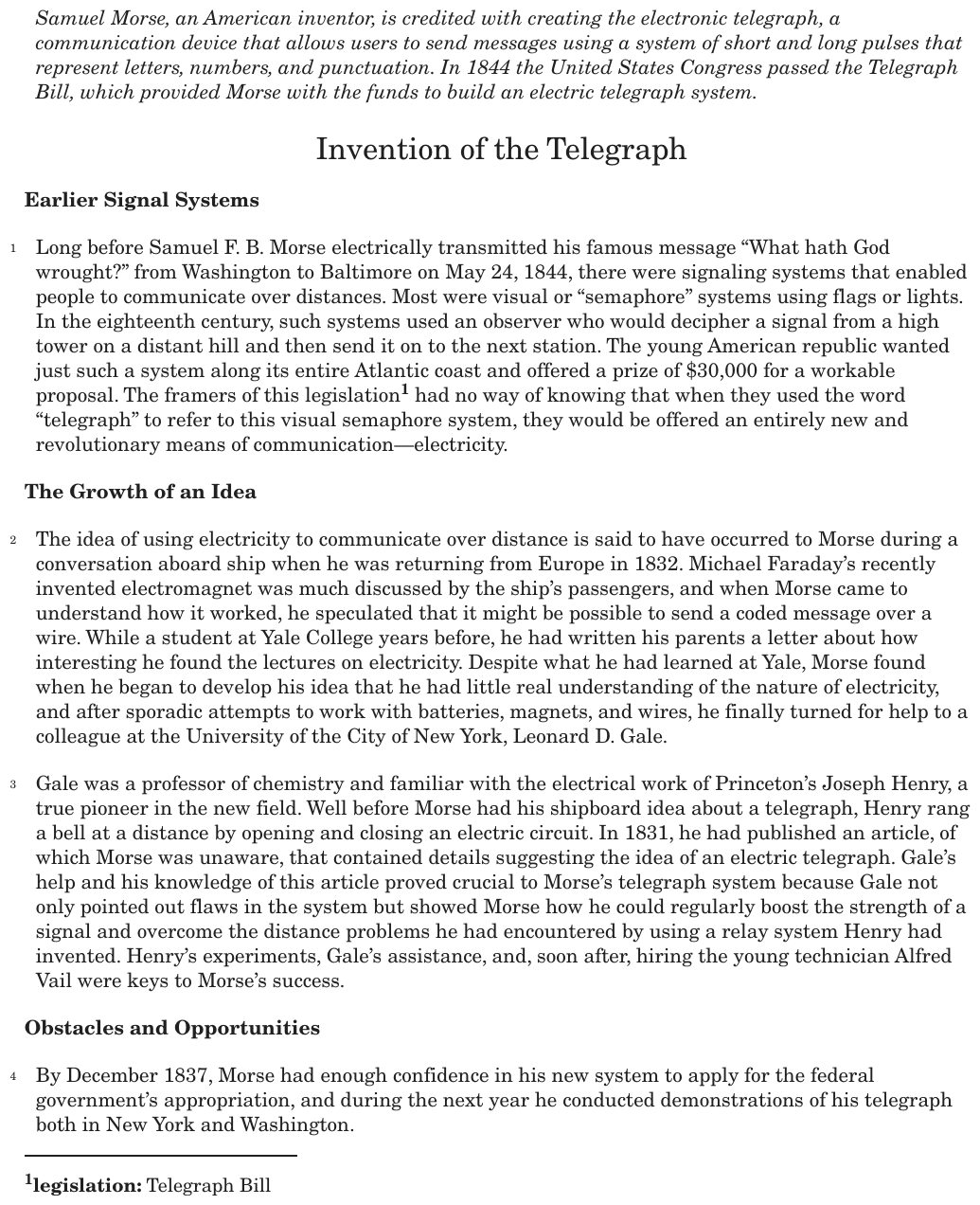
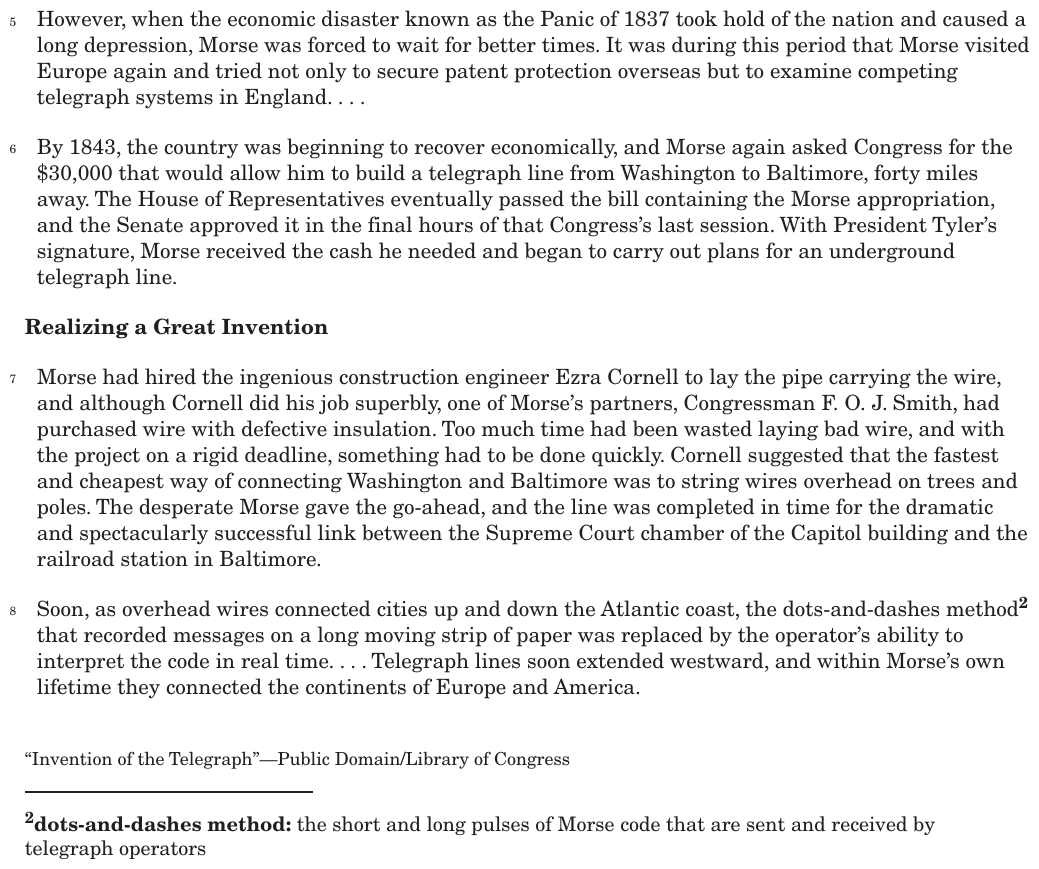
The passage “Invention of the Telegraph” as printed (pages 146–148)
Question 2 of 6
2024 Test A English, question 20Passage At Dusk
At Dusk
by Natasha Trethewey
At first I think she is calling a child,
my neighbor, leaning through her doorway
at dusk, street lamps just starting to hum
the backdrop of evening. Then I hear
the high-pitched wheedling1 we send out
to animals who know only sound, not
the meanings of our words—here here—
nor how they sometimes fall short.
In another yard, beyond my neighbor’s
sight, the cat lifts her ears, turns first
toward the voice, then back
to the constellation of fireflies flickering
near her head. It’s as if she can’t decide
whether to leap over the low hedge,
the neat row of flowers, and bound
onto the porch, into the steady circle
of light, or stay where she is: luminous
possibility—all that would keep her
away from home—flitting before her.
I listen as my neighbor’s voice trails off.
She’s given up calling for now, left me
to imagine her inside the house waiting,
perhaps in a chair in front of the TV,
or walking around, doing small tasks;
left me to wonder that I too might lift
my voice, sure of someone out there,
send it over the lines stitching here
to there, certain the sounds I make
are enough to call someone home.
“At Dusk” from NATIVE GUARD by Natasha Trethewey, published by Houghton Mifflin Company. Copyright © 2006 by Natasha Trethewey. All rights reserved.
1wheedling: speaking in a flattering manner
Question
The isolation of the words “—here here—” in line 7 contributes to the meaning of the poem mainly by
- Ademonstrating how people try to communicate in familiar ways but are still sometimes misunderstood.
- Bshowing how people can feel desperate to connect with others but give up quickly when their first attempts are ignored.
- Cusing the unspoken bond between the neighbor and her cat to highlight the understanding people have with their pets.
- Dillustrating the use of a simple expression to call home those who are loved and missed.
Show the answer
Correct answer: D
The question asks how the isolation of the words “—here here—” in line 7 mainly contributes to the meaning of the poem.
A. Incorrect. The words “—here here—” do interrupt the speaker’s observation in lines 7–8 that “our words . . . / . . . sometimes fall short.” However, in lines 5–7, the speaker observes that the neighbor accompanies her words with a “high-pitched wheedling” that people “send out” because they are aware that animals “know only sound, not / the meanings of our words,” indicating that the neighbor does not actually expect her words to be understood. The description of the cat’s response in lines 10–11 (“the cat lifts her ears, turns first / toward the voice, then back”) does not suggest that the neighbor’s message is misunderstood but rather suggests that the cat prefers not to respond to it.
B. Incorrect. In lines 20–21, the “neighbor’s voice trails off,” and she does give up calling the cat. However, rather than any desperation to connect, the neighbor’s use of a “high-pitched wheedling” (line 5) simply indicates her understanding that the cat, like other animals, understands “only sound, not / the meanings of our words” (lines 6–7) such as “here here.” Furthermore, the neighbor does not give up quickly. In lines 21–22, the speaker says the neighbor has “given up calling for now” but is still “waiting” for the cat.
C. Incorrect. In lines 4–7, the speaker describes the neighbor calling to the cat with a “high-pitched wheedling.” The sound may indicate a bond between the neighbor and the cat because the neighbor does understand that animals “know only sound, not / the meanings of our words” (lines 6–7). However, the use of the words “here here” in line 7 does not indicate that bond, because they are used as an example of the type of words that animals do not understand.
D. CORRECT. The speaker’s initial thought in line 1 that the neighbor is calling a child, rather than a cat, suggests that the neighbor loves and misses the cat. Lines 4–7 then present the speaker’s observation that the neighbor uses a “high-pitched wheedling,” to emphasize the simple words of her call, “—here here—.” The idea that the words are an example of a simple expression used to call home a missed loved one is reinforced in lines 25–29, when the speaker is “left . . . to wonder” whether the speaker, too, “might lift / [his or her] voice” and be able “to call someone home.”
Question analysis
This reading question asks how setting off the words here here with dashes in line 7 adds to the meaning of At Dusk, Natasha Trethewey's poem about a neighbor calling her cat at nightfall. Students must work out what two plain, isolated words contribute to the whole poem, choosing among four readings about how people and animals communicate and connect.
- Grade level
- Grade 8 reading and task
- Compared with grade 7
- Above grade 7 Grade 7 students explain how a line adds to a poem, but here the feature is a tiny typographic choice, and its meaning has to be built from the whole poem rather than nearby lines, which goes beyond typical grade 7 work.
- Estimated difficulty
- Among the hardest on the SHSAT: a non-obvious approach, heavy reading, or a well-hidden trap.
- Thinking it demands
- Depth of knowledge 3, strategic thinking · mainly analyze
- What makes it hard
- A very close wrong answer major
- Evidence in several places moderate
- How, not what moderate
- Evidence
- Answered from the whole text
- Reading level
- Passage: 236 words (a poem; reading level not measured); question and choices: about grade 9, 87 words.
- Corrected from the DOE handbook
- A grammar slip in the explanation was corrected.
- Students, last 30 days
- Not enough answers yet to show (it takes 10).
Why it is hard, traps and wrong answers (shows the answer)
Why it is hard
The words sit inside a sentence about animals not knowing the meanings of our words and about words that “sometimes fall short,” so the nearest lines point toward miscommunication. The poem's frame points elsewhere: it opens with a call that sounds like a parent's, ends with the speaker hoping a voice can “call someone home,” and even repeats “here” in line 27. Students who read only around line 7 choose the misunderstanding; those who connect the isolated call to the first and last lines see what it is for.
A very close wrong answer major Choosing the answer
The misunderstanding choice and the right one agree that “here here” is a familiar way of calling; they part only on what it shows, failed communication or a call home to someone missed. (Embretson & Wetzel, 1987; Gorin & Embretson, 2006; Ascalon et al., 2007)
Evidence in several places moderate Working it out
The right reading rests on lines far from line 7: the speaker's first guess that a child is being called, and the last line's wish “to call someone home.” (Kirsch & Mosenthal, 1990; Gorin & Embretson, 2006)
How, not what moderate Working it out
The question asks what setting two words apart with dashes and italics does for the poem, a typographic choice whose purpose the poem never explains. (Anderson & Krathwohl, 2001)
Strategy: Ask what the two words are meant to do and whom they are aimed at, then keep the choice that the poem's other lines confirm.
Traps
- Wrong purpose or structure: Names a purpose, structure or effect that the part does not serve, or describes what a part says when the question asks what it does.
- Twists what the text says: Uses the text's topic and ideas but changes what it says: who did it, how much, when, or why.
- Reads too much in: A reasonable-sounding conclusion that goes further than the text allows.
The wrong answers, classified
A Wrong purpose or structure (Anderson & Krathwohl, 2001)
Reads the words through line 8's “sometimes fall short” as failed communication, but the cat does hear and turn toward the call, and the ending hopes such sounds can bring someone home.
B Twists what the text says (King et al., 2004)
Sees the neighbor stop calling and calls her desperate and quick to quit, though she has given up only “for now” and is still waiting inside.
C Reads too much in (Graesser, Singer & Trabasso, 1994)
Assumes an owner and a pet share a silent understanding, but “here here” is spoken aloud, and the poem offers it as words animals cannot follow.
What was corrected from the DOE handbook, and why
- Explanation: In rejecting choice C, the handbook reads “the use of the words “here here” in line 7 do not indicate that bond.” It now reads “does not,” to agree with “use.”
Working it out, step by step
Figure out what the question asks
In line 7 the words here here are set apart by dashes and slanted letters (italics). The question asks what this does for the poem’s meaning. Think about what the words are for and who they are aimed at.
Look at line 7
Line 7 reads “the meanings of our words—here here—.” These are the words the neighbor calls to her cat. Setting them apart lets you hear them, as if spoken aloud. They are simple words that mean “come here.” Lines 6–7 say animals know “only sound, not / the meanings of our words.”
Connect to the start and end
In line 1 the speaker first thinks the neighbor “is calling a child.” So the call sounds like a parent calling someone they love. The poem ends with the hope that a voice can be “enough to call someone home” (line 29). So here here is a simple call to bring a loved one home.
Check each choice
- A is wrong. The cat isn’t confused. She “lifts her ears” and turns “toward the voice.” She just doesn’t come yet.
- B is wrong. The neighbor isn’t shown as desperate. She stops only “for now,” and the speaker pictures her waiting inside.
- C is wrong. Here here is spoken out loud. The poem treats it as words animals don’t understand, not a silent bond.
- D is right. It is a simple call to someone loved and missed.
Watch out: Line 8 says words “sometimes fall short,” which points toward A. But read the first and last lines too.
Choose the answer
The two words stand for the simple call people use to bring loved ones home. So the answer is D.
Why this answer and not the closest wrong one
A is the closest wrong answer, because line 8 says our words “sometimes fall short.” But the cat does hear the call and turn toward it. And the poem ends by hoping the sounds “are enough to call someone home.” D links the two words to that wish, and to the first guess that a child is being called.
More questions like this
The original DOE question
The passage “At Dusk” as printed (page 48)
Question 3 of 6
2024 Test B English, question 55Passage Excerpt from “The Past and the Future of the Earth’s Oldest Trees”
Excerpt from “The Past and the Future of the Earth’s Oldest Trees”
by Alex Ross
About forty-five hundred years ago, not long after the completion of the Great Pyramid at Giza, a seed of Pinus longaeva, the Great Basin bristlecone pine, landed on a steep slope in what are now known as the White Mountains, in eastern California. The seed may have travelled there on a gust of wind, its flight aided by a winglike attachment to the nut. Or it could have been planted by a bird known as the Clark’s nutcracker, which likes to hide pine seeds in caches; nutcrackers have phenomenal spatial1 memory and can recall thousands of such caches. This seed, however, lay undisturbed. On a moist day in fall, or in the wake of melting snows in spring, a seedling appeared above ground—a stubby one-inch stem with a tuft of bright-green shoots.
Most seedlings die within a year; the mortality rate is more than ninety-nine percent. The survivors are sometimes seen growing in the shadow of a fallen tree. The landscape of the Ancient Bristlecone Pine Forest, as this area of the White Mountains is called, is littered with fragments of dead trees—trunks, limbs, roots, and smaller chunks. Pinus longaeva grows exclusively in subalpine regions of the Great Basin, which stretches from the eastern slopes of the Sierra Nevada to the Wasatch Range, in Utah. Conditions are generally too arid for the dead wood to rot; instead, it erodes, sanded down like rock. The remnants may harbor nutrients and fungi that help new trees grow. Bristlecones rise from the bones of their ancestors—a city within a cemetery.
Coast redwoods and giant sequoias, California’s gargantuan world-record-holding trees, can grow fifty feet or more in their first twenty years. Bristlecones rise agonizingly slowly. After four or five years, the seedling on the steep slope would have been just a few inches higher, sprouting needles in place of the embryonic shoots. The needles are a deep green, tough, resinous, and closely bunched in groups of five. On a mature tree, they live for fifty years or more. Decades may have passed before the tree was human height, and decades more before it resembled a conventional pine. Bristlecone saplings grow straight up, with relatively sparse foliage, looking like undernourished Christmas trees. After a few hundred years—by which time the Old Kingdom of Egypt had fallen—it was probably forty or fifty feet in height.
Many tree species live for hundreds of years. A smaller but not inconsiderable number, including the sequoias and certain yews, oaks, cypresses, and junipers, survive for thousands. Once a bristlecone has established itself in the unforgiving conditions of the White Mountains, it can last almost indefinitely. The trees tend to grow some distance from one another, so fires almost never destroy an entire stand. Because only a few other plant species can handle the dry, cold climate, the bristlecones face little competition. Unlike most plants, they tolerate dolomite soil, which is composed of a chalky type of limestone that is heavily alkaline and low in nutrients. As for insect threats, bristlecone wood is so dense that mountain-pine beetles and other pests can rarely burrow their way into it.
Empires rose and fell; wars raged; . . . and the tree from 2500 B.C. continued its implacable slow-motion existence, adding about two-hundredths of an inch to the diameter of its trunk each year. Minute changes in the tree-ring record make bristlecones an exceptionally useful source of data about changing conditions on Earth. When rains are heavier than normal, the rings widen. When volcanic eruptions cause global cooling, frost rings make the anomaly2 visible. . . .
As the millennia go by, bristlecones become contorted and wraithlike.3 The main stem, or leader, dies back. Entire branches, even the trunk itself, become fossils. At first glance, the tree may look dead. Such is the case of the forty-five-hundred-year-old tree that clings to life near the tourist path that now runs through the Ancient Bristlecone Pine Forest. Spears of dead wood jut into the air. The trunk is a marbled hulk stripped of bark, like driftwood thrown from a vanished ocean. A ribbon of live bark runs up one side, funneling water and nutrients to clumps of green needles high above. All told, the tree is an unprepossessing specimen; most people march past it without giving it a second glance. . . .
. . . No two super-elderly trees look alike, to the point where they have acquired the characteristics of individuals. Trees are prone to anthropomorphism; we project our dreams and our anxieties onto them. Bristlecones have been called elders, sentinels, sages. The possibility that climate change will cause their extinction has inspired a spate4 of alarmed news stories, although tree scientists tend to discount the idea that the bristlecones are in immediate danger. They have survived any number of catastrophes in the past; they may survive humanity.
From “The Past and the Future of the Earth’s Oldest Trees” by Alex Ross from THE NEW YORKER, January 20, 2020. Copyright © 2020 by Condé Nast. All rights reserved.
1spatial: relating to physical space
2anomaly: oddity
3wraithlike: ghostly
4spate: sudden abundance
Question
The details in paragraph 7 convey a central idea of the excerpt by suggesting that
- Athe success of the bristlecone pine lies in its ability to resist climate change.
- Bthe uncommon appearance of the bristlecone pine is related to its ability to survive.
- Cthe attachment that humans have to the bristlecone pine is understandable.
- Dthe longevity of the bristlecone pine continues to encourage experts.
Show the answer
Correct answer: D
The question asks which central idea of the excerpt is supported by the details in paragraph 7.
A. Incorrect. While paragraph 7 mentions the pines’ ability to survive climate change, the central idea is about the trees’ longevity. Surviving climate change is a part of the pines’ longevity, but just surviving climate change does not fully encompass the central idea of the excerpt.
B. Incorrect. Although the paragraph mentions that the “super-elderly trees” are each unique in appearance, their appearance does not directly connect to their ability to survive. The details in paragraph 7 emphasize the durability and longevity of the trees.
C. Incorrect. While the beginning of paragraph 7 expresses the idea that each bristlecone pine appears to be a unique individual and supports the idea that humans relate to the pines, the paragraph expresses a stronger central idea in the last two sentences about the pines’ survival.
D. CORRECT. The longevity of bristlecone pines is a central idea of the excerpt. Experts are encouraged that bristlecone pines have survived many catastrophes, and the details in the second half of paragraph 7 draw direct attention to the trees’ longevity.
Question analysis
Students explain how the details in paragraph 7, the closing paragraph of Alex Ross’s excerpt on bristlecone pines, convey a central idea of the whole piece. The paragraph moves from people seeing old trees as individuals to alarmed news stories and the views of tree scientists, so students must decide which thread ties to the excerpt’s main idea.
- Grade level
- Grade 8 reading and task
- Compared with grade 7
- Above grade 7 Grade 7 central idea questions often ask what a passage is mostly about. Here students must connect one closing paragraph that touches several topics to an idea of the whole excerpt, reading its details for what they imply as well as what they say.
- Estimated difficulty
- Hard: combines ideas, needs a plan, and has more than one tempting wrong answer.
- Thinking it demands
- Depth of knowledge 3, strategic thinking · mainly understand
- What makes it hard
- Reading between the lines major
- The right answer is reworded moderate
- Evidence in several places minor
- Evidence
- Answered from the whole text
- Reading level
- Passage: about grade 8, 851 words; question and choices: about grade 10, 63 words.
- Students, last 30 days
- Not enough answers yet to show (it takes 10).
Why it is hard, traps and wrong answers (shows the answer)
Why it is hard
Paragraph 7 moves through several topics, trees that look like individuals, people projecting feelings onto them, alarmed news and calm scientists, and only its last two sentences connect to the excerpt’s main idea. The strongest lure states a true point about human attachment that the paragraph does make, while the key has to be inferred from the scientists’ calm and the trees’ record of survival. Naming the central idea first, the trees’ extraordinary age, shows which thread of the paragraph serves it.
Reading between the lines major Working it out
Nothing in paragraph 7 says experts are encouraged; it has to be read from “tree scientists tend to discount the idea that the bristlecones are in immediate danger,” set against the “alarmed news stories.” (Graesser, Singer & Trabasso, 1994; Kintsch, 1998)
The right answer is reworded moderate Choosing the answer
The key speaks of “longevity” and of experts being encouraged, words the paragraph never uses, while two wrong choices repeat its “climate change” and “survive” and so look better anchored. (Freedle & Kostin, 1993; Kirsch & Mosenthal, 1990)
Evidence in several places minor Working it out
Recognizing longevity as a central idea draws on the whole excerpt: the tree from the time of the Great Pyramid in paragraph 1, its endurance in paragraph 4 and its ring record in paragraph 5. (Kirsch & Mosenthal, 1990; Gorin & Embretson, 2006)
Strategy: Name the central idea of the whole excerpt first, then reread paragraph 7 and find the sentences that connect to it.
Traps
- True but not the answer: A choice says something accurate about the text that does not answer this question.
- Twists what the text says: Uses the text's topic and ideas but changes what it says: who did it, how much, when, or why.
- Reads too much in: A reasonable-sounding conclusion that goes further than the text allows.
The wrong answers, classified
A Twists what the text says (King et al., 2004)
Joins the paragraph’s mention of climate change to the trees’ survival and makes resisting it the secret of their success, but the paragraph only reports fears and gives no such cause.
B Reads too much in (Graesser, Singer & Trabasso, 1994)
Links the remark that no two old trees look alike to their survival, a connection paragraph 7 never draws; the detail shows only that they seem like individuals.
C True but not the answer (King et al., 2004; Embretson & Wetzel, 1987)
Relies on the paragraph’s real remarks about people calling the trees elders, sentinels and sages, but that human attachment is a side point, not a central idea of the excerpt.
Working it out, step by step
Figure out what the question asks
This asks how paragraph 7 connects to a central idea, a main point of the whole excerpt. So first name that idea. Then find which details in paragraph 7 point to it.
Name the excerpt’s central idea
The excerpt follows a tree that has lived about 4,500 years. Paragraph 1 starts its story near the time of the Great Pyramid. A settled bristlecone “can last almost indefinitely” (paragraph 4). Paragraph 5 shows a tree living on while empires “rose and fell.” So a central idea is the bristlecone’s amazing longevity, or long life.
Find the matching details in paragraph 7
Paragraph 7 first says people treat the old trees almost like persons. Then it turns to climate change. News stories sound alarmed, “although tree scientists tend to discount the idea that the bristlecones are in immediate danger.” To discount an idea is to doubt it. The last sentence gives the reason: “They have survived any number of catastrophes in the past; they may survive humanity.”
Explain what the details suggest
A catastrophe is a terrible disaster. The trees have lived through so many disasters that scientists are not very worried. In other words, the trees’ long record of survival gives the experts hope. That ties paragraph 7 to the central idea of longevity.
Check each choice
- A does not fit. Climate change comes up only as a fear in the news. The paragraph never says the trees succeed by resisting it.
- B does not fit. Paragraph 7 says no two old trees look alike, but it never links their looks to their survival.
- C does not fit. People do call the trees “elders, sentinels, sages,” but that feeling is a side point, not a central idea.
- D fits. Experts take comfort from how long the trees have survived.
Choose the answer
Paragraph 7 ends on the trees’ long survival and the experts’ calm about their future. So the answer is D.
Why this answer and not the closest wrong one
C is the strongest trap, because paragraph 7 really does say people feel close to the trees. But the question asks for a central idea of the whole excerpt. Long life runs through every paragraph, and the last two sentences of paragraph 7 tie into it. That is why D fits better.
More questions like this
The original DOE question

The passage “Excerpt from “The Past and the Future of the Earth’s Oldest Trees”” as printed (pages 193–194)
Question 4 of 6
2024 Test A Math, question 18Question
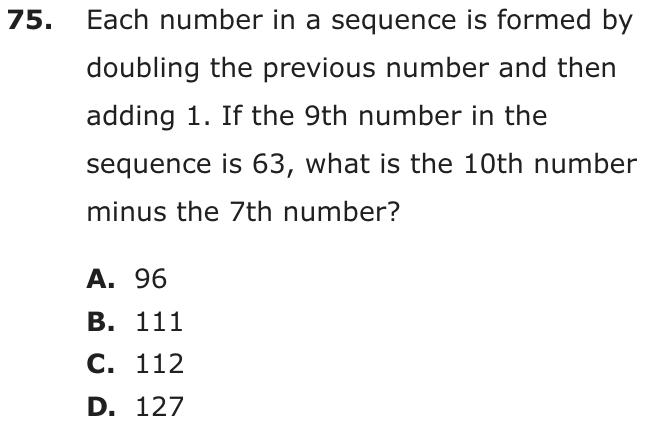
Each number in a sequence is formed by doubling the previous number and then adding 1. If the 9th number in the sequence is 63, what is the 10th number minus the 7th number?
- A96
- B111
- C112
- D127
Show the answer
Correct answer: C
First, write an equation based on the rule described in the item. Let x be the previous number in the sequence and y be the number in the sequence. The ninth number in the sequence is 63.
Determine the 10th number in the sequence, y, by making and solving:
Determine the 8th number in the sequence, x, by making and solving:
Subtract one from both sides of the equation.
Determine the 7th number in the sequence, x, by making and solving:
Subtract the 7th number in the sequence from the 10th number:
The difference is 112.
Question analysis
A sequence question: each number is found by doubling the one before it and adding 1, and the 9th number is 63. Students find the 10th number minus the 7th. That means running the rule forward once and backward twice, while keeping track of which position each number holds.
- Grade level
- Grade 7 content, by NYS standard
- Compared with grade 7
- Above grade 7 Grade 7 students solve two-step equations but rarely have to run a rule backward through a sequence. This mixes forward and backward steps with position counting, so it asks for more planning than a typical grade 7 task.
- Estimated difficulty
- Hard: combines ideas, needs a plan, and has more than one tempting wrong answer.
- Thinking it demands
- Depth of knowledge 2, skills and concepts · mainly apply
- What makes it hard
- No obvious method moderate
- Many steps moderate
- Much to keep track of minor
- Solution
- 4 steps
- Reading level
- Question and choices: about grade 7, 32 words.
- Corrected from the DOE handbook
- A misplaced parenthesis in the explanation’s working was corrected.
- Students, last 30 days
- Not enough answers yet to show (it takes 10).
Why it is hard, traps and wrong answers (shows the answer)
Why it is hard
Applying the rule forward is routine; running it backward is not, and the question needs both. Students must also count positions carefully, since the 9th number is given and the 7th is two steps back, not one. Each listed wrong answer stops or slips at a different stage, so writing the four numbers in a row, 15, 31, 63 and 127, before subtracting is the reliable way.
No obvious method moderate Working it out
The rule is stated only forward, double and add 1, but the 7th and 8th numbers come before the given 9th, so the rule must be undone: subtract 1, then halve. (Schoenfeld, 1985)
Many steps moderate Working it out
One forward step reaches the 10th number, 127, two backward steps reach the 8th and 7th, 31 and 15, and a final subtraction finishes. (Daniel & Embretson, 2010; Enright, Morley & Sheehan, 2002)
Much to keep track of minor Working it out
Four positions and their values, 7th to 10th, have to be kept straight, and the 8th number is easy to mistake for the 7th. (Sweller, 1988; Carpenter, Just & Shell, 1990)
Strategy: Apply the rule to 63 to get the 10th number; to go back a position, subtract 1 and halve, doing it twice to reach the 7th; then subtract.
Traps
- Counting the ends: Inclusive or exclusive ends, fence posts, consecutive numbers: an answer that is one too many or too few, or an endpoint drawn open where it belongs closed (or the reverse).
- Stops one step early: A choice is a number from partway through the solution.
The wrong answers, classified
A Counting the ends (Brown & Burton, 1978)
Steps back only once from the 9th number and subtracts the 8th, 127 − 31 = 96, one position short of the 7th.
B Misreads the question (Hegarty, Mayer & Monk, 1995)
Doubles 63 to 126 but forgets to add 1 on that step, then subtracts the correct 7th number: 126 − 15 = 111.
D Stops one step early (King et al., 2004; Gierl et al., 2017)
Finds the 10th number, 2 × 63 + 1 = 127, and stops without subtracting the 7th number from it.
What was corrected from the DOE handbook, and why
- Explanation: Finding the 7th number, the handbook writes “2x + (1 − 1 = 31 − 1)”, with the closing parenthesis after the whole equation, so the line reads as an equation inside an expression (and 1 − 1 = 31 − 1 is false). The site now reads 2x + (1 − 1) = 31 − 1, the same step the handbook writes correctly for the 8th number (2x + (1 − 1) = 63 − 1). It leads to 2x = 30 and x = 15 as before.
Worked solution, step by step
Formulas used
- The sequence rule
- A sequence is a list of numbers that follows a rule. x is a number in the list, and y is the next number. To get the next number, double x and then add 1.
- Going back one number
- y is a number in the list, and x is the one just before it. To go back, undo the rule in reverse order. The rule doubles and then adds 1. So first subtract 1, then divide by 2.
Sort out the question
Each number is “formed by doubling the previous number and then adding 1”. Previous means the one just before. The 9th number is 63. You need the 10th number minus the 7th number. So you go forward one number and back two numbers.
Find the 10th number
Use the rule with x = 63.
The 10th number is 127. Watch out: remember to add 1. Doubling only gives 126 and leads to 111, choice B.
Plan how to go back
The 7th number comes before the 9th, so you must undo the rule. The rule doubled, then added 1. Undo the last step first: subtract 1. Then undo the doubling: divide by 2.
Find the 8th number
The 8th number is 31. Watch out: 31 is the 8th number, not the 7th. Using it gives , choice A.
Find the 7th number
Step back once more, from the 8th number. Use the same rule with y = 31.
The 7th number is 15.
Subtract the 7th from the 10th
Watch out: 127 alone is choice D. You still have to subtract the 7th number. So the answer is C, 112.
Check your answer
Go forward from 15 using the rule. , then , then . You land on 63 as the 9th number, so the list is right. And .
More questions like this
The original DOE question
Question 5 of 6
2018 Test A Math, question 1Question
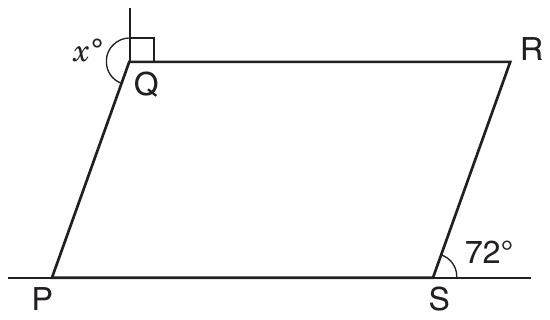
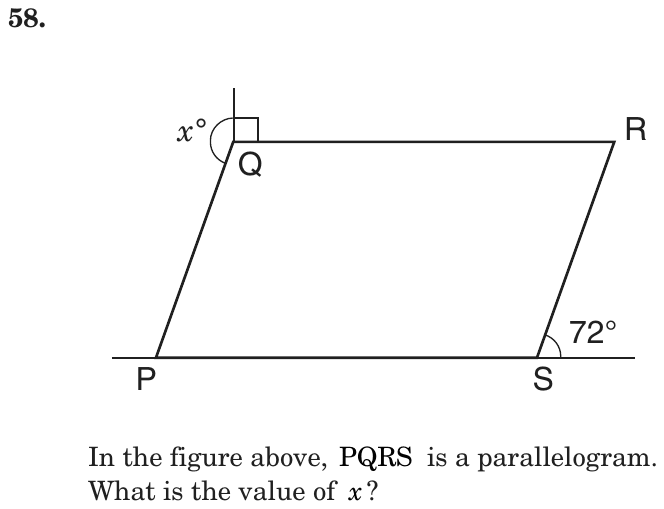
In the figure above, PQRS is a parallelogram. What is the value of ?
Grid-in question: work out the answer and enter it as a number.
Show the answer
Correct answer: 162
First, find the measure of angle PQR. The measure of angle PQR is equal to the measure of angle PSR.
m∠PSR = 180 − 72 = 108.
So, the measure of angle PQR is also 108.
108 + 90 + x = 360
198 + x = 360
x = 162
Question analysis
A grid-in geometry question about angles around a parallelogram PQRS. A 72° angle sits outside corner S on the extended base, and at corner Q a right angle and the unknown angle x complete the turn around the point. Students chain three angle facts, and the angle asked for lies outside the shape, not inside it.
- NYS standards
- Grade level
- Grade 8 content, by NYS standard
- Compared with grade 7
- Above grade 7 Grade 7 angle work usually applies one or two facts, such as supplementary or vertical angles, to find an angle. This chains three, and needs the equal opposite angles of a parallelogram, which rest on grade 8 parallel-line facts.
- Estimated difficulty
- Hard: combines ideas, needs a plan, and has more than one tempting wrong answer.
- Thinking it demands
- Depth of knowledge 2, skills and concepts · mainly apply
- What makes it hard
- Reading a figure, table or graph major
- Combines ideas moderate
- An answer in an unexpected form minor
- Solution
- 3 steps
- Reading level
- Question and choices: about grade 7, 14 words.
- Students, last 30 days
- Not enough answers yet to show (it takes 10).
Why it is hard, traps and wrong answers (shows the answer)
Why it is hard
The arithmetic is two subtractions; the difficulty is seeing which angles the marks refer to. Students lose points by treating the 72° as the parallelogram's own angle at S, or by stopping at angle PQR, the most natural number to grid. The question rewards tracing a route from S to Q before computing anything, and checking at the end that x is the angle outside the shape that the arc marks.
Reading a figure, table or graph major Understanding the question
The 72° is marked outside the parallelogram, between side SR and the base extended past S, and x sits outside corner Q, between QP and a vertical ray that meets QR at a right-angle mark. (Lesh, Post & Behr, 1987; Kirsch & Mosenthal, 1990)
Combines ideas moderate Working it out
Three angle facts have to be chained: a straight line gives the angle inside S, opposite angles of a parallelogram carry it to Q, and the angles around Q make a full 360° turn. (Embretson, 1998; Daniel & Embretson, 2010)
An answer in an unexpected form minor Choosing the answer
As a grid-in there are no choices to check against, so a student who stops at angle PQR, inside the parallelogram, gets no signal that the job is unfinished. (Enright, Morley & Sheehan, 2002)
Strategy: Use the straight line at S to find the parallelogram's angle there, carry it to the opposite corner Q, then take that angle and the right angle away from 360.
Traps
- Stops one step early: A choice is a number from partway through the solution.
The wrong answers, classified
108 Stops one step early (King et al., 2004; Gierl et al., 2017)
Finds angle PSR = 180 − 72 = 108 and carries it to angle PQR, then grids that interior angle instead of the angle x outside it.
198 Misreads the figure (Lesh, Post & Behr, 1987; Kirsch & Mosenthal, 1990)
Reads the 72° as the parallelogram's interior angle at S, so takes angle PQR as 72 and grids 360 − 90 − 72 = 198.
252 Misreads the figure (Lesh, Post & Behr, 1987; Kirsch & Mosenthal, 1990)
Overlooks the right-angle mark at Q and subtracts only the 108° angle PQR from 360, giving 252.
Worked solution, step by step
Formulas used
- Angles on a straight line
- a and b are two angles side by side on a straight line. Together they make a half turn, so they always add up to 180 degrees. Use it when an angle you need shares a straight line with an angle you know.
- Opposite angles of a parallelogram
- The symbol ∠ means angle. ∠PQR is the angle at corner Q, between sides QP and QR. ∠PSR is the angle at the opposite corner, S. In a parallelogram, opposite corners always have equal angles, because the shape leans the same way at both.
- Angles around a point
- a, b and c are angles that fit around one point with no gaps and no overlaps. Going all the way around is a full turn, which is 360 degrees. So the angles add up to 360.
Sort out what the figure shows
PQRS is a parallelogram. That is a four-sided shape whose opposite sides are parallel, which means they never meet. You need the value of x, in degrees.
Look closely at the marks. The 72° angle is outside the shape, at S. It sits between side SR and the base line, which keeps going past S. At Q, a vertical line meets side QR. The small square means a right angle, 90°. The angle x is outside the shape too. It runs from that vertical line around to side QP.
Find the angle inside corner S
Angle PSR is the shape’s own angle at S. It sits right next to the 72° angle, on the same straight base line. So the two angles add up to 180°.
So angle PSR is 108°. Watch out: 72° is not the inside angle at S. Using 72 as the inside angle leads to the wrong answer 198.
Carry the angle over to Q
Corners Q and S are opposite each other. In a parallelogram, opposite angles are equal. So angle PQR matches angle PSR.
So angle PQR is 108°. Watch out: this is not x. Angle PQR is inside the shape, and x is outside it. Stopping here and gridding 108 is the most common mistake.
Add the angles around Q
Three angles fill the space all the way around point Q. They are the right angle (90°), angle PQR (108°) and x. Together they make a full turn.
Watch out: don’t skip the right angle at Q. Leaving out the 90 gives 252.
Solve for x
Subtract 198 from 360 to find what is left for x.
So x is 162°. So you would grid 162.
Check your answer
Add the three angles at Q: . That is a full turn. Also, the arc for x is wider than a right angle but not as wide as a straight line. So x should be between 90° and 180°, and 162° is.
More questions like this
The original DOE question
Question 6 of 6
2026 Practice Test D Math, question 35Question
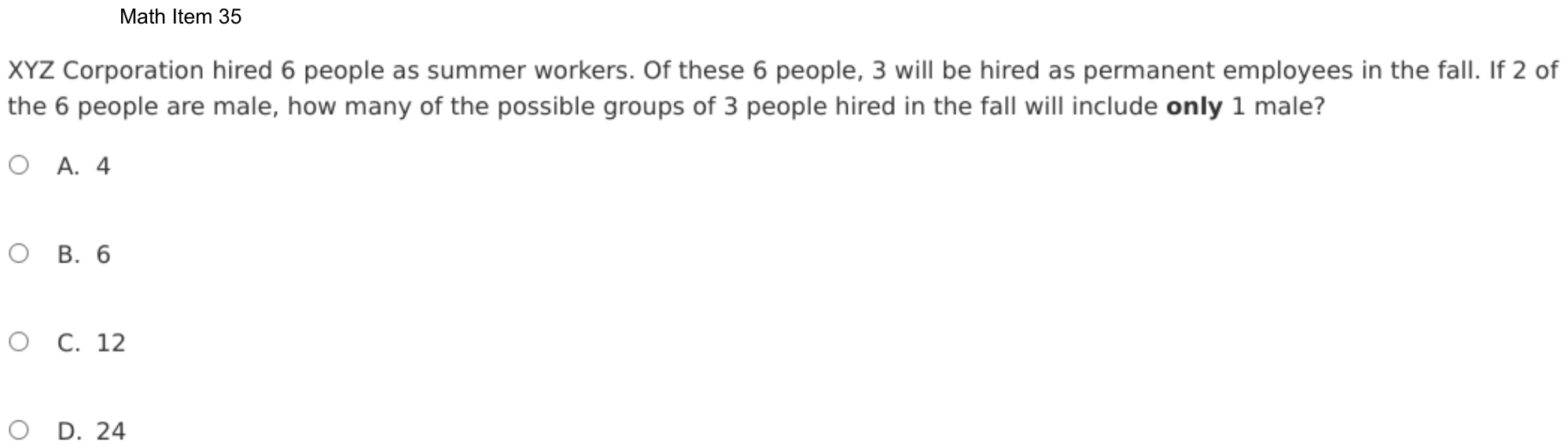
XYZ Corporation hired 6 people as summer workers. Of these 6 people, 3 will be hired as permanent employees in the fall. If 2 of the 6 people are male, how many of the possible groups of 3 people hired in the fall will include only 1 male?
- A4
- B6
- C12
- D24
Show the answer
Correct answer: C
An organized list can be used to determine the number of groups of 3 people that include only 1 male.
Let the letters A, B, C, and D represent the females, and let the numbers 1 and 2 represent the males.
Then, create a list of all possible combinations of 3 people with only 1 male.
AB1, AB2, AC1, AC2, AD1, AD2
BC1, BC2, BD1, BD2
CD1, CD2
There are 12 possible groups with only 1 male.
Question analysis
A company hired 6 summer workers, 2 of them male, and will keep 3 as permanent employees in the fall. This counting question asks how many possible groups of 3 include only 1 male. Students count combinations where order does not matter, and the bold word only, with two kinds of workers to combine, makes careful listing essential.
- NYS standards
- 7.SP.8b sample spaces for compound events
- Grade level
- Grade 7 content, by NYS standard
- Compared with grade 7
- Above grade 7 Grade 7 students list outcomes with organized lists and tree diagrams, usually ordered ones. Counting unordered groups of three under an "only one" condition, built from two kinds of people, goes beyond that typical work.
- Estimated difficulty
- Hard: combines ideas, needs a plan, and has more than one tempting wrong answer.
- Thinking it demands
- Depth of knowledge 2, skills and concepts · mainly apply
- What makes it hard
- Combines ideas moderate
- Something you must already know minor
- Turning words into math minor
- Solution
- 3 steps
- Reading level
- Question and choices: about grade 7, 41 words.
- Students, last 30 days
- Not enough answers yet to show (it takes 10).
Why it is hard, traps and wrong answers (shows the answer)
Why it is hard
The question hides a two-stage count in a hiring story. Students tend to get one stage right and forget the other: they count the pairs of women and stop, or they count ordered picks and so find every group twice. Naming the women A to D and the men 1 and 2, then listing the pairs of women alphabetically with each man attached, makes every group visible and checkable.
Combines ideas moderate Working it out
Two counts are joined: the 6 ways to pick 2 of the 4 women, then the 2 ways to pick the man, and the total is their product. (Embretson, 1998; Daniel & Embretson, 2010)
Something you must already know minor Working it out
Students must already know that a group is the same whichever order its members are named, so picking one woman and then another repeats the reverse pick. (Anderson & Krathwohl, 2001)
Turning words into math minor Understanding the question
The bold word only means exactly one man, so the other two places in each group of 3 must go to two of the 4 women, a step the stem leaves unsaid. (Hegarty, Mayer & Monk, 1995; Koedinger & Nathan, 2004)
Strategy: Name the women A to D and the men 1 and 2, list every pair of women without repeats, then attach each man to each pair and count the groups.
Traps
- Stops one step early: A choice is a number from partway through the solution.
- Overlapping groups: Things in two groups at once are counted twice, or not subtracted.
The wrong answers, classified
A Numbers taken from the question (Hegarty, Mayer & Monk, 1995)
Multiplies the 2 men by the 2 places left for women, 2 × 2 = 4, using numbers from the question without listing a single group.
B Stops one step early (King et al., 2004; Gierl et al., 2017)
Counts the 6 pairs of women correctly but stops before pairing each one with either of the 2 men, which doubles the count.
D Overlapping groups (King et al., 2004)
Counts ordered picks of the two women, 4 × 3 = 12 instead of 6, so each group appears twice, then doubles for the men to reach 24.
Worked solution, step by step
Formulas used
- Counting with two choices
- Each way of picking the man can go with each way of picking the two women. So you multiply the two counts. It is like outfits: 2 shirts with 6 pairs of pants make 12 outfits.
Sort out the question
Six people work for the summer. Two are male, so the other 4 are female. Three will be hired in the fall.
You need the number of groups of 3 with only 1 male. That means exactly 1 man and 2 women. In a group, order does not matter. Ann, Bea and Carl is the same group as Carl, Ann and Bea.
Give each person a name
Call the women A, B, C and D. Call the men 1 and 2. Every group you want has 2 letters and 1 number, like AB1.
List the pairs of women
List each pair once. Start with A, then pair B only with letters after it, and so on:
- AB, AC, AD
- BC, BD
- CD
That is 6 pairs. BA is not new, since it is the same pair as AB.
Watch out: counting the order gives pairs, each one twice. Then doubling for the men gives 24, choice D.
Add a man to each pair
Each pair of women can go with man 1 or man 2. Use the counting rule:
Watch out: stopping at the 6 pairs of women leaves out the men. That gives 6, choice B.
So the answer is C, 12.
Check your answer
Write out every group. With man 1: AB1, AC1, AD1, BC1, BD1, CD1. With man 2: AB2, AC2, AD2, BC2, BD2, CD2. Each list has 6 groups, and . No group repeats, and each has just one man.
More questions like this
The original DOE question