3 English and 3 math
Here are 6 random questions to try. Takers earning below 75% are unlikely to receive an offer. You have 1 minute 48 seconds per question on the real exam.
Question 1 of 6
2024 Test B English, question 40Passage Invention of the Telegraph
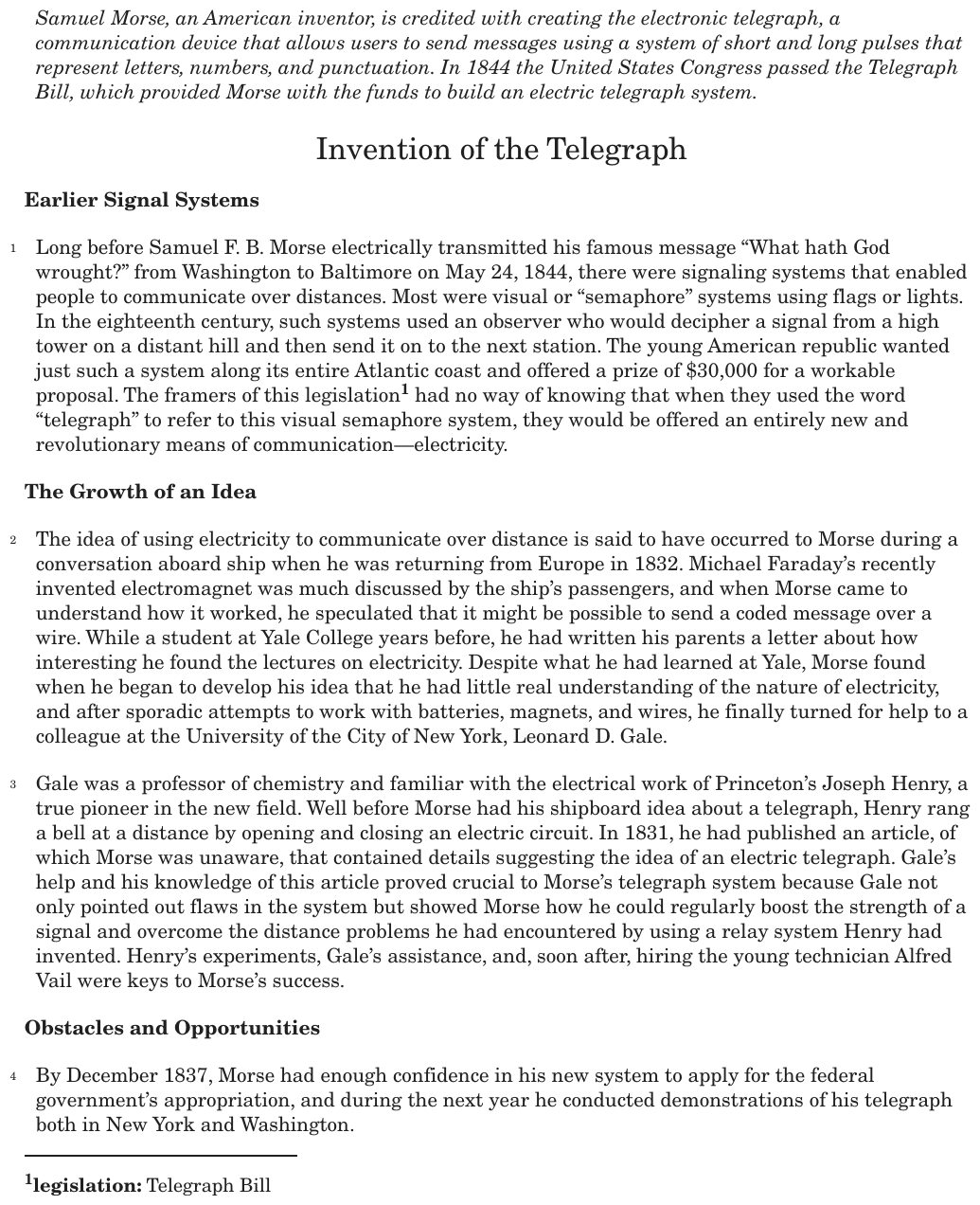
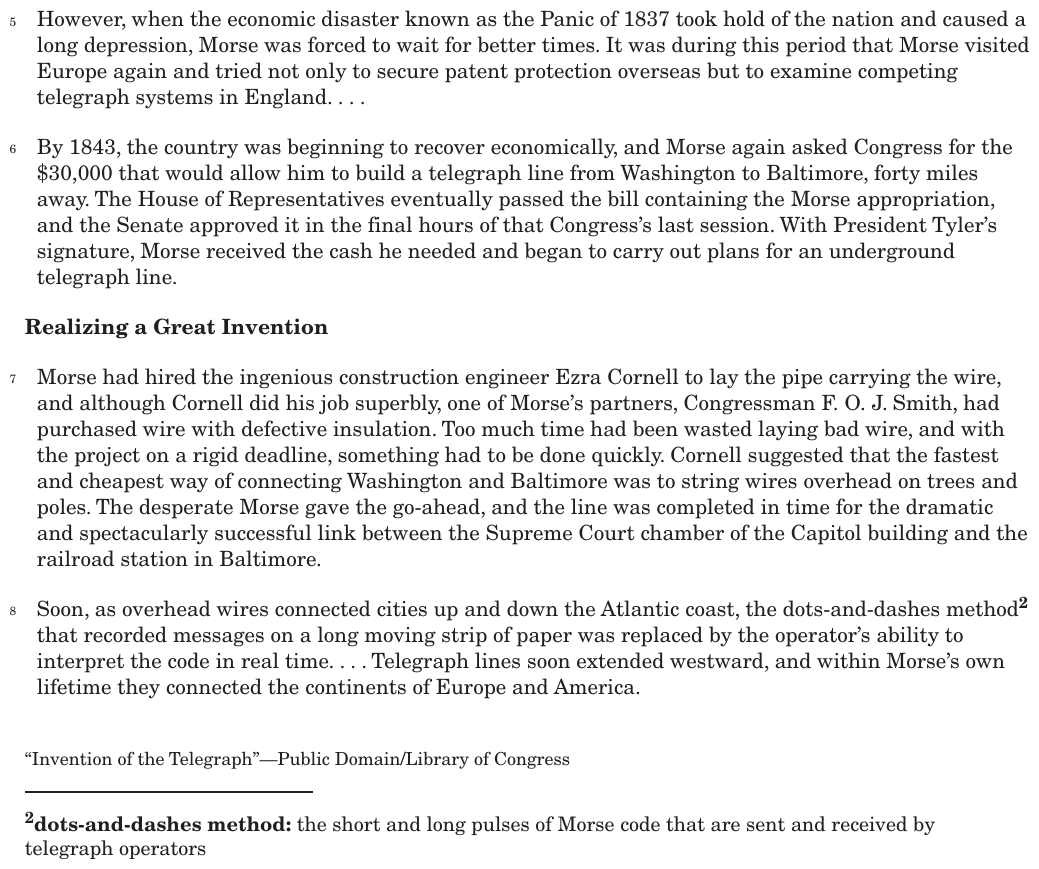
Samuel Morse, an American inventor, is credited with creating the electronic telegraph, a communication device that allows users to send messages using a system of short and long pulses that represent letters, numbers, and punctuation. In 1843 the United States Congress passed the Telegraph Bill, which provided Morse with the funds to build an electric telegraph system.
Invention of the Telegraph
Earlier Signal Systems
Long before Samuel F. B. Morse electrically transmitted his famous message “What hath God wrought?” from Washington to Baltimore on May 24, 1844, there were signaling systems that enabled people to communicate over distances. Most were visual or “semaphore” systems using flags or lights. In the eighteenth century, such systems used an observer who would decipher a signal from a high tower on a distant hill and then send it on to the next station. The young American republic wanted just such a system along its entire Atlantic coast and offered a prize of $30,000 for a workable proposal. The framers of this legislation had no way of knowing that when they used the word “telegraph” to refer to this visual semaphore system, they would be offered an entirely new and revolutionary means of communication—electricity.
The Growth of an Idea
The idea of using electricity to communicate over distance is said to have occurred to Morse during a conversation aboard ship when he was returning from Europe in 1832. Michael Faraday’s recently invented electromagnet was much discussed by the ship’s passengers, and when Morse came to understand how it worked, he speculated that it might be possible to send a coded message over a wire. While a student at Yale College years before, he had written his parents a letter about how interesting he found the lectures on electricity. Despite what he had learned at Yale, Morse found when he began to develop his idea that he had little real understanding of the nature of electricity, and after sporadic attempts to work with batteries, magnets, and wires, he finally turned for help to a colleague at the University of the City of New York, Leonard D. Gale.
Gale was a professor of chemistry and familiar with the electrical work of Princeton’s Joseph Henry, a true pioneer in the new field. Well before Morse had his shipboard idea about a telegraph, Henry rang a bell at a distance by opening and closing an electric circuit. In 1831, he had published an article, of which Morse was unaware, that contained details suggesting the idea of an electric telegraph. Gale’s help and his knowledge of this article proved crucial to Morse’s telegraph system because Gale not only pointed out flaws in the system but showed Morse how he could regularly boost the strength of a signal and overcome the distance problems he had encountered by using a relay system Henry had invented. Henry’s experiments, Gale’s assistance, and, soon after, hiring the young technician Alfred Vail were keys to Morse’s success.
Obstacles and Opportunities
By December 1837, Morse had enough confidence in his new system to apply for the federal government’s appropriation, and during the next year he conducted demonstrations of his telegraph both in New York and Washington.
However, when the economic disaster known as the Panic of 1837 took hold of the nation and caused a long depression, Morse was forced to wait for better times. It was during this period that Morse visited Europe again and tried not only to secure patent protection overseas but to examine competing telegraph systems in England. . . .
By 1843, the country was beginning to recover economically, and Morse again asked Congress for the $30,000 that would allow him to build a telegraph line from Washington to Baltimore, forty miles away. The House of Representatives eventually passed the bill containing the Morse appropriation, and the Senate approved it in the final hours of that Congress’s last session. With President Tyler’s signature, Morse received the cash he needed and began to carry out plans for an underground telegraph line.
Realizing a Great Invention
Morse had hired the ingenious construction engineer Ezra Cornell to lay the pipe carrying the wire, and although Cornell did his job superbly, one of Morse’s partners, Congressman F. O. J. Smith, had purchased wire with defective insulation. Too much time had been wasted laying bad wire, and with the project on a rigid deadline, something had to be done quickly. Cornell suggested that the fastest and cheapest way of connecting Washington and Baltimore was to string wires overhead on trees and poles. The desperate Morse gave the go-ahead, and the line was completed in time for the dramatic and spectacularly successful link between the Supreme Court chamber of the Capitol building and the railroad station in Baltimore.
Soon, as overhead wires connected cities up and down the Atlantic coast, the dots-and-dashes method that recorded messages on a long moving strip of paper was replaced by the operator’s ability to interpret the code in real time. . . . Telegraph lines soon extended westward, and within Morse’s own lifetime they connected the continents of Europe and America.
“Invention of the Telegraph”—Public Domain/Library of Congress
legislation: Telegraph Bill
dots-and-dashes method: the short and long pulses of Morse code that are sent and received by telegraph operators
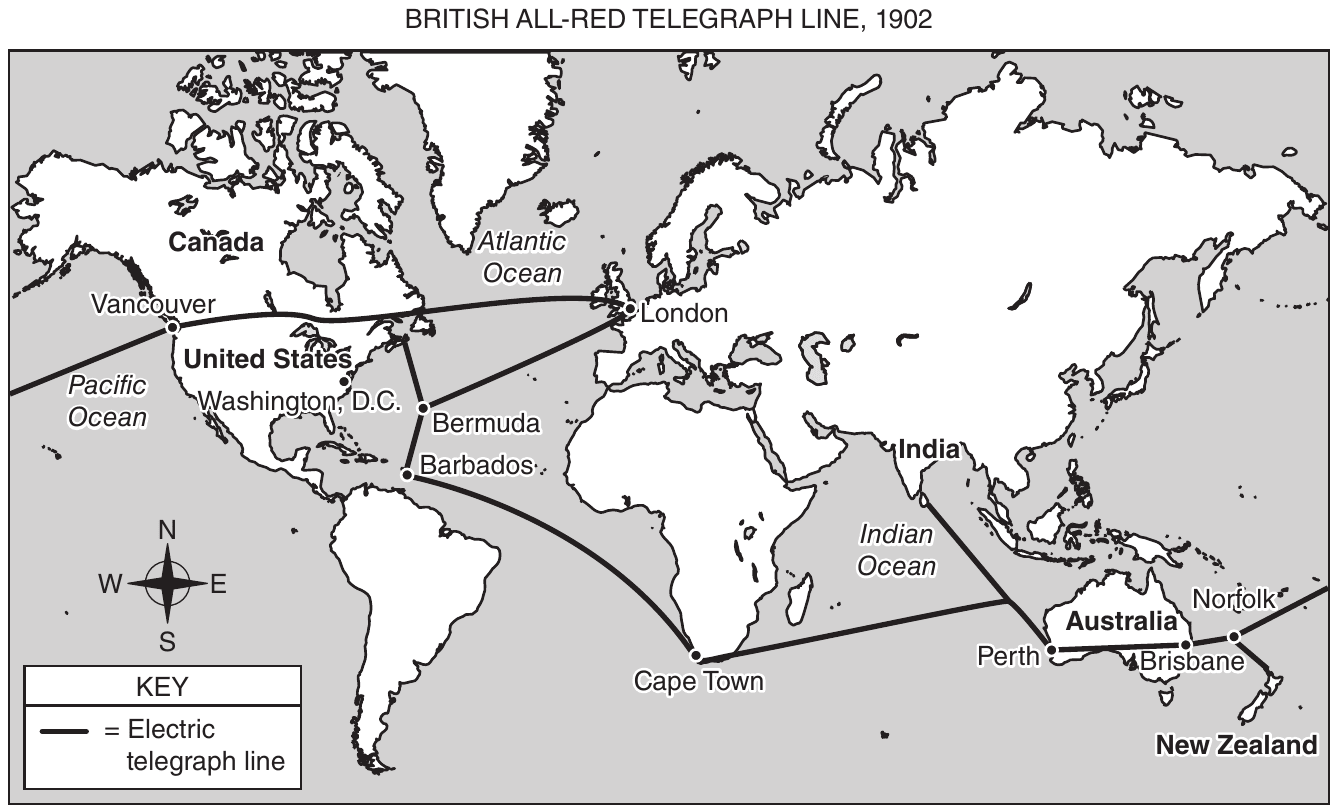
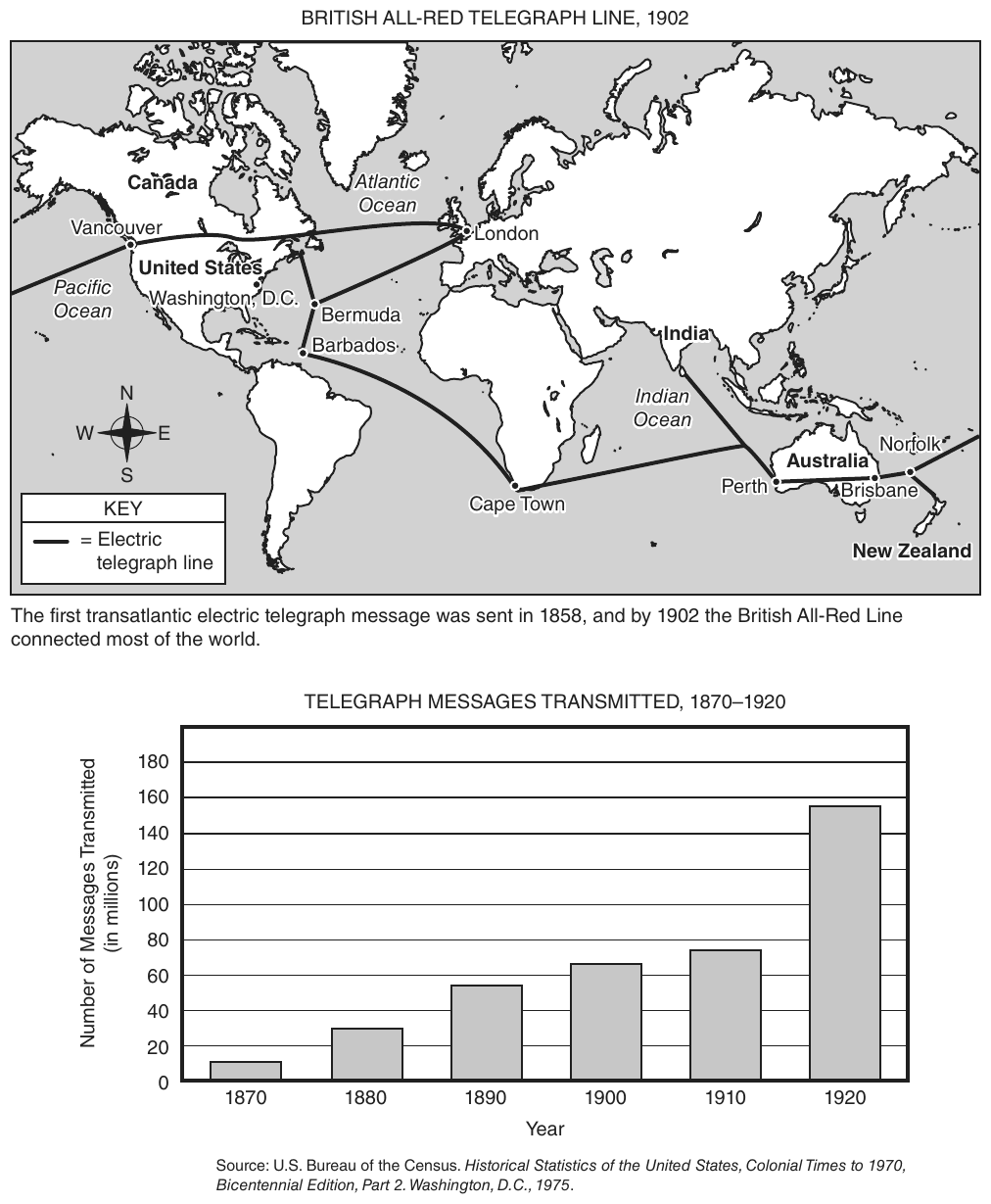
The first transatlantic electric telegraph message was sent in 1858, and by 1902 the British All-Red Line connected most of the world.
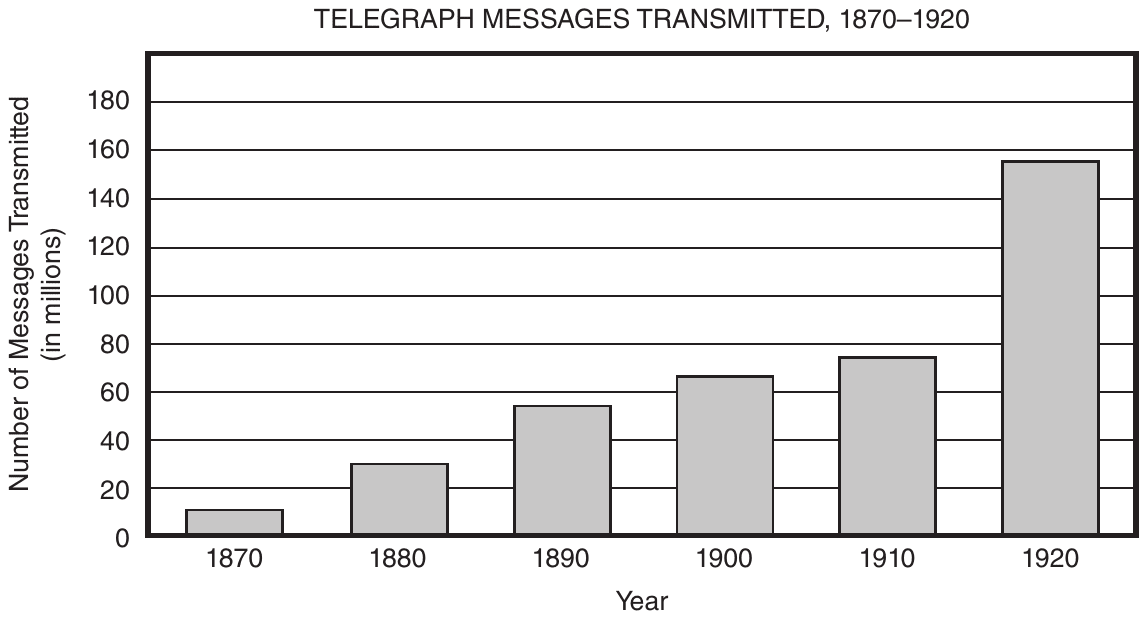
Source: U.S. Bureau of the Census. Historical Statistics of the United States, Colonial Times to 1970, Bicentennial Edition, Part 2. Washington, D.C., 1975.
Question
How does the map provide additional support for a central idea of the passage?
- Aby demonstrating that Morse’s telegraph system greatly exceeded the limitations of previous long-distance communication systems
- Bby indicating that Morse was lacking foresight by seeking a patent only in North America
- Cby proving that Gale’s advice helped Morse extend the telegraph’s range much farther than first thought possible
- Dby showing that the Morse telegraph had a surprisingly immense influence across the world
Show the answer
Correct answer: A
The question asks how the map provides additional support for a central idea of the passage.
A. CORRECT. The map shows the telegraph line crossing continents in 1902, just forty-four years after the first transatlantic message was sent in 1858. This is a much greater distance than the first line Morse built between “the Supreme Court chamber of the Capitol building and the railroad station in Baltimore” (paragraph 7).
B. Incorrect. The map shows the distance the line covers; it does not indicate Morse’s lack of foresight in seeking patents only in North America.
C. Incorrect. While Gale’s advice was crucial to Morse’s success, the map shows the physical line stretching across continents many years later, after their initial work.
D. Incorrect. While it can be inferred that the telegraph had influence across the world, the amount of influence cannot be determined.
Question analysis
This question pairs “Invention of the Telegraph” with a map of the British All-Red Telegraph Line in 1902 and asks how the map adds support for a central idea of the passage. Students must read a world map with a key and a caption, connect what it shows to the story of Samuel Morse’s invention, and sort through four claims about the map that vary in how far they go.
- Grade level
- Grade 8 reading and task
- Compared with grade 7
- Above grade 7 Linking a graphic to a text is familiar grade 7 work. Here students must pin down a central idea of the passage and work out how a 1902 world map, made decades after Morse’s first line, bears on it, a step beyond typical demand.
- Estimated difficulty
- Hard: combines ideas, needs a plan, and has more than one tempting wrong answer.
- Thinking it demands
- Depth of knowledge 3, strategic thinking · mainly analyze
- What makes it hard
- A very close wrong answer major
- Evidence in several places moderate
- Reading a figure, table or graph moderate
- Evidence
- Answered from the whole text
- Reading level
- Passage: about grade 11, 910 words; question and choices: about grade 11, 75 words.
- Corrected from the DOE handbook
- An inaccurate detail in the explanation was corrected.
- Students, last 30 days
- Not enough answers yet to show (it takes 10).
Why it is hard, traps and wrong answers (shows the answer)
Why it is hard
Lines on a map can prove how far the telegraph reached, and the question turns on how much more than that each choice claims. The key depends on a link back to paragraph 1, where a message went only as far as the next hilltop tower, read many minutes before the map. The influence choice skips that link and states the map’s message in bigger terms, so students who do not ask what a map of routes can show are drawn to it.
A very close wrong answer major Choosing the answer
The influence choice, a telegraph with “a surprisingly immense influence across the world,” sounds like a fair reading of lines circling the globe; it differs from the key in claiming impact and surprise rather than reach beyond earlier systems. (Embretson & Wetzel, 1987; Gorin & Embretson, 2006; Ascalon et al., 2007)
Evidence in several places moderate Working it out
The earlier systems the key measures against are in paragraph 1, towers on distant hills passing flag and light signals from station to station, far from the map at the end of the passage. (Kirsch & Mosenthal, 1990; Gorin & Embretson, 2006)
Reading a figure, table or graph moderate Understanding the question
The map shows a 1902 British line from London to Canada and Vancouver, south through Bermuda and Barbados to Cape Town, and on to India, Australia and New Zealand, with Washington left unconnected. (Lesh, Post & Behr, 1987; Kirsch & Mosenthal, 1990)
Strategy: Look at what the map and its caption actually show, sum up a central idea of the passage in your own words, and keep only a choice that both of them back up.
Traps
- Too broad or too strong: A choice overstates, generalizes, or uses absolute words the text does not support.
- Reads too much in: A reasonable-sounding conclusion that goes further than the text allows.
The wrong answers, classified
B Twists what the text says (King et al., 2004)
Reads the unconnected Washington dot as a patenting mistake of Morse’s, though a map of lines shows nothing about patents and paragraph 5 has him seeking protection overseas.
C Reads too much in (Graesser, Singer & Trabasso, 1994)
Remembers that Gale’s relay advice solved Morse’s “distance problems,” but a 1902 map that names no inventors cannot prove what that advice made possible decades earlier.
D Too broad or too strong (King et al., 2004)
Turns the map’s reach into a claim about impact, though routes on a map show where messages could travel, not how much the world changed or that anyone was surprised.
What was corrected from the DOE handbook, and why
- Explanation: The handbook says the 1902 line came “forty-four years after the first message was sent in 1858.” The first telegraph message was Morse’s in 1844 (paragraph 1); 1858 is the year of the first transatlantic message, as the map’s caption says. The site now says “the first transatlantic message.”
Working it out, step by step
Figure out what the question asks
This question asks how a graphic adds to the passage. You need two things. First, what does the map really show? Second, which central idea, a main point the whole passage builds, does it back up?
Read the map and its caption
This map is a picture of one British network of telegraph wires, as it stood in 1902. In its key, a thick black line stands for an electric telegraph line. From London, a line crosses the Atlantic Ocean and Canada to Vancouver. Other lines reach Bermuda, Barbados, Cape Town, India, Australia and New Zealand. According to the caption, by 1902 this network “connected most of the world.”
Recall the older ways of signaling
Next, compare that with paragraph 1. Before electricity, people signaled with flags or lights. An observer would “decipher a signal from a high tower on a distant hill and then send it on to the next station.” So a message could only jump as far as a person could see. Even Morse’s first line, in paragraph 6, reached Baltimore, just “forty miles away.”
Connect the map to that idea
The caption says the first message across the Atlantic was sent in 1858. Only 44 years later, in 1902, lines crossed several oceans and linked much of the globe. Paragraph 8 adds that telegraph lines “connected the continents of Europe and America” before Morse died. So the map supports a central idea: electric telegraph lines went far beyond the reach of older signal systems.
Check each choice
- A fits. Lines that span oceans go far past the limits of hilltop towers.
- B does not fit. A map of lines shows nothing about patents. Also, paragraph 5 says Morse sought patent protection in Europe, too.
- C does not fit. The map names no inventors, so it cannot prove what Gale’s advice did decades before.
- D does not fit. The map shows where lines went, not how much they changed the world, and nothing on it shows surprise.
Choose the answer
The map shows telegraph lines reaching around the globe, far past what flags and towers could do. So the answer is A.
Why this answer and not the closest wrong one
D is the closest trap, because lines around the world seem to prove a huge effect. But a map of routes shows only how far messages could travel. It cannot measure influence, and it cannot show that anyone was surprised. A sticks to what a map of lines can prove: the telegraph reached much farther than earlier systems.
More questions like this
The original DOE question
The passage “Invention of the Telegraph” as printed (pages 146–148)
Question 2 of 6
2024 Test B English, question 27Passage Excerpt from Do Them No Harm!
Excerpt from Do Them No Harm!
by Zoa L. Swayne
This narrative is about the Nez Perce, an American Indian tribe, in what is now northern Idaho. The tribe is preparing for a gathering before the coming winter.
In the moon of Ta-Yum, the hottest days of summer, when salmon spawn in the little streams and huckleberries ripen in the high mountains, people from many villages of the Chopunnish Nation gathered in the Oyaip Prairie for the work and festivities of their annual camas1 harvest.
From far and near The People came. . . .
Should a stranger enter their homeland and ask, “Where are you from?” the reply was always, “We are Nee-mee-poo, The People who live here in this place.”
It was a time of Lawtiwa-mah-ton—a time of being friends together—when The People came for this last chance to enjoy being together before the Cold Moons kept them close to their fires. The visiting and trading, the foot racing and horse racing, and the gambling and stick games would be remembered and talked about long after they had forgotten the drudgery of digging and roasting camas, picking berries, or drying meat and fish. Lawtiwa-mah-ton! It was good to be friends together.
As was their custom since wahk-kee-ma, a time far back beyond the memory of man, they set up their camps in the same locations their parents and grandparents had occupied before them. Red Bear’s people, from Kamiah, made their camp near the trail that came out of the mountains. Their neighbors in Kamiah Valley, The People from Tee-e-lap-a-lo, had their camp close by. Across the wide meadow, by the great roasting pits, the camps of the Te-wap-poo and Ask-kah-poo were located. The tepees and ish-nash, brush shelters, of other groups nestled in their accustomed areas in and among the pines in such numbers that they encircled the entire meadow land.
Red Bear’s people had traveled all summer with neighboring bands, gathering and preparing roots, picking and drying berries, drying and smoking meat and fish for their winter food supply. Now they were at the Oyaip camp. The women worked hard to dig and cure as many bags of roots as they could during the warm, sunny days, for the sharp night air brought warnings that WARM was going and COLD was coming.
Everyone helped in some way. Most of the men fished or hunted for meat. While many of the women dug and roasted camas, other women and older children picked and dried berries.
And the younger children played. They played at hunting. They played with the babies. They played with their horses and puppies. They learned how to live through their play.
This sun, happiness, peace, and quiet blessed the Red Bear camp. All were busy with their daily tasks, until sudden cries came from the children playing by the trail.
“People coming! People coming! People coming on the trail from the high mountains!” they called as they ran to their elders, who looked sharply at the figures of approaching horsemen.
Were they friends or enemies? Did they bring good news or bad?
“Who can it be? What brings them here?” were the questions in every mind.
“Could they be the four hunters who had gone to Buffalo Country two summers past? Would they have news of the families who had gone long ago to Buffalo Country and never returned?”
It was customary for a hunting party to be gone for more than one season.
“Looks like hunters,” the older men agreed. “Looks like they had good hunting. Maybe our four hunters. [They have] been gone many moons.”
“Looks like five people—not four,” others observed.
Excitement grew as the riders came close enough to be recognized.
“A-a-a-a-a, they are our four hunters! But who is the fifth person?” they asked.
“Looks like a woman. Who is she?”
The hunters rode up to the welcoming crowd, proud to show off the loads of meat, hides, and other trophies of their hunt. They paraded around the encampment for all to see how strong their Hunting Power had been—what great hunters they, themselves, were.
Red Bear’s people rejoiced at their hunters’ success. Good hunters brought good to everybody. The meat meant plenty of food and the hides meant soft-tanned robes to give comfort through the Cold Moons. But it was the sight of the frail figure of the woman that aroused their curiosity. Who was she? Where had she come from? . . .
“Belongs to Red Bear people. Gone then come back,” the hunters said, as they dismounted and unloaded their packs. . . .
Now they could see! She was the daughter of the family gone so long ago! The girl-child who had left came back now—a grown woman.
“Wat-ku-ese!” the women cried. “Gone-from-Home-then-Come-Back. Wat-ku-ese!” And Wat-ku-ese was her name from that time on.
Gentle arms lifted Wat-ku-ese from her horse. The women brought her food and made a place for her to rest. For many suns they cared for her until she became stronger.
One evening Wat-ku-ese told her story for all to hear.
From DO THEM NO HARM!: Lewis and Clark Among the Nez Perce by Zoa L. Swayne. Published by Caxton Press. Copyright © 1990 by Zoa L. Swayne. Orofino, Idaho and Legacy House, Inc. Orofino, Idaho. All rights reserved.
1camas: a wild, edible plant
Question
How do paragraphs 11–13 affect the plot of the excerpt?
- AThey establish a feeling of mystery by presenting different points of view about the arriving people.
- BThey contribute to the rising action by developing the idea that the arriving people could present a problem.
- CThey lead to a turning point by describing the moment that the crowd realizes why the strangers have come.
- DThey explain the cause of the main conflict by providing background information about the strangers.
Show the answer
Correct answer: B
The question asks how paragraphs 11–13 affect the plot of the excerpt.
A. Incorrect. The paragraphs contain questions about the arriving people. They do not present differing points of view.
B. CORRECT. The paragraphs ask questions in which the characters wonder whether the arriving people are friends or enemies, or whether they might be bringing good news or bad news. By suggesting that the arriving people could present problems such as these, the paragraphs contribute to the rising action.
C. Incorrect. The paragraphs do not lead to a turning point. Instead, they lead to the climax—the moment the characters discover who the visitors are. This means the paragraphs contribute to the rising action.
D. Incorrect. Paragraphs 11–13 ask questions. They do not provide background information about the strangers; instead, they ask for it.
Question analysis
This plot question asks how paragraphs 11–13, a series of questions the villagers ask as riders approach their camp, affect the plot of the Nez Perce narrative. Students must know terms such as rising action and turning point and apply them precisely, since several choices describe these paragraphs in ways that sound right but place them wrongly in the story.
- Grade level
- Grade 8 reading and task
- Compared with grade 7
- Above grade 7 Grade 7 plot questions usually ask what one event causes. Here students apply terms such as rising action and turning point to three short paragraphs of questions, which matches the grade 8 focus on how parts of a story propel the action.
- Estimated difficulty
- Hard: combines ideas, needs a plan, and has more than one tempting wrong answer.
- Thinking it demands
- Depth of knowledge 3, strategic thinking · mainly analyze
- What makes it hard
- A very close wrong answer major
- How, not what moderate
- Something you must already know minor
- Evidence
- Answered from several paragraphs or stanzas
- Reading level
- Passage: about grade 5, 885 words; question and choices: about grade 9, 77 words.
- Students, last 30 days
- Not enough answers yet to show (it takes 10).
Why it is hard, traps and wrong answers (shows the answer)
Why it is hard
Paragraphs 11–13 contain nothing but questions, so the answer depends on what questions do in a plot. Friends or enemies, good news or bad, they raise the chance of trouble and build toward the arrival. The trap is that they also create mystery, and the choice that says so fails only on one phrase about differing viewpoints. A second risk is jumping ahead: at this point no one even knows who the riders are, let alone why they came.
A very close wrong answer major Choosing the answer
The right choice and the one about mystery both see the questions building uncertainty about the riders; only the claim of “different points of view,” when the questions are “in every mind,” separates them. (Embretson & Wetzel, 1987; Gorin & Embretson, 2006; Ascalon et al., 2007)
How, not what moderate Working it out
The stem asks what paragraphs 11–13 do for the plot, so students must place a run of unanswered questions in the story’s shape rather than retell them. (Anderson & Krathwohl, 2001)
Something you must already know minor Working it out
The choices rely on plot terms the excerpt never explains, rising action, turning point and main conflict, and judging them means knowing what each one names. (Anderson & Krathwohl, 2001)
Strategy: Note what the villagers know and do not yet know in paragraphs 11–13, then compare that with what happens later in the excerpt to place these paragraphs in the plot.
Traps
- Half right: One half of a two-part choice is right and the other is not.
- Wrong part of the text: A choice is true of another paragraph, stanza or speaker than the one asked about.
- Wrong purpose or structure: Names a purpose, structure or effect that the part does not serve, or describes what a part says when the question asks what it does.
The wrong answers, classified
A Half right (King et al., 2004; Thissen, Steinberg & Fitzpatrick, 1989)
Rightly feels the mystery in the villagers’ questions but adds “different points of view,” though the whole camp shares the same questions.
C Wrong part of the text (Kirsch & Mosenthal, 1990)
Jumps ahead to the recognition in paragraphs 17–23; in paragraphs 11–13 the crowd does not yet know who the riders are, let alone why they came.
D Wrong purpose or structure (Anderson & Krathwohl, 2001)
Notices the hunters gone two summers and the families who never returned, but those details arrive as questions, and the excerpt has no conflict they explain.
Working it out, step by step
Figure out what the question asks
This asks how paragraphs 11–13 move the story along. You need some plot words. The plot is the order of events in a story. The rising action is the part where tension builds. Tension is the feeling that something big may happen. A turning point is the moment when things change.
Read paragraphs 11 to 13
These paragraphs are all questions. Paragraph 11 asks: “Were they friends or enemies? Did they bring good news or bad?” In paragraph 12, “Who can it be?” is one of “the questions in every mind.” Paragraph 13 asks if the riders are the hunters who left “two summers past.”
Decide what the questions do
The words “enemies” and “bad” news show the camp is worried. The riders might bring trouble. No one knows yet. So the questions build tension as the riders get closer. That is rising action. The answers come later. The crowd knows the hunters in paragraph 18. They learn who the woman is in paragraphs 22 and 23.
Check each choice
- B fits. The questions raise the chance of a problem and build tension.
- A: there is mystery, but not “different points of view.” Everyone asks the same questions.
- C: in these paragraphs, no one knows who the riders are yet, let alone why they came. So nothing here is the moment the crowd realizes anything.
- D: the paragraphs ask about the strangers. They give no background facts about them.
Pick the answer
Watch out: A is very close. The questions do create mystery. But one wrong phrase, “different points of view,” rules it out. So the answer is B.
Why this answer and not the closest wrong one
A is the closest wrong answer, because the questions do make the scene mysterious. But the questions are “in every mind,” so there are no different points of view. B names what the questions do for the plot: they hint that the riders could bring trouble, and they build tension.
More questions like this
The original DOE question
The passage “Excerpt from Do Them No Harm!” as printed (pages 177–178)
Question 3 of 6
2025 Practice Test B English, question 48Passage Letter from Brooklyn
Letter from Brooklyn
by Jacob Scheier
I can already see how this will end.
How I will grow tired of the bridge’s
steep incline, and the absent-minded tourists
wandering into the bicycle path.
The weather will turn cold.
But that all happens later.
For now it is the early edge of fall,
leaves green still while the air narrows,
is slightly crisp, almost grazing
the hair of my arm like a passing stranger,
as though the air has been forced into intimacy
by the brevity of daylight.
But when it starts darkening at 4,
this closeness, I know, will be a felt distance,
like someone drawing your attention
to their lack of intimacy.
These days I am still walking at a cathedral pace
beneath the branches bending across avenues,
brownstones like rows of lived-in chapels,
like a pop-up picture book I could have had as a child,
but didn’t. How Brooklyn makes me nostalgic
for the moment I am walking inside of.
These late afternoons filled
with a loneliness that makes me feel
distinctly myself, and an awareness
of how rare that is.
“Letter from Brooklyn” from LETTER FROM BROOKLYN: POEMS by Jacob Scheier, published by ECW Press. Copyright © 2013 by Jacob Scheier All rights reserved.
brevity: briefness
cathedral: meditative
chapels: private places of prayer or worship
nostalgic: yearning for the past
Question
The poet develops the speaker’s point of view by
- Aproviding details about the speaker’s longing to be in a different place.
- Bshowing the speaker’s sense of unease about the passing seasons.
- Cincluding details about the speaker’s hope that life will remain unchanged.
- Dshowing the speaker’s desire to treasure and appreciate the changes taking place.
Show the answer
Correct answer: D
The question asks how the poet develops the speaker’s point of view.
A. Incorrect. The speaker concedes that at some point, Brooklyn will become tiresome (lines 2–4). However, the bulk of the poem reveals the speaker’s appreciation for experiencing Brooklyn, not a desire to be in some other place.
B. Incorrect. Cold weather is inevitable, and the speaker is well aware of this future shift as well as the change in attitude it will bring. Nevertheless, the speaker does not focus on this future but rather embraces the current season, describing it in vivid detail.
C. Incorrect. The speaker is not hopeful that life will remain unchanged. Rather, the speaker accepts and appreciates the seasonal changes that occur.
D. CORRECT. The speaker’s point of view is largely positive and appreciative of the shift in seasons. This point of view is developed by language that shows a close connection between the speaker and the setting. For example, the speaker uses words such as “intimacy” (line 11) and “closeness” (line 14) and the description of the “pop-up picture book” (line 20). Finally, the conclusion emphasizes the point of view: “These late afternoons filled / with a loneliness that makes me feel / distinctly myself, and an awareness / of how rare that is” (lines 23–26).
Question analysis
This point-of-view question asks how the poet develops the speaker’s point of view in “Letter from Brooklyn,” in which the speaker walks through the city at the start of fall knowing that colder, darker days lie ahead. The speaker’s thoughts move between the present and the future, so students must weigh the whole poem, and each choice names a different attitude.
- Grade level
- Grade 8 reading and task
- Compared with grade 7
- Above grade 7 Typical grade 7 point-of-view questions focus on one passage or stanza. This one asks for the speaker’s attitude across a whole poem of shifting moods, and several choices rest on real lines, so judging the overall view takes more than typical grade 7 work.
- Estimated difficulty
- Hard: combines ideas, needs a plan, and has more than one tempting wrong answer.
- Thinking it demands
- Depth of knowledge 3, strategic thinking · mainly analyze
- What makes it hard
- Evidence in several places moderate
- Reading between the lines moderate
- Every choice must be checked minor
- Evidence
- Answered from the whole text
- Reading level
- Passage: 217 words (a poem; reading level not measured); question and choices: about grade 7, 54 words.
- Students, last 30 days
- Not enough answers yet to show (it takes 10).
Why it is hard, traps and wrong answers (shows the answer)
Why it is hard
The poem opens by predicting its own end and returns to the coming dark in lines 13–16, so a reader who weighs those lines heavily finds unease, and the speaker does feel some. But the speaker turns back to the present each time, with “But that all happens later” and “These days I am still walking,” and the closing lines call the moment rare. The point of view is a wish to savor what is passing, and only a choice that fits the whole poem, not its most anxious lines, matches it.
Evidence in several places moderate Working it out
The point of view has to hold from line 1 to line 26 while the poem swings between the future, tiring of the bridge and darkening at 4, and the present walk under the branches. (Kirsch & Mosenthal, 1990; Gorin & Embretson, 2006)
Reading between the lines moderate Working it out
No line names the speaker’s attitude; it has to be drawn from “For now,” the walk “at a cathedral pace,” the nostalgia “for the moment I am walking inside of” and “how rare that is.” (Graesser, Singer & Trabasso, 1994; Kintsch, 1998)
Every choice must be checked minor Choosing the answer
Three wrong choices rest on real lines, tiring of the bridge’s “steep incline,” the “felt distance” of line 14 and the nostalgia of lines 21–22, so each must be weighed against the whole poem. (Embretson & Wetzel, 1987)
Strategy: Sum up in one sentence how the speaker feels about the present walk and about the season ahead, then pick the choice that holds true from the first line to the last.
Traps
- Wrong tone or attitude: Misjudges the tone, attitude or point of view, such as reading admiration as criticism, or taking a character's or subject's feelings for the author's.
- Reads too much in: A reasonable-sounding conclusion that goes further than the text allows.
- Twists what the text says: Uses the text's topic and ideas but changes what it says: who did it, how much, when, or why.
The wrong answers, classified
A Twists what the text says (King et al., 2004)
Turns the forecast that the speaker “will grow tired” of the bridge and the tourists into a present longing to be elsewhere, though the rest of the poem savors Brooklyn’s streets.
B Wrong tone or attitude (Graesser, Singer & Trabasso, 1994)
Fixes on the coming cold and the “felt distance” of lines 13–16, real notes of unease, and takes them for the whole view, though “But that all happens later” sets the future aside.
C Reads too much in (Graesser, Singer & Trabasso, 1994)
Reads nostalgia “for the moment I am walking inside of” as a wish that nothing change, though the speaker opens by accepting “how this will end” and treasures the moment because it passes.
Working it out, step by step
Figure out what the question asks
This asks about point of view: how the speaker, the voice talking in the poem, feels about what is happening. The question is about the whole poem, not a few lines. So follow the speaker’s feelings from line 1 to line 26. The right choice must fit all of it.
Follow the speaker’s thoughts
The poem moves back and forth in time. Lines 1–5 look ahead: “I can already see how this will end.” The speaker will tire of the bridge, and “The weather will turn cold.” Line 6 turns back: “But that all happens later.” Lines 7–12 describe the cool air of early fall. Lines 13–16 look ahead again, to days that get dark at 4 o’clock. Line 17 returns to now: “These days I am still walking at a cathedral pace.”
See how the speaker treats now
The glossary says cathedral means “meditative,” or calm and thoughtful. The speaker walks slowly to take everything in. Brownstones look “like a pop-up picture book.” Lines 21–22 say “How Brooklyn makes me nostalgic / for the moment I am walking inside of.” Nostalgic means “yearning for the past.” Yet the speaker longs for right now. In the last lines, even the loneliness of late afternoon is welcome. It makes the speaker feel “distinctly myself,” and aware “of how rare that is.”
Put the point of view in words
The speaker knows this season will end. That is why each moment matters. The speaker notices the first signs of fall, like the crisp air, and savors them. To treasure something is to value it highly. So the speaker wants to treasure and appreciate the changes happening now.
Check each choice
- A does not fit. Lines 2–4 say the speaker will tire of the bridge someday. But the speaker enjoys Brooklyn now and never wishes to be elsewhere.
- B does not fit. Lines 13–16 show some unease about the dark days ahead. But each time, the speaker turns back to the present.
- C does not fit. The speaker knows from line 1 that this will end, and treasures the moment because it will pass.
- D fits. The speaker savors the early-fall walk while it lasts.
Watch out: B rests on real lines: the closeness the speaker feels now “will be a felt distance” (line 14). But that is one part of the poem, not the whole view.
Choose the answer
The speaker knows the season will change and holds on to each moment of it. So the answer is D, “showing the speaker’s desire to treasure and appreciate the changes taking place.”
Why this answer and not the closest wrong one
B is the closest wrong choice, because lines 13–16 do show unease. But each time the poem looks ahead, the speaker turns back to now: “But that all happens later” and “These days I am still walking.” The poem ends by calling the moment rare. The main feeling is a wish to treasure the present, which is D.
More questions like this
The original DOE question
The passage “Letter from Brooklyn” as printed (page 50)
Question 4 of 6
2026 Practice Test D Math, question 48Question
The perimeter of square W is twice the perimeter of equilateral triangle X. What is the ratio of the length of one side of square W to the length of one side of equilateral triangle X?
- A3:8
- B2:3
- C3:2
- D2:1
Show the answer
Correct answer: C
First, set up the ratio of the perimeter of the square to the triangle as 2:1 because the question states that the perimeter of the square is twice the perimeter of the triangle.
Recognizing that the square has 4 equal sides and that an equilateral triangle has 3 sides, use division to find the ratio of the sides.
Perimeter:
Sides:
Question analysis
The perimeter of square W is twice the perimeter of equilateral triangle X, and students find the ratio of a side of the square to a side of the triangle. This ratio question uses perimeters of regular shapes with no lengths given. Turning a comparison of perimeters into one of sides, and keeping the ratio in the order asked, are the tricky parts.
- NYS standards
- Grade level
- Grade 7 content, by NYS standard
- Compared with grade 7
- Above grade 7 Grade 7 ratio problems usually supply numbers to work with. This one gives only a relationship between two perimeters, so students must bring in the number of sides of each shape themselves and keep the ratio in the order asked.
- Estimated difficulty
- Hard: combines ideas, needs a plan, and has more than one tempting wrong answer.
- Thinking it demands
- Depth of knowledge 2, skills and concepts · mainly apply
- What makes it hard
- Turning words into math moderate
- Variables instead of numbers moderate
- A very close wrong answer minor
- Solution
- 3 steps
- Reading level
- Question and choices: about grade 9, 36 words.
- Students, last 30 days
- Not enough answers yet to show (it takes 10).
Why it is hard, traps and wrong answers (shows the answer)
Why it is hard
The question turns a statement about perimeters into a ratio of sides, and the natural guess, that the sides keep the perimeters’ 2 to 1, ignores that the square shares its perimeter among 4 sides and the triangle among 3. Choosing a triangle perimeter such as 12 makes the comparison concrete. The order of the ratio still has to be checked at the end, because its reverse is listed too.
Turning words into math moderate Understanding the question
“The perimeter of square W is twice the perimeter of equilateral triangle X” must become 4s = 2 × 3t, with the 2 on the triangle’s side; written backward, it gives the triangle the larger perimeter. (Hegarty, Mayer & Monk, 1995; Koedinger & Nathan, 2004)
Variables instead of numbers moderate Understanding the question
No side length is given, so students must either work with letters for the two sides or choose a convenient perimeter themselves, such as 12 for the triangle. (Koedinger & Nathan, 2004; Enright, Morley & Sheehan, 2002)
A very close wrong answer minor Choosing the answer
The ratios 3:2 and 2:3 use the same two numbers, so only keeping the square’s side first, as the question orders it, separates the answer from its reverse. (Embretson & Wetzel, 1987; Gorin & Embretson, 2006; Ascalon et al., 2007)
Strategy: Pick an easy side length for the triangle, find its perimeter, double that for the square, divide by the square's number of sides, and write square to triangle.
Traps
- Misunderstands the concept: A wrong belief about a concept: that percents can be added, that area grows like length, that averages can be averaged, that a bigger denominator means a bigger fraction.
- Wrong operation: Adds instead of multiplying, divides the wrong way round, turns a ratio or rate upside down, or undoes a step in the wrong direction (subtracts what should be added back).
- Equation written backwards: Writes a comparison the wrong way round, word for word: "six times as many students as professors" as 6S = P. The bigger quantity gets the bigger number.
The wrong answers, classified
A Equation written backwards (Clement, Lochhead & Monk, 1981)
Writes the comparison backward, 2 × 4s = 3t, giving the triangle the larger perimeter, so the ratio of the sides comes out 3:8.
B Wrong operation (Hegarty, Mayer & Monk, 1995; King et al., 2004)
Finds the right relationship but turns the ratio upside down, giving the triangle’s side to the square’s instead of the square’s side first.
D Misunderstands the concept (Smith, diSessa & Roschelle, 1993; De Bock et al., 1998; Ni & Zhou, 2005)
Assumes the sides are in the same ratio as the perimeters, 2:1, ignoring that the square has 4 sides and the triangle only 3.
Worked solution, step by step
Formulas used
- Perimeter of a square
- P is the perimeter, the distance around the shape. s is the length of one side. A square has 4 equal sides, so its perimeter is 4 times one side.
- Perimeter of an equilateral triangle
- An equilateral triangle has 3 equal sides. t is the length of one side. So its perimeter is 3 times one side.
- Ratio
- A ratio compares two amounts in order. a : b means a compared with b. The order matters, so write the amounts in the order the question names them.
Sort out the question
Square W has a perimeter twice as long as the perimeter of triangle X. Equilateral means all 3 sides of X are equal.
You need the ratio of one side of the square to one side of the triangle, in that order. No lengths are given, so you can pick a size to try.
Pick a size for the triangle
Choose an easy side length for the triangle, such as 2 units. All 3 sides are 2, so its perimeter is:
Find the square’s side
The square’s perimeter is twice the triangle’s:
The square has 4 equal sides, so divide by 4:
Each side of the square is 3 units.
Write the ratio in order
The square comes first, then the triangle. Their sides are 3 and 2, so the ratio is 3 : 2.
Watch out: 2 : 1, choice D, compares the perimeters, not the sides. The square splits its perimeter into 4 sides, the triangle into only 3. Choice B, 2 : 3, puts the triangle first. Choice A, 3 : 8, comes from giving the triangle the bigger perimeter.
So the answer is C, 3:2.
Check your answer
Try a different size. Give the triangle sides of 4. Its perimeter is 12, so the square’s is 24. Each side of the square is . The ratio 6 : 4 simplifies to 3 : 2. The size does not change the ratio.
More questions like this
The original DOE question
Question 5 of 6
2026 Practice Test B Math, question 31Question
A pizza shop offers a choice of 3 sizes (small, medium, and large) and 7 different toppings. Different pizzas can be created by changing the size and the choice of toppings. If Cody wants to order a pizza with exactly 2 different toppings, how many different pizzas can he create?
- A6
- B21
- C63
- D126
Show the answer
Correct answer: C
Figure out how many different topping pairs are possible. Use 1, 2, 3, 4, 5, 6, 7 to represent the toppings, and create a list of possible pairs:
1,2; 1,3; 1,4; 1,5; 1,6; 1,7
2,3; 2,4; 2,5; 2,6; 2,7
3,4; 3,5; 3,6; 3,7
4,5; 4,6; 4,7
5,6; 5,7
6,7
So there are 21 different topping combinations for one pizza.
Since there are 3 pizza sizes, multiply the total number of combinations by 3 to get the total number of different pizzas Cody can create: .
Question analysis
Cody orders a pizza with exactly 2 of 7 toppings in one of 3 sizes, and students count how many different pizzas he could create. It tests counting combinations, where the order of the toppings does not matter, combined with a second choice. The challenge is to count every possible pizza exactly once.
- NYS standards
- 7.SP.8b sample spaces for compound events
- Grade level
- Grade 7 content, by NYS standard
- Compared with grade 7
- Above grade 7 In grade 7, compound events are usually ordered pairs, such as a coin with a number cube. Here an unordered pair of toppings is chosen from seven and then matched with three sizes, a combination count beyond typical grade 7 work.
- Estimated difficulty
- Hard: combines ideas, needs a plan, and has more than one tempting wrong answer.
- Thinking it demands
- Depth of knowledge 2, skills and concepts · mainly apply
- What makes it hard
- Combines ideas moderate
- Something you must already know minor
- Solution
- 3 steps
- Reading level
- Question and choices: about grade 8, 47 words.
- Students, last 30 days
- Not enough answers yet to show (it takes 10).
Why it is hard, traps and wrong answers (shows the answer)
Why it is hard
The question packs two counts into one sentence, each with its own trap. Order does not matter among the toppings, while the size multiplies every pair, and students tend to remember one of these and forget the other. Listing pairs systematically, each topping matched only with later ones, keeps the first count honest, and the stem’s “changing the size and the choice of toppings” is the reminder that size counts too.
Combines ideas moderate Working it out
Two counts are joined: the unordered pairs of toppings from 7, then the 3 sizes each pair can come in, and a mistake in either count changes the total. (Embretson, 1998; Daniel & Embretson, 2010)
Something you must already know minor Working it out
Students must know that a pizza with mushroom and onion is the same as one with onion and mushroom, so the ordered count 7 × 6 has to be halved. (Anderson & Krathwohl, 2001)
Strategy: Number the toppings 1 to 7, list each pair once by matching every topping only with higher-numbered ones, count the list, then bring in the choice of size.
Traps
- Stops one step early: A choice is a number from partway through the solution.
- Overlapping groups: Things in two groups at once are counted twice, or not subtracted.
The wrong answers, classified
A Numbers taken from the question (Hegarty, Mayer & Monk, 1995)
Multiplies the 3 sizes by the 2 toppings Cody wants, using the number of toppings on the pizza instead of the number of possible pairs.
B Stops one step early (King et al., 2004; Gierl et al., 2017)
Lists or counts the 21 pairs of toppings correctly, then stops without giving each pair its 3 possible sizes.
D Overlapping groups (King et al., 2004)
Counts ordered pairs, 7 × 6 = 42, so each pair of toppings appears twice, and then multiplies by the 3 sizes to reach 126.
Worked solution, step by step
Formulas used
- The counting principle
- m is the number of ways to make one choice, and n is the number of ways to make a second choice. Every first choice can go with every second choice, so you multiply. Here, every pair of toppings can come in every size.
- Pairs when order does not matter
- n is the number of items to choose from. There are n ways to pick a first item and n − 1 ways to pick a different second one. That counts each pair twice, once in each order. Dividing by 2 counts each pair once.
Sort out the question
Each of Cody’s pizzas has one size and exactly 2 different toppings. There are 3 sizes and 7 toppings. Pizzas differ by “changing the size and the choice of toppings.” So a small and a large with the same toppings are two different pizzas. You need to count every pizza once.
List the topping pairs
Order does not matter: onion with peppers is the same pizza as peppers with onion. So number the toppings 1 to 7, and pair each one only with bigger numbers. Then no pair shows up twice.
Topping Pairs with Pairs 1 2, 3, 4, 5, 6, 7 6 2 3, 4, 5, 6, 7 5 3 4, 5, 6, 7 4 4 5, 6, 7 3 5 6, 7 2 6 7 1 There are 21 different pairs of toppings.
Check the pairs with the formula
Use the pairs formula with 7 toppings:
Watch out: 7 × 6 = 42 counts every pair twice, once as 1 then 2 and once as 2 then 1. Keeping 42 leads to , choice D.
Bring in the sizes
Each of the 21 topping pairs can come in any of the 3 sizes. Use the counting principle:
Watch out: stopping at 21 leaves out the sizes, which gives choice B. Choice A, 6, multiplies the 3 sizes by the 2 toppings on one pizza. That does not count pizzas.
Give the answer
There are 21 topping pairs, and each one comes in 3 sizes. Cody can create 63 different pizzas. So the answer is C, 63.
Check your answer
Count one size at a time. A small pizza can have any of the 21 pairs, so there are 21 small pizzas. There are also 21 medium and 21 large ones: . That is more than the 21 pairs but fewer than 126, so it is reasonable.
More questions like this
The original DOE question
Question 6 of 6
2018 Test A Math, question 30Question
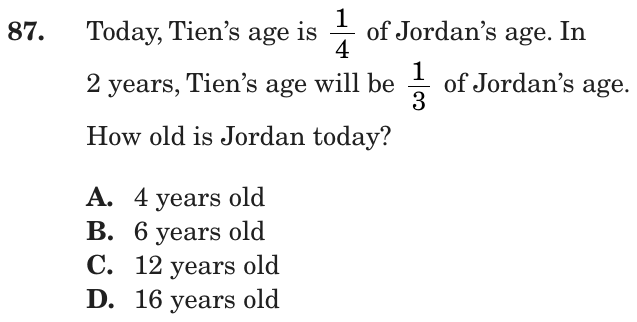
Today, Tien’s age is of Jordan’s age. In 2 years, Tien’s age will be of Jordan’s age. How old is Jordan today?
- A4 years old
- B6 years old
- C12 years old
- D16 years old
Show the answer
Correct answer: D
First, set up an equation to express Tien’s age () and Jordan’s age () today:
Two years from now, Tien’s age will be , and Jordan’s age will be .
Set up an equation about the relationship between Tien’s age and Jordan’s age in two years:
Solve the above equation for :
Now set the two equations equal to each other and solve for :
Question analysis
This age word problem says Tien is one fourth of Jordan's age today and will be one third of Jordan's age in two years, then asks for Jordan's current age. Students must turn two fractional relationships into equations and solve them together. Both people age by the same two years, and it is easy to solve for the wrong person.
- NYS standards
- Grade level
- Grade 8 content, by NYS standard
- Compared with grade 7
- Above grade 7 Grade 7 equations have one unknown on one side, like 3x + 5 = 20. This one links two unknown ages with fractional coefficients and leads to a variable on both sides, which is grade 8 algebra.
- Estimated difficulty
- Hard: combines ideas, needs a plan, and has more than one tempting wrong answer.
- Thinking it demands
- Depth of knowledge 2, skills and concepts · mainly apply
- What makes it hard
- Turning words into math major
- Error-prone arithmetic moderate
- Solution
- 4 steps
- Reading level
- Question and choices: about grade 1, 31 words.
- Students, last 30 days
- Not enough answers yet to show (it takes 10).
Why it is hard, traps and wrong answers (shows the answer)
Why it is hard
The difficulty is in the setup: two fractional relationships at two different times, with both people aging. Once the equations are right, the algebra is short, but it ends with two ages and only one is asked for. Testing the choices against both conditions is a reliable alternative that avoids the algebra entirely.
Turning words into math major Understanding the question
The second sentence must become T + 2 = (J + 2)/3; writing J/3, or forgetting that Jordan also ages two years, breaks the equation. (Hegarty, Mayer & Monk, 1995; Koedinger & Nathan, 2004)
Error-prone arithmetic moderate Working it out
Substituting J/4 for T leaves J/4 + 2 = (J + 2)/3, an equation with fractions on both sides that must be cleared, usually by multiplying by 12. (Brown & Burton, 1978; Junker & Sijtsma, 2001)
Strategy: Let Jordan's age be J, write Tien's age as J/4, and set J/4 + 2 equal to one third of (J + 2); or test each choice against both conditions.
Traps
- Answers a different question: A choice is right for another quantity: the other unknown, the rest instead of the part, the part instead of the whole.
The wrong answers, classified
A Answers a different question (King et al., 2004; Hegarty, Mayer & Monk, 1995)
Solves the equations correctly but reports Tien's age today, 4, which is one fourth of Jordan's 16, instead of Jordan's age.
B Answers a different question (King et al., 2004; Hegarty, Mayer & Monk, 1995)
Gives Tien's age two years from now, 4 + 2 = 6, answering for the wrong person and the wrong time.
C Numbers taken from the question (Hegarty, Mayer & Monk, 1995)
Picks 12 because it is a multiple of both 4 and 3, but then Tien would be 3 and later 5, not a third of 14.
Worked solution, step by step
Formulas used
- Distributive property
- a, b and c are any numbers. To multiply a sum by a number, multiply each part of the sum, then add. It works because a groups of (b + c) is the same as a groups of b plus a groups of c.
Sort out what you know
Today, Tien’s age is of Jordan’s age. That means Jordan is 4 times as old as Tien.
In 2 years, both of them will be 2 years older. Then Tien’s age will be of Jordan’s. So Jordan will be 3 times as old as Tien. You need Jordan’s age today.
Name the ages with a letter
Let t stand for Tien’s age today. Jordan is 4 times as old, so his age is 4t, which means 4 times t. Add 2 years to each age:
Person Today In 2 years Tien Jordan Watch out: Jordan gets 2 years older too. Do not forget to add 2 to his age.
Write an equation for later
In 2 years, Jordan’s age will be 3 times Tien’s age. Write that as an equation:
Use the distributive property on the right side. Multiply both t and 2 by 3:
Solve for Tien’s age
Take 3t away from both sides. Doing the same thing to both sides keeps them equal:
Now take 2 away from both sides:
So Tien is 4 years old today. Watch out: 4 is Tien’s age, not Jordan’s. Choice A, 4 years old, is a trap.
Find Jordan’s age
Jordan is 4 times as old as Tien:
So the answer is D, 16 years old.
Check your answer
Put 16 back into the story. Today, Tien is 16 ÷ 4 = 4. In 2 years, Tien is 6 and Jordan is 18. Is 6 one third of 18? Yes, because 18 ÷ 3 = 6. Choice C fails: Tien would be 3, then 5, and 5 is not a third of 14.
More questions like this
The original DOE question