3 English and 3 math
Here are 6 random questions to try. Takers earning below 75% are unlikely to receive an offer. You have 1 minute 48 seconds per question on the real exam.
Question 1 of 6
2024 Test A English, question 8Passage The Free College Debate
The Free College Debate
(1) A college degree has become an essential tool in an increasingly competitive job market. (2) Yet the price of higher education, at both private and public universities, continues to rise. (3) Helping students cover the cost of attending college is an important issue.
(4) Many people agree that a college education should be a financially realistic option for those who aspire to obtain a degree. (5) For example, in 2017, the New York State legislature passed a bill creating a program to cover the tuition costs for nearly one million students. (6) The state of Tennessee also has a program that offers all students scholarships and mentoring services if they attend one of the state’s community colleges. (7) Proponents generally believe that these programs are a step in the right direction for making college affordable for students who would have had to take out loans or who would have decided not to pursue higher education at all.
(8) On the other hand, some people oppose bills like the ones in New York and Tennessee because they believe “free” college programs are unsustainable. (9) In order to implement these types of programs, a state pays the college on behalf of the students using funds from the state’s budget, which primarily comes from state taxes. (10) As more students choose to attend college, more funds will be needed to cover the costs. (11) Additionally, many students do not finish college within four years because they switch majors or because they have to work. (12) Critics believe that these circumstances will inevitably lead to an increase in taxes, a decline in the quality of the education offered by the schools, or both. (13) They think narrower college-affordability efforts that target the students who need the most support, such as first-generation college students, may be more effective and viable solutions.
(14) Faculty and students at higher-education institutions can work to keep costs down. (15) In light of increased access to computers, mobile devices, and the Internet, there are more opportunities for students to take courses online, thus reducing the need for and cost of maintaining physical classrooms. (16) Additionally, colleges should account for experience by allowing students to demonstrate their knowledge in order to avoid having to pay to sit through classes on subjects they have already mastered. (17) Similarly, college-bound high school students need to be prepared for college-level work so that they do not have to spend money on remedial classes.
(18) The solutions to the problems associated with rising college costs are not simple. (19) Passing legislation that boosts college affordability will take time, input from experts with different ideas, and careful planning.
Question
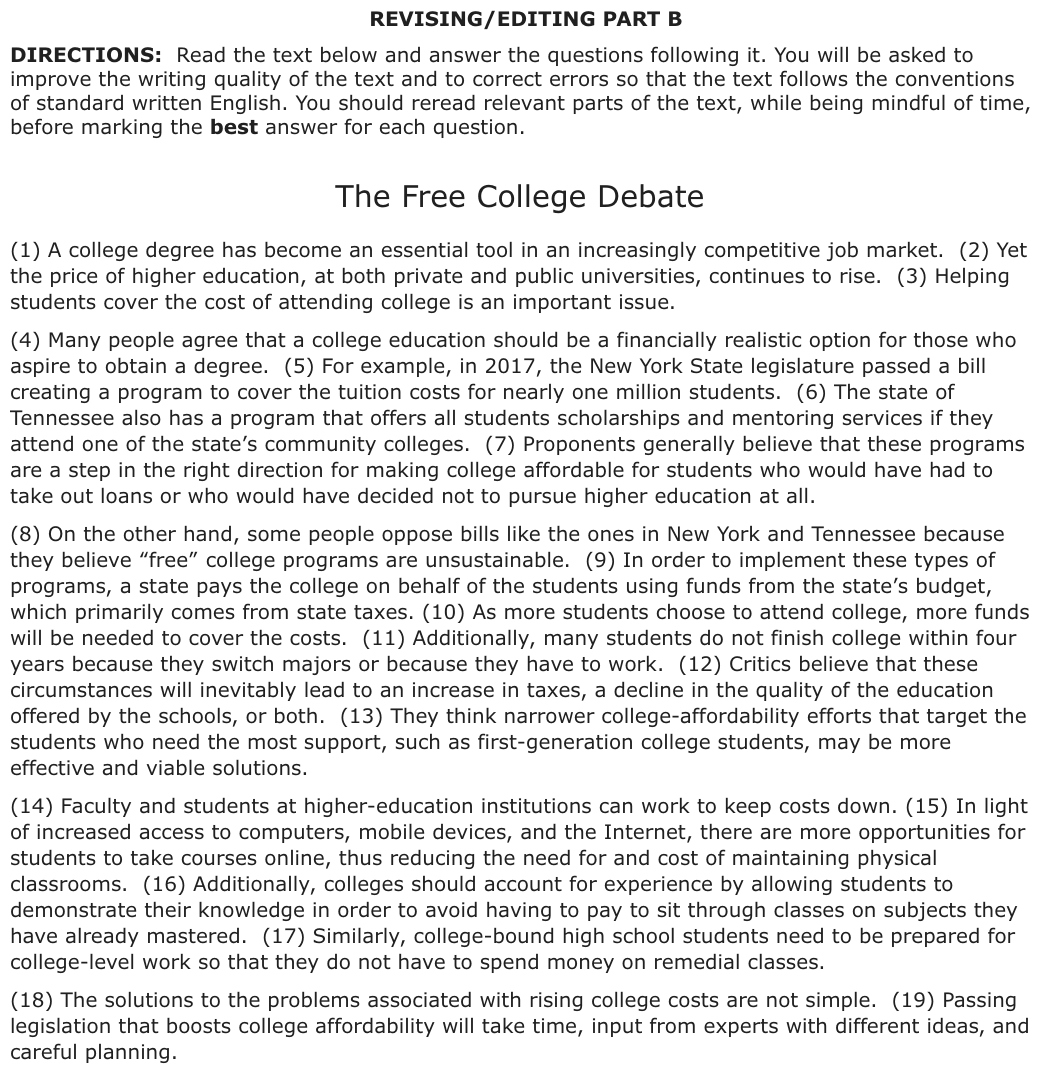
Which phrase should be added before sentence 14 to best transition to the ideas in the fourth paragraph (sentences 14–17)?
- ABecause college affordability is a complicated issue,
- BWith so many opinions about how to make college affordable,
- CUntil college becomes more affordable,
- DAlthough some college affordability programs have been successful,
Show the answer
Correct answer: C
The question asks which phrase should be added before sentence 14 to best transition to the ideas in the fourth paragraph (sentences 14–17).
A. Incorrect. Sentence 13 summarizes the viewpoint of opponents, who believe that targeted approaches to funding education “may be more effective and viable solutions,” and sentence 14 serves to introduce how “faculty and students at higher-education institutions can work to keep costs down.” Affordability is “a complicated issue,” but the use of the word “Because” suggests that the ideas that follow in sentences 14–17 will explain a cause-and-effect relationship. However, sentences 14–17 discuss ways faculty and students should work together to keep the cost of college down while waiting for a long-term solution to the problem, not a causal relationship.
B. Incorrect. Sentences 4–13 provide information about the viewpoint of proponents, who believe that “a college education should be a financially realistic option for those who aspire to obtain a degree” (sentence 4), and opponents, who believe free college programs are “unsustainable” (sentence 8). Although the phrase in this option mentions “opinions,” it indicates that the fourth paragraph will discuss why the number of opinions makes affordability a debatable issue. Instead, the fourth paragraph discusses ways faculty and students can help keep costs down until a solution is reached.
C. CORRECT. Sentence 13 summarizes the viewpoint of opponents, who believe that targeted approaches to funding education “may be more effective and viable solutions,” while proponents “generally believe that these [government] programs are a step in the right direction for making college affordable” (sentence 7). However, sentences 14–17 offer three possible solutions that could alleviate the problem in the meantime. Therefore, the phrase in this option should be added before sentence 14 to best transition to the ideas in the fourth paragraph because it suggests that until the issue of affordability is resolved, alternatives are available to help make a college education more affordable.
D. Incorrect. This phrase mentions “college affordability,” a topic discussed in the fourth paragraph. However, the ideas introduced in the phrase do not logically lead into the ideas discussed in sentences 14–17, because the phrase mentions “programs [that] have been successful,” whereas the paragraph states that “faculty and students at higher-education institutions can work to keep costs down” (sentence 14) and that colleges “should account for experience by allowing students to demonstrate their knowledge in order to avoid having to pay to sit through classes on subjects they have already mastered” (sentence 16). Use of the words “can” and “should” in these sentences indicates that the actions or programs mentioned in the paragraph have not been completed.
Question analysis
This revising question asks which introductory phrase should begin the fourth paragraph of a passage on college affordability, linking the debate over state tuition programs to the cost-saving ideas that follow. All four phrases sound natural, so students must work out the relationship between the paragraphs and choose the phrase that signals it accurately.
- NYS standards
- 7W2d transitions in informative writing
- Grade level
- Grade 8 reading and task
- Compared with grade 7
- Above grade 7 Grade 7 transition work usually links two sentences with a word such as however. Here the choices are whole phrases that set up an entire paragraph, and judging them needs a grasp of the full argument, which asks more than typical grade 7 work.
- Estimated difficulty
- Hard: combines ideas, needs a plan, and has more than one tempting wrong answer.
- Thinking it demands
- Depth of knowledge 3, strategic thinking · mainly evaluate
- What makes it hard
- How sentences fit together major
- Reading between the lines moderate
- Every choice must be checked minor
- Evidence
- Answered from several paragraphs or stanzas
- Reading level
- Passage: about grade 12, 427 words; question and choices: about grade 10, 48 words.
- Students, last 30 days
- Not enough answers yet to show (it takes 10).
Why it is hard, traps and wrong answers (shows the answer)
Why it is hard
Every phrase sounds like a reasonable bridge, and the right one can even seem odd at first, since cutting costs is itself a way to make college affordable. The key is seeing paragraph 4 as what campuses can do while the debate over state programs goes on, a reading the passage confirms only at its end. Students who link back to the many opinions, or accept a causal “Because,” have found real ideas from the passage but not the relationship between these two paragraphs.
How sentences fit together major Working it out
The phrase must link paragraph 3's case against state programs to paragraph 4's steps that “can work to keep costs down,” steps that make sense only as help in the meantime. (Halliday & Hasan, 1976)
Reading between the lines moderate Working it out
Nothing says paragraph 4's ideas are stopgaps; that has to be inferred from sentences 18 and 19, which say the solutions “are not simple” and “will take time.” (Graesser, Singer & Trabasso, 1994; Kintsch, 1998)
Every choice must be checked minor Choosing the answer
All four phrases are grammatical and about affordability, so each must be read into sentence 14 and judged by the relationship its first word signals. (Embretson & Wetzel, 1987)
Strategy: Sum up paragraphs 3 and 4 in a few words each, decide how the second relates to the first, then test the relationship each phrase's opening word signals.
Traps
- Wrong transition: A connecting word or phrase that signals the wrong relationship, such as contrast where the idea continues.
The wrong answers, classified
A Wrong transition (Halliday & Hasan, 1976)
Agrees that affordability is complicated, as sentence 18 says, but “Because” makes the complexity the reason faculty and students can cut costs, a cause the paragraph never gives.
B Wrong transition (Halliday & Hasan, 1976)
Rightly looks back to the clashing views of paragraphs 2 and 3, but offers the disagreement as the ground for the steps instead of marking them as help until a solution arrives.
D Wrong transition (Halliday & Hasan, 1976)
Hears “Although” as a natural turn to a new idea, but the passage never says any program has succeeded, and paragraph 4 does not set its steps against such programs.
Working it out, step by step
Figure out what the question asks
You need a phrase to start sentence 14. It should work as a transition: a word or phrase that shows how two ideas connect. Words like “because,” “although” and “until” each show a different link. So first work out how paragraph 4 connects to what came before.
Compare paragraphs 3 and 4
Paragraph 3 ends with the critics’ view of state programs. People still disagree, so there is no fix everyone accepts yet. Paragraph 4 then says “Faculty and students at higher-education institutions can work to keep costs down.” Faculty means teachers. The paragraph lists ways to do it: online classes, skipping classes you’ve mastered, and getting ready in high school.
Use the ending as a clue
Sentences 18 and 19 say the solutions “are not simple” and “will take time.” So a big fix is still far off. That makes paragraph 4’s ideas things to do in the meantime, while people wait. The phrase “Until college becomes more affordable” says exactly that.
Check each choice
- A is wrong. “Because” shows a cause. The issue being complicated is not the reason teachers can cut costs.
- B is wrong. It makes the many opinions the reason for the steps. The passage never links them that way.
- C is right. “Until” shows these are steps to take while waiting for a bigger fix.
- D is wrong. The passage never says any program has been successful.
Watch out: B looks back at the many opinions, which really are in the passage. But it doesn’t show how paragraph 4 relates to paragraph 3.
Choose the answer
Sentence 14 would read: Until college becomes more affordable, faculty and students at higher-education institutions can work to keep costs down. So the answer is C.
Why this answer and not the closest wrong one
B is the closest wrong answer, because the passage does share many opinions. But “With so many opinions” makes the opinions sound like the reason for the cost-cutting steps. They are not. C shows the steps are help for now, while the bigger problem waits to be solved.
More questions like this
The original DOE question
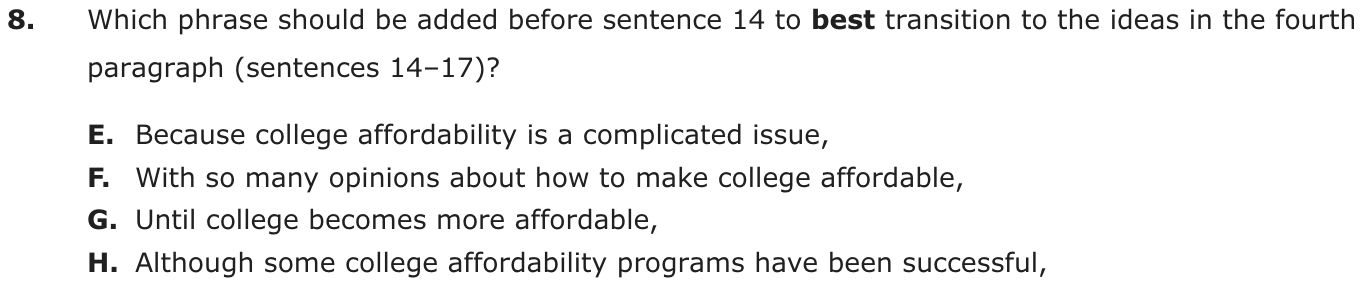
The passage “The Free College Debate” as printed (page 38)
Question 2 of 6
2025 Practice Test A English, question 11Passage Excerpt from “Scribe Like an Egyptian”
Excerpt from “Scribe Like an Egyptian”
by Hilary Wilson
In ancient Egypt, literacy was the key to success. However, contrary to popular belief, not all Egyptian scribes understood hieroglyphs. Many relied instead on the simpler hieratic script for the multitude of everyday documents generated by the Egyptian bureaucracy.
Hieroglyphs—“the Words of God”—compose a writing system with more than 1,000 distinct characters, the meanings of which were lost for 1,500 years before they were deciphered by Jean-François Champollion in 1822. Including both ideograms (which convey a whole word or idea, either concrete or abstract, in a single sign) and phonograms (representing either an alphabetic sound or a group of consonants), [the writing system] was used in formal inscriptions on tomb and temple walls as well as on elaborate funerary papyri. For everyday purposes, however, scribes used a shorthand version of the hieroglyphic script known as hieratic, which was quicker to write and more economical of space. The two writings existed side by side for at least 2,500 years.
Scraps of ancient hieratic writing, mostly penned by student scribes on limestone flakes called ostraca, suggest that no matter how humble his origins, an educated Egyptian could achieve almost anything. Horemheb (d.1292 B.C.) is a good example. Born of middle-ranking parents, his scribal training led to an army career. From Scribe of Recruits, during the reign of Akhenaten (1353–1336 B.C.), Horemheb rose through the military ranks and, by the rule of Tutankhamun (1332–1323 B.C.), he was commander in chief of the Egyptian forces. As a close adviser of the young Pharaoh, Horemheb was appointed “Deputy of the King throughout the Two Lands,” and might have expected to succeed to the throne should the king die childless. He had to wait a few years, but eventually Horemheb achieved the pinnacle of his career by becoming the last king of the 18th Dynasty, making his mark by instituting dramatic reforms to the organisation of the army, the judiciary and administration in general. The lasting success of these changes owed much to his scribal background. . . .
But education was not available to all. Government departments and major temples supported schools, where boys commenced their training at six or seven, sometimes earlier. To these boarding establishments . . . family or household servants delivered the students’ food and drink rations daily for several years, during which time the student was not contributing to the family’s income. Boys from poorer families could only hope to be educated with support from a wealthier relative or patron, or through apprenticeship to an older scribe, perhaps the local clerk or land agent, who would teach them the basics of the scribe’s craft. This limited the scope for employment but such “on the job” training allowed apprentices to help out at home while learning. . . .
Scribal education began with the elementary principles of the hieratic script. The lowliest scribes, who trained for just five or six years, probably learned only the rudiments of the hieroglyphic script. Students were set exemplar documents and extracts from popular texts to copy, to practice their hieratic handwriting on basic-format letters, reports and contracts, while absorbing the good advice contained in the texts. Surviving examples of copy-work sometimes include tutors’ corrections added in red. Some significant Egyptian literary works survive almost exclusively from student copies.
A schoolboy “dictionary” of hieroglyphs with their hieratic equivalents shows that a knowledge of more than 450 signs was required for everyday writing purposes. Lessons in record-keeping and filing and labelling enabled any half-competent scribe to perform that most essential of all scribal functions: the making and updating of lists. For professions such as those of government official, priest or lawyer, a scribe would train for several more years, increasing his vocabulary to perhaps a thousand or more signs. Those with the best handwriting or drawing skills might follow the craft of creating beautifully illustrated copies of funerary texts, commonly called Books of the Dead. Others could become draughtsmen, artists or architects. Doctors compiled their own collections of medication recipes, treatments and associated incantations, many copied from texts found in the House of Life, the temple library. Lawyers had to be familiar with the corpus of civil and religious laws and precedents found in the official records, which were administered by archivists. Egypt’s bureaucratic society depended on the skills of an army of scribes of all ranks from filing clerk to tax assessor. For young Egyptians, “be a scribe” was the best of career advice.
From “Scribe Like an Egyptian” by Hilary Wilson from HISTORY TODAY, August 8, 2019. Copyright © 2019 by History Today Ltd. Company.
bureaucracy: an administrative staff of government officials
funerary papyri: a sheet or scroll of papyrus containing religious images and hieroglyphs meant to help the deceased be reborn in the afterlife
rudiments: basics
schoolboy: slang that refers to materials used during the course of receiving an education
draughtsmen: people who draw plans of machinery or structures
corpus: a collection of writings
Question
Which statement summarizes the process that schools used to train scribes?
- ABoys had to memorize around 450 hieratic signs. Once they had learned these, they were expected to copy literary texts that contained valuable lessons.
- BBoys spent at least five years learning hieratic signs, which they practiced by copying texts. During this period, they were also introduced to basic hieroglyphs.
- CBoys spent five or six years learning the basics of hieratic script. After this period, they could become apprentices and begin learning hieroglyphics.
- DBoys were taught two different scripts. They practiced both types by copying lists and eventually progressed to writing letters, reports, and contracts.
Show the answer
Correct answer: B
The question asks for the best summary of the process that schools used to train scribes.
A. Incorrect. This summary incorrectly explains that scribes were expected to learn 450 hieratic signs instead of 450 hieroglyphs along with their hieratic versions as explained in paragraph 6. In paragraph 5, the author explains that scribes copied texts as part of the process of learning the scripts rather than as practice after the signs had already been memorized.
B. CORRECT. Paragraph 5 explains that students began by learning hieratic script and studied for about five or six years by using “exemplar documents and extracts from popular texts to copy, to practice their hieratic handwriting.” The paragraph also explains that during this time, they learned only the basics of hieroglyphic script.
C. Incorrect. Although paragraph 5 does explain that the scribes spent five or six years learning hieratic script, it does not suggest that hieroglyphs were learned only during apprenticeships.
D. Incorrect. This summary correctly explains that scribes learned two types of scripts, but the second sentence of the summary is incorrect. In paragraph 5, the author explains that the students copied from exemplar texts, but the author clearly states that the purpose of this copy work was “to practice their hieratic handwriting” and does not suggest that the copy work was used to practice hieroglyphs. Paragraph 6 explains that scribes could make lists as part of their professional skills but does not suggest that copy work was used to help them learn this task. Paragraph 5 mentions letters, reports, and contracts as the formats students practiced on while copying, not as a later stage of their training.
Question analysis
This summary question on “Scribe Like an Egyptian” asks which statement sums up how ancient Egyptian schools trained young scribes. Each choice is a two-sentence summary that combines years of study, kinds of script and copying practice, so students must check every detail against what the article says about scribal education.
- Grade level
- Grade 8 reading and task
- Compared with grade 7
- Above grade 7 Summarizing a process is a grade 7 standard, but these four summaries are long, two-part and mostly accurate, and the details they mix up come from three different paragraphs, so judging them asks more than typical grade 7 work.
- Estimated difficulty
- Hard: combines ideas, needs a plan, and has more than one tempting wrong answer.
- Thinking it demands
- Depth of knowledge 2, skills and concepts · mainly understand
- What makes it hard
- A very close wrong answer moderate
- Evidence in several places moderate
- The right answer is reworded minor
- Evidence
- Answered from several paragraphs or stanzas
- Reading level
- Passage: about grade 12, 810 words; question and choices: about grade 7, 104 words.
- Corrected from the DOE handbook
- A detail in the explanation that misdescribes the excerpt was corrected.
- Students, last 30 days
- Not enough answers yet to show (it takes 10).
Why it is hard, traps and wrong answers (shows the answer)
Why it is hard
Every wrong summary opens with something true or nearly true, so a quick reading of first sentences cannot separate them. Most of the errors concern order: one makes copying follow memorizing, one turns apprenticeship into a later stage where hieroglyphs begin, and one makes the copied letters, reports and contracts a later step. Students who check the order of training against paragraph 5, not just the facts, find the only summary with nothing out of place.
A very close wrong answer moderate Choosing the answer
The apprenticeship summary repeats the right one’s opening, years of hieratic study, and parts from it on one phrase: hieroglyphs come “After this period” instead of “During this period.” (Embretson & Wetzel, 1987; Gorin & Embretson, 2006; Ascalon et al., 2007)
Evidence in several places moderate Working it out
The details sit in three paragraphs: the five or six years, the copying and the hieroglyph basics in paragraph 5, apprenticeship in paragraph 4, and the 450-sign dictionary and list-making in paragraph 6. (Kirsch & Mosenthal, 1990; Gorin & Embretson, 2006)
The right answer is reworded minor Choosing the answer
The right summary puts the text in new words, “at least five years” and “basic hieroglyphs,” while wrong ones repeat its own details: “five or six years,” the “450” signs, “letters, reports, and contracts.” (Freedle & Kostin, 1993; Kirsch & Mosenthal, 1990)
Strategy: Note what the article says students learned, for how long and by what method, then check both sentences of each summary against those notes; one wrong detail rules a summary out.
Traps
- Half right: One half of a two-part choice is right and the other is not.
- Twists what the text says: Uses the text's topic and ideas but changes what it says: who did it, how much, when, or why.
The wrong answers, classified
A Twists what the text says (King et al., 2004)
Takes paragraph 6’s 450 signs, hieroglyphs listed with their hieratic forms, as hieratic signs to memorize first, and makes copying come afterward, though copying was how students learned.
C Half right (King et al., 2004; Thissen, Steinberg & Fitzpatrick, 1989)
Gets the five or six years of hieratic right, then makes apprenticeship, the other route paragraph 4 offers poorer boys, a later stage where hieroglyphs are first taught.
D Half right (King et al., 2004; Thissen, Steinberg & Fitzpatrick, 1989)
Rightly says two scripts were taught, then claims students copied lists for both and only later wrote letters, reports and contracts, though paragraph 5 ties copying to hieratic and to those very formats.
What was corrected from the DOE handbook, and why
- Explanation: The DOE’s explanation of Option D ends: “Paragraph 6 explains that scribes could make lists and write letters as part of their professional skills but does not suggest that copy work was used to help them learn these tasks.” Paragraph 6 mentions the making and updating of lists, but not letters. Letters come up in paragraph 5, where students copy texts “to practice their hieratic handwriting” on basic-format letters, reports and contracts, so the excerpt does tie the copy work to letters. The site now says that paragraph 6 explains that scribes could make lists as part of their professional skills but does not suggest that copy work was used to help them learn this task, and that paragraph 5 mentions letters, reports, and contracts as the formats students practiced on while copying, not as a later stage of their training. Option D is still wrong, and the answer, B, is unchanged.
Working it out, step by step
Figure out what the question asks
This asks for the best summary of how schools trained scribes. A summary retells the main steps in a few words. Each choice has two sentences. Both must match the article, including the order of the steps. One wrong detail rules a choice out.
Find the training in paragraph 5
Paragraph 5 says training began with the basics of hieratic script. The lowest scribes studied for five or six years, and others studied longer. In that time they learned only the basics of hieroglyphs. Students were given “exemplar documents and extracts from popular texts to copy, to practice their hieratic handwriting.” Exemplar means model. Extracts are short pieces. So they learned by copying good examples.
Sort out paragraphs 4 and 6
Two other paragraphs hold details that look alike. Paragraph 4 describes apprenticeship. An apprentice learns on the job from a skilled worker. It was another way in for boys from poorer families, not a step after school. Paragraph 6 mentions a list of hieroglyphs with their hieratic forms. It says more than 450 signs were needed for everyday writing. It never says students memorized them before copying.
Check each choice
- A does not fit. The 450 signs were hieroglyphs paired with their hieratic forms. And copying was how students learned, not a step after memorizing.
- B fits. Students spent at least five years on hieratic, practiced by copying, and learned basic hieroglyphs along the way.
- C does not fit. Apprenticeship was a different route, not a later stage. Hieroglyphs were not saved for apprentices.
- D does not fit. The copying was to practice hieratic. Lists come up in paragraph 6 as a job skill, not as practice. Letters, reports and contracts were what students copied, not a later stage.
Choose the answer
Watch out: C starts out right, with five or six years of hieratic. Then it says hieroglyphs came “After this period” instead of during it. That one change makes it wrong.
Only B gets every detail and the order right. So the answer is B.
Why this answer and not the closest wrong one
C is the closest wrong choice. It gets the five or six years of hieratic right. But it says hieroglyphs came afterward, through apprenticeship. Paragraph 5 says students learned the basics of hieroglyphs during their schooling. Apprenticeship was a separate path for poorer boys. B says “During this period,” which matches.
More questions like this
The original DOE question
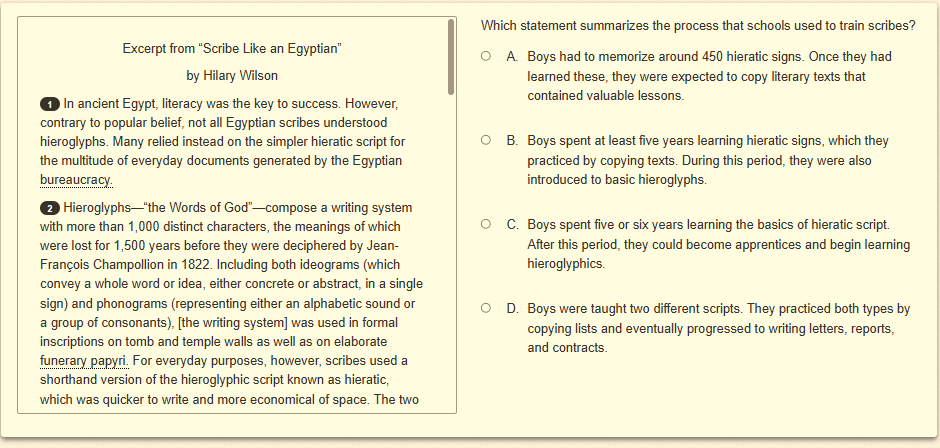
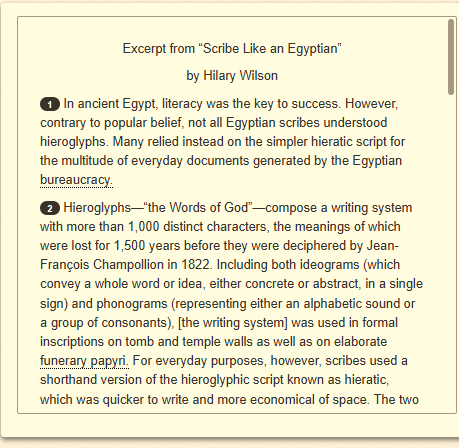
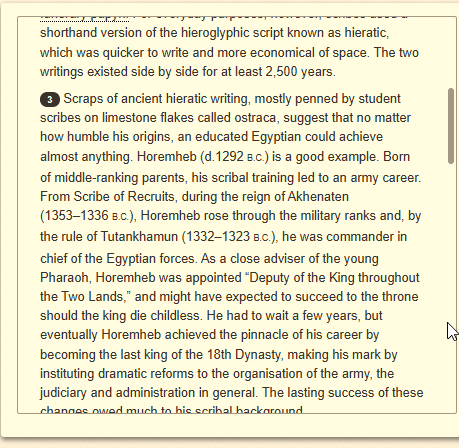
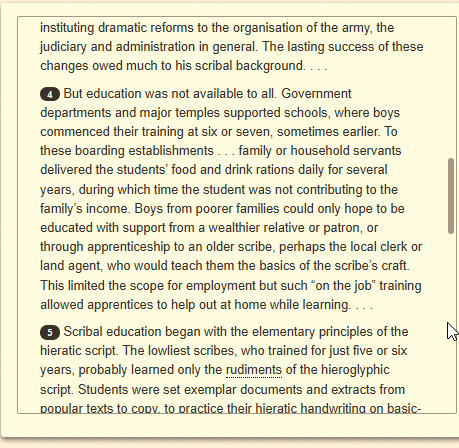
The passage “Excerpt from “Scribe Like an Egyptian”” as shown on the test
Question 3 of 6
2026 Practice Test B English, question 25Passage Looking for the Smallest Spark of Everything
Looking for the Smallest Spark of Everything
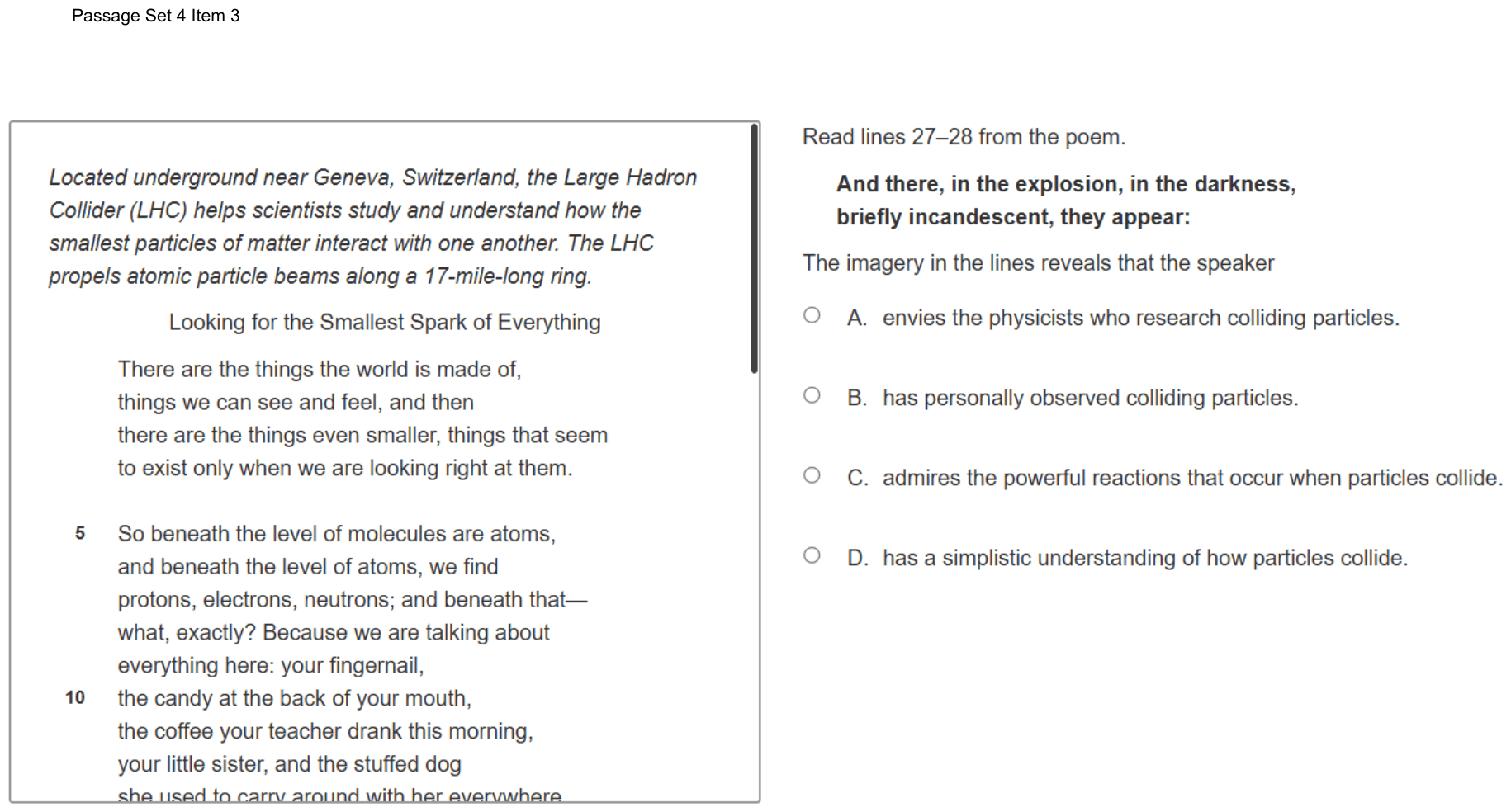
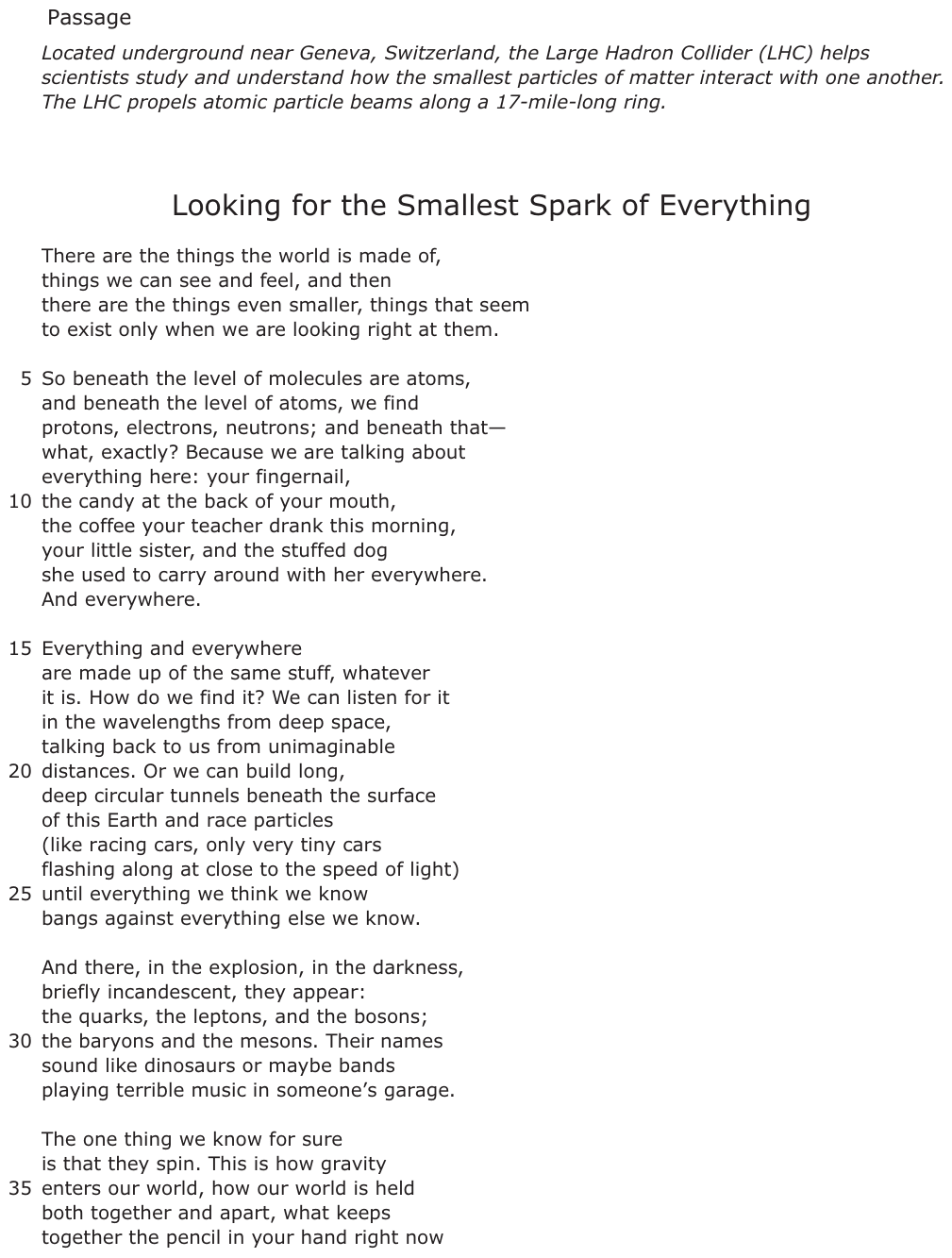
Located underground near Geneva, Switzerland, the Large Hadron Collider (LHC) helps scientists study and understand how the smallest particles of matter interact with one another. The LHC propels atomic particle beams along a 17-mile-long ring.
There are the things the world is made of,
things we can see and feel, and then
there are the things even smaller, things that seem
to exist only when we are looking right at them.
So beneath the level of molecules are atoms,
and beneath the level of atoms, we find
protons, electrons, neutrons; and beneath that—
what, exactly? Because we are talking about
everything here: your fingernail,
the candy at the back of your mouth,
the coffee your teacher drank this morning,
your little sister, and the stuffed dog
she used to carry around with her everywhere.
And everywhere.
Everything and everywhere
are made up of the same stuff, whatever
it is. How do we find it? We can listen for it
in the wavelengths from deep space,
talking back to us from unimaginable
distances. Or we can build long,
deep circular tunnels beneath the surface
of this Earth and race particles
(like racing cars, only very tiny cars
flashing along at close to the speed of light)
until everything we think we know
bangs against everything else we know.
And there, in the explosion, in the darkness,
briefly incandescent, they appear:
the quarks, the leptons, and the bosons;
the baryons and the mesons. Their names
sound like dinosaurs or maybe bands
playing terrible music in someone’s garage.
The one thing we know for sure
is that they spin. This is how gravity
enters our world, how our world is held
both together and apart, what keeps
together the pencil in your hand right now
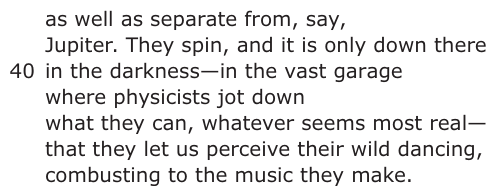
as well as separate from, say,
Jupiter. They spin, and it is only down there
in the darkness—in the vast garage
where physicists jot down
what they can, whatever seems most real—
that they let us perceive their wild dancing,
combusting to the music they make.
Question
Read lines 27–28 from the poem.
And there, in the explosion, in the darkness,
briefly incandescent, they appear:
The imagery in the lines reveals that the speaker
- Aenvies the physicists who research colliding particles.
- Bhas personally observed colliding particles.
- Cadmires the powerful reactions that occur when particles collide.
- Dhas a simplistic understanding of how particles collide.
Show the answer
Correct answer: C
The question asks what the imagery in lines 27–28 reveals about the speaker.
A. Incorrect. The physicists mentioned in the fifth stanza (lines 33–44) are described as mere observers: they “jot down / what they can” (lines 41–42). In lines 27–28, the speaker is focused on the reaction between the colliding particles, not on the physicists who study them.
B. Incorrect. The speaker describes the particle collision in detail, but the text does not imply that the speaker has personally witnessed a collision. The speaker implies that his or her understanding of the collision is based on the experiences of the physicists observing the phenomenon (“They spin, and it is only down there / in the darkness—in the vast garage / where physicists jot down / what they can, whatever seems most real— / that they let us perceive their wild dancing” [lines 39–43]).
C. CORRECT. The word “explosion” and the phrase “briefly incandescent” create a picture of rapid changes and short bursts of bright light, revealing how powerful the new particles are. The language the speaker uses is positive, revealing that the speaker admires the power of the reaction and stands in awe of the new particles.
D. Incorrect. The poem reveals the speaker’s deep knowledge about subatomic particles. For example, the speaker is able to name the new particles discovered—“the quarks, the leptons, and the bosons; / the baryons and the mesons” (lines 29–30)—and is able to use imagery to create a powerful picture that reveals the complexity of a scientific process that humans have never been able to see.
Question analysis
This imagery question asks what lines 27–28 of “Looking for the Smallest Spark of Everything” reveal about the poem’s speaker, as particles appear “briefly incandescent” in an explosion inside a particle collider. Students must infer what a vivid image says about the person describing it. The word “incandescent” may be unfamiliar, and the choices are about very different things.
- Grade level
- Grade 8 reading and task
- Compared with grade 7
- Above grade 7 Grade 7 students infer a speaker’s attitude from imagery, but these two lines turn on the uncommon word “incandescent,” state nothing about the speaker outright, and the choices range over the speaker’s knowledge, experience and feelings, which is harder than typical grade 7 work.
- Estimated difficulty
- Hard: combines ideas, needs a plan, and has more than one tempting wrong answer.
- Thinking it demands
- Depth of knowledge 2, skills and concepts · mainly analyze
- What makes it hard
- Reading between the lines major
- Hard words moderate
- Figurative or literary language minor
- Evidence
- Answered from one paragraph or stanza
- Reading level
- Passage: 346 words (a poem; reading level not measured); question and choices: about grade 9, 55 words.
- Students, last 30 days
- Not enough answers yet to show (it takes 10).
Why it is hard, traps and wrong answers (shows the answer)
Why it is hard
Nothing in the two lines names a feeling, so students must judge the speaker’s attitude from the image alone, and its key word is uncommon. The vividness is itself a trap: a scene described this sharply can seem to be one the speaker watched, though the poem says the particles are perceived only through the physicists’ work. The choices range over envy, experience, admiration and understanding, so each must be tested against the lines rather than against an overall impression.
Reading between the lines major Working it out
The lines describe particles, not the speaker, and contain no word of feeling; admiration has to be inferred from the drama of “the explosion” and the glow of “briefly incandescent.” (Graesser, Singer & Trabasso, 1994; Kintsch, 1998)
Hard words moderate Understanding the question
“Incandescent,” glowing with heat and light, is the word that makes the image dazzling, and a student who does not know it sees only an explosion in the dark. (Perfetti, 2007; Freedle & Kostin, 1993)
Figurative or literary language minor Understanding the question
The two lines are pure imagery, a burst of light in darkness as the particles “appear,” and the question asks what that picture reveals about the person painting it. (Graesser, Singer & Trabasso, 1994; Kintsch, 1998)
Strategy: Picture the scene in lines 27–28, including what “incandescent” means, decide what the description suggests about the speaker, and test each choice against these two lines.
Traps
- Taking figurative language literally: A choice reads a figure of speech or image at face value.
- Reads too much in: A reasonable-sounding conclusion that goes further than the text allows.
The wrong answers, classified
A Reads too much in (Graesser, Singer & Trabasso, 1994)
Reasons that someone so drawn to the scene must envy the physicists who study it, though the physicists appear only in lines 39–44 and nothing in the poem hints at envy.
B Taking figurative language literally (Graesser, Singer & Trabasso, 1994)
Takes the vivid scene of particles that “appear” in a glow as something the speaker witnessed, though lines 39–43 place that sight “down there,” where physicists record what they can.
D Reads too much in (Graesser, Singer & Trabasso, 1994)
Treats the poem’s playful comparisons, racing cars and garage bands, as a sign of shallow knowledge, though the next lines have the speaker naming quarks, leptons, bosons, baryons and mesons.
Working it out, step by step
Figure out what the question asks
This asks what the imagery in lines 27–28 shows about the speaker. Imagery is language that helps you see, hear or feel a scene. The lines describe particles, not the speaker. So you must infer, or figure out from clues, how the speaker feels.
Read lines 27–28
The lines say “And there, in the explosion, in the darkness, / briefly incandescent, they appear:” Briefly means for a short time. Incandescent means glowing with heat and light. So picture a burst of bright light flashing in the dark. The particles have just crashed into each other, or collided. In that flash, the tiny particles appear.
Decide how the speaker feels
The words are bold and bright: “explosion,” “incandescent,” “appear.” The speaker makes the moment sound dramatic and amazing. People describe something this way when they are in awe of it. So the speaker admires, or looks up to, the power of the crash.
Check each choice
- A does not fit. Physicists come up only later, in line 41. Nothing shows envy, or wanting what they have.
- B does not fit. Nothing says the speaker was there. Lines 39–42 place the sight “down there,” where “physicists jot down / what they can.”
- C fits. The glowing burst in the dark shows the speaker’s wonder.
- D does not fit. Right after, the speaker names quarks, leptons, bosons, baryons and mesons. That is not a simple understanding.
Watch out: B is tempting because the scene is so vivid. But a writer can picture something without seeing it in person.
Choose the answer
The bright, explosive picture shows a speaker who is amazed by the crash. So the answer is C, “admires the powerful reactions that occur when particles collide.”
Why this answer and not the closest wrong one
B is the closest wrong choice, because the scene feels like an eyewitness report. But the lines never say the speaker was in the tunnel. What they do show is a feeling. Words like “explosion” and “briefly incandescent” make the moment thrilling. That is admiration, so C fits.
More questions like this
The original DOE question
The passage “Looking for the Smallest Spark of Everything” as printed (pages 32–33)
Question 4 of 6
2018 Test A Math, question 30Question
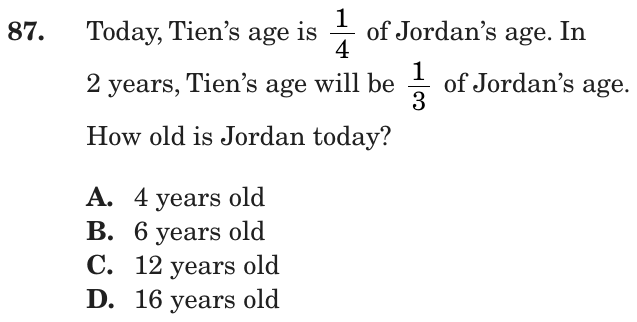
Today, Tien’s age is of Jordan’s age. In 2 years, Tien’s age will be of Jordan’s age. How old is Jordan today?
- A4 years old
- B6 years old
- C12 years old
- D16 years old
Show the answer
Correct answer: D
First, set up an equation to express Tien’s age () and Jordan’s age () today:
Two years from now, Tien’s age will be , and Jordan’s age will be .
Set up an equation about the relationship between Tien’s age and Jordan’s age in two years:
Solve the above equation for :
Now set the two equations equal to each other and solve for :
Question analysis
This age word problem says Tien is one fourth of Jordan's age today and will be one third of Jordan's age in two years, then asks for Jordan's current age. Students must turn two fractional relationships into equations and solve them together. Both people age by the same two years, and it is easy to solve for the wrong person.
- NYS standards
- Grade level
- Grade 8 content, by NYS standard
- Compared with grade 7
- Above grade 7 Grade 7 equations have one unknown on one side, like 3x + 5 = 20. This one links two unknown ages with fractional coefficients and leads to a variable on both sides, which is grade 8 algebra.
- Estimated difficulty
- Hard: combines ideas, needs a plan, and has more than one tempting wrong answer.
- Thinking it demands
- Depth of knowledge 2, skills and concepts · mainly apply
- What makes it hard
- Turning words into math major
- Error-prone arithmetic moderate
- Solution
- 4 steps
- Reading level
- Question and choices: about grade 1, 31 words.
- Students, last 30 days
- Not enough answers yet to show (it takes 10).
Why it is hard, traps and wrong answers (shows the answer)
Why it is hard
The difficulty is in the setup: two fractional relationships at two different times, with both people aging. Once the equations are right, the algebra is short, but it ends with two ages and only one is asked for. Testing the choices against both conditions is a reliable alternative that avoids the algebra entirely.
Turning words into math major Understanding the question
The second sentence must become T + 2 = (J + 2)/3; writing J/3, or forgetting that Jordan also ages two years, breaks the equation. (Hegarty, Mayer & Monk, 1995; Koedinger & Nathan, 2004)
Error-prone arithmetic moderate Working it out
Substituting J/4 for T leaves J/4 + 2 = (J + 2)/3, an equation with fractions on both sides that must be cleared, usually by multiplying by 12. (Brown & Burton, 1978; Junker & Sijtsma, 2001)
Strategy: Let Jordan's age be J, write Tien's age as J/4, and set J/4 + 2 equal to one third of (J + 2); or test each choice against both conditions.
Traps
- Answers a different question: A choice is right for another quantity: the other unknown, the rest instead of the part, the part instead of the whole.
The wrong answers, classified
A Answers a different question (King et al., 2004; Hegarty, Mayer & Monk, 1995)
Solves the equations correctly but reports Tien's age today, 4, which is one fourth of Jordan's 16, instead of Jordan's age.
B Answers a different question (King et al., 2004; Hegarty, Mayer & Monk, 1995)
Gives Tien's age two years from now, 4 + 2 = 6, answering for the wrong person and the wrong time.
C Numbers taken from the question (Hegarty, Mayer & Monk, 1995)
Picks 12 because it is a multiple of both 4 and 3, but then Tien would be 3 and later 5, not a third of 14.
Worked solution, step by step
Formulas used
- Distributive property
- a, b and c are any numbers. To multiply a sum by a number, multiply each part of the sum, then add. It works because a groups of (b + c) is the same as a groups of b plus a groups of c.
Sort out what you know
Today, Tien’s age is of Jordan’s age. That means Jordan is 4 times as old as Tien.
In 2 years, both of them will be 2 years older. Then Tien’s age will be of Jordan’s. So Jordan will be 3 times as old as Tien. You need Jordan’s age today.
Name the ages with a letter
Let t stand for Tien’s age today. Jordan is 4 times as old, so his age is 4t, which means 4 times t. Add 2 years to each age:
Person Today In 2 years Tien Jordan Watch out: Jordan gets 2 years older too. Do not forget to add 2 to his age.
Write an equation for later
In 2 years, Jordan’s age will be 3 times Tien’s age. Write that as an equation:
Use the distributive property on the right side. Multiply both t and 2 by 3:
Solve for Tien’s age
Take 3t away from both sides. Doing the same thing to both sides keeps them equal:
Now take 2 away from both sides:
So Tien is 4 years old today. Watch out: 4 is Tien’s age, not Jordan’s. Choice A, 4 years old, is a trap.
Find Jordan’s age
Jordan is 4 times as old as Tien:
So the answer is D, 16 years old.
Check your answer
Put 16 back into the story. Today, Tien is 16 ÷ 4 = 4. In 2 years, Tien is 6 and Jordan is 18. Is 6 one third of 18? Yes, because 18 ÷ 3 = 6. Choice C fails: Tien would be 3, then 5, and 5 is not a third of 14.
More questions like this
The original DOE question
Question 5 of 6
2024 Test B Math, question 41Question
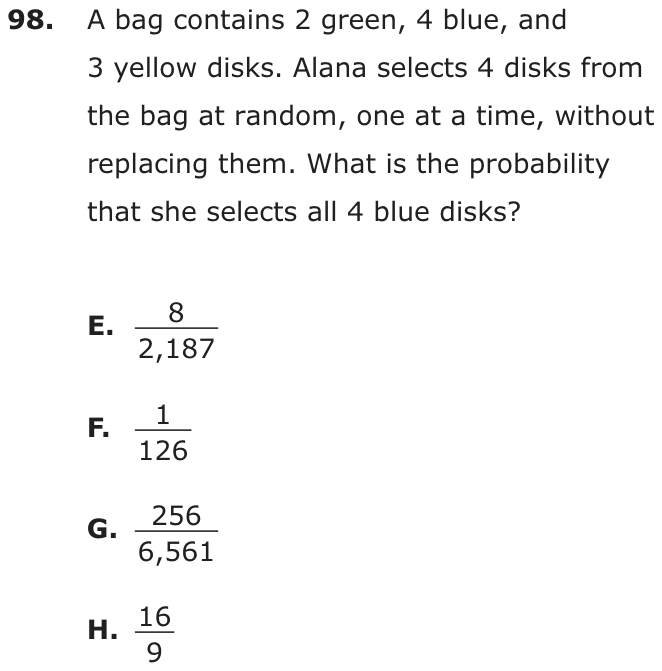
A bag contains 2 green, 4 blue, and 3 yellow disks. Alana selects 4 disks from the bag at random, one at a time, without replacing them. What is the probability that she selects all 4 blue disks?
- A
- B
- C
- D
Show the answer
Correct answer: B
If Alana picks 4 blue disks in a row, the number of blue disks and the total number of disks will both decrease by 1 after each selection.
For the first selection, there are 4 blue disks out of 9 total disks, so the probability of selecting the first blue disk is .
The probabilities of selecting blue for the next three selections are , , and .
Question analysis
A bag holds green, blue and yellow disks, and Alana draws four of them one at a time without putting any back. Students find the probability that all four disks are blue. It tests the probability of dependent events, and the difficulty is keeping track of how the bag changes after each draw.
- NYS standards
- Grade level
- Grade 7 content, by NYS standard
- Compared with grade 7
- Above grade 7 Grade 7 compound probability is usually found with lists or tree diagrams for two stages. Four dependent draws, each changing the counts, are too many to list and need the multiplication rule, which grade 7 does not formally teach.
- Estimated difficulty
- Hard: combines ideas, needs a plan, and has more than one tempting wrong answer.
- Thinking it demands
- Depth of knowledge 2, skills and concepts · mainly apply
- What makes it hard
- Something you must already know moderate
- Error-prone arithmetic moderate
- Solution
- 3 steps
- Reading level
- Question and choices: about grade 5, 37 words.
- Students, last 30 days
- Not enough answers yet to show (it takes 10).
Why it is hard, traps and wrong answers (shows the answer)
Why it is hard
Students who know the multiplication rule for successive draws still have two adjustments to make on every draw, and each wrong choice skips at least one of them. Leaving the bag at 9 disks, or putting each disk back, both produce fractions over 6,561 that look as exact as the right one. Writing the four fractions in a row before multiplying, and cancelling as you go, keeps the arithmetic small.
Something you must already know moderate Working it out
The rule for successive draws without replacement is assumed: each draw's chance is multiplied in, with both the blue count and the total lowered by one. (Anderson & Krathwohl, 2001)
Error-prone arithmetic moderate Working it out
The product 4/9 × 3/8 × 2/7 × 1/6 = 24/3,024 has to be reduced to 1/126, and two wrong choices hide behind 9 to the fourth power, 6,561. (Brown & Burton, 1978; Junker & Sijtsma, 2001)
Strategy: Write the chance of blue for each of the four draws in turn, lowering both the blue count and the total by one each time, and multiply.
Traps
- Without replacement: In a second pick there is one fewer item, which changes the probability.
- Wrong operation: Adds instead of multiplying, divides the wrong way round, turns a ratio or rate upside down, or undoes a step in the wrong direction (subtracts what should be added back).
The wrong answers, classified
A Without replacement (Fischbein & Schnarch, 1997)
Lowers the blue count on each draw but keeps all 9 disks in the bag, 4 × 3 × 2 × 1 over 9 × 9 × 9 × 9, which is 24/6,561 = 8/2,187.
C Without replacement (Fischbein & Schnarch, 1997)
Uses 4/9 for every draw, (4/9) to the fourth power = 256/6,561, as if each disk were put back before the next draw.
D Wrong operation (Hegarty, Mayer & Monk, 1995; King et al., 2004)
Adds the first draw's 4/9 four times, or multiplies it by 4, instead of multiplying the draws' chances, and misses that a probability cannot exceed 1.
Worked solution, step by step
Formulas used
- Probability
- P is the probability, the chance that something happens. It is a number from 0 to 1. The top counts the results you want. The bottom counts all the results that can happen. It works when every result is equally likely.
- Chance of events in a row
- A and B are two events that happen one after the other. P(A) is the chance of the first. P(B after A) is the chance of the second, counting only what is left after the first. You multiply because the second must also happen inside the share of times the first did.
Sort out the question
The bag holds 2 green, 4 blue and 3 yellow disks. That is 9 disks in all. Alana takes 4 disks, one at a time.
“Without replacing them” means a disk she takes does not go back in the bag. You need the chance that all 4 disks are blue.
Find the chance for each pick
For all 4 to be blue, each pick must be blue. After each blue pick, one blue disk is gone. One disk is gone from the total, too. So the top and the bottom each go down by 1.
Pick Blue disks left Disks left Chance of blue 1st 4 9 2nd 3 8 3rd 2 7 4th 1 6 Multiply the four chances
All four picks must go right, one after another. Use the rule for events in a row and multiply.
Simplify the fraction
Divide the top and the bottom by 24. That keeps the value the same.
Watch out: Using for every pick gives , choice C. That is right only if each disk goes back in. Keeping 9 on the bottom each time gives , choice A. Choice D is more than 1, and no chance can be more than 1.
So the answer is B, .
Check your answer
Cancel before you multiply. On top, cancels the 8 on the bottom. That leaves . Divide the top and bottom by 3 to get again.
More questions like this
The original DOE question
Question 6 of 6
2024 Test A Math, question 6Question
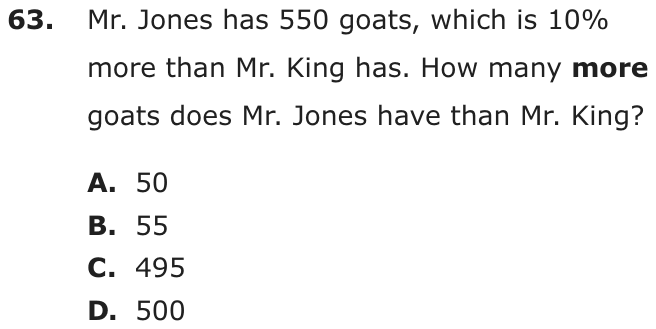
Mr. Jones has 550 goats, which is 10% more than Mr. King has. How many more goats does Mr. Jones have than Mr. King?
- A50
- B55
- C495
- D500
Show the answer
Correct answer: A
First, set up a proportion to determine x, the number of goats Mr. King has.
Then solve the proportion for x.
Finally, determine the difference between the number of goats Mr. Jones has, 550, and the number of goats Mr. King has, 500.
Mr. Jones has 50 more goats than Mr. King.
Question analysis
A percent word problem: Mr. Jones has 550 goats, which is 10% more than Mr. King has, and students find how many more goats Mr. Jones has. It asks students to work with a percent increase when only the larger amount is known. The tricky part is deciding which amount the 10% is taken of.
- Grade level
- Grade 7 content, by NYS standard
- Compared with grade 7
- Above grade 7 Grade 7 students usually find a percent increase from a known original amount. This runs the task backward: the increased amount is given, and the original must be recovered before the difference can be found, a step many do not expect.
- Estimated difficulty
- Hard: combines ideas, needs a plan, and has more than one tempting wrong answer.
- Thinking it demands
- Depth of knowledge 2, skills and concepts · mainly apply
- What makes it hard
- Turning words into math major
- A very close wrong answer moderate
- Solution
- 2 steps
- Reading level
- Question and choices: about grade 1, 22 words.
- Students, last 30 days
- Not enough answers yet to show (it takes 10).
Why it is hard, traps and wrong answers (shows the answer)
Why it is hard
The arithmetic is one division and one subtraction, so the question is really about the base of a percent. The sentence gives the bigger number and calls it 10% more, and the reflex is to take 10% of the number on the page. That shortcut lands on a listed choice five goats from the answer. Students who find King's herd first, 550 ÷ 1.1, still have to remember that the question wants the difference, not the herd.
Turning words into math major Understanding the question
The clause "which is 10% more than" makes King's unknown herd the base of the 10%, so 550 is 110% of his number rather than the amount the 10% is taken of. (Hegarty, Mayer & Monk, 1995; Koedinger & Nathan, 2004)
A very close wrong answer moderate Choosing the answer
The choices 50 and 55 are only 5 goats apart, and both are 10% of a herd; only taking the percent of King's 500 rather than of 550 separates them. (Embretson & Wetzel, 1987; Gorin & Embretson, 2006; Ascalon et al., 2007)
Strategy: Mr. Jones's 550 is 110% of Mr. King's number, so divide 550 by 1.10 to find Mr. King's goats, then subtract that from 550.
Traps
- Percent of the wrong amount: Finding the whole from a part, or a percent change measured from the wrong starting amount.
- Stops one step early: A choice is a number from partway through the solution.
The wrong answers, classified
B Percent of the wrong amount (Parker & Leinhardt, 1995)
Takes 10% of 550, measuring the increase from Jones's herd instead of from King's smaller herd, which is the amount the 10% is based on.
C Percent of the wrong amount (Parker & Leinhardt, 1995)
Takes 10% off 550 to get King's herd, 550 − 55 = 495, using the wrong base, then gives that herd instead of the difference.
D Stops one step early (King et al., 2004; Gierl et al., 2017)
Finds King's herd correctly, 550 ÷ 1.1 = 500, then stops there instead of subtracting it from 550 to get how many more.
Worked solution, step by step
Formulas used
- Percent increase
- The original is the amount you start from, the one the percent is taken of. p is the percent of increase. The new amount is all of the original, which is 100%, plus p% more. For 10% more, you multiply by 1.10.
Sort out the question
Mr. Jones has 550 goats. That is “10% more than Mr. King has”. You need how many more goats Mr. Jones has than Mr. King. That is the difference between the two herds, not the size of a herd.
Decide what the 10% is of
The words “10% more than Mr. King” mean the 10% is a part of Mr. King’s herd. So Mr. King’s herd is the original. Mr. Jones has all of Mr. King’s goats, 100%, plus 10% more. That is 110% of Mr. King’s herd. Watch out: do not take 10% of 550. That gives 55, choice B. It uses the wrong herd. Taking those 55 away from 550 gives 495, choice C, which is also wrong.
Find Mr. King’s herd
Call Mr. King’s number of goats K. Use the percent increase formula with p = 10. The new amount is 550.
Mr. King has 500 goats. Watch out: 500 is Mr. King’s herd, choice D. It is not the difference.
Find the difference
Mr. Jones has 50 more goats than Mr. King. So the answer is A, 50.
Check your answer
Check the 10%. 10% of 500 is , and , Mr. Jones’s herd. So 550 really is 10% more than 500. If King had 495, then 10% more would be about 545, not 550.
More questions like this
The original DOE question