Two-variable problems
Question 1 of 6
2026 Practice Test A Math, question 8Question
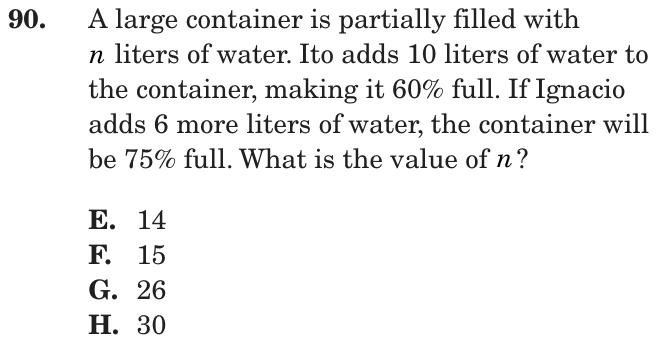
Liam and Kevin each collect stamps. Liam has twice as many stamps as Kevin. Liam gives 8 of his stamps to Kevin. Liam now has 12 more stamps than Kevin.
How many stamps did Liam start with?
Select the correct answer from each drop-down to complete the sentences.
An equation that relates the number of stamps originally in Liam’s and Kevin’s collections is .
After Liam gives 8 stamps to Kevin, the equation becomes .
By solving the equation, it can be determined that Liam started with stamps.
Choose an answer from each menu, then check. The DOE has not published how answers with several parts are scored; this site counts one right only when every part is right.
Show the answer
Correct answer: blank 1: 2; blank 2: K + 20; blank 3: 56
Liam originally has twice as many stamps as Kevin, so the equation is .
After Liam gives 8 stamps to Kevin, the equation becomes , which simplifies to .
Substitute into the equation: .
Solve for K:
Substitute to find L: .
So, Liam started with 56 stamps.
Question analysis
This word problem about two stamp collections is answered with three drop-down menus: an equation for the starting counts, an equation for after Liam gives Kevin 8 stamps, and the number Liam started with. Students turn "twice as many" and "12 more" into algebra and solve. Tracking both boys' counts before and after the gift is the tricky part, and every menu must be right.
- Grade level
- Grade 8 content, by NYS standard
- Compared with grade 7
- Above grade 7 Grade 7 students solve one equation in one unknown. The menus lay out the equations, but the problem still ties two unknowns together before and after a gift, a grade 8 system, and all three menus must be right.
- Estimated difficulty
- Moderate: several steps, or a close reading with one strong distractor.
- Thinking it demands
- Depth of knowledge 2, skills and concepts · mainly apply
- What makes it hard
- Turning words into math moderate
- Much to keep track of moderate
- Solution
- 4 steps
- Reading level
- Question and choices: about grade 5, 86 words.
- Students, last 30 days
- Not enough answers yet to show (it takes 10).
Why it is hard, traps and wrong answers (shows the answer)
Why it is hard
The menus do much of the setting up, since each sentence already shows the shape of its equation. The second menu is the hard one: the 8 stamps leave Liam and join Kevin before the gap of 12 is measured. Solving gives Kevin's 28 first, and K + 20 then equals 48, Liam's count after the gift, which waits on the last menu beside his starting 56. Testing each starting count against the story is a quick check on the last menu.
Turning words into math moderate Understanding the question
The gift changes both counts, so "Liam now has 12 more stamps than Kevin" compares Liam's L − 8 with Kevin's K + 8, and the second menu's K + 20 holds a 20 that appears nowhere in the stem. (Hegarty, Mayer & Monk, 1995; Koedinger & Nathan, 2004)
Much to keep track of moderate Working it out
Each boy has a count before and after the gift, four numbers in all, and all three menus must be right; the last asks for Liam's start, not the 48 he has after giving 8 away. (Sweller, 1988; Carpenter, Just & Shell, 1990)
Strategy: Let K be Kevin's starting count, write each boy's count after the gift in terms of K, and set Liam's 12 above Kevin's; testing each number in the last menu is a fast check.
Traps
- Answers a different question: A choice is right for another quantity: the other unknown, the rest instead of the part, the part instead of the whole.
- Follows a key word: Picks the operation from a single word rather than the situation: "removed" so subtract, "of" so multiply, "more" so add, when the situation needs something else.
- Equation written backwards: Writes a comparison the wrong way round, word for word: "six times as many students as professors" as 6S = P. The bigger quantity gets the bigger number.
The wrong answers, classified
BCB Answers a different question (King et al., 2004; Hegarty, Mayer & Monk, 1995)
Sets up both equations and solves for Kevin's 28, then takes the value of K + 20, 48, which is Liam's count after the gift, not at the start.
BBC Follows a key word (Hegarty, Mayer & Monk, 1995)
Follows the words "12 more" to L + 12, adding 12 to Liam's own count instead of Kevin's, then finds 56 by testing the three counts against the story.
ACC Equation written backwards (Clement, Lochhead & Monk, 1981)
Writes "twice as many stamps as Kevin" backwards, as 2L = K, and picks 0.5, giving Liam half of Kevin's stamps, while the other two menus are right.
Worked solution, step by step
Formulas used
- Twice as many as
- L is the number of stamps Liam starts with, and K is the number Kevin starts with. Twice as many means 2 times as many, so Liam’s count is 2 times Kevin’s. Because L and 2K are equal, you can put 2K in place of L in any equation.
- Doing the same to both sides
- a and b are the two sides of an equation, and c is any number or term. An equation is like a balanced scale. Add the same thing to both sides, or take the same thing away from both, and the scale stays level. This is how you move a term to the other side.
Sort out the question
Let L be Liam’s stamps at the start and K be Kevin’s. You know three facts:
- Liam has twice as many stamps as Kevin.
- Liam gives 8 of his stamps to Kevin.
- After that, Liam has 12 more stamps than Kevin.
The first menu finishes the starting equation. The second finishes the equation after the gift. The third is Liam’s count at the start.
Fill in the first menu
Twice as many means 2 times as many. Liam has twice as many as Kevin, so:
Pick 2 in the first menu.
Watch out: the 0.5 in the menu turns the fact around. would give Liam half as many as Kevin. Liam has more, so his count must be the bigger one.
Write both counts after the gift
The gift changes both counts. Liam loses 8 stamps, and Kevin gains those same 8.
- Liam now has stamps.
- Kevin now has stamps.
Liam has 12 more than Kevin. So Liam’s count equals Kevin’s count plus 12:
Pick K + 20 in the second menu.
Watch out: the 12 goes on Kevin’s count, not Liam’s. Picking L + 12 adds it to the wrong boy.
Solve for K
Now use the first equation. Since , put 2K in place of L:
Subtract K from both sides. Then add 8 to both sides. Each move keeps the scale level.
Kevin started with 28 stamps.
Find Liam’s starting count
Liam started with twice as many as Kevin:
Liam started with 56 stamps.
Watch out: is Liam’s count after the gift. The menu offers 48, but the question asks about the start.
So the menus read 2, K + 20 and 56.
Check your answer
At the start, Liam has 56 stamps and Kevin has 28, and 56 is twice 28. After the gift, Liam has 48 and Kevin has 36. , so Liam has 12 more. Every fact fits.
More questions like this
The original DOE question
Question 2 of 6
2023 Test A Math, question 40Question
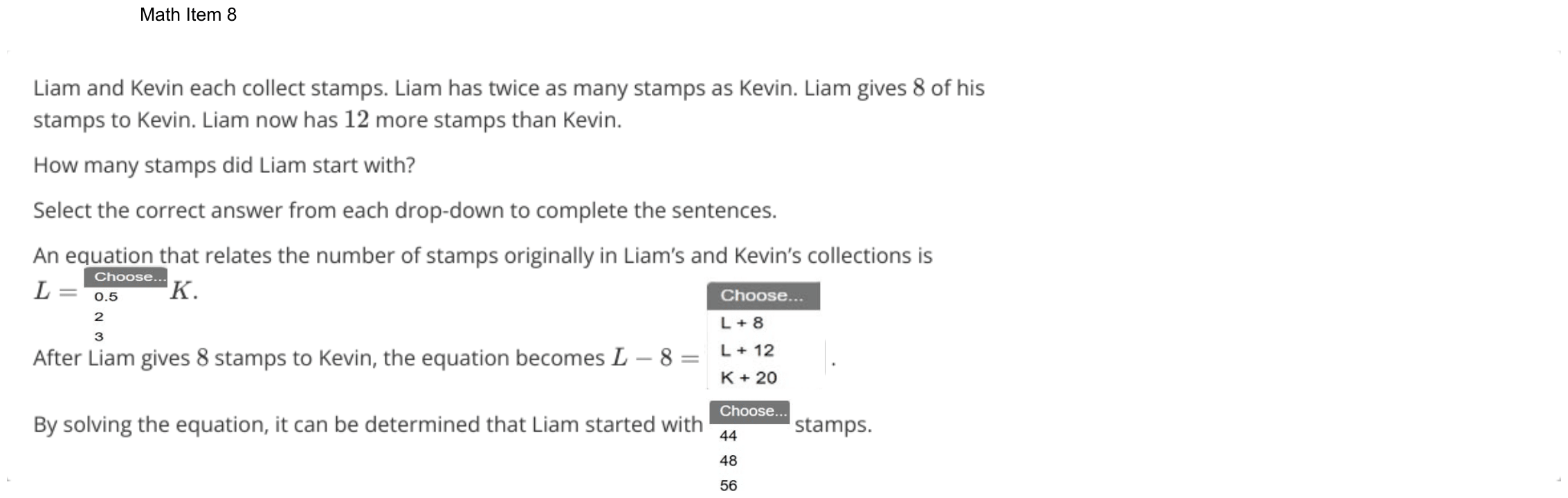
Ken has k video games, and Jeff has j video games. If Ken gives 6 video games to Jeff, Ken will have twice as many video games as Jeff. Which equation shows the relationship between k and j?
- A
- B
- C
- D
Show the answer
Correct answer: A
If Ken gives 6 video games to Jeff, the number Ken has is , and the number Jeff has is . After the exchange, Ken has twice as many video games as Jeff. The equation is:
Question analysis
This algebra word problem says Ken has k video games and Jeff has j, and if Ken gives Jeff 6 games, Ken will have twice as many as Jeff. Students choose the equation that models the situation. Getting the comparison the right way round, and grouping each new total correctly, is where most errors happen.
- Grade level
- Grade 7 content, by NYS standard
- Compared with grade 7
- At grade 7 Grade 7 students write equations from word problems. This one tracks two people's counts after a transfer and states a times-as-many comparison, so both counts change and the factor of 2 must go on the right side: typical but error-prone.
- Estimated difficulty
- Moderate: several steps, or a close reading with one strong distractor.
- Thinking it demands
- Depth of knowledge 2, skills and concepts · mainly apply
- What makes it hard
- Turning words into math moderate
- A very close wrong answer moderate
- Variables instead of numbers minor
- Solution
- 2 steps
- Reading level
- Question and choices: about grade 4, 41 words.
- Students, last 30 days
- Not enough answers yet to show (it takes 10).
Why it is hard, traps and wrong answers (shows the answer)
Why it is hard
The question is all setup: no solving is needed, just an equation that says what the story says. The trade moves games out of one count and into the other, and the comparison has to be written with the 2 on the smaller side. The wrong equations reverse the comparison, forget Jeff's gain, or drop the parentheses, and all four look alike. Plugging in sample counts is the surest check.
Turning words into math moderate Understanding the question
After the gift both counts change, Ken's to k − 6 and Jeff's to j + 6, and “twice as many video games as Jeff” must double Jeff's whole new count, putting the 2 on his side. (Hegarty, Mayer & Monk, 1995; Koedinger & Nathan, 2004)
A very close wrong answer moderate Choosing the answer
All four equations share the pieces k − 6, j + 6 and a 2; the right one differs from 2(k − 6) = j + 6 only in where the 2 sits, and from k − 6 = 2j + 6 by parentheses. (Embretson & Wetzel, 1987; Gorin & Embretson, 2006; Ascalon et al., 2007)
Variables instead of numbers minor Understanding the question
There are no numbers to check against, only k and j, so testing an equation means inventing counts that fit the story, such as Jeff with 4 games and Ken with 26. (Koedinger & Nathan, 2004; Enright, Morley & Sheehan, 2002)
Strategy: Write each boy's number of games after the exchange as an expression, then translate "Ken will have twice as many as Jeff" into an equation and test it with sample numbers.
Traps
- Equation written backwards: Writes a comparison the wrong way round, word for word: "six times as many students as professors" as 6S = P. The bigger quantity gets the bigger number.
- Order of operations: Working left to right, or distributing a minus sign wrongly, gives a choice.
The wrong answers, classified
B Order of operations (Brown & Burton, 1978)
Leaves out the parentheses, doubling only Jeff's old count j and then adding 6, instead of doubling his whole new count j + 6.
C Equation written backwards (Clement, Lochhead & Monk, 1981)
Puts the 2 on Ken's side, writing the comparison backwards, and also forgets that Jeff gains the 6 games, two errors in one equation.
D Equation written backwards (Clement, Lochhead & Monk, 1981)
Writes the comparison backwards word for word, doubling Ken's new count, which would mean Jeff ends with twice as many games as Ken.
Worked solution, step by step
Formulas used
- Twice as many
- A and B are two amounts. “A has twice as many as B” means A equals 2 times B. The 2 goes with the smaller amount, because that is the one you double to match the bigger one.
- The distributive property
- a, b and c are numbers. Multiplying a by a sum means multiplying a by each part, then adding. For example, 2(4 + 6) = 8 + 12 = 20.
Sort out the question
Ken has k video games, and Jeff has j. Then Ken gives 6 of his games to Jeff. After that, Ken has twice as many games as Jeff. You need the equation that links k and j.
Write each new amount
Ken gives away 6 games, so he has k − 6 left. Jeff gets those 6 games, so he has j + 6. Both amounts change, so use both new amounts.
Write “twice as many”
After the gift, Ken has more games. So Jeff’s new amount is the one that gets doubled.
Watch out: putting the 2 on Ken’s side, as in , would mean Jeff has twice as many. That is choice D.
Keep the parentheses
Twice Jeff’s new amount is 2j + 12, not 2j + 6. Watch out: dropping the parentheses gives choice B. So the answer is A, .
Check your answer
Make up numbers that fit the story. Say Jeff has 4 games and Ken has 26. After the gift, Ken has 20 and Jeff has 10, and 20 is twice 10. Choice A gives , or 20 = 20. Choice B gives 20 = 14, which is false.
More questions like this
The original DOE question
Question 3 of 6
2018 Test A Math, question 9Question
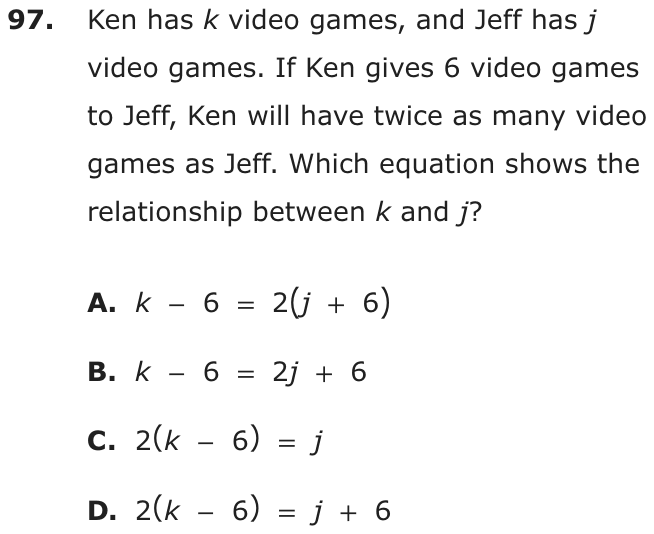
Jenny starts a game with twice as many marbles as Keiko. Jenny gives Keiko 5 marbles, but she still has 10 more than Keiko. How many marbles did Jenny have to start with?
- A25
- B30
- C35
- D40
Show the answer
Correct answer: D
Set up some equations. Jenny (J) has twice as many marbles as Keiko (K):
Jenny gives Keiko 5 marbles, so now they each have: J − 5 and K + 5 marbles. Jenny still has 10 more than Keiko:
To find how many marbles Jenny had to start with, solve J = 2K for K and substitute that into the second equation:
In equation J = 2K, solve for K:
Substitute in for K.
marbles
Question analysis
A two-variable word problem about marbles: Jenny starts with twice as many as Keiko, gives Keiko 5, and still has 10 more. Students set up equations for before and after the trade and solve for Jenny's starting number. The trade changes both players' counts, and the question asks about the start, not the end.
- Grade level
- Grade 8 content, by NYS standard
- Compared with grade 7
- Above grade 7 Grade 7 students solve one equation in one unknown. This needs two related unknowns and a before-and-after change, which leads to a system of equations or a variable on both sides, both grade 8 skills.
- Estimated difficulty
- Hard: combines ideas, needs a plan, and has more than one tempting wrong answer.
- Thinking it demands
- Depth of knowledge 2, skills and concepts · mainly apply
- What makes it hard
- Turning words into math major
- Much to keep track of moderate
- Solution
- 4 steps
- Reading level
- Question and choices: about grade 4, 31 words.
- Students, last 30 days
- Not enough answers yet to show (it takes 10).
Why it is hard, traps and wrong answers (shows the answer)
Why it is hard
Most of the difficulty is in setting up the equations, not solving them. The gift of 5 marbles changes both counts, so the gap between the girls shrinks by 10, not 5, and students who take the marbles from Jenny without giving them to Keiko reach a consistent but wrong answer. Two other choices are true counts from after the trade, so finishing the algebra is not the same as answering the question. Testing the choices backward is a fast, safe alternative.
Turning words into math major Understanding the question
Three relations hide in two sentences: "twice as many", the gift of 5 that lowers Jenny's count and raises Keiko's, and "still has 10 more", which compares the counts after the gift. (Hegarty, Mayer & Monk, 1995; Koedinger & Nathan, 2004)
Much to keep track of moderate Working it out
Each girl has a count before and after the trade, four quantities in all, and the question asks for only one of them, Jenny's at the start. (Sweller, 1988; Carpenter, Just & Shell, 1990)
Strategy: Work backward from the choices: halve each one for Keiko's start, move 5 marbles from Jenny to Keiko, and check whether Jenny ends with exactly 10 more.
Traps
- Misreads the question: Misses or misreads a condition or a word in the question: "at least", "each", "remaining", "not".
- Answers a different question: A choice is right for another quantity: the other unknown, the rest instead of the part, the part instead of the whole.
The wrong answers, classified
A Answers a different question (King et al., 2004; Hegarty, Mayer & Monk, 1995)
Solves correctly for Keiko's start, 20, then reports her count after receiving the 5 marbles, 25, instead of Jenny's starting count.
B Misreads the question (Hegarty, Mayer & Monk, 1995)
Subtracts the 5 marbles from Jenny but forgets that Keiko gains them, solving 2K − 5 = K + 10 to get K = 15 and J = 30.
C Answers a different question (King et al., 2004; Hegarty, Mayer & Monk, 1995)
Gives Jenny's count after she hands over 5 marbles, 40 − 5 = 35, instead of the number she had at the start.
Worked solution, step by step
Formulas used
- Twice as many
- J is the number of marbles Jenny starts with, and K is the number Keiko starts with. Twice as many means 2 times as many, so J equals 2 times K. Because J and 2K are equal, you can write 2K anywhere you see J.
- Keeping an equation balanced
- a and b are the two sides of an equation, and c is any number or term. An equation is like a balanced scale. If you subtract the same thing from both sides, it stays balanced. The same is true if you add the same thing, or divide both sides by the same number that is not zero.
Sort out the question
Let K be Keiko’s marbles at the start. Jenny starts with twice as many, so she has 2K. Then Jenny gives Keiko 5 marbles. After that, “she still has 10 more than Keiko”. You need Jenny’s count at the start, before the gift.
Write the counts after the gift
The gift changes both counts. Jenny loses 5, and Keiko gains 5.
- Jenny now has .
- Keiko now has .
Jenny has 10 more than Keiko. So Jenny’s count equals Keiko’s count plus 10.
Watch out: Keiko gains the 5 marbles too. Taking 5 from Jenny but not adding 5 to Keiko leads to 30, choice B.
Solve for K
Add the numbers on the right side first.
Subtract K from both sides. Then add 5 to both sides. Each move keeps the equation balanced.
Keiko started with 20 marbles.
Find Jenny’s starting count
Jenny started with twice as many as Keiko.
Watch out: 25 is Keiko’s count after the gift, choice A. 35 is Jenny’s count after the gift, choice C. The question asks about the start. So the answer is D, 40.
Check your answer
Start: Jenny has 40 and Keiko has 20, and 40 is twice 20. After the gift, Jenny has 35 and Keiko has 25. , so Jenny still has 10 more. Every fact fits.
More questions like this
The original DOE question
Question 4 of 6
2018 Test A Math, question 30Question
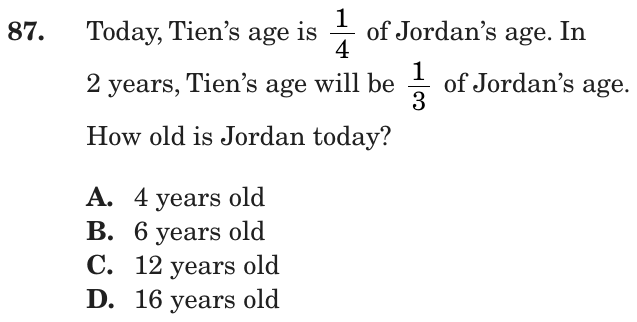
Today, Tien’s age is of Jordan’s age. In 2 years, Tien’s age will be of Jordan’s age. How old is Jordan today?
- A4 years old
- B6 years old
- C12 years old
- D16 years old
Show the answer
Correct answer: D
First, set up an equation to express Tien’s age () and Jordan’s age () today:
Two years from now, Tien’s age will be , and Jordan’s age will be .
Set up an equation about the relationship between Tien’s age and Jordan’s age in two years:
Solve the above equation for :
Now set the two equations equal to each other and solve for :
Question analysis
This age word problem says Tien is one fourth of Jordan's age today and will be one third of Jordan's age in two years, then asks for Jordan's current age. Students must turn two fractional relationships into equations and solve them together. Both people age by the same two years, and it is easy to solve for the wrong person.
- NYS standards
- Grade level
- Grade 8 content, by NYS standard
- Compared with grade 7
- Above grade 7 Grade 7 equations have one unknown on one side, like 3x + 5 = 20. This one links two unknown ages with fractional coefficients and leads to a variable on both sides, which is grade 8 algebra.
- Estimated difficulty
- Hard: combines ideas, needs a plan, and has more than one tempting wrong answer.
- Thinking it demands
- Depth of knowledge 2, skills and concepts · mainly apply
- What makes it hard
- Turning words into math major
- Error-prone arithmetic moderate
- Solution
- 4 steps
- Reading level
- Question and choices: about grade 1, 31 words.
- Students, last 30 days
- Not enough answers yet to show (it takes 10).
Why it is hard, traps and wrong answers (shows the answer)
Why it is hard
The difficulty is in the setup: two fractional relationships at two different times, with both people aging. Once the equations are right, the algebra is short, but it ends with two ages and only one is asked for. Testing the choices against both conditions is a reliable alternative that avoids the algebra entirely.
Turning words into math major Understanding the question
The second sentence must become T + 2 = (J + 2)/3; writing J/3, or forgetting that Jordan also ages two years, breaks the equation. (Hegarty, Mayer & Monk, 1995; Koedinger & Nathan, 2004)
Error-prone arithmetic moderate Working it out
Substituting J/4 for T leaves J/4 + 2 = (J + 2)/3, an equation with fractions on both sides that must be cleared, usually by multiplying by 12. (Brown & Burton, 1978; Junker & Sijtsma, 2001)
Strategy: Let Jordan's age be J, write Tien's age as J/4, and set J/4 + 2 equal to one third of (J + 2); or test each choice against both conditions.
Traps
- Answers a different question: A choice is right for another quantity: the other unknown, the rest instead of the part, the part instead of the whole.
The wrong answers, classified
A Answers a different question (King et al., 2004; Hegarty, Mayer & Monk, 1995)
Solves the equations correctly but reports Tien's age today, 4, which is one fourth of Jordan's 16, instead of Jordan's age.
B Answers a different question (King et al., 2004; Hegarty, Mayer & Monk, 1995)
Gives Tien's age two years from now, 4 + 2 = 6, answering for the wrong person and the wrong time.
C Numbers taken from the question (Hegarty, Mayer & Monk, 1995)
Picks 12 because it is a multiple of both 4 and 3, but then Tien would be 3 and later 5, not a third of 14.
Worked solution, step by step
Formulas used
- Distributive property
- a, b and c are any numbers. To multiply a sum by a number, multiply each part of the sum, then add. It works because a groups of (b + c) is the same as a groups of b plus a groups of c.
Sort out what you know
Today, Tien’s age is of Jordan’s age. That means Jordan is 4 times as old as Tien.
In 2 years, both of them will be 2 years older. Then Tien’s age will be of Jordan’s. So Jordan will be 3 times as old as Tien. You need Jordan’s age today.
Name the ages with a letter
Let t stand for Tien’s age today. Jordan is 4 times as old, so his age is 4t, which means 4 times t. Add 2 years to each age:
Person Today In 2 years Tien Jordan Watch out: Jordan gets 2 years older too. Do not forget to add 2 to his age.
Write an equation for later
In 2 years, Jordan’s age will be 3 times Tien’s age. Write that as an equation:
Use the distributive property on the right side. Multiply both t and 2 by 3:
Solve for Tien’s age
Take 3t away from both sides. Doing the same thing to both sides keeps them equal:
Now take 2 away from both sides:
So Tien is 4 years old today. Watch out: 4 is Tien’s age, not Jordan’s. Choice A, 4 years old, is a trap.
Find Jordan’s age
Jordan is 4 times as old as Tien:
So the answer is D, 16 years old.
Check your answer
Put 16 back into the story. Today, Tien is 16 ÷ 4 = 4. In 2 years, Tien is 6 and Jordan is 18. Is 6 one third of 18? Yes, because 18 ÷ 3 = 6. Choice C fails: Tien would be 3, then 5, and 5 is not a third of 14.
More questions like this
The original DOE question
Question 5 of 6
2018 Test B Math, question 27Question
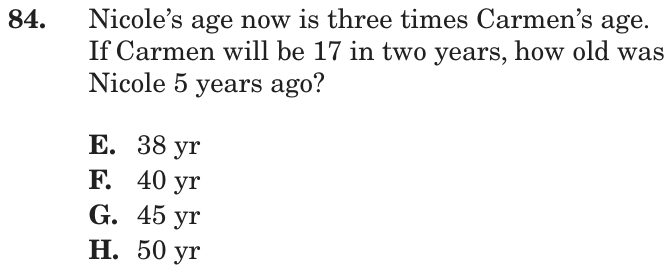
Nicole’s age now is three times Carmen’s age. If Carmen will be 17 in two years, how old was Nicole 5 years ago?
- A38 yr
- B40 yr
- C45 yr
- D50 yr
Show the answer
Correct answer: B
First, find out how old Nicole and Carmen are now.
Let = Nicole’s age now. Let = Carmen’s age now.
(Carmen’s age now)
(Nicole’s age now)
(Nicole’s age 5 years ago)
Question analysis
This age word problem says Nicole is three times as old as Carmen now, and that Carmen will be 17 in two years. Students work out both present ages and then go back five years for Nicole. Keeping the times straight is the tricky part: two years ahead for Carmen, five years back for Nicole.
- Grade level
- Grade 7 content, by NYS standard
- Compared with grade 7
- At grade 7 Grade 7 students write simple equations from word problems. Age problems like this one take three short steps, and the shifts in time are the only real hurdle, so the demand is typical of grade 7.
- Estimated difficulty
- Straightforward: two steps or one careful reading.
- Thinking it demands
- Depth of knowledge 2, skills and concepts · mainly apply
- What makes it hard
- Turning words into math moderate
- Much to keep track of minor
- Solution
- 3 steps
- Reading level
- Question and choices: about grade 1, 25 words.
- Students, last 30 days
- Not enough answers yet to show (it takes 10).
Why it is hard, traps and wrong answers (shows the answer)
Why it is hard
The arithmetic is short, but the question moves through three points in time, and only one of them carries the three-times relationship. Students who find Nicole's present age often stop there, since it is a choice. Labeling each age with its time, now or then, keeps the two-year and five-year shifts with the right person and in the right direction.
Turning words into math moderate Understanding the question
Three points in time appear, now, in two years and 5 years ago, and “three times Carmen's age” holds only for now, so each shift must be applied to the right person. (Hegarty, Mayer & Monk, 1995; Koedinger & Nathan, 2004)
Much to keep track of minor Working it out
Students must hold Carmen's future age 17, her present age 15, Nicole's present age 45 and the 5-year shift while deciding which to report. (Sweller, 1988; Carpenter, Just & Shell, 1990)
Strategy: Find Carmen's age now by going back two years from 17, triple it for Nicole's current age, then subtract five.
Traps
- Stops one step early: A choice is a number from partway through the solution.
- Negatives and direction: Arithmetic with negative numbers, the order of a subtraction, or direction on a number line. (Moving a term across the equals sign without changing its sign is a faulty procedure.)
The wrong answers, classified
A Misreads the question (Hegarty, Mayer & Monk, 1995)
Applies the two-year shift to Nicole as well, subtracting both 2 and 5 from her present age of 45.
C Stops one step early (King et al., 2004; Gierl et al., 2017)
Finds Nicole's present age, three times 15, and stops before going back 5 years.
D Negatives and direction (Brown & Burton, 1978)
Adds 5 years to Nicole's present age instead of subtracting, giving her age 5 years from now.
Worked solution, step by step
Formulas used
- Age at another time
- n is a number of years. To find an age in the future, add n to the age now. To find an age in the past, subtract n instead. Everyone gets older at the same speed, one year per year.
Sort out the times
The question talks about three times: now, two years from now, and 5 years ago. Nicole is 3 times as old as Carmen now.
Carmen will be 17 in two years. You need Nicole’s age 5 years ago.
Find Carmen's age now
In two years Carmen will be 17. So right now she is 2 years younger.
Carmen is 15 now.
Find Nicole's age now
Nicole’s age now is three times Carmen’s age now.
Nicole is 45 now.
Watch out: 45 is her age now, choice C. The question asks about 5 years ago.
Go back 5 years
Going back in time means subtracting.
Nicole was 40 five years ago.
Watch out: Adding 5 gives 50, choice D. Also, the 2 years only apply to Carmen. Taking 2 more years off Nicole gives 38, choice A.
So the answer is B, 40 yr.
Check your answer
Work forward from your answer. Nicole was 40 five years ago, so she is 45 now. Carmen is a third of that, 15. In two years Carmen will be 17. That matches the question.
More questions like this
The original DOE question
Question 6 of 6
2018 Test B Math, question 33Question
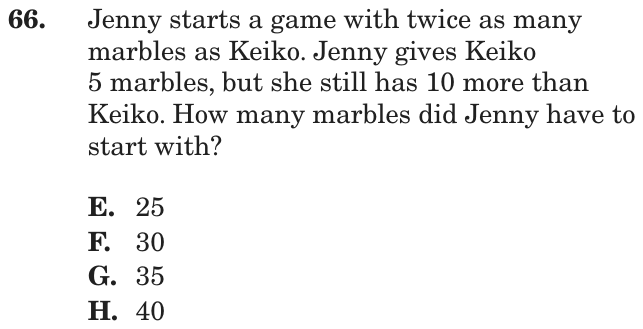
A large container is partially filled with liters of water. Ito adds 10 liters of water to the container, making it 60% full. If Ignacio adds 6 more liters of water, the container will be 75% full. What is the value of ?
- A14
- B15
- C26
- D30
Show the answer
Correct answer: A
Let be the total number of liters the container can hold.
First, solve each equation for :
Equation 1:
Equation 2:
Now, set the two equations equal to each other and solve for .
Question analysis
Water is poured into a large container in two stages: 10 liters make it 60% full, and 6 more liters bring it to 75% full. Students must work out how much water was in it to begin with. This percent word problem hides two unknowns, the starting amount and the capacity, and several in-between numbers look like answers.
- Grade level
- Grade 7 content, by NYS standard
- Compared with grade 7
- Above grade 7 Grade 7 percent problems usually give the whole and ask for a part. Here the whole is unknown and must be found from the change between two percents before a second step reaches the answer.
- Estimated difficulty
- Hard: combines ideas, needs a plan, and has more than one tempting wrong answer.
- Thinking it demands
- Depth of knowledge 3, strategic thinking · mainly analyze
- What makes it hard
- Turning words into math major
- No obvious method moderate
- Many steps moderate
- A very close wrong answer minor
- Solution
- 4 steps
- Reading level
- Question and choices: about grade 7, 40 words.
- Students, last 30 days
- Not enough answers yet to show (it takes 10).
Why it is hard, traps and wrong answers (shows the answer)
Why it is hard
The container's size is the hidden key, and nothing in the stem names it. Students who write an equation for each fill level, or who notice that 6 liters equal 15 percent, get there; others grab a number from the story or stop at the 75% level. Because every wrong choice is a number that appears in the problem or arises while solving it, a careless finish is rewarded with a match.
Turning words into math major Understanding the question
Two percent-full statements about a container of unknown size have to become equations, n + 10 = 60% of the capacity and n + 16 = 75% of it, and the capacity is never given. (Hegarty, Mayer & Monk, 1995; Koedinger & Nathan, 2004)
No obvious method moderate Working it out
The quick route is to see that Ignacio's 6 liters raise the level by 15 percentage points, which fixes the capacity at 40 liters; the wording does not point to it. (Schoenfeld, 1985)
Many steps moderate Working it out
After the capacity, the solution still needs the 60% amount, 24 liters, and a subtraction of Ito's 10 liters, so two unknowns are chased through four steps. (Daniel & Embretson, 2010; Enright, Morley & Sheehan, 2002)
A very close wrong answer minor Choosing the answer
15 sits one unit from the right 14, so a rough estimate of the starting amount cannot choose between them; only solving exactly, 24 − 10, separates them. (Embretson & Wetzel, 1987; Gorin & Embretson, 2006; Ascalon et al., 2007)
Strategy: Compare the two fill levels: the extra 6 liters account for the change in percent, which gives the capacity. Then use the 60% level to work back to the starting amount.
Traps
- Answers a different question: A choice is right for another quantity: the other unknown, the rest instead of the part, the part instead of the whole.
- Numbers taken from the question: Combines the numbers in the question without a model of the situation, or is simply a number that appears in the question.
- Wrong operation: Adds instead of multiplying, divides the wrong way round, turns a ratio or rate upside down, or undoes a step in the wrong direction (subtracts what should be added back).
The wrong answers, classified
B Numbers taken from the question (Hegarty, Mayer & Monk, 1995)
Subtracts the percents, 75 − 60 = 15, and gives a gap in percentage points as a number of liters.
C Wrong operation (Hegarty, Mayer & Monk, 1995; King et al., 2004)
Works back from the 30 liters at 75% full but adds Ignacio's 6 liters instead of removing them: 30 + 6 − 10 = 26.
D Answers a different question (King et al., 2004; Hegarty, Mayer & Monk, 1995)
Finds the 40-liter capacity and its 75% level, 30 liters, then gives the amount after both additions instead of the starting amount n.
Worked solution, step by step
Formulas used
- Percent of a number
- p is the percent. The whole is the full amount, here how much the container holds. The part is p percent of it. Percent means out of 100, so you divide p by 100 and then multiply.
Sort out what you know
The container starts with liters of water. Ito adds 10 liters, and it is 60% full. Then 6 more liters make it 75% full. You do not know how much the container holds when full. Call that its capacity. You need , the starting amount.
See what the 6 liters did
The extra 6 liters raised the level from 60% to 75%.
So 6 liters is 15% of the capacity.
Watch out: 15 is a percent, not a number of liters. Picking 15 gives choice B.
Find the full capacity
If 15% is 6 liters, then 1% is liters. A full container is 100%.
The container holds 40 liters when full.
Find the water at 60 percent
Use the percent formula with 60 for p and 40 liters for the whole.
After Ito adds his water, there are 24 liters.
Undo Ito’s 10 liters
Ito added 10 liters to the starting amount. To go back, subtract them.
The container started with 14 liters.
Watch out: 75% of 40 is 30 liters. That is the amount after both people add water, not at the start. It is choice D.
Give the answer
The question asks for , the amount before anyone added water. So the answer is A, 14.
Check your answer
Run the story forward. Start with 14 liters. Add 10 to get 24 liters, and 24 is 60% of 40. Add 6 more to get 30 liters, and 30 is 75% of 40. Both facts match.
More questions like this
The original DOE question