6.G.5 perfect squares and perfect cubes
Question 1 of 7
2024 Test A Math, question 8Question
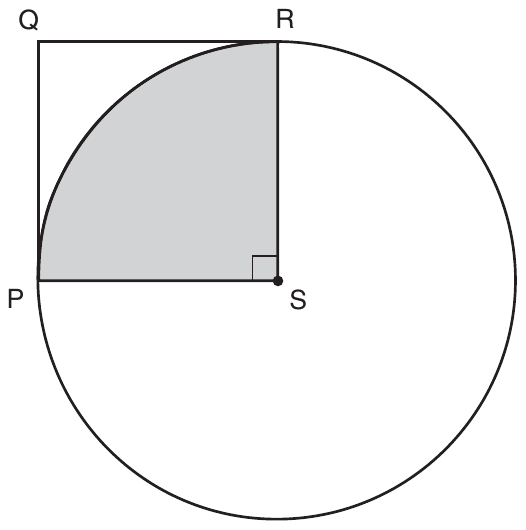
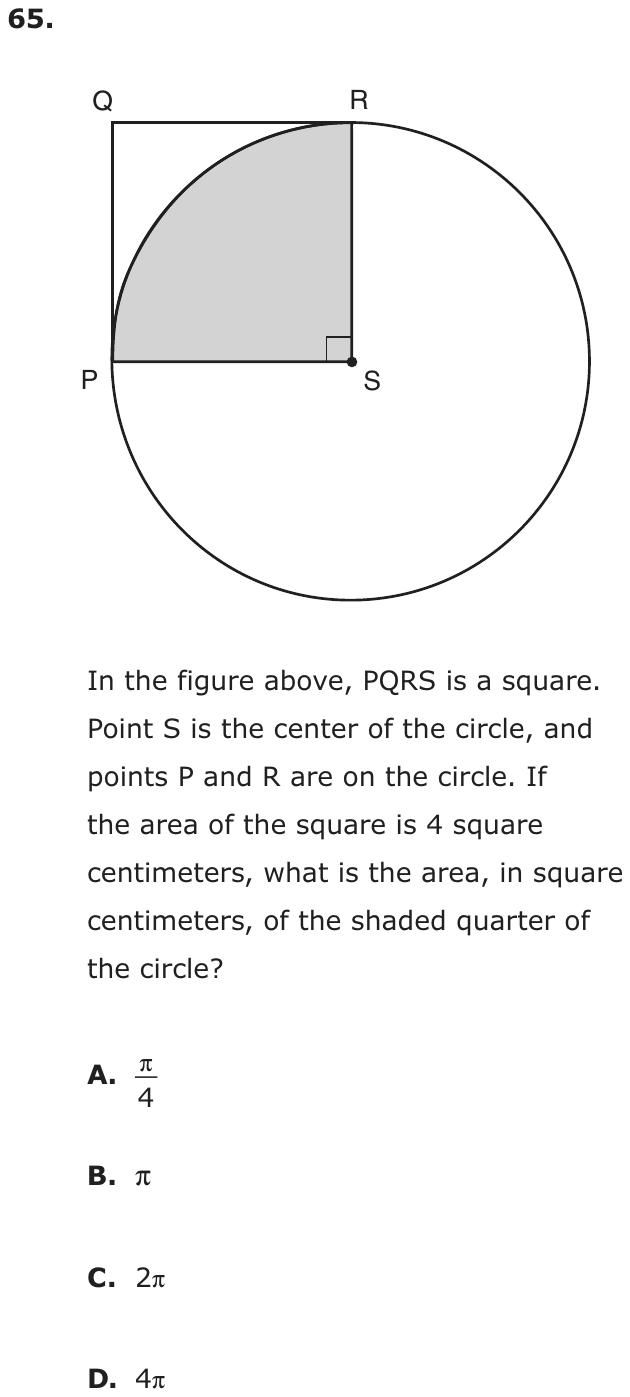
In the figure above, PQRS is a square. Point S is the center of the circle, and points P and R are on the circle. If the area of the square is 4 square centimeters, what is the area, in square centimeters, of the shaded quarter of the circle?
- A
- B
- C
- D
Show the answer
Correct answer: B
The area of square PQRS is 4 square centimeters. So
Sides PS and RS are each a radius of the circle. So the radius of the circle is 2 cm.
The shaded region is of the circle. The area of a circle is . So the area of the shaded region, in square centimeters, is
Question analysis
A geometry question with a figure: square PQRS has one corner at the center of a circle, and the quarter of the circle inside the square is shaded. Given the area of the square, students find the area of the shaded quarter circle. The key is connecting the square's side to the circle's radius.
- Grade level
- Grade 7 content, by NYS standard
- Compared with grade 7
- At grade 7 Circle area is grade 7 content, and this question adds only one linking step from the square's area to the radius. Typical grade 7 circle work gives the radius directly; here it takes one short extra inference.
- Estimated difficulty
- Straightforward: two steps or one careful reading.
- Thinking it demands
- Depth of knowledge 2, skills and concepts · mainly apply
- What makes it hard
- Reading a figure, table or graph moderate
- Something you must already know minor
- Combines ideas minor
- Solution
- 3 steps
- Reading level
- Question and choices: about grade 4, 52 words.
- Students, last 30 days
- Not enough answers yet to show (it takes 10).
Why it is hard, traps and wrong answers (shows the answer)
Why it is hard
The question chains three short facts: from the square's area to its side, from the side to the radius, and from the whole circle to a quarter of it. None is hard, but each wrong choice marks a broken link, most often the whole circle's area, which looks like a finished answer. Pointing to S as the center before computing anything settles the radius.
Reading a figure, table or graph moderate Understanding the question
The radius is never labeled: students must see that S is both a corner of the square and the circle's center, so sides PS and RS are radii. (Lesh, Post & Behr, 1987; Kirsch & Mosenthal, 1990)
Something you must already know minor Working it out
Neither the circle area formula, π times the radius squared, nor the step from a square's area to its side length is given. (Anderson & Krathwohl, 2001)
Combines ideas minor Working it out
Square and circle are linked in one chain: the area 4 gives a side of 2, the side is the radius, and the shaded part is a quarter of π × 2². (Embretson, 1998; Daniel & Embretson, 2010)
Strategy: Take the square root of the square's area to get its side, which is also the radius, then take one quarter of pi times the radius squared.
Traps
- Wrong formula: Uses a related but wrong formula: perimeter for area, diameter for radius, area for volume, or a misremembered one.
- Stops one step early: A choice is a number from partway through the solution.
- A formula you must know: Needs a formula the test does not give: area, circumference, volume, probability rules.
The wrong answers, classified
A Wrong formula (King et al., 2004)
Halves the square's side as if it were a diameter, so it uses a radius of 1, and one quarter of π × 1² gives π/4.
C Wrong formula (King et al., 2004)
Misremembers the circle's area as 2πr², blending it with the circumference 2πr, so one quarter of 2π × 2² gives 2π.
D Stops one step early (King et al., 2004; Gierl et al., 2017)
Finds the whole circle's area, π × 2² = 4π, and stops before taking the quarter that is shaded.
Worked solution, step by step
Formulas used
- Area of a square
- A is the area, the space inside. s is the length of one side, and s² means s × s. All four sides of a square are equal, so its area is side times side.
- Area of a circle
- A is the area of the whole circle. r is the radius: the distance from the center to the edge. π, called pi, is a number a little more than 3, about 3.14. Multiply π by r × r. This works for every circle.
Sort out the figure
PQRS is a square with an area of 4 sq cm. Point S is the center of the circle. Points P and R are on the circle. The shaded part is a quarter of the circle, inside the square. You need the shaded area, in square centimeters. The answer will have π in it.
Find the side of the square
Use the square formula. The area is 4, so find the number that times itself gives 4.
Each side is 2 cm long, because .
See that the side is the radius
Side SP goes from the center, S, to point P on the circle. So SP is a radius. So is side SR. The radius is 2 cm. Watch out: the side is a radius, not a diameter, the full width of the circle. Using a radius of 1 leads to , choice A.
Find the area of the whole circle
The whole circle has an area of 4π sq cm. Watch out: this is the whole circle. Stopping here gives choice D.
Take one quarter
The shaded part is one quarter of the circle, so take one quarter of 4π.
The shaded area is π sq cm. So the answer is B, .
Check your answer
π is about 3.14, so the shaded part is about 3.14 sq cm. The whole square is 4 sq cm. In the figure, the shaded part fills most of the square, but not all. So a bit less than 4 makes sense. The choice 4π is about 12.6, far too big.
More questions like this
The original DOE question
Question 2 of 7
2024 Test B Math, question 34Question
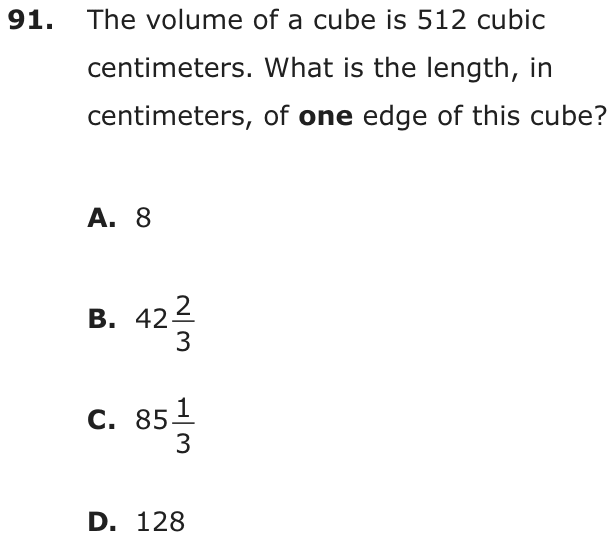
The volume of a cube is 512 cubic centimeters. What is the length, in centimeters, of one edge of this cube?
- A8
- B
- C
- D128
Show the answer
Correct answer: A
The volume of a cube is , where s is the length of one edge.
So , and .
If you are not sure how to find the cube root, you can estimate.
We know , so .
Since 512 is less than 1,000, the answer must be less than 10. The only given option less than 10 is 8. Double-check to make sure this is correct: .
Question analysis
A cube has a volume of 512 cubic centimeters, and students work backward to find the length of one edge. It tests the volume formula for a cube and the idea of a cube root. The tricky part is going from a volume to a length, the reverse of the usual volume problem.
- Grade level
- Grade 8 content, by NYS standard
- Compared with grade 7
- Above grade 7 Grade 7 volume work goes from edge lengths to a volume. Going backward needs a cube root, a grade 8 idea, and 512 is beyond the perfect cubes students are expected to know, though checking a guess by multiplying keeps it short.
- Estimated difficulty
- Straightforward: two steps or one careful reading.
- Thinking it demands
- Depth of knowledge 1, recall and reproduction · mainly apply
- What makes it hard
- Something you must already know moderate
- Solution
- 2 steps
- Reading level
- Question and choices: about grade 5, 22 words.
- Students, last 30 days
- Not enough answers yet to show (it takes 10).
Why it is hard, traps and wrong answers (shows the answer)
Why it is hard
This is a one-fact question: a cube's volume is its edge used three times as a factor. Students who remember that need only the number whose cube is 512, and the choices help, because only one is under 10 while 10 × 10 × 10 = 1,000. The wrong choices divide 512 by numbers tied to other measures of a cube or a square, so they catch students who do not recall the formula.
Something you must already know moderate Working it out
Neither V = s³ nor the cube root of 512 is given, so students must recall the formula and know, or find by trial, that 8 × 8 × 8 = 512. (Anderson & Krathwohl, 2001)
Strategy: Write the volume as edge × edge × edge, then find the number that, multiplied by itself three times, gives 512, and confirm it by multiplying.
Traps
- Wrong formula: Uses a related but wrong formula: perimeter for area, diameter for radius, area for volume, or a misremembered one.
- A formula you must know: Needs a formula the test does not give: area, circumference, volume, probability rules.
The wrong answers, classified
B Wrong formula (King et al., 2004)
Divides 512 by 12, the number of edges, as if the volume were the total length of all the edges, giving 42 2/3.
C Wrong formula (King et al., 2004)
Divides 512 by 6, the number of faces, mixing up volume with surface area, giving 85 1/3.
D Wrong formula (King et al., 2004)
Divides 512 by 4, as when a square's side is found from its perimeter, instead of finding the number whose cube is 512.
Worked solution, step by step
Formulas used
- Volume of a cube
- V is the volume, the space inside, in cubic units. s is the length of one edge. s³ means s × s × s. A cube’s length, width and height are all s, so length × width × height becomes s × s × s.
Sort out the question
The cube’s volume is 512 cubic centimeters. Volume is the space inside a solid. You need the length of one edge.
A cube has 12 edges, and they are all the same length. So one edge tells you all of them.
Write the volume formula
You need a number that gives 512 when you multiply it by itself three times. That number is called the cube root of 512.
Try numbers to find the edge
Start with an easy one: . That is too big, so the edge is less than 10. Try 8.
It works. Each edge is 8 centimeters.
Rule out the other choices
Watch out: The volume is not shared out among the faces or the edges. Dividing 512 by the 6 faces gives , choice C. Dividing by the 12 edges gives , choice B. Dividing by 4 gives 128, choice D.
So the answer is A, 8.
Check your answer
Test the biggest choice. is over 2 million, far more than 512. Only an edge less than 10 can work, and 8 is the only choice less than 10. And .
More questions like this
The original DOE question
Question 3 of 7
2024 Test B Math, question 51Question
Rita used 125 small solid cubes to build a large solid cube. The measure of each edge of the small cubes equals 1 inch. What is the measure of each edge of the large cube, in inches?
- A5
- B25
- C41.33
- D125
Show the answer
Correct answer: A
The volume of a cube with a side length of s is
Since 125 small cubes were used to build the large cube, .
Each side of the large cube is made up of 5 small cubes.
Since 5 small cubes make up each edge of the large cube, and the edge of each small cube measures 1 inch, the measure of each edge of the large cube is .
Question analysis
Rita stacks 125 one-inch cubes into a single large solid cube. Students find the length of each edge of the large cube in inches. It tests volume and perfect cubes with a building-block model, and the care needed is in telling apart the cubes along an edge, across a face and in the whole solid.
- Grade level
- Grade 6 content, by NYS standard
- Compared with grade 7
- Below grade 7 Building a large cube from unit cubes is the model grade 6 uses to introduce perfect cubes. It is a single step with small numbers, easier than typical grade 7 geometry, which works with composite solids and formulas.
- Estimated difficulty
- Routine: one familiar step, little to misread.
- Thinking it demands
- Depth of knowledge 1, recall and reproduction · mainly apply
- What makes it hard
- Solution
- 1 step
- Reading level
- Question and choices: about grade 3, 35 words.
- Students, last 30 days
- Not enough answers yet to show (it takes 10).
Why it is hard, traps and wrong answers (shows the answer)
Why it is hard
This is one of the easiest questions on the test, since 125 is a familiar cube and the small cubes make the large one easy to picture as 5 rows of 5 in 5 layers. The wrong choices name a layer instead of an edge, a division by 3 for three dimensions, or the total count itself, and multiplying 5 × 5 × 5 as a check rules all of them out.
Something you must already know minor Working it out
Students must see that 125 one-inch cubes make a volume of 125 cubic inches, and know or find that 5 × 5 × 5 = 125. (Anderson & Krathwohl, 2001)
Strategy: Think of the large cube as equal rows, columns and layers of small cubes, and find the number that, used three times as a factor, gives 125.
Traps
- Answers a different question: A choice is right for another quantity: the other unknown, the rest instead of the part, the part instead of the whole.
- Wrong operation: Adds instead of multiplying, divides the wrong way round, turns a ratio or rate upside down, or undoes a step in the wrong direction (subtracts what should be added back).
The wrong answers, classified
B Answers a different question (King et al., 2004; Hegarty, Mayer & Monk, 1995)
Gives the number of small cubes in one layer or on one face, 5 × 5 = 25, instead of the number along one edge.
C Wrong operation (Hegarty, Mayer & Monk, 1995; King et al., 2004)
Divides 125 by 3 for the cube's three dimensions instead of taking a cube root; that gives 41.67, and 41.33 is the only choice near it.
D Numbers taken from the question (Hegarty, Mayer & Monk, 1995)
Gives back the 125 from the stem, the count of small cubes and the volume in cubic inches, rather than an edge length.
Worked solution, step by step
Formulas used
- Volume of a cube
- V is the volume, the space inside, in cubic units. s is the length of one edge. s³ means s × s × s. A cube’s length, width and height are all s, so length × width × height becomes s × s × s.
Sort out the question
Rita stacks 125 small cubes into one big solid cube. Each small cube has edges of 1 inch. You need the length of one edge of the big cube, in inches.
Find the big cube’s volume
Each small cube is cubic inch. The big cube is solid, with no gaps. So its volume is 125 cubic inches.
Find the edge length
Find the number that makes 125 when you use it three times. Try 5.
So 5 small cubes sit along each edge. Each one is 1 inch long, so the edge is 5 inches.
Rule out the other choices
Watch out: 25, choice B, is the number of small cubes in one layer, 5 rows of 5. 125, choice D, is the number of cubes, or the volume. Dividing 125 by 3 does not give an edge either. That is about 41.67, near choice C.
So the answer is A, 5.
Check your answer
Picture building it. A row of 5 cubes is 5 inches long. Five rows make a layer of 25 cubes. Five layers make cubes. That matches.
More questions like this
The original DOE question
Question 4 of 7
2023 Test A Math, question 37Question
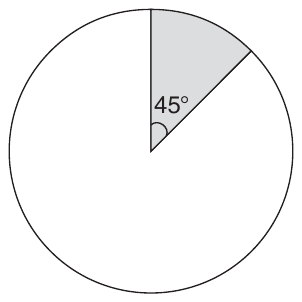
The shaded sector of the circle shown above has an area of square feet. What is the circumference of the circle?
- A ft
- B ft
- C ft
- D ft
Show the answer
Correct answer: B
The area of the entire circle is .
The fraction of the circle that is shaded is . So, the area of the sector is . Use that information to find r:
Use r to calculate the circumference of the circle:
The circumference is feet.
Question analysis
This circle question shows a shaded 45° sector with an area of 18π square feet and asks for the circumference of the whole circle. Students work backward: from the sector to the full area, from the area to the radius, and from the radius to the circumference. Mixing up area and circumference, or stopping partway, gives wrong choices.
- Grade level
- Grade 7 content, by NYS standard
- Compared with grade 7
- Above grade 7 Grade 7 circle problems usually give the radius and ask for area or circumference. This one runs backward from the area of a 45° sector, needing the sector's share of the circle, a square root and a switch to circumference: four linked steps.
- Estimated difficulty
- Hard: combines ideas, needs a plan, and has more than one tempting wrong answer.
- Thinking it demands
- Depth of knowledge 2, skills and concepts · mainly apply
- What makes it hard
- Combines ideas moderate
- Something you must already know moderate
- Reading a figure, table or graph minor
- Solution
- 4 steps
- Reading level
- Question and choices: about grade 5, 30 words.
- Students, last 30 days
- Not enough answers yet to show (it takes 10).
Why it is hard, traps and wrong answers (shows the answer)
Why it is hard
The question moves from a part of the circle's area to the whole circle's length, so area and circumference both appear and are easy to swap. Many students scale the sector up to 144π and stop, giving an area when a length was asked. Solving r² = 144 also needs a square root, after which 2πr is routine. Asking at the end whether the result is a length, measured in feet rather than square feet, catches the main trap.
Combines ideas moderate Working it out
Three ideas chain together: the 45° sector is 1/8 of the circle, so the whole area is 8 × 18π = 144π, then the radius comes from the area, and the circumference from the radius. (Embretson, 1998; Daniel & Embretson, 2010)
Something you must already know moderate Working it out
Neither πr² nor 2πr is given, nor that a full turn is 360°, so every link of the chain rests on formulas students must already know. (Anderson & Krathwohl, 2001)
Reading a figure, table or graph minor Understanding the question
The stem says only “shaded sector”; its 45° angle is marked at the center in the figure, the one place the fraction of the circle comes from. (Lesh, Post & Behr, 1987; Kirsch & Mosenthal, 1990)
Strategy: Work out what fraction of the circle a 45° sector is, scale its area up to the whole circle, solve for the radius, and only then use the circumference formula.
Traps
- Answers a different question: A choice is right for another quantity: the other unknown, the rest instead of the part, the part instead of the whole.
- A formula you must know: Needs a formula the test does not give: area, circumference, volume, probability rules.
- Numbers taken from the question: Combines the numbers in the question without a model of the situation, or is simply a number that appears in the question.
The wrong answers, classified
A Answers a different question (King et al., 2004; Hegarty, Mayer & Monk, 1995)
Scales the sector up to the whole circle, 8 × 18π = 144π, and gives that area, though the question asks for the circumference.
C Numbers taken from the question (Hegarty, Mayer & Monk, 1995)
Repeats the sector's area from the stem, 18π, as if the shaded part's area were the circle's circumference.
D Little reason to choose it (Haladyna & Downing, 1993; Rodriguez, 2005)
No step with the 45° angle or the circle formulas gives 9π, which is half the sector's area, so it mostly attracts guesses.
Worked solution, step by step
Formulas used
- Fraction of a circle in a sector
- A sector is a slice of a circle, like a slice of pizza. Its angle is the angle at the center, in degrees. A full turn around the center is 360 degrees. So the slice is that fraction of the whole circle.
- Area of a circle
- A is the area, the space inside the circle. r is the radius, the distance from the center to the edge. π, called pi, is a number a little more than 3. r² means r times r.
- Circumference of a circle
- C is the circumference, the distance around the circle. r is the radius and π is pi. Two radii make the diameter, the distance across, so this is the same as π times the diameter.
Sort out the question
The shaded slice has a 45° angle at the center. Its area is square feet. You need the circumference, the distance around the whole circle. For that you need the radius, so work back to it.
Find what fraction is shaded
The shaded slice is one eighth of the circle. Eight slices like it would fill the circle.
Find the area of the whole circle
The whole circle has an area of square feet. Watch out: this is an area, not the circumference. Stopping here gives choice A.
Find the radius
Divide both sides by π. Then ask what number times itself makes 144. It is 12, so the radius is 12 feet.
Find the circumference
Leave π as it is, because the choices are written with π. The circumference is feet. So the answer is B, ft.
Check your answer
Work forward. A radius of 12 feet gives an area of square feet. One eighth of that is square feet, the shaded area in the question.
More questions like this
The original DOE question
Question 5 of 7
2023 Test B Math, question 24Question
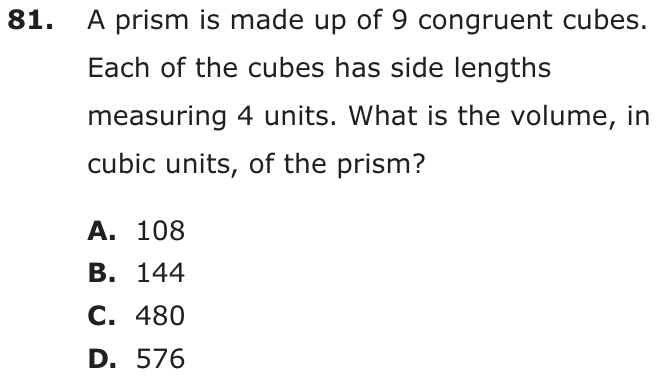
A prism is made up of 9 congruent cubes. Each of the cubes has side lengths measuring 4 units. What is the volume, in cubic units, of the prism?
- A108
- B144
- C480
- D576
Show the answer
Correct answer: D
First, determine the volume of each congruent cube. All the side lengths of the cubes are equal, so the length, width, and height of each cube is 4 units. To determine the volume of each cube, multiply :
So, the volume of each cube is 64 cubic units.
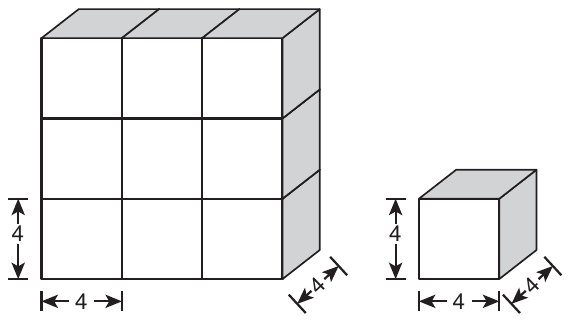
The prism is comprised of 9 of these cubes, so multiply the volume of each cube (64) by the total number of cubes (9) to determine the volume, in cubic units, of the prism:
Question analysis
A prism is built from 9 identical cubes, and each cube has edges 4 units long. Students find the volume of the prism in cubic units. It tests the volume of a cube and how volumes add when solids are put together, and it rewards keeping area, surface area and volume apart.
- Grade level
- Grade 6 content, by NYS standard
- Compared with grade 7
- Below grade 7 Volume of cubes and rectangular prisms is grade 5 and 6 content. This item needs one cube's volume and a multiplication by 9, two short steps, so it is below typical grade 7 work.
- Estimated difficulty
- Routine: one familiar step, little to misread.
- Thinking it demands
- Depth of knowledge 1, recall and reproduction · mainly apply
- What makes it hard
- Solution
- 2 steps
- Reading level
- Question and choices: about grade 3, 27 words.
- Corrected from the DOE handbook
- A letter x printed in place of a multiplication sign in the explanation was corrected.
- Students, last 30 days
- Not enough answers yet to show (it takes 10).
Why it is hard, traps and wrong answers (shows the answer)
Why it is hard
The question needs one formula and one multiplication, and the stem does not even say how the cubes are arranged, because the volume does not depend on it. The wrong choices come from mishandling the cube’s volume: the exponent multiplied instead of applied, the area of one face, or a surface area. Writing the volume out as edge times edge times edge, in cubic units, rules all three out.
Something you must already know minor Working it out
A cube’s volume, edge × edge × edge, is not given; with it, each 4-unit cube holds 64 cubic units, and the arrangement of the 9 cubes does not matter. (Anderson & Krathwohl, 2001)
Strategy: Find the volume of one cube by multiplying its three edges, then multiply by the number of cubes; how the cubes are arranged does not matter.
Traps
- Wrong formula: Uses a related but wrong formula: perimeter for area, diameter for radius, area for volume, or a misremembered one.
- A faulty procedure: A systematic but wrong procedure: adding fractions straight across, applying an exponent to each term of a sum, dropping a sign when moving a term.
The wrong answers, classified
A A faulty procedure (Brown & Burton, 1978; Tatsuoka, 1983)
Takes 4³ as 4 × 3 = 12, multiplying the edge by the exponent, so each cube seems to hold 12 cubic units and 9 × 12 = 108.
B Wrong formula (King et al., 2004)
Uses the area of one face, 4 × 4 = 16 square units, as each cube’s volume, so 9 × 16 = 144.
C Wrong formula (King et al., 2004)
Pictures the 9 cubes as a 3-by-3 slab, 12 by 12 by 4 units, and finds its surface area, 480 square units, instead of its volume.
What was corrected from the DOE handbook, and why
- Explanation: The handbook gives the volume of a cube as “length x width x height”, with the letter x where it means “times”. In a math explanation the letter x reads as a variable, so the site writes length × width × height, the sign the handbook itself uses on the next line (4 × 4 × 4 = 64). Nothing else changes: each cube is 64 cubic units, and the 9 cubes make 64 × 9 = 576.
Worked solution, step by step
Formulas used
- Volume of a cube
- V is the volume, the space inside a solid, in cubic units. s is the length of one edge. All the edges of a cube are equal, so its length, width and height are all s. Multiplying them counts how many unit cubes fit inside.
Sort out the question
A prism, a solid with flat faces, is made of 9 congruent cubes. Congruent means exactly the same size and shape. Each cube has sides of 4 units. You need the volume of the whole prism, in cubic units.
The question doesn’t say how the cubes are stacked. You don’t need to know. Volume is the space inside, and 9 cubes fill the same space however they are arranged.
Find the volume of one cube
Each cube has a volume of 64 cubic units. Watch out: means , not . That slip leads to 108, choice A. Also, is only the area of one face. It leads to 144, choice B.
Multiply by the number of cubes
The prism is 9 of these cubes, so its volume is 9 times as big.
The prism’s volume is 576 cubic units.
Give the answer
Watch out: volume counts the space inside, not the outside faces. Suppose the cubes formed one flat 3-by-3 layer. Adding up the areas of its outside faces gives 480, choice C. That is surface area, not volume. So the answer is D, 576.
Check your answer
Estimate: , and one cube fewer is . You can also test one arrangement. A flat 3-by-3 layer is 12 by 12 by 4 units, and . Same answer.
More questions like this
The original DOE question
Question 6 of 7
2023 Test B Math, question 36Question
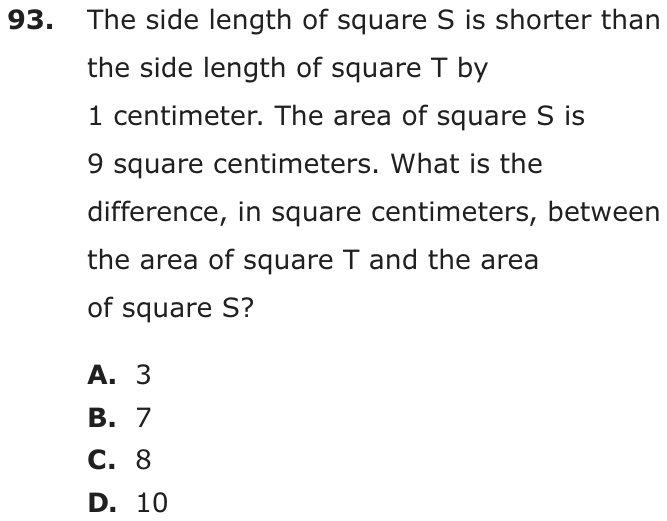
The side length of square S is shorter than the side length of square T by 1 centimeter. The area of square S is 9 square centimeters. What is the difference, in square centimeters, between the area of square T and the area of square S?
- A3
- B7
- C8
- D10
Show the answer
Correct answer: B
Let x represent the side length of square T, in centimeters. Then the side length of square S is .
The area of square S is:
So the side length of square T is 4 cm, and the area of square T is 16 sq cm.
The difference between the areas, in square centimeters, is .
Question analysis
Two squares differ in side length by 1 centimeter, and the smaller one has an area of 9 square centimeters. Students find how much greater the larger square's area is. It tests the link between a square's side and its area, and the extra area is easy to miscount when picturing the border that the longer sides add.
- Grade level
- Grade 6 content, by NYS standard
- Compared with grade 7
- Below grade 7 The area of a square and recognizing 9 as a perfect square are grade 6 ideas. This takes three short steps with small whole numbers, lighter than grade 7 work on composite figures, though the first step runs backward from area to side.
- Estimated difficulty
- Straightforward: two steps or one careful reading.
- Thinking it demands
- Depth of knowledge 2, skills and concepts · mainly apply
- What makes it hard
- Many steps minor
- Turning words into math minor
- Solution
- 3 steps
- Reading level
- Question and choices: about grade 6, 44 words.
- Students, last 30 days
- Not enough answers yet to show (it takes 10).
Why it is hard, traps and wrong answers (shows the answer)
Why it is hard
Every number is small, so the work is keeping track of which quantity the question wants: a difference of areas, not a side or a single area. The added area forms an L-shaped strip around square S, and students who picture it as two strips 4 centimeters long count the corner square twice. Finding both areas, 9 and 16, and subtracting avoids reasoning about the strip at all.
Many steps minor Working it out
The work runs from area to side and back: the square root of 9 gives S’s side, adding 1 gives T’s, squaring gives 16, and subtracting gives the difference. (Daniel & Embretson, 2010; Enright, Morley & Sheehan, 2002)
Turning words into math minor Understanding the question
The phrase “shorter than the side length of square T by 1 centimeter” describes S from T’s point of view, so T’s side is S’s side plus 1, not minus 1. (Hegarty, Mayer & Monk, 1995; Koedinger & Nathan, 2004)
Strategy: Find the side of square S from its area, add 1 centimeter to get the side of square T, find that square's area, and subtract the smaller area from the larger.
Traps
- Overlapping groups: Things in two groups at once are counted twice, or not subtracted.
- Answers a different question: A choice is right for another quantity: the other unknown, the rest instead of the part, the part instead of the whole.
- Numbers taken from the question: Combines the numbers in the question without a model of the situation, or is simply a number that appears in the question.
The wrong answers, classified
A Answers a different question (King et al., 2004; Hegarty, Mayer & Monk, 1995)
Finds the side of square S, 3 centimeters, from its area of 9 and gives that length instead of a difference between two areas.
C Overlapping groups (King et al., 2004)
Pictures the added area as two 4-by-1 strips along two sides of square S, 8 in all, counting the 1-by-1 corner where they overlap twice.
D Numbers taken from the question (Hegarty, Mayer & Monk, 1995)
Adds the stem’s two numbers, 9 + 1 = 10, as if a side 1 centimeter longer made the area 1 square centimeter larger, and gives that area.
Worked solution, step by step
Formulas used
- Area of a square
- A is the area, the space inside the square, in square units. s is the length of one side. All four sides of a square are equal, so the area is the side times itself. To go backward from an area, find the number that times itself gives the area.
Sort out the two squares
Square S has an area of 9 square centimeters. Its side is 1 centimeter shorter than the side of square T. You need the area of square T minus the area of square S, in square centimeters.
Find the side of square S
Use the area formula backward. Which number times itself makes 9?
So each side of square S is 3 centimeters. This number is called the square root of 9.
Find the side of square T
Square T’s side is 1 centimeter longer than square S’s side.
Each side of square T is 4 centimeters.
Find the area of square T
Use the area formula with a side of 4 centimeters.
The area of square T is 16 square centimeters.
Subtract the areas
Take the smaller area away from the larger one.
The difference is 7 square centimeters.
Watch out: Picturing the new area as two strips, each 4 by 1, gives 8, choice C. But those strips share a 1-by-1 corner, so it gets counted twice. Also, 3 is a side length, not a difference of areas. That is choice A.
So the answer is B, 7 square centimeters.
Check your answer
Draw square T and mark square S in one corner. The extra space is an L shape. It is a 3-by-1 strip, another 3-by-1 strip and a 1-by-1 corner. That is 3 + 3 + 1 = 7 square centimeters. It matches.
More questions like this
The original DOE question
Question 7 of 7
2023 Test B Math, question 43Question
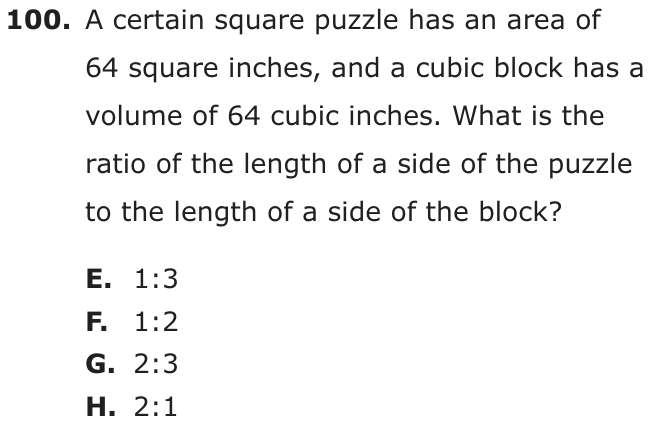
A certain square puzzle has an area of 64 square inches, and a cubic block has a volume of 64 cubic inches. What is the ratio of the length of a side of the puzzle to the length of a side of the block?
- A
- B
- C
- D
Show the answer
Correct answer: D
The length of one side of the puzzle is inches. The length of one side of the block is inches.
The ratio of the side of the puzzle to the side of the block is , which reduces to .
Question analysis
A square puzzle has an area of 64 square inches, and a cube-shaped block has a volume of 64 cubic inches. Students find the ratio of a side of the puzzle to a side of the block. Both figures are described by the number 64, but turning an area and a volume back into lengths takes different steps, and the order of the ratio matters.
- NYS standards
- Grade level
- Grade 8 content, by NYS standard
- Compared with grade 7
- Above grade 7 Grade 7 area and volume problems go from side lengths to an area or a volume. Going backward needs a square root and a cube root, and cube roots are grade 8 content, although 64 is both a perfect square and a perfect cube.
- Estimated difficulty
- Moderate: several steps, or a close reading with one strong distractor.
- Thinking it demands
- Depth of knowledge 2, skills and concepts · mainly apply
- What makes it hard
- Something you must already know moderate
- Combines ideas minor
- Solution
- 3 steps
- Reading level
- Question and choices: about grade 3, 46 words.
- Students, last 30 days
- Not enough answers yet to show (it takes 10).
Why it is hard, traps and wrong answers (shows the answer)
Why it is hard
Because 64 is both a perfect square and a perfect cube, the computation is easy once students know to undo squaring and cubing. The risk is at the end: with sides of 8 and 4 inches in hand, writing the block first turns the ratio upside down. Students who never find the side lengths are left with ideas such as two dimensions against three.
Something you must already know moderate Working it out
Neither formula is given: the puzzle’s side is the number whose square is 64 and the block’s edge the number whose cube is 64, and cube roots are grade 8 work. (Anderson & Krathwohl, 2001)
Combines ideas minor Working it out
A square and a cube share the number 64 in different units, so two different inverse operations feed one ratio, which must list the puzzle’s side first. (Embretson, 1998; Daniel & Embretson, 2010)
Strategy: Find the side of the square from its area and the edge of the cube from its volume by testing small whole numbers, then write the puzzle's side first and simplify.
Traps
- Wrong operation: Adds instead of multiplying, divides the wrong way round, turns a ratio or rate upside down, or undoes a step in the wrong direction (subtracts what should be added back).
- Numbers taken from the question: Combines the numbers in the question without a model of the situation, or is simply a number that appears in the question.
The wrong answers, classified
A Little reason to choose it (Haladyna & Downing, 1993; Rodriguez, 2005)
No common working gives 1 : 3; it makes the puzzle’s side the shorter one, the reverse of 8 and 4 inches, so it mostly draws guesses.
B Wrong operation (Hegarty, Mayer & Monk, 1995; King et al., 2004)
Finds both lengths correctly, 8 and 4 inches, but writes the block’s side first, turning the ratio upside down to 1 : 2.
C Numbers taken from the question (Hegarty, Mayer & Monk, 1995)
Matches the square to 2 and the cube to 3, the powers behind square inches and cubic inches, and writes 2 : 3 without finding any length.
Worked solution, step by step
Formulas used
- Area of a square
- A is the area, in square units. s is the length of one side. All sides of a square are equal, so the area is the side times itself. To find the side from the area, ask which number times itself gives the area.
- Volume of a cube
- V is the volume, the space inside, in cubic units. s is the length of one edge. A cube’s length, width and height are all equal, so the volume is the edge used three times. To go backward, ask which number used three times gives the volume.
Sort out the shapes
The puzzle is a square with an area of 64 square inches. The block is a cube with a volume of 64 cubic inches. A cube is a box with every edge the same length. You need the ratio of the puzzle’s side to the block’s side, with the puzzle first.
Find the puzzle’s side
Use the area formula backward. Which number times itself makes 64?
The puzzle’s side is 8 inches. This number is the square root of 64.
Find the block’s side
Use the volume formula backward. Which number used three times makes 64? Try small numbers. 3 × 3 × 3 = 27 is too small.
The block’s side is 4 inches. This number is the cube root of 64.
Write and simplify the ratio
Put the puzzle first, as the question asks. Then divide both parts by 4.
Watch out: Writing the block’s side first gives 1 : 2, choice B. The order in a ratio matters.
So the answer is D, 2 : 1.
Check your answer
Check both sides. 8 × 8 = 64 square inches, and 4 × 4 × 4 = 64 cubic inches. The puzzle’s side is longer, so its number in the ratio must be bigger. Only choice D puts the bigger number first.
More questions like this
The original DOE question