7W2a introducing and organizing a topic
Question 1 of 8
2026 Practice Test A English, question 43Passage The Benefits of Indoor Plants
The Benefits of Indoor Plants
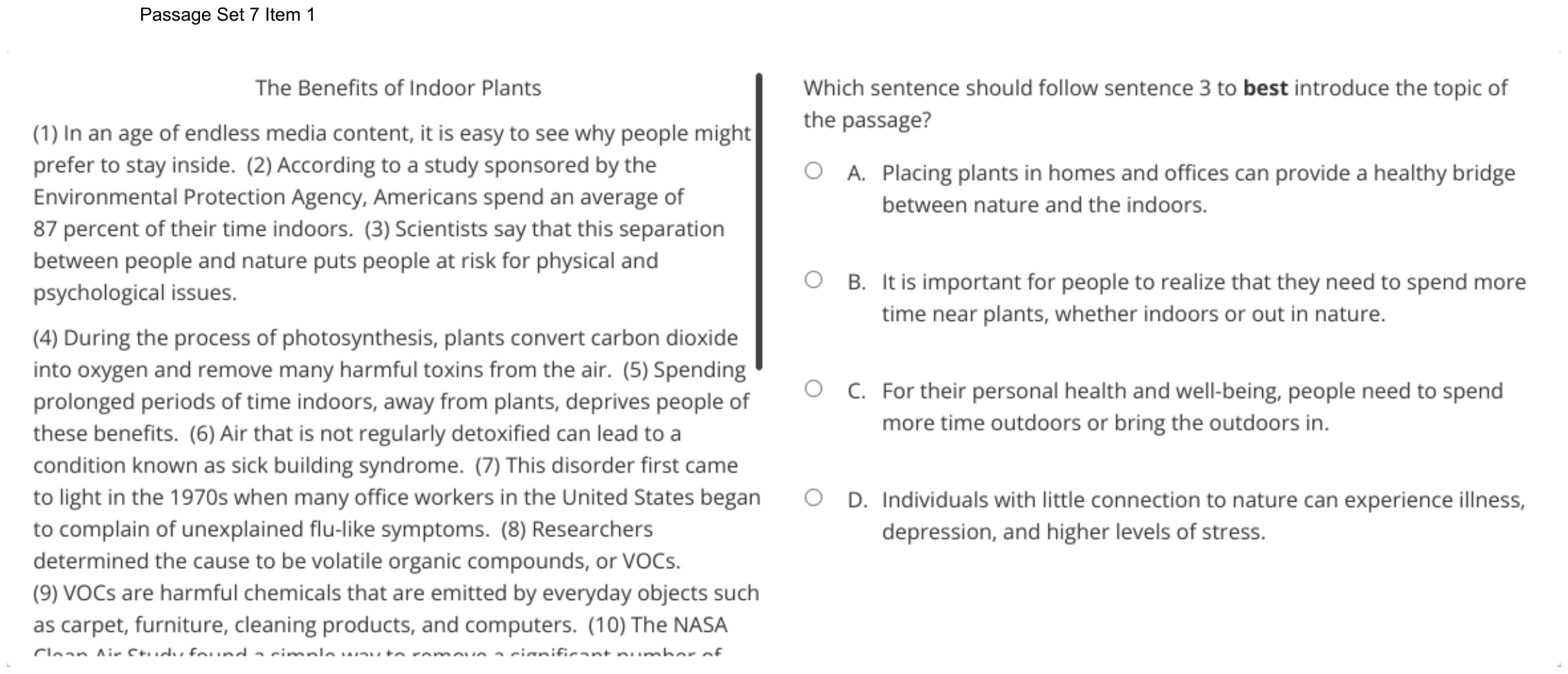
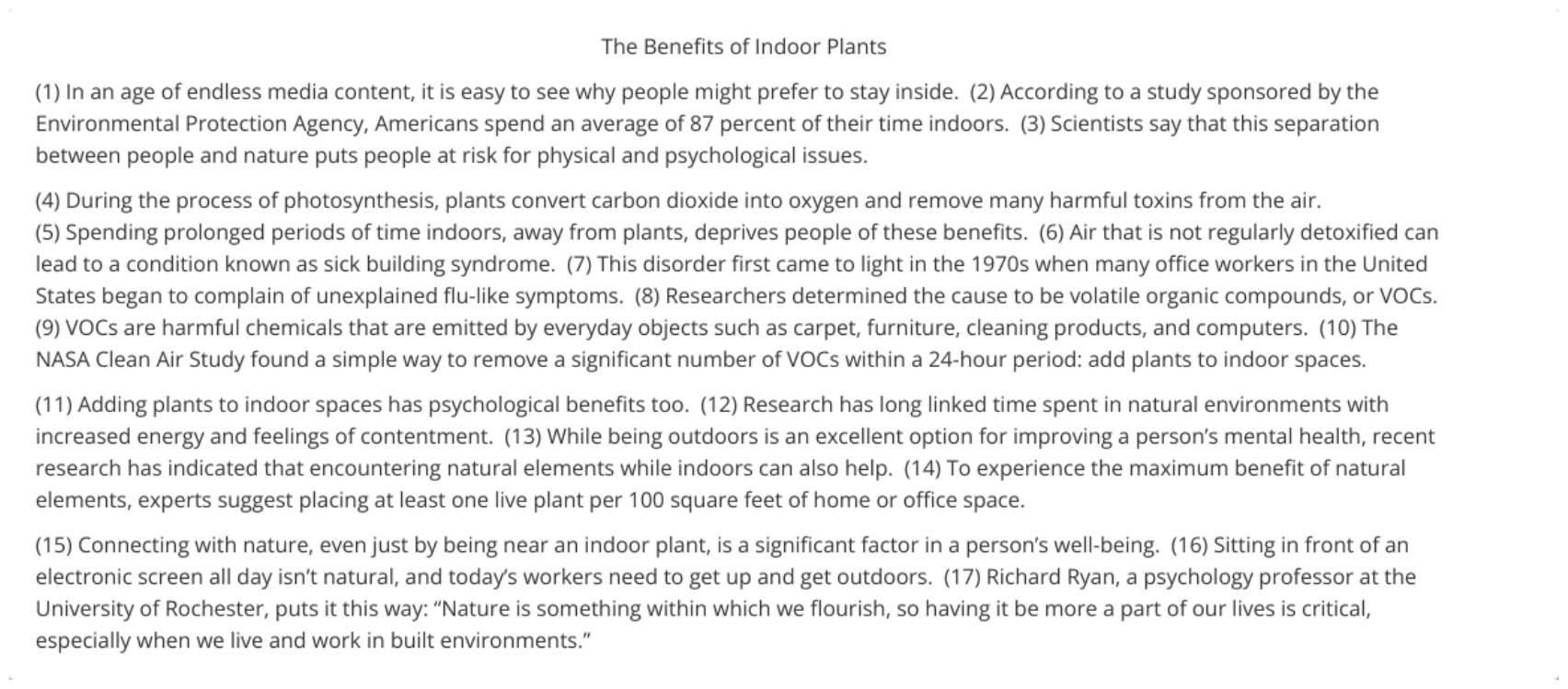
(1) In an age of endless media content, it is easy to see why people might prefer to stay inside. (2) According to a study sponsored by the Environmental Protection Agency, Americans spend an average of 87 percent of their time indoors. (3) Scientists say that this separation between people and nature puts people at risk for physical and psychological issues.
(4) During the process of photosynthesis, plants convert carbon dioxide into oxygen and remove many harmful toxins from the air. (5) Spending prolonged periods of time indoors, away from plants, deprives people of these benefits. (6) Air that is not regularly detoxified can lead to a condition known as sick building syndrome. (7) This disorder first came to light in the 1970s when many office workers in the United States began to complain of unexplained flu-like symptoms. (8) Researchers determined the cause to be volatile organic compounds, or VOCs. (9) VOCs are harmful chemicals that are emitted by everyday objects such as carpet, furniture, cleaning products, and computers. (10) The NASA Clean Air Study found a simple way to remove a significant number of VOCs within a 24-hour period: add plants to indoor spaces.
(11) Adding plants to indoor spaces has psychological benefits too. (12) Research has long linked time spent in natural environments with increased energy and feelings of contentment. (13) While being outdoors is an excellent option for improving a person’s mental health, recent research has indicated that encountering natural elements while indoors can also help. (14) To experience the maximum benefit of natural elements, experts suggest placing at least one live plant per 100 square feet of home or office space.
(15) Connecting with nature, even just by being near an indoor plant, is a significant factor in a person’s well-being. (16) Sitting in front of an electronic screen all day isn’t natural, and today’s workers need to get up and get outdoors. (17) Richard Ryan, a psychology professor at the University of Rochester, puts it this way: “Nature is something within which we flourish, so having it be more a part of our lives is critical, especially when we live and work in built environments.”
Question
Which sentence should follow sentence 3 to best introduce the topic of the passage?
- APlacing plants in homes and offices can provide a healthy bridge between nature and the indoors.
- BIt is important for people to realize that they need to spend more time near plants, whether indoors or out in nature.
- CFor their personal health and well-being, people need to spend more time outdoors or bring the outdoors in.
- DIndividuals with little connection to nature can experience illness, depression, and higher levels of stress.
Show the answer
Correct answer: A
The question asks which sentence should follow sentence 3 to best introduce the topic of the passage.
A. CORRECT. The sentence introduces the overall topic by previewing the main ideas in the passage. It introduces the connection between natural elements and well-being (“a healthy bridge”) and sets up the main argument of the passage (“Placing plants in homes and offices” can increase people’s well-being).
B. Incorrect. Although sentence 3 mentions the connection between “people and nature,” this sentence references the importance of spending time near plants while both indoors and outdoors. However, the passage focuses specifically on the benefits of having indoor plants.
C. Incorrect: Though the sentence describes a reason why indoor plants are important (“For [people’s] personal health and well-being”), the topic of the passage is related to the need for indoor plants, not the need for people to spend more time outdoors.
D. Incorrect. While the sentence refers to how time away from nature can affect health and well-being, the vague wording (“little connection to nature”) makes this sentence too broad to introduce the topic of the passage, and thus, it should not follow sentence 3.
Question analysis
This revising question works with the four-paragraph passage “The Benefits of Indoor Plants” and asks which sentence should follow sentence 3 to introduce the passage's topic. The opening paragraph ends on the health risks of time spent away from nature, and every choice continues that thought in some way, so students must judge which one prepares a reader for what the passage goes on to cover.
- NYS standards
- 7W2a introducing and organizing a topic
- Grade level
- Grade 7 reading and task
- Compared with grade 7
- At grade 7 Introducing a topic so that it previews what follows is a grade 7 writing standard, practised often in class. The passage is short and plainly worded, and the choices differ in focus rather than in grammar, typical grade 7 revision.
- Estimated difficulty
- Moderate: several steps, or a close reading with one strong distractor.
- Thinking it demands
- Depth of knowledge 2, skills and concepts · mainly evaluate
- What makes it hard
- A very close wrong answer moderate
- Evidence in several places moderate
- How sentences fit together minor
- Evidence
- Answered from the whole text
- Reading level
- Passage: about grade 12, 346 words; question and choices: about grade 9, 84 words.
- Students, last 30 days
- Not enough answers yet to show (it takes 10).
Why it is hard, traps and wrong answers (shows the answer)
Why it is hard
The first paragraph ends on a problem, and all four choices continue it plausibly, so the decision is about scope. The passage is about plants indoors, and the near miss offers outdoor time as an equal remedy, while another widens the subject to plants anywhere and a third simply restates the danger. Students who skim the topic sentences of the later paragraphs before choosing see that only an indoor solution introduces what follows.
A very close wrong answer moderate Choosing the answer
The choice ending “or bring the outdoors in” sounds like the key's “bridge between nature and the indoors,” but it adds spending more time outdoors, a remedy the passage does not develop. (Embretson & Wetzel, 1987; Gorin & Embretson, 2006; Ascalon et al., 2007)
Evidence in several places moderate Working it out
The topic only emerges from the later paragraphs: plants cleaning indoor air in sentences 4–10, their psychological benefits in 11–14, and nature brought indoors in 15–17. (Kirsch & Mosenthal, 1990; Gorin & Embretson, 2006)
How sentences fit together minor Working it out
The new sentence must follow sentence 3's warning about “separation between people and nature” and lead into sentence 4's photosynthesis, so it has to name plants as the remedy. (Halliday & Hasan, 1976)
Strategy: Skim the first sentence of each later paragraph to see what the passage actually covers, then test each choice: would it set up those paragraphs without promising something they never discuss?
Traps
- Half right: One half of a two-part choice is right and the other is not.
- Too broad or too strong: A choice overstates, generalizes, or uses absolute words the text does not support.
- Says it twice: Repeats an idea that the sentence or passage already states.
The wrong answers, classified
B Too broad or too strong (King et al., 2004)
Accepts a sentence about needing plants, but “whether indoors or out in nature” widens the subject to plants anywhere, while the passage discusses only plants inside.
C Half right (King et al., 2004; Thissen, Steinberg & Fitzpatrick, 1989)
Is drawn by “bring the outdoors in” and “health and well-being,” but the other half, spending more time outdoors, is a remedy the passage never goes on to develop.
D Says it twice (Connors & Lunsford, 1988)
Follows sentence 3 smoothly by naming illness, depression and stress, but that only restates its “physical and psychological issues” and never introduces plants, the passage's subject.
Working it out, step by step
Figure out what the question asks
This revising question asks you to add a sentence that introduces the topic. Such a sentence tells the reader what the passage will be about. For example, an essay about why dogs make good pets might start: Dogs make loyal, loving pets. The new sentence goes after sentence 3, so it must also follow from it.
Find the passage’s topic
Skim the rest of the passage. Sentences 4–10 tell how plants clean indoor air. Sentences 11–14 say plants indoors help the mind. Sentences 15–17 say even an indoor plant connects you with nature. So the topic is plants inside homes and offices. The title says it too: “The Benefits of Indoor Plants.”
Connect it to sentence 3
Sentence 3 names a problem: “this separation between people and nature puts people at risk for physical and psychological issues.” Psychological means having to do with the mind and feelings. The best next sentence should name the fix the passage talks about: bringing plants indoors.
Check each choice
- A is right. It names plants “in homes and offices” as “a healthy bridge between nature and the indoors.” A bridge connects two things, so plants bring nature inside. That sets up every later paragraph.
- B is wrong. “Whether indoors or out in nature” widens the topic to plants anywhere. The passage only discusses plants inside.
- C is wrong. It offers two fixes: more time outdoors, or bringing the outdoors in. The passage develops only the second. C never even mentions plants.
- D is wrong. It just repeats sentence 3’s problem in new words. It never brings up plants, the subject of the passage.
Look closely at choice C
Watch out: C sounds close because of “bring the outdoors in.” But the passage gives no tips for spending more time outside. Sentence 13 mentions being outdoors only on its way to the indoor point. So half of C promises something the passage never delivers.
Choose the answer
Only one choice moves from sentence 3’s problem to the passage’s answer, plants inside. So the answer is A.
Why this answer and not the closest wrong one
C is the closest wrong answer, because “bring the outdoors in” sounds like A. But C gives equal weight to spending more time outdoors, and the passage never develops that idea. A points only to plants indoors, which is exactly what the rest of the passage is about.
More questions like this
The original DOE question
The passage “The Benefits of Indoor Plants” as printed (page 60)
Question 2 of 8
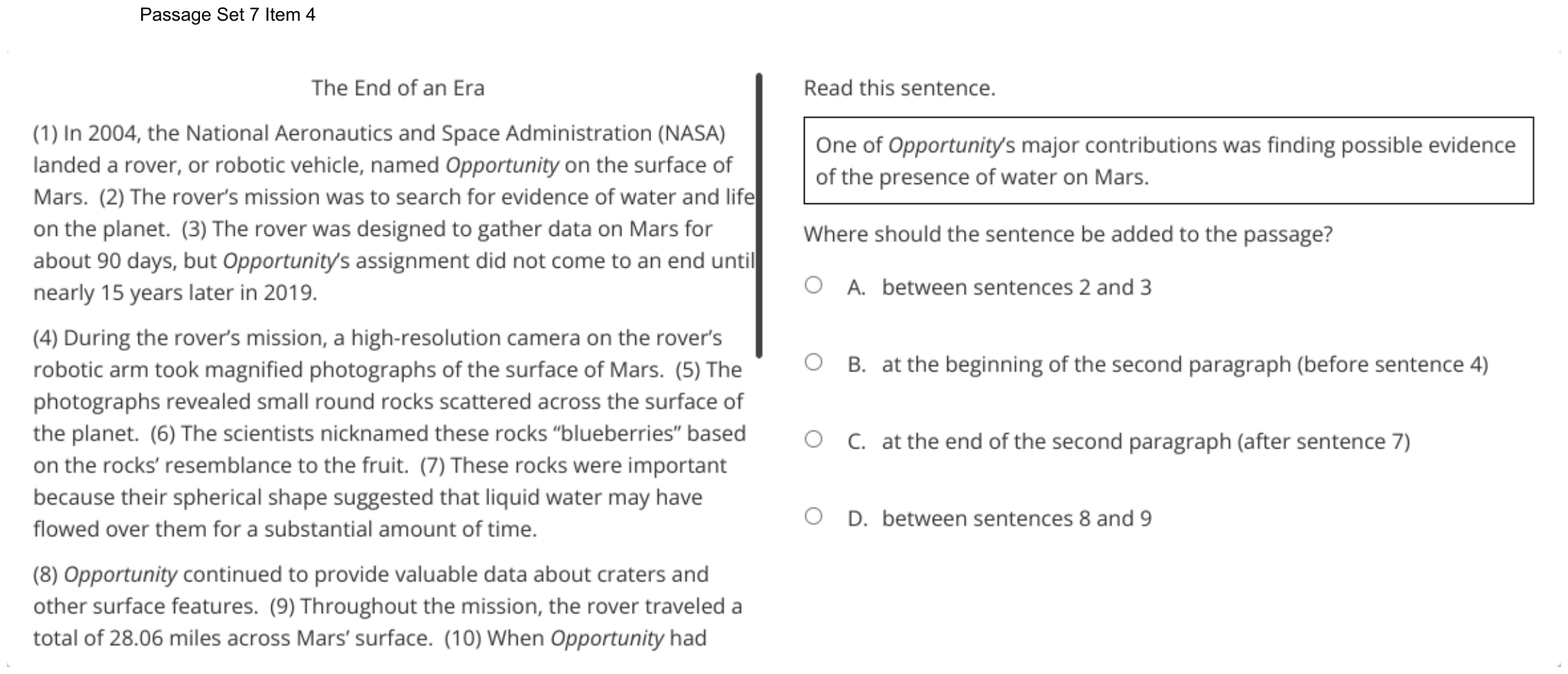
2026 Practice Test B English, question 43Passage The End of an Era
The End of an Era
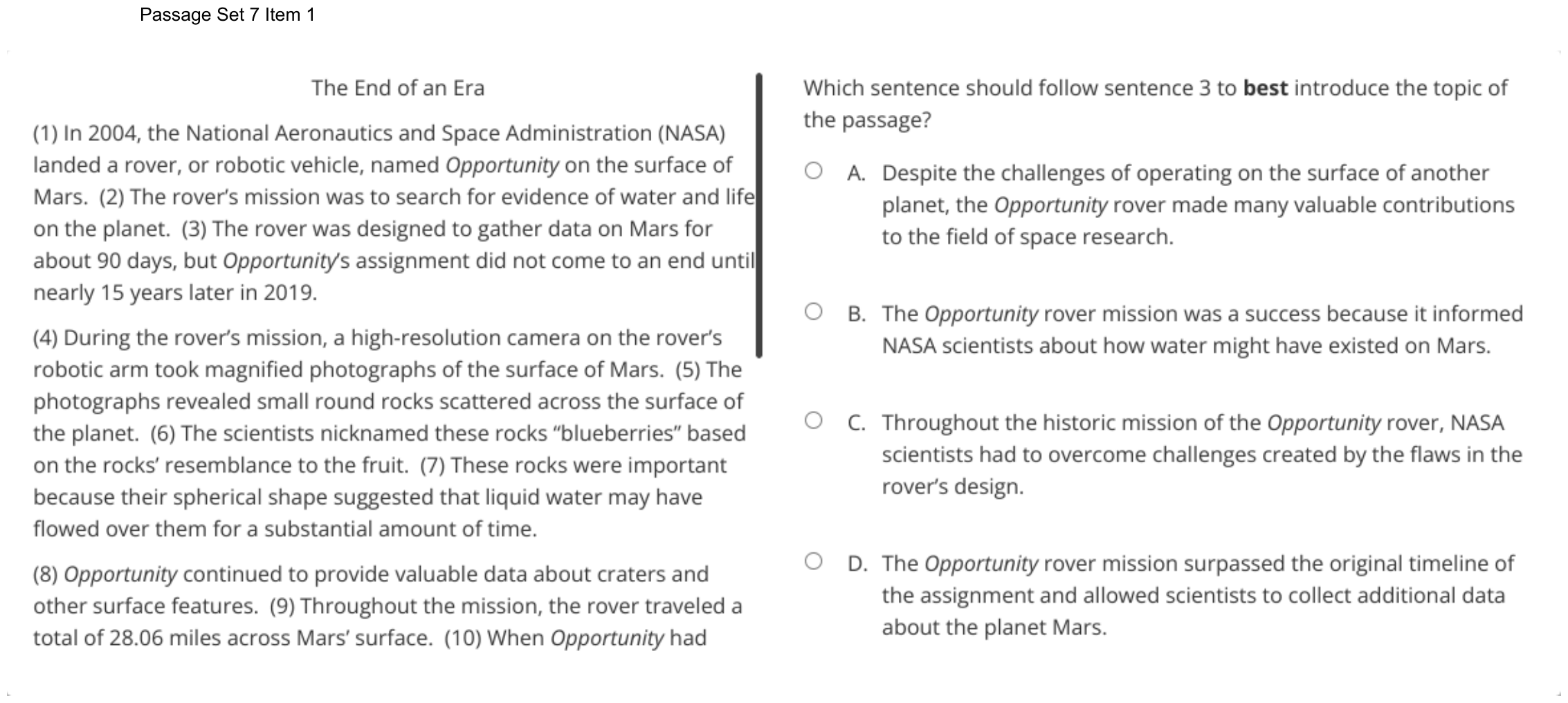
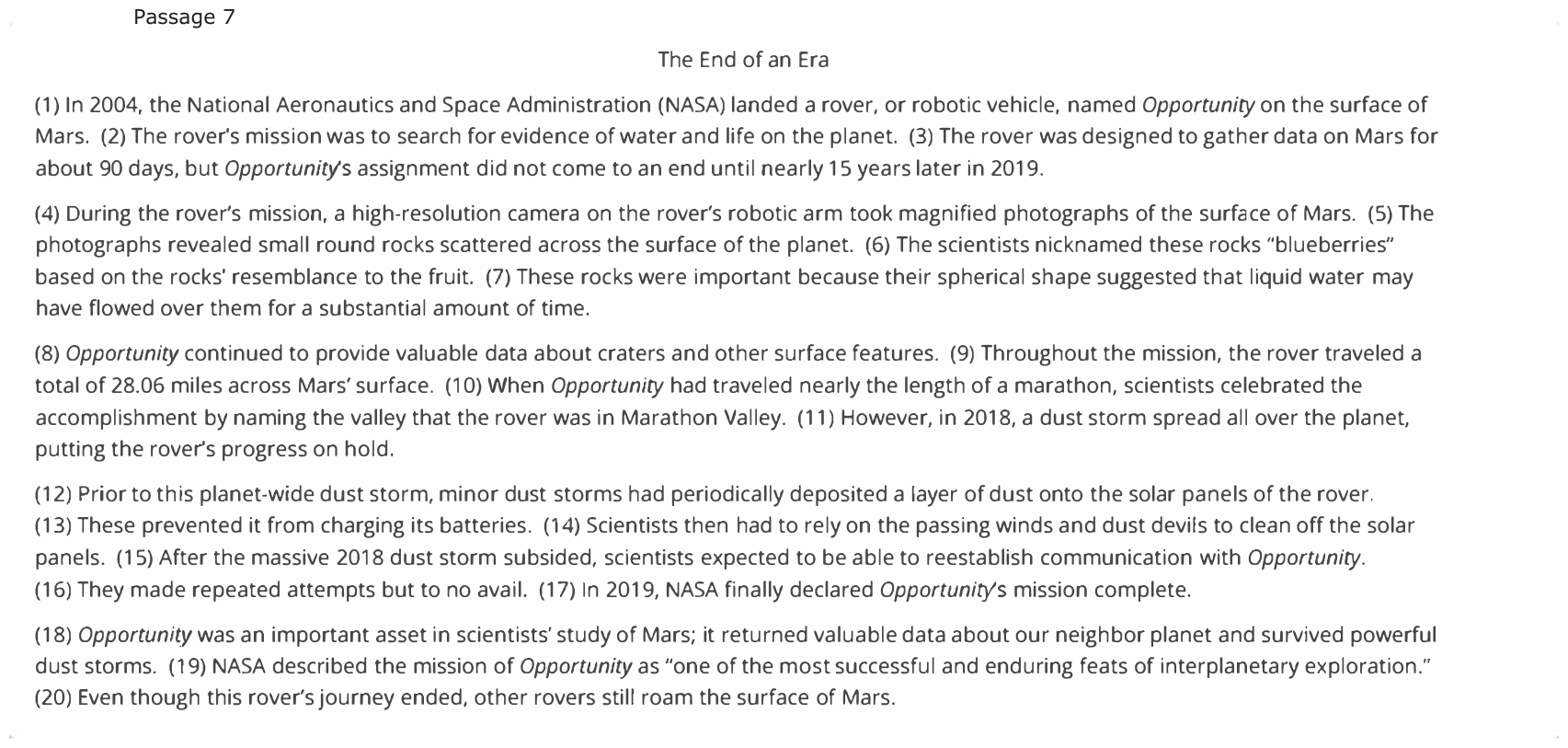
(1) In 2004, the National Aeronautics and Space Administration (NASA) landed a rover, or robotic vehicle, named Opportunity on the surface of Mars. (2) The rover’s mission was to search for evidence of water and life on the planet. (3) The rover was designed to gather data on Mars for about 90 days, but Opportunity’s assignment did not come to an end until nearly 15 years later in 2019.
(4) During the rover’s mission, a high-resolution camera on the rover’s robotic arm took magnified photographs of the surface of Mars. (5) The photographs revealed small round rocks scattered across the surface of the planet. (6) The scientists nicknamed these rocks “blueberries” based on the rocks’ resemblance to the fruit. (7) These rocks were important because their spherical shape suggested that liquid water may have flowed over them for a substantial amount of time.
(8) Opportunity continued to provide valuable data about craters and other surface features. (9) Throughout the mission, the rover traveled a total of 28.06 miles across Mars’ surface. (10) When Opportunity had traveled nearly the length of a marathon, scientists celebrated the accomplishment by naming the valley that the rover was in Marathon Valley. (11) However, in 2018, a dust storm spread all over the planet, putting the rover’s progress on hold.
(12) Prior to this planet-wide dust storm, minor dust storms had periodically deposited a layer of dust onto the solar panels of the rover. (13) These prevented it from charging its batteries. (14) Scientists then had to rely on the passing winds and dust devils to clean off the solar panels. (15) After the massive 2018 dust storm subsided, scientists expected to be able to reestablish communication with Opportunity. (16) They made repeated attempts but to no avail. (17) In 2019, NASA finally declared Opportunity’s mission complete.
(18) Opportunity was an important asset in scientists’ study of Mars; it returned valuable data about our neighbor planet and survived powerful dust storms. (19) NASA described the mission of Opportunity as “one of the most successful and enduring feats of interplanetary exploration.” (20) Even though this rover’s journey ended, other rovers still roam the surface of Mars.
Question
Which sentence should follow sentence 3 to best introduce the topic of the passage?
- ADespite the challenges of operating on the surface of another planet, the Opportunity rover made many valuable contributions to the field of space research.
- BThe Opportunity rover mission was a success because it informed NASA scientists about how water might have existed on Mars.
- CThroughout the historic mission of the Opportunity rover, NASA scientists had to overcome challenges created by the flaws in the rover’s design.
- DThe Opportunity rover mission surpassed the original timeline of the assignment and allowed scientists to collect additional data about the planet Mars.
Show the answer
Correct answer: A
The question asks for the sentence that should follow sentence 3 to best introduce the topic of the passage.
A. CORRECT. This sentence best introduces the passage’s topic: the Opportunity rover had many accomplishments on its mission, despite numerous challenges. Some of those accomplishments include providing high-resolution photographs (paragraph 2), traveling long distances (paragraph 3), and providing data about craters and other surface features (paragraph 3).
B. Incorrect. Although paragraph 2 discusses how photographs taken by the rover showed rocks that may have been shaped by water, this idea alone is not the topic of the entire passage.
C. Incorrect. While this sentence incorporates ideas about difficulties the scientists encountered because of the Opportunity rover’s design (paragraph 4), the main topic of the passage is not the design flaws and obstacles scientists encountered throughout the mission. The passage primarily focuses on the achievements of the mission.
D. Incorrect. While it is true that the Opportunity rover mission lasted much longer than planned (sentence 3), this fact is a supporting detail of the passage, not the main topic of the passage; surpassing the original timeline is only one of the rover’s many achievements mentioned in the passage.
Question analysis
This revising question works with “The End of an Era,” a passage about NASA's Opportunity rover on Mars, and asks which sentence should follow sentence 3 to best introduce the topic. Students must keep the whole passage in view, from the rover's photographs and travels to the dust storms that ended its mission, and judge which choice previews it best.
- NYS standards
- 7W2a introducing and organizing a topic
- Grade level
- Grade 7 reading and task
- Compared with grade 7
- At grade 7 Choosing a sentence that introduces a passage's topic is a standard grade 7 writing task. The passage is twenty plain sentences about one rover mission, and every choice draws on that mission, so it calls for a typical careful comparison.
- Estimated difficulty
- Moderate: several steps, or a close reading with one strong distractor.
- Thinking it demands
- Depth of knowledge 2, skills and concepts · mainly evaluate
- What makes it hard
- Evidence in several places moderate
- How sentences fit together minor
- Evidence
- Answered from the whole text
- Reading level
- Passage: about grade 11, 337 words; question and choices: about grade 14, 101 words.
- Students, last 30 days
- Not enough answers yet to show (it takes 10).
Why it is hard, traps and wrong answers (shows the answer)
Why it is hard
Sentence 3 already tells a striking story, a 90-day mission that lasted nearly fifteen years, and the most tempting continuation simply repeats it in new words. The other near misses each pick one part of the passage, the water evidence or the dust problems, and make it the whole. The question rewards skimming every paragraph first and choosing the sentence that covers both the achievements and the hardships, the pairing the final paragraph makes.
Evidence in several places moderate Working it out
The topic only emerges from the later paragraphs: the “blueberries” of sentences 4–7, the 28.06 miles of paragraph 3, the dust storms of paragraph 4 and NASA’s praise in sentence 19. (Kirsch & Mosenthal, 1990; Gorin & Embretson, 2006)
How sentences fit together minor Working it out
The new sentence follows sentence 3’s surprise that a 90-day mission lasted nearly 15 years, so it must turn from that fact to what the mission achieved. (Halliday & Hasan, 1976)
Strategy: Skim the opening sentence of each later paragraph to see what the passage covers, then ask which choice would prepare a reader for all of it.
Traps
- Too narrow: A single detail offered as the central idea or a summary, or a summary that keeps minor details and leaves out an essential part.
- Says it twice: Repeats an idea that the sentence or passage already states.
- Off the point: Adds or keeps something that does not support the paragraph's or the passage's focus, or an introduction or conclusion that misses the main point.
The wrong answers, classified
B Too narrow (King et al., 2004)
Picks the water finding of paragraph 2, a real result, but it covers one paragraph and leaves out the rover’s travels, its endurance and the dust storms.
C Off the point (Halliday & Hasan, 1976)
Builds on the dust that blocked the solar panels in paragraph 4, but the passage never blames flaws in the rover’s design and dwells on its achievements.
D Says it twice (Connors & Lunsford, 1988)
Follows sentence 3 smoothly, but saying the mission “surpassed the original timeline” only restates the 90 days that became 15 years instead of introducing what comes next.
Working it out, step by step
Figure out what the question asks
This revising question asks for a sentence to add after sentence 3. It should introduce the topic of the whole passage. A good introduction gives a preview, a quick look at everything coming. It doesn’t repeat one fact or zoom in on one part. For example, a report on a soccer season might begin: The team lost two stars but still won the title. That previews both the struggles and the wins.
Skim each paragraph
- Paragraph 2 (sentences 4–7): The rover’s camera found small round rocks that hinted at water.
- Paragraph 3 (sentences 8–11): It sent data and traveled 28.06 miles. Then a huge dust storm stopped it.
- Paragraph 4 (sentences 12–17): Dust had covered its solar panels before. After the 2018 storm, NASA could not reach it.
- Paragraph 5 (sentences 18–20): It “returned valuable data about our neighbor planet and survived powerful dust storms.”
Name the topic
So the passage covers two things. One is what the rover achieved: photos, data and miles. The other is its challenges, mainly the dust storms. Challenges are hard problems. Sentence 18 puts both together. The new sentence should preview both.
Check each choice
- A is right. It names the challenges and the “many valuable contributions.” That covers the whole passage.
- B is wrong. Water is only paragraph 2. It leaves out the travel and the dust storms.
- C is wrong. The passage never blames flaws in the rover’s design. It mostly praises the rover.
- D is wrong. Sentence 3 already says the mission lasted far past 90 days. D repeats it instead of looking ahead.
Watch out: D follows sentence 3 smoothly, so it sounds right. But it only restates sentence 3 in new words.
Choose the answer
So the answer is A: “Despite the challenges of operating on the surface of another planet, the Opportunity rover made many valuable contributions to the field of space research.”
Why this answer and not the closest wrong one
D is the closest wrong answer, because it flows right after sentence 3. But it only repeats that the mission lasted longer than planned. A previews both halves of the passage: the rover’s achievements and the challenges it survived. Sentence 18 sums up the same two ideas.
More questions like this
The original DOE question
The passage “The End of an Era” as printed (page 60)
Question 3 of 8
2026 Practice Test B English, question 46Uses the passage above: “The End of an Era”.
Question
Read this sentence.
One of Opportunity’s major contributions was finding possible evidence of the presence of water on Mars.
Where should the sentence be added to the passage?
- Abetween sentences 2 and 3
- Bat the beginning of the second paragraph (before sentence 4)
- Cat the end of the second paragraph (after sentence 7)
- Dbetween sentences 8 and 9
Show the answer
Correct answer: B
The question asks where the sentence should be added to the passage.
A. Incorrect. While sentence 2 refers to Opportunity’s mission to search for evidence of water, sentence 3 mentions the rover lasting much longer than anticipated. Placing the sentence between these two ideas, rather than at the start of the second paragraph, where it introduces the topic of the paragraph, would create a disjointed and confusing experience for the reader.
B. CORRECT. The sentence introduces the idea of finding possible evidence of water on Mars, which is the main topic of the second paragraph.
C. Incorrect. The sentence sets up the main idea of paragraph 2, which is the possibility of water on Mars. As a concluding sentence, it would be repetitive and confusing.
D. Incorrect. The sentence introduces the possibility of water on Mars, while sentences 8 and 9 discuss other surface features and the distance traveled by the rover. Adding the sentence here would create a disorganized paragraph.
Question analysis
This organization question gives a new sentence about Opportunity's possible discovery of evidence of water on Mars and asks where it should be added to the rover passage. Students must follow the order of ideas across the first three paragraphs, because the sentence echoes ideas that appear in several places and could seem to fit more than one of them.
- NYS standards
- 7W2a introducing and organizing a topic
- Grade level
- Grade 7 reading and task
- Compared with grade 7
- At grade 7 Deciding where a sentence belongs is typical grade 7 revision work. The four positions span three paragraphs of a plain passage, and the sentence's wording connects to more than one of them, so the order of ideas must be checked.
- Estimated difficulty
- Moderate: several steps, or a close reading with one strong distractor.
- Thinking it demands
- Depth of knowledge 2, skills and concepts · mainly analyze
- What makes it hard
- How sentences fit together moderate
- A very close wrong answer moderate
- Evidence
- Answered from several paragraphs or stanzas
- Reading level
- Passage: about grade 11, 337 words; question and choices: about grade 7, 52 words.
- Students, last 30 days
- Not enough answers yet to show (it takes 10).
Why it is hard, traps and wrong answers (shows the answer)
Why it is hard
The new sentence reads well in more than one place, because water comes up in sentence 2, in sentence 7 and near the “valuable data” of sentence 8. Its wording settles the matter: “One of Opportunity’s major contributions” announces a topic, so it belongs ahead of the evidence. The strongest pull places it as a closing line after sentence 7, where it restates the point the blueberries have just made.
How sentences fit together moderate Working it out
The new sentence names a contribution in general terms, so it belongs before sentence 4, where the camera and the “blueberries” supply the details, not after them. (Halliday & Hasan, 1976)
A very close wrong answer moderate Choosing the answer
The two positions in paragraph 2, before sentence 4 and after sentence 7, both keep the sentence beside the water evidence; they differ only in whether it introduces the details or sums them up. (Embretson & Wetzel, 1987; Gorin & Embretson, 2006; Ascalon et al., 2007)
Strategy: Find what the new sentence is about and where the passage discusses that, then read the sentence in each offered position and check whether it introduces, interrupts or repeats the ideas around it.
Traps
- Sentence in the wrong place: Puts a sentence where it breaks the order of ideas or separates it from what it refers to.
- Says it twice: Repeats an idea that the sentence or passage already states.
The wrong answers, classified
A Sentence in the wrong place (Halliday & Hasan, 1976)
Matches the sentence to sentence 2’s search for water, but there it announces the finding before the photographs are described and cuts into the account of the mission’s length.
C Says it twice (Connors & Lunsford, 1988)
Uses it as a wrap-up after the blueberries, a common paragraph shape, but there it only repeats sentence 7’s point about water instead of introducing the paragraph’s topic.
D Sentence in the wrong place (Halliday & Hasan, 1976)
Links “major contributions” to the “valuable data” of sentence 8, though paragraph 3 covers craters, distance traveled and the dust storm, not water.
Working it out, step by step
Figure out what the question asks
This question asks where a new sentence belongs. First find what the sentence is about. Then find where the passage talks about that. Last, decide whether the sentence should start that part, interrupt it or end it.
Read the new sentence
It says that one of Opportunity’s major contributions was “finding possible evidence of the presence of water on Mars.” It names a big idea in general terms. A sentence like that is a topic sentence. A topic sentence tells what a paragraph will be about. It usually comes first. For example, Dogs help people in many ways. comes before the details about guiding, herding and comforting.
Find where water comes up
Paragraph 2 (sentences 4–7) gives the details. The camera took close-up photos. They showed small round rocks, nicknamed “blueberries.” Sentence 7 says the rocks’ round shape “suggested that liquid water may have flowed over them.” So the new sentence should come right before these details, at the start of paragraph 2.
Check each choice
- A is wrong. Between sentences 2 and 3, it would announce the finding before the photos are described. It would also break up the facts about the mission’s length.
- B is right. Before sentence 4, it introduces the paragraph about the round rocks and water.
- C is wrong. After sentence 7, it would only repeat the point sentence 7 just made.
- D is wrong. Paragraph 3 is about craters, miles and the dust storm, not water.
Watch out: C is tempting because some paragraphs end with a summary. But sentence 7 already makes the point about water.
Choose the answer
So the answer is B: “at the beginning of the second paragraph (before sentence 4).”
Why this answer and not the closest wrong one
C is the closest wrong answer, because it keeps the sentence in the paragraph about water. But the sentence names a topic, so it works best before the details. After sentence 7, it would repeat what the blueberries just showed. Before sentence 4, it tells readers what is coming.
More questions like this
The original DOE question
Question 4 of 8
2026 Practice Test D English, question 36Passage Martial Arts for the Mind and Body
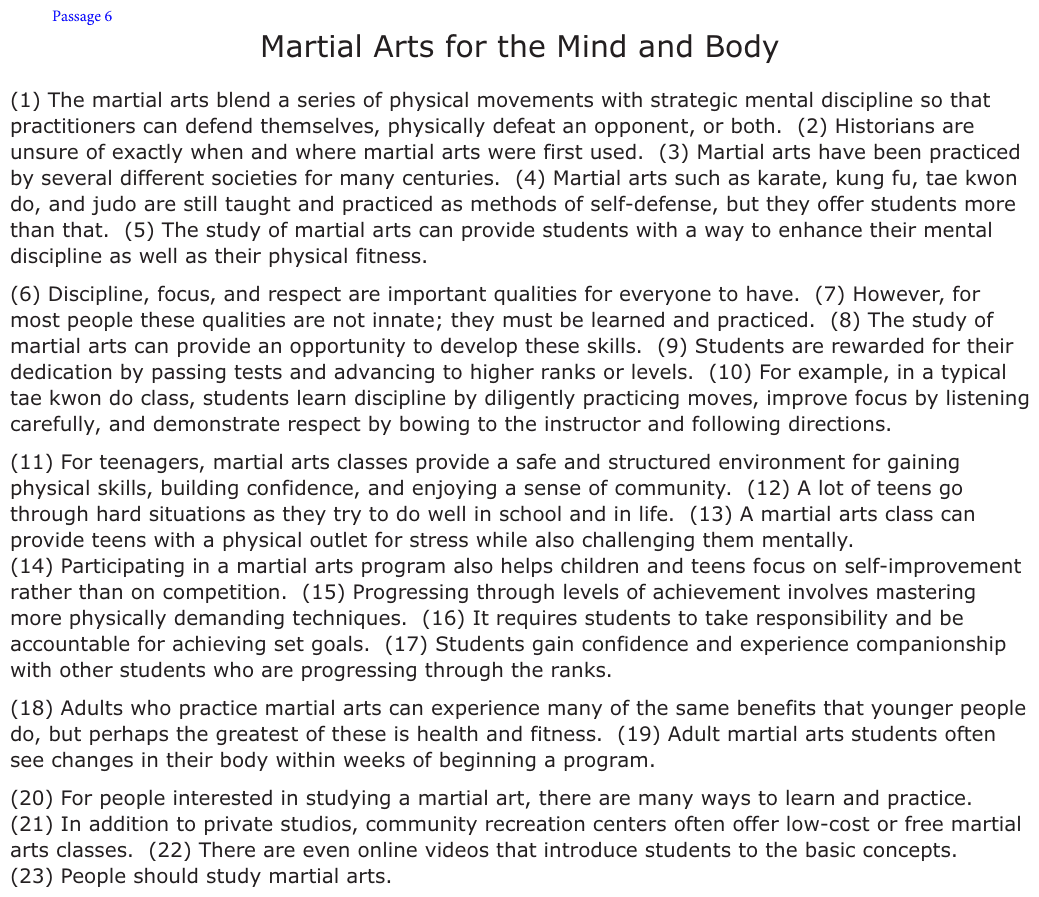
Martial Arts for the Mind and Body
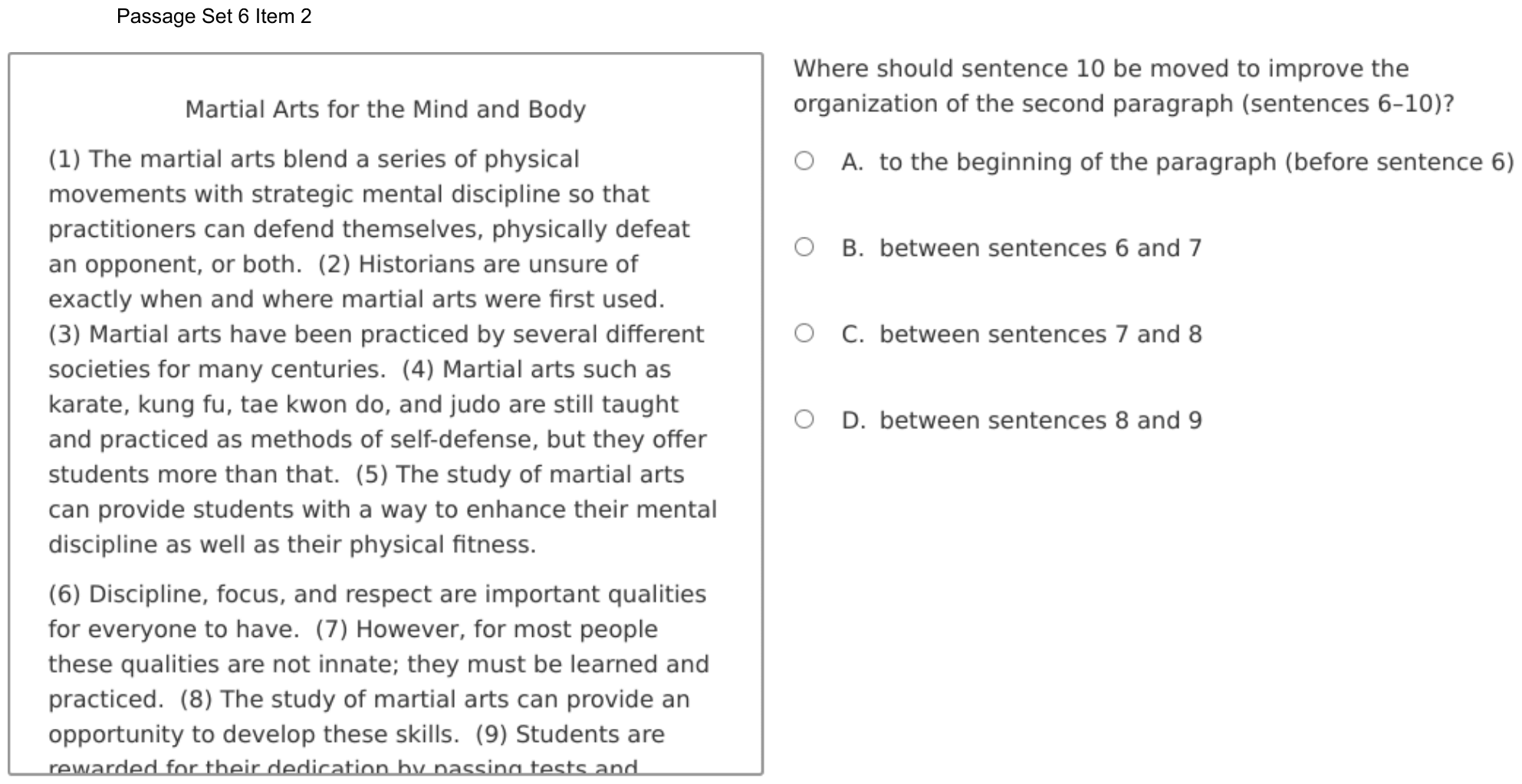
(1) The martial arts blend a series of physical movements with strategic mental discipline so that practitioners can defend themselves, physically defeat an opponent, or both. (2) Historians are unsure of exactly when and where martial arts were first used. (3) Martial arts have been practiced by several different societies for many centuries. (4) Martial arts such as karate, kung fu, tae kwon do, and judo are still taught and practiced as methods of self-defense, but they offer students more than that. (5) The study of martial arts can provide students with a way to enhance their mental discipline as well as their physical fitness.
(6) Discipline, focus, and respect are important qualities for everyone to have. (7) However, for most people these qualities are not innate; they must be learned and practiced. (8) The study of martial arts can provide an opportunity to develop these skills. (9) Students are rewarded for their dedication by passing tests and advancing to higher ranks or levels. (10) For example, in a typical tae kwon do class, students learn discipline by diligently practicing moves, improve focus by listening carefully, and demonstrate respect by bowing to the instructor and following directions.
(11) For teenagers, martial arts classes provide a safe and structured environment for gaining physical skills, building confidence, and enjoying a sense of community. (12) A lot of teens go through hard situations as they try to do well in school and in life. (13) A martial arts class can provide teens with a physical outlet for stress while also challenging them mentally. (14) Participating in a martial arts program also helps children and teens focus on self-improvement rather than on competition. (15) Progressing through levels of achievement involves mastering more physically demanding techniques. (16) It requires students to take responsibility and be accountable for achieving set goals. (17) Students gain confidence and experience companionship with other students who are progressing through the ranks.
(18) Adults who practice martial arts can experience many of the same benefits that younger people do, but perhaps the greatest of these is health and fitness. (19) Adult martial arts students often see changes in their body within weeks of beginning a program.
(20) For people interested in studying a martial art, there are many ways to learn and practice. (21) In addition to private studios, community recreation centers often offer low-cost or free martial arts classes. (22) There are even online videos that introduce students to the basic concepts. (23) People should study martial arts.
Question
Where should sentence 10 be moved to improve the organization of the second paragraph (sentences 6–10)?
- Ato the beginning of the paragraph (before sentence 6)
- Bbetween sentences 6 and 7
- Cbetween sentences 7 and 8
- Dbetween sentences 8 and 9
Show the answer
Correct answer: D
The question asks where sentence 10 should be moved to improve the organization of the second paragraph.
A. Incorrect. Starting this paragraph with sentence 10 would weaken the paragraph’s organization because it would place a supporting detail sentence (sentence 10) before the topic sentence (sentence 6). Sentence 6 belongs at the beginning of the paragraph because it introduces the topic—the qualities of discipline, focus, and respect. Sentence 10 supports the key idea of the paragraph, that these qualities can be developed through the study of martial arts. If sentence 10 preceded sentence 6, the transitional phrase “for example” would refer to an unspecified topic and idea.
B. Incorrect. Sentence 6 presents the idea that “discipline, focus, and respect are important qualities for everyone to have,” but the example in sentence 10 does not directly relate to this idea. Sentence 10 explains how martial arts develop these qualities, not why they are important qualities to have. Because sentence 10 is not directly related to the idea in sentence 6 (the qualities are important), it should not follow sentence 6.
C. Incorrect. Sentences 7 and 8 should not be separated, because the idea presented in sentence 8—that “the study of martial arts can provide an opportunity to develop these skills”—is directly related to the idea from sentence 7—that the skills of discipline, focus, and respect “are not innate; they must be learned and practiced.” Sentence 10 supports the idea from sentence 8 by describing an example from a typical martial arts class, so sentence 10 should not precede sentence 8.
D. CORRECT. This option is correct because sentence 10 logically follows and supports the idea in sentence 8 that “the study of martial arts can provide an opportunity to develop” the qualities of discipline, focus, and respect. Sentence 10 explains this idea with examples, describing three specific ways that students in a typical tae kwon do class develop discipline, focus, and respect—by “diligently practicing,” “listening carefully,” and “bowing to the instructor and following directions.”
Question analysis
This organization question asks where sentence 10, a “For example” sentence describing a typical tae kwon do class, should be moved within the second paragraph of the martial arts passage. Students must work out what idea the example illustrates and read the paragraph with the sentence in each position, since several spots sound acceptable.
- Grade level
- Grade 7 reading and task
- Compared with grade 7
- At grade 7 Placing a sentence where it supports the right idea is regular grade 7 revision work. The paragraph is five plain sentences and the opening “For example” is a strong clue, which keeps the demand typical of grade 7.
- Estimated difficulty
- Moderate: several steps, or a close reading with one strong distractor.
- Thinking it demands
- Depth of knowledge 2, skills and concepts · mainly analyze
- What makes it hard
- How sentences fit together moderate
- A very close wrong answer minor
- Much to keep track of minor
- Evidence
- Answered from one paragraph or stanza
- Reading level
- Passage: about grade 11, 402 words; question and choices: about grade 7, 31 words.
- Students, last 30 days
- Not enough answers yet to show (it takes 10).
Why it is hard, traps and wrong answers (shows the answer)
Why it is hard
The example sentence fits loosely almost anywhere in a paragraph about discipline, focus and respect, so students have to ask what exactly it is an example of. The slot just before sentence 8 is the trap: the class’s practicing seems to illustrate sentence 7’s claim that the qualities “must be learned and practiced,” but the paragraph has not yet brought in martial arts. Those who match the example to sentence 8’s claim about martial arts place it correctly.
How sentences fit together moderate Working it out
Sentence 10 opens with “For example,” so it must follow the claim it illustrates, sentence 8’s point that studying martial arts can “develop these skills,” before sentence 9 turns to rewards. (Halliday & Hasan, 1976)
A very close wrong answer minor Choosing the answer
The slots before and after sentence 8 are neighbors, and the tae kwon do class could seem to illustrate sentence 7 as well as sentence 8, so only rereading tells them apart. (Embretson & Wetzel, 1987; Gorin & Embretson, 2006; Ascalon et al., 2007)
Much to keep track of minor Working it out
Each of the four positions means rereading a five-sentence paragraph in a new order in your head while keeping track of what “these qualities” and “these skills” refer to. (Sweller, 1988; Carpenter, Just & Shell, 1990)
Strategy: Ask which sentence the tae kwon do class is an example of, then reread the paragraph with sentence 10 placed right after it and check that every sentence still follows the one before.
Traps
- Sentence in the wrong place: Puts a sentence where it breaks the order of ideas or separates it from what it refers to.
The wrong answers, classified
A Sentence in the wrong place (Halliday & Hasan, 1976)
Moves the example to the front, where “For example” would point back to nothing and the topic sentence would come after its own illustration.
B Sentence in the wrong place (Halliday & Hasan, 1976)
Places the example after sentence 6, but the class shows how the qualities are built, not why everyone needs them, and it would cut sentence 7’s “However” off from sentence 6.
C Sentence in the wrong place (Halliday & Hasan, 1976)
Hears sentence 7’s “learned and practiced” echoed in “learn” and “practicing,” but the example must come after sentence 8, which first connects the qualities to martial arts.
Working it out, step by step
Figure out what the question asks
This asks where to move sentence 10 so paragraph 2 reads in a better order. Sentence 10 starts with “For example.” So it must come right after the idea it is an example of.
Name the rule
An example goes right after the claim it shows. “For example” points back to the sentence before it. For instance: Reading builds your word power. For example, you meet new words in every book. If the example came first, it would point back to nothing.
Find what sentence 10 shows
Sentence 10 says students “learn discipline by diligently practicing moves, improve focus by listening carefully, and demonstrate respect by bowing to the instructor and following directions.” Diligently means with steady, careful effort. This shows how martial arts build those three qualities. Sentence 8 makes that claim: “The study of martial arts can provide an opportunity to develop these skills.” So sentence 10 belongs right after sentence 8.
Read the new order
Now the paragraph runs 6, 7, 8, 10, 9. Sentence 6 names the qualities. Sentence 7 says they “must be learned and practiced.” Sentence 8 says martial arts can build them. Sentence 10 gives the tae kwon do example. Then sentence 9 tells how students are rewarded. Each sentence leads to the next.
Check each choice
- A is wrong. “For example” would point back to nothing.
- B is wrong. Sentence 6 says why the qualities matter, but the class shows how they are built. It would also cut sentence 7’s “However” off from sentence 6.
- C is wrong. Sentence 7 never mentions martial arts. Sentence 8 is the first to link the qualities to martial arts.
- D is right. The example follows the claim it shows.
Watch out: Sentence 7 says “learned and practiced,” and sentence 10 uses “learn” and “practicing.” That echo pulls you toward C.
Choose the answer
Sentence 10 gives an example of sentence 8’s claim. It belongs right after it. So the answer is D, “between sentences 8 and 9.”
Why this answer and not the closest wrong one
C is the closest wrong answer, because sentence 7 talks about learning and practice too. But sentence 7 does not mention martial arts. Sentence 8 claims that martial arts can build these skills, and the tae kwon do class is an example of exactly that. So the example belongs right after sentence 8.
More questions like this
The original DOE question
The passage “Martial Arts for the Mind and Body” as printed (page 52)
Question 5 of 8
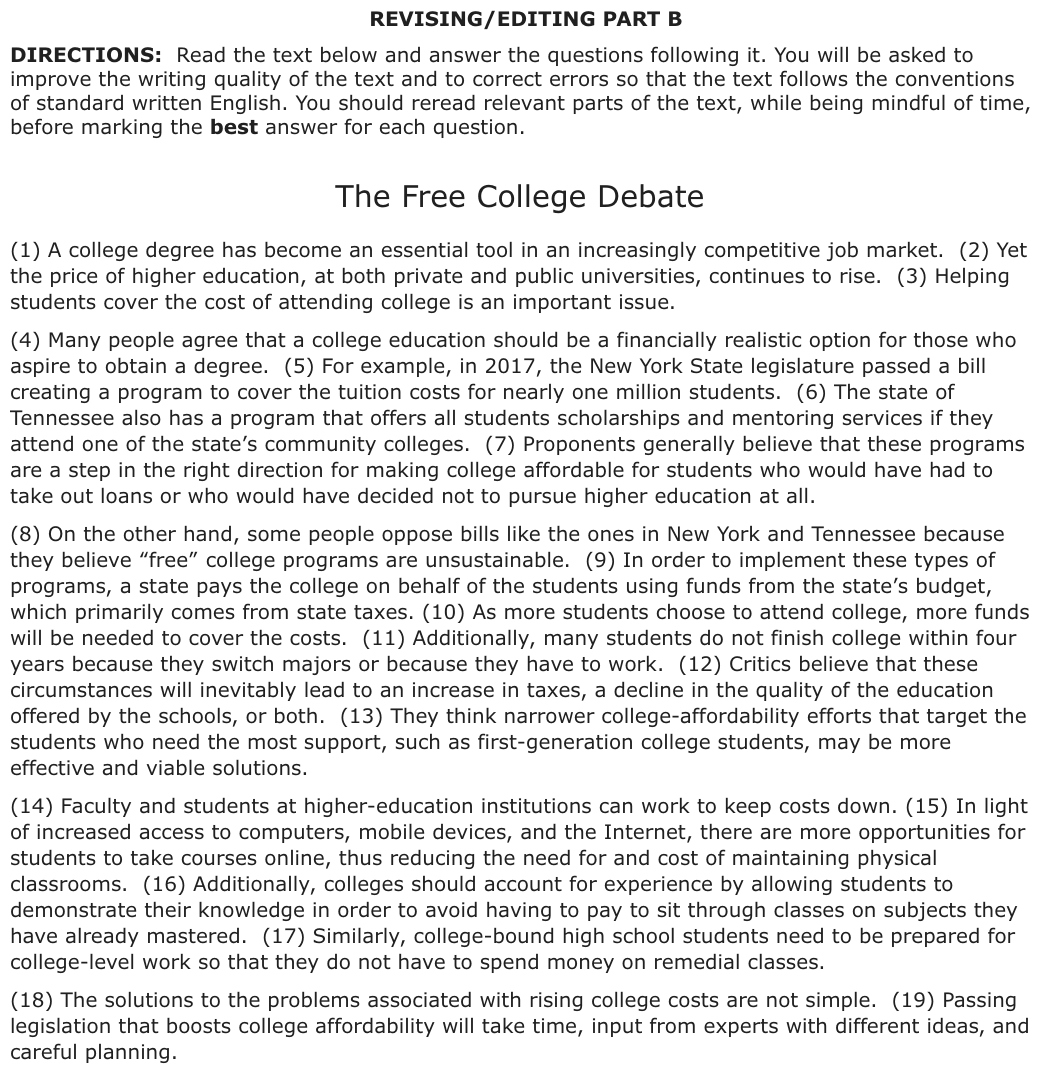
2024 Test A English, question 5Passage The Free College Debate
The Free College Debate
(1) A college degree has become an essential tool in an increasingly competitive job market. (2) Yet the price of higher education, at both private and public universities, continues to rise. (3) Helping students cover the cost of attending college is an important issue.
(4) Many people agree that a college education should be a financially realistic option for those who aspire to obtain a degree. (5) For example, in 2017, the New York State legislature passed a bill creating a program to cover the tuition costs for nearly one million students. (6) The state of Tennessee also has a program that offers all students scholarships and mentoring services if they attend one of the state’s community colleges. (7) Proponents generally believe that these programs are a step in the right direction for making college affordable for students who would have had to take out loans or who would have decided not to pursue higher education at all.
(8) On the other hand, some people oppose bills like the ones in New York and Tennessee because they believe “free” college programs are unsustainable. (9) In order to implement these types of programs, a state pays the college on behalf of the students using funds from the state’s budget, which primarily comes from state taxes. (10) As more students choose to attend college, more funds will be needed to cover the costs. (11) Additionally, many students do not finish college within four years because they switch majors or because they have to work. (12) Critics believe that these circumstances will inevitably lead to an increase in taxes, a decline in the quality of the education offered by the schools, or both. (13) They think narrower college-affordability efforts that target the students who need the most support, such as first-generation college students, may be more effective and viable solutions.
(14) Faculty and students at higher-education institutions can work to keep costs down. (15) In light of increased access to computers, mobile devices, and the Internet, there are more opportunities for students to take courses online, thus reducing the need for and cost of maintaining physical classrooms. (16) Additionally, colleges should account for experience by allowing students to demonstrate their knowledge in order to avoid having to pay to sit through classes on subjects they have already mastered. (17) Similarly, college-bound high school students need to be prepared for college-level work so that they do not have to spend money on remedial classes.
(18) The solutions to the problems associated with rising college costs are not simple. (19) Passing legislation that boosts college affordability will take time, input from experts with different ideas, and careful planning.
Question
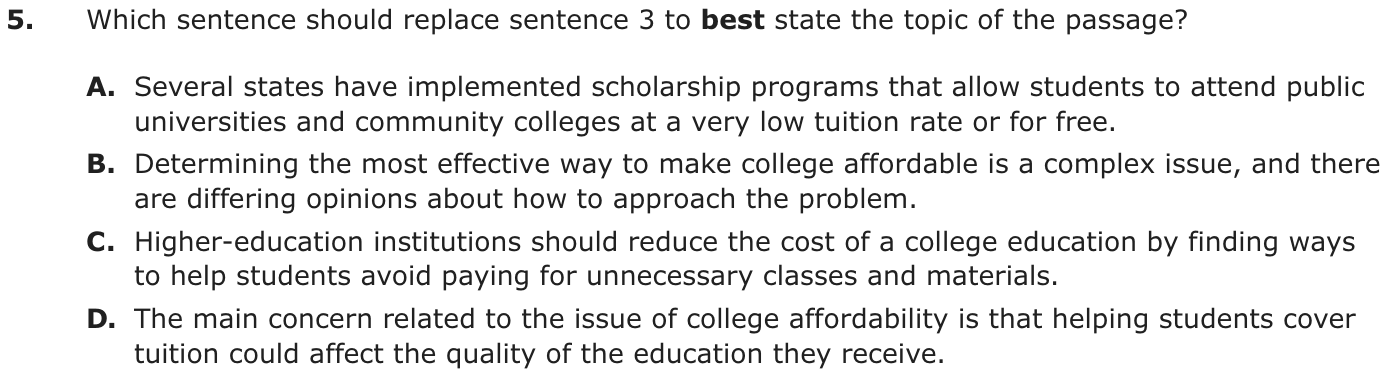
Which sentence should replace sentence 3 to best state the topic of the passage?
- ASeveral states have implemented scholarship programs that allow students to attend public universities and community colleges at a very low tuition rate or for free.
- BDetermining the most effective way to make college affordable is a complex issue, and there are differing opinions about how to approach the problem.
- CHigher-education institutions should reduce the cost of a college education by finding ways to help students avoid paying for unnecessary classes and materials.
- DThe main concern related to the issue of college affordability is that helping students cover tuition could affect the quality of the education they receive.
Show the answer
Correct answer: B
The question asks which sentence should replace sentence 3 to best state the topic of the passage.
A. Incorrect. Although this sentence mentions that “several states have implemented scholarship programs,” it does not clearly introduce the topic of the passage, which is differing opinions about and approaches to solving the problem of the cost of college.
B. CORRECT. This sentence best replaces sentence 3 because it clearly states the topic of “determining the most effective way to make college affordable.” It also provides an introduction to the “differing opinions” of proponents, who believe that states should provide low-cost or free tuition, and opponents, who believe that such state programs are “unsustainable” (sentence 8).
C. Incorrect. This sentence mentions the role of higher-education institutions in helping “reduce the cost of a college education” for students, which is an idea discussed in sentences 14 and 15 in the passage. Although the sentence provides details to support the topic of the passage by referring to “ways to help students avoid paying for unnecessary classes and materials,” it does not state the topic, which is differing opinions about and approaches to solving the problem of the cost of college.
D. Incorrect. Even though this sentence mentions “college affordability,” it is primarily focused on a problem that is related to, but different from, the issue discussed in the passage. The passage is concerned with “the price of higher education” (sentence 2), not how tuition rates “affect the quality of the education [students] receive.”
Question analysis
This revising question uses a passage about the rising cost of college and state programs that cover tuition, and asks which sentence should replace sentence 3 to state the passage's topic. Every choice is about college affordability, so students must tell a sentence that covers the whole passage from one that fits a single paragraph.
- NYS standards
- 7W2a introducing and organizing a topic
- Grade level
- Grade 7 reading and task
- Compared with grade 7
- At grade 7 Choosing a sentence that states a passage's topic is core grade 7 writing work. The passage is formal and five paragraphs long, but each paragraph opens by signalling its part of the subject, so the demand is typical.
- Estimated difficulty
- Straightforward: two steps or one careful reading.
- Thinking it demands
- Depth of knowledge 2, skills and concepts · mainly evaluate
- What makes it hard
- Evidence in several places moderate
- The right answer is reworded minor
- Evidence
- Answered from the whole text
- Reading level
- Passage: about grade 12, 427 words; question and choices: about grade 14, 110 words.
- Corrected from the DOE handbook
- A grammar slip in the explanation was corrected.
- Students, last 30 days
- Not enough answers yet to show (it takes 10).
Why it is hard, traps and wrong answers (shows the answer)
Why it is hard
The replacement must cover a passage that argues both sides of free college and then turns to campus cost-cutting, so a sentence about any one part falls short. Students most often take the state scholarship programs for the topic, because those programs fill the two middle paragraphs. Summing up each paragraph in a few words before reading the choices shows that only a sentence about the debate over how to make college affordable fits them all.
Evidence in several places moderate Working it out
The topic shows only across all five paragraphs: supporters of state programs in sentences 4–7, critics in 8–13, campus cost-cutting in 14–17, and the closing warning that solutions are not simple. (Kirsch & Mosenthal, 1990; Gorin & Embretson, 2006)
The right answer is reworded minor Choosing the answer
The right sentence says “complex issue” and “differing opinions,” words the passage never uses, while wrong ones echo its “scholarship,” “community colleges” and “helping students cover.” (Freedle & Kostin, 1993; Kirsch & Mosenthal, 1990)
Strategy: Note in a few words what each of the five paragraphs does, then choose the sentence that would prepare a reader for all of them rather than for one paragraph's details.
Traps
- Too narrow: A single detail offered as the central idea or a summary, or a summary that keeps minor details and leaves out an essential part.
- Off the point: Adds or keeps something that does not support the paragraph's or the passage's focus, or an introduction or conclusion that misses the main point.
The wrong answers, classified
A Too narrow (King et al., 2004)
Picks the state scholarship programs, which do fill paragraphs 2 and 3, but they are what the two sides argue about, not a topic that also covers paragraph 4.
C Too narrow (King et al., 2004)
Takes paragraph 4's cost-cutting ideas, such as not paying for classes already mastered, as the topic, though they are one approach among several and leave out the debate over state programs.
D Off the point (Halliday & Hasan, 1976)
Echoes the original sentence's “helping students cover” and sounds like a thesis, but it makes the passage about quality, which comes up once, among the critics' fears in sentence 12.
What was corrected from the DOE handbook, and why
- Explanation: In its reason for rejecting choice C, the handbook reads “which is a idea discussed in sentences 14 and 15.” It now reads “an idea.”
Working it out, step by step
Figure out what the question asks
The new sentence 3 should state the topic of the whole passage. The topic is what the passage is about overall. So the sentence must fit every paragraph, not just one part.
Sum up each paragraph
- Paragraph 1 (sentences 1–3): college matters, but it keeps costing more.
- Paragraph 2 (sentences 4–7): some people support state programs that pay for college.
- Paragraph 3 (sentences 8–13): critics say those programs can’t last.
- Paragraph 4 (sentences 14–17): colleges and students can cut costs.
- Paragraph 5 (sentences 18–19): the solutions “are not simple.”
Find the big idea
Put together, the passage is about one problem: how to make college affordable. Affordable means cheap enough to pay for. People disagree about the best way to do it. And the answers are not simple. The right sentence should say that.
Check each choice
- A is wrong. State programs fill paragraphs 2 and 3. But they are only what people argue about. A says nothing about the critics or about cutting costs.
- B is right. “A complex issue” and “differing opinions” cover the whole debate.
- C is wrong. Not paying for classes you don’t need is an idea from paragraph 4 only.
- D is wrong. The worry about quality comes up just once, in sentence 12.
Watch out: A is tempting because the state programs take up so much space. But a topic must cover all of the passage.
Choose the answer
B prepares the reader for both sides of the debate and for the cost-cutting ideas too. So the answer is B.
Why this answer and not the closest wrong one
A is the closest wrong answer. It names the state scholarship programs, which fill two paragraphs. But those programs are one thing people argue about, not the whole topic. A leaves out the critics and the ways to cut costs. B calls the issue “complex” and says opinions differ. That fits every paragraph.
More questions like this
The original DOE question
The passage “The Free College Debate” as printed (page 38)
Question 6 of 8
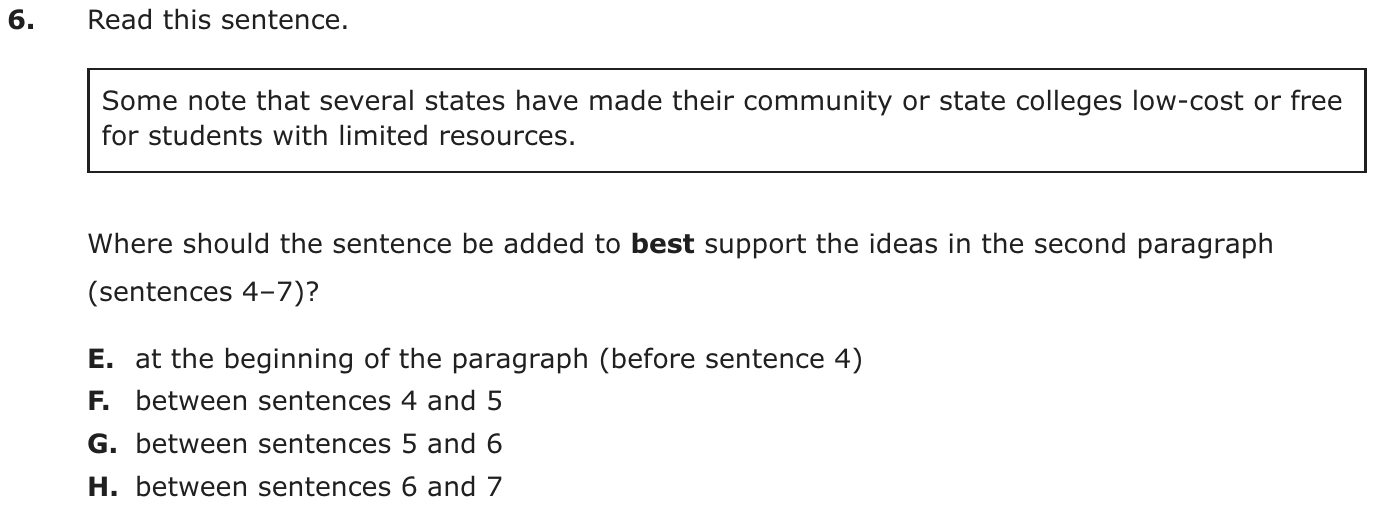
2024 Test A English, question 6Uses the passage above: “The Free College Debate”.
Question
Read this sentence.
Some note that several states have made their community or state colleges low-cost or free for students with limited resources.
Where should the sentence be added to best support the ideas in the second paragraph (sentences 4–7)?
- Aat the beginning of the paragraph (before sentence 4)
- Bbetween sentences 4 and 5
- Cbetween sentences 5 and 6
- Dbetween sentences 6 and 7
Show the answer
Correct answer: B
The question asks where the sentence should be added to best support the ideas in the second paragraph (sentences 4–7).
A. Incorrect. Sentence 4 introduces the main idea of the second paragraph (making college “a financially realistic option for those who aspire to obtain a degree”) and should not be preceded by the added sentence, which focuses more narrowly on the specific ways that some states are implementing that idea.
B. CORRECT. The added sentence provides a proposed solution to the issue stated in sentence 4, that “a college education should be a financially realistic option.” Sentence 5 is an example of the programs discussed in the added sentence.
C. Incorrect. Sentences 5 and 6 offer examples of state governments providing “low-cost or free” tuition. The added sentence introduces this idea in the second paragraph and should come before these specific examples are provided as evidence.
D. Incorrect. Sentence 6 provides an example of the state government of Tennessee providing “low-cost or free” tuition, and sentence 7 further explains the opinion of those in favor of such programs (“a step in the right direction for making college affordable”). However, the ideas in sentences 6 and 7 follow from and support the idea in the added sentence. Therefore, the added sentence should be placed before sentences 6 and 7, which help elaborate its idea.
Question analysis
This revising question gives a sentence noting that several states have made public colleges low-cost or free and asks where it best fits in the paragraph about making college financially realistic. Students must follow how the paragraph moves between general claims and specific examples, since the sentence reads smoothly in more than one place.
- NYS standards
- 7W2a introducing and organizing a topic
- Grade level
- Grade 7 reading and task
- Compared with grade 7
- At grade 7 Placing a sentence so ideas follow logically is grade 7 writing work. The paragraph is only four sentences long and the four positions sit side by side, so this matches a typical grade 7 revision task.
- Estimated difficulty
- Moderate: several steps, or a close reading with one strong distractor.
- Thinking it demands
- Depth of knowledge 2, skills and concepts · mainly analyze
- What makes it hard
- How sentences fit together moderate
- Every choice must be checked moderate
- Evidence
- Answered from one paragraph or stanza
- Reading level
- Passage: about grade 12, 427 words; question and choices: about grade 6, 56 words.
- Students, last 30 days
- Not enough answers yet to show (it takes 10).
Why it is hard, traps and wrong answers (shows the answer)
Why it is hard
This is a general-before-specific question disguised by smooth reading: the added sentence fits grammatically anywhere in the paragraph. What decides it is that New York and Tennessee are examples of states making college low-cost or free, so the claim belongs before them and after sentence 4's broader belief. Students who place it as a summary before “these programs” have noticed a real link but put the claim after its own evidence.
How sentences fit together moderate Working it out
Sentence 5 opens “For example” and sentence 6 says Tennessee “also” has a program, so the claim about several states must come right before the New York example it introduces. (Halliday & Hasan, 1976)
Every choice must be checked moderate Choosing the answer
The new sentence reads smoothly in all four spots, even after the examples, where sentence 7's “these programs” seems to point back to it, so each position has to be tried in context. (Embretson & Wetzel, 1987)
Strategy: Decide whether the new sentence is a general statement or a specific example, then read the paragraph with it in each position and check that every example follows what it illustrates.
Traps
- Sentence in the wrong place: Puts a sentence where it breaks the order of ideas or separates it from what it refers to.
The wrong answers, classified
A Sentence in the wrong place (Halliday & Hasan, 1976)
Rightly treats the new sentence as general, then makes it the opener, ahead of sentence 4, the broader belief that college should be financially realistic.
C Sentence in the wrong place (Halliday & Hasan, 1976)
Drops the claim about several states between the New York and Tennessee examples, splitting the pair and leaving the first example without the statement it illustrates.
D Sentence in the wrong place (Halliday & Hasan, 1976)
Sees that sentence 7's “these programs” could refer back to the new sentence, but placed there it only restates what the New York and Tennessee examples have shown.
Working it out, step by step
Figure out what the question asks
You need the best place for a new sentence in paragraph 2. First ask: is it a general idea or a specific example? A general idea usually comes before the examples that show it.
Look at the new sentence
The new sentence says “several states have made their community or state colleges low-cost or free.” It does not name any state. So it is a general claim. A claim is a statement that something is true.
Look at sentences 4 to 7
- Sentence 4 is the paragraph’s main idea. College should be “a financially realistic option,” or something people can afford.
- Sentence 5 starts “For example” and names New York.
- Sentence 6 says Tennessee “also has a program.”
- Sentence 7 tells what supporters think of “these programs.”
New York and Tennessee are two of the “several states.” So the new sentence belongs right before them.
Check each choice
- A is wrong. Sentence 4 is the broader main idea, so it should stay first.
- B is right. The claim comes after the main idea. Then “For example” leads into New York.
- C is wrong. It splits New York and Tennessee, two examples that belong together.
- D is wrong. It puts the claim after both of the examples that show it.
Watch out: D is tempting, since “these programs” in sentence 7 could point back to it. But there the claim would just repeat what the examples already showed.
Choose the answer
The order should be main idea, then claim, then examples. So the answer is B, between sentences 4 and 5.
Why this answer and not the closest wrong one
D is the closest wrong answer, because the sentence reads smoothly there too. But a general claim should come before the examples that prove it. In B, the reader first hears about “several states.” Then “For example” brings in New York, and Tennessee follows.
More questions like this
The original DOE question
Question 7 of 8
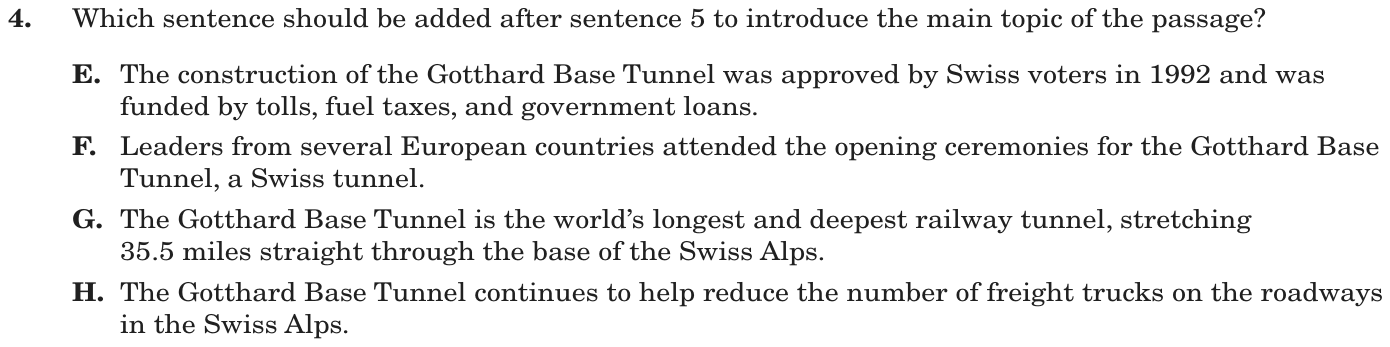
2018 Test A English, question 4Passage Moving through Mountains
Moving through Mountains
(1) An age-old proverb says that necessity is the mother of invention. (2) Centuries of human ingenuity in the face of obstacles prove this to be true. (3) For many years the Swiss Alps, a mountain range spanning southern Switzerland and northern Italy, were such an obstacle. (4) Roads and railways had to navigate around the mountains or through winding tunnels inside the mountains, making the transportation of people and goods difficult and time consuming. (5) In 2016 these burdens were eased with the completion of the Gotthard Base Tunnel.
(6) Construction of the high-speed railway tunnel began in 1996. (7) The tunnel was created through the use of tunnel-boring machines, which are giant drills with a flat rotating head called a cutter head. (8) Each of the tunnel-boring machines used during the construction of the tunnel was about the length of four football fields arranged end-to-end. (9) During the seventeen-year construction period, 28 million tons of rock were removed, enough to rebuild the Great Pyramid of Giza five times. (10) This massive construction project is reported to have cost $12 billion. (11) After that, 4 million cubic meters of concrete, or enough concrete to build eighty-four Empire State Buildings, were used to construct and support the tunnel.
(12) By 2020 the high-speed railway will carry more than 250 freight trains and 55 passenger trains a day, with most traveling at speeds of around 100 to 125 miles per hour. (13) It will be faster for people to travel between northern and southern Europe. (14) The travel time between the European cities of Zurich, Switzerland, and Milan, Italy, will be reduced by an hour. (15) Many European leaders compare the Gotthard Base Tunnel to the Channel Tunnel, a 33-mile underwater tunnel that connects the United Kingdom and France. (16) While there is no roadway in the Channel Tunnel, people can drive their cars onto special trains that will carry vehicles through to the other side.
(17) Just as traffic congestion in major cities led to the construction of underground local transportation, natural formations, such as mountain ranges, have also sent people underground for faster, easier, and cheaper methods of transportation across larger areas. (18) There is renewed interest in constructing innovative methods of transportation that will help eliminate problems associated with traveling to and from certain areas.
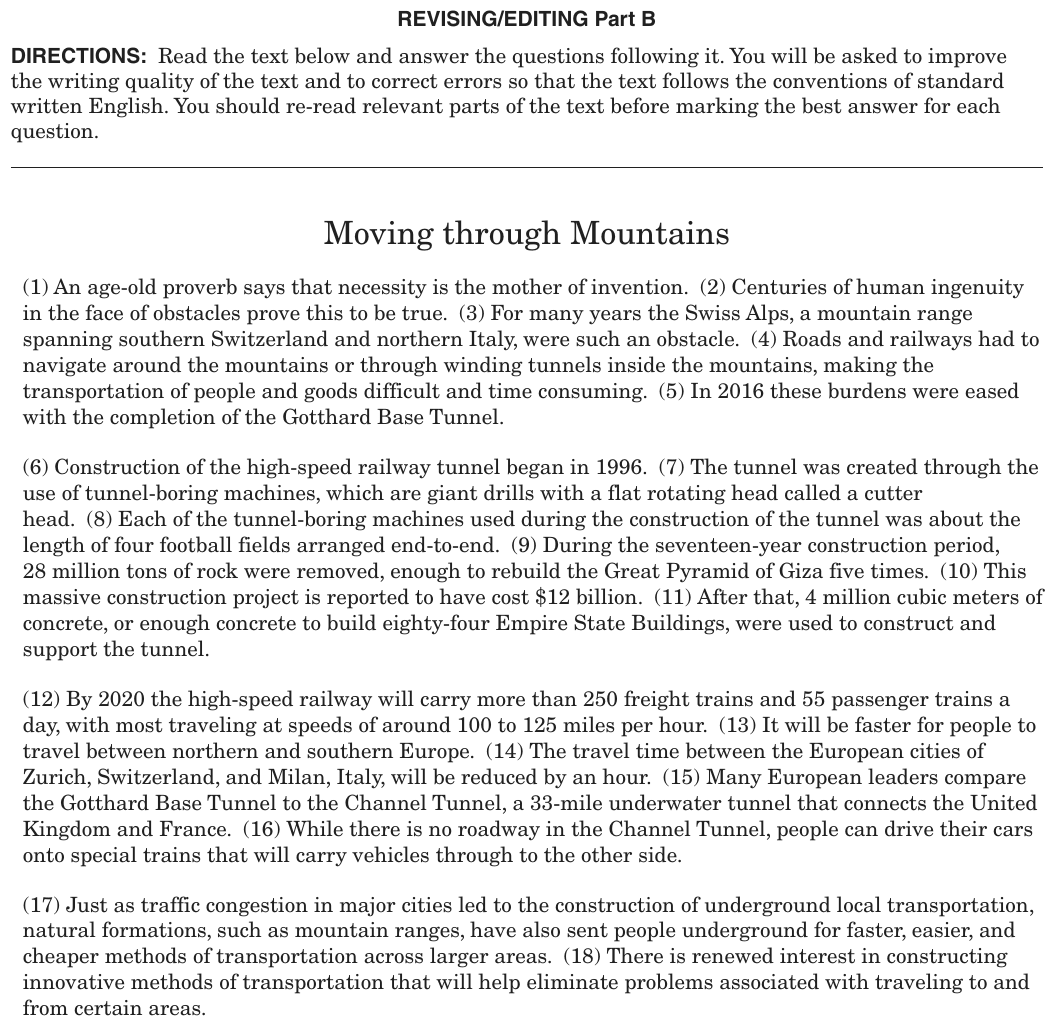
Question
Which sentence should be added after sentence 5 to introduce the main topic of the passage?
- AThe construction of the Gotthard Base Tunnel was approved by Swiss voters in 1992 and was funded by tolls, fuel taxes, and government loans.
- BLeaders from several European countries attended the opening ceremonies for the Gotthard Base Tunnel, a Swiss tunnel.
- CThe Gotthard Base Tunnel is the world’s longest and deepest railway tunnel, stretching 35.5 miles straight through the base of the Swiss Alps.
- DThe Gotthard Base Tunnel continues to help reduce the number of freight trucks on the roadways in the Swiss Alps.
Show the answer
Correct answer: C
The Answer is (C)
The question asks which sentence should be added to the end of the first paragraph in order to introduce the topic of the passage, which is the description, construction, and use of the Gotthard Base Tunnel.
Option C correctly presents and describes the Gotthard Base Tunnel.
Option A is incorrect because it offers overly detailed information about the funding used to build the Gotthard Base Tunnel, and it does not provide a description of the tunnel.
Option B is incorrect because it gives details about the opening ceremony of the tunnel, and it does not provide a description of the tunnel.
Option D is incorrect because it offers a result of completing the Gotthard Base Tunnel, rather than offering an introductory statement presenting and describing the tunnel.
Question analysis
This revising question uses a short informational passage about the Gotthard Base Tunnel through the Swiss Alps and asks which sentence best introduces the main topic at the end of the first paragraph. Several choices offer true-sounding facts about the tunnel, so students must tell an introduction apart from a supporting detail.
- NYS standards
- 7W2a introducing and organizing a topic
- Grade level
- Grade 7 reading and task
- Compared with grade 7
- At grade 7 Choosing a sentence that introduces a topic and previews what follows is standard grade 7 writing work. The passage is short and factual, and the wrong choices are related details, much like a classroom revision exercise.
- Estimated difficulty
- Straightforward: two steps or one careful reading.
- Thinking it demands
- Depth of knowledge 2, skills and concepts · mainly evaluate
- What makes it hard
- Evidence in several places moderate
- How sentences fit together minor
- Evidence
- Answered from the whole text
- Reading level
- Passage: about grade 11, 362 words; question and choices: about grade 9, 97 words.
- Students, last 30 days
- Not enough answers yet to show (it takes 10).
Why it is hard, traps and wrong answers (shows the answer)
Why it is hard
Most students find the descriptive sentence once they ask what a reader needs right after the tunnel is first named. Points are lost to sentences that follow on smoothly from the word “completion” or that name a real benefit, but which set up a passage about something else. The right sentence even adds facts the passage never states, so students should judge fit rather than hunt for repeated words.
Evidence in several places moderate Working it out
The topic the new sentence must introduce only emerges across all four paragraphs: what the Gotthard Base Tunnel is, how it was dug, and what it will do for travel. (Kirsch & Mosenthal, 1990; Gorin & Embretson, 2006)
How sentences fit together minor Working it out
The added sentence follows sentence 5, which names the tunnel only as what eased the burdens, so it should present the tunnel itself before paragraph 2 turns to its construction. (Halliday & Hasan, 1976)
Strategy: Skim the first sentence of each paragraph to see what the passage as a whole covers, then pick the sentence that would prepare a reader for all of it.
Traps
- Too narrow: A single detail offered as the central idea or a summary, or a summary that keeps minor details and leaves out an essential part.
- Off the point: Adds or keeps something that does not support the paragraph's or the passage's focus, or an introduction or conclusion that misses the main point.
The wrong answers, classified
A Off the point (Halliday & Hasan, 1976)
Picks voter approval in 1992 and funding by tolls, fuel taxes and loans, background that would set up a passage about financing, which this one never discusses.
B Off the point (Halliday & Hasan, 1976)
Follows naturally from “the completion of the Gotthard Base Tunnel” in sentence 5, but an opening ceremony with European leaders is not what the passage goes on to describe.
D Too narrow (King et al., 2004)
Offers one result, fewer freight trucks on Alpine roads, which echoes the difficult roads of sentence 4 but does not present the tunnel before the passage explains it.
Working it out, step by step
Figure out what the question asks
The new sentence goes at the end of paragraph 1, right after sentence 5. It must introduce the main topic, which is what the whole passage is mostly about. So first you need to know what the whole passage covers.
Skim the passage for its topic
Sentence 5 ends paragraph 1: “In 2016 these burdens were eased with the completion of the Gotthard Base Tunnel.” Paragraph 2 tells how the tunnel was built. Paragraph 3 tells how it will make travel faster. Paragraph 4 tells why people build tunnels like it. So the passage is about the Gotthard Base Tunnel: what it is, how it was built, and what it does.
See what sentence 5 leaves out
Sentence 5 names the tunnel, but it doesn’t say what the tunnel is. A reader doesn’t yet know how long it is or what makes it special. Then paragraph 2 jumps right into building it. So the new sentence should describe the tunnel itself. That gets the reader ready for the rest.
Check each choice
- A is about voters and money from tolls and taxes. The passage never discusses how the tunnel was paid for.
- B is about an opening ceremony. The passage never describes one.
- C says what the tunnel is: “the world’s longest and deepest railway tunnel,” running “straight through the base of the Swiss Alps.”
- D gives one result, fewer trucks on the roads. That is a detail, not an introduction.
Watch out: D links back to the slow roads in sentence 4, so it seems to fit. But it is one benefit, and the passage never mentions trucks.
Pick the answer
Choice C presents the tunnel and tells what makes it special. So the answer is C.
Why this answer and not the closest wrong one
Choice D is the closest wrong answer. It is about the tunnel, and it ties back to the hard travel in sentence 4. But it gives a result before the reader even knows what the tunnel is. C describes the tunnel itself, and that is what an introduction needs.
More questions like this
The original DOE question
The passage “Moving through Mountains” as printed (page 48)
Question 8 of 8
2018 Test A English, question 6Uses the passage above: “Moving through Mountains”.
Question
Where should sentence 11 be moved in order to improve the organization of the second paragraph (sentences 6–11)?
- Ato the beginning of the paragraph (before sentence 6)
- Bbetween sentences 6 and 7
- Cbetween sentences 8 and 9
- Dbetween sentences 9 and 10
Show the answer
Correct answer: D
The Answer is (D)
The question asks where sentence 11, which completes the detailed steps of how the tunnel was built, should be moved within the second paragraph in order to improve the organization of the paragraph.
Option D, placing the sentence between sentences 9 and 10, is correct because placing the sentence there helps the reader understand the full sequence of steps performed in constructing the tunnel before the cost of the project is introduced.
Option A, placing the sentence at the beginning of the paragraph (before sentence 6), is incorrect because it would not make sense since the process of building the tunnel has not yet been introduced.
Similarly, Option B is incorrect because placing the sentence after sentence 6 would not make sense given that adding concrete would have to happen after the rock was broken down and removed from the tunnel.
Option C, placing the sentence between sentences 8 and 9, would also be incorrect because the use of concrete did not take place before the removal of “28 million tons of rock” (sentence 9).
Question analysis
This revising question asks where to move a sentence about the concrete used to support the Gotthard Base Tunnel so the second paragraph is better organized. Students must follow the order of the construction steps and notice what the sentence's opening words refer back to, since several positions sound acceptable at a glance.
- Grade level
- Grade 7 reading and task
- Compared with grade 7
- At grade 7 Ordering sentences logically is a grade 7 writing skill. Here the student follows a sequence of construction steps and a time-order signal word, a short, typical grade 7 revision task with four nearby positions to compare.
- Estimated difficulty
- Moderate: several steps, or a close reading with one strong distractor.
- Thinking it demands
- Depth of knowledge 2, skills and concepts · mainly analyze
- What makes it hard
- How sentences fit together major
- A very close wrong answer moderate
- Much to keep track of minor
- Every choice must be checked minor
- Evidence
- Answered from one paragraph or stanza
- Reading level
- Passage: about grade 11, 362 words; question and choices: about grade 7, 33 words.
- Students, last 30 days
- Not enough answers yet to show (it takes 10).
Why it is hard, traps and wrong answers (shows the answer)
Why it is hard
The question turns on two signal phrases: what “After that” must follow, and what “This massive construction project” sums up. Students who see only that the concrete belongs with the digging often park it beside the machine details, before the rock has been cleared. Those who try each position in context see that lining the tunnel can only follow removing the rock.
How sentences fit together major Working it out
Sentence 11 opens with “After that”, so it must follow the rock removal in sentence 9, while “This massive construction project” in sentence 10 reads best as the paragraph's close. (Halliday & Hasan, 1976)
A very close wrong answer moderate Choosing the answer
Moving the sentence between sentences 8 and 9 differs from the right spot, between 9 and 10, by a single sentence, and only seeing that sentence 9's rock removal must come first tells them apart. (Embretson & Wetzel, 1987; Gorin & Embretson, 2006; Ascalon et al., 2007)
Much to keep track of minor Working it out
The construction steps, from the 1996 start through the machines, the 28 million tons of rock and the concrete, have to be kept in order across six sentences. (Sweller, 1988; Carpenter, Just & Shell, 1990)
Every choice must be checked minor Choosing the answer
Each of the four positions has to be tried by rereading the paragraph with the concrete sentence in place, since several sound acceptable at a glance. (Embretson & Wetzel, 1987)
Strategy: Look at the signal words that open sentence 11 and ask what event they must follow. Then read the paragraph with the sentence in each position to check the order of events.
Traps
- Sentence in the wrong place: Puts a sentence where it breaks the order of ideas or separates it from what it refers to.
The wrong answers, classified
A Sentence in the wrong place (Halliday & Hasan, 1976)
Moves the sentence to open the paragraph, where “After that” would follow the 2016 completion in sentence 5, putting the concrete work after the tunnel was finished.
B Sentence in the wrong place (Halliday & Hasan, 1976)
Reads “After that” as following the 1996 start of construction, which sounds smooth but has the tunnel lined with concrete before any machine had bored it.
C Sentence in the wrong place (Halliday & Hasan, 1976)
Sees that the concrete comes after the machines did their work but places it before sentence 9, so the tunnel is lined before its 28 million tons of rock are removed.
Working it out, step by step
Figure out what the question asks
Sentence 11 is in the wrong spot. You need to move it so paragraph 2 tells events in the right order. Paragraph 2 is sentences 6 to 11.
Look at the clue words in sentence 11
Sentence 11 says: “After that, 4 million cubic meters of concrete, or enough concrete to build eighty-four Empire State Buildings, were used to construct and support the tunnel.” “After that” is a transition, a word or phrase that links ideas. It tells you the concrete came after some other event. You need to find that event.
Put the building steps in order
Think about how you build a tunnel. First you dig out the rock. Then you line the hole with concrete to hold it up.
- Sentence 6: work began in 1996.
- Sentences 7 and 8: the machines that did the digging.
- Sentence 9: “28 million tons of rock were removed.”
- Sentence 10: the project cost $12 billion.
The concrete must come after the rock is removed. So sentence 11 belongs right after sentence 9.
Read the paragraph in the new order
Sentence 9 removes the rock. “After that,” the concrete is poured. Then sentence 10 sums up “This massive construction project” and its cost. The cost makes a good last point. Right now, sentence 11 comes after the cost. So “After that” seems to mean after paying. That makes no sense.
Check each choice
- A, before sentence 6: “After that” would point back to sentence 5, after the tunnel was finished.
- B, after sentence 6: the concrete would come before any digging.
- C, between 8 and 9: the tunnel would be lined before the rock was removed.
- D, between 9 and 10: the concrete comes right after the rock is removed.
Watch out: C is only one spot away from D. Ask yourself: is the rock gone yet? In C, it isn’t.
Pick the answer
So the answer is D, between sentences 9 and 10.
Now the paragraph goes: start, machines, digging, concrete, cost.
Why this answer and not the closest wrong one
Choice C is close because it puts the concrete after the machines. But sentence 9 is where the rock is removed, and you can’t line a tunnel that is still full of rock. Only D puts “After that” right after the rock removal.
More questions like this
The original DOE question
