3 English and 3 math
Here are 6 random questions to try. Takers earning below 75% are unlikely to receive an offer. You have 1 minute 48 seconds per question on the real exam.
Question 1 of 6
2026 Practice Test C English, question 8Passage Excerpt from “Niagara Falls”
Excerpt from “Niagara Falls”
by Rupert Brooke
The real secret of the beauty and terror of the Falls is not their height or width, but the feeling of colossal power and of unintelligible disaster caused by the plunge of that vast body of water. If that were taken away, there would be little visible change, but the heart would be gone.
The American Falls do not inspire this feeling in the same way as the Canadian. It is because they are less in volume, and because the water does not fall so much into one place. By comparison their beauty is almost delicate and fragile. They are extraordinarily level, one long curtain of lacework and woven foam. Seen from opposite, when the sun is on them, they are blindingly white, and the clouds of spray show dark against them. With both Falls the colour of the water is the ever-altering wonder. Greens and blues, purples and whites, melt into one another, fade, and come again, and change with the changing sun. Sometimes they are as richly diaphanous as a precious stone, and glow from within with a deep, inexplicable light. Sometimes the white intricacies of dropping foam become opaque and creamy. And always there are the rainbows. If you come suddenly upon the Falls from above, a great double rainbow, very vivid, spanning the extent of spray from top to bottom, is the first thing you see. If you wander along the cliff opposite, a bow springs into being in the American Falls, accompanies you courteously on your walk, dwindles and dies as the mist ends, and awakens again as you reach the Canadian tumult. And the bold traveller who attempts the trip under the American Falls sees, when he dare open his eyes to anything, tiny baby rainbows, some four or five yards in span, leaping from rock to rock among the foam, and gambolling beside him, barely out of hand’s reach, as he goes. One I saw in that place was a complete circle, such as I have never seen before, and so near that I could put my foot on it. It is a terrifying journey, beneath and behind the Falls. The senses are battered and bewildered by the thunder of the water and the assault of wind and spray; or rather, the sound is not of falling water, but merely of falling; a noise of unspecified ruin. So, if you are close behind the endless clamour, the sight cannot recognise liquid in the masses that hurl past. You are dimly and pitifully aware that sheets of light and darkness are falling in great curves in front of you. Dull omnipresent foam washes the face. Farther away, in the roar and hissing, clouds of spray seem literally to slide down some invisible plane of air.
Beyond the foot of the Falls the river is like a slipping floor of marble, green with veins of dirty white, made by the scum that was foam. It slides very quietly and slowly down for a mile or two, sullenly exhausted. Then it turns to a dull sage green, and hurries more swiftly, smooth and ominous. As the walls of the ravine close in, trouble stirs, and the waters boil and eddy. These are the lower rapids, a sight more terrifying than the Falls, because less intelligible. Close in its bands of rock the river surges tumultuously forward, writhing and leaping as if inspired by a demon. It is pressed by the straits into a visibly convex form. Great planes of water slide past. Sometimes it is thrown up into a pinnacle of foam higher than a house, or leaps with incredible speed from the crest of one vast wave to another, along the shining curve between, like the spring of a wild beast. Its motion continually suggests muscular action. The power manifest in these rapids moves one with a different sense of awe and terror from that of the Falls. Here the inhuman life and strength are spontaneous, active, almost resolute. . . . A place of fear.
One is drawn back, strangely, to a contemplation of the Falls, at every hour, and especially by night, when the cloud of spray becomes an immense visible ghost, straining and wavering high above the river, white and pathetic and translucent. The Victorian lies very close below the surface in every man. There one can sit and let great cloudy thoughts of destiny and the passage of empires drift through the mind; for such dreams are at home by Niagara. I could not get out of my mind the thought of a friend, who said that the rainbows over the Falls were like the arts and beauty and goodness, with regard to the stream of life—caused by it, thrown upon its spray, but unable to stay or direct or affect it, and ceasing when it ceased. In all comparisons that rise in the heart, the river, with its multitudinous waves and its single current, likens itself to a life, whether of an individual or of a community. A man’s life is of many flashing moments, and yet one stream; a nation’s flows through all its citizens, and yet is more than they. In such places, one is aware, with an almost insupportable and yet comforting certitude, that both men and nations are hurried onwards to their ruin or ending as inevitably as this dark flood. Some go down to it unreluctant, and meet it, like the river, not without nobility. And as incessant, as inevitable, and as unavailing as the spray that hangs over the Falls, is the white cloud of human crying. . . . With some such thoughts does the platitudinous heart win from the confusion and thunder of a Niagara peace that the quietest plains or most stable hills can never give.
From LETTERS FROM AMERICA by Rupert Brooke—Public Domain
diaphanous: sheer, translucent
platitudinous: clichéd, common
Question
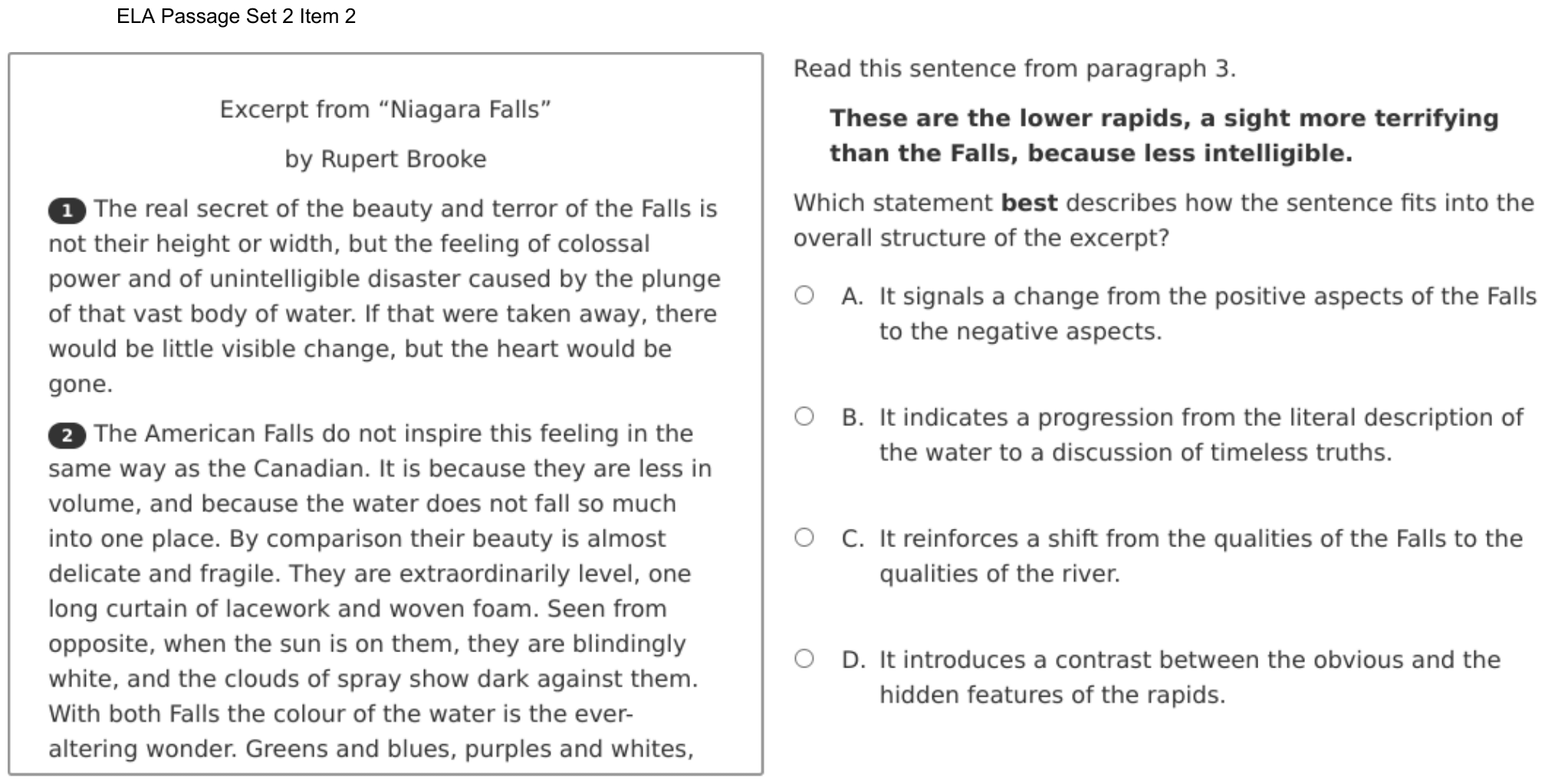
Read this sentence from paragraph 3.
These are the lower rapids, a sight more terrifying than the Falls, because less intelligible.
Which statement best describes how the sentence fits into the overall structure of the excerpt?
- AIt signals a change from the positive aspects of the Falls to the negative aspects.
- BIt indicates a progression from the literal description of the water to a discussion of timeless truths.
- CIt reinforces a shift from the qualities of the Falls to the qualities of the river.
- DIt introduces a contrast between the obvious and the hidden features of the rapids.
Show the answer
Correct answer: C
The question asks for the statement that best describes how the sentence from paragraph 3 fits into the overall structure of the excerpt.
A. Incorrect. Although in paragraph 2 the author describes the beauty of the Falls as both an “ever-altering wonder” and an “assault of wind and spray,” in paragraph 3 the author does not signal a change from the positive aspects of the Falls to the negative aspects. Instead, the author provides a description of the river and the rapids below the Falls.
B. Incorrect. While the author compares the water of the river to “a slipping floor of marble, green with veins of dirty white, made by the scum that was foam” in paragraph 3, the statement that the lower rapids are “more terrifying than the Falls, because less intelligible” does not indicate a progression from the literal description of the water to a discussion of timeless truths. Instead, the author is merely describing all aspects of the rapids, both literally and figuratively.
C. CORRECT. The first sentence of paragraph 3 moves the description “beyond the foot of the Falls” to “the river” and then the paragraph begins to describe this location in further detail (“a dull sage green,” “hurries more swiftly,” “smooth and ominous,” “waters boil and eddy”) before reinforcing this shift by confirming it again with the words “These are the lower rapids, a sight more terrifying than the Falls.”
D. Incorrect. Although the author states that the waters of the rapids “boil and eddy” and suggests that the rapids are “less intelligible,” these statements do not introduce a contrast between the obvious and the hidden features of the rapids. They merely describe a feature and the sight of the lower rapids.
Question analysis
This text structure question quotes a sentence from paragraph 3 of Rupert Brooke’s “Niagara Falls,” in which the lower rapids are called “more terrifying than the Falls,” and asks how it fits the excerpt’s overall organization. It rewords a question from the 2018 handbook’s Test B. Every choice describes a turn the essay could plausibly take, so students need a clear picture of what each paragraph covers.
- NYS standards
- 7R5 structure and genre features
- Grade level
- Grade 8 reading and task
- Compared with grade 7
- Above grade 7 A typical grade 7 structure question asks what one paragraph adds. This one asks where a sentence from the middle of paragraph 3 fits in the whole essay, which means summing up four long paragraphs of century-old prose.
- Estimated difficulty
- Hard: combines ideas, needs a plan, and has more than one tempting wrong answer.
- Thinking it demands
- Depth of knowledge 3, strategic thinking · mainly analyze
- What makes it hard
- How, not what major
- Much to keep track of moderate
- Hard words moderate
- Evidence
- Answered from several paragraphs or stanzas
- Reading level
- Passage: about grade 9, 987 words; question and choices: about grade 8, 97 words.
- Students, last 30 days
- Not enough answers yet to show (it takes 10).
Why it is hard, traps and wrong answers (shows the answer)
Why it is hard
A sentence that compares the rapids with the Falls is easy to misplace, because both of its subjects appear elsewhere in the excerpt. The strongest pull is a real turn in the essay, from describing water to musing on destiny, that comes a paragraph later, while “more terrifying” draws students who forget that terror runs through the excerpt from its first sentence. The 2026 verb “reinforces” rewards those who saw that paragraph 3 had already left the Falls with “Beyond the foot of the Falls the river.”
How, not what major Working it out
The task is to place one sentence in the essay’s plan, and the sentence pulls the wrong way: it mentions “the Falls” and “more terrifying,” though its job is to confirm that paragraph 3 has already moved downstream to the rapids. (Anderson & Krathwohl, 2001)
Much to keep track of moderate Working it out
Placing the sentence takes a summary of all four long paragraphs at once: the Falls’ power, the two Falls’ beauty and the trip behind them, the river below, and the night thoughts on destiny. (Sweller, 1988; Carpenter, Just & Shell, 1990)
Hard words moderate Understanding the question
“Less intelligible” means harder to make sense of; a student who takes it as harder to see is led toward a contrast between obvious and hidden features of the rapids. (Perfetti, 2007; Freedle & Kostin, 1993)
Strategy: Sum up each of the four paragraphs in a few words, find where this sentence sits in that outline, and choose the description of the essay’s movement at exactly that point.
Traps
- Wrong part of the text: A choice is true of another paragraph, stanza or speaker than the one asked about.
The wrong answers, classified
A Twists what the text says (King et al., 2004)
Takes “more terrifying” as the essay’s first turn from the Falls’ beauty to their dangers, but this sentence is about the rapids, and paragraph 1 already speaks of “unintelligible disaster.”
B Wrong part of the text (Kirsch & Mosenthal, 1990)
Names a turn the excerpt really makes, from describing the water to “thoughts of destiny and the passage of empires,” but that turn comes in paragraph 4, not at the rapids.
D Wrong purpose or structure (Anderson & Krathwohl, 2001)
Reads “less intelligible” as less visible and finds a contrast between obvious and hidden features, though rapids that “boil and eddy” and leap like “a wild beast” are in plain view.
Working it out, step by step
Figure out what the question asks
This is a text structure question. Structure is the plan of a piece of writing: what each part does and how the parts connect. You get one sentence from paragraph 3. You must decide what job it does in the plan of the whole excerpt. So first sum up what each of the four paragraphs is about.
Sum up the four paragraphs
- Paragraph 1: the real secret of the Falls is “the feeling of colossal power.” Colossal means huge.
- Paragraph 2: the two Falls, their colors, the rainbows, and the scary trip behind the water.
- Paragraph 3: the river below the Falls and its wild rapids.
- Paragraph 4: the author goes back to the Falls at night and thinks about life and destiny, or what happens in the end.
See where paragraph 3 begins
Paragraph 3 opens with “Beyond the foot of the Falls the river is like a slipping floor of marble.” Beyond the foot means past the bottom. So the author has already left the Falls. He follows the river as it “hurries more swiftly” and the waters “boil and eddy,” or swirl. Then comes the sentence: “These are the lower rapids, a sight more terrifying than the Falls, because less intelligible.” Rapids are a stretch of fast, rough water. Less intelligible means harder to make sense of.
Decide what the sentence does
The sentence names the new place: the lower rapids. It also sets the rapids against the Falls. That tells you again that the essay has moved from the Falls to the river below them. To reinforce something is to make it stronger. The sentence reinforces a shift, or change of subject, that the paragraph’s first sentence began.
Check each choice
- A does not fit. Terror is not new here. Paragraph 1 already speaks of “unintelligible disaster,” and paragraph 2 calls the trip behind the Falls “a terrifying journey.”
- B does not fit. The essay does turn to big, timeless ideas, but in paragraph 4, not here.
- C fits. The sentence confirms the move from the Falls to the river.
- D does not fit. The rapids are in plain sight. “Less intelligible” means harder to understand, not hidden.
Watch out: B names a real turn in the essay. But it comes one paragraph later, with “thoughts of destiny and the passage of empires.”
Choose the answer
The sentence names the rapids and compares them with the Falls. That confirms the essay has moved downstream. So the answer is C, “It reinforces a shift from the qualities of the Falls to the qualities of the river.”
Why this answer and not the closest wrong one
B is the closest wrong choice, because the essay really does move from describing water to big ideas about life. But that move comes in paragraph 4, at night. The sentence in paragraph 3 is still describing water. Its job is to name the rapids and confirm that the essay has left the Falls for the river.
More questions like this
The original DOE question
The passage “Excerpt from “Niagara Falls”” as printed (pages 134–135)
Question 2 of 6
2026 Practice Test D English, question 19Passage Wolves of the Sea
Wolves of the Sea
The cool and misty landscape of the Great Bear Rainforest can be found along the coast of British Columbia, Canada, and its nearby islands, from Vancouver Island to the Alaskan border. Within this protected area, wolves roam the forests, islands, and beaches. When biologist Chris Darimont began to study these wolves, he wanted to confer with local First Nations groups, as aboriginal Canadians are known, in order to learn what they knew about these wolves. He spoke with Chester Starr, an elder of the Heiltsuk Nation that has occupied the Great Bear Rainforest for thousands of years. What Starr had to say about the wolves changed Darimont’s perception of the animals.
Starr asked Darimont which wolves he and his team were going to study—the timber wolves (mainland wolves) or the coastal wolves on the islands. The question took Darimont by surprise. Biologists had always believed that the wolves that are sometimes spotted swimming between islands and eating salmon are the same wolves that live on the mainland. Darimont was intrigued by Starr’s classification of the wolves as two different groups. At first, he was hesitant to accept the idea. The distances between the mainland and the islands are small, less than a mile. Why would the wolves on the islands be any different from the wolves on the mainland? To find out, Darimont and his research team studied the wolves on the islands and in the densely forested territory of the Great Bear Rainforest for ten years.
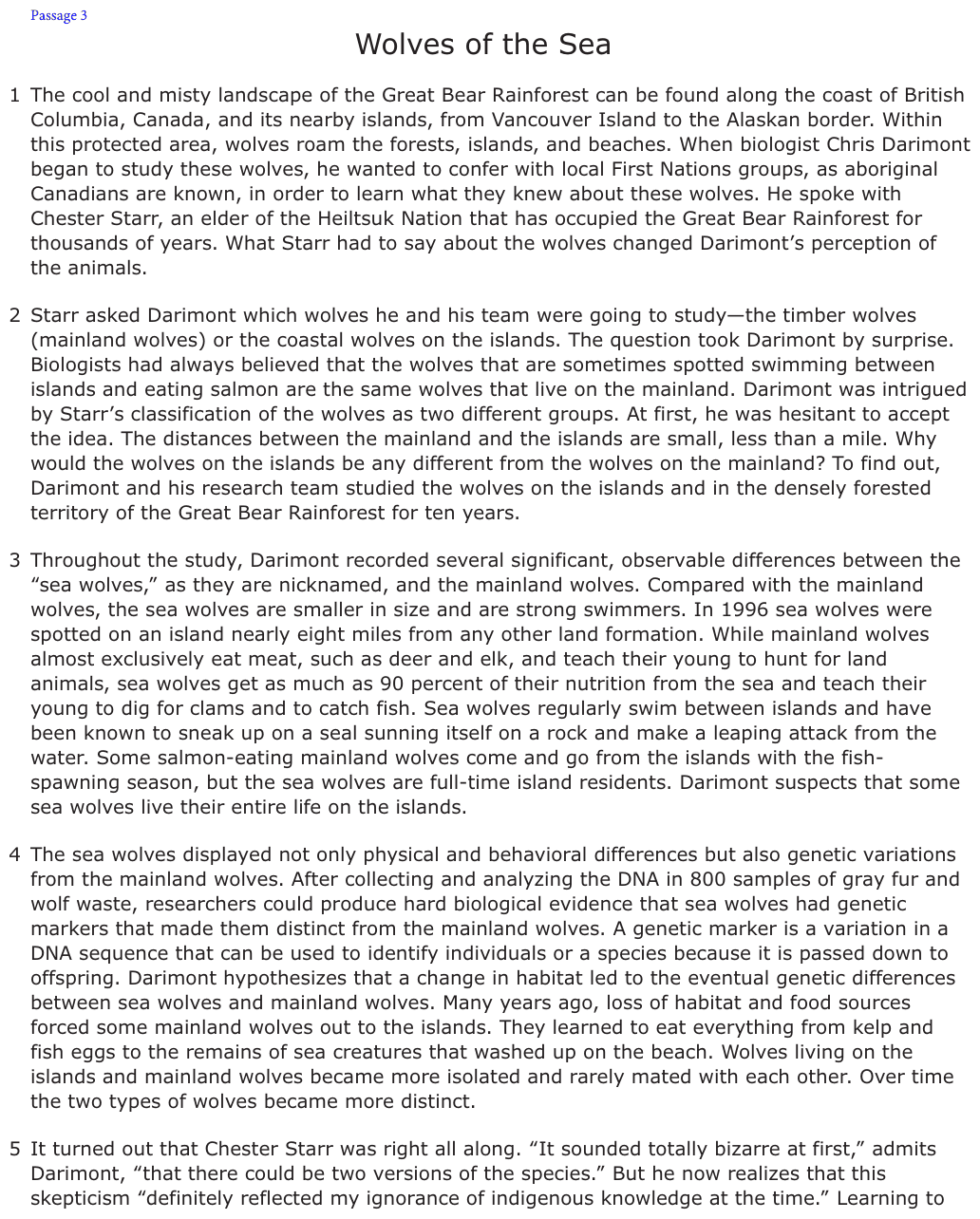
Throughout the study, Darimont recorded several significant, observable differences between the “sea wolves,” as they are nicknamed, and the mainland wolves. Compared with the mainland wolves, the sea wolves are smaller in size and are strong swimmers. In 1996 sea wolves were spotted on an island nearly eight miles from any other land formation. While mainland wolves almost exclusively eat meat, such as deer and elk, and teach their young to hunt for land animals, sea wolves get as much as 90 percent of their nutrition from the sea and teach their young to dig for clams and to catch fish. Sea wolves regularly swim between islands and have been known to sneak up on a seal sunning itself on a rock and make a leaping attack from the water. Some salmon-eating mainland wolves come and go from the islands with the fish-spawning season, but the sea wolves are full-time island residents. Darimont suspects that some sea wolves live their entire life on the islands.
The sea wolves displayed not only physical and behavioral differences but also genetic variations from the mainland wolves. After collecting and analyzing the DNA in 800 samples of gray fur and wolf waste, researchers could produce hard biological evidence that sea wolves had genetic markers that made them distinct from the mainland wolves. A genetic marker is a variation in a DNA sequence that can be used to identify individuals or a species because it is passed down to offspring. Darimont hypothesizes that a change in habitat led to the eventual genetic differences between sea wolves and mainland wolves. Many years ago, loss of habitat and food sources forced some mainland wolves out to the islands. They learned to eat everything from kelp and fish eggs to the remains of sea creatures that washed up on the beach. Wolves living on the islands and mainland wolves became more isolated and rarely mated with each other. Over time the two types of wolves became more distinct.
It turned out that Chester Starr was right all along. “It sounded totally bizarre at first,” admits Darimont, “that there could be two versions of the species.” But he now realizes that this skepticism “definitely reflected my ignorance of indigenous knowledge at the time.” Learning to trust the wisdom of the Heiltsuk people opened Darimont up to knowledge accumulated over millennia and positioned him so that he could gather new scientific evidence about one of British Columbia’s most elusive species, the sea wolf.
Question
Which sentence from the passage best supports the idea that sea wolves had successfully adapted to living on the islands?
- A“While mainland wolves almost exclusively eat meat, such as deer and elk, and teach their young to hunt for land animals, sea wolves get as much as 90 percent of their nutrition from the sea and teach their young to dig for clams and to catch fish.” (paragraph 3)
- B“Sea wolves regularly swim between islands and have been known to sneak up on a seal sunning itself on a rock and make a leaping attack from the water.” (paragraph 3)
- C“Darimont suspects that some sea wolves live their entire life on the islands.” (paragraph 3)
- D“Darimont hypothesizes that a change in habitat led to the eventual genetic differences between sea wolves and mainland wolves.” (paragraph 4)
Show the answer
Correct answer: A
The question asks for the sentence from the passage that best supports the idea that sea wolves had successfully adapted to living on the islands.
A. CORRECT. This sentence from paragraph 3 describes a significant difference in the diets of the mainland and sea wolves: the mainland wolves “almost exclusively eat meat, such as deer and elk, and teach their young to hunt for land animals,” whereas the sea wolves had adapted to the point where they derive “as much as 90 percent of their nutrition from the sea and teach their young to dig for clams and to catch fish.” This sentence emphasizes the dietary difference between the two groups of wolves and best supports the idea that sea wolves had successfully adapted to living on the islands.
B. Incorrect. Although this sentence from paragraph 3 describes one technique that the sea wolves used to hunt, it does not offer evidence as strong as that provided by the preceding sentence, which explains that sea wolves were able to derive “as much as 90 percent” (paragraph 3) of their sustenance from the sea alone (versus the mainland wolves, which “almost exclusively eat meat” from land animals [paragraph 3]).
C. Incorrect. Although this sentence from paragraph 3 states that “some sea wolves live their entire life on the islands,” it does not provide strong evidence of the necessary adaptations—namely, how these wolves were able to successfully live their whole lives on the islands. Living on the islands was not necessarily an adaptation in and of itself; the adaptation was the sea-based diet that enabled the sea wolves to live on the islands without access to land animals.
D. Incorrect. Although this sentence from paragraph 4 presents Darimont’s hypothesis that “a change in habitat led to the eventual genetic differences” between the wolves, the sentence does not describe any of the sea wolves’ adaptations nor best support the idea that the sea wolves successfully adapted to living on the islands.
Question analysis
This evidence question on “Wolves of the Sea” asks which sentence best supports the idea that sea wolves had successfully adapted to living on the islands. Three choices come from paragraph 3’s list of differences between sea wolves and mainland wolves and one from paragraph 4, so students must rank closely related sentences by how directly each shows the wolves thriving there.
- NYS standards
- 7R1 textual evidence and inferences
- Grade level
- Grade 8 reading and task
- Compared with grade 7
- Above grade 7 Grade 7 evidence questions often have one clearly relevant sentence. Here three neighboring sentences all describe the sea wolves’ island life, so students must decide what counts as successful adaptation and rank strong evidence against nearly as strong.
- Estimated difficulty
- Hard: combines ideas, needs a plan, and has more than one tempting wrong answer.
- Thinking it demands
- Depth of knowledge 3, strategic thinking · mainly evaluate
- What makes it hard
- A very close wrong answer moderate
- Reading between the lines moderate
- Every choice must be checked minor
- Evidence
- Answered from several paragraphs or stanzas
- Reading level
- Passage: about grade 10, 662 words; question and choices: about grade 12, 131 words.
- Students, last 30 days
- Not enough answers yet to show (it takes 10).
Why it is hard, traps and wrong answers (shows the answer)
Why it is hard
All four sentences are about sea wolves, and three describe their island lives, so the question turns on ranking evidence rather than spotting it. The seal attack is one of the passage’s most vivid images and shows a real island skill, which makes it hard to give up for a sentence about diet. The key wins because it shows a whole way of life changing, most food from the sea and the young taught to fish, while the other sentences offer one habit, a hedged guess or a cause.
A very close wrong answer moderate Choosing the answer
The seal-hunting sentence sits right after the key in paragraph 3 and also shows sea wolves living off the sea; it differs in showing one hunting trick instead of up to 90 percent of their food. (Embretson & Wetzel, 1987; Gorin & Embretson, 2006; Ascalon et al., 2007)
Reading between the lines moderate Working it out
No sentence uses the word “adapted,” so students must first decide what would prove an animal thrives in a new place, such as getting its food there and teaching that skill to its young. (Graesser, Singer & Trabasso, 1994; Kintsch, 1998)
Every choice must be checked minor Choosing the answer
Three of the four sentences come from paragraph 3’s list of island habits, and all four mention sea wolves or their habitat, so none can be dismissed at a glance. (Embretson & Wetzel, 1987)
Strategy: Before reading the choices, decide what would prove that an animal has adapted well to a new place, then rank the four sentences by how fully each one shows that, not merely whether it fits.
Traps
- Supports only part of the claim: In a question about evidence: a line that backs one half of the claim but not the other, or a related point rather than the claim itself.
- True but not the answer: A choice says something accurate about the text that does not answer this question.
The wrong answers, classified
B Supports only part of the claim (King et al., 2004; Thissen, Steinberg & Fitzpatrick, 1989)
Is impressed by the leaping attack on a seal, a real island skill, but one hunting technique shows less than wolves getting up to 90 percent of their food from the sea.
C Supports only part of the claim (King et al., 2004; Thissen, Steinberg & Fitzpatrick, 1989)
Matches “live their entire life on the islands” to the claim’s “living on the islands,” but it is Darimont’s guess about where the wolves stay, not how they manage there.
D True but not the answer (King et al., 2004; Embretson & Wetzel, 1987)
Sees “change in habitat” and thinks of adaptation, but the sentence gives Darimont’s theory of what caused the genetic differences, not evidence that the wolves thrive.
Working it out, step by step
Figure out what the question asks
This asks for evidence: the sentence that best supports a claim. The claim is that sea wolves “had successfully adapted to living on the islands.” To adapt is to change so you can live well in a new place.
Decide what strong proof looks like
Before you read the choices, ask what would prove an animal is doing well somewhere new. It can find its food there. It can also teach its young to live there. One clever trick is weaker proof. A guess is weaker still. So look for a sentence that shows a whole way of life built around the new home.
Test the diet sentence
Choice A comes from paragraph 3. It says “sea wolves get as much as 90 percent of their nutrition from the sea and teach their young to dig for clams and to catch fish.” Nutrition is the food a body needs. So almost all their food comes from the sea. They also pass those skills on to their pups. Mainland wolves, by contrast, “almost exclusively eat meat, such as deer and elk.” Exclusively means only.
Check the other choices
- B shows one hunting trick, a leap at a seal. It is a real island skill. But it shows less than a diet that is up to 90 percent from the sea.
- C uses the word “suspects,” so it is only Darimont’s guess. It also tells where some wolves live, not how they manage there.
- D gives Darimont’s idea about what caused the genetic differences. It does not show the wolves doing well.
Watch out: The seal attack in B is the most exciting picture. But one exciting hunt is weaker proof than a whole new diet.
Choose the answer
Sentence A shows sea wolves getting most of their food from the sea and training their young to do the same. So the answer is A, the sentence “While mainland wolves almost exclusively eat meat, such as deer and elk, and teach their young to hunt for land animals, sea wolves get as much as 90 percent of their nutrition from the sea and teach their young to dig for clams and to catch fish.”
Why this answer and not the closest wrong one
B is the closest wrong answer. It comes right after A in paragraph 3 and also shows sea wolves living off the sea. But B shows one way of hunting. A shows where nearly all their food comes from, and that they teach it to their young. That is stronger proof that they adapted well.
More questions like this
The original DOE question
The passage “Wolves of the Sea” as printed (pages 23–24)

Question 3 of 6
2026 Practice Test D English, question 5Passage A Memory Revolution
A Memory Revolution
A high school senior logs on to a computer at the library to double-check the application due date listed on a college admissions website. Nearby, a librarian helps a group of biology students use a database to search for recent studies about mammals. In the past few decades, the Internet has become an integral component of daily life for many people. The seemingly limitless power of search engines made the Internet search extremely common, and today people increasingly rely on the Internet’s vast accumulation of sources to access all types of information. Scientists are beginning to examine how this reliance is modifying the strategies people use to store and prioritize information in their mind.
A Dependable and Valuable Asset
Psychologist Benjamin Storm from the University of California, Santa Cruz, and researchers Sean Stone and Aaron Benjamin devised an experiment to study students’ tendency to depend on the Internet for facts. To begin, the scientists divided sixty participants into multiple groups, including an “Internet” group and a “memory” group, and placed them in front of computers. The Internet group was required to use the search engine Google to answer eight challenging trivia questions. In contrast, participants in the memory group were permitted to use only their personal knowledge to answer the questions. In the second round, the researchers administered notably easier questions. This time, they allowed each group the option of using Google as they answered. Their results showed that 83 percent of the Internet group continued to consult Google in the second round, while only 63 percent of the memory group chose to do so.
People’s growing inclination to rely on the Internet in order to retrieve information, particularly facts and figures, is called cognitive offloading. Canadian researcher Evan F. Risko and British researcher Sam Gilbert, who have written extensively about the topic, say a similar process has been taking place for centuries. In the past, people used resources like encyclopedias to assist their memories; however, today the Internet, serving as a vast extended memory, allows people to digitally access and retrieve much larger volumes of information. Consequently, people’s minds are free for other cognitive feats, such as connecting data, learning new information, or solving problems.
Filing Information Away
The use of the Internet also appears to be modifying the strategies people use to store information in their mind. Researchers Betsy Sparrow from Columbia University, Jenny Liu from the University of Wisconsin-Madison, and Daniel Wegner from Harvard University conducted several studies to discover how people efficiently manage their information intake.
To begin, the researchers examined how people evaluate which information deserves their effort to remember. For this experiment, participants read forty trivia facts, such as “An ostrich’s eye is bigger than its brain,” and typed the statements into a computer file. Half the participants had been previously told the file would be saved, while half believed it would be erased. Next, the participants wrote down every fact they could recall. Those who believed the information would be erased and no longer available could recall 40 percent more facts than those who thought the information would be saved.
In another experiment, the same researchers tested the ability of study participants to remember where to access information. For this trial, participants read and typed trivia statements, which they saved in folders with generic names such as “Facts” and “Items.” After spending ten minutes writing down all the facts they could recall from memory, participants were asked which folder contained a particular fact based on a keyword. For example, “Which folder has the fact about ostriches?” Overall, participants recalled the information’s location more often than the content itself, correctly identifying 49 percent of the folders for specific facts while remembering only 23 percent of the actual trivia. The researchers concluded that our memory is adapting to the Internet age by prioritizing where to locate information even when the specific details are forgotten. According to Sparrow, the Internet has become an important form of transactive memory, an external source of the recollections and associative networks that constitute memory.
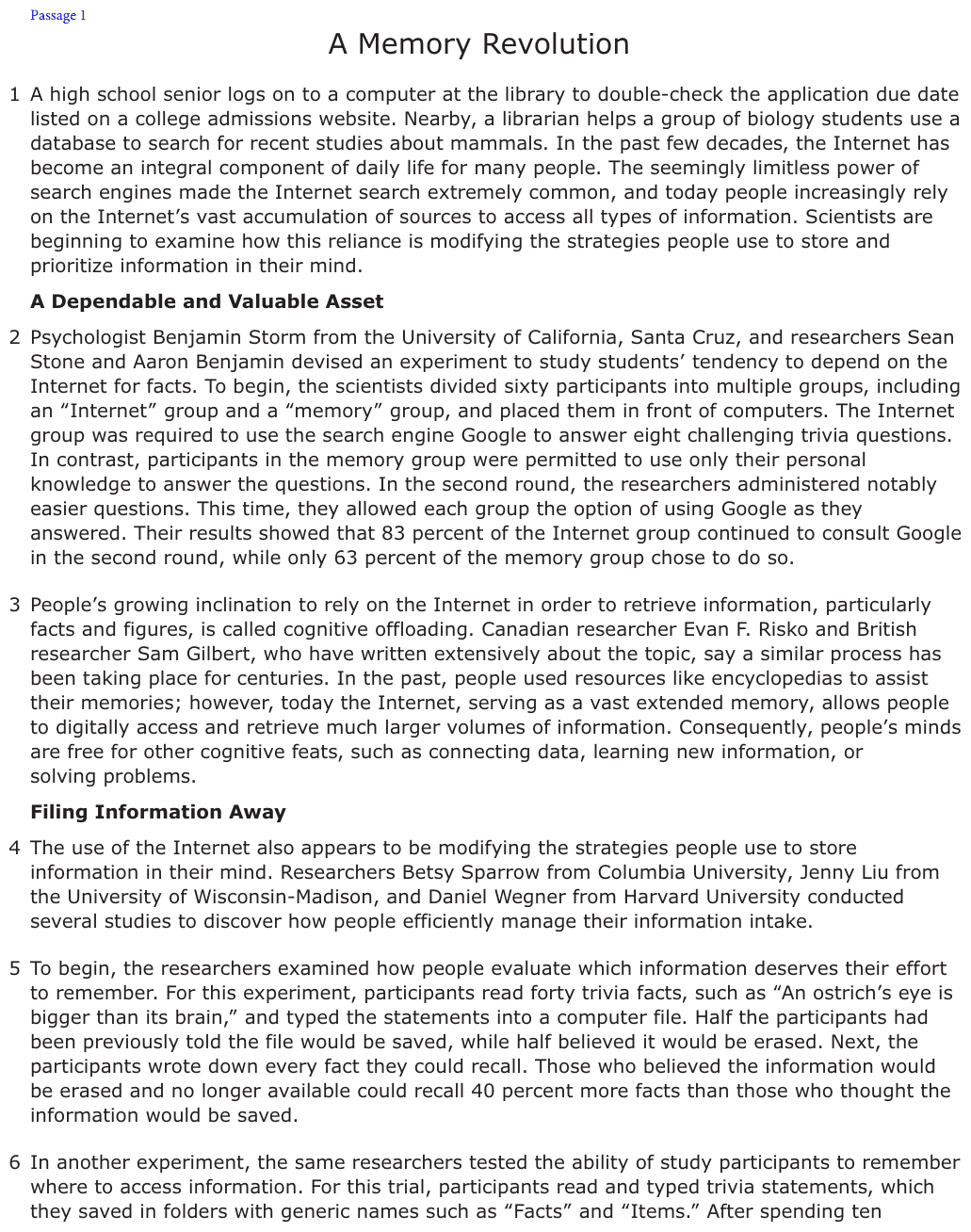
As the Internet’s resources continue to expand our “external” memory, some question whether the process may cause people to depend too heavily on technology. However, Steven Pinker, a professor of psychology at Harvard University, says, “Knowledge is increasing exponentially; human brainpower and waking hours are not. Fortunately, the Internet and information technologies are helping us manage, search and retrieve our collective intellectual output at different scales, from Twitter and previews to e-books and online encyclopedias. Far from making us stupid, these technologies are the only things that will keep us smart.”
Question
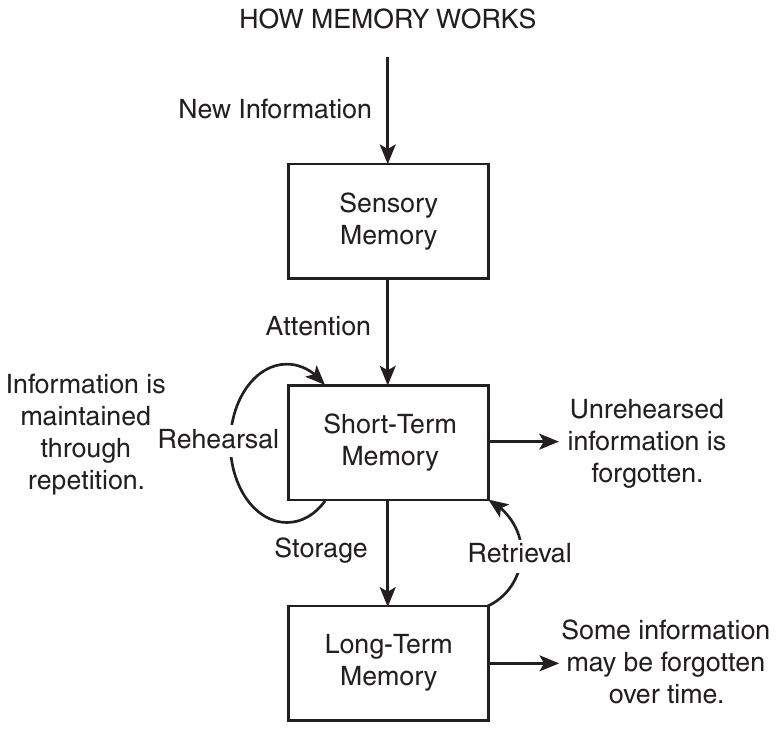
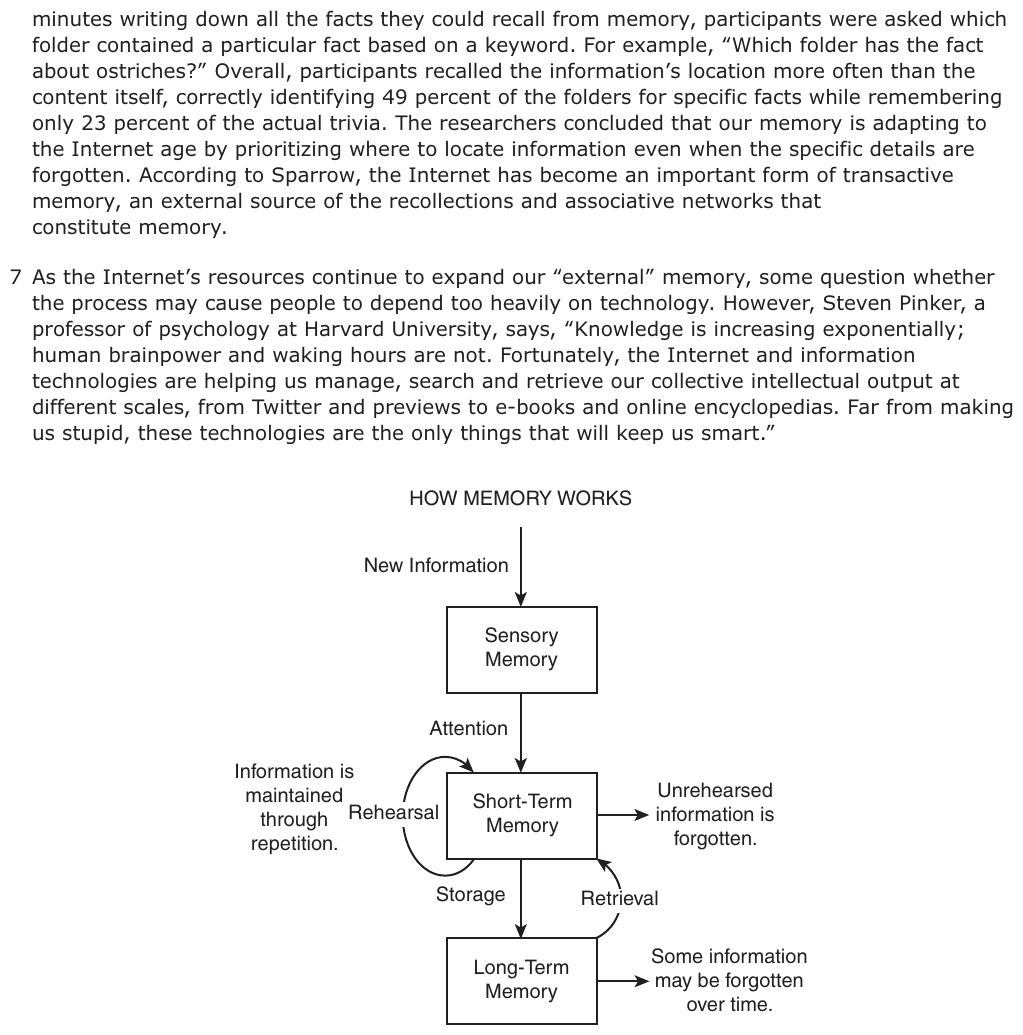
How does the diagram provide additional support for the topic presented in the passage?
- AIt reveals why human brains must adapt to obtaining information from the Internet as opposed to other sources.
- BIt indicates how people can use the Internet to help improve their long-term recollection of information.
- CIt shows how study participants’ brains distinguished between important and unimportant details.
- DIt depicts the idea that repetition and rehearsal are necessary to recall information when tools such as search engines are unavailable.
Show the answer
Correct answer: D
The question asks how the diagram provides additional support for the topic presented in the passage.
A. Incorrect. While the diagram indicates that the human brain has the ability to maintain different types of memory, the diagram does not show the need for the brain to adapt to obtaining information from the Internet rather than from other sources.
B. Incorrect. The diagram enhances the reader’s understanding of how long-term memories are formed, but it does not provide details about how the Internet can be used to improve long-term recollection of information.
C. Incorrect. The diagram provides an understanding of how details that are important to people can become stored because of an effort made to recall them. However, the diagram does not show how people decide which information is important and which is not.
D. CORRECT. The diagram depicts the connections that the human brain maintains between the different forms of memory. It also illustrates the idea that repetition and rehearsal are important steps in creating memories, as unrehearsed information will be forgotten. This supports the passage by highlighting the idea that access to search engines and other tools leads people to skip rehearsal and repetition steps that create memories, because people know that the information is readily accessible.
Question analysis
This question pairs “A Memory Revolution” with its flow diagram, “How Memory Works,” which follows new information from sensory memory through short-term and long-term memory, and asks how the diagram supports the topic of the passage. Students must read the diagram’s boxes, arrows and notes and relate them to an article about the Internet that never refers to the diagram, so the connection has to be worked out.
- Grade level
- Grade 8 reading and task
- Compared with grade 7
- Above grade 7 Grade 7 students regularly connect a diagram to a text. This flow diagram of memory never mentions the Internet, so students must build the bridge to the article’s studies themselves, and every choice claims something the diagram alone cannot show.
- Estimated difficulty
- Hard: combines ideas, needs a plan, and has more than one tempting wrong answer.
- Thinking it demands
- Depth of knowledge 3, strategic thinking · mainly analyze
- What makes it hard
- Combines ideas moderate
- Reading a figure, table or graph moderate
- Every choice must be checked minor
- Evidence
- Answered from the whole text
- Reading level
- Passage: about grade 14, 763 words; question and choices: about grade 12, 81 words.
- Students, last 30 days
- Not enough answers yet to show (it takes 10).
Why it is hard, traps and wrong answers (shows the answer)
Why it is hard
The diagram is a general model of memory, and every choice, even the right one, goes beyond it by bringing in the Internet, search engines or the study participants. The way through is to ask which choice rests on something the diagram really shows, and only one names its rehearsal loop and the forgetting of unrehearsed information. The strongest pull uses the diagram’s long-term memory and retrieval but claims the Internet improves recollection, the opposite of what paragraph 5’s experiment found.
Combines ideas moderate Working it out
The diagram never mentions the Internet and the article never mentions the diagram, so students must join its rehearsal loop to paragraph 5’s finding that people who expected the facts to be saved remembered fewer. (Embretson, 1998; Daniel & Embretson, 2010)
Reading a figure, table or graph moderate Understanding the question
Students must follow the arrows from “Attention” into short-term memory and find the “Rehearsal” loop beside “Information is maintained through repetition,” with “Unrehearsed information is forgotten” on the other side. (Lesh, Post & Behr, 1987; Kirsch & Mosenthal, 1990)
Every choice must be checked minor Choosing the answer
Three choices tie the diagram to the Internet, adaptation or the study participants, and even the key mentions search engines, so each claim must be held against the boxes and arrows actually drawn. (Embretson & Wetzel, 1987)
Strategy: Trace the diagram’s arrows from new information to long-term memory and say what each label shows, then ask which choice links that process to the studies without crediting the diagram with ideas it never shows.
Traps
- Reads too much in: A reasonable-sounding conclusion that goes further than the text allows.
- Wrong part of the text: A choice is true of another paragraph, stanza or speaker than the one asked about.
- Twists what the text says: Uses the text's topic and ideas but changes what it says: who did it, how much, when, or why.
The wrong answers, classified
A Reads too much in (Graesser, Singer & Trabasso, 1994)
Credits the diagram with the article’s claim that memory is “adapting to the Internet age” and adds a “must,” though its boxes and arrows show memory in general and never mention the Internet.
B Twists what the text says (King et al., 2004)
Joins the diagram’s long-term memory and retrieval arrow to the Internet as outside memory, though paragraph 5 found that people who expected the facts to be saved recalled fewer of them.
C Wrong part of the text (Kirsch & Mosenthal, 1990)
Reads the “Attention” arrow and the forgotten unrehearsed information as a picture of paragraph 5’s experiment, though the diagram shows no participants and nothing about judging what is important.
Working it out, step by step
Figure out what the question asks
This asks how the diagram supports the article. The diagram is the flow chart called “HOW MEMORY WORKS” at the end of the passage. It never mentions the Internet. So you must find what it shows, then link that to the article.
Follow the arrows in the diagram
Start at the top. An arrow labeled “New Information” goes into the box “Sensory Memory.” The “Attention” arrow leads to “Short-Term Memory.” From there, two things can happen. On the left, a loop labeled “Rehearsal” sits beside the note “Information is maintained through repetition.” On the right, a note says “Unrehearsed information is forgotten.” A “Storage” arrow leads down to “Long-Term Memory,” and a “Retrieval” arrow leads back up.
Explain what the diagram means
To rehearse information is to repeat it, the way you practice lines for a play. To maintain something is to keep it. So the diagram says that information you repeat stays with you. Information you don’t repeat is lost. Repeating takes effort.
Link the diagram to the passage
Paragraph 5 describes people who typed forty facts. Some thought the file would be saved. Others thought it would be erased. Those who thought it would be erased “could recall 40 percent more facts.” They knew they could not look the facts up later. So they made the effort to remember. The diagram shows that effort: rehearsal. When search engines are at hand, people may skip it.
Check each choice
- A does not fit. The diagram never mentions the Internet. It does not say brains must adapt.
- B does not fit. The diagram shows nothing about using the Internet. Paragraph 5 even found that people remembered less when they expected the facts to be saved.
- C does not fit. The diagram shows memory in general. It shows no study participants and no sorting of important facts.
- D fits. The “Rehearsal” loop shows that repeating information keeps it. Without a tool to look things up, that repeating is what lets you recall.
Watch out: B is tempting because the diagram has “Long-Term Memory” and “Retrieval,” and the article calls the Internet an outside memory. But the diagram is about the brain, not the Internet.
Choose the answer
The diagram shows rehearsal keeping information and unrehearsed information being forgotten. That explains why people who can’t look facts up must work to remember them. So the answer is D, “It depicts the idea that repetition and rehearsal are necessary to recall information when tools such as search engines are unavailable.”
Why this answer and not the closest wrong one
B is the closest wrong choice. It uses the diagram’s “Long-Term Memory” and “Retrieval” labels. But the diagram never shows the Internet improving recall. The passage says the opposite: expecting the facts to be saved made people remember fewer. D rests on what the diagram really shows, the “Rehearsal” loop and the note “Unrehearsed information is forgotten.”
More questions like this
The original DOE question
The passage “A Memory Revolution” as printed (pages 3–4)
Question 4 of 6
2018 Test A Math, question 54Question
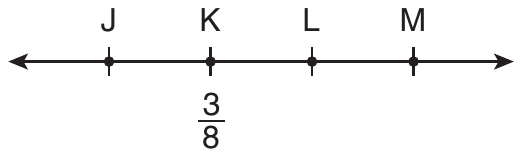
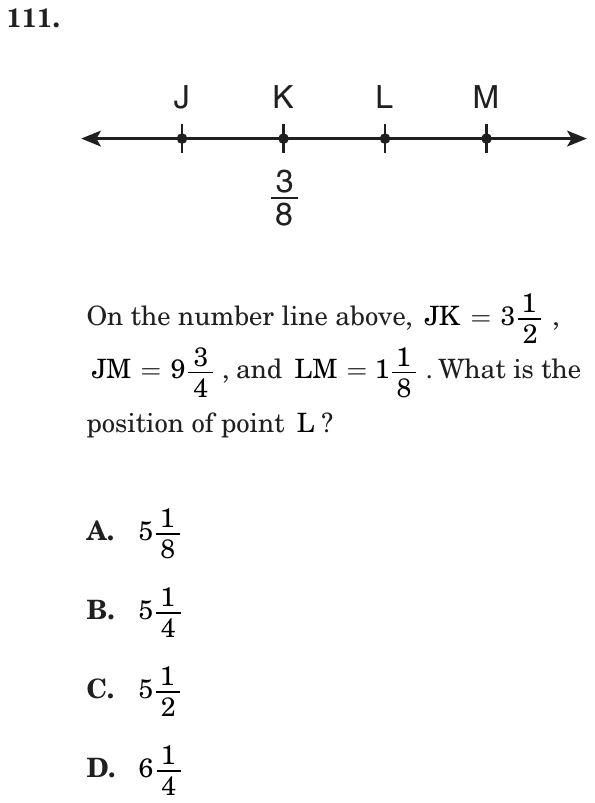
On the number line above, , , and . What is the position of point ?
- A
- B
- C
- D
Show the answer
Correct answer: C
First, use to find the location of :
Now, use to find the location of :
Finally, use to find the location of :
Question analysis
This number line question gives the lengths JK, JM and LM as mixed numbers and asks for the position of point L. Students must chain three distance steps, moving left from K to J, right to M and back to L, with fractions in eighths and a negative position. Losing track of where K sits is the main danger.
- Grade level
- Grade 7 content, by NYS standard
- Compared with grade 7
- Above grade 7 Grade 7 students add and subtract rational numbers and find distances on a number line one at a time. This item chains three such steps with mixed numbers and a negative position, more than typical grade 7 work demands.
- Estimated difficulty
- Among the hardest on the SHSAT: a non-obvious approach, heavy reading, or a well-hidden trap.
- Thinking it demands
- Depth of knowledge 2, skills and concepts · mainly apply
- What makes it hard
- A very close wrong answer major
- Error-prone arithmetic moderate
- Reading a figure, table or graph moderate
- Many steps minor
- Solution
- 4 steps
- Reading level
- Question and choices: about grade 9, 20 words.
- Students, last 30 days
- Not enough answers yet to show (it takes 10).
Why it is hard, traps and wrong answers (shows the answer)
Why it is hard
Every number is a mixed fraction, one position is negative, and the figure's even spacing hides how long KL really is. The distance route, KL = 9 3/4 − 3 1/2 − 1 1/8, avoids the negative entirely but ends one step short of a position unless K's 3/8 is added back. That last step is the one most students skip, which is why the question sits at the top of the scale.
A very close wrong answer major Choosing the answer
The choices 5 1/8, 5 1/4 and 5 1/2 lie within 3/8 of one another, so no estimate separates them; only exact eighths and adding K's 3/8 pick out the right one. (Embretson & Wetzel, 1987; Gorin & Embretson, 2006; Ascalon et al., 2007)
Error-prone arithmetic moderate Working it out
Every step mixes halves, quarters and eighths, and placing J means 3/8 − 3 1/2 = −3 1/8, a subtraction that crosses zero. (Brown & Burton, 1978; Junker & Sijtsma, 2001)
Reading a figure, table or graph moderate Understanding the question
Only K is labeled, and the points are drawn evenly spaced although KL is over four times LM, so the picture gives no help with sizes. (Lesh, Post & Behr, 1987; Kirsch & Mosenthal, 1990)
Many steps minor Working it out
Three linked moves, K to J, J to M and M back to L, each depend on the last, so an early slip carries through. (Daniel & Embretson, 2010; Enright, Morley & Sheehan, 2002)
Strategy: Start from K's labeled position, subtract JK to place J, add JM to place M, then subtract LM, keeping every fraction in eighths.
Traps
- Answers a different question: A choice is right for another quantity: the other unknown, the rest instead of the part, the part instead of the whole.
- Stops one step early: A choice is a number from partway through the solution.
The wrong answers, classified
A Stops one step early (King et al., 2004; Gierl et al., 2017)
Finds KL = 9 3/4 − 3 1/2 − 1 1/8 = 5 1/8 and stops one step short, never adding K's position of 3/8.
B An arithmetic slip (Junker & Sijtsma, 2001)
Rewrites 9 3/4 as 9 4/8 instead of 9 6/8, so M lands at 6 3/8 and L at 6 3/8 − 1 1/8 = 5 1/4.
D Answers a different question (King et al., 2004; Hegarty, Mayer & Monk, 1995)
Finds KM = 9 3/4 − 3 1/2 = 6 1/4, the distance from K to M, and gives it without moving back 1 1/8 to L.
Worked solution, step by step
Formulas used
- Distance on a number line
- d is the distance between two points. b is the point on the right and a is the point on the left. Subtracting left from right always gives a positive distance. It works even when a is negative.
- Equal fractions
- a is the top number (numerator) and b is the bottom number (denominator). Multiplying both by the same number k gives an equal fraction. It is like cutting each piece into k smaller pieces. Use it to give fractions the same bottom before you add or subtract.
Sort out what you know
Only K has a value: . JK means the distance from J to K. You know JK = , JM = and LM = .
You need the position of L, the number where L sits. The points are drawn evenly spaced, but the distances are not equal. So use the numbers, not the picture.
Write the fractions in eighths
The fractions use halves, fourths and eighths. Give them all a bottom of 8:
Watch out: is , not . That slip leads to choice B.
Find the distance from K to M
JM is JK and KM put together. So take JK away from JM:
KM is , or . Watch out: this is a distance, not where L sits. Choice D stops here.
Find the distance from K to L
KM is KL and LM put together. So take LM away:
KL is . Watch out: this is still a distance. Choice A stops here.
Find the position of L
L is to the right of K, and K is at . Add:
So the answer is C, .
Check your answer
Place every point. J is left of K, at . M is right of J, at . L is left of M, at , which is . Same answer.
More questions like this
The original DOE question
Question 5 of 6
2018 Test A Math, question 48Question
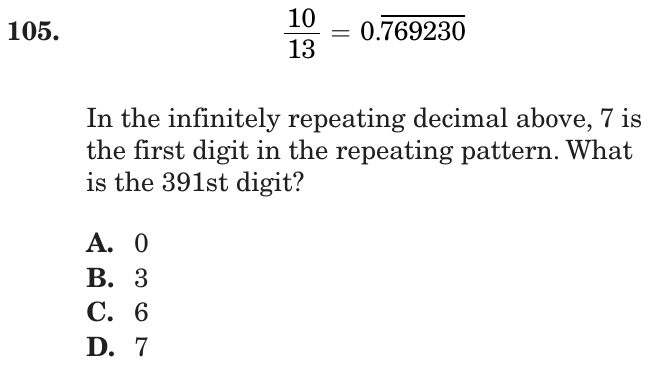
In the infinitely repeating decimal above, 7 is the first digit in the repeating pattern. What is the 391st digit?
- A0
- B3
- C6
- D7
Show the answer
Correct answer: D
There are 6 digits in the repeating decimal (769230), so 7 would be the first, seventh, thirteenth digit and so on.
To find the 391st digit, divide 391 by 6.
391 ÷ 6 = 65 R1
Since the remainder is 1, that means the 391st digit is the same as the 1st digit, which is 7.
Question analysis
This repeating decimal question shows the six-digit repeating pattern of 10/13 and asks for the 391st digit after the decimal point. Students must use the length of the repeating block and division with a remainder to find the position within the cycle. Matching the remainder to the right digit is where students slip.
- Grade level
- Grade 7 content, by NYS standard
- Compared with grade 7
- Above grade 7 Seventh graders learn that fractions have repeating decimals. Using the length of the repeating block and a remainder to find a digit hundreds of places away is a pattern-reasoning step beyond typical seventh-grade classwork.
- Estimated difficulty
- Hard: combines ideas, needs a plan, and has more than one tempting wrong answer.
- Thinking it demands
- Depth of knowledge 2, skills and concepts · mainly apply
- What makes it hard
- No obvious method moderate
- Solution
- 2 steps
- Reading level
- Question and choices: about grade 8, 20 words.
- Students, last 30 days
- Not enough answers yet to show (it takes 10).
Why it is hard, traps and wrong answers (shows the answer)
Why it is hard
Once the cycle length is used, the arithmetic is a single division, 391 ÷ 6 = 65 remainder 1. The difficulty is turning the remainder into a position: remainder 1 is the first digit of a new block, not the last digit of the previous one or the second of the new one. Checking the rule on small positions, the 1st and 7th digits are both 7, removes the doubt.
No obvious method moderate Working it out
Nothing in the stem mentions division; students must see that the six-digit block 769230 repeats, so position 391 depends only on the remainder of 391 divided by 6. (Schoenfeld, 1985)
Strategy: Divide 391 by the length of the repeating block and look only at the remainder; a remainder of r points to the r-th digit of the block.
Traps
- Counting the ends: Inclusive or exclusive ends, fence posts, consecutive numbers: an answer that is one too many or too few, or an endpoint drawn open where it belongs closed (or the reverse).
The wrong answers, classified
A Counting the ends (Brown & Burton, 1978)
Sees that 65 blocks fill 390 places and lands on the 390th digit, the 0 that ends a block, one place short.
B A faulty procedure (Brown & Burton, 1978; Tatsuoka, 1983)
Uses the quotient 65 instead of the remainder, takes its last digit 5, and reads the fifth digit of 769230, which is 3.
C Counting the ends (Brown & Burton, 1978)
Treats the remainder 1 as one step past the block's first digit, moving from 7 to the second digit, 6.
Worked solution, step by step
Formulas used
- Division with a remainder
- n is the number you divide. d is what you divide by. q is the quotient, the number of whole groups. r is the remainder, what is left over. Here it tells how many full blocks of digits fit, and where you land after them.
Sort out what you know
The bar over 769230 means those six digits repeat forever: 769230769230 and so on. The 7 is digit number 1. You need digit number 391.
Spot the pattern
The block 769230 has 6 digits, so the pattern starts over every 6 digits. Digit 1 is 7, and so are digits 7, 13, 19 and so on. Each full block ends with a 0, at digits 6, 12, 18 and so on.
Divide 391 by 6
Find how many full blocks fit into 391 digits, and what is left:
So 65 full blocks use up 6 × 65 = 390 digits. The remainder is 1. That means digit 391 is the 1st digit of the next block.
Read the digit
The 1st digit of the block is 7. Watch out: digit 390 is the last digit of a full block, which is 0. That is choice A. Digit 391 is one step past it, so it starts a new block.
So the answer is D, 7.
Check your answer
Test the idea on a small number. Digit 7: 7 = 6 × 1 + 1, so the remainder is 1 and the digit should be 7. Write it out: 7692307. The 7th digit is indeed 7. The rule works.
More questions like this
The original DOE question
Question 6 of 6
2026 Practice Test C Math, question 32Question
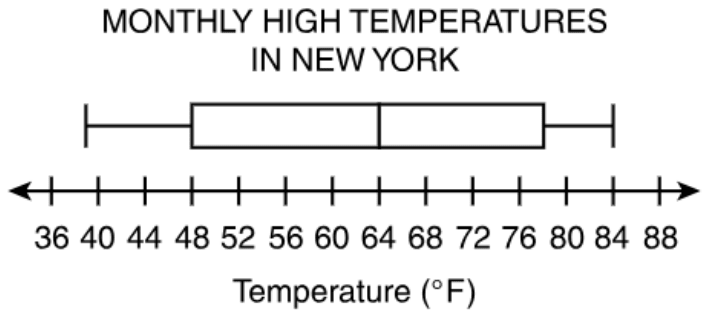
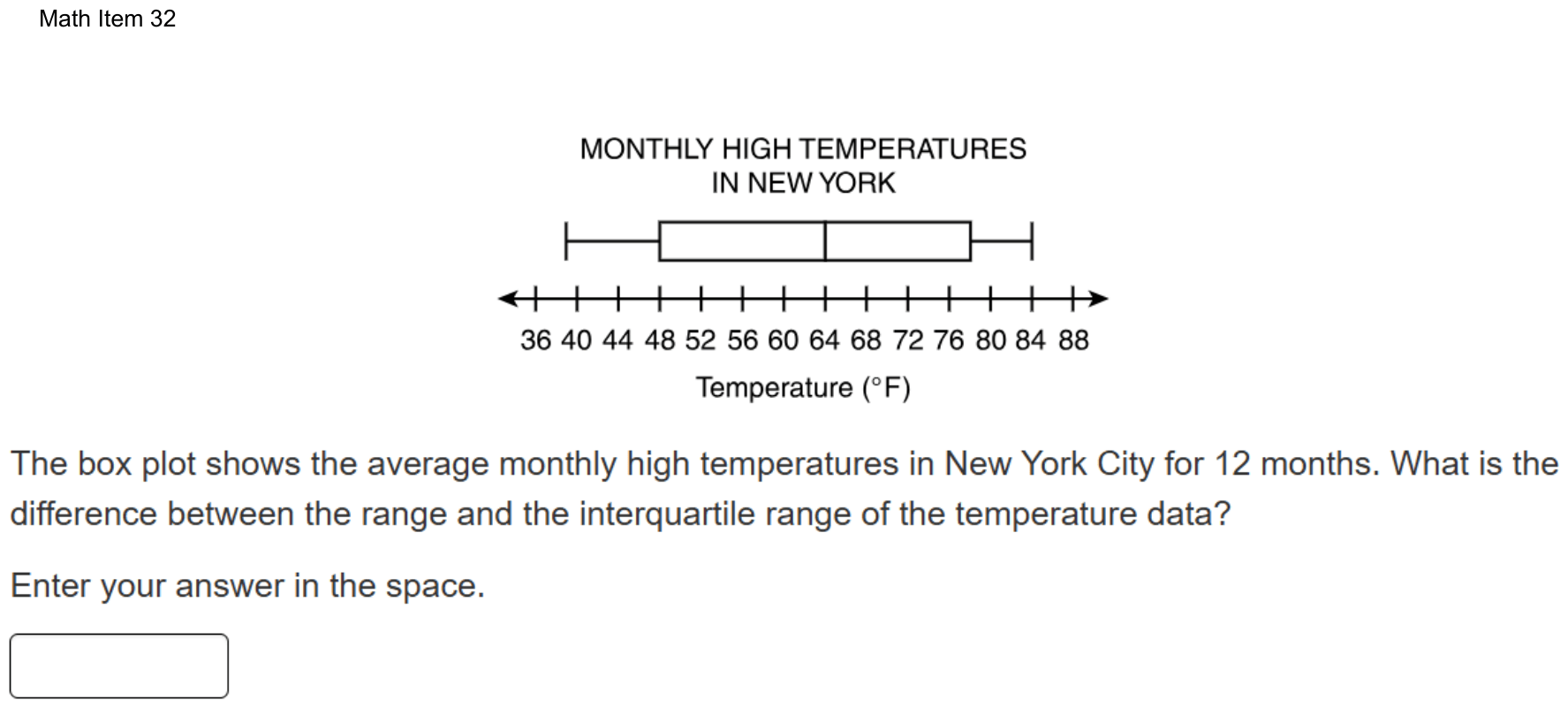
The box plot shows the average monthly high temperatures in New York City for 12 months. What is the difference between the range and the interquartile range of the temperature data?
Enter your answer in the space.
Fill-in question: work out the answer and type it as a number.
Show the answer
Correct answer: 15
Determine the range by subtracting the minimum value on the box plot from the maximum value on the box plot:
Maximum value , Minimum value
Determine the interquartile range by subtracting the lower quartile value on the box plot from the upper quartile value on the box plot:
Upper Quartile Value , Lower Quartile Value
Determine the difference between the range (45° F) and the interquartile range (30° F):
Question analysis
A box plot of New York City's average monthly high temperatures for 12 months sits above a number line labeled every 4 degrees. Students type the difference between the range and the interquartile range of the data. Two of the plot's values fall between labeled ticks, so careful reading of the scale decides the answer.
- Grade level
- Grade 7 content, by NYS standard
- Compared with grade 7
- Above grade 7 Reading a box plot and finding its interquartile range are grade 7 skills. Here two of the five values fall between ticks spaced 4 apart, and the range, the IQR and their difference must all be found and typed with no choices.
- Estimated difficulty
- Hard: combines ideas, needs a plan, and has more than one tempting wrong answer.
- Thinking it demands
- Depth of knowledge 2, skills and concepts · mainly apply
- What makes it hard
- Solution
- 3 steps
- Reading level
- Question and choices: about grade 7, 36 words.
- Students, last 30 days
- Not enough answers yet to show (it takes 10).
Why it is hard, traps and wrong answers (shows the answer)
Why it is hard
The method is standard, but the key rests on reading the scale between its labels. The axis is ticked only every 4 degrees, and the minimum and the upper quartile land off the ticks, so rounding either one to the nearest label moves the result by a degree or two with nothing to flag it. Students who find the range correctly can also stop there, entering 45, the larger of the two spreads, instead of the difference the question asks for.
Reading a figure, table or graph major Understanding the question
Two of the five values fall between ticks spaced 4 degrees apart: the left whisker ends just short of the 40 tick, at 39, and the box’s right edge sits midway between 76 and 80, at 78. (Lesh, Post & Behr, 1987; Kirsch & Mosenthal, 1990)
Many steps minor Working it out
Four values are read and combined in three subtractions, the range, the interquartile range and then their difference, so one misread value changes the final entry. (Daniel & Embretson, 2010; Enright, Morley & Sheehan, 2002)
Something you must already know minor Working it out
Neither measure is defined on the page: the range spans the whiskers, and the interquartile range is the width of the box, the upper quartile minus the lower. (Anderson & Krathwohl, 2001)
An answer in an unexpected form minor Choosing the answer
The result is typed with no choices to compare, so an entry one or two degrees off, from rounding a value to the nearest tick, looks just as finished as the right one. (Enright, Morley & Sheehan, 2002)
Strategy: Read the minimum, both quartiles and the maximum, judging where each mark falls between the ticks, then subtract for the range and for the IQR, and subtract those two results.
Traps
- Misreads the figure: Reads a value, label or tick spacing in a figure, table or graph wrongly.
- Stops one step early: A choice is a number from partway through the solution.
The wrong answers, classified
14 Misreads the figure (Lesh, Post & Behr, 1987; Kirsch & Mosenthal, 1990)
Reads the left whisker’s end as 40, the nearest labeled tick, instead of 39, so the range becomes 84 − 40 = 44 and 44 − 30 = 14.
45 Stops one step early (King et al., 2004; Gierl et al., 2017)
Finds the range, 84 − 39 = 45 degrees, and enters it, stopping before the interquartile range of 30 is subtracted from it.
17 Misreads the figure (Lesh, Post & Behr, 1987; Kirsch & Mosenthal, 1990)
Reads the box’s right edge as 76, the tick just left of it, instead of 78, so the IQR becomes 76 − 48 = 28 and 45 − 28 = 17.
Worked solution, step by step
Formulas used
- Range
- The maximum is the greatest value, at the right end of the right whisker. The minimum is the least value, at the left end of the left whisker. The range tells how far the whole set of data spreads.
- Interquartile range (IQR)
- Q3 is the upper quartile, the right edge of the box. Q1 is the lower quartile, the left edge of the box. The IQR is the width of the box. It tells how far the middle half of the data spreads.
Sort out the question
A box plot shows data with five numbers. The two whiskers are the lines on each side of the box. Their ends are the minimum, the least value, and the maximum, the greatest. The box runs from the lower quartile to the upper quartile. These are the middles of the lower half and the upper half of the data. The line inside the box is the median, the middle value.
You need the range minus the interquartile range (IQR), in degrees.
Read the values between the ticks
The ticks on the number line are 4 degrees apart. So each degree is one quarter of the space between two ticks. Three values sit right on ticks: the box’s left edge at 48, the median at 64, and the right whisker’s end at 84.
- The left whisker starts just left of the 40 tick. It sits about one quarter of the way back toward 36. So the minimum is degrees.
- The box’s right edge is halfway between 76 and 80. Halfway is 78 degrees.
Find the range
Use the range formula:
The data spread over 45 degrees.
Watch out: rounding the minimum to the 40 tick gives a range of 44. Then the final answer comes out 14, which is wrong.
Find the IQR
Use the IQR formula with the two edges of the box:
The middle half of the data spreads over 30 degrees.
Watch out: reading the box’s right edge as 76 gives an IQR of 28. Then the final answer comes out 17.
Subtract the IQR from the range
The question asks for the difference between the two:
Watch out: 45 is only the range. Do not stop there. Type only the number, with no degree sign.
So you would enter 15.
Check your answer
The range covers the whole plot, and the IQR covers only the box. So their difference is the two whiskers added together. The left whisker is degrees long. The right whisker is degrees long. , which matches.
More questions like this
The original DOE question