Question
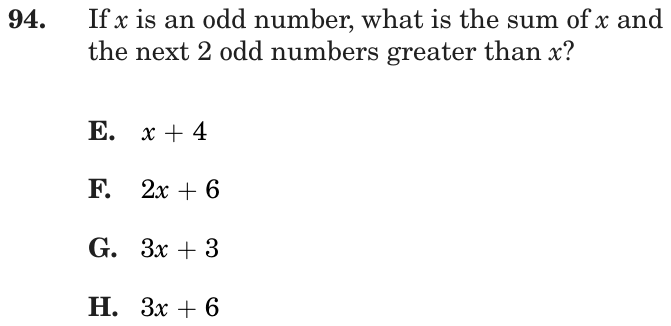
If x is an odd number, what is the sum of x and the next 2 odd numbers greater than x?
- A
- B
- C
- D
Show the answer
Correct answer: D
If x is an odd number, then the next two odd numbers are and .
Question analysis
If x is an odd number, what is the sum of x and the next two odd numbers greater than x? This algebra question asks students to represent consecutive odd numbers with expressions and add them. The wording packs three numbers into one sum, so students must read exactly which odd numbers to include.
- NYS standards
- Grade level
- Grade 7 content, by NYS standard
- Compared with grade 7
- At grade 7 Grade 7 students routinely add linear expressions. The extra idea is expressing the odd numbers that follow x in terms of x, a familiar setup from consecutive-number problems, so the demand matches typical grade 7 work.
- Estimated difficulty
- Straightforward: two steps or one careful reading.
- Thinking it demands
- Depth of knowledge 2, skills and concepts · mainly apply
- What makes it hard
- Variables instead of numbers moderate
- Turning words into math minor
- Solution
- 2 steps
- Reading level
- Question and choices: about grade 4, 24 words.
- Students, last 30 days
- Not enough answers yet to show (it takes 10).
Why it is hard, traps and wrong answers (shows the answer)
Why it is hard
The algebra is one addition of three terms, so the work lies in naming the terms correctly. The choices punish each misreading of the phrase: stepping by 1 as with consecutive integers, leaving x out of the sum, or giving the last number instead of the total. A single test value, such as x = 5, checks all four choices in seconds and exposes every one of these.
Variables instead of numbers moderate Understanding the question
Here x stands for any odd number, so its odd successors have to be written as x + 2 and x + 4; trying x = 5, with 7 and 9, gives a sum of 21 to test the choices against. (Koedinger & Nathan, 2004; Enright, Morley & Sheehan, 2002)
Turning words into math minor Understanding the question
“The sum of x and the next 2 odd numbers greater than x” names three numbers, x itself included, and “next odd” means a step of 2, not 1. (Hegarty, Mayer & Monk, 1995; Koedinger & Nathan, 2004)
Strategy: Write the next two odd numbers in terms of x and add all three, then check by trying an odd number such as 5 in the stem and in each choice.
Traps
- Misunderstands the concept: A wrong belief about a concept: that percents can be added, that area grows like length, that averages can be averaged, that a bigger denominator means a bigger fraction.
- Misreads the question: Misses or misreads a condition or a word in the question: "at least", "each", "remaining", "not".
- Answers a different question: A choice is right for another quantity: the other unknown, the rest instead of the part, the part instead of the whole.
The wrong answers, classified
A Answers a different question (King et al., 2004; Hegarty, Mayer & Monk, 1995)
Writes the next two odd numbers and gives the larger one, x + 4, naming the third number instead of the sum of all three.
B Misreads the question (Hegarty, Mayer & Monk, 1995)
Adds only the two odd numbers after x, (x + 2) + (x + 4) = 2x + 6, leaving x itself out of the sum.
C Misunderstands the concept (Smith, diSessa & Roschelle, 1993; De Bock et al., 1998; Ni & Zhou, 2005)
Uses consecutive integers, x, x + 1 and x + 2, forgetting that the next odd number after an odd x is 2 more, not 1 more.
Worked solution, step by step
Formulas used
- An odd number and the next two
- x is an odd number, like 5. Odd numbers are every other whole number: 1, 3, 5, 7. So the next odd number is always 2 more, not 1 more. The odd number after that is 2 more again, which is x + 4.
- Combining like terms
- a and b are numbers, and x is the letter. Like terms have the same letter part. Add their numbers in front and keep the letter. A plain x means 1x. Plain numbers are added only to plain numbers.
Sort out the question
x is an odd number. An odd number can’t be split into pairs, like 3, 5 or 7. You need the sum of three numbers: x itself and the next 2 odd numbers after it. The answer is an expression, a math phrase with a letter that stands for a number.
Name the next two odd numbers
Odd numbers skip every other number: 5, 7, 9, 11. Each odd number is 2 more than the one before. So x and the next two odd numbers are:
For example, if x is 5, the next two are 7 and 9.
Watch out: x + 1 is the next number, but it is even. Using x, x + 1 and x + 2 adds up to , choice C.
Add all three numbers
The sum includes x itself. Write all three, then group the x’s together and the plain numbers together.
Three x’s make 3x, because 1 + 1 + 1 = 3. And 2 + 4 = 6.
Watch out: don’t leave out x. Adding only the next two gives , choice B. And is just the third number, not the sum. That is choice A.
So the answer is D, .
Check your answer
Try a real odd number. Let x = 5. The next two odd numbers are 7 and 9, and . Now put 5 into choice D: . It matches. Choice B gives 16, and choice C gives 18, so they don’t work.
More questions like this
The original DOE question