Passage Serpent Mound
Serpent Mound
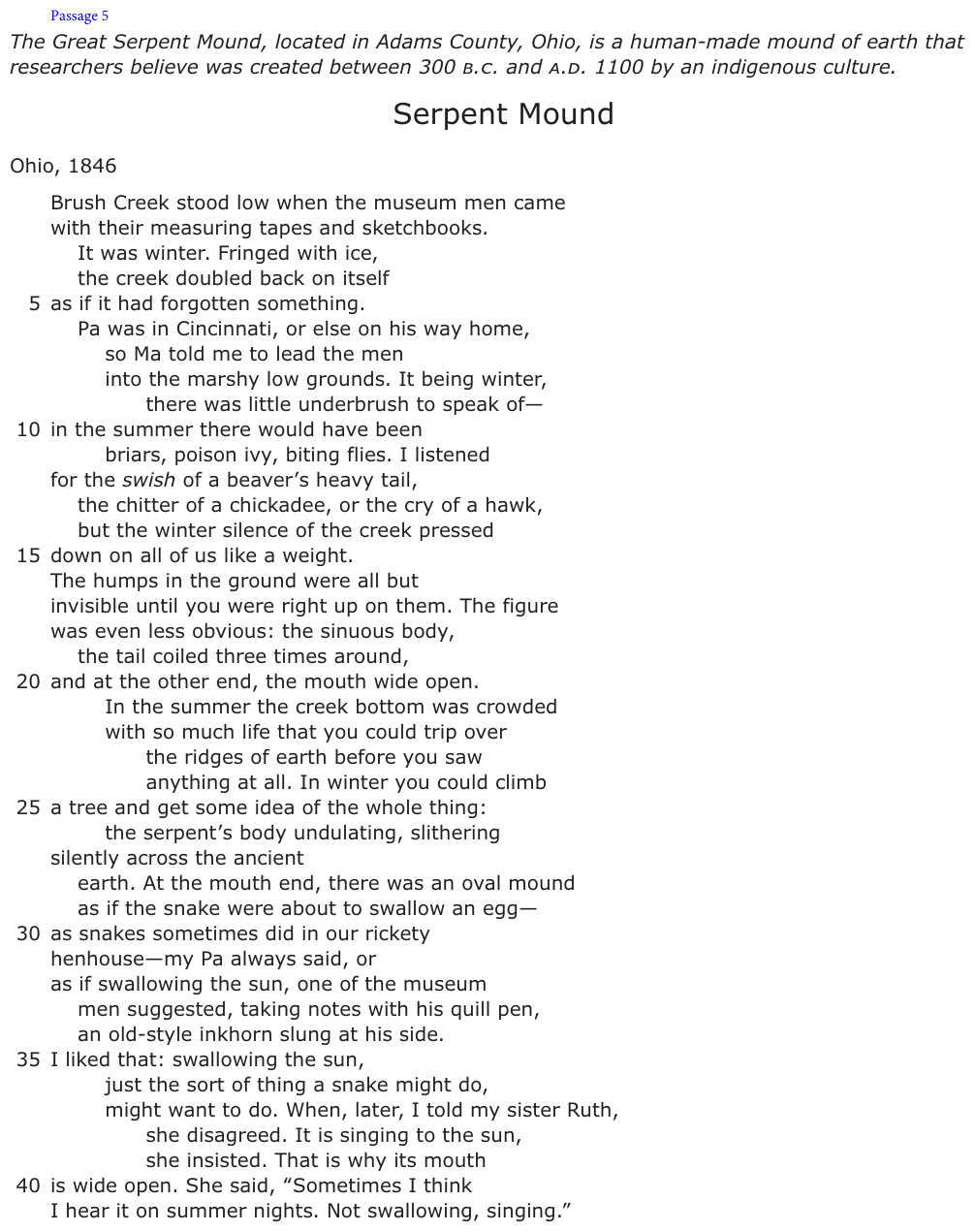
The Great Serpent Mound, located in Adams County, Ohio, is a human-made mound of earth that researchers believe was created between 300 B.C. and A.D. 1100 by an indigenous culture.
Ohio, 1846
Brush Creek stood low when the museum men came
with their measuring tapes and sketchbooks.
It was winter. Fringed with ice,
the creek doubled back on itself
as if it had forgotten something.
Pa was in Cincinnati, or else on his way home,
so Ma told me to lead the men
into the marshy low grounds. It being winter,
there was little underbrush to speak of—
in the summer there would have been
briars, poison ivy, biting flies. I listened
for the swish of a beaver’s heavy tail,
the chitter of a chickadee, or the cry of a hawk,
but the winter silence of the creek pressed
down on all of us like a weight.
The humps in the ground were all but
invisible until you were right up on them. The figure
was even less obvious: the sinuous body,
the tail coiled three times around,
and at the other end, the mouth wide open.
In the summer the creek bottom was crowded
with so much life that you could trip over
the ridges of earth before you saw
anything at all. In winter you could climb
a tree and get some idea of the whole thing:
the serpent’s body undulating, slithering
silently across the ancient
earth. At the mouth end, there was an oval mound
as if the snake were about to swallow an egg—
as snakes sometimes did in our rickety
henhouse—my Pa always said, or
as if swallowing the sun, one of the museum
men suggested, taking notes with his quill pen,
an old-style inkhorn slung at his side.
I liked that: swallowing the sun,
just the sort of thing a snake might do,
might want to do. When, later, I told my sister Ruth,
she disagreed. It is singing to the sun,
she insisted. That is why its mouth
is wide open. She said, “Sometimes I think
I hear it on summer nights. Not swallowing, singing.”
Question
The poet contrasts the speaker’s and Ruth’s points of view regarding the mound by using dialogue to
- Aimply that Ruth knows her interpretation of the mound is abstract.
- Bindicate that Ruth hopes the men from the museum will agree with her interpretation of the mound.
- Csuggest that Ruth wants the speaker to agree with her interpretation of the mound.
- Dshow that Ruth has already decided on her interpretation of the mound.
Show the answer
Correct answer: D
The question asks how the poet uses dialogue to contrast the points of view of the speaker and Ruth regarding the mound.
A. Incorrect. The interpretation Ruth offers of the mound as a snake singing is abstract, but Ruth does not seem to acknowledge that it is a metaphorical or figurative interpretation. The dialogue serves to highlight that Ruth is firm in her belief.
B. Incorrect. There is no indication that the museum men are considering Ruth’s interpretation of the mound. Ruth’s interpretation is meant to convey an abstract idea, while the museum men would be looking for a firm academic explanation of the mound. Ruth is persistent in her belief, and the museum men’s interpretation or findings are unlikely to change her perspective.
C. Incorrect. Ruth merely states her interpretation and says that she thinks she hears the Serpent Mound singing sometimes. She does not seek to make the speaker agree with her.
D. CORRECT. Beginning in line 37, after the speaker suggests the mound is swallowing the sun, Ruth disagrees. The poet uses the word “insisted” in line 39 to show that Ruth firmly believes in her own interpretation of the mound.
Question analysis
In the closing lines of the poem “Serpent Mound,” the speaker’s sister Ruth answers a museum man’s notion that the great earthen snake is swallowing the sun with an idea of her own. Students must say what the poet reveals about Ruth by using dialogue to set her point of view against the speaker’s, and the answer rests on a few lines of reported speech.
- Grade level
- Grade 7 reading and task
- Compared with grade 7
- At grade 7 The grade 7 standard asks how an author contrasts characters’ perspectives, and this item tests that directly with a short passage of dialogue. Its demand is precision: the choices describe Ruth’s state of mind in fine shades.
- Estimated difficulty
- Moderate: several steps, or a close reading with one strong distractor.
- Thinking it demands
- Depth of knowledge 2, skills and concepts · mainly analyze
- What makes it hard
- A very close wrong answer moderate
- Reading between the lines moderate
- Evidence
- Answered from one paragraph or stanza
- Reading level
- Passage: 354 words (a poem; reading level not measured); question and choices: about grade 8, 71 words.
- Students, last 30 days
- Not enough answers yet to show (it takes 10).
Why it is hard, traps and wrong answers (shows the answer)
Why it is hard
The dialogue is only a few lines, and every choice describes how Ruth regards her own reading of the mound. “Insisted” is the hinge, since it can sound like pressing the speaker to agree, though nothing she says asks for agreement. Her “Sometimes I think” can also be heard as admitting the idea is fanciful, when it introduces what she hears on summer nights and she treats the singing as fact.
A very close wrong answer moderate Choosing the answer
The choice about Ruth wanting the speaker’s agreement and the key both rest on “she insisted”; they differ in whether insisting tries to win the speaker over or shows a mind already made up. (Embretson & Wetzel, 1987; Gorin & Embretson, 2006; Ascalon et al., 2007)
Reading between the lines moderate Working it out
Ruth’s attitude is never named; students must read it from “she disagreed,” “she insisted” and the clipped “Not swallowing, singing,” and from what she never does, ask anyone to agree. (Graesser, Singer & Trabasso, 1994; Kintsch, 1998)
Strategy: Focus on the verbs and reasons attached to Ruth’s words, how she speaks and what she points to as support, and judge each choice only by what those lines show.
Traps
- Reads too much in: A reasonable-sounding conclusion that goes further than the text allows.
- Wrong tone or attitude: Misjudges the tone, attitude or point of view, such as reading admiration as criticism, or taking a character's or subject's feelings for the author's.
The wrong answers, classified
A Wrong tone or attitude (Graesser, Singer & Trabasso, 1994)
Hears “Sometimes I think” as Ruth admitting her singing serpent is only a fancy, but she “insisted” and points to the open mouth as proof, treating her reading as fact.
B Reads too much in (Graesser, Singer & Trabasso, 1994)
Brings the museum men into a conversation they are not part of; Ruth speaks to the speaker later and never mentions the men or seeks their approval.
C Reads too much in (Graesser, Singer & Trabasso, 1994)
Reads “insisted” as an effort to win the speaker over, but Ruth simply states her view and what she hears, and asks for no agreement.
Working it out, step by step
Figure out what the question asks
This asks what the poet shows by using dialogue, the words people say to each other. The speaker and Ruth see the mound in different ways. An interpretation is an idea about what something means. Decide what Ruth’s words show about how she feels about her own idea.
Read the dialogue in lines 35–41
The speaker likes a museum man’s idea that the snake is swallowing the sun. Later the speaker tells Ruth. The poem says “she disagreed. It is singing to the sun, / she insisted. That is why its mouth / is wide open.” Then she says, “Sometimes I think / I hear it on summer nights. Not swallowing, singing.”
Look closely at the word insisted
To insist is to say something firmly and refuse to back down. Ruth gives a reason: the open mouth. She doesn’t say “maybe,” and she doesn’t ask what the speaker thinks. Her last words, “Not swallowing, singing,” sound final. “Sometimes I think” leads into a sound she believes she hears on summer nights. She treats the singing as real. Her mind was made up before this talk began.
Check each choice
- A does not fit. Abstract means only an idea, not something real you can sense. Ruth says she thinks she hears it singing on summer nights. She treats her idea as real.
- B does not fit. Ruth talks only to the speaker, later. She never mentions the museum men.
- C does not fit. Ruth states her view, but she never asks the speaker to agree.
- D fits. “Insisted” and her firm last words show that her mind is made up.
Watch out: “Insisted” can sound like pushing someone to agree, which leads to C. But nothing Ruth says asks for agreement.
Choose the answer
Ruth’s firm words show she is sure of her own idea about the mound. So the answer is D.
Why this answer and not the closest wrong one
C is the closest wrong choice. Both C and D rest on the word “insisted.” But you can insist because you are sure, not to win someone over. Ruth never asks whether the speaker agrees. She just states her view and backs it with what she hears. That shows a mind already made up, which is D.
More questions like this
The original DOE question

The passage “Serpent Mound” as printed (page 40)