Combining and revising sentences
Question 1 of 6
2026 Practice Test B English, question 47Passage The End of an Era
The End of an Era
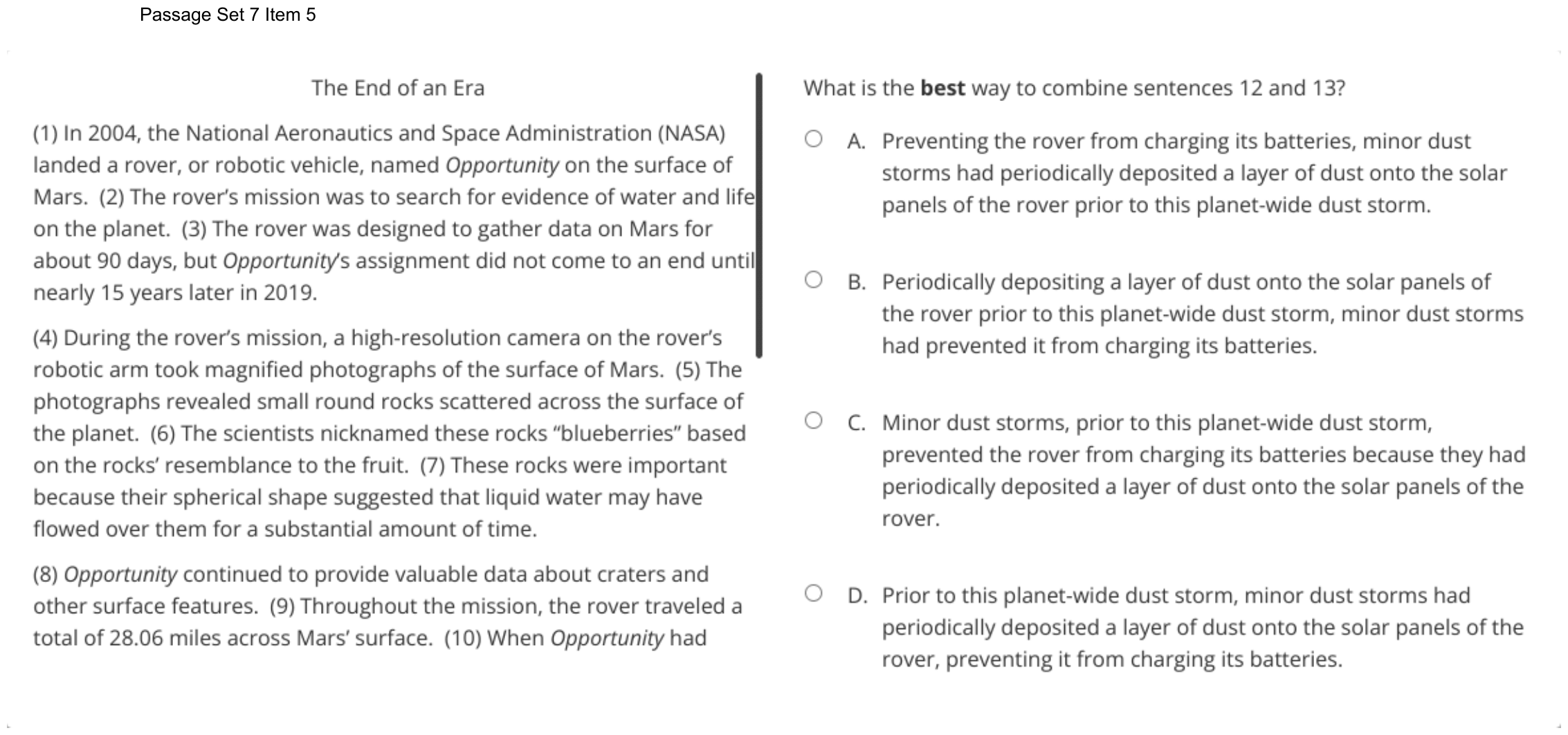
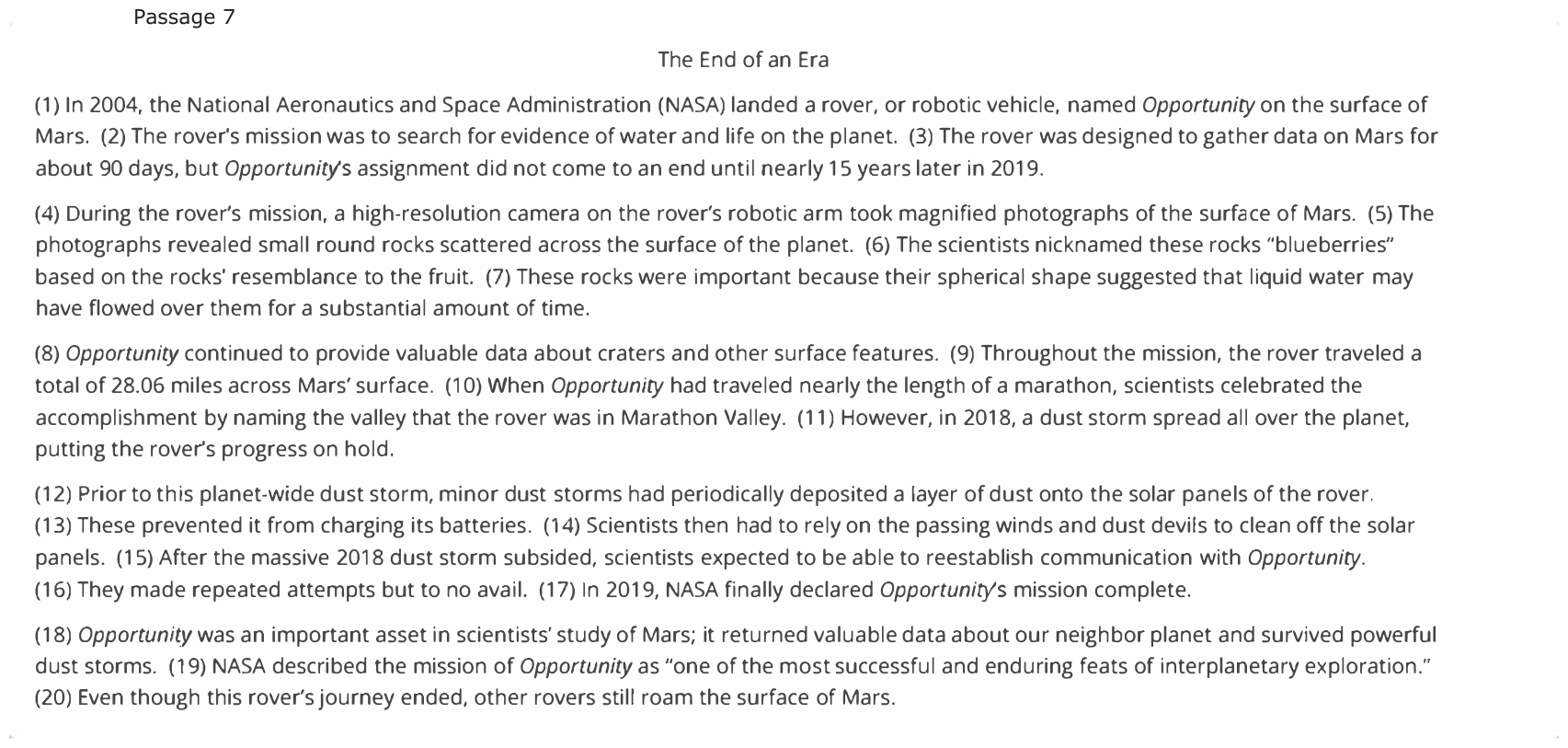
(1) In 2004, the National Aeronautics and Space Administration (NASA) landed a rover, or robotic vehicle, named Opportunity on the surface of Mars. (2) The rover’s mission was to search for evidence of water and life on the planet. (3) The rover was designed to gather data on Mars for about 90 days, but Opportunity’s assignment did not come to an end until nearly 15 years later in 2019.
(4) During the rover’s mission, a high-resolution camera on the rover’s robotic arm took magnified photographs of the surface of Mars. (5) The photographs revealed small round rocks scattered across the surface of the planet. (6) The scientists nicknamed these rocks “blueberries” based on the rocks’ resemblance to the fruit. (7) These rocks were important because their spherical shape suggested that liquid water may have flowed over them for a substantial amount of time.
(8) Opportunity continued to provide valuable data about craters and other surface features. (9) Throughout the mission, the rover traveled a total of 28.06 miles across Mars’ surface. (10) When Opportunity had traveled nearly the length of a marathon, scientists celebrated the accomplishment by naming the valley that the rover was in Marathon Valley. (11) However, in 2018, a dust storm spread all over the planet, putting the rover’s progress on hold.
(12) Prior to this planet-wide dust storm, minor dust storms had periodically deposited a layer of dust onto the solar panels of the rover. (13) These prevented it from charging its batteries. (14) Scientists then had to rely on the passing winds and dust devils to clean off the solar panels. (15) After the massive 2018 dust storm subsided, scientists expected to be able to reestablish communication with Opportunity. (16) They made repeated attempts but to no avail. (17) In 2019, NASA finally declared Opportunity’s mission complete.
(18) Opportunity was an important asset in scientists’ study of Mars; it returned valuable data about our neighbor planet and survived powerful dust storms. (19) NASA described the mission of Opportunity as “one of the most successful and enduring feats of interplanetary exploration.” (20) Even though this rover’s journey ended, other rovers still roam the surface of Mars.
Question
What is the best way to combine sentences 12 and 13?
- APreventing the rover from charging its batteries, minor dust storms had periodically deposited a layer of dust onto the solar panels of the rover prior to this planet-wide dust storm.
- BPeriodically depositing a layer of dust onto the solar panels of the rover prior to this planet-wide dust storm, minor dust storms had prevented it from charging its batteries.
- CMinor dust storms, prior to this planet-wide dust storm, prevented the rover from charging its batteries because they had periodically deposited a layer of dust onto the solar panels of the rover.
- DPrior to this planet-wide dust storm, minor dust storms had periodically deposited a layer of dust onto the solar panels of the rover, preventing it from charging its batteries.
Show the answer
Correct answer: D
The question asks for the best way to combine sentences 12 and 13.
A. Incorrect. The phrase “this planet-wide dust storm” in the original sentence 12 makes a direct reference to sentence 11 and therefore acts as a transition that should be kept at the beginning. In this sentence, the transition phrase is placed at the end of the sentence, making the phrase confusing. In addition, the sentence is unnecessarily repetitive and wordy.
B. Incorrect. This combination unnecessarily turns sentence 12 into an overly long participial phrase, making the connection between “it” and its antecedent, “the rover,” unclear and distracting from the subject of the sentence, “minor dust storms.”
C. Incorrect. Not only does this combination move the reference to “this planet-wide dust storm” farther from sentence 11, but it is also unnecessarily wordy, adding “because” and repeating “the rover.”
D. CORRECT. This sentence efficiently and accurately adds sentence 13 to sentence 12 as a participial phrase by changing “These prevented” to “preventing,” while also retaining the meanings of the original sentences 12 and 13.
Question analysis
This sentence-combining question asks for the best way to join two sentences from the rover passage: one saying minor dust storms had periodically coated the rover's solar panels, the other saying this kept it from charging its batteries. The four versions keep the same facts in different orders, so students must judge which is clearest and most concise in context.
- Grade level
- Grade 8 reading and task
- Compared with grade 7
- Above grade 7 Combining two sentences is grade 7 work, usually with one version clearly better. These four are long, keep the same facts and differ in order and wording, so students must weigh clarity and concision across nearly identical sentences, more than typical.
- Estimated difficulty
- Hard: combines ideas, needs a plan, and has more than one tempting wrong answer.
- Thinking it demands
- Depth of knowledge 2, skills and concepts · mainly evaluate
- What makes it hard
- How sentences fit together moderate
- Every choice must be checked moderate
- Complex sentences minor
- Evidence
- Answered from one sentence or line
- Reading level
- Passage: about grade 11, 337 words; question and choices: about grade 13, 129 words.
- Corrected from the DOE handbook
- Two grammar terms in the explanation were corrected.
- Students, last 30 days
- Not enough answers yet to show (it takes 10).
Why it is hard, traps and wrong answers (shows the answer)
Why it is hard
None of the versions is plainly ungrammatical, so the ear gives little help, and the version with “because” looks best to students who value a clearly stated cause. Its cost is wordiness and a weaker link: the result comes first and the reference back to sentence 11 is buried mid-sentence. The question rewards keeping the original order, cause then effect, and folding sentence 13 in as a short closing phrase.
How sentences fit together moderate Working it out
“Prior to this planet-wide dust storm” points back to sentence 11, so the best version keeps it first; three versions move it later, which loosens the link between the two sentences. (Halliday & Hasan, 1976)
Every choice must be checked moderate Choosing the answer
All four versions keep every fact of sentences 12 and 13 and run 29 to 32 words, so none can be ruled out by content; order, pronouns and repetition decide. (Embretson & Wetzel, 1987)
Complex sentences minor Understanding the question
Each version is one long sentence built around a participial phrase or a “because” clause, and at that length a stranded “it” or a doubled “the rover” is easy to miss. (Abedi & Lord, 2001; Freedle & Kostin, 1993; Messick, 1989)
Strategy: Read sentence 11 first, then compare the versions on how smoothly each connects to it, how many words it uses, and whether every pronoun has a clear antecedent.
Traps
- Wordy, vague or informal: A revision is grammatical but wordy, imprecise or too casual for the passage.
- Unclear pronoun: A pronoun whose reference is vague or ambiguous, or one in the wrong case.
The wrong answers, classified
A Wordy, vague or informal (Connors & Lunsford, 1988)
Opens with the effect as a participial phrase, which pushes “prior to this planet-wide dust storm,” the link to sentence 11, to the end and names “the rover” twice.
B Unclear pronoun (Connors & Lunsford, 1988)
Packs sentence 12 into a 19-word opening phrase, so “it” follows “this planet-wide dust storm” and no longer points clearly to the rover buried inside the phrase.
C Wordy, vague or informal (Connors & Lunsford, 1988)
Likes the clear cause word “because,” but the result now comes first, “the rover” appears twice, and “prior to this planet-wide dust storm” splits the subject from its verb.
What was corrected from the DOE handbook, and why
- Explanation: The DOE’s explanation of Option B says the combination turns sentence 12 into “an overly long dependent clause,” and its explanation of Option D says Option D adds sentence 13 to sentence 12 “as a dependent clause” by changing “These prevented” to “preventing.” Neither is a clause: “Periodically depositing a layer of dust onto the solar panels of the rover prior to this planet-wide dust storm” (Option B) and “preventing it from charging its batteries” (Option D) have no subject or finite verb of their own. Both are participial phrases, and the site now calls them that. The reasoning and the answer, Option D, are unchanged.
Working it out, step by step
Figure out what the question asks
This question asks for the best way to join sentences 12 and 13 into one sentence. The best version keeps the meaning, uses few words and is clear. It should also connect smoothly to sentence 11, the sentence before.
Read the sentences in order
Sentence 11 tells about the giant 2018 dust storm. Sentence 12 begins “Prior to this planet-wide dust storm.” Prior to means before. That phrase points back to sentence 11, so it works best at the start. Sentence 12 says small storms put dust on the solar panels. Sentence 13 gives the result: “These prevented it from charging its batteries.”
Learn the tool: a participial phrase
A participial phrase is a group of words built on a verb form, often an -ing word. It describes something, but it has no subject and can’t stand alone. Example: The dog ran to the door. It wagged its tail. becomes The dog ran to the door, wagging its tail. Choice D does this. It turns “These prevented” into “preventing.”
Check each choice
- A is wrong. It starts with the result. It moves “prior to this planet-wide dust storm” to the end, far from sentence 11. It also says “the rover” twice.
- B is wrong. Its long opening phrase hides the rover. Then “it” comes after “minor dust storms,” so it is hard to tell what “it” means.
- C is wrong. It adds “because,” puts the result first and says “the rover” twice. It is wordier than D.
- D is right. It keeps the link to sentence 11 first, gives the cause, then adds the result as a short participial phrase.
Watch out: C looks clear because “because” names the cause. But it is longer, and it puts an extra phrase between “Minor dust storms” and its verb.
Choose the answer
So the answer is D: “Prior to this planet-wide dust storm, minor dust storms had periodically deposited a layer of dust onto the solar panels of the rover, preventing it from charging its batteries.”
Why this answer and not the closest wrong one
C is the closest wrong answer, because “because” makes the cause very clear. But C puts the result first and repeats “the rover.” D keeps the original order, cause then result. It also keeps the link to sentence 11 up front, in fewer words.
More questions like this
The original DOE question
The passage “The End of an Era” as printed (page 60)
Question 2 of 6
2026 Practice Test B English, question 49Question
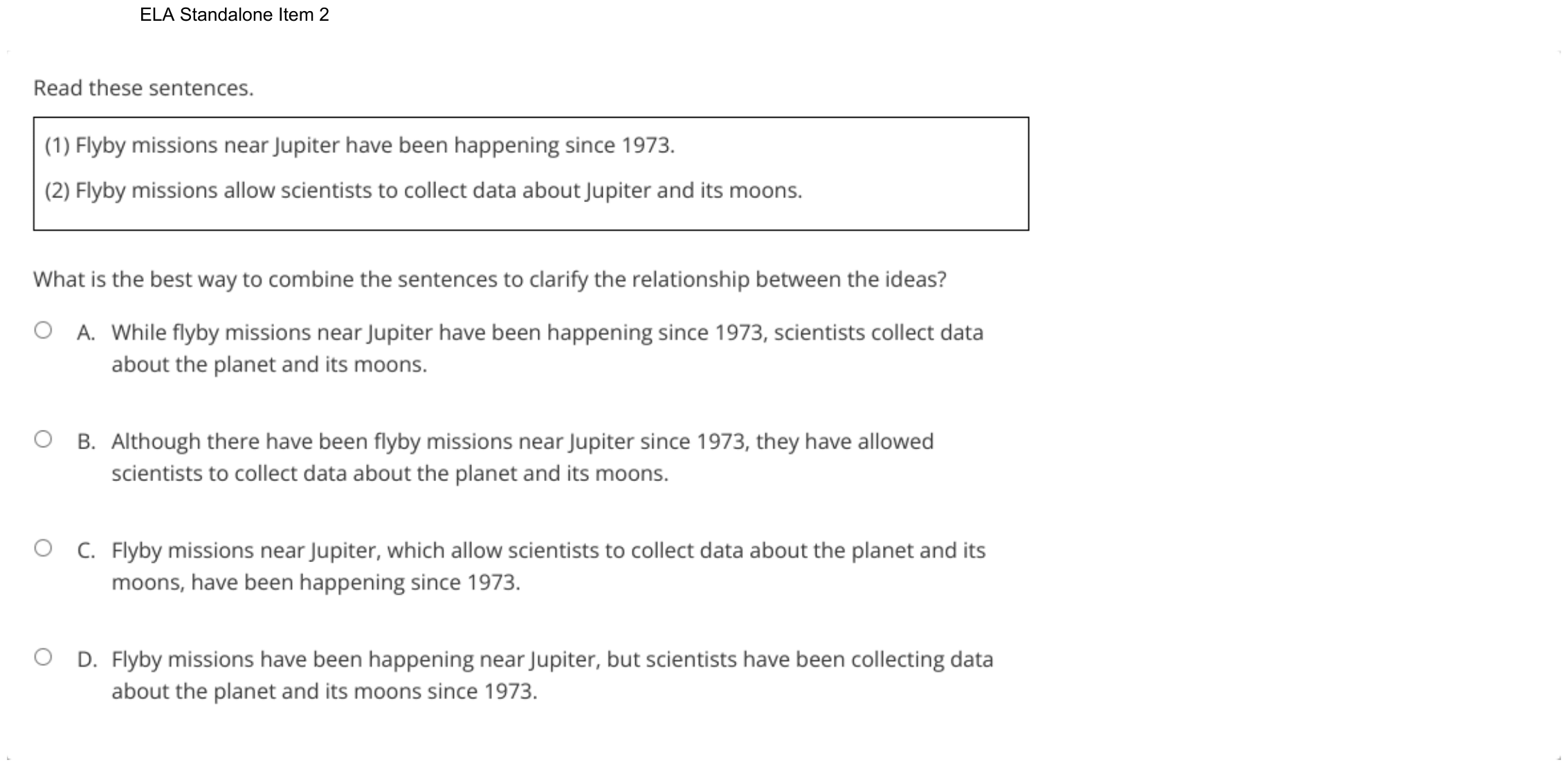
Read these sentences.
(1) Flyby missions near Jupiter have been happening since 1973.
(2) Flyby missions allow scientists to collect data about Jupiter and its moons.
What is the best way to combine the sentences to clarify the relationship between the ideas?
- AWhile flyby missions near Jupiter have been happening since 1973, scientists collect data about the planet and its moons.
- BAlthough there have been flyby missions near Jupiter since 1973, they have allowed scientists to collect data about the planet and its moons.
- CFlyby missions near Jupiter, which allow scientists to collect data about the planet and its moons, have been happening since 1973.
- DFlyby missions have been happening near Jupiter, but scientists have been collecting data about the planet and its moons since 1973.
Show the answer
Correct answer: C
The question asks for the best way to combine the sentences to clarify the relationship between the ideas.
A. Incorrect. Even though the two ideas from the original sentences are incorporated into the combined sentence, the use of the conjunction “while” in the first part of the sentence suggests that there is a simultaneous but unrelated relationship between the two ideas, which is incorrect.
B. Incorrect. The combined sentence incorporates the ideas from both sentences, but the conjunction “although” suggests that scientists were allowed to collect data even though there were flyby missions, which is an inaccurate way to express the relationship between the ideas.
C. CORRECT. This sentence is the best way to combine the sentences because it accurately reflects the relationship between the ideas by using the nonrestrictive clause “which allow scientists to collect data about the planet and its moons” to describe the purpose of the flyby missions. (Nonrestrictive clauses are adjective clauses that give additional information about a word or phrase. They sometimes begin with the relative pronoun “which” and are set off by commas.) The idea that the missions “have been happening since 1973” follows the nonrestrictive clause.
D. Incorrect. The combined sentence uses the conjunction “but” to connect the ideas in the two original sentences. This suggests a contrasting relationship between ideas, which is an inaccurate way to connect the ideas expressed in the original sentences.
Question analysis
This sentence-combining question gives two short sentences about flyby missions near Jupiter, one saying they have happened since 1973 and the other that they let scientists collect data about the planet and its moons. Students choose the combination that makes the relationship between the ideas clear, weighing what each connecting word or clause says about how the facts relate.
- NYS standards
- 7L1 grammar and usage conventions
- Grade level
- Grade 7 reading and task
- Compared with grade 7
- At grade 7 Combining two short sentences so their relationship is clear is regular grade 7 work. Both sentences here are brief and plainly related, and the versions differ mainly in their connecting words, so this is a typical, fairly quick task.
- Estimated difficulty
- Straightforward: two steps or one careful reading.
- Thinking it demands
- Depth of knowledge 2, skills and concepts · mainly evaluate
- What makes it hard
- How sentences fit together moderate
- Every choice must be checked minor
- Evidence
- Answered from one sentence or line
- Reading level
- Question and choices: about grade 9, 119 words.
- Corrected from the DOE handbook
- A wrong word in the explanation of D was corrected.
- Students, last 30 days
- Not enough answers yet to show (it takes 10).
Why it is hard, traps and wrong answers (shows the answer)
Why it is hard
The two sentences are short, and the work lies in naming how they relate before reading the versions. The most tempting one, beginning “While,” keeps both facts but drops the word “allow,” so the missions no longer explain the data. Students who test each connector against the relationship also catch the concession in “Although” and the contrast in “but,” which also moves the date onto the data collection.
How sentences fit together moderate Working it out
Students must first name the relationship, that the missions make the data possible, a link only the version with “which allow” keeps, since the others recast it as time, concession or contrast. (Halliday & Hasan, 1976)
Every choice must be checked minor Choosing the answer
All four versions keep both facts and read smoothly, so each joining word, “While,” “Although,” “which” and “but,” has to be tested for what it claims. (Embretson & Wetzel, 1987)
Strategy: Before reading the choices, decide in a few words how the two facts are connected, then reject any version whose joining word signals a different relationship or shifts what a detail describes.
Traps
- Wrong transition: A connecting word or phrase that signals the wrong relationship, such as contrast where the idea continues.
- Changes the meaning: A revision is correct English but no longer says what the writer meant.
The wrong answers, classified
A Wrong transition (Halliday & Hasan, 1976)
Keeps both facts and reads smoothly, but “While” presents the missions and the data collection as merely happening at the same time and drops “allow,” the link between them.
B Wrong transition (Halliday & Hasan, 1976)
Treats “Although” as a neutral joining word, but it makes the data collection happen in spite of the missions, when the missions are what make it possible.
D Changes the meaning (Connors & Lunsford, 1988)
Joins the facts with “but,” implying a contrast, and moves “since 1973” from the missions to the data collection, so the date now describes something else.
What was corrected from the DOE handbook, and why
- Explanation: Rejecting D, the handbook's explanation says “but” “suggests an adverse relationship between ideas”. “Adverse” means harmful; the point is that “but” signals a contrast, which the two sentences don't have. It now says “a contrasting relationship”. The answer, C, is unchanged.
Working it out, step by step
Figure out what the question asks
This question asks for the best way to join two sentences. The joined sentence must show how the ideas are related. So first decide how they connect. Then pick the version whose joining word shows that link.
Find the relationship
Sentence 1 says flyby missions near Jupiter “have been happening since 1973.” A flyby mission sends a spacecraft past a planet without landing. Sentence 2 says the missions “allow scientists to collect data about Jupiter and its moons.” Data means facts and measurements. So sentence 2 tells what the missions do for scientists. The ideas don’t contrast, or clash. They fit together.
Learn the tool: a which clause
A clause is a group of words with a subject and a verb. A which clause adds extra facts about a noun. Commas set it off. Example: My bike, which has red wheels, is new. The extra facts describe the bike. In C, “which allow scientists to collect data about the planet and its moons” describes the missions.
Check each choice
- A is wrong. “While” makes the two facts just happen at the same time. It drops “allow,” so the missions no longer explain the data.
- B is wrong. “Although” means in spite of the fact that. It suggests scientists got data even though there were missions. That is backward.
- C is right. The which clause tells what the missions do, and the date stays with the missions.
- D is wrong. “But” signals a contrast that isn’t there. It also moves “since 1973” onto the data collecting.
Watch out: A reads smoothly and keeps both facts. But “While” loses the link: the missions are what make the data possible.
Choose the answer
So the answer is C: “Flyby missions near Jupiter, which allow scientists to collect data about the planet and its moons, have been happening since 1973.”
Why this answer and not the closest wrong one
A is the closest wrong answer, because it keeps both facts and sounds fine. But “While” only says two things happen at once. It drops the word “allow,” which shows the missions make the data collection possible. C keeps that link with its which clause.
More questions like this
The original DOE question
Question 3 of 6
2026 Practice Test C English, question 49Question
Read these sentences.
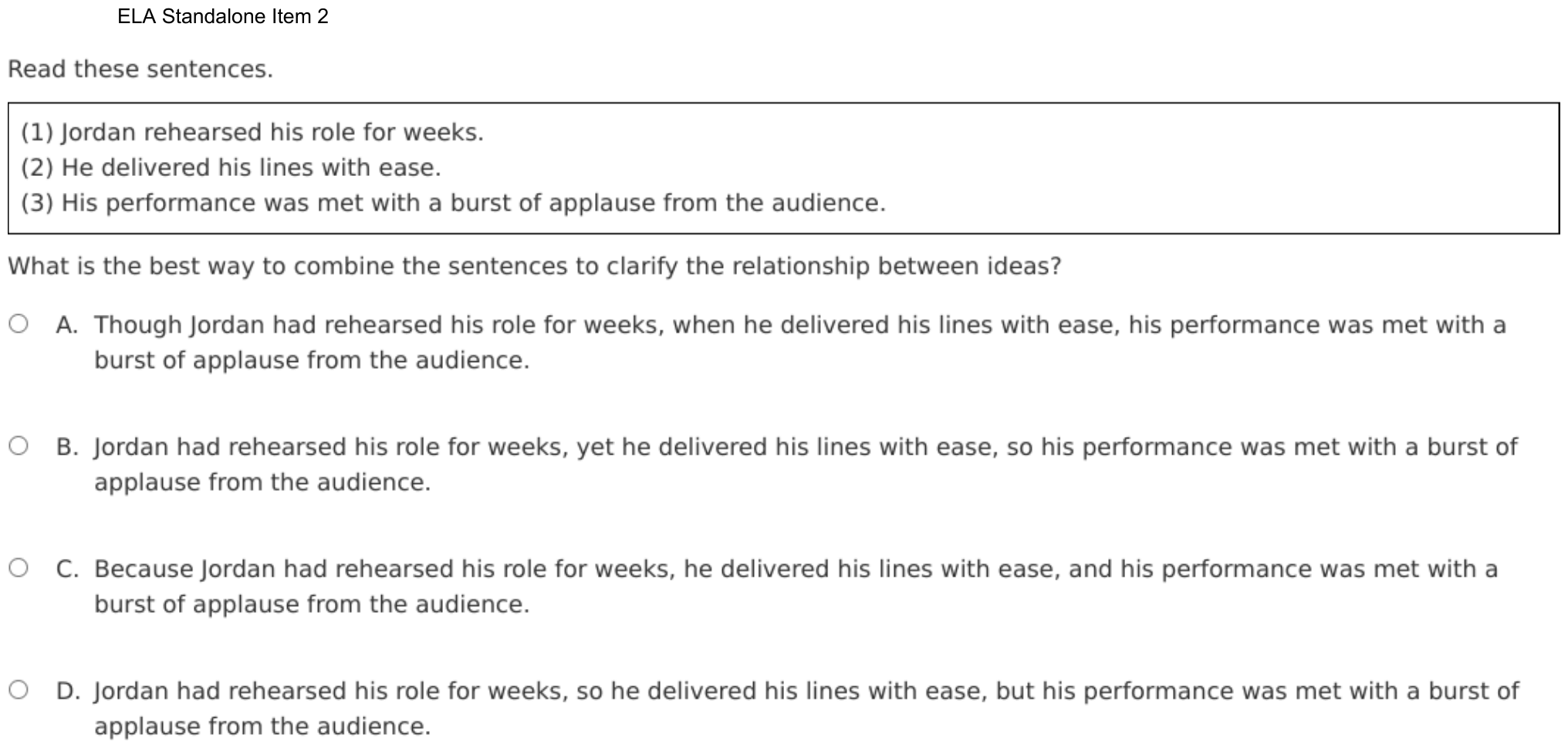
(1) Jordan rehearsed his role for weeks.
(2) He delivered his lines with ease.
(3) His performance was met with a burst of applause from the audience.
What is the best way to combine the sentences to clarify the relationship between ideas?
- AThough Jordan had rehearsed his role for weeks, when he delivered his lines with ease, his performance was met with a burst of applause from the audience.
- BJordan had rehearsed his role for weeks, yet he delivered his lines with ease, so his performance was met with a burst of applause from the audience.
- CBecause Jordan had rehearsed his role for weeks, he delivered his lines with ease, and his performance was met with a burst of applause from the audience.
- DJordan had rehearsed his role for weeks, so he delivered his lines with ease, but his performance was met with a burst of applause from the audience.
Show the answer
Correct answer: C
The question asks for the best way to combine the sentences to clarify the relationship between ideas.
A. Incorrect. The conjunction “though” does not make sense with the rest of the sentence since Jordan likely received applause for his performance because he rehearsed, not in spite of rehearsing.
B. Incorrect. The conjunction “yet” is incongruous with the rest of the sentence because Jordan was successful at delivering his lines likely because he rehearsed, not in spite of rehearsing.
C. CORRECT. This combination of sentences clarifies the relationship among the ideas in a way that is logical. Jordan was able to deliver his lines with ease and receive applause from the audience because he had rehearsed. “Because” is the best choice for conveying the cause-and-effect relationship between rehearsing and a successful performance.
D. Incorrect. This combination of sentences correctly expresses the relationship between rehearsing and delivering lines with ease by linking the ideas with the word “so”; however, the word “but” incorrectly links the delivery of lines with applause, suggesting that the burst of applause from the audience was unexpected.
Question analysis
This sentence-combining question gives three short sentences about Jordan, who rehearsed his role for weeks, delivered his lines with ease and drew a burst of applause, and asks for the best way to join them. Every version keeps the same facts, so students must judge which connecting words show how rehearsing, performing and the audience’s response relate.
- Grade level
- Grade 7 reading and task
- Compared with grade 7
- At grade 7 Combining sentences with connecting words that show how ideas relate is a grade 7 language skill. The three sentences are short and describe an everyday event, and the versions differ only in their connecting words, so the demand is typical.
- Estimated difficulty
- Straightforward: two steps or one careful reading.
- Thinking it demands
- Depth of knowledge 2, skills and concepts · mainly evaluate
- What makes it hard
- Every choice must be checked moderate
- How sentences fit together minor
- Evidence
- Answered from one sentence or line
- Reading level
- Question and choices: about grade 7, 150 words.
- Students, last 30 days
- Not enough answers yet to show (it takes 10).
Why it is hard, traps and wrong answers (shows the answer)
Why it is hard
The three facts form a simple chain of causes, and most students see that rehearsal explains the easy delivery. Points are lost by checking only the first connector: one version starts with a correct “so” and then joins the applause with “but,” as if it were a surprise. Versions opening with “Though” or using “yet” fail on the first link, so they are easier to rule out.
Every choice must be checked moderate Choosing the answer
Every version runs 27 words and keeps the same three facts, differing only in its two connecting words, so a wrong one can hide at the end, as “but” does after a correct “so.” (Embretson & Wetzel, 1987)
How sentences fit together minor Working it out
Students must first see the chain the sentences imply, weeks of rehearsal causing an easy delivery and the easy delivery earning applause, before any connector can be judged. (Halliday & Hasan, 1976)
Strategy: Before reading the choices, decide how each sentence leads to the next, then check every connecting word in each version, since one wrong word anywhere makes the whole combined sentence wrong.
Traps
- Wrong transition: A connecting word or phrase that signals the wrong relationship, such as contrast where the idea continues.
The wrong answers, classified
A Wrong transition (Halliday & Hasan, 1976)
Opens with “Though,” which treats weeks of rehearsal as something that should have worked against Jordan, when practice is the reason his lines came easily.
B Wrong transition (Halliday & Hasan, 1976)
Gets the second link right with “so” but joins rehearsing and easy delivery with “yet,” as if delivering lines smoothly were surprising after weeks of practice.
D Wrong transition (Halliday & Hasan, 1976)
Joins rehearsal and easy delivery correctly with “so,” then adds the applause with “but,” as if a burst of applause after a smooth performance were unexpected.
Working it out, step by step
Figure out what the question asks
You need the best way to join three short sentences into one. The joined sentence must show how the ideas connect. All four choices keep the same facts. They differ only in their connecting words. So check every connecting word in each choice.
See how the three ideas connect
Sentence 1: “Jordan rehearsed his role for weeks.” To rehearse means to practice. Sentence 2: “He delivered his lines with ease.” With ease means easily. Sentence 3: the audience burst into applause. These ideas form a chain. Practice made his lines easy. A strong performance then earned the applause. Nothing here is surprising.
Learn what each connecting word signals
- Because and so show cause and effect: I studied, so I passed.
- Though, yet and but show a contrast, something surprising: I studied, but I still failed.
- And simply adds the next idea: I studied, and I passed.
Check each choice
- A is wrong. “Though” makes the practice sound like it should have hurt him.
- B is wrong. “Yet” makes his easy delivery sound surprising after weeks of practice.
- C is right. “Because” shows that practice caused his easy delivery. “And” adds the applause that followed.
- D is wrong. “So” is right, but “but” makes the applause sound unexpected.
Watch out: D starts well with “so.” The mistake hides in its second connecting word.
Choose the answer
Only one version shows that practice led to success, with no false surprise. So the answer is C, “Because Jordan had rehearsed his role for weeks, he delivered his lines with ease, and his performance was met with a burst of applause from the audience.”
Why this answer and not the closest wrong one
D is the closest wrong answer, since its first half uses “so” correctly. But “but” tells the reader the applause was a surprise. A smooth performance after weeks of practice should earn applause. C uses “because” and “and,” which show the real chain of events.
More questions like this
The original DOE question
Question 4 of 6
2026 Practice Test D English, question 35Passage Martial Arts for the Mind and Body
Martial Arts for the Mind and Body
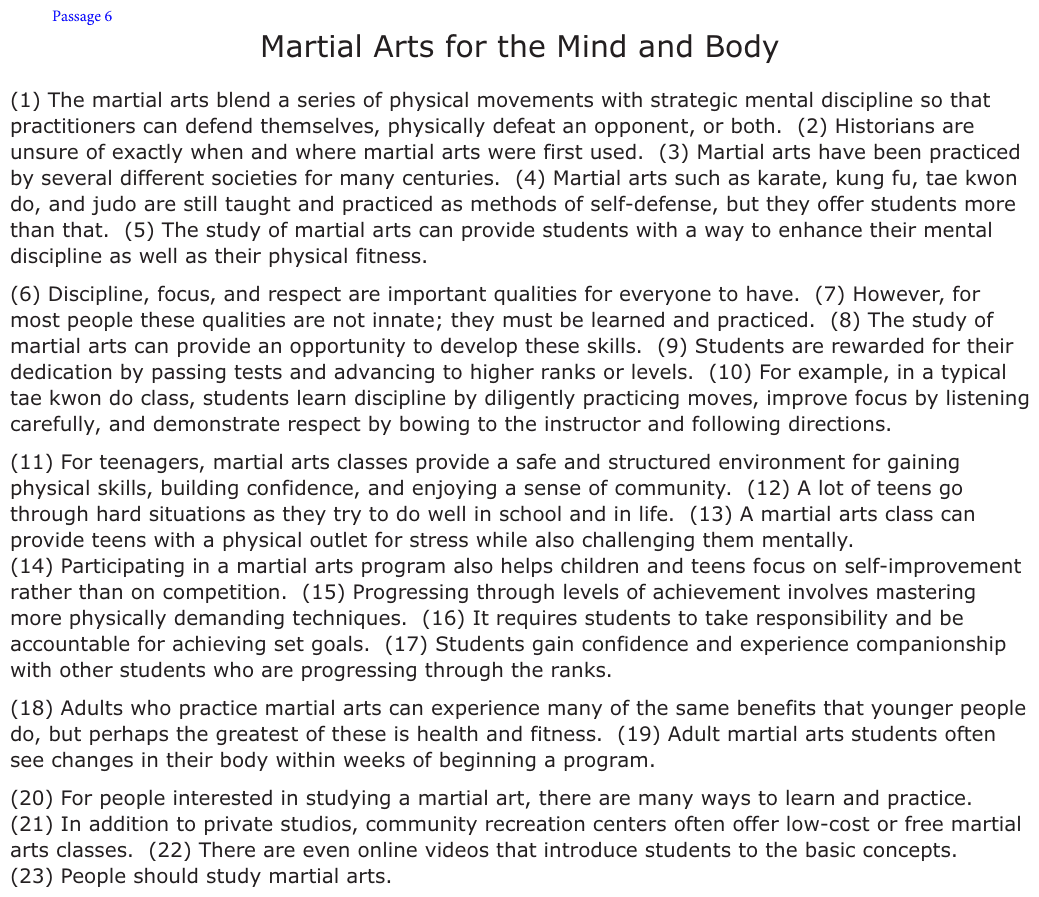
(1) The martial arts blend a series of physical movements with strategic mental discipline so that practitioners can defend themselves, physically defeat an opponent, or both. (2) Historians are unsure of exactly when and where martial arts were first used. (3) Martial arts have been practiced by several different societies for many centuries. (4) Martial arts such as karate, kung fu, tae kwon do, and judo are still taught and practiced as methods of self-defense, but they offer students more than that. (5) The study of martial arts can provide students with a way to enhance their mental discipline as well as their physical fitness.
(6) Discipline, focus, and respect are important qualities for everyone to have. (7) However, for most people these qualities are not innate; they must be learned and practiced. (8) The study of martial arts can provide an opportunity to develop these skills. (9) Students are rewarded for their dedication by passing tests and advancing to higher ranks or levels. (10) For example, in a typical tae kwon do class, students learn discipline by diligently practicing moves, improve focus by listening carefully, and demonstrate respect by bowing to the instructor and following directions.
(11) For teenagers, martial arts classes provide a safe and structured environment for gaining physical skills, building confidence, and enjoying a sense of community. (12) A lot of teens go through hard situations as they try to do well in school and in life. (13) A martial arts class can provide teens with a physical outlet for stress while also challenging them mentally. (14) Participating in a martial arts program also helps children and teens focus on self-improvement rather than on competition. (15) Progressing through levels of achievement involves mastering more physically demanding techniques. (16) It requires students to take responsibility and be accountable for achieving set goals. (17) Students gain confidence and experience companionship with other students who are progressing through the ranks.
(18) Adults who practice martial arts can experience many of the same benefits that younger people do, but perhaps the greatest of these is health and fitness. (19) Adult martial arts students often see changes in their body within weeks of beginning a program.
(20) For people interested in studying a martial art, there are many ways to learn and practice. (21) In addition to private studios, community recreation centers often offer low-cost or free martial arts classes. (22) There are even online videos that introduce students to the basic concepts. (23) People should study martial arts.
Question
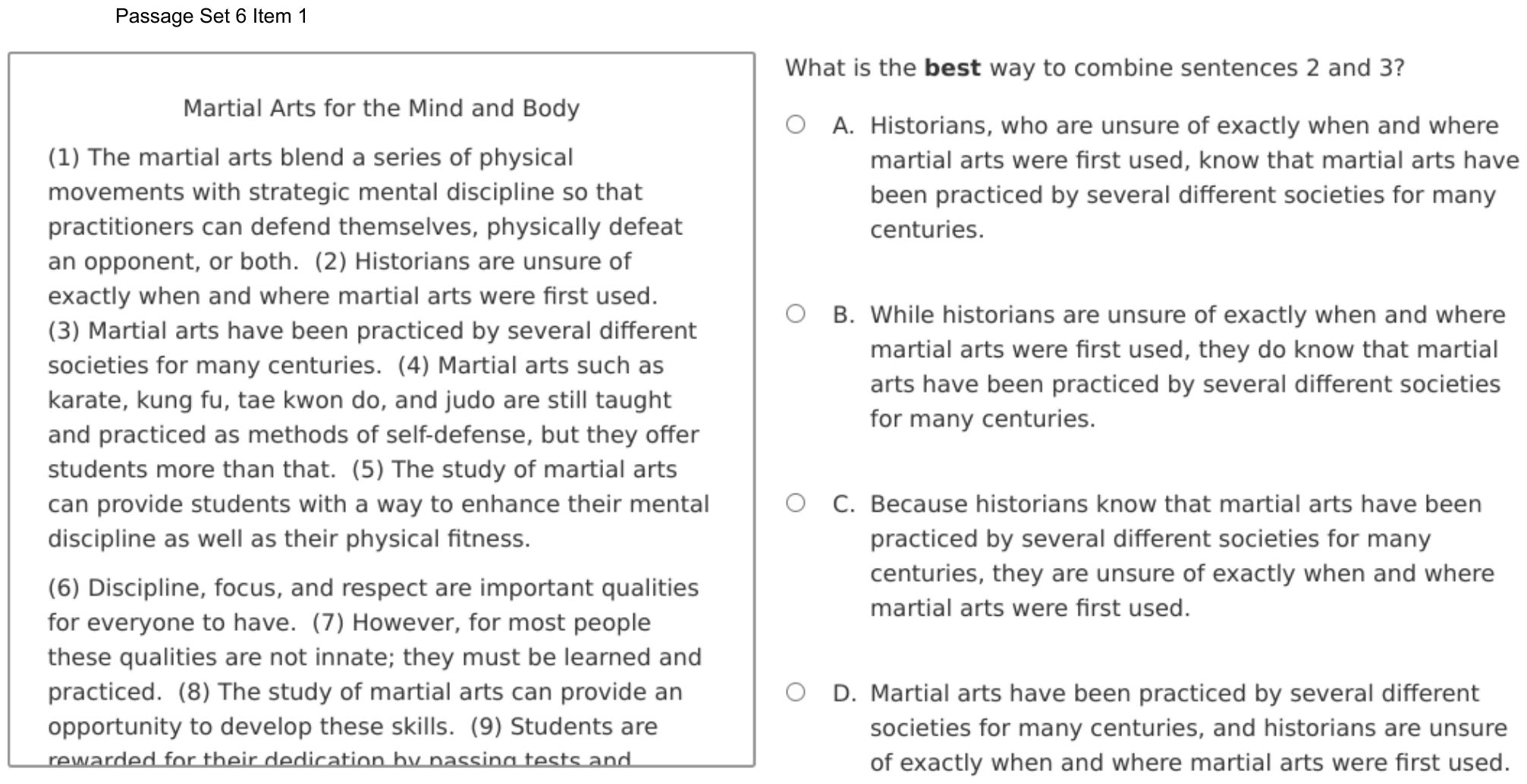
What is the best way to combine sentences 2 and 3?
- AHistorians, who are unsure of exactly when and where martial arts were first used, know that martial arts have been practiced by several different societies for many centuries.
- BWhile historians are unsure of exactly when and where martial arts were first used, they do know that martial arts have been practiced by several different societies for many centuries.
- CBecause historians know that martial arts have been practiced by several different societies for many centuries, they are unsure of exactly when and where martial arts were first used.
- DMartial arts have been practiced by several different societies for many centuries, and historians are unsure of exactly when and where martial arts were first used.
Show the answer
Correct answer: B
The question asks for the best way to combine sentences 2 and 3.
A. Incorrect. This way of combining sentences 2 and 3 places unnecessary emphasis on characterizing historians, and it does not clearly show the contrasting relationship between the idea from sentence 2 that historians do not know the exact origins of martial arts and the idea in sentence 3 that historians know that martial arts have a long history.
B. CORRECT. This option is correct because the word “while” at the beginning of the sentence best indicates the contrast between the ideas in sentences 2 and 3. Sentence 2 states that historians do not know the exact origins of martial arts (“unsure of exactly when and where”). Sentence 3 describes what historians do know about these origins (“practiced by several different societies for many centuries”). This combination indicates that historians have a general understanding about the origins of martial arts even though they cannot confirm the exact details.
C. Incorrect. Starting this sentence with the word “because” indicates a cause-and-effect relationship that does not exist between the ideas in the original sentences. The idea from sentence 3, that historians know that martial arts have been practiced for many years, did not cause the idea in sentence 2, that historians do not know exact details about the origins of martial arts.
D. Incorrect. The conjunction (connecting word) “and” does not clearly show how the ideas in sentences 2 and 3 are related. While “and” can be used to combine related sentences, it does not demonstrate the contrast between the idea in sentence 2, that historians do not know the exact origins of martial arts, and the idea in sentence 3, that historians know that martial arts have a long history.
Question analysis
This sentence-combining question uses sentences 2 and 3 of a passage on the benefits of martial arts: historians are unsure when and where martial arts were first used, and the arts have been practiced by many societies for centuries. Students must choose the combination whose connecting word shows how the two facts relate, among four grammatical versions.
- Grade level
- Grade 7 reading and task
- Compared with grade 7
- At grade 7 Joining two sentences with a word that shows how their ideas relate is routine grade 7 work. Both sentences are short and plain, and the four versions differ mainly in one connecting word or structure, so the task is typical.
- Estimated difficulty
- Straightforward: two steps or one careful reading.
- Thinking it demands
- Depth of knowledge 2, skills and concepts · mainly evaluate
- What makes it hard
- How sentences fit together moderate
- Every choice must be checked minor
- Evidence
- Answered from one sentence or line
- Reading level
- Passage: about grade 11, 402 words; question and choices: about grade 13, 122 words.
- Students, last 30 days
- Not enough answers yet to show (it takes 10).
Why it is hard, traps and wrong answers (shows the answer)
Why it is hard
The two sentences are short and plain, and the only real decision is the relationship between them: uncertainty about origins set against knowledge of a long history. The relative-clause version tempts most because it sounds polished and keeps everything, yet it turns the uncertainty into a description of historians and drops the contrast. The versions with “Because” and “and” are easier to rule out once the contrast is named, since one invents a cause and the other only adds.
How sentences fit together moderate Working it out
Sentence 2 says what historians do not know and sentence 3 what they do, so the combined sentence needs a word that marks that contrast, which students should name before reading the choices. (Halliday & Hasan, 1976)
Every choice must be checked minor Choosing the answer
All four versions keep both facts and are grammatical, so each must be read through to see whether its opening word or structure shows contrast, addition, cause or mere description. (Embretson & Wetzel, 1987)
Strategy: Before reading the choices, decide how sentence 3 relates to sentence 2: an added fact, a cause, or a contrast. Then pick the version whose opening word or structure signals that relationship.
Traps
- Wrong transition: A connecting word or phrase that signals the wrong relationship, such as contrast where the idea continues.
- Changes the meaning: A revision is correct English but no longer says what the writer meant.
The wrong answers, classified
A Changes the meaning (Connors & Lunsford, 1988)
Keeps both facts in one polished sentence, but tucking sentence 2 into a “who” clause makes it a description of historians and hides the contrast between unknown and known.
C Wrong transition (Halliday & Hasan, 1976)
Opens with “Because,” making the long history the cause of historians’ uncertainty about origins, a cause-and-effect link the two facts do not have.
D Wrong transition (Halliday & Hasan, 1976)
Joins the sentences with “and,” which simply adds one fact to the other in reverse order, so nothing signals that what historians know contrasts with what they don’t.
Working it out, step by step
Figure out what the question asks
This asks how to join two sentences into one. The best way shows how the two ideas are related. So first figure out how they relate.
Read sentences 2 and 3
Sentence 2: “Historians are unsure of exactly when and where martial arts were first used.” Sentence 3: “Martial arts have been practiced by several different societies for many centuries.” A historian studies the past. Sentence 2 tells what historians don’t know. Sentence 3 tells what they do know. That is a contrast: two ideas that pull different ways.
Name the rule
When two ideas contrast, join them with a contrast word, such as while, although or but. Here “while” means although. For example: Sam forgot the exact date. He knew it was in May. Joined: While Sam forgot the exact date, he knew it was in May.
Check each choice
- A is wrong. The part that starts with “who” just describes the historians. The contrast between not knowing and knowing gets lost.
- B is right. “While” shows the contrast. The words “do know” make it even clearer.
- C is wrong. “Because” means one thing causes the other. A long history does not cause historians to be unsure.
- D is wrong. “And” just adds one fact to another. It does not show the contrast.
Watch out: A sounds smooth and keeps every fact, so it is tempting. But a good combined sentence must also show how the ideas relate.
Choose the answer
B joins the two facts and shows the contrast. So the answer is B, “While historians are unsure of exactly when and where martial arts were first used, they do know that martial arts have been practiced by several different societies for many centuries.”
Why this answer and not the closest wrong one
A is the closest wrong answer. It keeps both facts in one smooth sentence. But tucking sentence 2 into a “who” part turns it into a description of historians. Nothing marks the turn from what they don’t know to what they do. B’s “While” and “do know” make that contrast plain.
More questions like this
The original DOE question
The passage “Martial Arts for the Mind and Body” as printed (page 52)
Question 5 of 6
2026 Practice Test D English, question 50Question
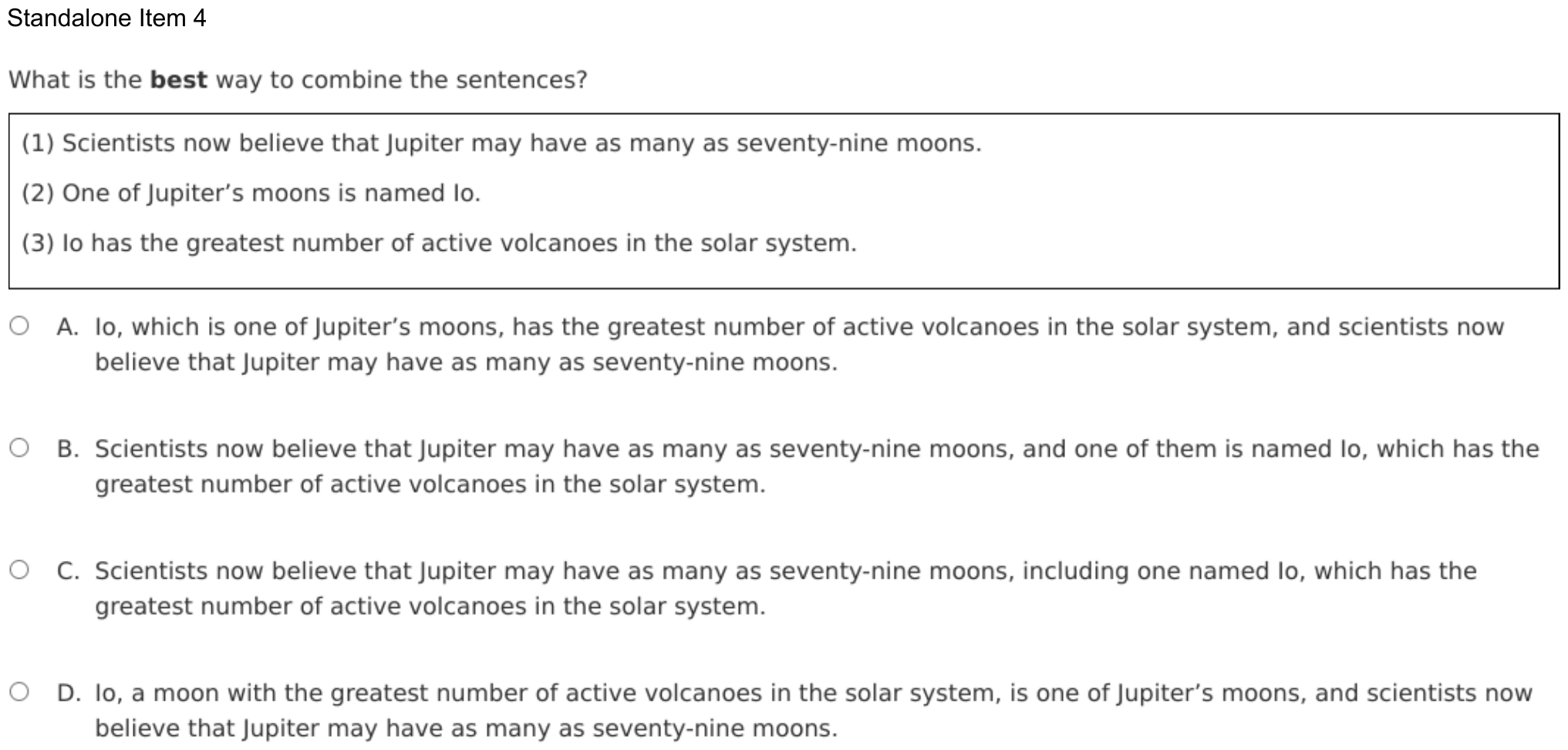
What is the best way to combine the sentences?
(1) Scientists now believe that Jupiter may have as many as seventy-nine moons.
(2) One of Jupiter’s moons is named Io.
(3) Io has the greatest number of active volcanoes in the solar system.
- AIo, which is one of Jupiter’s moons, has the greatest number of active volcanoes in the solar system, and scientists now believe that Jupiter may have as many as seventy-nine moons.
- BScientists now believe that Jupiter may have as many as seventy-nine moons, and one of them is named Io, which has the greatest number of active volcanoes in the solar system.
- CScientists now believe that Jupiter may have as many as seventy-nine moons, including one named Io, which has the greatest number of active volcanoes in the solar system.
- DIo, a moon with the greatest number of active volcanoes in the solar system, is one of Jupiter’s moons, and scientists now believe that Jupiter may have as many as seventy-nine moons.
Show the answer
Correct answer: C
The question asks for the best way to combine the sentences.
A. Incorrect. Although the sentence incorporates the ideas presented in the three original sentences, it is incorrect because the combination suggests an incorrect relationship between the ideas. By beginning with “Io,” the sentence places emphasis on the moon and the detail about the number of active volcanoes rather than the key idea that “scientists now believe that Jupiter may have as many as seventy-nine moons.” Since Io is an example of one of Jupiter’s moons, the details about Io should follow and be subordinate to the main clause, which provides new information about the number of Jupiter’s moons in general.
B. Incorrect. Although the sentence incorporates all three ideas from the original sentences and correctly places the detail about the number of active volcanoes on Io in a dependent clause, this option is incorrect because it presents an imprecise relationship between the ideas. By using the conjunction (connecting word) “and,” the sentence construction suggests that scientists “now believe” that “Jupiter may have as many as seventy-nine moons” and that “one of them is named Io,” instead of presenting Io as an example of one of Jupiter’s moons.
C. CORRECT. This sentence is the best way to combine the original sentences because it uses a complex sentence to present ideas clearly and precisely, and it shows the relationship between the ideas in the original sentences. The sentence starts by stating the number of moons scientists now believe Jupiter may have and then specifies that one of those moons is named Io. The dependent clause “which has the greatest number of active volcanoes in the solar system” immediately follows the word “Io” to provide additional information about the moon. A dependent clause contains a subject (“which,” referring to Io) and a verb (“has”) but is not a complete sentence on its own.
D. Incorrect. The sentence incorporates the key ideas from the original sentences, but its structure does not accurately present the relationship between these ideas. The beginning of the sentence includes the detail about Io having “the greatest number of active volcanoes in the solar system” before specifying that Io is one of the seventy-nine moons of Jupiter. The presentation of the details about Io at the beginning lessens the emphasis of the key idea that “scientists now believe that Jupiter may have as many as seventy-nine moons.”
Question analysis
This sentence-combining question gives three short sentences: scientists believe Jupiter may have as many as seventy-nine moons, one moon is named Io, and Io has the most active volcanoes in the solar system. Students must choose the single sentence that joins all three facts while showing how they relate, and the four versions differ only in order and connecting structure.
- Grade level
- Grade 7 reading and task
- Compared with grade 7
- At grade 7 Combining sentences so the ideas relate clearly is grade 7 language work. The three sentences are short, but every version keeps all the facts, so the choice rests on which idea leads and which is tucked into a clause, a typical grade 7 demand.
- Estimated difficulty
- Moderate: several steps, or a close reading with one strong distractor.
- Thinking it demands
- Depth of knowledge 2, skills and concepts · mainly evaluate
- What makes it hard
- A very close wrong answer moderate
- How sentences fit together moderate
- Every choice must be checked minor
- Evidence
- Answered from one sentence or line
- Reading level
- Question and choices: about grade 10, 162 words.
- Students, last 30 days
- Not enough answers yet to show (it takes 10).
Why it is hard, traps and wrong answers (shows the answer)
Why it is hard
Because every version keeps all three facts and is grammatical, the question is about emphasis and connection, which students rarely check for. Two versions open with Io and its volcanoes and leave the seventy-nine moons trailing after “and,” and one of them also calls Io a moon twice. The strongest pull is the version with the right order that still joins Io with “and,” so Io’s name reads as a second piece of news rather than an example of the moons just counted.
A very close wrong answer moderate Choosing the answer
The “and one of them is named Io” version matches the key in its order and in its which-clause about volcanoes; only its connector differs from the key’s “including one named Io.” (Embretson & Wetzel, 1987; Gorin & Embretson, 2006; Ascalon et al., 2007)
How sentences fit together moderate Working it out
Students must see that sentence 1 is the main news and that sentences 2 and 3 narrow to one example, so Io belongs inside the sentence about Jupiter’s seventy-nine moons. (Halliday & Hasan, 1976)
Every choice must be checked minor Choosing the answer
Every version is grammatical and keeps all three facts, so none can be ruled out by an error; each is judged on which idea leads and how the others attach. (Embretson & Wetzel, 1987)
Strategy: Decide which of the three sentences states the main idea and which ones add detail, then check whether each version’s order and structure show that relationship.
Traps
- Wrong transition: A connecting word or phrase that signals the wrong relationship, such as contrast where the idea continues.
- Changes the meaning: A revision is correct English but no longer says what the writer meant.
The wrong answers, classified
A Changes the meaning (Connors & Lunsford, 1988)
Opens with Io and its volcanoes and adds the moon count with “and,” so the main news about Jupiter trails behind its own example as an afterthought.
B Wrong transition (Halliday & Hasan, 1976)
Keeps the right order and the which-clause, but “and one of them is named Io” adds Io as a second piece of news instead of an example of those moons.
D Changes the meaning (Connors & Lunsford, 1988)
Leads with Io’s volcanoes, then says Io “is one of Jupiter’s moons” right after calling it “a moon,” and leaves the main news about Jupiter for the end.
Working it out, step by step
Figure out what the question asks
This asks for the best way to join three sentences into one. All four choices keep every fact. So the best one shows how the facts relate. Decide which fact is the main idea and which ones add detail.
Find the main idea
Sentence 1 is the big news: “Scientists now believe that Jupiter may have as many as seventy-nine moons.” Sentences 2 and 3 zoom in on one of those moons, Io. Io is an example of the moons, and its volcanoes are a detail about Io. So the main idea should come first, and Io should fit inside it.
Name the rule
Put the main idea in the main part of the sentence. Tuck the details in with words like including and which. For example: My school has thirty clubs. One is chess. The chess club meets on Fridays. Joined: My school has thirty clubs, including a chess club, which meets on Fridays.
Check each choice
- A is wrong. It starts with Io and its volcanoes. The main news about Jupiter trails at the end after “and.”
- B is wrong. The order is right. But “and one of them is named Io” adds Io as a second piece of news, not as an example.
- C is right. “Including one named Io” shows Io is one of the moons. Then “which” adds the fact about its volcanoes.
- D is wrong. It calls Io “a moon,” then says again that it “is one of Jupiter’s moons.” The main news comes last.
Watch out: B is very close to C. The only change is “and one of them is named Io” in place of “including one named Io.” The word “including” shows that Io belongs to the group.
Choose the answer
C leads with the main news and tucks in Io as an example. So the answer is C, “Scientists now believe that Jupiter may have as many as seventy-nine moons, including one named Io, which has the greatest number of active volcanoes in the solar system.”
Why this answer and not the closest wrong one
B is the closest wrong answer. It has the right order and the same “which” clause. But “and” tacks Io’s name on as a separate fact, as if it were more news. “Including” shows that Io is one of the seventy-nine moons. That ties the three facts together most clearly.
More questions like this
The original DOE question
Question 6 of 6
2024 Test B English, question 1Question
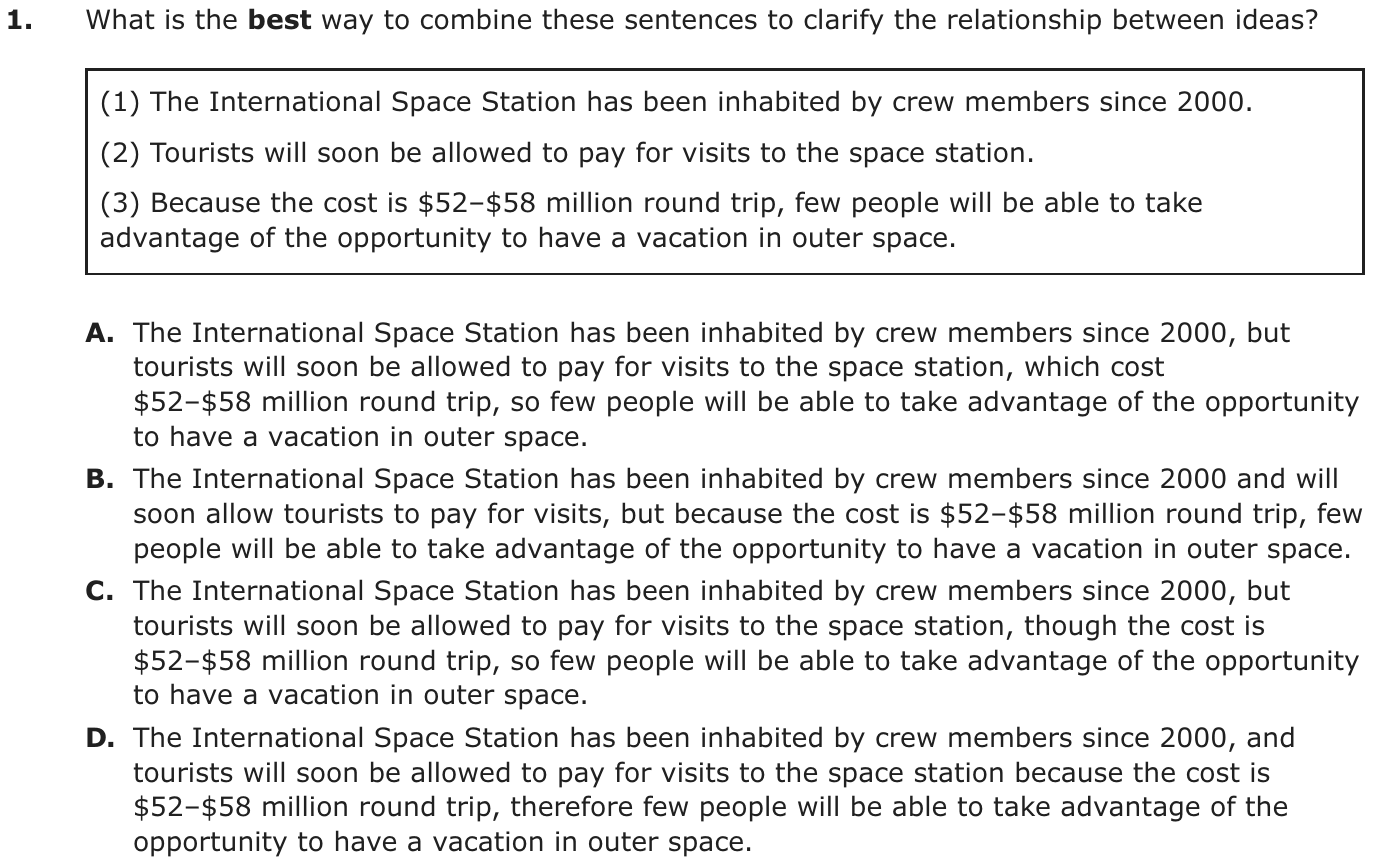
What is the best way to combine these sentences to clarify the relationship between ideas?
(1) The International Space Station has been inhabited by crew members since 2000.
(2) Tourists will soon be allowed to pay for visits to the space station.
(3) Because the cost is $52–$58 million round trip, few people will be able to take advantage of the opportunity to have a vacation in outer space.
- AThe International Space Station has been inhabited by crew members since 2000, but tourists will soon be allowed to pay for visits to the space station, which cost $52–$58 million round trip, so few people will be able to take advantage of the opportunity to have a vacation in outer space.
- BThe International Space Station has been inhabited by crew members since 2000 and will soon allow tourists to pay for visits, but because the cost is $52–$58 million round trip, few people will be able to take advantage of the opportunity to have a vacation in outer space.
- CThe International Space Station has been inhabited by crew members since 2000, but tourists will soon be allowed to pay for visits to the space station, though the cost is $52–$58 million round trip, so few people will be able to take advantage of the opportunity to have a vacation in outer space.
- DThe International Space Station has been inhabited by crew members since 2000, and tourists will soon be allowed to pay for visits to the space station because the cost is $52–$58 million round trip, therefore few people will be able to take advantage of the opportunity to have a vacation in outer space.
Show the answer
Correct answer: B
The question asks for the best way to combine the sentences.
A. Incorrect. Although the option combines the sentences in a way that accurately reflects the meaning of each individual sentence, the combined sentence is a string of clauses that do not effectively cohere. Because it is poorly structured, the combined sentence does not clarify the relationship of ideas as effectively as the correct response does. The sentence incorrectly uses “but tourists,” and “which cost” modifies “the space station” but does not modify the trip. Compared with the correct response, the combined sentence in this option is also imprecise and unnecessarily wordy.
B. CORRECT. The option uses a complex sentence to present ideas clearly and precisely, and it shows the relationship between the ideas in the original sentences. In the first part of the sentence, the conjunction “and” correctly joins the first and second sentences by indicating a relationship, rather than a contrast, between the two. In the second part of the sentence, the conjunction “but” adds additional emphasis to the fact that while tourists will be allowed to visit the space station, the cost of the trip will likely prohibit most people from visiting.
C. Incorrect. Although the option combines the sentences in a way that accurately reflects the meaning of each individual sentence, the combined sentence is a string of clauses that do not effectively cohere. Because it is so poorly structured, the combined sentence does not clarify the relationship of ideas as effectively as the correct response does. Compared with the correct response, the combined sentence in this option is also imprecise and unnecessarily wordy.
D. Incorrect. The combination of the sentences contains an illogical relationship between ideas with the statement that tourists will be allowed to pay for visits to the space station because the cost is $52–$58 million round trip. The connection between the idea that “tourists will soon be allowed to pay for visits” and the subsequent “therefore few people will be able to take advantage of the opportunity” is also illogical.
Question analysis
This sentence-combining question gives three sentences about the International Space Station, its crew and the high price of a tourist trip, and asks for the best way to join them into one. Every version keeps the same facts, so students must judge which connecting words show how the ideas relate while the sentences stay long and nearly identical.
- Grade level
- Grade 8 reading and task
- Compared with grade 7
- Above grade 7 Grade 7 students practice joining two short sentences with a fitting conjunction. Here three sentences become one long sentence in four nearly identical versions, so students must weigh every connecting word and clause rather than spot one error.
- Estimated difficulty
- Hard: combines ideas, needs a plan, and has more than one tempting wrong answer.
- Thinking it demands
- Depth of knowledge 2, skills and concepts · mainly evaluate
- What makes it hard
- How sentences fit together major
- Complex sentences moderate
- Every choice must be checked moderate
- Evidence
- Answered from one sentence or line
- Reading level
- Question and choices: about grade 15, 261 words.
- Students, last 30 days
- Not enough answers yet to show (it takes 10).
Why it is hard, traps and wrong answers (shows the answer)
Why it is hard
None of the wrong versions drops a fact, and two of them are loose rather than plainly ungrammatical, so the ear is little help. Students lose the point by accepting the smoothest chain of clauses without asking what each connector claims: whether the crew and the tourists really contrast, what the price belongs to, and what the price explains. The question rewards deciding the three links before reading the versions, then checking them one connector at a time.
How sentences fit together major Working it out
Sentence 2 simply adds to sentence 1, while sentence 3’s price works against the tourist plan and explains why few will go, so every “but,” “though,” “because” or “so” in a version must fit one of those links. (Halliday & Hasan, 1976)
Complex sentences moderate Understanding the question
Each version is one sentence of 48 to 53 words with four clauses, and at that length a “which cost” hanging on the wrong noun or a comma before “therefore” is easy to read past. (Abedi & Lord, 2001; Freedle & Kostin, 1993; Messick, 1989)
Every choice must be checked moderate Choosing the answer
All four versions keep the same facts in the same order and share most of their words, so none can be ruled out by content; each connecting word has to be tested in turn. (Embretson & Wetzel, 1987)
Strategy: Before reading the choices, decide how each sentence relates to the next: added fact, contrast, or cause and result. Then check every connecting word in each version against those links.
Traps
- Misplaced modifier: A describing word or phrase that attaches to the wrong word, or to nothing in the sentence.
- Wordy, vague or informal: A revision is grammatical but wordy, imprecise or too casual for the passage.
- Wrong transition: A connecting word or phrase that signals the wrong relationship, such as contrast where the idea continues.
The wrong answers, classified
A Misplaced modifier (Connors & Lunsford, 1988)
Keeps the price as the reason few can go, marked by “so,” but misses that “which cost” hangs on “the space station” and that “but” sets crew against tourists.
C Wordy, vague or informal (Connors & Lunsford, 1988)
Keeps every fact in order, but stacking “but,” “though” and “so” in one sentence turns the price into an aside instead of plainly the reason few people will go.
D Wrong transition (Halliday & Hasan, 1976)
Keeps sentence 3’s “because the cost is” word for word, but here it explains why tourists are allowed, and “therefore” after a comma splices on the result.
Working it out, step by step
Figure out what the question asks
You need to join three sentences into one. The best version shows clearly how the ideas connect. Joining words do that job. A conjunction is a joining word, like and, but, so or because. Each one tells the reader something. And adds a fact. But shows a contrast (two ideas that pull against each other). Because and so show a cause and its result.
Decide how the three sentences connect
Sentence 1 says crews have lived on the station since 2000. Sentence 2 adds a new fact: tourists will soon be able to visit. That is not a contrast, so it needs and. Sentence 3 works against sentence 2. The trip costs “$52–$58 million round trip.” That price is also the reason few people will go. So you need a contrast and a reason. Example: The pool is open to all, but because it costs $90, few kids swim there.
Test each choice
- B uses “and will soon allow tourists” to add the new fact. Then “but because the cost is” shows the contrast and the reason. Every link is right.
- A joins sentence 2 with “but tourists,” as if crews and tourists were opposites. Also, “which cost” comes right after “the space station.” So it sounds like the station costs that much, not the trip.
- C stacks “but,” “though” and “so” in one long chain. The price turns into a side note instead of the clear reason.
- D says tourists may visit “because the cost is” so high. That makes no sense. And “therefore” after a comma joins two sentences the wrong way.
Pick the answer
Watch out: A is the most tempting. It keeps the price as the reason, with “so.” But its “but” and its “which” send the reader the wrong way. Only one choice links every idea correctly. So the answer is B.
Why this answer and not the closest wrong one
A is the closest wrong answer. Like B, it says the price keeps most people away. But A sets crews against tourists with “but tourists.” Its “which cost” also seems to give the price of the station. B uses and for the added fact and but because for the price, so each link is clear.
More questions like this
The original DOE question