7.RP.2c proportional relationship equations
Question 1 of 5
2026 Practice Test A Math, question 37Question
When a student buys 4 notebooks, the total cost is $12. Each notebook costs the same amount. Select each point on the graph that best represents y, the total cost of x notebooks.
Select all the correct answers.
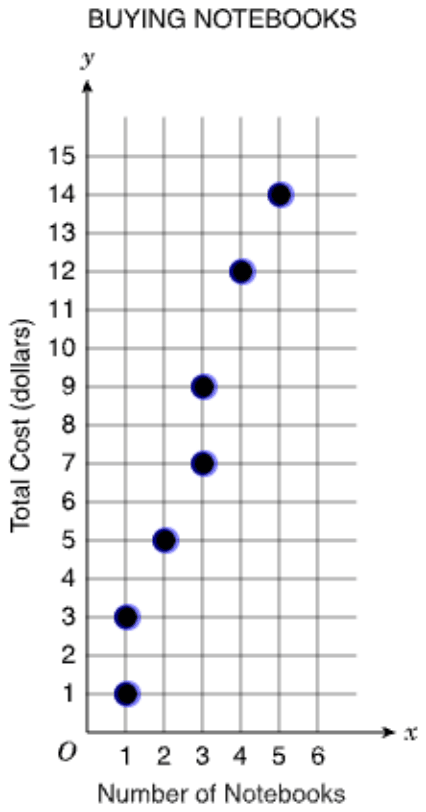
On the test you click the points in the figure; here, choose them below. The DOE has not published how answers with several parts are scored; this site counts one right only when every part is right.
- A(1, 1)
- B(1, 3)
- C(2, 5)
- D(3, 7)
- E(3, 9)
- F(4, 12)
- G(5, 14)
Show the answer
Correct answer: B, E, and F
Solution:
There are three correct points: (1, 3), (3, 9), and (4, 12).
Find the cost per notebook: .
The equation of the line is , where y is the total cost of x notebooks.
Check each point by plugging the x-value into the equation . If the y-value from the equation matches the y-value of the point, then the point is on the line .
Check all seven points:
(1, 1) y-values do not match; incorrect point
(1, 3) y-values match; CORRECT point
(2, 5) y-values do not match; incorrect point
(3, 7) y-values do not match; incorrect point
(3, 9) y-values match; CORRECT point
(4, 12) y-values match; CORRECT point
(5, 14) y-values do not match; incorrect point
Question analysis
A graph titled Buying Notebooks shows seven points, and students select every point that fits the total cost of buying notebooks, given the cost of a few notebooks and that each costs the same. It tests finding a unit rate and recognizing points of a proportional relationship. Some points line up in tempting patterns, and the item does not say how many to select.
- NYS standards
- Grade level
- Grade 7 content, by NYS standard
- Compared with grade 7
- At grade 7 Finding a unit rate and deciding which points fit a proportional relationship are grade 7 skills, and the arithmetic here is easy. What adds demand is testing all seven points with no count given, since one miss or extra pick loses the item.
- Estimated difficulty
- Straightforward: two steps or one careful reading.
- Thinking it demands
- Depth of knowledge 2, skills and concepts · mainly apply
- What makes it hard
- Solution
- 2 steps
- Reading level
- Question and choices: about grade 5, 36 words.
- Students, last 30 days
- Not enough answers yet to show (it takes 10).
Why it is hard, traps and wrong answers (shows the answer)
Why it is hard
Finding the price is one division, 12 ÷ 4 = 3, so the question is really about checking: each chosen dot must fit y = 3x exactly, and the item does not say how many do. The graph punishes judging by eye, since a straight row of dots climbs from (1, 3) at $2 a notebook and two dots sit a single gridline off the true line. Multiplying each x by 3 and reading each y from the axis, not from the pattern, settles all seven.
Every choice must be checked moderate Choosing the answer
Seven dots must each be tested against $3 a notebook, and the item never says how many fit; one missed point or one extra loses the whole item, so no dot can be skipped. (Embretson & Wetzel, 1987)
Reading a figure, table or graph minor Understanding the question
The graph stacks two dots above 1 notebook and two above 3, and each total cost has to be read off a grid ruled at every dollar up to 15. (Lesh, Post & Behr, 1987; Kirsch & Mosenthal, 1990)
A very close wrong answer minor Choosing the answer
(5, 14) sits one gridline below (5, 15), where 5 notebooks at $3 would be, and (2, 5) sits one below (2, 6), so judging by the line's direction cannot rule either out. (Embretson & Wetzel, 1987; Gorin & Embretson, 2006; Ascalon et al., 2007)
Strategy: Work out the cost of one notebook from the total given in the question, then multiply each point's x-coordinate by that price and keep only the points whose y-coordinate matches exactly.
Traps
- Misunderstands the concept: A wrong belief about a concept: that percents can be added, that area grows like length, that averages can be averaged, that a bigger denominator means a bigger fraction.
- Misreads the figure: Reads a value, label or tick spacing in a figure, table or graph wrongly.
The wrong answers, classified
A Little reason to choose it (Haladyna & Downing, 1993; Rodriguez, 2005)
No working from 4 notebooks for $12 makes one notebook cost $1, so this lowest dot mostly catches guesses, such as taking the dot nearest the origin as a start.
C Misunderstands the concept (Smith, diSessa & Roschelle, 1993; De Bock et al., 1998; Ni & Zhou, 2005)
Takes the straight row (1, 3), (2, 5), (3, 7) as the graph because its dots line up, though it climbs $2 a notebook and would meet the y-axis at $1, not the origin.
D Misunderstands the concept (Smith, diSessa & Roschelle, 1993; De Bock et al., 1998; Ni & Zhou, 2005)
Prefers the lower of the two dots above 3 notebooks because it continues the evenly spaced row from (1, 3) and (2, 5), instead of checking that 3 notebooks cost $9.
G Misreads the figure (Lesh, Post & Behr, 1987; Kirsch & Mosenthal, 1990)
Finds that 5 notebooks cost 5 × $3 = $15, then reads the dot above 5 as sitting on the top gridline, 15, when it is one line lower, at 14.
Worked solution, step by step
Formulas used
- Unit price
- The unit price is what one item costs. Divide the total cost by the number of items bought. This works because every notebook costs the same, so the total splits into equal parts.
- A proportional relationship
- y is the total cost in dollars, and x is the number of notebooks. k is the price of one notebook, the number you always multiply by. A point fits only if its y is exactly k times its x. The graph is a straight line through (0, 0).
Sort out the question
Four notebooks cost $12, and each one costs the same. On the graph, x is the number of notebooks, and y is the total cost in dollars. The graph shows seven points. You must select every point that fits. The question does not say how many fit, so test all seven.
Find the price of one notebook
Split the $12 equally among the 4 notebooks:
Each notebook costs $3. So the total cost is 3 times the number of notebooks:
Test each point
For each point, multiply its x by 3. Keep the point only if the result equals its y.
Choice Point 3 × x Fits? A (1, 1) 3 No B (1, 3) 3 Yes C (2, 5) 6 No D (3, 7) 9 No E (3, 9) 9 Yes F (4, 12) 12 Yes G (5, 14) 15 No Watch for look-alike points
Watch out: the dots (1, 3), (2, 5) and (3, 7) sit in a neat straight row. But that row climbs $2 per notebook, not $3. Lining up is not enough: (2, 5) and (3, 7), choices C and D, do not fit.
Watch out: 5 notebooks cost dollars. The dot above 5 sits one gridline lower, at 14. Read the y-axis carefully, and you will skip choice G.
Name the points
Three points fit: (1, 3), (3, 9) and (4, 12). On the test, you click each of these dots on the graph. On this site, you check their boxes. So the answers are B, E and F.
Check your answer
All three points fit : , and . They also line up with (0, 0), since 0 notebooks cost $0. And (4, 12) is the fact the question gave you.
More questions like this
The original DOE question
Question 2 of 5
2026 Practice Test B Math, question 3Question
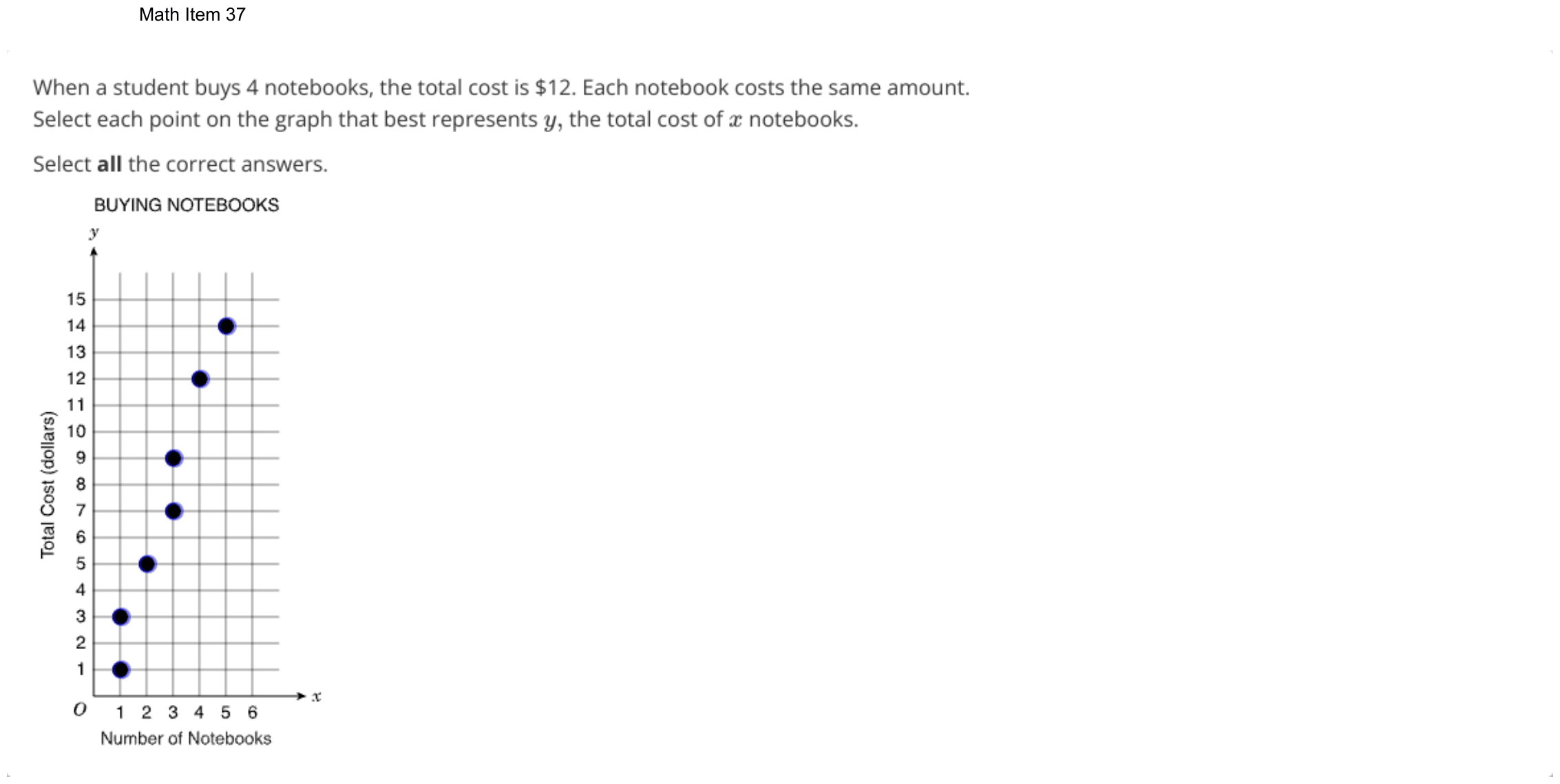
At a diner, 18 dozen buns were used yesterday for 150 lunch customers. Today, there were 250 lunch customers. Assuming that the bun usage rate is the same for both days, which proportions can be used to determine how many dozen buns are needed for 250 lunch customers?
Select the three correct answers.
Choose every answer that is correct, then check. The DOE has not published how answers with several parts are scored; this site counts one right only when every part is right.
- A
- B
- C
- D
- E
Show the answer
Correct answer: A, C, and D
The three correct answers are:
Set up a proportion to compare the number of buns per customer. These are all equivalent:
To check for equivalency, solve each proportion for x.
Each of the three correct proportions simplifies to .
Then solve for x to determine how many dozen buns are needed for 250 lunch customers:
Question analysis
A diner used 18 dozen buns for 150 lunch customers yesterday, and students select the three proportions, out of five, that can find how many dozen buns 250 customers need at the same rate. It tests setting up proportions and recognizing equivalent ones. All five equations use the same numbers, so each has to be checked for which quantities it pairs.
- Grade level
- Grade 7 content, by NYS standard
- Compared with grade 7
- At grade 7 Setting up a proportion from a rate is everyday grade 7 work. Here nothing is solved: five setups built from the same numbers must each be judged, some arranged in unfamiliar ways, and all three usable ones found.
- Estimated difficulty
- Moderate: several steps, or a close reading with one strong distractor.
- Thinking it demands
- Depth of knowledge 2, skills and concepts · mainly apply
- What makes it hard
- Every choice must be checked moderate
- A very close wrong answer moderate
- An answer in an unexpected form minor
- Much to keep track of minor
- Solution
- 3 steps
- Reading level
- Question and choices: about grade 6, 54 words.
- Students, last 30 days
- Not enough answers yet to show (it takes 10).
Why it is hard, traps and wrong answers (shows the answer)
Why it is hard
Nothing needs solving here; the question is which pairings keep the usage rate fixed. Students who check only for buns over customers on both sides find exactly three such setups, two of them wrong, and pass over the two right ones written another way. The wrong pair gives 10.8 dozen, fewer buns for more customers, which a quick sense check would catch, and cross-multiplying every setup settles all five.
Every choice must be checked moderate Choosing the answer
All five setups are built from 18, 150, 250 and x, so none can be dismissed on sight; each has to be cross-multiplied and compared with 150x = 18 × 250. (Embretson & Wetzel, 1987)
A very close wrong answer moderate Choosing the answer
The first two setups differ only in where 150 and 250 sit, 18/150 = x/250 against 18/250 = x/150, and both show buns over customers on each side, so a units check passes both. (Embretson & Wetzel, 1987; Gorin & Embretson, 2006; Ascalon et al., 2007)
An answer in an unexpected form minor Choosing the answer
One right setup puts customers over dozens of buns, and another sets today’s x over yesterday’s 18 equal to 250 customers over 150, forms that look wrong to students who learned only rate equals rate. (Enright, Morley & Sheehan, 2002)
Much to keep track of minor Working it out
Three of the five must be picked and all three must be right to score, so the verdict on each setup has to be kept until the last one is tested. (Sweller, 1988; Carpenter, Just & Shell, 1990)
Strategy: Write one proportion you trust by matching both units and days, cross-multiply it, then cross-multiply each choice and keep only those that give the same equation.
Traps
- Misunderstands the concept: A wrong belief about a concept: that percents can be added, that area grows like length, that averages can be averaged, that a bigger denominator means a bigger fraction.
- Answer in another form: The right answer is written differently from the way you worked it out.
The wrong answers, classified
B Misunderstands the concept (Smith, diSessa & Roschelle, 1993; De Bock et al., 1998; Ni & Zhou, 2005)
Checks only that both fractions show dozens of buns over customers, missing that 18 sits over today’s 250 customers; cross-multiplying gives 250x = 2,700, so x = 10.8.
D Misunderstands the concept (Smith, diSessa & Roschelle, 1993; De Bock et al., 1998; Ni & Zhou, 2005)
Left out by students who expect each fraction to compare buns with customers, not seeing that today over yesterday for buns and for customers also gives 150x = 4,500.
E Misunderstands the concept (Smith, diSessa & Roschelle, 1993; De Bock et al., 1998; Ni & Zhou, 2005)
Accepts x over 150 because it shows buns over customers like the trusted setup, but today’s buns sit over yesterday’s customers, which yields only 10.8 dozen for more people.
Worked solution, step by step
Formulas used
- A rate
- The rate is how many dozen buns are used for each customer. Yesterday it was 18 dozen over 150 customers. Today it is x dozen over 250 customers. The question says the rate is the same both days, so those two fractions are equal.
- Cross-multiplying a proportion
- A proportion says two fractions are equal. a and c are the tops, and b and d are the bottoms. Multiply each top by the other bottom, and the two products are equal. This turns any proportion into a plain equation, so you can compare setups that look different.
Sort out the question
Yesterday the diner used 18 dozen buns for 150 customers. Today it has 250 customers. Let x be the number of dozen buns needed today. The bun usage rate is the same both days.
A proportion is two equal fractions. You must pick the three proportions that give the right value of x.
Write one proportion you trust
Put each day’s buns over that same day’s customers. The rates are equal, so the fractions are equal:
This is choice A. Cross-multiply it:
Any choice that leads to 150x = 4,500 is a right one.
Solve for x
Divide both sides by 150 to get x by itself:
So the diner needs 30 dozen buns today. A wrong setup gives a different number.
Test choices C and D
Cross-multiply each one.
- C: gives . That is the same equation, so C works. It is choice A with both fractions flipped.
- D: gives . The same equation again, so D works too.
D compares today with yesterday. Today’s buns over yesterday’s buns equals today’s customers over yesterday’s customers.
Watch out: D looks odd because it puts buns over buns. Do not skip it. It still keeps the rate the same.
Test choices B and E
- B: gives , so 250x = 2,700.
- E: gives , the same 250x = 2,700.
Both give . That is fewer buns for more customers, which makes no sense.
Watch out: B and E show buns over customers, so they look right. But each one mixes up the days. B puts yesterday’s 18 dozen over today’s 250 customers. E puts today’s buns over yesterday’s 150 customers.
Name the three answers
Choices A, C and D all give 150x = 4,500, so x = 30. On the test, you check the box next to each one. So the answers are A, C and D.
Check your answer
Find the buns a second way. Today has times as many customers as yesterday. So it needs 5/3 times as many buns: dozen. That matches the 30 from choices A, C and D.
More questions like this
The original DOE question
Question 3 of 5
2026 Practice Test C Math, question 43Question
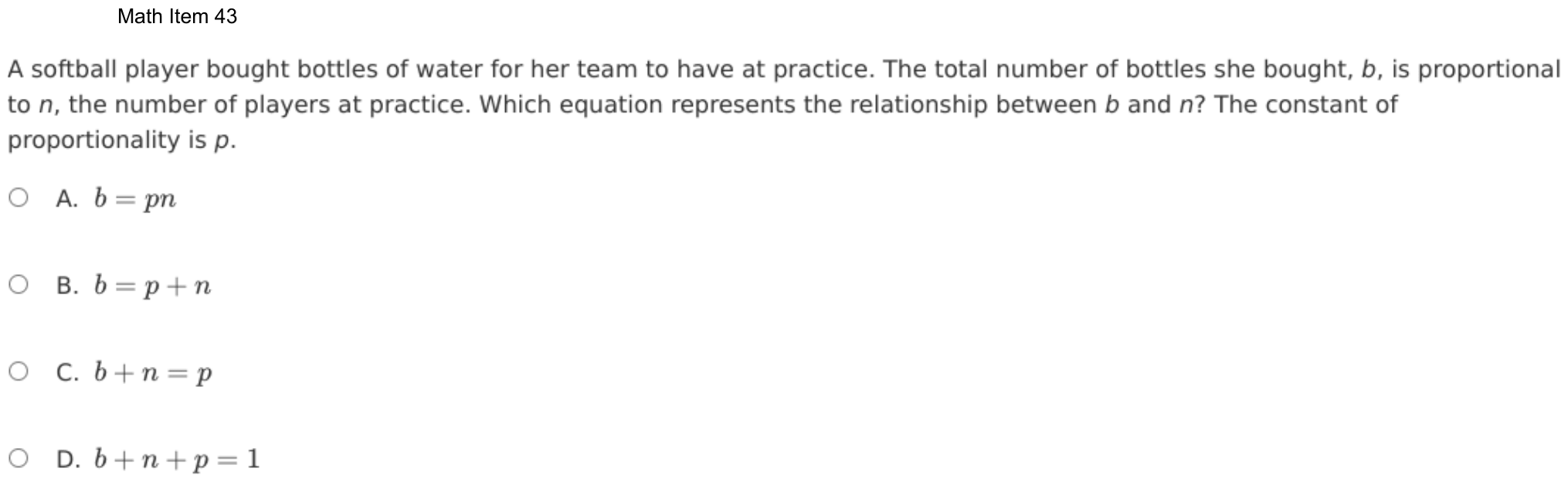
A softball player bought bottles of water for her team to have at practice. The total number of bottles she bought, b, is proportional to n, the number of players at practice. Which equation represents the relationship between b and n? The constant of proportionality is p.
- A
- B
- C
- D
Show the answer
Correct answer: A
In this context, the constant of proportionality, p, represents the relationship between b, the number of bottles of water, and n, the number of players on the team.
The number of bottles of water is the product of the constant of proportionality and the number of players.
The equation that represents this relationship is .
Question analysis
A softball player buys bottles of water for practice, and the number of bottles, b, is proportional to the number of players, n, with constant of proportionality p. Students choose the equation that represents the relationship. It tests writing an equation for a proportional relationship using letters only, so the meaning of proportional has to be clear.
- NYS standards
- 7.RP.2c proportional relationship equations
- Grade level
- Grade 7 content, by NYS standard
- Compared with grade 7
- Below grade 7 Grade 7 students write equations for proportional relationships from tables, graphs and descriptions, usually with a number to find. Here the constant is already given as a letter, so only the general form must be recalled, a short task.
- Estimated difficulty
- Routine: one familiar step, little to misread.
- Thinking it demands
- Depth of knowledge 1, recall and reproduction · mainly remember
- What makes it hard
- Solution
- 1 step
- Reading level
- Question and choices: about grade 7, 51 words.
- Students, last 30 days
- Not enough answers yet to show (it takes 10).
Why it is hard, traps and wrong answers (shows the answer)
Why it is hard
This is a recall question dressed in a short story: the softball team adds nothing but names for the letters. The one idea needed is that proportional means multiplied by a constant, so doubling the players doubles the bottles. Students who think of a constant as something added, or as a fixed total, are drawn to the two sums that use the same letters.
Something you must already know minor Working it out
The general form of a proportional relationship, one amount equal to the constant times the other, has to be recalled; the stem names p but never says it multiplies. (Anderson & Krathwohl, 2001)
Variables instead of numbers minor Understanding the question
No numbers are given, only b, n and p, so a choice cannot be checked by computing unless students make up a case, such as 2 bottles per player for 10 players. (Koedinger & Nathan, 2004; Enright, Morley & Sheehan, 2002)
Strategy: Recall how two proportional quantities are linked through the constant of proportionality, then test each choice with sample numbers: if the players double, the bottles should double too.
Traps
- Misunderstands the concept: A wrong belief about a concept: that percents can be added, that area grows like length, that averages can be averaged, that a bigger denominator means a bigger fraction.
The wrong answers, classified
B Misunderstands the concept (Smith, diSessa & Roschelle, 1993; De Bock et al., 1998; Ni & Zhou, 2005)
Treats proportional as adding a fixed amount, so the bottles would be the players plus p, rather than the players multiplied by a constant.
C Misunderstands the concept (Smith, diSessa & Roschelle, 1993; De Bock et al., 1998; Ni & Zhou, 2005)
Takes the constant of proportionality as the total of bottles and players, confusing a constant sum with a constant ratio.
D Little reason to choose it (Haladyna & Downing, 1993; Rodriguez, 2005)
Puts all three letters into one sum equal to 1, an equation that uses the right letters but matches no idea of proportion, so it mostly draws guesses.
Worked solution, step by step
Formulas used
- Proportional relationship
- y and x are two amounts that change together. k is the constant of proportionality, the number you always multiply x by to get y. Because it is a multiplication, doubling x doubles y.
Sort out the question
The letter b is the number of bottles, and n is the number of players. The bottles are proportional to the players. The constant of proportionality is p.
You need the equation that links b and n. There are no numbers, only letters.
Recall what proportional means
Proportional means one amount is always a fixed number times the other. For example, say there are 2 bottles for each player. Then 10 players need 20 bottles, and 20 players need 40 bottles. Doubling the players doubles the bottles.
The fixed number, here 2, is the constant of proportionality.
Write it with these letters
Start with the rule . The bottles take the place of y, the players take the place of x, and p is the constant:
Here pn means p times n.
Check the other choices
Watch out: choice B, , adds instead of multiplying. With p = 2, 10 players give 12 bottles. Then 20 players give 22, which is not double.
Choice C makes p a total of bottles and players, not a multiplier. Choice D makes all three letters add up to 1, which does not fit at all.
Give the answer
Only multiplies the players by a constant. So it is the only choice where doubling the players doubles the bottles.
So the answer is A, .
Check your answer
Try p = 3 bottles per player. With 5 players, . With 10 players, . Twice the players, twice the bottles. Also, , so b ÷ n gives back the constant.
More questions like this
The original DOE question
Question 4 of 5
2024 Test A Math, question 48Question
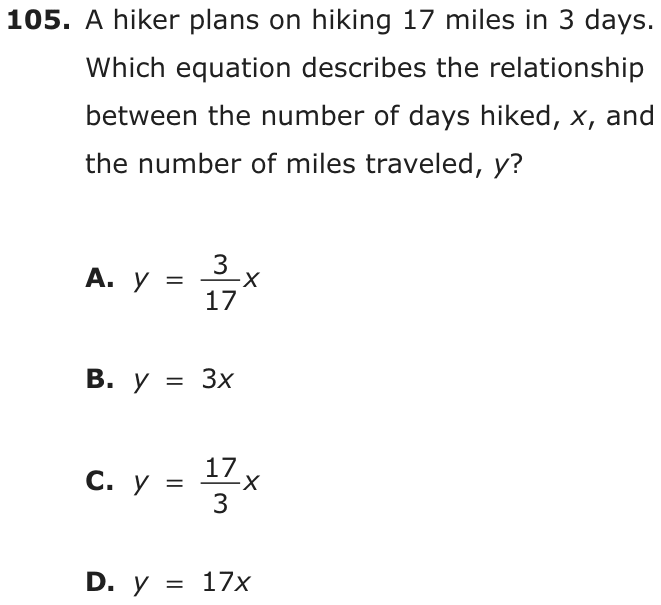
A hiker plans on hiking 17 miles in 3 days. Which equation describes the relationship between the number of days hiked, x, and the number of miles traveled, y?
- A
- B
- C
- D
Show the answer
Correct answer: C
There is a proportional relationship between the number of miles traveled, y, and the number of days hiked, x.
So the equation describes the relationship.
Question analysis
A hiker plans to cover 17 miles in 3 days, and this proportional relationship question asks for the equation linking days hiked, x, to miles traveled, y. Students find the constant rate and write it as an equation of the form y = kx. Putting the right quantity on top of the rate is the main decision.
- Grade level
- Grade 7 content, by NYS standard
- Compared with grade 7
- At grade 7 Writing an equation y = kx for a proportional relationship is a core grade 7 skill, and this is the textbook form. The only extra demand is keeping the rate's direction straight: miles per day or days per mile.
- Estimated difficulty
- Straightforward: two steps or one careful reading.
- Thinking it demands
- Depth of knowledge 2, skills and concepts · mainly apply
- What makes it hard
- A very close wrong answer moderate
- Turning words into math minor
- Solution
- 2 steps
- Reading level
- Question and choices: about grade 7, 31 words.
- Students, last 30 days
- Not enough answers yet to show (it takes 10).
Why it is hard, traps and wrong answers (shows the answer)
Why it is hard
Writing y = kx is routine, so the question rests on putting the right number on top of the rate. Two choices use one number from the stem with no division at all, and one inverts the rate. Substituting x = 3 into each equation is the fastest check, since only one of them gives y = 17.
A very close wrong answer moderate Choosing the answer
The coefficients 17/3 and 3/17 use the same two numbers, one the other inverted, so only checking that 3 days gives 17 miles separates the two equations. (Embretson & Wetzel, 1987; Gorin & Embretson, 2006; Ascalon et al., 2007)
Turning words into math minor Understanding the question
With x as days and y as miles, "17 miles in 3 days" becomes miles per day, 17 ÷ 3, the number that multiplies x. (Hegarty, Mayer & Monk, 1995; Koedinger & Nathan, 2004)
Strategy: Find the constant of proportionality as miles per day, since y is miles and x is days, then write y equals that constant times x; check with x = 3.
Traps
- Wrong operation: Adds instead of multiplying, divides the wrong way round, turns a ratio or rate upside down, or undoes a step in the wrong direction (subtracts what should be added back).
- Numbers taken from the question: Combines the numbers in the question without a model of the situation, or is simply a number that appears in the question.
The wrong answers, classified
A Wrong operation (Hegarty, Mayer & Monk, 1995; King et al., 2004)
Divides days by miles, 3/17, the number of days per mile, turning the rate upside down.
B Numbers taken from the question (Hegarty, Mayer & Monk, 1995)
Uses the 3 days as the rate, writing y = 3x, a number from the question with no division.
D Numbers taken from the question (Hegarty, Mayer & Monk, 1995)
Uses the 17 total miles as if they were covered in one day, writing y = 17x without dividing by the 3 days.
Worked solution, step by step
Formulas used
- Constant of proportionality
- x and y are two amounts that change together. k is the constant of proportionality: how much y goes with 1 of x. In a proportional relationship, y divided by x gives the same k every time.
- Proportional relationship
- kx means k times x. In a proportional relationship, y is always k times x. Here x is the number of days and y is the miles. k is the miles for each day. Use it to write the equation once you know k.
Sort out the question
The hiker plans 17 miles in 3 days. x is the number of days, and y is the number of miles. You need an equation that links them. Assume the hiker goes the same distance each day. Then y is always the same number times x.
Find the miles for each day
That number is the constant of proportionality, k. It is miles divided by days.
That is miles each day. Watch out: miles go on top, because y is miles. is days per mile, upside down. That is choice A.
Write the equation
Watch out: 17 is the miles for all 3 days, not for 1 day. So , choice D, is too fast. And , choice B, uses the days as the rate.So the answer is C, .
Check your answer
Put in x = 3, for 3 days: . That is 17 miles, which matches the plan. Try choice A the same way: . That is less than 1 mile, far too short.
More questions like this
The original DOE question
Question 5 of 5
2024 Test B Math, question 19Question
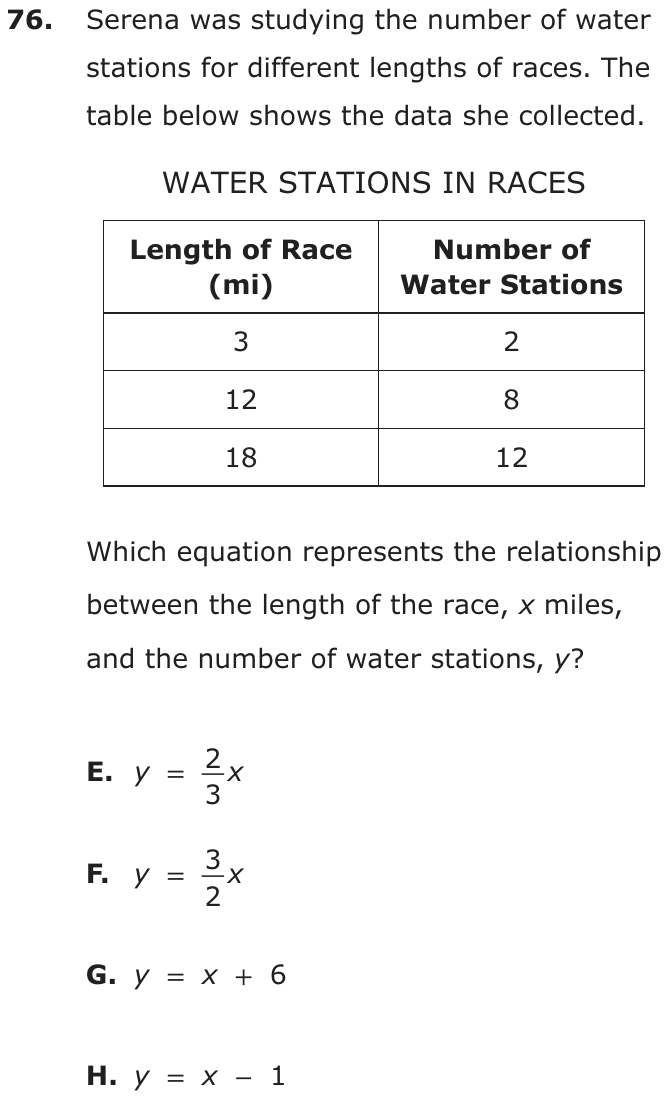
Serena was studying the number of water stations for different lengths of races. The table below shows the data she collected.
WATER STATIONS IN RACES
| Length of Race (mi) | Number of Water Stations |
|---|---|
| 3 | 2 |
| 12 | 8 |
| 18 | 12 |
Which equation represents the relationship between the length of the race, x miles, and the number of water stations, y?
- A
- B
- C
- D
Show the answer
Correct answer: A
There is a proportional relationship between the length of the race, x miles, and the number of water stations, y. The constant of proportionality is
Therefore, the equation represents this relationship.
Question analysis
A table from a study of races shows the number of water stations for races of 3, 12 and 18 miles. Students choose the equation that links the race length x to the number of stations y. It tests reading a relationship from a table and expressing it as an equation in x and y.
- Grade level
- Grade 7 content, by NYS standard
- Compared with grade 7
- At grade 7 Writing an equation for a relationship given in a table is a central grade 7 skill. With three clean rows and whole numbers, this is a typical grade 7 exercise.
- Estimated difficulty
- Straightforward: two steps or one careful reading.
- Thinking it demands
- Depth of knowledge 2, skills and concepts · mainly apply
- What makes it hard
- A very close wrong answer moderate
- Reading a figure, table or graph minor
- Solution
- 2 steps
- Reading level
- Question and choices: about grade 6, 57 words.
- Students, last 30 days
- Not enough answers yet to show (it takes 10).
Why it is hard, traps and wrong answers (shows the answer)
Why it is hard
The table is small and its numbers are friendly, so the question comes down to which way the ratio runs and whether every row is checked. One wrong equation fits only the first row and another fits none, so testing a single row is not enough. Putting the 12-mile race into each equation, which should give 8 stations, leaves only one rule standing.
A very close wrong answer moderate Choosing the answer
The coefficients 2/3 and 3/2 use the same two digits, and only dividing stations by miles, 2 ÷ 3, rather than miles by stations, separates them. (Embretson & Wetzel, 1987; Gorin & Embretson, 2006; Ascalon et al., 2007)
Reading a figure, table or graph minor Understanding the question
The table lists miles first and stations second, while each equation puts stations, y, alone on the left, so every row must be read as an (x, y) pair. (Lesh, Post & Behr, 1987; Kirsch & Mosenthal, 1990)
Strategy: Test each equation on all three rows of the table, not just the first; only a rule that fits every row represents the relationship.
Traps
- Wrong operation: Adds instead of multiplying, divides the wrong way round, turns a ratio or rate upside down, or undoes a step in the wrong direction (subtracts what should be added back).
- Checks only one number: Tries one value in each choice and takes the first that works, when that value happens to work for a wrong choice too; a second value would rule it out.
- Numbers taken from the question: Combines the numbers in the question without a model of the situation, or is simply a number that appears in the question.
The wrong answers, classified
B Wrong operation (Hegarty, Mayer & Monk, 1995; King et al., 2004)
Divides race length by water stations, 3 ÷ 2, turning the ratio upside down, so the rule gives more stations than miles.
C Numbers taken from the question (Hegarty, Mayer & Monk, 1995)
Builds an addition rule from the gap of 6 between 18 and 12 in the last row, with the sign reversed, and it fits no row of the table.
D Checks only one number (Schoenfeld, 1985)
Checks only the first row, where 3 − 1 = 2 works, without testing the 12- and 18-mile races, where it gives 11 and 17.
Worked solution, step by step
Formulas used
- Proportional relationship
- x is the race length in miles, and y is the number of water stations. k is the constant of proportionality, the number of stations for each mile. Find it with y ÷ x. If every row gives the same k, the table is proportional.
Sort out the table
Each row of the table is a pair of numbers. The first is the race length, x, in miles. The second is the number of water stations, y. You need the equation that works for every row.
Divide y by x in each row
See if every row has the same ratio of stations to miles. Divide y by x.
Miles (x) Stations (y) y ÷ x 3 2 12 8 18 12 Every row gives 2/3. So the relationship is proportional: y is always the same number times x.
Write the equation
Here k is the ratio you found, .
Watch out: divide stations by miles, not miles by stations. 3 ÷ 2 gives 3/2, choice B. That rule would give more stations than miles.Test the other choices and answer
Watch out: test every row, not just the first one. Choice D, y = x − 1, works for 3 miles. But it gives 11 stations for 12 miles, not 8. Choice C, y = x + 6, gives 9 stations for 3 miles, not 2.So the answer is A, .
Check your answer
Put each race length into . , and . All three match the table.
More questions like this
The original DOE question