6.SP.1b samples and populations
Question 1 of 5
2026 Practice Test C Math, question 39Question
A shipment contains 170 small boxes of medical supplies. In a random sample of 20 of these boxes, 8 have damage and the others are undamaged. Based on this sample, what is the best prediction of the number of undamaged boxes in the shipment, not including the boxes in the random sample?
- A60
- B68
- C90
- D102
Show the answer
Correct answer: C
Determine the fraction of undamaged boxes in the sample, given 8 of the 20 boxes are damaged.
Subtract the number of boxes in the sample from 170.
Basing the prediction of undamaged boxes on the sample, multiply the number of boxes not in the sample by the fraction of undamaged boxes in the sample.
Question analysis
A shipment holds 170 boxes of medical supplies, and in a random sample of 20, 8 are damaged. Students predict how many undamaged boxes are in the shipment, leaving out the boxes in the sample. It tests using a sample to make a prediction, and the question's two conditions each lead to a different tempting wrong choice.
- Grade level
- Grade 7 content, by NYS standard
- Compared with grade 7
- At grade 7 Predicting from a random sample is grade 7 proportional reasoning. This version adds two conditions, undamaged rather than damaged and the shipment without the sample, so it takes three steps and a close reading.
- Estimated difficulty
- Moderate: several steps, or a close reading with one strong distractor.
- Thinking it demands
- Depth of knowledge 2, skills and concepts · mainly apply
- What makes it hard
- Much to keep track of moderate
- Many steps minor
- Solution
- 3 steps
- Reading level
- Question and choices: about grade 8, 49 words.
- Students, last 30 days
- Not enough answers yet to show (it takes 10).
Why it is hard, traps and wrong answers (shows the answer)
Why it is hard
The proportion itself is routine; the question is built around two conditions that each change the numbers. The stem reports the damaged boxes, but the question asks about undamaged ones, and its bold not removes the 20 sampled boxes from the shipment. Each wrong choice matches one way of mishandling the two conditions, so checking the result against both words, undamaged and not, is what the question rewards.
Much to keep track of moderate Working it out
Two conditions point away from the obvious numbers: the question wants undamaged boxes while the stem counts the 8 damaged, and it leaves out the 20 sampled, so 150 boxes, not 170. (Sweller, 1988; Carpenter, Just & Shell, 1990)
Many steps minor Working it out
Three steps follow in order, the undamaged share 12/20, the 150 boxes outside the sample, and their product, and each wrong turn lands on a listed choice. (Daniel & Embretson, 2010; Enright, Morley & Sheehan, 2002)
Strategy: Find the fraction of the sample that is undamaged, count the boxes that were not sampled, and multiply; then check that the answer describes the group of boxes asked about.
Traps
- Misreads the question: Misses or misreads a condition or a word in the question: "at least", "each", "remaining", "not".
- Answers a different question: A choice is right for another quantity: the other unknown, the rest instead of the part, the part instead of the whole.
The wrong answers, classified
A Answers a different question (King et al., 2004; Hegarty, Mayer & Monk, 1995)
Uses the damaged share, 8 of 20 or 0.4, instead of the undamaged share, taking it of the 150 unsampled boxes: 0.4 × 150 = 60.
B Answers a different question (King et al., 2004; Hegarty, Mayer & Monk, 1995)
Takes the damaged share of the whole shipment, 0.4 × 170 = 68, answering for damaged boxes and keeping the 20 sampled ones as well.
D Misreads the question (Hegarty, Mayer & Monk, 1995)
Finds the undamaged share, 0.6, but takes it of all 170 boxes, missing the bold not that leaves the 20 sampled boxes out: 0.6 × 170 = 102.
Worked solution, step by step
Formulas used
- Predicting from a sample
- A sample is a small group chosen at random from a bigger group. The fraction is the share of the sample with some feature. A random sample is likely to look like the bigger group. So use the same share of the group you are predicting for.
Sort out the question
The shipment has 170 boxes. A random sample of 20 boxes was checked, and 8 of them were damaged.
You need to predict the undamaged boxes in the shipment, not counting the 20 in the sample. Two words matter: undamaged and not.
Find the undamaged share
The sample has undamaged boxes. Write that as a share of the sample, and simplify:
So 0.6, or 60%, of the sample is undamaged.
Watch out: is the damaged share. Using it leads to choice A or B.
Count the boxes outside the sample
The question leaves out the 20 boxes in the sample. Take them away from the shipment:
So the prediction is about 150 boxes.
Make the prediction
Use the same undamaged share for the 150 boxes:
About 90 of those boxes should be undamaged.
Watch out: , choice D, forgets the bold not. It counts the sample boxes again.
Give the answer
The best prediction is 90 undamaged boxes outside the sample.
So the answer is C, 90.
Check your answer
Predict the damaged boxes outside the sample too: . Then , every box outside the sample. Also, 12 out of 20 is a bit more than half. And 90 is a bit more than half of 150.
More questions like this
The original DOE question
Question 2 of 5
2026 Practice Test D Math, question 31Question
A box contains an unknown number of green marbles. An experimenter adds 100 red marbles to the box, mixes the marbles thoroughly, and then draws out 10 marbles at random. Assume that this sample is representative of the proportion in the box. If there are 2 red marbles and 8 green marbles in this sample, approximately how many green marbles are in the box?
- A80
- B300
- C400
- D500
Show the answer
Correct answer: C
In this context, the phrase “this sample is representative” means that the ratio of 2 red marbles to 8 green marbles is the same as the ratio of red to green marbles in the entire box. Use this ratio of 2 to 8 to set up a proportion and solve, where x represents the number of green marbles in the box.
Question analysis
An experimenter adds 100 red marbles to a box of green marbles, mixes them, and draws a sample of 10 with 2 red and 8 green. This sampling question asks students to estimate how many green marbles the box holds. It applies a ratio from a representative sample, worked from a count known for the box rather than for the sample.
- Grade level
- Grade 6 content, by NYS standard
- Compared with grade 7
- At grade 7 Using a representative sample to reason about a population is grade 6 and 7 work. The twist is that the known count, the 100 red marbles added, belongs to the box rather than the sample, so the usual scaling runs in an unfamiliar direction.
- Estimated difficulty
- Moderate: several steps, or a close reading with one strong distractor.
- Thinking it demands
- Depth of knowledge 2, skills and concepts · mainly apply
- What makes it hard
- Turning words into math moderate
- Much to keep track of minor
- Solution
- 2 steps
- Reading level
- Question and choices: about grade 8, 60 words.
- Students, last 30 days
- Not enough answers yet to show (it takes 10).
Why it is hard, traps and wrong answers (shows the answer)
Why it is hard
This is the logic of estimating a population by tagging, and the twist is that the known count belongs to the marbles that were added, not to the ones being estimated. Scaling the sample up by 50, so that its 2 red become the box’s 100, turns its 8 green into the estimate in one step. Students who scale by way of the whole box often stop at the box’s total, and those who treat 100 as the whole box scale the wrong amount.
Turning words into math moderate Understanding the question
The 100 red marbles are counted in the box, while the 2 red and 8 green are counted in a sample of 10, so “representative of the proportion” must become 2 : 8 = 100 : x. (Hegarty, Mayer & Monk, 1995; Koedinger & Nathan, 2004)
Much to keep track of minor Working it out
Three ratios can be read from the sample, red to green, red to all and green to all, and only the first two connect to the known 100 red marbles. (Sweller, 1988; Carpenter, Just & Shell, 1990)
Strategy: Use the sample's ratio of red to green marbles, then scale it up until the red part matches the 100 red marbles known to be in the box.
Traps
- Answers a different question: A choice is right for another quantity: the other unknown, the rest instead of the part, the part instead of the whole.
- Misunderstands the concept: A wrong belief about a concept: that percents can be added, that area grows like length, that averages can be averaged, that a bigger denominator means a bigger fraction.
The wrong answers, classified
A Misreads the question (Hegarty, Mayer & Monk, 1995)
Scales the sample’s 8 green in 10 up to 100 marbles, getting 80, as if the 100 red marbles added were every marble in the box.
B Misunderstands the concept (Smith, diSessa & Roschelle, 1993; De Bock et al., 1998; Ni & Zhou, 2005)
Reads the sample’s 2 to 8 as red to all marbles, so 2/8 = 100/400 makes 400 marbles in the box, then subtracts the 100 red ones.
D Answers a different question (King et al., 2004; Hegarty, Mayer & Monk, 1995)
Uses 2 red in 10 marbles to find 500 marbles in the whole box, then stops without taking away the 100 red ones to leave the green.
Worked solution, step by step
Formulas used
- Equal ratios (a proportion)
- A ratio compares two amounts. A proportion says two ratios are equal. A sample that is representative has the same mix as the whole box. So the box is the sample scaled up.
Sort out the question
You know:
- The box has an unknown number of green marbles.
- 100 red marbles are added to the box.
- A sample of 10 marbles has 2 red and 8 green.
Representative means the sample has the same mix as the box. You need the number of green marbles in the box. Notice that the 100 red marbles are counted in the box, not in the sample.
Set up the proportion
In the sample, red to green is 2 to 8. In the box, red to green is 100 to x, where x is the number of green marbles. The two ratios are equal:
Scale up the sample
How do you get from 2 red to 100 red? Multiply by 50, since . The green marbles grow by the same factor:
So the box has about 400 green marbles.
Avoid the tempting wrong totals
Watch out: there is another way that can trip you up. In the sample, 2 of 10 marbles are red. So the 100 red marbles are 2/10 of the box, and the box holds 500 marbles in all. But 100 of those are red. Stopping at 500 gives choice D.
Taking away the red ones gives green marbles, the same answer. Treating 100 as the whole box gives 80 green, choice A. Reading 2 to 8 as red to all marbles gives 300, choice B.
So the answer is C, 400.
Check your answer
Picture the finished box: 400 green and 100 red, so 500 marbles. The red part is . The sample had red too. The mix matches, so 400 makes sense.
More questions like this
The original DOE question
Question 3 of 5
2024 Test A Math, question 47Question
In a survey of 200 adults in the town of Waskegon, 45 reported reading the online version of the Waskegon Bulletin the previous day. If 25,000 adults live in Waskegon, which number is the best estimate of the number of adults who read the online version of the Waskegon Bulletin the previous day?
- A5,600
- B9,000
- C11,300
- D24,800
Show the answer
Correct answer: A
In the survey, 45 out of 200 adults reported reading the online version of the Waskegon Bulletin, and there are 25,000 adults living in Waskegon. Set up a proportion to find the number of adults who read the online version.
Rounded to the nearest 100, this number is 5,600.
Question analysis
In a survey of 200 adults in Waskegon, 45 said they read the online Waskegon Bulletin the day before, and the town has 25,000 adults. This sampling question asks for the best estimate of how many adults in town read it. Students scale the sample's rate up to the population with a proportion and round.
- Grade level
- Grade 6 content, by NYS standard
- Compared with grade 7
- At grade 7 Using a sample to estimate a count for a whole population is typical grade 7 statistics and ratio work. This version takes one proportion with large numbers and a rounding step, about the usual grade 7 demand.
- Estimated difficulty
- Straightforward: two steps or one careful reading.
- Thinking it demands
- Depth of knowledge 2, skills and concepts · mainly apply
- What makes it hard
- Turning words into math minor
- Error-prone arithmetic minor
- Solution
- 3 steps
- Reading level
- Question and choices: about grade 13, 50 words.
- Students, last 30 days
- Not enough answers yet to show (it takes 10).
Why it is hard, traps and wrong answers (shows the answer)
Why it is hard
The idea is a single proportion, and the choices are far apart, so a reasonable estimate is enough. The main trap is treating 45 out of 200 as 45 percent, which doubles the estimate; the other wrong choices combine the survey numbers without a proportion. Noting that 45 is a bit under a quarter of 200, so the town figure must be a bit under a quarter of 25,000, confirms the choice.
Turning words into math minor Understanding the question
The survey's 45 out of 200 is a rate to scale up to the town's 25,000 adults, a fraction of the sample rather than a percent. (Hegarty, Mayer & Monk, 1995; Koedinger & Nathan, 2004)
Error-prone arithmetic minor Working it out
The scale factor 25,000 ÷ 200 = 125 and the product 45 × 125 = 5,625 involve large numbers, and the result must then be rounded to the nearest hundred. (Brown & Burton, 1978; Junker & Sijtsma, 2001)
Strategy: Set the survey's fraction, 45 out of 200, equal to the unknown number out of 25,000, then scale up: 25,000 is 125 times 200.
Traps
- Numbers taken from the question: Combines the numbers in the question without a model of the situation, or is simply a number that appears in the question.
- Misunderstands the concept: A wrong belief about a concept: that percents can be added, that area grows like length, that averages can be averaged, that a bigger denominator means a bigger fraction.
The wrong answers, classified
B Numbers taken from the question (Hegarty, Mayer & Monk, 1995)
Multiplies the two survey numbers, 45 × 200 = 9,000, combining numbers from the question without setting up a proportion.
C Misunderstands the concept (Smith, diSessa & Roschelle, 1993; De Bock et al., 1998; Ni & Zhou, 2005)
Treats 45 out of 200 as 45 percent, as if 100 adults were surveyed: 0.45 × 25,000 = 11,250, about 11,300.
D Numbers taken from the question (Hegarty, Mayer & Monk, 1995)
Subtracts the 200 surveyed adults from the 25,000 in town, giving the number of adults who were not surveyed.
Worked solution, step by step
Formulas used
- Proportion
- A proportion says two ratios are equal. A ratio compares two numbers by dividing. Here a out of b in the survey matches c out of d in the whole town. Use it when a small group stands for a bigger group.
Sort out the question
A survey asked 200 adults, and 45 of them read the online paper. The town has 25,000 adults. You need a good estimate of how many adults in the whole town read it. Assume the town is like the survey. Then the same fraction of adults read it.
Set up a proportion
A proportion says two fractions are equal. Let x be the number of readers in the town. The fraction of readers is the same in both groups.
Watch out: multiplying 45 by 200 gives 9,000, choice B. That mixes the numbers without a plan.Find the scale factor
The scale factor is how many times bigger the town is than the survey group.
The town is 125 times as big. So multiply the top, 45, by 125 too.
Scale up the readers
Break 125 into 100 and 25.
About 5,625 adults read it. Watch out: 45 out of 200 is not 45%. A percent is out of 100. Using 45% gives about 11,300, choice C.
Round to the nearest hundred
The choices are rounded, since this is an estimate. 5,625 is between 5,600 and 5,700. Its last two digits, 25, are less than 50, so round down to 5,600.
So the answer is A, 5,600.
Check your answer
45 out of 200 is a bit less than 50 out of 200, which is one fourth. One fourth of 25,000 is 6,250. So the answer should be a bit less than 6,250. 5,600 fits, and the other choices are all much bigger.
More questions like this
The original DOE question
Question 4 of 5
2024 Test B Math, question 20Question
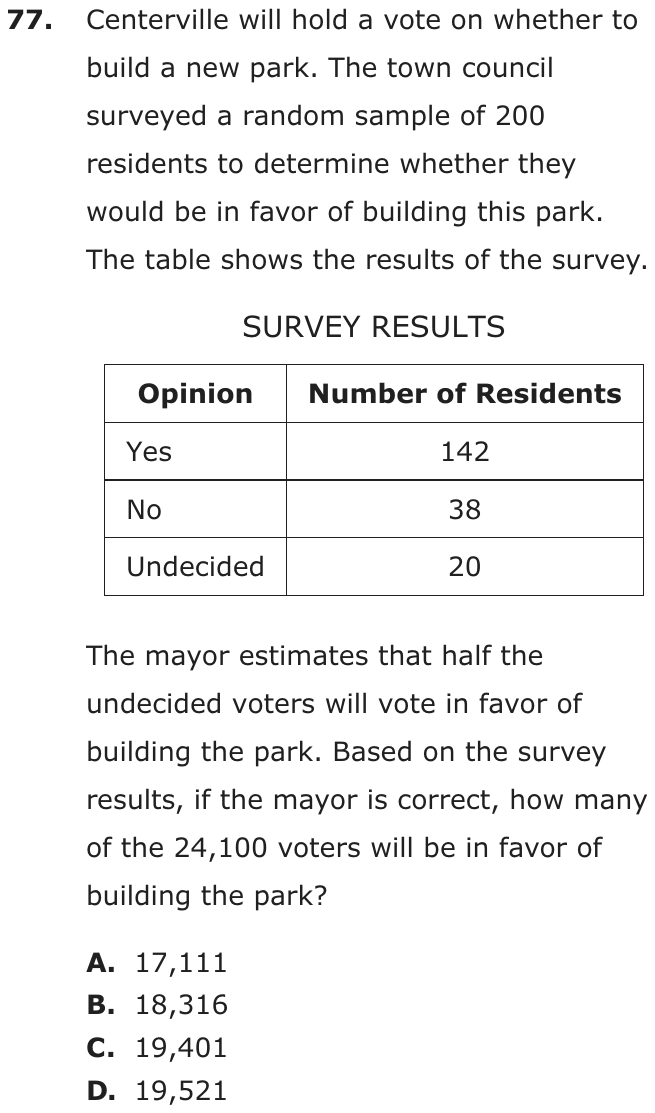
Centerville will hold a vote on whether to build a new park. The town council surveyed a random sample of 200 residents to determine whether they would be in favor of building this park. The table shows the results of the survey.
SURVEY RESULTS
| Opinion | Number of Residents |
|---|---|
| Yes | 142 |
| No | 38 |
| Undecided | 20 |
The mayor estimates that half the undecided voters will vote in favor of building the park. Based on the survey results, if the mayor is correct, how many of the 24,100 voters will be in favor of building the park?
- A17,111
- B18,316
- C19,401
- D19,521
Show the answer
Correct answer: B
If half the undecided voters (half of 20) vote in favor of building the park, the total number of “yes” votes from the survey will be 152.
There are 24,100 voters, and 200 residents were surveyed. Set up a proportion to solve:
Question analysis
A survey question: a random sample of 200 Centerville residents answered yes, no or undecided about building a park, and the mayor expects half the undecided to vote yes. Students use the sample to predict how many of 24,100 voters will favor the park. It joins a proportion from a sample with large-number arithmetic.
- Grade level
- Grade 7 content, by NYS standard
- Compared with grade 7
- At grade 7 Using a random sample to estimate a count in a whole population is a typical grade 7 proportion task. The extra step for the undecided group and the large numbers add care without going beyond grade 7.
- Estimated difficulty
- Hard: combines ideas, needs a plan, and has more than one tempting wrong answer.
- Thinking it demands
- Depth of knowledge 2, skills and concepts · mainly apply
- What makes it hard
- Error-prone arithmetic moderate
- Turning words into math moderate
- Reading a figure, table or graph minor
- Solution
- 3 steps
- Reading level
- Question and choices: about grade 5, 88 words.
- Students, last 30 days
- Not enough answers yet to show (it takes 10).
Why it is hard, traps and wrong answers (shows the answer)
Why it is hard
The setup is a sample-to-population proportion, and the trap is the mayor's assumption in the middle of the stem. Students who scale the 142 yes answers directly, or who count every undecided resident, reach believable totals that sit right among the choices. Once the count of 152 is settled, a rough estimate, about three quarters of 24,000, is enough to confirm the exact product.
Error-prone arithmetic moderate Working it out
Scaling 152 out of 200 up to 24,100 voters means computing 24,100 × 0.76, or 120.5 × 152, by hand with five-digit numbers. (Brown & Burton, 1978; Junker & Sijtsma, 2001)
Turning words into math moderate Understanding the question
The mayor's sentence adds a step: “half the undecided voters” turns the 20 undecided residents into 10 more yes votes, giving 152 before any scaling. (Hegarty, Mayer & Monk, 1995; Koedinger & Nathan, 2004)
Reading a figure, table or graph minor Understanding the question
The table gives Yes, No and Undecided counts, and the half must be taken of the Undecided row, not of the No row just above it. (Lesh, Post & Behr, 1987; Kirsch & Mosenthal, 1990)
Strategy: Count the sample's expected yes votes, including half of the undecided, write them as a fraction of 200, and multiply that fraction by 24,100; estimate first to check the choice.
Traps
- Misreads the question: Misses or misreads a condition or a word in the question: "at least", "each", "remaining", "not".
- Misreads the figure: Reads a value, label or tick spacing in a figure, table or graph wrongly.
The wrong answers, classified
A Misreads the question (Hegarty, Mayer & Monk, 1995)
Uses only the 142 yes answers, 142/200 of 24,100 = 17,111, leaving out the undecided residents the mayor expects to vote yes.
C Misreads the figure (Lesh, Post & Behr, 1987; Kirsch & Mosenthal, 1990)
Takes half of the 38 No answers instead of the 20 Undecided, reading the wrong row, so 161/200 of 24,100 ≈ 19,401.
D Misreads the question (Hegarty, Mayer & Monk, 1995)
Counts all 20 undecided residents as yes votes instead of half of them, so 162/200 of 24,100 = 19,521.
Worked solution, step by step
Formulas used
- Scaling up a sample
- A random sample is a smaller group picked by chance. Its share of yes votes should be about the same as the whole town’s share. So the two fractions are set equal. Use it to scale a survey up to a whole group.
Sort out what you know
The town surveyed 200 people. 142 said Yes, 38 said No, and 20 were Undecided (not sure yet). The mayor thinks half of the undecided people will vote yes. There are 24,100 voters in all. You need how many of them will vote yes.
Count the yes votes in the survey
Half of the 20 undecided people is . Add them to the yes votes.
So 152 of the 200 people surveyed would vote yes. Watch out: take half of the Undecided row, not the No row. Half of 38 leads to 19,401, choice C.
Find the share who vote yes
That is 76% of the people surveyed. The sample was random, so about 76% of all the voters should vote yes too. Watch out: using only the 142 yes votes gives 17,111, choice A. Counting all 20 undecided people gives 19,521, choice D.
Scale up to all the voters
Break it into easy parts. 75% is , and 1% is .
So the answer is B, 18,316.
Check your answer
Estimate. 76% is a little more than three fourths. Three fourths of 24,000 is 18,000. So the answer should be a little more than 18,000, and 18,316 fits. Also, , the same share as the survey.
More questions like this
The original DOE question
Question 5 of 5
2023 Test A Math, question 46Question
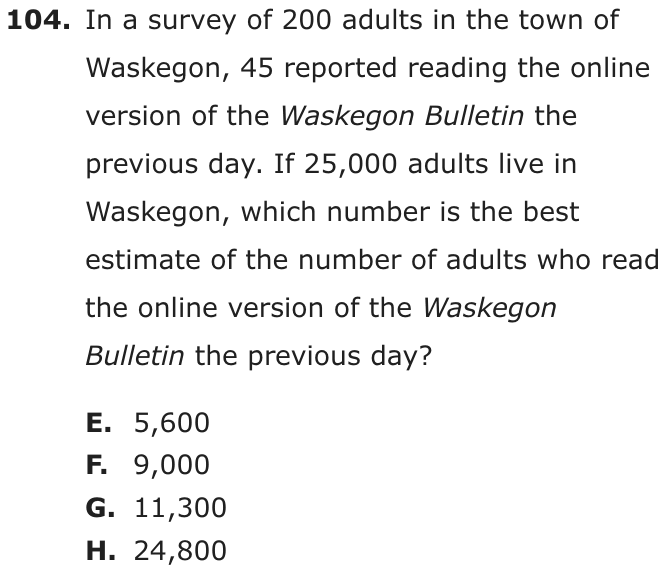
ESSAY LENGTH
| Number of Words | Number of Essays |
|---|---|
| <100 | 6 |
| 100–250 | 4 |
| 251–500 | 11 |
| >500 | 9 |
All 150 students in Grade 8 at a school are assigned to write an essay on the same topic. A teacher records the number of words in a random sample of the essays, as shown in the table above. Based on this sample, how many students in the entire grade would be expected to write essays with at least 100 words?
- A20
- B30
- C100
- D120
Show the answer
Correct answer: D
The number of students in the sample who wrote an essay with at least 100 words is 24 out of the 30 students. Write it as a fraction: . To predict the number of students in the entire grade who would write an essay with at least 100 words, find of 150, which is .
Question analysis
This statistics question gives a table of word counts for a random sample of Grade 8 essays and asks how many of all 150 students would be expected to write at least 100 words. Students find the sample size, the share meeting the condition, and scale it to the whole grade. Matching the words at least to the table's ranges is the tricky part.
- Grade level
- Grade 6 content, by NYS standard
- Compared with grade 7
- At grade 7 Using a random sample to predict a count for a whole population is typical grade 7 statistics and ratio work. Students total the sample from a table, read at least 100 against the table's ranges, and scale by a whole-number factor.
- Estimated difficulty
- Moderate: several steps, or a close reading with one strong distractor.
- Thinking it demands
- Depth of knowledge 2, skills and concepts · mainly apply
- What makes it hard
- Reading a figure, table or graph moderate
- Turning words into math minor
- Many steps minor
- Solution
- 3 steps
- Reading level
- Question and choices: about grade 6, 65 words.
- Students, last 30 days
- Not enough answers yet to show (it takes 10).
Why it is hard, traps and wrong answers (shows the answer)
Why it is hard
The proportion at the end is routine; the question is decided at the table. Students must turn “at least 100 words” into the right rows and also find the sample size, which is printed nowhere. Each listed wrong answer scales up a different group of rows, so a careless reading still produces a believable number. Noting that only 6 of 30 essays fall short, one fifth, gives a quick check.
Reading a figure, table or graph moderate Understanding the question
The table never prints the sample size; it has to be built by adding all four rows, 6 + 4 + 11 + 9 = 30, and the qualifying essays sit in three rows, not one. (Lesh, Post & Behr, 1987; Kirsch & Mosenthal, 1990)
Turning words into math minor Understanding the question
The bold “at least 100 words” must be matched to the rows 100–250, 251–500 and >500, keeping the row that begins at 100 and leaving out only the <100 row. (Hegarty, Mayer & Monk, 1995; Koedinger & Nathan, 2004)
Many steps minor Working it out
Four steps follow in order: the sample total, the qualifying count of 24, the fraction 24/30 = 4/5, and that fraction of all 150 students. (Daniel & Embretson, 2010; Enright, Morley & Sheehan, 2002)
Strategy: Add the table's counts to find the sample size, add the rows with 100 or more words, and scale that fraction of the sample up to all 150 students.
Traps
- Misreads the question: Misses or misreads a condition or a word in the question: "at least", "each", "remaining", "not".
- Answers a different question: A choice is right for another quantity: the other unknown, the rest instead of the part, the part instead of the whole.
The wrong answers, classified
A Misreads the question (Hegarty, Mayer & Monk, 1995)
Counts only the 100–250 row as at least 100 words, then scales its 4 essays up to the grade: 4/30 of 150 = 20.
B Answers a different question (King et al., 2004; Hegarty, Mayer & Monk, 1995)
Scales up the 6 essays with fewer than 100 words, 6/30 of 150 = 30, the very students the question leaves out.
C Misreads the question (Hegarty, Mayer & Monk, 1995)
Leaves out the 100–250 row, as if at least 100 meant more than 250, so it scales 11 + 9 = 20 essays up to 100.
Worked solution, step by step
Formulas used
- Predicting from a sample
- A sample is a smaller group picked at random from the whole group. The fraction of the sample with some feature is your best guess for the fraction of the whole group. So multiply that fraction by the size of the whole group.
Sort out the question
The table shows a random sample of the essays from a grade of 150 students. You need to predict how many of the 150 students wrote at least 100 words. At least 100 means 100 or more.
Find the sample size
The table doesn’t give the total, so add all four rows.
The sample has 30 essays.
Count the essays with enough words
Three rows count: 100–250, 251–500 and >500. Only the <100 row is left out.
Watch out: the 100–250 row counts, because 100 is at least 100. Leaving it out gives 100, choice C. Using the 6 short essays instead gives 30, choice B.
Scale up to the whole grade
About 4 out of every 5 students write at least 100 words. So the answer is D, 120 students.
Check your answer
The whole grade, 150, is 5 times the sample of 30. So multiply the sample count by 5: . The short essays scale to , and 120 + 30 = 150, the whole grade.
More questions like this
The original DOE question