Question
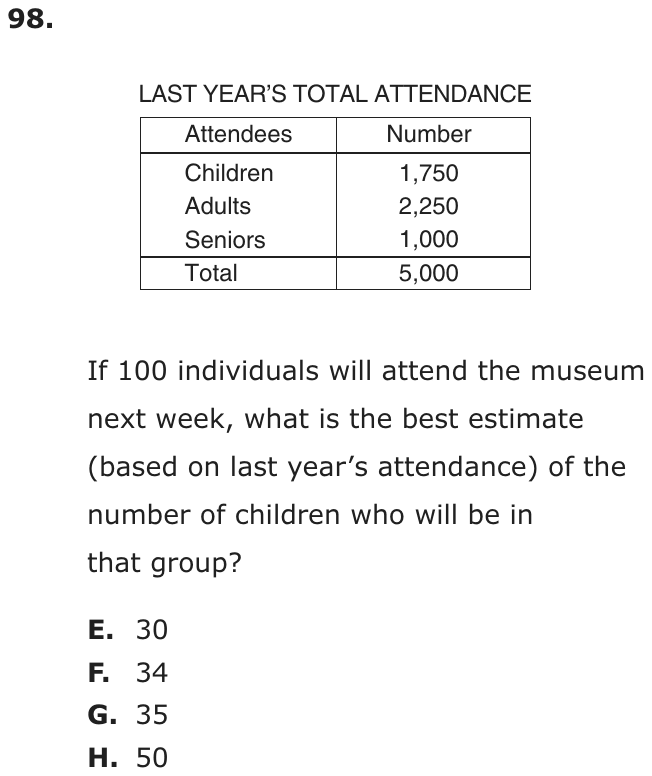
LAST YEAR’S TOTAL ATTENDANCE
| Attendees | Number |
|---|---|
| Children | 1,750 |
| Adults | 2,250 |
| Seniors | 1,000 |
| Total | 5,000 |
If 100 individuals will attend the museum next week, what is the best estimate (based on last year’s attendance) of the number of children who will be in that group?
- A30
- B34
- C35
- D50
Show the answer
Correct answer: C
First, determine what percentage of the total attendees last year were children.
The best estimate based on last year’s attendance is 35% of 100.
Question analysis
A table gives last year's attendance by children, adults and seniors, 5,000 people in all. If 100 people attend the museum next week, students estimate how many of them will be children. It tests using a ratio or percent from data to make a prediction; only the children's row and the total matter.
- Grade level
- Grade 6 content, by NYS standard
- Compared with grade 7
- Below grade 7 Using last year's share of visitors to predict a smaller group is grade 6 ratio and probability work. A group of exactly 100 makes the scaling easy, so the arithmetic is lighter than in typical grade 7 proportion problems.
- Estimated difficulty
- Straightforward: two steps or one careful reading.
- Thinking it demands
- Depth of knowledge 2, skills and concepts · mainly apply
- What makes it hard
- Solution
- 2 steps
- Reading level
- Question and choices: about grade 5, 38 words.
- Students, last 30 days
- Not enough answers yet to show (it takes 10).
Why it is hard, traps and wrong answers (shows the answer)
Why it is hard
The share 1,750 out of 5,000 converts neatly to 35 out of 100, and next week's group happens to be exactly 100, so the arithmetic is nearly done once the proportion is written. Points slip away when a student works out the scale factor between the two totals and gives it, or estimates the share instead of computing it. Dividing 1,750 by 50 checks the result.
Turning words into math minor Understanding the question
The phrase “best estimate (based on last year’s attendance)” has to become a proportion: children keep the share of next week's 100 that they had of last year's 5,000. (Hegarty, Mayer & Monk, 1995; Koedinger & Nathan, 2004)
Reading a figure, table or graph minor Understanding the question
Only the children row, 1,750, and the 5,000 total are needed; the adults and seniors rows add numbers that play no part in the estimate. (Lesh, Post & Behr, 1987; Kirsch & Mosenthal, 1990)
Strategy: Find what fraction of last year's 5,000 visitors were children, rewrite it as an equivalent fraction out of 100, and apply it to next week's group.
Traps
- Stops one step early: A choice is a number from partway through the solution.
- Information you don't need: The question gives numbers or facts that play no part in the answer.
The wrong answers, classified
A Little reason to choose it (Haladyna & Downing, 1993; Rodriguez, 2005)
No common working gives 30, which would need 1,500 children last year; it mostly draws students who round the share down or guess a round number.
B Little reason to choose it (Haladyna & Downing, 1993; Rodriguez, 2005)
No common working gives 34; splitting 100 evenly among three groups gives 33 1/3, the closest route, so it mostly draws guesses.
D Stops one step early (King et al., 2004; Gierl et al., 2017)
Divides 5,000 by 100 to get the scale factor, 50, and gives it, stopping before dividing the 1,750 children by that factor.
Worked solution, step by step
Formulas used
- Percent of a total
- The part is the number in one group, here children. The whole is the total of all groups. Dividing gives the fraction of the whole that the group makes up. Times 100 turns it into a percent, a number out of 100.
- Percent of a number
- p is the percent. The whole is the full amount. The part is the piece that matches the percent. Percent means out of 100, so p% is p hundredths of the whole.
Sort out the question
Last year 5,000 people came in all. 1,750 of them were children. Next week 100 people will come. You need the best estimate of how many will be children. Best estimate means children make up the same share as last year. You don’t need the adults and seniors rows.
Find last year’s percent of children
So 35% of last year’s visitors were children. That means 35 out of every 100.
Use that percent for 100 people
About 35 of the 100 people should be children. Watch out: tells how many times bigger last year’s crowd was. It is not a number of children. Don’t pick 50, choice D. So the answer is C, 35.
Check your answer
Shrink both numbers the same way. Since , divide the children by 50 too: . That matches. Also, 1,750 is a bit more than one third of 5,000, and 35 is a bit more than one third of 100.
More questions like this
The original DOE question