Question
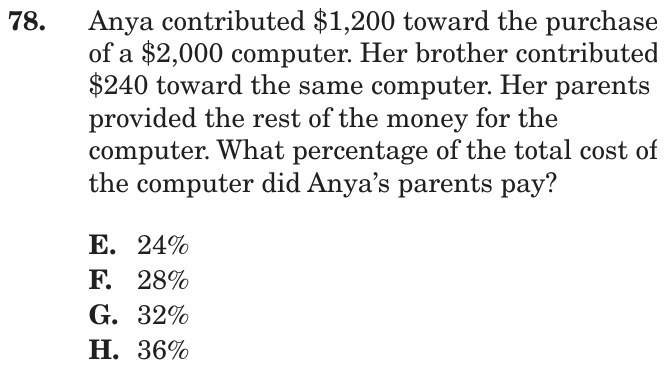
Anya contributed $1,200 toward the purchase of a $2,000 computer. Her brother contributed $240 toward the same computer. Her parents provided the rest of the money for the computer. What percentage of the total cost of the computer did Anya’s parents pay?
- A24%
- B28%
- C32%
- D36%
Show the answer
Correct answer: B
First, calculate the amount of money Anya’s parents contributed:
.
Then, find what percentage of $2,000 is $560:
Question analysis
Anya puts $1,200 and her brother $240 toward a $2,000 computer, and their parents pay the rest. Students find what percent of the cost the parents paid. It is a two-step percent word problem in which the percent describes an amount the stem never states.
- NYS standards
- 6.RP.3c percent as a rate per 100
- Grade level
- Grade 6 content, by NYS standard
- Compared with grade 7
- Below grade 7 Writing a part as a percent of a whole is grade 6 work. Finding the parents' share first is quick subtraction, and a total of $2,000 makes the division easy, so this is lighter than grade 7's multistep percent problems.
- Estimated difficulty
- Straightforward: two steps or one careful reading.
- Thinking it demands
- Depth of knowledge 2, skills and concepts · mainly apply
- What makes it hard
- Turning words into math minor
- Solution
- 2 steps
- Reading level
- Question and choices: about grade 8, 39 words.
- Students, last 30 days
- Not enough answers yet to show (it takes 10).
Why it is hard, traps and wrong answers (shows the answer)
Why it is hard
Two easy steps, a subtraction and a division by $2,000, make up the whole solution, so the risk lies in skipping the first. The parents' share is never stated, and a student hunting the stem for a percent finds the brother's $240, whose digits echo one of the choices. The other two wrong percents match no working with the stated amounts and catch only guesses.
Turning words into math minor Understanding the question
“Her parents provided the rest of the money” hides the amount the question is about: $2,000 − $1,200 − $240 = $560 must be found before any percent. (Hegarty, Mayer & Monk, 1995; Koedinger & Nathan, 2004)
Strategy: Subtract both contributions from $2,000 to find the parents' share, then divide that share by $2,000 and change the decimal to a percent.
Traps
- Numbers taken from the question: Combines the numbers in the question without a model of the situation, or is simply a number that appears in the question.
The wrong answers, classified
A Numbers taken from the question (Hegarty, Mayer & Monk, 1995)
Turns the brother's $240 into 24%, matching the digits of a number in the stem instead of finding the parents' $560 share of the $2,000.
C Little reason to choose it (Haladyna & Downing, 1993; Rodriguez, 2005)
No subtraction or division of $1,200, $240 and $2,000 gives 32%, which would mean the parents paid $640, so it mostly catches guesses.
D Little reason to choose it (Haladyna & Downing, 1993; Rodriguez, 2005)
Matches no working with the stated amounts: 36% of $2,000 is $720, a share that no combination of the two contributions leaves for the parents.
Worked solution, step by step
Formulas used
- Percent of a total
- The part is the amount you are asking about, here what the parents paid. The whole is the full amount, the cost of the computer. Dividing gives the fraction of the cost. Multiplying by 100 turns that fraction into a percent, a number out of 100.
Sort out the question
The computer costs $2,000. Anya paid $1,200. Her brother paid $240. Her parents paid the rest. “The rest” means whatever was still left to pay. You need the parents’ part as a percent of the whole $2,000. The question never gives the parents’ amount, so find it first.
Find what the parents paid
Take Anya’s money and her brother’s money away from the full cost.
The parents paid $560.
Watch out: the brother’s $240 has the same digits as 24%, choice A. But the question asks about the parents, not the brother.
Write the parents’ share as a percent
Use the percent formula. The part is $560, and the whole is $2,000.
To simplify, divide the top and the bottom of the fraction by 20. That gives 28 out of 100, which is 28%. So the answer is B, 28%.
Check your answer
Find everyone’s share. Anya paid 1,200 out of 2,000, which is 60%. Her brother paid 240 out of 2,000, which is 12%. The parents paid 28%. Together, . The three shares make up the whole cost, so 28% fits.
More questions like this
The original DOE question