Question
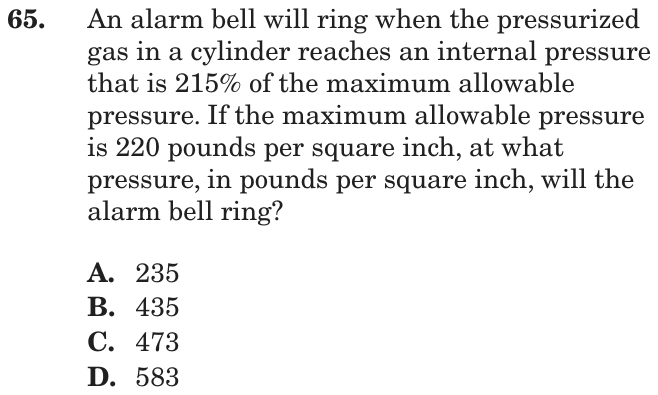
An alarm bell will ring when the pressurized gas in a cylinder reaches an internal pressure that is 215% of the maximum allowable pressure. If the maximum allowable pressure is 220 pounds per square inch, at what pressure, in pounds per square inch, will the alarm bell ring?
- A235
- B435
- C473
- D583
Show the answer
Correct answer: C
Calculate 215% of 220:
Question analysis
A pressure alarm rings when the gas in a cylinder reaches 215% of its maximum allowable pressure of 220 pounds per square inch, and students find that alarm pressure. It tests taking a percent of a number when the percent is greater than 100. Writing 215% correctly as a decimal is the step that matters.
- Grade level
- Grade 6 content, by NYS standard
- Compared with grade 7
- Below grade 7 Finding a percent of a number is grade 6 work. The one unusual feature is a percent above 100, which some students distrust, but the solution is a single multiplication by a decimal, lighter than grade 7's multistep percent problems.
- Estimated difficulty
- Routine: one familiar step, little to misread.
- Thinking it demands
- Depth of knowledge 2, skills and concepts · mainly apply
- What makes it hard
- Solution
- 1 step
- Reading level
- Question and choices: about grade 11, 46 words.
- Students, last 30 days
- Not enough answers yet to show (it takes 10).
Why it is hard, traps and wrong answers (shows the answer)
Why it is hard
This is a single multiplication, so the question is decided by what students make of a percent greater than 100. Anyone who reads 215% as a little more than double expects an answer just above 440, which rules out 235 and 435 at once and leaves 583 far too high. The tempting slip is treating 215 as an amount of pressure to add on, not the arithmetic, which is short once the percent becomes a decimal.
Something you must already know minor Working it out
Writing 215% as the multiplier 2.15 is assumed; a percent above 100 means more than the whole, here a little more than twice the 220 pounds per square inch. (Anderson & Krathwohl, 2001)
Error-prone arithmetic minor Working it out
The product 2.15 × 220 mixes a two-place decimal with a three-digit number; splitting it as 2 × 220 = 440 plus 0.15 × 220 = 33 keeps the decimal point in place. (Brown & Burton, 1978; Junker & Sijtsma, 2001)
Strategy: Write 215% as the decimal 2.15, then multiply the 220-pound maximum by it, since a percent of a quantity means that many hundredths of it.
Traps
- Misunderstands the concept: A wrong belief about a concept: that percents can be added, that area grows like length, that averages can be averaged, that a bigger denominator means a bigger fraction.
The wrong answers, classified
A Little reason to choose it (Haladyna & Downing, 1993; Rodriguez, 2005)
No percent of 220 gives 235, which is 220 plus the 15 from 215%; no rule produces that sum, so it mostly catches guesses.
B Misunderstands the concept (Smith, diSessa & Roschelle, 1993; De Bock et al., 1998; Ni & Zhou, 2005)
Reads 215% as 215 pounds per square inch and adds it to the maximum, 220 + 215 = 435, instead of multiplying 220 by 2.15.
D Little reason to choose it (Haladyna & Downing, 1993; Rodriguez, 2005)
No working with 215% and 220 gives 583, which would be 265% of the maximum; it is 110 above the true pressure and mostly draws guesses.
Worked solution, step by step
Formulas used
- Percent of a number
- p is the percent. The whole is the amount you take the percent of. The part is the result. Percent means “out of 100,” so p% is p hundredths of the whole. That is why you divide p by 100 and then multiply.
Sort out the question
The alarm rings when the pressure reaches 215% of the maximum allowable pressure. The maximum is 220 pounds per square inch. Pounds per square inch is a unit for pressure. So you need 215% of 220. In math, “of” after a percent means multiply.
Picture a percent over 100
100% of an amount is all of it. 200% is twice as much. So 215% is a little more than double. Double 220 is . The answer should be a little more than 440 pounds per square inch.
Watch out: 215% is not 215 pounds per square inch. Adding 215 to 220 gives 435, choice B. That is less than double, so it can’t be right.
Change the percent to a decimal
Percent means “out of 100.” So divide 215 by 100. That moves the decimal point two places to the left.
So 215% is the same as 2.15. That is 2 wholes and 15 hundredths.
Multiply the maximum by 2.15
Use the percent formula with p = 215 and the whole = 220.
Split 2.15 into 2 and 0.15. Multiply each one by 220, then add.
The alarm rings at 473 pounds per square inch. So the answer is C, 473.
Check your answer
Build 215% from easy pieces of 220. 200% is 440. 10% is 22. 5% is half of that, 11. Add them: . That matches. It is also just above 440, as the estimate said.
More questions like this
The original DOE question