Question
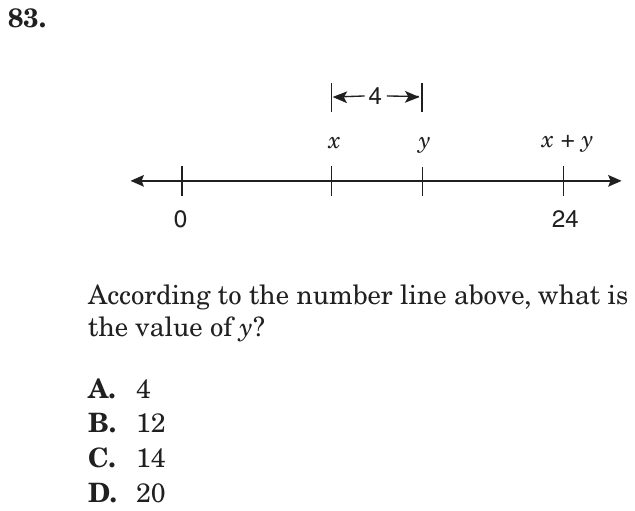
According to the number line above, what is the value of y?
- A4
- B12
- C14
- D20
Show the answer
Correct answer: C
According to the number line, and . Add the two equations together and solve for y:
Question analysis
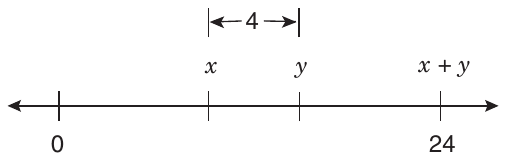
A number line marks 0, x, y and x + y, with x + y at 24 and a bracket showing that x and y are 4 units apart. Students find the value of y. The question combines reading a number line with solving for two unknowns, and the bracket and the sum have to be used together.
- Grade level
- Grade 7 content, by NYS standard
- Compared with grade 7
- At grade 7 Two unknowns usually call for grade 8 systems, but here one unknown is 4 more than the other, so a single grade 7 equation of the form px + q = r is enough. Reading those facts from a number line adds a step.
- Estimated difficulty
- Moderate: several steps, or a close reading with one strong distractor.
- Thinking it demands
- Depth of knowledge 2, skills and concepts · mainly apply
- What makes it hard
- Reading a figure, table or graph moderate
- Variables instead of numbers minor
- No obvious method minor
- Solution
- 3 steps
- Reading level
- Question and choices: about grade 6, 12 words.
- Students, last 30 days
- Not enough answers yet to show (it takes 10).
Why it is hard, traps and wrong answers (shows the answer)
Why it is hard
The number line holds all the information but none of it as an equation, and the drawing is not to scale, so the positions must come from the labels. Students who split 24 evenly stop at the point midway between x and y, and those who take the bracket's 4 for a position subtract it from 24. Writing the two facts down and checking the result, 10 + 14 = 24 with a gap of 4, closes off every listed slip.
Reading a figure, table or graph moderate Understanding the question
The two facts needed, y − x = 4 and x + y = 24, are never written; they come from the bracket over x and y and from the 24 under the tick marked x + y. (Lesh, Post & Behr, 1987; Kirsch & Mosenthal, 1990)
Variables instead of numbers minor Understanding the question
Neither x nor y has a value, and the point x + y is itself built from both, so nothing can be placed until the two facts are combined. (Koedinger & Nathan, 2004; Enright, Morley & Sheehan, 2002)
No obvious method minor Working it out
Two unknowns usually call for a system of equations, which grade 7 students have not met; they must instead write y as x + 4, or see that x and y sit 2 units either side of 12. (Schoenfeld, 1985)
Strategy: Write the two facts the labels give, y − x = 4 and x + y = 24, then add the equations or replace y with x + 4; the drawing is not to scale, so don't measure.
Traps
- Stops one step early: A choice is a number from partway through the solution.
- Misreads the figure: Reads a value, label or tick spacing in a figure, table or graph wrongly.
- Numbers taken from the question: Combines the numbers in the question without a model of the situation, or is simply a number that appears in the question.
The wrong answers, classified
A Numbers taken from the question (Hegarty, Mayer & Monk, 1995)
Gives the labeled distance between x and y as the value of y, a number read straight off the figure rather than worked out.
B Stops one step early (King et al., 2004; Gierl et al., 2017)
Halves the sum 24 to get 12, the point midway between x and y, and stops before adding half of the 4-unit gap.
D Misreads the figure (Lesh, Post & Behr, 1987; Kirsch & Mosenthal, 1990)
Takes the 4 above x as the position of x rather than the gap from x to y, so y = 24 − 4 = 20.
Worked solution, step by step
Formulas used
- Distance on a number line
- On a number line, numbers get bigger to the right. The distance between two points is how many units apart they are. Subtract the left number from the right one, so the distance is never negative.
- Keeping an equation balanced
- An equation says two sides are equal, like a balanced scale. a and b are the two sides. c is any number, but not 0 when you divide. Doing the same thing to both sides keeps them equal. Use it to get the letter by itself.
Sort out the question
The number line shows 0, x, y and x + y. You need the value of y. The drawing is not to scale, though the question doesn’t say so. That means the spacing on the page doesn’t match the numbers. If you measure, y looks like it is near 15. So don’t measure. Work only from the labels.
Write the labels as equations
An equation is a math sentence that says two amounts are equal. The bracket marked 4 runs from x to y, and y is to the right.
So y is 4 more than x, or y = x + 4. The tick marked x + y has 24 under it, so x + y = 24.
Watch out: the 4 is the distance from x to y. It is not where x is, and it is not y. Taking x as 4 gives , choice D. Taking y as 4 is choice A.
Put x + 4 in place of y
Two unknown letters are hard to solve at once. y is the same as x + 4, so swap it into x + y = 24. Now there is only one letter.
Here 2x means 2 times x. Two x’s plus 4 make 24.
Solve for x
Subtract 4 from both sides. Then divide both sides by 2. Doing the same to both sides keeps the equation balanced.
So x is 10.
Find y
y is 4 more than x.
So y is 14.
Watch out: half of 24 is 12, choice B. That is the point halfway between x and y. y is 2 more than that.
So the answer is C, 14.
Check your answer
Put both numbers back. , so x + y lands at 24. , so x and y are 4 apart. Both labels work. Notice that y is 14, not the 15 or so that the drawing suggests.
More questions like this
The original DOE question