6.SP.6 probability from 0 to 1
Question 1 of 4
2026 Practice Test B Math, question 13Question
A basket contains 3 apples, 4 oranges, 5 bananas, and 8 pears.
If one piece of fruit is randomly pulled from the basket, what is the probability that it will be a pear?
Select the place on the number line to plot the point.
On the test you click a point on the number line; here, choose it from the menu.
Show the answer
Correct answer: the point 0.4
The total number of fruits is:
The probability of picking a pear is:
Question analysis
A basket holds apples, oranges, bananas and pears, and students find the probability that a piece of fruit pulled at random is a pear, then plot it as a point on a number line from 0 to 1. It tests simple probability as a part of a whole. With no choices to pick from, the fraction has to be turned into tenths to find its place.
- Grade level
- Grade 6 content, by NYS standard
- Compared with grade 7
- Below grade 7 Finding the probability of a simple event from counts is grade 6 work in New York. This one adds four whole numbers, forms one fraction and plots it among marked tenths, a shorter and more routine task than grade 7 probability.
- Estimated difficulty
- Routine: one familiar step, little to misread.
- Thinking it demands
- Depth of knowledge 1, recall and reproduction · mainly apply
- What makes it hard
- Solution
- 3 steps
- Reading level
- Question and choices: about grade 6, 40 words.
- Students, last 30 days
- Not enough answers yet to show (it takes 10).
Why it is hard, traps and wrong answers (shows the answer)
Why it is hard
Adding the four counts to 20 and writing 8 over 20 is routine, so most students succeed. The losses come from the number line: its decimal labels make it easy to read the 8 pears as 0.8, and a part-to-part fraction such as 8/12 falls between marks and has to be rounded, which should prompt a second look. Simplifying 8/20 to 2/5 and then to 4/10 makes the mark plain.
Something you must already know minor Working it out
The question does not say that a probability is the favorable count over the whole count, here the 8 pears over all 20 pieces of fruit rather than over the other 12. (Anderson & Krathwohl, 2001)
An answer in an unexpected form minor Choosing the answer
The number line is labeled only in tenths from 0 to 1, so 8/20 has to be rewritten as a decimal before the right mark can be chosen. (Enright, Morley & Sheehan, 2002)
Strategy: Add up all the fruit for the total, write the number of pears over that total, rewrite the fraction in tenths, and select that mark on the line.
Traps
- Answers a different question: A choice is right for another quantity: the other unknown, the rest instead of the part, the part instead of the whole.
- Misunderstands the concept: A wrong belief about a concept: that percents can be added, that area grows like length, that averages can be averaged, that a bigger denominator means a bigger fraction.
The wrong answers, classified
0.8 Numbers taken from the question (Hegarty, Mayer & Monk, 1995)
Takes the 8 pears straight to the mark labeled 0.8, never dividing by the 20 pieces of fruit in the basket.
0.7 Misunderstands the concept (Smith, diSessa & Roschelle, 1993; De Bock et al., 1998; Ni & Zhou, 2005)
Compares the 8 pears with the 12 other pieces of fruit, 8/12 or about 0.67, a part-to-part ratio, and plots the nearest tenth.
0.6 Answers a different question (King et al., 2004; Hegarty, Mayer & Monk, 1995)
Puts the 12 apples, oranges and bananas over the 20 pieces of fruit, plotting the chance of not getting a pear instead of getting one.
Worked solution, step by step
Formulas used
- Probability of an event
- P is the probability, the chance that something happens. It goes from 0 (never) to 1 (always). The top counts the results you want, here pears. The bottom counts every possible result, here every piece of fruit. It works when each result is equally likely, like grabbing fruit without looking.
- Equal fractions
- a is the top of a fraction, and b is the bottom. n is any number except 0. Dividing the top and the bottom by the same number gives an equal fraction. Use it to get 10 on the bottom, which is easy to write as a decimal.
Sort out the question
The basket has 3 apples, 4 oranges, 5 bananas and 8 pears. You pull out one piece without looking. You need the probability that it is a pear. Then you plot that number as a point. The number line runs from 0 to 1, with a mark at every tenth.
Count all the fruit
The bottom of the fraction is every piece of fruit you could pull out. Add all four kinds:
There are 20 pieces of fruit in all.
Write the probability as a fraction
Use the probability formula. There are 8 pears out of 20 pieces of fruit:
Watch out: the bottom is all the fruit, not just the other fruit. compares the pears with the 12 fruits that are not pears. It is about 0.67, and it leads you to the mark at 0.7. And 12 over 20 is the chance of not getting a pear.
Change it to tenths
The number line is marked in tenths. So rewrite the fraction with 10 on the bottom. Divide the top and the bottom by 2:
Four tenths is written 0.4.
Watch out: the 8 pears do not make 0.8. That skips dividing by the 20 pieces of fruit.
Plot the point
Start at 0 and count four marks to the right: 0.1, 0.2, 0.3, 0.4. On the test, you click the mark labeled 0.4. On this site, you choose 0.4 from the menu.
So the answer is the point at 0.4.
Check your answer
The chance of not getting a pear is . A pear and not a pear cover every result, so the two must add to 1: . Also, pears are less than half of the fruit, so the point should be left of 0.5. It is.
More questions like this
The original DOE question

Question 2 of 4
2026 Practice Test C Math, question 12Question
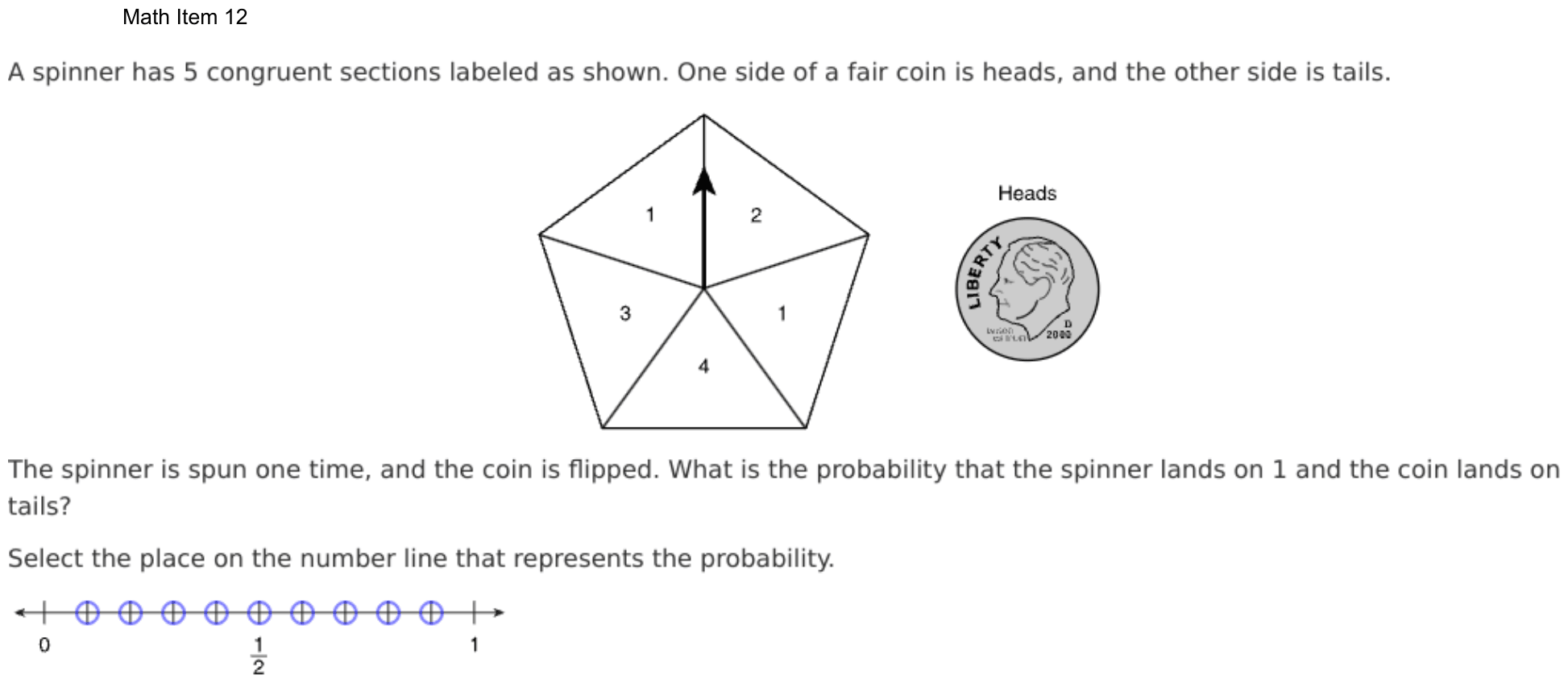
A spinner has 5 congruent sections labeled as shown. One side of a fair coin is heads, and the other side is tails.
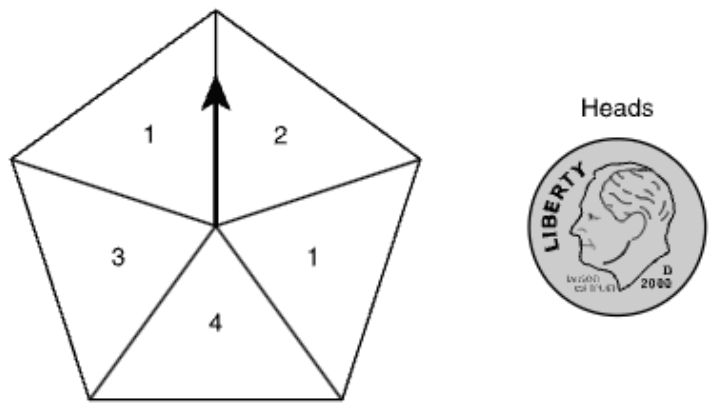
The spinner is spun one time, and the coin is flipped. What is the probability that the spinner lands on 1 and the coin lands on tails?
Select the place on the number line that represents the probability.
On the test you click a point on the number line; here, choose it from the menu.
Show the answer
Correct answer: the point 0.2
The spinner has five equal-sized sections. Two of the sections are labeled with a 1. So, the probability of landing on a 1 is two out of five, or 2/5.
A coin has two sides, one heads and one tails. So, the probability of landing on tails is one out of two, or 1/2.
The compound probability of the spinner landing on a 1 and the coin landing on tails can be calculated by multiplying 2/5 and 1/2 as shown:
Question analysis
A spinner with five equal sections is spun once and a fair coin is flipped. Students find the probability that the spinner lands on 1 and the coin shows tails, then select that point on a number line from 0 to 1. Counting the right sections and combining the two events correctly are the tricky parts.
- Grade level
- Grade 7 content, by NYS standard
- Compared with grade 7
- At grade 7 Finding the chance of two independent events together is grade 7 compound probability, here with one spinner and one coin. Counting sections from the picture and placing the result on a number line add two small steps.
- Estimated difficulty
- Moderate: several steps, or a close reading with one strong distractor.
- Thinking it demands
- Depth of knowledge 2, skills and concepts · mainly apply
- What makes it hard
- Solution
- 3 steps
- Reading level
- Question and choices: about grade 5, 59 words.
- Students, last 30 days
- Not enough answers yet to show (it takes 10).
Why it is hard, traps and wrong answers (shows the answer)
Why it is hard
The probability itself takes one multiplication of two simple fractions; the losses come before and after it. Before, the spinner has to be searched for every section labeled 1, and the coin's chance brought in as well. After, 1/5 has to be rewritten as 2/10 to find its point, since only 0, 1/2 and 1 are labeled. Checking that the result is smaller than both separate chances catches an addition.
Reading a figure, table or graph moderate Understanding the question
The two sections labeled 1, upper left and right, are not side by side, and the number line labels only 0, 1/2 and 1, so its nine points must be read as tenths. (Lesh, Post & Behr, 1987; Kirsch & Mosenthal, 1990)
Something you must already know minor Working it out
Nothing says that the chance of two independent events both happening is the product of their chances, 2/5 × 1/2, rather than their sum. (Anderson & Krathwohl, 2001)
Strategy: Count the sections labeled 1 to get the spinner's chance, take the coin's chance of tails, multiply the two because both must happen, and write the result in tenths.
Traps
- Stops one step early: A choice is a number from partway through the solution.
- Wrong operation: Adds instead of multiplying, divides the wrong way round, turns a ratio or rate upside down, or undoes a step in the wrong direction (subtracts what should be added back).
- Misreads the figure: Reads a value, label or tick spacing in a figure, table or graph wrongly.
The wrong answers, classified
0.4 Stops one step early (King et al., 2004; Gierl et al., 2017)
Finds the spinner's chance of landing on 1, two sections out of five, and plots 2/5 without multiplying by the coin's chance of tails.
0.9 Wrong operation (Hegarty, Mayer & Monk, 1995; King et al., 2004)
Adds the two chances, 2/5 + 1/2 = 9/10, instead of multiplying them, though both events must happen together.
0.1 Misreads the figure (Lesh, Post & Behr, 1987; Kirsch & Mosenthal, 1990)
Counts only one section labeled 1, so multiplies 1/5 by 1/2 and plots 1/10, missing the second 1 on the spinner.
Worked solution, step by step
Formulas used
- Probability of an event
- P is the probability, the chance that something happens. It goes from 0 (never) to 1 (always). The top counts the results you want. The bottom counts all possible results. It works when every result is equally likely, like equal sections of a spinner.
- Probability that two things both happen
- A and B are two events that do not affect each other, like a spin and a coin flip. P(A) and P(B) are their chances. Multiply them to get the chance that both happen. Needing both makes the chance smaller, never bigger.
Sort out the question
The spinner has 5 congruent sections. Congruent means the same size and shape, so each is equally likely. The coin has a heads side and a tails side. You need the chance that the spinner lands on 1 and the coin lands on tails.
Find the spinner’s chance
Two sections show 1: the upper left one and the one on the right. So 2 of the 5 equal sections give a 1:
Watch out: the two 1s are not next to each other. Counting only one gives 1/5 here, and 0.1 at the end.
Find the coin’s chance
A fair coin is equally likely to land on either side. Tails is 1 of its 2 sides:
Multiply the two chances
The spin and the flip do not affect each other, and both must happen. So multiply:
Watch out: stopping at 2/5 gives 0.4. Adding gives , or 0.9. Both are wrong.
Select the point
On the test, the number line labels only 0, 1/2 and 1. Between 0 and 1 are 9 targets, one at each tenth. 0.2 is the second target to the right of 0. On this site, choose 0.2 from the Point menu.
So the answer is the point at 0.2.
Check your answer
List every result. The spinner has 5 sections and the coin has 2 sides, so there are results, all equally likely. Just 2 of them are a 1 with tails, one for each section labeled 1. That is 2 out of 10, or 0.2.
More questions like this
The original DOE question
Question 3 of 4
2026 Practice Test C Math, question 37Question
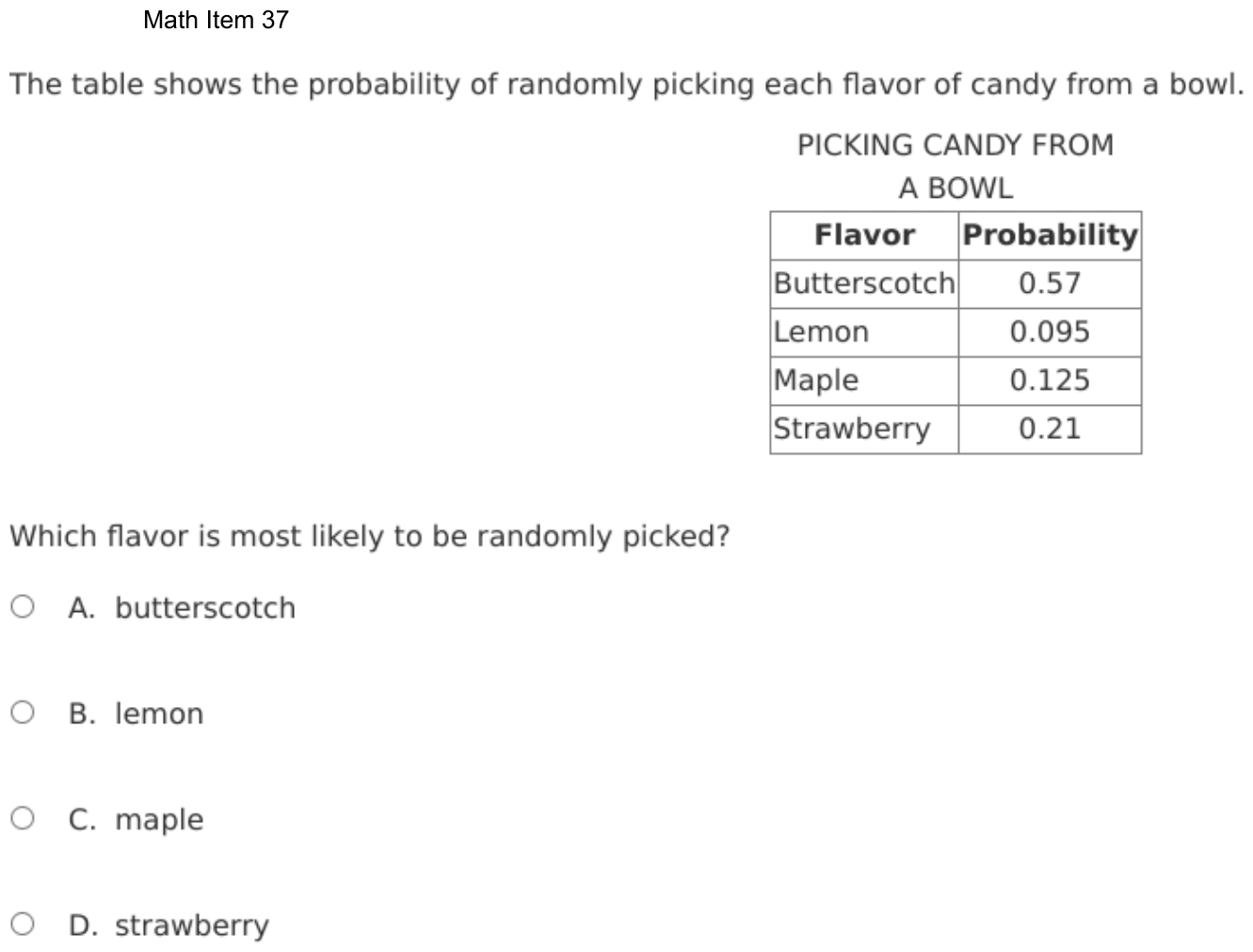
The table shows the probability of randomly picking each flavor of candy from a bowl.
PICKING CANDY FROM
A BOWL
| Flavor | Probability |
|---|---|
| Butterscotch | 0.57 |
| Lemon | 0.095 |
| Maple | 0.125 |
| Strawberry | 0.21 |
Which flavor is most likely to be randomly picked?
- Abutterscotch
- Blemon
- Cmaple
- Dstrawberry
Show the answer
Correct answer: A
The flavor most likely to be picked at random is butterscotch, because its probability is the greatest of the probabilities in the list. More than half the candies in the bowl are butterscotch.
Question analysis
A table lists the probability of picking butterscotch, lemon, maple or strawberry candy at random from a bowl, each as a decimal. Students decide which flavor is most likely to be picked. It tests the meaning of probability and comparing decimals, which have different numbers of digits here and must be compared by place value.
- Grade level
- Grade 6 content, by NYS standard
- Compared with grade 7
- Below grade 7 Reading probabilities as likelihoods is grade 6 content, and this needs only a comparison of four decimals. The one demand is comparing decimals with different numbers of digits, a skill from earlier grades.
- Estimated difficulty
- Routine: one familiar step, little to misread.
- Thinking it demands
- Depth of knowledge 1, recall and reproduction · mainly understand
- What makes it hard
- Error-prone arithmetic minor
- Solution
- 1 step
- Reading level
- Question and choices: about grade 9, 37 words.
- Students, last 30 days
- Not enough answers yet to show (it takes 10).
Why it is hard, traps and wrong answers (shows the answer)
Why it is hard
One idea answers the question: the most likely flavor has the greatest probability. The only obstacle is comparing decimals of different lengths, where 0.125 and 0.095 look bigger than 0.57 to students who count digits. Writing each as thousandths, 570, 95, 125 and 210, or noticing that 0.57 alone is more than one half, makes the order plain.
Error-prone arithmetic minor Working it out
The probabilities have two and three decimal places, 0.57 beside 0.095 and 0.125, so comparing them by length, or by their digits as whole numbers, ranks them wrongly. (Brown & Burton, 1978; Junker & Sijtsma, 2001)
Strategy: Line the four decimals up by place value, adding zeros so each has three decimal places, and compare them digit by digit starting from the tenths place.
Traps
- Misunderstands the concept: A wrong belief about a concept: that percents can be added, that area grows like length, that averages can be averaged, that a bigger denominator means a bigger fraction.
The wrong answers, classified
B Misreads the figure (Lesh, Post & Behr, 1987; Kirsch & Mosenthal, 1990)
Reads lemon’s 0.095 as 0.95, overlooking the 0 in the tenths place, so it looks almost certain and larger than 0.57.
C Misunderstands the concept (Smith, diSessa & Roschelle, 1993; De Bock et al., 1998; Ni & Zhou, 2005)
Treats the decimal with more digits as the larger, or compares 125 with 57 as whole numbers, so 0.125 seems bigger than 0.57.
D Little reason to choose it (Haladyna & Downing, 1993; Rodriguez, 2005)
No common misreading makes 0.21 the largest, since it is neither the longest decimal nor the one with the biggest digits, so it mostly draws guesses.
Worked solution, step by step
Formulas used
- Probability
- P is the probability of picking a flavor. It is a number from 0 to 1. The more candies of a flavor there are, the bigger its probability. So the flavor with the greatest probability is the most likely to be picked.
Sort out the question
The table gives the probability of picking each of four flavors. You need the flavor that is most likely to be picked.
The greater the probability, the more likely the pick. So you need the greatest of the four decimals.
Line up the decimals
The decimals have different numbers of digits. Add zeros at the end so each has three decimal places. This does not change their values:
Flavor Probability Butterscotch 0.570 Lemon 0.095 Maple 0.125 Strawberry 0.210 Compare the tenths digits
Start with the first digit after the decimal point, the tenths place. The tenths digits are 5, 0, 1 and 2. The biggest is 5, so 0.570 is the greatest.
Watch out: 0.125 has more digits than 0.57, but it is smaller. Compare place by place, not by length. That mistake leads to choice C. Also, lemon is 0.095, not 0.95, so choice B is out.
Give the answer
Butterscotch has the greatest probability, 0.57. So it is the flavor most likely to be picked.
So the answer is A, butterscotch.
Check your answer
0.57 is more than 0.5, which is one half. So more than half the candies are butterscotch. The other three flavors add up to , less than half. So butterscotch must be the most likely.
More questions like this
The original DOE question
Question 4 of 4
2024 Test A Math, question 54Question
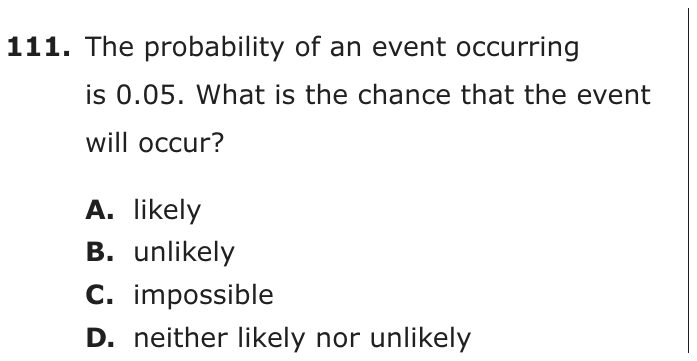
The probability of an event occurring is 0.05. What is the chance that the event will occur?
- Alikely
- Bunlikely
- Cimpossible
- Dneither likely nor unlikely
Show the answer
Correct answer: B
The probability of the event is 0.05, which equals 5%, which is less than 50%.
Option A:
An event that is likely has a probability over 50%.
Option B:
An event that is unlikely has a probability less than 50% but greater than 0%.
Option C:
An event that is impossible has a 0% probability.
Option D:
An event that is neither likely nor unlikely has a 50% probability.
Question analysis
This probability question gives an event a probability of 0.05 and asks how likely the event is to occur, described in words. Students place the decimal on the scale from 0, impossible, to 1, certain. Reading the place value of the decimal correctly is the only real hurdle.
- NYS standards
- 6.SP.6 probability from 0 to 1
- Grade level
- Grade 6 content, by NYS standard
- Compared with grade 7
- Below grade 7 Describing in words how likely an event is from its probability between 0 and 1 is a grade 6 standard. This is one quick judgment with no computation, well below grade 7 probability work with compound events.
- Estimated difficulty
- Routine: one familiar step, little to misread.
- Thinking it demands
- Depth of knowledge 1, recall and reproduction · mainly understand
- What makes it hard
- Solution
- 1 step
- Reading level
- Question and choices: about grade 10, 23 words.
- Students, last 30 days
- Not enough answers yet to show (it takes 10).
Why it is hard, traps and wrong answers (shows the answer)
Why it is hard
One judgment answers the question: 0.05 is a small probability, but it is not zero. The two tempting errors are treating a small chance as no chance at all and misreading 0.05 as 0.5, an even chance. Writing the probability as 5% or as 1 in 20 makes its size plain.
Something you must already know minor Working it out
The probability scale, 0 for impossible, 1/2 for an even chance and 1 for certain, is assumed, and 0.05 has to be placed near its low end. (Anderson & Krathwohl, 2001)
Strategy: Picture the probability scale from 0 to 1, with 0 for impossible, 1/2 for an even chance and 1 for certain, and see where 0.05 falls.
Traps
- Misunderstands the concept: A wrong belief about a concept: that percents can be added, that area grows like length, that averages can be averaged, that a bigger denominator means a bigger fraction.
- An arithmetic slip: The right method with a plausible arithmetic error: a digit, a place value or a times-table fact.
The wrong answers, classified
A Little reason to choose it (Haladyna & Downing, 1993; Rodriguez, 2005)
No common reading makes 0.05 likely, which would need a probability above one half, so it mostly draws guesses.
C Misunderstands the concept (Smith, diSessa & Roschelle, 1993; De Bock et al., 1998; Ni & Zhou, 2005)
Treats a probability close to 0 as exactly 0, as if an event with a 1 in 20 chance could never happen.
D An arithmetic slip (Junker & Sijtsma, 2001)
Reads 0.05 as 0.5, a place-value slip, which would mean an even chance of happening or not.
Worked solution, step by step
Formulas used
- Probability scale
- P is the probability of an event, a number that tells how likely it is to happen. It is always from 0 to 1. 0 means impossible, and 1 means certain. One half, or 0.5, means an even chance. The closer P is to 0, the less likely the event.
Sort out the question
Probability is a number that tells how likely an event is. An event is something that might happen. Here the probability is 0.05. You need the word that best describes that chance.
Change 0.05 to a percent
So 0.05 is 5 out of 100, or 5%. That is the same as 1 chance in 20. Watch out: 0.05 is not 0.5. A probability of 0.5 would be an even chance, choice D.
Place it on the scale
Probability Chance 0 impossible more than 0, less than 0.5 unlikely 0.5 neither likely nor unlikely more than 0.5, less than 1 likely 1 certain 0.05 is more than 0 but much less than 0.5. So the event is unlikely.
Rule out the other choices
Watch out: a small chance is still a chance. 0.05 is more than 0, so the event can happen. It is not impossible, choice C. Likely, choice A, would need more than 0.5.So the answer is B, unlikely.
Check your answer
Picture 20 tries. With a 5% chance, the event would happen about once, since 5% of 20 is 1. It would not happen about 19 times. That is rare but possible, so unlikely fits.
More questions like this
The original DOE question