6.G.2 volume with fractional edge lengths
Question 1 of 7
2026 Practice Test C Math, question 42Question
Tariq is making a clay block in the shape of a cube with a side length of . He hollows out the center by removing clay to form a rectangular prism-shaped hole with a base of and a height of .
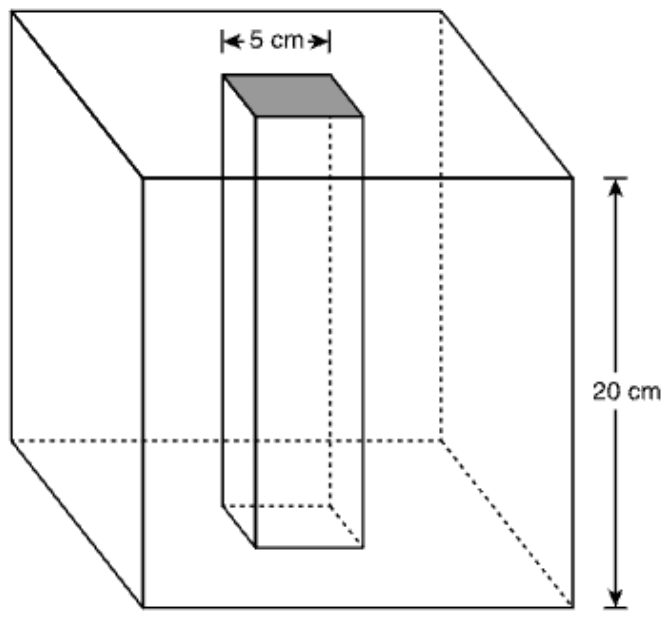
What is the volume, in cubic centimeters, of the block after the clay is removed from the center?
Enter your answer in the space.
Fill-in question: work out the answer and type it as a number.
Show the answer
Correct answer: 7,500
First, find the volume of the cube using the formula .
The length, width, and height of the cube are each equal to 20 cm.
Next, find the volume of the cut-out square prism, with equal length and width of 5 cm and height of 20 cm.
Finally, subtract the volume of the prism from the volume of the cube.
Question analysis
Tariq makes a clay cube 20 centimeters on each side and removes a rectangular prism from its center, with a 5 cm by 5 cm base and a height of 20 cm. Students type the volume of the block that is left, in cubic centimeters. It tests the volume of rectangular prisms, and the hole's size must be read carefully from the words and figure.
- Grade level
- Grade 7 content, by NYS standard
- Compared with grade 7
- At grade 7 Finding the volume of a solid made from rectangular prisms, here by taking one away, is named in the grade 7 standards. This is a direct case with whole numbers, two volumes and one subtraction.
- Estimated difficulty
- Straightforward: two steps or one careful reading.
- Thinking it demands
- Depth of knowledge 1, recall and reproduction · mainly apply
- What makes it hard
- Solution
- 3 steps
- Reading level
- Question and choices: about grade 8, 66 words.
- Students, last 30 days
- Not enough answers yet to show (it takes 10).
Why it is hard, traps and wrong answers (shows the answer)
Why it is hard
This is a direct composite-volume problem with whole numbers: one cube, one hole, one subtraction. What it checks is that both volumes are real volumes, the hole as tall as the cube, and that the subtraction is done at the end. Students who stop at the hole’s volume, or who subtract only the square face, give amounts that are easy to type and hard to doubt without choices.
Something you must already know minor Working it out
The volume of a rectangular prism, length times width times height, is not given, and it is needed twice, once for the 20 cm cube and once for the hole. (Anderson & Krathwohl, 2001)
Reading a figure, table or graph minor Understanding the question
The figure labels only the 5 cm opening and the cube’s 20 cm edge; the hole’s 20 cm height comes from the words, while the drawing shows it reaching from top to bottom. (Lesh, Post & Behr, 1987; Kirsch & Mosenthal, 1990)
An answer in an unexpected form minor Choosing the answer
The volume is typed with no choices to compare, so the hole’s 500 cubic centimeters or the cube’s 8,000 can be entered without any warning. (Enright, Morley & Sheehan, 2002)
Strategy: Find the volume of the full cube, then the volume of the square hole that runs from the top face to the bottom, and subtract the hole from the cube.
Traps
- Answers a different question: A choice is right for another quantity: the other unknown, the rest instead of the part, the part instead of the whole.
- Misreads the figure: Reads a value, label or tick spacing in a figure, table or graph wrongly.
- Wrong formula: Uses a related but wrong formula: perimeter for area, diameter for radius, area for volume, or a misremembered one.
The wrong answers, classified
500 Answers a different question (King et al., 2004; Hegarty, Mayer & Monk, 1995)
Finds the volume of the hole, 5 × 5 × 20 = 500 cubic centimeters, and gives the clay removed instead of the clay that is left.
7,875 Misreads the figure (Lesh, Post & Behr, 1987; Kirsch & Mosenthal, 1990)
Treats the hole as a 5 cm cube, 5 × 5 × 5 = 125, though it runs the full 20 cm height, so 8,000 − 125 = 7,875.
7,975 Wrong formula (King et al., 2004)
Subtracts only the area of the square opening, 5 × 5 = 25, from the cube’s 8,000, mixing a face’s area with the hole’s volume.
Worked solution, step by step
Formulas used
- Volume of a rectangular prism
- V is the volume, the space inside a solid. l is the length, w is the width and h is the height. A cube is a prism with all three the same. Volume is measured in cubic centimeters, tiny cubes 1 cm on each side.
Sort out the question
Tariq’s block starts as a cube 20 cm on each side. He removes a hole shaped like a rectangular prism, a box shape with flat rectangle sides. Its base is 5 cm by 5 cm, and its height is 20 cm. The figure shows it running from the top face to the bottom face.
You need the volume of the clay that is left, in cubic centimeters.
Find the volume of the cube
Use the volume formula. The length, width and height are all 20 cm:
The full cube holds 8,000 cubic cm of clay.
Find the volume of the hole
The hole is a prism too. Its length and width are 5 cm, and its height is 20 cm:
So 500 cubic cm of clay are removed.
Watch out: the hole is 20 cm tall, not 5 cm. Treating it as a small 5 cm cube gives 125 and the wrong answer 7,875. And 5 × 5 = 25 is only the area of the opening, not a volume. Subtracting it gives 7,975, also wrong.
Subtract the hole from the cube
The clay left is the cube minus the hole:
The block has 7,500 cubic cm of clay left.
Watch out: 500 is the clay taken out, not the clay that is left.
Enter the number
Type only the number, with no units. You can type 7500 or 7,500.
So you would enter 7,500.
Check your answer
Think of the cube as 20 flat layers, each 1 cm thick. Each layer is a 20 by 20 square, 400 square cm, with a 5 by 5 hole, 25 square cm. So each layer holds cubic cm of clay. Then . It matches.
More questions like this
The original DOE question
Question 2 of 7
2024 Test B Math, question 51Question
Rita used 125 small solid cubes to build a large solid cube. The measure of each edge of the small cubes equals 1 inch. What is the measure of each edge of the large cube, in inches?
- A5
- B25
- C41.33
- D125
Show the answer
Correct answer: A
The volume of a cube with a side length of s is
Since 125 small cubes were used to build the large cube, .
Each side of the large cube is made up of 5 small cubes.
Since 5 small cubes make up each edge of the large cube, and the edge of each small cube measures 1 inch, the measure of each edge of the large cube is .
Question analysis
Rita stacks 125 one-inch cubes into a single large solid cube. Students find the length of each edge of the large cube in inches. It tests volume and perfect cubes with a building-block model, and the care needed is in telling apart the cubes along an edge, across a face and in the whole solid.
- Grade level
- Grade 6 content, by NYS standard
- Compared with grade 7
- Below grade 7 Building a large cube from unit cubes is the model grade 6 uses to introduce perfect cubes. It is a single step with small numbers, easier than typical grade 7 geometry, which works with composite solids and formulas.
- Estimated difficulty
- Routine: one familiar step, little to misread.
- Thinking it demands
- Depth of knowledge 1, recall and reproduction · mainly apply
- What makes it hard
- Solution
- 1 step
- Reading level
- Question and choices: about grade 3, 35 words.
- Students, last 30 days
- Not enough answers yet to show (it takes 10).
Why it is hard, traps and wrong answers (shows the answer)
Why it is hard
This is one of the easiest questions on the test, since 125 is a familiar cube and the small cubes make the large one easy to picture as 5 rows of 5 in 5 layers. The wrong choices name a layer instead of an edge, a division by 3 for three dimensions, or the total count itself, and multiplying 5 × 5 × 5 as a check rules all of them out.
Something you must already know minor Working it out
Students must see that 125 one-inch cubes make a volume of 125 cubic inches, and know or find that 5 × 5 × 5 = 125. (Anderson & Krathwohl, 2001)
Strategy: Think of the large cube as equal rows, columns and layers of small cubes, and find the number that, used three times as a factor, gives 125.
Traps
- Answers a different question: A choice is right for another quantity: the other unknown, the rest instead of the part, the part instead of the whole.
- Wrong operation: Adds instead of multiplying, divides the wrong way round, turns a ratio or rate upside down, or undoes a step in the wrong direction (subtracts what should be added back).
The wrong answers, classified
B Answers a different question (King et al., 2004; Hegarty, Mayer & Monk, 1995)
Gives the number of small cubes in one layer or on one face, 5 × 5 = 25, instead of the number along one edge.
C Wrong operation (Hegarty, Mayer & Monk, 1995; King et al., 2004)
Divides 125 by 3 for the cube's three dimensions instead of taking a cube root; that gives 41.67, and 41.33 is the only choice near it.
D Numbers taken from the question (Hegarty, Mayer & Monk, 1995)
Gives back the 125 from the stem, the count of small cubes and the volume in cubic inches, rather than an edge length.
Worked solution, step by step
Formulas used
- Volume of a cube
- V is the volume, the space inside, in cubic units. s is the length of one edge. s³ means s × s × s. A cube’s length, width and height are all s, so length × width × height becomes s × s × s.
Sort out the question
Rita stacks 125 small cubes into one big solid cube. Each small cube has edges of 1 inch. You need the length of one edge of the big cube, in inches.
Find the big cube’s volume
Each small cube is cubic inch. The big cube is solid, with no gaps. So its volume is 125 cubic inches.
Find the edge length
Find the number that makes 125 when you use it three times. Try 5.
So 5 small cubes sit along each edge. Each one is 1 inch long, so the edge is 5 inches.
Rule out the other choices
Watch out: 25, choice B, is the number of small cubes in one layer, 5 rows of 5. 125, choice D, is the number of cubes, or the volume. Dividing 125 by 3 does not give an edge either. That is about 41.67, near choice C.
So the answer is A, 5.
Check your answer
Picture building it. A row of 5 cubes is 5 inches long. Five rows make a layer of 25 cubes. Five layers make cubes. That matches.
More questions like this
The original DOE question
Question 3 of 7
2023 Test A Math, question 50Question
A rectangular concrete driveway is 30 feet long, 8 feet wide, and 6 inches thick. What is the volume of the concrete?
- A44 cu ft
- B48 cu ft
- C120 cu ft
- D240 cu ft
Show the answer
Correct answer: C
First convert 6 inches to 0.5 foot. Then, calculate the volume, in cubic feet:
Question analysis
This volume word problem describes a concrete driveway 30 feet long, 8 feet wide and 6 inches thick, and asks for the volume of the concrete in cubic feet. Students convert inches to feet and multiply three dimensions. Mixing units, or stopping at the area of the driveway's surface, is the main way to go wrong.
- Grade level
- Grade 6 content, by NYS standard
- Compared with grade 7
- Below grade 7 Volume of a rectangular prism with a fractional edge is grade 6 content. The only extra step is changing inches to feet before multiplying, so it is lighter than grade 7 volume work with composite or triangular prisms.
- Estimated difficulty
- Straightforward: two steps or one careful reading.
- Thinking it demands
- Depth of knowledge 2, skills and concepts · mainly apply
- What makes it hard
- Solution
- 2 steps
- Reading level
- Question and choices: about grade 2, 27 words.
- Students, last 30 days
- Not enough answers yet to show (it takes 10).
Why it is hard, traps and wrong answers (shows the answer)
Why it is hard
Volume of a box is familiar, so the question is decided by the mix of units: two dimensions in feet and one in inches. Multiplying the three numbers as printed gives 1,440, which is not a choice, and that should send students back to convert. The listed wrong answers instead come from leaving out the thickness or combining the numbers without the volume rule.
Something you must already know minor Working it out
The stem gives no formula and no conversion, so students must bring both the volume rule, length times width times height, and the 12 inches in a foot. (Anderson & Krathwohl, 2001)
Error-prone arithmetic minor Working it out
The thickness becomes the fraction 1/2 foot, so the product is 30 × 8 × 1/2, or, if the inches are kept, 1,440 divided by 12. (Brown & Burton, 1978; Junker & Sijtsma, 2001)
Strategy: Change 6 inches to a fraction of a foot first so that all three measurements share a unit, then multiply length, width and thickness.
Traps
- Stops one step early: A choice is a number from partway through the solution.
- Numbers taken from the question: Combines the numbers in the question without a model of the situation, or is simply a number that appears in the question.
The wrong answers, classified
A Numbers taken from the question (Hegarty, Mayer & Monk, 1995)
Adds the three numbers in the stem, 30 + 8 + 6 = 44, instead of multiplying the dimensions.
B Numbers taken from the question (Hegarty, Mayer & Monk, 1995)
Multiplies only the width and the thickness, 8 × 6 = 48, combining two of the stem's numbers and leaving out the 30-foot length.
D Stops one step early (King et al., 2004; Gierl et al., 2017)
Finds the area of the driveway's surface, 30 × 8 = 240, and stops before multiplying by the half-foot thickness.
Worked solution, step by step
Formulas used
- Inches to feet
- There are 12 inches in 1 foot. So to change inches into feet, divide the number of inches by 12.
- Volume of a rectangular box
- V is the volume, the space inside a box shape. l is the length, w is the width and h is the height, here the thickness. All three must use the same unit. The answer is in cubic units, such as cubic feet.
Sort out the question
The driveway is a flat box of concrete. It is 30 feet long, 8 feet wide and 6 inches thick. You need its volume, the space the concrete fills, in cubic feet. The thickness is in inches, so change it to feet first.
Change the thickness to feet
So 6 inches is half a foot. Now all three measures are in feet.
Multiply the three measures
The volume is 120 cubic feet. Watch out: 30 × 8 = 240 is only the area of the top surface, in square feet. Stopping there gives choice D. Adding 30 + 8 + 6 = 44 gives choice A.
So the answer is C, 120 cu ft.
Check your answer
Think of it another way. A slab 30 feet by 8 feet and a full foot thick would hold 240 cubic feet. This one is only half a foot thick, so it holds half as much, 120 cubic feet. Using 6 instead of one half would give 1,440, far too big.
More questions like this
The original DOE question
Question 4 of 7
2023 Test B Math, question 24Question
A prism is made up of 9 congruent cubes. Each of the cubes has side lengths measuring 4 units. What is the volume, in cubic units, of the prism?
- A108
- B144
- C480
- D576
Show the answer
Correct answer: D
First, determine the volume of each congruent cube. All the side lengths of the cubes are equal, so the length, width, and height of each cube is 4 units. To determine the volume of each cube, multiply :
So, the volume of each cube is 64 cubic units.
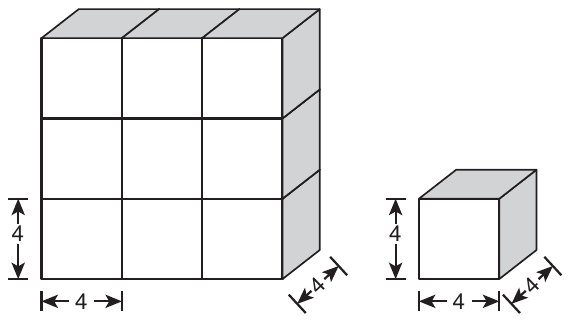
The prism is comprised of 9 of these cubes, so multiply the volume of each cube (64) by the total number of cubes (9) to determine the volume, in cubic units, of the prism:
Question analysis
A prism is built from 9 identical cubes, and each cube has edges 4 units long. Students find the volume of the prism in cubic units. It tests the volume of a cube and how volumes add when solids are put together, and it rewards keeping area, surface area and volume apart.
- Grade level
- Grade 6 content, by NYS standard
- Compared with grade 7
- Below grade 7 Volume of cubes and rectangular prisms is grade 5 and 6 content. This item needs one cube's volume and a multiplication by 9, two short steps, so it is below typical grade 7 work.
- Estimated difficulty
- Routine: one familiar step, little to misread.
- Thinking it demands
- Depth of knowledge 1, recall and reproduction · mainly apply
- What makes it hard
- Solution
- 2 steps
- Reading level
- Question and choices: about grade 3, 27 words.
- Corrected from the DOE handbook
- A letter x printed in place of a multiplication sign in the explanation was corrected.
- Students, last 30 days
- Not enough answers yet to show (it takes 10).
Why it is hard, traps and wrong answers (shows the answer)
Why it is hard
The question needs one formula and one multiplication, and the stem does not even say how the cubes are arranged, because the volume does not depend on it. The wrong choices come from mishandling the cube’s volume: the exponent multiplied instead of applied, the area of one face, or a surface area. Writing the volume out as edge times edge times edge, in cubic units, rules all three out.
Something you must already know minor Working it out
A cube’s volume, edge × edge × edge, is not given; with it, each 4-unit cube holds 64 cubic units, and the arrangement of the 9 cubes does not matter. (Anderson & Krathwohl, 2001)
Strategy: Find the volume of one cube by multiplying its three edges, then multiply by the number of cubes; how the cubes are arranged does not matter.
Traps
- Wrong formula: Uses a related but wrong formula: perimeter for area, diameter for radius, area for volume, or a misremembered one.
- A faulty procedure: A systematic but wrong procedure: adding fractions straight across, applying an exponent to each term of a sum, dropping a sign when moving a term.
The wrong answers, classified
A A faulty procedure (Brown & Burton, 1978; Tatsuoka, 1983)
Takes 4³ as 4 × 3 = 12, multiplying the edge by the exponent, so each cube seems to hold 12 cubic units and 9 × 12 = 108.
B Wrong formula (King et al., 2004)
Uses the area of one face, 4 × 4 = 16 square units, as each cube’s volume, so 9 × 16 = 144.
C Wrong formula (King et al., 2004)
Pictures the 9 cubes as a 3-by-3 slab, 12 by 12 by 4 units, and finds its surface area, 480 square units, instead of its volume.
What was corrected from the DOE handbook, and why
- Explanation: The handbook gives the volume of a cube as “length x width x height”, with the letter x where it means “times”. In a math explanation the letter x reads as a variable, so the site writes length × width × height, the sign the handbook itself uses on the next line (4 × 4 × 4 = 64). Nothing else changes: each cube is 64 cubic units, and the 9 cubes make 64 × 9 = 576.
Worked solution, step by step
Formulas used
- Volume of a cube
- V is the volume, the space inside a solid, in cubic units. s is the length of one edge. All the edges of a cube are equal, so its length, width and height are all s. Multiplying them counts how many unit cubes fit inside.
Sort out the question
A prism, a solid with flat faces, is made of 9 congruent cubes. Congruent means exactly the same size and shape. Each cube has sides of 4 units. You need the volume of the whole prism, in cubic units.
The question doesn’t say how the cubes are stacked. You don’t need to know. Volume is the space inside, and 9 cubes fill the same space however they are arranged.
Find the volume of one cube
Each cube has a volume of 64 cubic units. Watch out: means , not . That slip leads to 108, choice A. Also, is only the area of one face. It leads to 144, choice B.
Multiply by the number of cubes
The prism is 9 of these cubes, so its volume is 9 times as big.
The prism’s volume is 576 cubic units.
Give the answer
Watch out: volume counts the space inside, not the outside faces. Suppose the cubes formed one flat 3-by-3 layer. Adding up the areas of its outside faces gives 480, choice C. That is surface area, not volume. So the answer is D, 576.
Check your answer
Estimate: , and one cube fewer is . You can also test one arrangement. A flat 3-by-3 layer is 12 by 12 by 4 units, and . Same answer.
More questions like this
The original DOE question
Question 5 of 7
2023 Test B Math, question 49Question
A rectangular swimming pool of uniform depth is 20 yards long and 14 yards wide. If the water is 6 feet deep, what is the volume of water in the pool, in cubic yards?
- A40
- B286
- C560
- D1,680
Show the answer
Correct answer: C
First, change 6 feet to yards:
Then, multiply the dimensions of the pool to find the volume, in cubic yards:
Question analysis
A rectangular swimming pool is 20 yards long and 14 yards wide, and the water is 6 feet deep. Students find the volume of water in cubic yards. It tests the volume of a rectangular prism, and the depth is in a different unit from the other measurements, so it has to be converted first.
- Grade level
- Grade 6 content, by NYS standard
- Compared with grade 7
- Below grade 7 The volume of a rectangular prism is grade 5 and 6 content, and the conversion here gives a whole number. Grade 7 volume work is usually longer, with composite or triangular prisms; here the only extra step is one unit conversion.
- Estimated difficulty
- Straightforward: two steps or one careful reading.
- Thinking it demands
- Depth of knowledge 2, skills and concepts · mainly apply
- What makes it hard
- Combines ideas minor
- Something you must already know minor
- Solution
- 2 steps
- Reading level
- Question and choices: about grade 6, 31 words.
- Students, last 30 days
- Not enough answers yet to show (it takes 10).
Why it is hard, traps and wrong answers (shows the answer)
Why it is hard
The only real trap is the mixed units: 20 and 14 are yards, 6 is feet, and the answer is wanted in cubic yards. Multiplying the three numbers as printed gives a listed choice three times too large. Underlining the unit of each measurement before multiplying, and converting the odd one out, takes seconds.
Combines ideas minor Working it out
The length and width are in yards but the depth is in feet, so a conversion, 6 feet = 2 yards, must come before the volume formula is used. (Embretson, 1998; Daniel & Embretson, 2010)
Something you must already know minor Working it out
Neither 3 feet = 1 yard nor volume = length × width × depth is given; both are assumed in a stem that asks for cubic yards. (Anderson & Krathwohl, 2001)
Strategy: Change the depth from feet to yards first, so that all three measurements are in yards, then multiply the length, width and depth.
Traps
- Units or scale: The answer is wanted in other units, or a rate or scale must be converted first.
- Wrong formula: Uses a related but wrong formula: perimeter for area, diameter for radius, area for volume, or a misremembered one.
- Numbers taken from the question: Combines the numbers in the question without a model of the situation, or is simply a number that appears in the question.
The wrong answers, classified
A Numbers taken from the question (Hegarty, Mayer & Monk, 1995)
Adds the three measurements, 20 + 14 + 6 = 40, with no conversion and no volume formula, combining the stem’s numbers.
B Wrong formula (King et al., 2004)
Finds the area of the water’s surface, 20 × 14 = 280, then adds the depth of 6 instead of multiplying by it.
D Units or scale (King et al., 2004)
Multiplies 20 × 14 × 6 without changing 6 feet to 2 yards, mixing yards with feet and getting a volume three times too large.
Worked solution, step by step
Formulas used
- Volume of a rectangular box
- V is the volume, the space inside, in cubic units. l is the length, w is the width, and h is the height or depth. All three must be in the same unit. Multiplying them counts the unit cubes that fill the box.
- Feet to yards
- There are 3 feet in 1 yard. So to change feet to yards, divide the number of feet by 3. A yard is longer than a foot, so you get a smaller number.
Sort out the measurements
The pool is shaped like a box. Uniform depth means the water is equally deep everywhere. The pool is 20 yards long and 14 yards wide. The water is 6 feet deep. You need the volume, the space the water fills, in cubic yards.
Change the depth to yards
Two sides are in yards, but the depth is in feet. All three must use the same unit before you multiply. The answer is in cubic yards, so change feet to yards.
The water is 2 yards deep.
Find the volume
Use the volume formula with all three measurements in yards.
The pool holds 560 cubic yards of water.
Give the answer
Watch out: Multiplying 20 × 14 × 6 mixes yards with feet. It gives 1,680, choice D, which is three times too big.
So the answer is C, 560 cubic yards.
Check your answer
Check the units. Yards times yards times yards gives cubic yards, just what the question asks for. Also, 1,680 ÷ 3 = 560. So using 6 feet unchanged makes the answer exactly three times too big.
More questions like this
The original DOE question
Question 6 of 7
2022 Test B Math, question 1Question
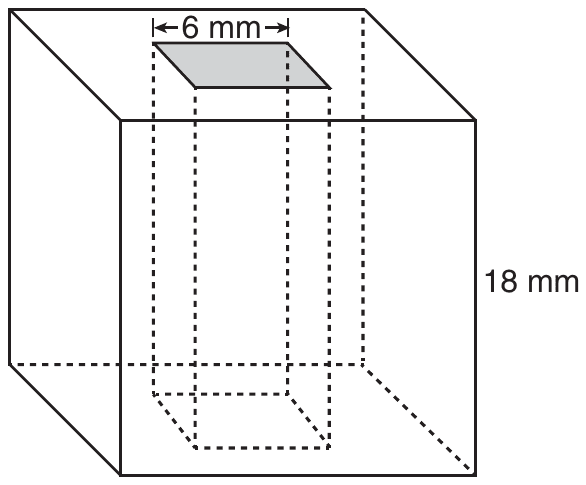
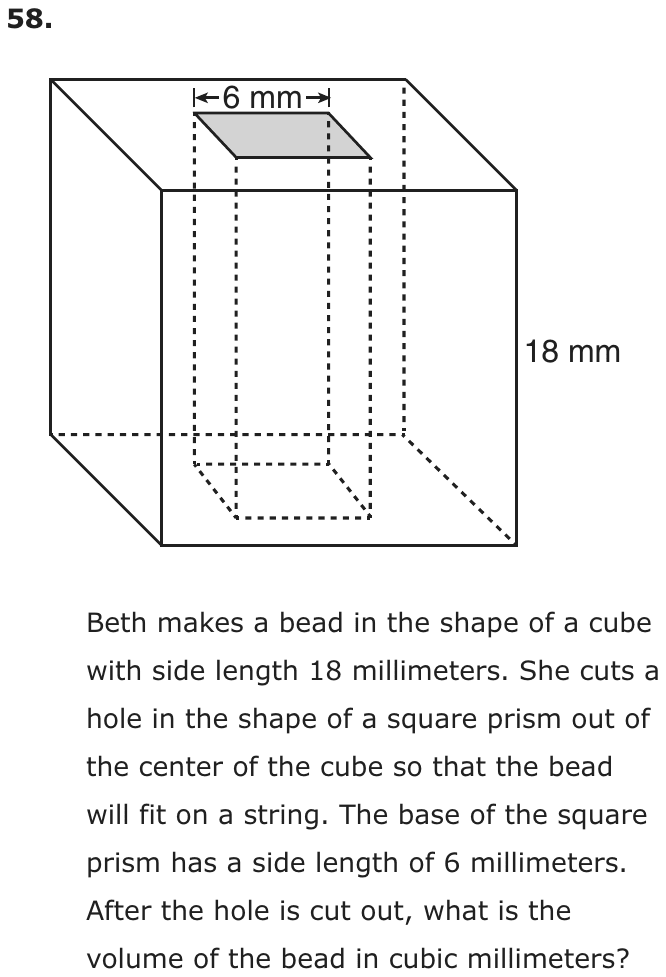
Beth makes a bead in the shape of a cube with side length 18 millimeters. She cuts a hole in the shape of a square prism out of the center of the cube so that the bead will fit on a string. The base of the square prism has a side length of 6 millimeters. After the hole is cut out, what is the volume of the bead in cubic millimeters?
Grid-in question: work out the answer and enter it as a number.
Show the answer
Correct answer: 5184
First, find the volume of the cube using the formula .
The length, width, and height of the cube are equal (18 mm).
Next, find the volume of the cut-out square prism, with equal length and width (6 mm), and height of 18 mm.
Finally, subtract the volume of the prism from the volume of the cube.
Question analysis
Beth makes a bead from a cube 18 millimeters on each side and cuts a square prism-shaped hole, 6 millimeters across, through its center for a string. Students find the volume of the bead that is left, in cubic millimeters. It tests the volume of rectangular prisms, and the hole's height is not given in words, so it has to be read from the figure.
- Grade level
- Grade 7 content, by NYS standard
- Compared with grade 7
- At grade 7 Finding the volume of a solid made by removing one rectangular prism from another is grade 7 work. This case is direct, but the hole's height is not stated in words, and cubing 18 by hand is heavier arithmetic, typed with no choices.
- Estimated difficulty
- Moderate: several steps, or a close reading with one strong distractor.
- Thinking it demands
- Depth of knowledge 2, skills and concepts · mainly apply
- What makes it hard
- Solution
- 3 steps
- Reading level
- Question and choices: about grade 6, 69 words.
- Students, last 30 days
- Not enough answers yet to show (it takes 10).
Why it is hard, traps and wrong answers (shows the answer)
Why it is hard
The method is short, cube minus hole, but the hole’s height is never stated and has to be read from the drawing. Students who picture the hole as a 6 mm cube take away only 216 cubic millimeters, and those who stop at either volume grid a number that looks finished. Seeing the hole as a square shaft, 6 by 6 by 18, and checking that the bead holds less than the cube catches all three slips.
Reading a figure, table or graph moderate Understanding the question
The stem gives only the 6 mm side of the hole’s square base; that the hole runs the full 18 mm, from the top face to the bottom, shows only in the figure’s dashed edges. (Lesh, Post & Behr, 1987; Kirsch & Mosenthal, 1990)
Something you must already know minor Working it out
Neither volume formula is given: the cube needs edge × edge × edge, and the square hole needs its 36 square millimeter base times its 18 mm length. (Anderson & Krathwohl, 2001)
Error-prone arithmetic minor Working it out
Cubing 18 by hand, 324 × 18 = 5,832, and then 6 × 6 × 18 = 648 are multi-digit products, and a carrying slip in either changes the final difference. (Brown & Burton, 1978; Junker & Sijtsma, 2001)
An answer in an unexpected form minor Choosing the answer
The volume is gridded with no choices to compare, so entering the hole’s 648 or the whole cube’s 5,832 brings no warning that a step is missing. (Enright, Morley & Sheehan, 2002)
Strategy: Find the volume of the whole cube, then the volume of the square hole, which runs from the top face to the bottom face, and subtract the hole from the cube.
Traps
- Answers a different question: A choice is right for another quantity: the other unknown, the rest instead of the part, the part instead of the whole.
- Misreads the figure: Reads a value, label or tick spacing in a figure, table or graph wrongly.
- Stops one step early: A choice is a number from partway through the solution.
The wrong answers, classified
648 Answers a different question (King et al., 2004; Hegarty, Mayer & Monk, 1995)
Finds the volume of the hole, 6 × 6 × 18 = 648 cubic millimeters, and enters the material removed instead of the bead that is left.
5616 Misreads the figure (Lesh, Post & Behr, 1987; Kirsch & Mosenthal, 1990)
Takes the hole to be a 6 mm cube, 6 × 6 × 6 = 216, though the figure shows it running the full 18 mm, so 5,832 − 216 = 5,616.
5832 Stops one step early (King et al., 2004; Gierl et al., 2017)
Finds the volume of the whole cube, 18 × 18 × 18 = 5,832 cubic millimeters, and stops before taking away the hole cut through its center.
Worked solution, step by step
Formulas used
- Volume of a rectangular prism
- V is the volume, the space inside a solid, in cubic units. l is the length, w is the width and h is the height. A cube is a prism whose length, width and height are all equal. Multiplying counts the unit cubes that fill the box, layer by layer.
Sort out the question
The bead starts as a cube, a box whose edges are all 18 millimeters long. A hole is cut through its middle. The hole is a square prism, a box with a square base. Each side of that square is 6 millimeters.
You need the volume of the bead that is left, in cubic millimeters. Volume is the space a solid takes up.
Read the hole’s height from the figure
The words don’t say how tall the hole is. Look at the figure. The gray square sits on the top face. Its dashed edges run all the way down to the bottom face.
So the hole is as tall as the cube, 18 millimeters. The hole measures 6 by 6 by 18 millimeters.
Find the volume of the cube
Use the volume formula. All three measures of the cube are 18.
Work it in two parts: , then . The whole cube is 5,832 cubic millimeters.
Find the volume of the hole
Use the same formula for the hole: 6 by 6 by 18.
The hole is 648 cubic millimeters.
Watch out: the hole is not a small 6 mm cube. Using would give 5,616, which is wrong.
Subtract the hole from the cube
The bead is the cube with the hole taken out. So subtract.
The bead’s volume is 5,184 cubic millimeters.
Watch out: 648 is the part cut out, and 5,832 is the cube before the cut. Neither one is the bead. So you would grid 5184.
Check your answer
Picture the cube cut into tall columns, each the size of the hole. It is 3 columns wide and 3 deep, so it holds columns. The hole takes 1, leaving 8. And . It matches.
More questions like this
The original DOE question
Question 7 of 7
2018 Test B Math, question 39Question
A wooden box has a square base. The height of this box is 3 times the length of one side of the base. If one side of the base is 3 feet long, what is the volume of this box?
- A9 cu ft
- B27 cu ft
- C36 cu ft
- D81 cu ft
Show the answer
Correct answer: D
One side of the square base is 3 ft long. Since the height of the box is 3 times the length, then the height is
3 × 3 = 9 ft.
The volume of a rectangular prism is length × height × width. The volume of the wooden box is
V= 3 × 3 × 9 = 81 cu ft.
Question analysis
A wooden box has a square base, and its height is 3 times the length of a side of the base; students find its volume in cubic feet. It tests the volume of a rectangular prism with dimensions described in words. The work is short, but the height must be built from the side length before multiplying.
- NYS standards
- 6.G.2 volume with fractional edge lengths
- Grade level
- Grade 6 content, by NYS standard
- Compared with grade 7
- Below grade 7 Volume of a box is grade 5 and 6 content, and this is a two-step version with whole numbers. Grade 7 volume problems usually involve composite or triangular prisms, so this sits below.
- Estimated difficulty
- Routine: one familiar step, little to misread.
- Thinking it demands
- Depth of knowledge 1, recall and reproduction · mainly apply
- What makes it hard
- Solution
- 2 steps
- Reading level
- Question and choices: about grade 1, 46 words.
- Students, last 30 days
- Not enough answers yet to show (it takes 10).
Why it is hard, traps and wrong answers (shows the answer)
Why it is hard
This is a routine volume question once all three dimensions are written down. Errors come from treating the box as a 3-foot cube, from stopping at the base area, or from mixing perimeter into the product. Listing the dimensions 3, 3 and 9 before multiplying prevents each of them.
Turning words into math minor Understanding the question
"The height of this box is 3 times the length of one side of the base" must become a height of 9 feet before the volume formula can be used. (Hegarty, Mayer & Monk, 1995; Koedinger & Nathan, 2004)
Something you must already know minor Working it out
The volume of a box, length times width times height, is not given, and the square base means the length and width are both 3 feet. (Anderson & Krathwohl, 2001)
Strategy: Write down all three dimensions first, computing the height from the base side, then multiply length, width and height.
Traps
- Stops one step early: A choice is a number from partway through the solution.
The wrong answers, classified
A Stops one step early (King et al., 2004; Gierl et al., 2017)
Stops at the area of the square base, 3 × 3 = 9, or at the 9-foot height, without bringing in the third dimension.
B Misreads the question (Hegarty, Mayer & Monk, 1995)
Uses 3 feet for the height too, as if the box were a cube, 3 × 3 × 3 = 27; multiplying only 3 × 9 also gives 27.
C Wrong formula (King et al., 2004)
Multiplies the base perimeter, 4 × 3 = 12 feet, by 3, putting a perimeter where the base area belongs.
Worked solution, step by step
Formulas used
- Volume of a box
- V is the volume, the space inside the box. l is the length, w is the width and h is the height. l times w is the area of the bottom. Multiplying by h stacks that many layers of cubes.
Sort out what you know
The box has a square base with sides of 3 feet. A square has equal sides, so the length and width are both 3 feet. The height is “3 times the length of one side of the base”. You need the volume, the space inside the box.
Find the height
The height is 3 times the 3-foot side.
The height is 9 feet.
Watch out: the height is not 3 feet. If you use 3 for the height, you get . That is choice B.
Find the volume
Use the volume formula with all three sizes.
The volume is 81 cubic feet.
Watch out: is only the area of the bottom. Stopping there gives choice A.
Give the answer
The box is 3 feet long, 3 feet wide and 9 feet tall. So the answer is D, 81 cu ft.
Check your answer
Think in layers. The bottom layer holds cubes, each 1 foot on a side. The box is 9 feet tall, so it holds 9 layers. Then cubic feet. The units are cubic feet because the answer is a volume.
More questions like this
The original DOE question