Question
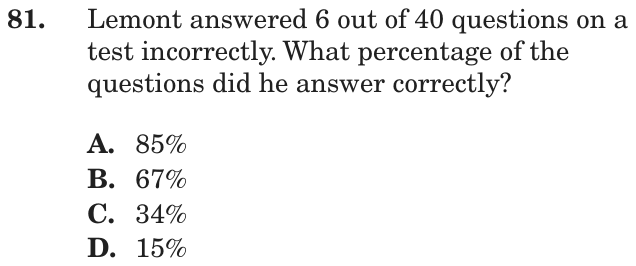
Lemont answered 6 out of 40 questions on a test incorrectly. What percentage of the questions did he answer correctly?
- A85%
- B67%
- C34%
- D15%
Show the answer
Correct answer: A
If Lemont answered 6 out of 40 questions incorrectly, then he answered 34 questions correctly.
Question analysis
Lemont got 6 of the 40 questions on a test wrong, and students find the percentage of questions he answered correctly. It tests writing part of a whole as a percent. The stem gives the number of incorrect answers, so students must switch to the correct ones before or after turning the fraction into a percent.
- NYS standards
- 6.RP.3c percent as a rate per 100
- Grade level
- Grade 6 content, by NYS standard
- Compared with grade 7
- Below grade 7 Writing a test score as a percent is grade 6 work, and a test of 40 questions makes the division short. Grade 7 percent problems usually add a second change or a reverse step, which this lacks.
- Estimated difficulty
- Routine: one familiar step, little to misread.
- Thinking it demands
- Depth of knowledge 2, skills and concepts · mainly apply
- What makes it hard
- Turning words into math minor
- Solution
- 2 steps
- Reading level
- Question and choices: about grade 8, 18 words.
- Students, last 30 days
- Not enough answers yet to show (it takes 10).
Why it is hard, traps and wrong answers (shows the answer)
Why it is hard
The arithmetic is light, 34 out of 40, so the only real demand is keeping track of which group the question asks about. The stem's one count is of wrong answers, and the percent those make is a listed choice, waiting for anyone who skims the final word. Writing 34 correct before dividing, then checking that the answer is well above half, settles it.
Turning words into math minor Understanding the question
The stem counts the questions Lemont answered incorrectly, 6, but asks for the percentage he answered correctly, so the 6 must become 34 right, or 15% must come off 100%. (Hegarty, Mayer & Monk, 1995; Koedinger & Nathan, 2004)
Strategy: Subtract the wrong answers from 40 to get the number right, then divide by 40; or find the percent wrong and take it away from 100%.
Traps
- Answers a different question: A choice is right for another quantity: the other unknown, the rest instead of the part, the part instead of the whole.
- Stops one step early: A choice is a number from partway through the solution.
The wrong answers, classified
B Wrong operation (Hegarty, Mayer & Monk, 1995; King et al., 2004)
Divides 40 by 6 instead of a part by the whole, gets about 6.67, and reads those digits as 67%, an inverted ratio few students reach.
C Stops one step early (King et al., 2004; Gierl et al., 2017)
Finds that Lemont answered 34 questions correctly and gives that count as the percent, stopping before dividing it by the 40 questions on the test.
D Answers a different question (King et al., 2004; Hegarty, Mayer & Monk, 1995)
Divides the 6 wrong answers by 40 and gives 15%, the share he answered incorrectly rather than the share he answered correctly.
Worked solution, step by step
Formulas used
- Percent of a total
- The part is the number of questions you are asking about. The whole is the total number of questions on the test. Dividing gives the fraction of the test. Multiplying by 100 turns that fraction into a percent, a number out of 100.
Sort out the question
The test has 40 questions. Lemont answered 6 of them incorrectly. The question asks for the percent he answered correctly. Notice the switch. You are told the wrong answers, but you need the right ones.
Count the correct answers
Each question was either right or wrong. So take the wrong ones away from all 40.
Lemont answered 34 questions correctly.
Write 34 out of 40 as a percent
Use the percent formula. The part is 34 questions, and the whole is 40 questions.
To get 85 out of 100, divide the top and bottom by 2, then multiply both by 5. Lemont got 85% right.
Watch out: is 15%. That is the percent he got wrong, choice D. And 34 is a number of questions, not a percent, so 34%, choice C, stops too soon.
So the answer is A, 85%.
Check your answer
Right answers and wrong answers together make the whole test, 100%. He got 6 out of 40 wrong, which is 15%. Then , so he got 85% right. Both ways give the same answer.
More questions like this
The original DOE question