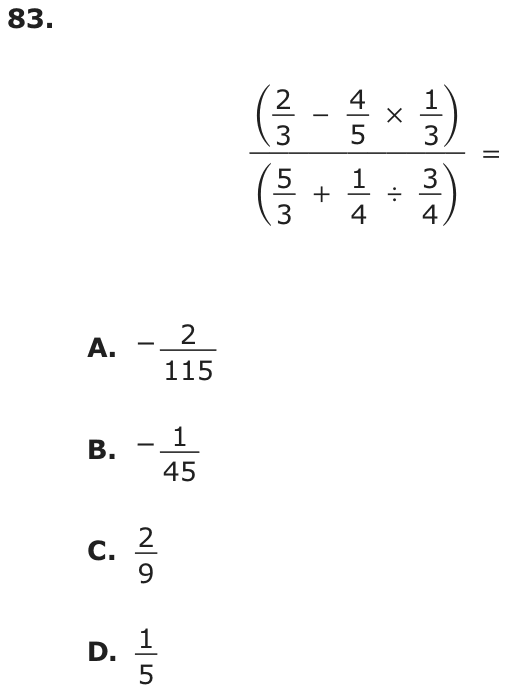
Question
- A
- B
- C
- D
Show the answer
Correct answer: D
First, simplify the numerator and the denominator separately.
To simplify the numerator, multiply the last two fractions and then subtract from the first fraction.
To simplify the denominator, divide the last two fractions and then add to the first fraction.
Finally, divide the numerator by the denominator.
Question analysis
This fraction arithmetic question gives a complex fraction: a numerator with a subtraction and a multiplication over a denominator with an addition and a division, all with fractions. Students choose its value. It tests order of operations and the four operations with fractions, and working left to right instead of following the order of operations leads to a wrong result.
- NYS standards
- Grade level
- Grade 7 content, by NYS standard
- Compared with grade 7
- Above grade 7 Grade 7 students compute with fractions, usually two or three operations at a time. This expression needs five, in an order set by the rules rather than read left to right, so it is longer and more trap-prone than typical work.
- Estimated difficulty
- Moderate: several steps, or a close reading with one strong distractor.
- Thinking it demands
- Depth of knowledge 1, recall and reproduction · mainly apply
- What makes it hard
- Many steps moderate
- Error-prone arithmetic moderate
- Something you must already know minor
- Solution
- 5 steps
- Reading level
- Question and choices: about grade 16+, 5 words.
- Students, last 30 days
- Not enough answers yet to show (it takes 10).
Why it is hard, traps and wrong answers (shows the answer)
Why it is hard
Nothing here is beyond grade 7, but the expression stacks five fraction operations, and the top and the bottom each hide an order-of-operations decision. Working left to right in the numerator alone gives a negative value, and doing so in both parts gives an even stranger fraction; both are listed. The sign is a quick check: 4/15 is less than 2/3, so the numerator is positive, and so is the value.
Many steps moderate Working it out
The numerator and the denominator are each simplified on their own, to 2/5 and 2, before the final division, so five operations stand between the expression and its value. (Daniel & Embretson, 2010; Enright, Morley & Sheehan, 2002)
Error-prone arithmetic moderate Working it out
Every step is fraction work: 2/3 − 4/15 needs fifteenths, 1/4 ÷ 3/4 needs the divisor flipped, and the last step, 2/5 ÷ 2, is easily turned into 2/5 × 2. (Brown & Burton, 1978; Junker & Sijtsma, 2001)
Something you must already know minor Working it out
No parentheses inside the numerator or the denominator show the order, so students must know to multiply before subtracting and to divide before adding. (Anderson & Krathwohl, 2001)
Strategy: Simplify the numerator and the denominator separately, doing the multiplication and the division before the subtraction and the addition, then divide the two results.
Traps
- Order of operations: Working left to right, or distributing a minus sign wrongly, gives a choice.
The wrong answers, classified
A Order of operations (Brown & Burton, 1978)
Works left to right in both parts, (2/3 − 4/5) × 1/3 = −2/45 over (5/3 + 1/4) ÷ 3/4 = 23/9, and −2/45 ÷ 23/9 = −2/115.
B Order of operations (Brown & Burton, 1978)
Subtracts before multiplying in the numerator, (2/3 − 4/5) × 1/3 = −2/45, but handles the denominator correctly, so −2/45 ÷ 2 = −1/45.
C Little reason to choose it (Haladyna & Downing, 1993; Rodriguez, 2005)
No common working gives 2/9: it is positive like the answer, but no single order or fraction slip reaches it, so it mostly draws guesses between the two positive choices.
Worked solution, step by step
Formulas used
- Order of operations
- When no parentheses show the order, multiply and divide first. Then add and subtract. Everyone follows the same order, so an expression has only one value.
- Multiplying fractions
- a and c are the top numbers, and b and d are the bottom numbers. Multiply top times top and bottom times bottom.
- Dividing fractions
- To divide by a fraction, multiply by its reciprocal, the fraction flipped upside down. The reciprocal of c/d is d/c. It works because c/d times d/c is 1. So multiplying by d/c undoes c/d, just as dividing by c/d does.
Sort out the question
The big fraction bar means divide: the top part divided by the bottom part. Work out the top and the bottom on their own. Then divide.
Inside each part, no parentheses show the order. So follow the order of operations.
Multiply first in the top
The top is . Multiply before you subtract.
Watch out: subtracting first, 2/3 − 4/5, makes the top negative. That leads to −1/45, choice B. Working left to right in the bottom as well gives −2/115, choice A.
Subtract to finish the top
To subtract, the bottoms must match. Change 2/3 to fifteenths by multiplying its top and bottom by 5.
To simplify 6/15, divide its top and bottom by 3. The top part is 2/5.
Divide first in the bottom
The bottom is . Divide before you add. Flip 3/4 and multiply.
To simplify 4/12, divide its top and bottom by 4.
Add to finish the bottom
The bottoms already match, so add the tops and keep the bottom.
Six thirds make 2 wholes. The bottom part is 2.
Divide the top by the bottom
Now divide 2/5 by 2. Flip 2, which is 2/1, to get 1/2.
Dividing by 2 is the same as taking half, and half of 2/5 is 1/5. So the answer is D, .
Check your answer
Look at the signs. 4/15 is less than 2/3, so the top is positive. The bottom is positive too. So the answer must be positive, which rules out A and B. Then multiply back: , the top. It matches.
More questions like this
The original DOE question