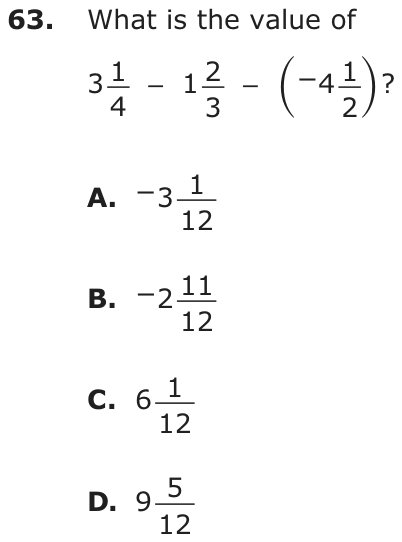
Question
What is the value of ?
- A
- B
- C
- D
Show the answer
Correct answer: C
The first step is to rewrite the problem replacing all subtraction with adding the opposite:
Then, rewrite all the fractions using a common denominator of 12, which is the least common multiple of the fractions’ denominators, 4, 3, and 2:
Next, combine the positive numbers and, finally, add the negative number to the sum by subtracting the number with the least absolute value from the number with the greatest absolute value and using the sign of the number with the greatest absolute value:
Question analysis
What is 3 1/4 − 1 2/3 − (−4 1/2)? This question on rational-number arithmetic combines mixed numbers with denominators of 4, 3 and 2 and ends by subtracting a negative number. Students must turn that last subtraction into an addition and find a common denominator before combining.
- Grade level
- Grade 7 content, by NYS standard
- Compared with grade 7
- At grade 7 Subtracting negative mixed numbers is core grade 7 content. This expression is typical in length, but it needs a common denominator of 12 and careful handling of the rule for subtracting a negative.
- Estimated difficulty
- Moderate: several steps, or a close reading with one strong distractor.
- Thinking it demands
- Depth of knowledge 1, recall and reproduction · mainly apply
- What makes it hard
- Error-prone arithmetic moderate
- Many steps minor
- Solution
- 4 steps
- Reading level
- Question and choices: about grade 10, 10 words.
- Students, last 30 days
- Not enough answers yet to show (it takes 10).
Why it is hard, traps and wrong answers (shows the answer)
Why it is hard
The expression is short, but it mixes a subtraction that stays a subtraction with one that becomes an addition, and that difference is what most wrong answers miss. The fractions add a second load, since twelfths are needed before anything combines. Estimating first, 3 − 1.7 + 4.5 is about 6, shows the result is positive, which rules out both negative values.
Error-prone arithmetic moderate Working it out
Three mixed numbers with denominators 4, 3 and 2 must become twelfths, and the last term, −(−4 1/2), changes sign while the middle subtraction does not. (Brown & Burton, 1978; Junker & Sijtsma, 2001)
Many steps minor Working it out
Rewriting the double negative, renaming each fraction, adding 3 1/4 and 4 1/2, then taking away 1 2/3 are four steps, each able to carry a slip forward. (Daniel & Embretson, 2010; Enright, Morley & Sheehan, 2002)
Strategy: Change subtracting −4 1/2 into adding 4 1/2, rename every fraction in twelfths, add the two positive numbers, then take away 1 2/3.
Traps
- Negatives and direction: Arithmetic with negative numbers, the order of a subtraction, or direction on a number line. (Moving a term across the equals sign without changing its sign is a faulty procedure.)
The wrong answers, classified
A Little reason to choose it (Haladyna & Downing, 1993; Rodriguez, 2005)
No single error gives −3 1/12; it needs subtracting 4 1/2 and also miswriting 3 1/4 as 3 1/12, two errors at once, so it mostly draws guesses.
B Negatives and direction (Brown & Burton, 1978)
Treats subtracting −4 1/2 as subtracting 4 1/2, so 3 1/4 − 1 2/3 − 4 1/2 = −2 11/12.
D Negatives and direction (Brown & Burton, 1978)
Drops both minus signs and adds the three mixed numbers, 3 1/4 + 1 2/3 + 4 1/2 = 9 5/12, as if every operation were addition.
Worked solution, step by step
Formulas used
- Subtracting a negative number
- a and b stand for any numbers. Taking away a negative number is the same as adding its opposite, the same number with the other sign. Think of it this way: taking away a debt leaves you richer.
- Equivalent fractions
- a is the top and b is the bottom of a fraction. Multiplying both by the same number n does not change its value. Use it to give fractions the same bottom number, so you can add or subtract them.
Sort out the question
You need the value of . Each number is a mixed number, a whole number plus a fraction. There are two subtractions. The second one takes away a negative number.
Change the double negative
Use the rule for subtracting a negative. Taking away is the same as adding .
The first minus sign stays as it is. Watch out: if you subtract instead, you get , choice B.
Give the fractions one denominator
The denominator is the bottom number of a fraction. Here they are 4, 3 and 2. The smallest number all three divide into is 12. So change each fraction to twelfths.
The problem is now:
Add the two positive numbers
You may add and subtract in any order, as long as each number keeps its sign. Add the two positive numbers first.
That is 3 + 4 = 7 wholes and 3 + 6 = 9 twelfths.
Take away the last number
That is 7 − 1 = 6 wholes and 9 − 8 = 1 twelfth. So the answer is C, .
Check your answer
Estimate with decimals: . And is about 6.08 too. The answer must be positive, so A and B are out. Choice D comes from adding all three numbers.
More questions like this
The original DOE question