Question
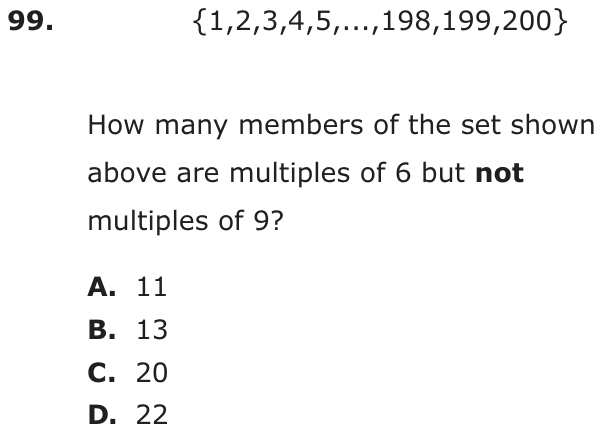
How many members of the set shown above are multiples of 6 but not multiples of 9?
- A11
- B13
- C20
- D22
Show the answer
Correct answer: D
First, list the first several multiples of 6: 6, 12, 18, 24, 30, 36, 42, 48, 54 . . .
Every third multiple (i.e., 18, 36, 54, . . .) is also a multiple of 9. Thus, of the multiples of 6 are not multiples of 9.
Next, calculate how many multiples of 6 are in the given number range. The last multiple of 6 would be 198. So, there are a total of multiples of 6. Since of those are not multiples of 9, the answer is .
Question analysis
This number properties question shows the set of whole numbers from 1 to 200 and asks how many of them are multiples of 6 but not multiples of 9. Students count multiples in a range and remove the overlap, the numbers divisible by both. Finding the right common multiple, and removing only the overlap, is where it gets tricky.
- NYS standards
- 6.NS.4 common factors and multiples
- Grade level
- Grade 6 content, by NYS standard
- Compared with grade 7
- Above grade 7 Multiples and common multiples are grade 6 content, but counting the members of a set that meet one condition and fail another is rare in grade 7 work. The overlap between the two kinds of multiples must be found and removed exactly.
- Estimated difficulty
- Hard: combines ideas, needs a plan, and has more than one tempting wrong answer.
- Thinking it demands
- Depth of knowledge 2, skills and concepts · mainly apply
- What makes it hard
- No obvious method moderate
- Much to keep track of minor
- Turning words into math minor
- Solution
- 3 steps
- Reading level
- Question and choices: about grade 6, 16 words.
- Students, last 30 days
- Not enough answers yet to show (it takes 10).
Why it is hard, traps and wrong answers (shows the answer)
Why it is hard
Counting multiples of 6 is routine; the harder decision is how to remove the ones that are also multiples of 9. Those are the multiples of 18, the least common multiple, not of 54 or 15, and students who count them correctly must still subtract them rather than report them. Listing 6, 12, 18, 24, 30, 36 shows the pattern, two kept for every one removed, which also gives the answer as two thirds of 33.
No obvious method moderate Working it out
The stem never mentions a common multiple: students must see that the multiples of 6 that are also multiples of 9 are the multiples of 18, every third multiple of 6. (Schoenfeld, 1985)
Much to keep track of minor Working it out
Three counts are in play at once, 33 multiples of 6 up to 198, 11 multiples of 18 up to 198, and their difference, and two of them are listed choices. (Sweller, 1988; Carpenter, Just & Shell, 1990)
Turning words into math minor Understanding the question
The bold not in “multiples of 6 but not multiples of 9” asks for what is left after a removal, a set difference rather than a count of the numbers removed. (Hegarty, Mayer & Monk, 1995; Koedinger & Nathan, 2004)
Strategy: Count the multiples of 6 up to 200, find the smallest number that is a multiple of both 6 and 9, count its multiples in the set, and subtract.
Traps
- Answers a different question: A choice is right for another quantity: the other unknown, the rest instead of the part, the part instead of the whole.
- Misunderstands the concept: A wrong belief about a concept: that percents can be added, that area grows like length, that averages can be averaged, that a bigger denominator means a bigger fraction.
The wrong answers, classified
A Answers a different question (King et al., 2004; Hegarty, Mayer & Monk, 1995)
Counts the 11 multiples of 18, the numbers to be removed, and gives that count instead of the multiples of 6 that remain.
B Misunderstands the concept (Smith, diSessa & Roschelle, 1993; De Bock et al., 1998; Ni & Zhou, 2005)
Takes 6 + 9 = 15 as the step between numbers divisible by both, and gives its 13 multiples up to 195, the numbers it would remove.
C Misunderstands the concept (Smith, diSessa & Roschelle, 1993; De Bock et al., 1998; Ni & Zhou, 2005)
Uses 6 + 9 = 15 instead of 18 as the common multiple and removes its 13 multiples from the 33 multiples of 6, leaving 20.
Worked solution, step by step
Formulas used
- Counting multiples
- n is the number whose multiples you count, such as 6. The first multiple is n × 1, the second is n × 2, and so on. So if the largest multiple in the set is n × k, there are k multiples in all.
- Least common multiple
- The least common multiple, or LCM, is the smallest number that two numbers both divide evenly. A number is a multiple of both 6 and 9 exactly when it is a multiple of 18.
Sort out the question
The set holds the whole numbers from 1 to 200. A multiple of 6 is a number that 6 divides evenly, like 6, 12 or 18. You need the multiples of 6 that are not multiples of 9. So count all the multiples of 6. Then take away those that are also multiples of 9.
Count the multiples of 6
200 is not a multiple of 6, but 198 is. So 198 is the last multiple of 6 in the set.
There are 33 multiples of 6.
Find the numbers to take away
List the multiples of 6: 6, 12, 18, 24, 30, 36. The first one 9 also divides is 18, then 36. So every third multiple of 6 is also a multiple of 9.
Watch out: the shared multiples are multiples of 18, not of 6 + 9 = 15. Using 15 leads to 13 or 20, choices B and C.
Count the multiples of 18
The last multiple of 18 in the set is also 198.
There are 11 of them. Watch out: these are the numbers you take away, not the answer. Stopping here gives 11, choice A.
Take away the multiples of 18
There are 22 multiples of 6 left over. So the answer is D, 22.
Check your answer
Every third multiple of 6 is a multiple of 18, so two out of every three multiples of 6 stay. Two thirds of 33 is . That matches. Test one: 30 is a multiple of 6, and 30 ÷ 9 is not a whole number, so 30 counts.
More questions like this
The original DOE question