Question
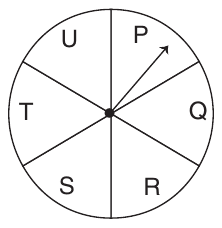
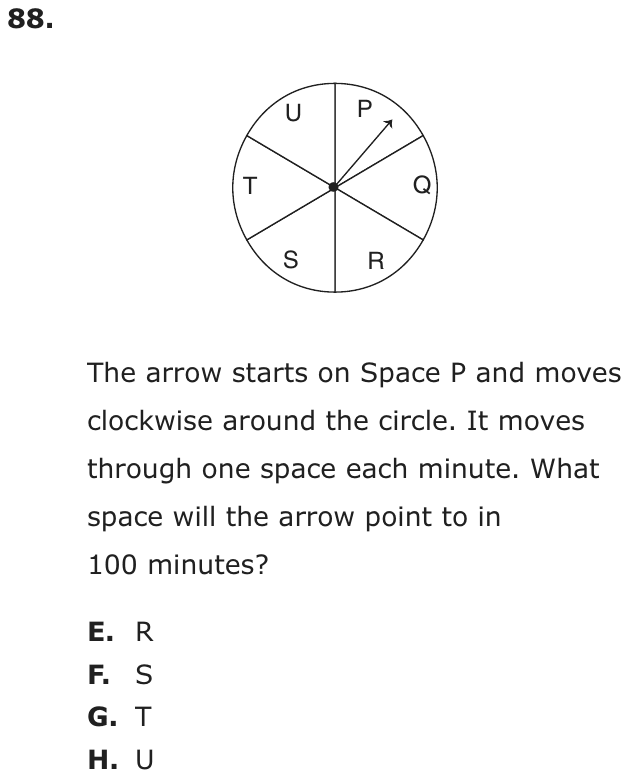
The arrow starts on Space P and moves clockwise around the circle. It moves through one space each minute. What space will the arrow point to in 100 minutes?
- AR
- BS
- CT
- DU
Show the answer
Correct answer: C
There are 6 spaces, so first divide 100 by 6: , remainder 4. So, the arrow goes around 16 full times and then 4 more spaces. Four spaces from Space P is Space T.
Question analysis
This patterns question shows a circle split into six lettered spaces, with an arrow that starts on P and moves one space clockwise each minute, and asks where it points after 100 minutes. Students use division with a remainder to skip the full trips around. Counting the leftover moves without including the starting space, and in the right direction, is the tricky part.
- NYS standards
- 6.NS.2 multi-digit division
- Grade level
- Grade 6 content, by NYS standard
- Compared with grade 7
- At grade 7 Division with a remainder is grade 6 arithmetic, but using that remainder to step around a six-part circle is a pattern task that grade 7 classes seldom practice. It needs careful counting rather than new content.
- Estimated difficulty
- Straightforward: two steps or one careful reading.
- Thinking it demands
- Depth of knowledge 2, skills and concepts · mainly apply
- What makes it hard
- Solution
- 2 steps
- Reading level
- Question and choices: about grade 1, 32 words.
- Students, last 30 days
- Not enough answers yet to show (it takes 10).
Why it is hard, traps and wrong answers (shows the answer)
Why it is hard
The division is short; the points are lost in turning the remainder into a space. The arrow starts on P, so the 4 leftover moves land on Q, R, S and T, and counting P itself as a move stops one space short. Going around the wrong way, or one move too far, gives the other two choices. Checking a small case first, such as 7 minutes landing on Q, fixes the rule before it is used.
No obvious method minor Working it out
The stem never mentions division; the step that unlocks it is seeing that every 6 minutes brings the arrow back to P, so only the remainder of 100 ÷ 6 matters. (Schoenfeld, 1985)
Reading a figure, table or graph minor Understanding the question
The six spaces and their clockwise order, P, Q, R, S, T, U, appear only in the circle diagram, so the cycle length and the direction of counting both come from the figure. (Lesh, Post & Behr, 1987; Kirsch & Mosenthal, 1990)
Strategy: Divide 100 by 6: every full trip around the circle brings the arrow back to P, so only the remainder matters; count that many moves clockwise, starting with the space after P.
Traps
- Counting the ends: Inclusive or exclusive ends, fence posts, consecutive numbers: an answer that is one too many or too few, or an endpoint drawn open where it belongs closed (or the reverse).
- Negatives and direction: Arithmetic with negative numbers, the order of a subtraction, or direction on a number line. (Moving a term across the equals sign without changing its sign is a faulty procedure.)
The wrong answers, classified
A Negatives and direction (Brown & Burton, 1978)
Counts the 4 leftover moves counterclockwise from P, through U, T and S to R, instead of clockwise as the stem says the arrow moves.
B Counting the ends (Brown & Burton, 1978)
Counts Space P itself as the first of the 4 leftover moves, P, Q, R, S, so the arrow stops one space short of where it really points.
D Counting the ends (Brown & Burton, 1978)
Makes 5 moves past P instead of the 4 left after 16 full turns, overshooting by one space, the fence-post slip in the other direction.
Worked solution, step by step
Formulas used
- Division with a remainder
- a is the number you divide, here the minutes. b is the number you divide by, here the spaces in one trip around. q is how many whole groups of b fit into a. r is the remainder, the amount left over. The remainder is always less than b.
Sort out the question
The circle has 6 spaces. Going clockwise, the way a clock’s hands turn, they are P, Q, R, S, T and U. The arrow starts on P and moves one space each minute. You need the space it points to after 100 minutes.
Notice that the pattern repeats
After 6 minutes, the arrow has gone all the way around and points to P again. After 12 minutes it is back on P again, and so on. So full trips of 6 minutes don’t change where it points. Only the leftover minutes matter.
Divide 100 by 6
The arrow makes 16 full trips. That takes minutes, and it is back on P. There are 4 minutes left over.
Count the last 4 moves
From P, move one space each minute: Q (minute 97), R (minute 98), S (minute 99), T (minute 100).
Watch out: don’t count P itself as the first move. That stops on S, choice B. Also count clockwise. Counting the other way lands on R, choice A.
So the answer is C, T.
Check your answer
Use a smaller number with the same remainder. 100 − 96 = 4, and 96 minutes is a whole number of trips. So after 100 minutes the arrow points where it does after 4 minutes. Four moves from P are Q, R, S, T. That is T again.
More questions like this
The original DOE question