Fragment or run-on
Question 1 of 2
2025 Practice Test A English, question 55Question
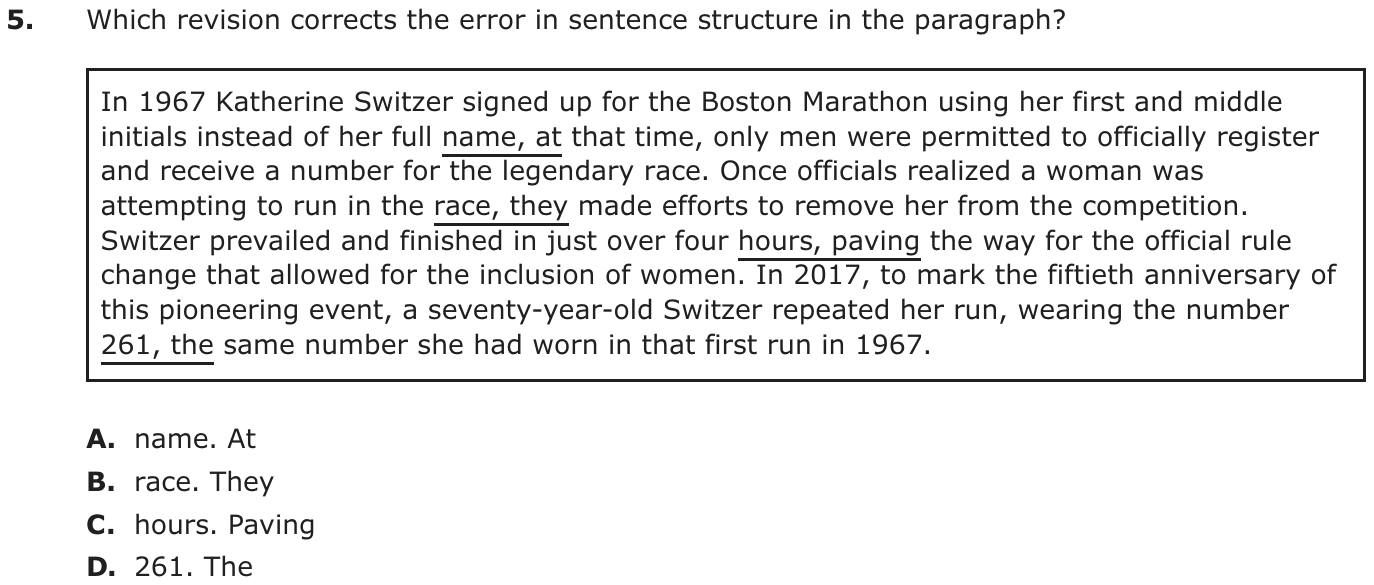
Which revision corrects the error in sentence structure in the paragraph?
The land on Earth has not always been separated into the seven continents, at one time a massive supercontinent, known as Pangaea, covered one-third of Earth’s surface. Additionally, the supercontinent was surrounded by ocean waters called Panthalassa, much of which were in Earth’s Southern Hemisphere. Geologists believe that the supercontinent split apart over millions of years because of the movement of the tectonic plates that form Earth’s crust. In fact, experts predict that over the next 250 million years the movement of the plates will cause the seven continents to merge into a supercontinent again.
- Acontinents. At
- Bsurface; additionally,
- CPanthalassa. Much
- Dcrust, in fact,
Show the answer
Correct answer: A
The question asks for the revision that corrects the error in sentence structure in the paragraph.
A. CORRECT. The first sentence of the paragraph is a run-on because both clauses—“The land on Earth has not always been separated into the seven continents” and “at one time a massive supercontinent, known as Pangaea, covered one-third of Earth’s surface”—are independent clauses. Independent clauses are complete sentences, and two complete sentences should not be combined with just a comma. The revision is correct because it separates the two sentences by placing a period where it is needed after “continents” and by capitalizing the word “At.”
B. Incorrect. While adding a semicolon after “surface” can be considered a correct way to separate the independent clauses “at one time a massive supercontinent, known as Pangaea, covered one-third of Earth’s surface” and “Additionally, the supercontinent was surrounded by ocean waters called Panthalassa, much of which were in Earth’s Southern Hemisphere,” this change does not address the sentence structure error in the paragraph (the run-on sentence). The use of a period separating the independent clauses (complete sentences) is correct as is.
C. Incorrect. Adding a period after “Panthalassa” would separate the dependent clause “much of which were in Earth’s Southern Hemisphere” from its antecedent: “ocean waters called Panthalassa.” The dependent clause cannot stand on its own, because it shares elements with the main clause. A dependent clause is not a complete sentence and must be joined with an independent clause. The clause beginning with “much of which” is an adjective clause that modifies “ocean waters.” Changing the comma to a period creates a new error (a sentence fragment) and does not address the existing sentence structure error at the beginning of the paragraph (the run-on sentence).
D. Incorrect. Removing the period after “crust” would create a run-on sentence because the period is needed to separate two complete sentences—“Geologists believe that the supercontinent split apart over millions of years because of the movement of the tectonic plates that form Earth’s crust” and “In fact, experts predict that over the next 250 million years the movement of the plates will cause the seven continents to merge into a supercontinent again.” A comma after “crust” would combine these sentences into a run-on, creating a new error in the sentence without fixing the existing sentence structure error (the run-on sentence) at the beginning of the paragraph.
Question analysis
This editing question shows a short paragraph about Pangaea, the supercontinent that once covered a third of Earth’s surface, and the ocean around it, with four underlined spots, and asks which revision corrects the error in sentence structure. Each revision changes only punctuation and capitals at one spot, so the decision rests on how the clauses around each spot fit together.
- Grade level
- Grade 6 reading and task
- Compared with grade 7
- Below grade 7 Fixing run-ons and fragments is taught well before grade 7, and this item tests that basic skill in one short paragraph. The sentences are long, with an appositive and a clause beginning “much of which,” but the grammar involved stays simple.
- Estimated difficulty
- Straightforward: two steps or one careful reading.
- Thinking it demands
- Depth of knowledge 2, skills and concepts · mainly apply
- What makes it hard
- A rule that doesn't sound wrong moderate
- Every choice must be checked minor
- Complex sentences minor
- Evidence
- Answered from one paragraph or stanza
- Reading level
- Question and choices: about grade 9, 114 words.
- Corrected from the DOE handbook
- Two grammar terms in the explanation were corrected.
- Students, last 30 days
- Not enough answers yet to show (it takes 10).
Why it is hard, traps and wrong answers (shows the answer)
Why it is hard
The error is in the first sentence, but it hides behind a comma that sounds like an ordinary pause, while the later spots carry features that look riskier: a transition word, a clause beginning “much of which,” the phrase “in fact.” Students who test each spot for a complete sentence on both sides find the splice at once. Those who look for a revision that merely sounds polished are drawn to the semicolon, which is correct but fixes nothing.
A rule that doesn't sound wrong moderate Working it out
The comma after “continents” joins two complete sentences, and because “at one time” sounds like an introductory phrase continuing the thought, the splice reads as a natural pause. (Connors & Lunsford, 1988)
Every choice must be checked minor Choosing the answer
Each revision changes only punctuation at one underlined spot, and the semicolon one is correct English, so students must ask whether each spot was wrong to begin with, not only whether the change looks right. (Embretson & Wetzel, 1987)
Complex sentences minor Understanding the question
The paragraph’s sentences are long, with the appositive “known as Pangaea” and the clause “much of which were,” whose odd-sounding verb draws suspicion to a spot that is correctly punctuated. (Abedi & Lord, 2001; Freedle & Kostin, 1993; Messick, 1989)
Strategy: At each underlined spot, read the words on both sides and ask whether each side could stand as a sentence, then pick the revision that leaves every sentence correctly joined or separated.
Traps
- Fixes what isn't broken: Changes a part of the sentence that was already correct, while the real error stays; or, where the question asks which sentence has an error or should go, picks one that is correct and belongs.
- Fragment or run-on: Creates or keeps a sentence fragment, a run-on sentence or a comma splice.
The wrong answers, classified
B Fixes what isn't broken (Connors & Lunsford, 1988)
Knows a semicolon can join two clauses before “additionally” and picks that tidy-looking change, though the period it replaces was already correct and the comma splice up front remains.
C Fragment or run-on (Connors & Lunsford, 1988)
Treats the long second sentence as a run-on and splits it after “Panthalassa,” leaving “Much of which were in Earth’s Southern Hemisphere” as a fragment with no main clause.
D Fragment or run-on (Connors & Lunsford, 1988)
Thinks “in fact” belongs inside the sentence before it, set off by commas, which joins two complete sentences with only a comma and creates the error the paragraph already has.
What was corrected from the DOE handbook, and why
- Explanation: The DOE’s explanation of Option C says a period after “Panthalassa” would separate the dependent clause “much of which were in Earth’s Southern Hemisphere” “from its subject: ‘ocean waters called Panthalassa.’” The clause has a subject of its own, “much”; “ocean waters called Panthalassa” is its antecedent, the noun phrase that “which” refers to. The explanation also calls the clause “an adjective for ‘ocean waters’”; a clause is not an adjective but an adjective (relative) clause, which modifies the noun. The site now says “from its antecedent” and “an adjective clause that modifies ‘ocean waters.’” The reasoning and the answer, A, are unchanged.
Working it out, step by step
Learn the rule for joining sentences
An independent clause is a group of words with a subject and a verb that can stand alone as a sentence. Two of them can’t be joined with only a comma. That mistake is a run-on sentence, also called a comma splice. For example: I love soccer, my brother loves chess. Fix it with a period: I love soccer. My brother loves chess.
Test each underlined spot
At each spot, read the words on both sides. Ask: could each side stand alone as a sentence?
- After “continents”: both sides are complete. A comma joins them, so this is an error.
- After “surface”: a period already separates two sentences. That is correct.
- After “Panthalassa”: the words after the comma can’t stand alone. The comma is correct.
- After “crust”: a period already separates two sentences. That is correct.
Look closely at the first sentence
The first part says “The land on Earth has not always been separated into the seven continents.” That is a full sentence. The second part says “at one time a massive supercontinent, known as Pangaea, covered one-third of Earth’s surface.” Its subject is “supercontinent,” and its verb is “covered.” So it is a full sentence too. The words “At one time” start a new sentence.
Show the fix
Change the comma to a period, and capitalize the next word: The land on Earth has not always been separated into the seven continents. At one time a massive supercontinent, known as Pangaea, covered one-third of Earth’s surface. Now each sentence stands on its own. That is the revision continents. At.
Check each choice
- A is right. It splits the run-on into two sentences.
- B is wrong. A semicolon could join those two sentences, but the period there was already correct. It fixes nothing.
- C is wrong. “Much of which were in Earth’s Southern Hemisphere” is a dependent clause, a group of words with a verb that can’t be a sentence by itself. “Which” points back to “ocean waters called Panthalassa,” its antecedent. So the clause must stay attached.
- D is wrong. A comma after “crust” would join two full sentences. That makes a new run-on.
Choose the answer
Only the comma after “continents” joins two complete sentences. So the answer is A, continents. At.
Why this answer and not the closest wrong one
B is the closest wrong choice, because a semicolon can correctly join two sentences. But the spot after “surface” already had a period, which was correct. Changing it does not fix the real error. The comma splice after “continents” would still be there. Only A fixes it.
More questions like this
The original DOE question
Question 2 of 2
2022 Test A English, question 5Question
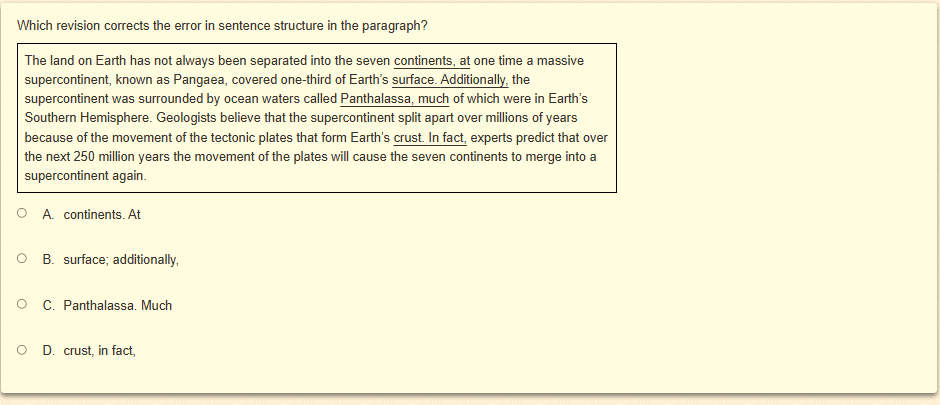
Which revision corrects the error in sentence structure in the paragraph?
In 1967 Kathrine Switzer signed up for the Boston Marathon using her first and middle initials instead of her full name, at that time, only men were permitted to officially register and receive a number for the legendary race. Once officials realized a woman was attempting to run in the race, they made efforts to remove her from the competition. Switzer prevailed and finished in just over four hours, paving the way for the official rule change that allowed for the inclusion of women. In 2017, to mark the fiftieth anniversary of this pioneering event, a seventy-year-old Switzer repeated her run, wearing the number 261, the same number she had worn in that first run in 1967.
- Aname. At
- Brace. They
- Chours. Paving
- D261. The
Show the answer
Correct answer: A
The question asks for the revision that corrects the error in sentence structure in the paragraph.
A. CORRECT. As written, the first sentence (“In 1967 Kathrine Switzer . . . legendary race.”) is a run-on sentence because a comma is used to combine two independent clauses. Independent clauses are complete sentences with a subject and a verb. The clauses—“In 1967 Kathrine Switzer signed up for the Boston Marathon using her first and middle initials instead of her full name” and “at that time, only men were permitted to officially register and receive a number for the legendary race”—should be separated with a period instead. This revision correctly places a period after the word “name” and capitalizes the word “At” to separate the two independent clauses into two sentences.
B. Incorrect. The revision introduces an error into the paragraph and does not revise the run-on in the first sentence. The clause “Once officials realized a woman was attempting to run in the race” is a dependent clause functioning as an adverb of the independent clause that follows it. Changing the comma after the word “race” to a period would incorrectly separate the adverbial dependent clause from the independent clause.
C. Incorrect. The revision introduces an error into the paragraph and does not revise the run-on in the first sentence. The sentence “Switzer prevailed and finished in just over four hours, paving the way for the official rule change that allowed for the inclusion of women” combines an independent clause (“Switzer prevailed and finished in just over four hours”) and a participial phrase (“paving the way for the official rule change that allowed for the inclusion of women”). The phrase “paving the way for the official rule change that allowed for the inclusion of women” is not a complete sentence and must stay connected to the first part of the sentence. Changing the comma after “hours” to a period would incorrectly separate the participial phrase from the independent clause.
D. Incorrect. The revision introduces an error into the paragraph and does not revise the run-on in the first sentence. Changing the comma after “261” to a period would incorrectly separate the appositive phrase “the same number she had worn in that first run in 1967” from the words it describes (“number 261”). Additionally, the phrase “the same number she had worn in that first run in 1967” is not a complete sentence.
Question analysis
This sentence-structure question gives a four-sentence paragraph about Kathrine Switzer, who entered the 1967 Boston Marathon under her initials when only men could register and ran it again at seventy. Students pick the revision that corrects its error in sentence structure, and because every choice turns an underlined comma into a period, each spot needs its own check.
- Grade level
- Grade 6 reading and task
- Compared with grade 7
- Below grade 7 Run-ons and fragments are taught before grade 7, and this item checks that skill at four underlined spots in one short paragraph. The clauses and phrases around the correct commas take some grammar sense, but the core skill is basic.
- Estimated difficulty
- Straightforward: two steps or one careful reading.
- Thinking it demands
- Depth of knowledge 2, skills and concepts · mainly apply
- What makes it hard
- A rule that doesn't sound wrong moderate
- Every choice must be checked minor
- Complex sentences minor
- Evidence
- Answered from one paragraph or stanza
- Reading level
- Question and choices: about grade 7, 131 words.
- Corrected from the DOE handbook
- A misspelled name in the paragraph and its explanation was corrected.
- Grammar terms in the explanations of two wrong options were corrected.
- Students, last 30 days
- Not enough answers yet to show (it takes 10).
Why it is hard, traps and wrong answers (shows the answer)
Why it is hard
Every choice makes the same kind of change, so the question comes down to telling one real comma splice from three commas doing legitimate work. The most dangerous spot is after “race,” where a subject and verb sit on both sides of the comma, just as at the real error, and only the word “Once” marks the first part as dependent. Students who test each side for a complete thought, not just for a subject and a verb, find the splice in the opening sentence quickly.
A rule that doesn't sound wrong moderate Working it out
The run-on hides behind the short phrase “at that time,” which makes the comma after “name” sound like an ordinary pause; only checking that each side can stand alone exposes the comma splice. (Connors & Lunsford, 1988)
Every choice must be checked minor Choosing the answer
All four revisions swap a comma for a period, so every underlined spot needs the same test: could the words before it and the words after it each stand as a sentence? (Embretson & Wetzel, 1987)
Complex sentences minor Understanding the question
The three correct commas guard three different structures, an opening “Once” clause, a participial phrase beginning with “paving” and an appositive after “261,” and each has to be recognized as unable to stand alone. (Abedi & Lord, 2001; Freedle & Kostin, 1993; Messick, 1989)
Strategy: At each underlined comma, read the words before it and the words after it as separate pieces and ask whether each could stand alone as a sentence; that shows where a period belongs.
Traps
- Fragment or run-on: Creates or keeps a sentence fragment, a run-on sentence or a comma splice.
The wrong answers, classified
B Fragment or run-on (Connors & Lunsford, 1988)
Finds a subject and verb on both sides of the comma after “race” and calls it a splice, missing that “Once” makes the first part a dependent clause that cannot stand alone.
C Fragment or run-on (Connors & Lunsford, 1988)
Treats the long third sentence as a run-on and ends it after “hours,” leaving “Paving the way for the official rule change” as a fragment with no subject or main verb.
D Fragment or run-on (Connors & Lunsford, 1988)
Spots the subject and verb “she had worn” after the comma following “261,” but they sit inside a phrase that renames the number, so the new sentence would be a fragment.
What was corrected from the DOE handbook, and why
- Stem and explanation: The handbook spells the runner’s name “Katherine Switzer” in the paragraph and twice in the explanation. She is Kathrine Switzer, who entered the 1967 Boston Marathon as “K. V. Switzer,” so the site now spells her name that way, in the question’s title too. No answer depends on the spelling.
- Explanation: The DOE’s explanation of Option C calls “paving the way for the official rule change that allowed for the inclusion of women” a dependent clause, and on that basis calls the sentence a complex sentence. The words have no subject or finite verb of their own: they are a participial phrase, which the site now calls them, and the site no longer calls the sentence complex for that reason. Its explanation of Option D calls “the same number she had worn in that first run in 1967” a modifying clause; it is an appositive phrase, a noun phrase that renames “number 261,” and the site now says so. Neither phrase can stand alone as a sentence, so Options C and D are still wrong, and the answer, Option A, is unchanged.
Working it out, step by step
Figure out what the question asks
This is a sentence structure question. In one spot, two full sentences are joined by only a comma. That mistake is called a run-on. Every choice turns one underlined comma into a period. Only one of those changes fixes a run-on. The other three would break off a piece that can’t stand alone.
Learn the rule for run-ons
An independent clause is a group of words that makes sense alone. It has a subject and a verb. The subject is who or what the sentence is about. The verb tells what the subject does or is. A comma alone can’t join two independent clauses. Use a period instead.
Example: It rained, we stayed inside. Fix: It rained. We stayed inside.
Test the comma after name
Read the words before that comma: “In 1967 Kathrine Switzer signed up for the Boston Marathon using her first and middle initials instead of her full name.” That makes sense alone. Now read the words after it: “at that time, only men were permitted to officially register.” That makes sense alone too. Its subject is “only men,” and its verb is “were permitted.” So two full sentences are joined by a comma. That is the run-on.
Test the other three commas
- B (after “race”): The first part is “Once officials realized a woman was attempting to run in the race.” The word “Once” makes it a dependent clause. That is a group of words with a subject and verb that can’t stand alone.
- C (after “hours”): The words starting “paving the way for the official rule change” are a participial phrase. The phrase starts with an -ing verb form and adds information. It has no subject of its own.
- D (after “261”): “the same number she had worn in that first run in 1967” is an appositive phrase. It renames the noun right before it, the number 261. It can’t stand alone either.
Choose the answer
Watch out: B is the trickiest. It has a subject and a verb on each side of its comma, “officials realized” and “they made.” But “Once” keeps the first part from standing alone. Only the comma after “name” joins two full sentences. A period goes there, and “At” gets a capital letter. So the answer is A: name. At.
Why this answer and not the closest wrong one
B is the closest wrong answer. Like the comma after “name,” its comma has a subject and a verb on each side. But “Once” means the first part needs the words after the comma to finish its thought. At the comma after “name,” both sides already stand alone. So that comma is the real run-on.
More questions like this
The original DOE question