6.EE.9 dependent and independent variables
Question 1 of 3
2026 Practice Test B Math, question 46Question
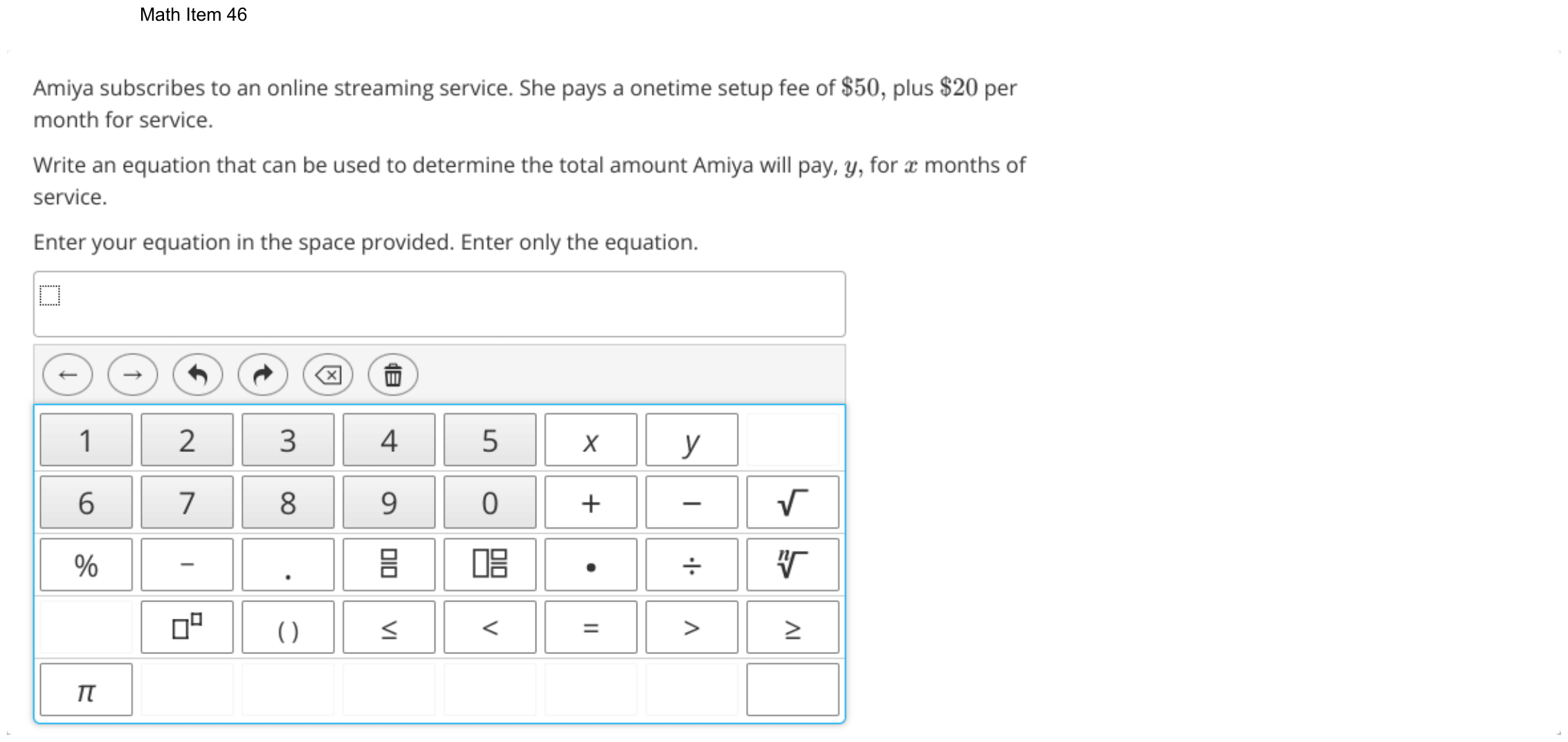
Amiya subscribes to an online streaming service. She pays a onetime setup fee of $50, plus $20 per month for service.
Write an equation that can be used to determine the total amount Amiya will pay, y, for x months of service.
Enter your equation in the space provided. Enter only the equation.
On the test you build the answer on an on-screen keypad; here, type it. Use ^ for a power, sqrt( ) or √ for a root, pi for π, and <= or >= for ≤ and ≥.
Show the answer
Correct answer: y = 20x + 50
Solution:
An equation of the form can be used to represent the total amount Amiya will pay.
Using the information from the scenario, the onetime setup fee of $50 is the constant term (q), and the $20 per month of service is the coefficient (p) of the number of months (x).
So, the equation that can be used to determine the total amount Amiya will pay, y, for x months of service is .
Question analysis
Amiya pays a one-time setup fee plus a monthly charge for a streaming service, and students type an equation for her total cost y after x months. It tests writing a linear equation from a word problem with a starting amount and a rate. The two dollar amounts play different roles, so which one goes with x has to be thought through.
- NYS standards
- Grade level
- Grade 7 content, by NYS standard
- Compared with grade 7
- At grade 7 Writing an equation for a fixed fee plus a steady monthly charge is a familiar grade 7 task, and the numbers are whole. Typing the full equation, with both variables and no choices to compare, makes it less forgiving.
- Estimated difficulty
- Straightforward: two steps or one careful reading.
- Thinking it demands
- Depth of knowledge 2, skills and concepts · mainly apply
- What makes it hard
- Turning words into math moderate
- An answer in an unexpected form minor
- Solution
- 2 steps
- Reading level
- Question and choices: about grade 6, 51 words.
- Students, last 30 days
- Not enough answers yet to show (it takes 10).
Why it is hard, traps and wrong answers (shows the answer)
Why it is hard
The numbers are small and whole, so the work is in the roles. The $50 is paid once and the $20 every month, and a student who places them in the order they appear writes the fee as the monthly rate; others leave the fee out entirely. Checking the equation at x = 1 and x = 2, where Amiya has paid $70 and then $90, shows at once whether each amount is in the right place.
Turning words into math moderate Understanding the question
Only the words “onetime setup fee” and “per month” tell which amount is multiplied by x and which is added once, and the $50 comes first in the sentence. (Hegarty, Mayer & Monk, 1995; Koedinger & Nathan, 2004)
An answer in an unexpected form minor Choosing the answer
The whole equation, with y, an equals sign and x, is built on a keypad with no choices, so a reversed or incomplete equation looks as finished as the right one. (Enright, Morley & Sheehan, 2002)
Strategy: Work out Amiya's total for 1 month and for 2 months by hand, see which amount is added again each month, and build an equation that gives both totals.
Traps
- Misunderstands the concept: A wrong belief about a concept: that percents can be added, that area grows like length, that averages can be averaged, that a bigger denominator means a bigger fraction.
- Stops one step early: A choice is a number from partway through the solution.
- Numbers taken from the question: Combines the numbers in the question without a model of the situation, or is simply a number that appears in the question.
The wrong answers, classified
y = 20x Stops one step early (King et al., 2004; Gierl et al., 2017)
Multiplies the $20 monthly charge by x months but never adds the one-time $50 setup fee, so the equation gives only the cost of service.
y = 50x + 20 Misunderstands the concept (Smith, diSessa & Roschelle, 1993; De Bock et al., 1998; Ni & Zhou, 2005)
Attaches x to the $50 fee and adds the $20 once, putting the numbers into y = mx + b in the order they appear rather than by which one repeats.
y = 70x Numbers taken from the question (Hegarty, Mayer & Monk, 1995)
Adds the $50 fee and the $20 charge into $70 and multiplies by the months, which would charge the setup fee again every month.
Worked solution, step by step
Formulas used
- Total cost with a fee and a rate
- y is the total cost in dollars, and x is the number of months. The rate is the amount paid every month. You multiply it by x because it is paid once for each month. The fee is paid only once, so you add it once, no matter how many months.
Sort out the question
Amiya pays two kinds of charges:
- a setup fee of $50, paid one time only;
- a charge of $20 for every month of service.
y is her total cost in dollars, and x is the number of months. You need an equation that links them. The answer is an equation, not a number.
Work out a few totals
Find the total for a few months by hand. Each month adds one more $20:
Months Monthly charges ($) Total ($) 1 2 3 The $50 shows up once in every total. The $20 shows up once for each month.
Match each number to its job
Use the fee-and-rate model, . The rate is the amount that repeats each month, $20. It multiplies the months, so it becomes 20x. The fee, $50, is paid once, so it is added once.
Watch out: the $50 comes first in the question, but it is not the rate. charges $50 a month. charges the fee every month. forgets the fee.
Write the equation
Put the rate and the fee into the model:
Here 20x means 20 times x. An equal form is fine too, such as , because you can add in either order.
Enter it on the keypad
Type the whole equation, including y =. Without it, you have an expression, not an equation. On the test, the keypad has x, y and = keys. Press y, =, 2, 0, x, +, 5, 0. You do not need a times sign or dollar signs. On this site, type it the same way.
So you would enter y = 20x + 50.
Check your answer
Test the equation with the totals you found. For 1 month, , and Amiya pays $50 + $20 = $70. For 2 months, . Both match. For 0 months, y = 50, just the setup fee.
More questions like this
The original DOE question
Question 2 of 3
2026 Practice Test D Math, question 28Question
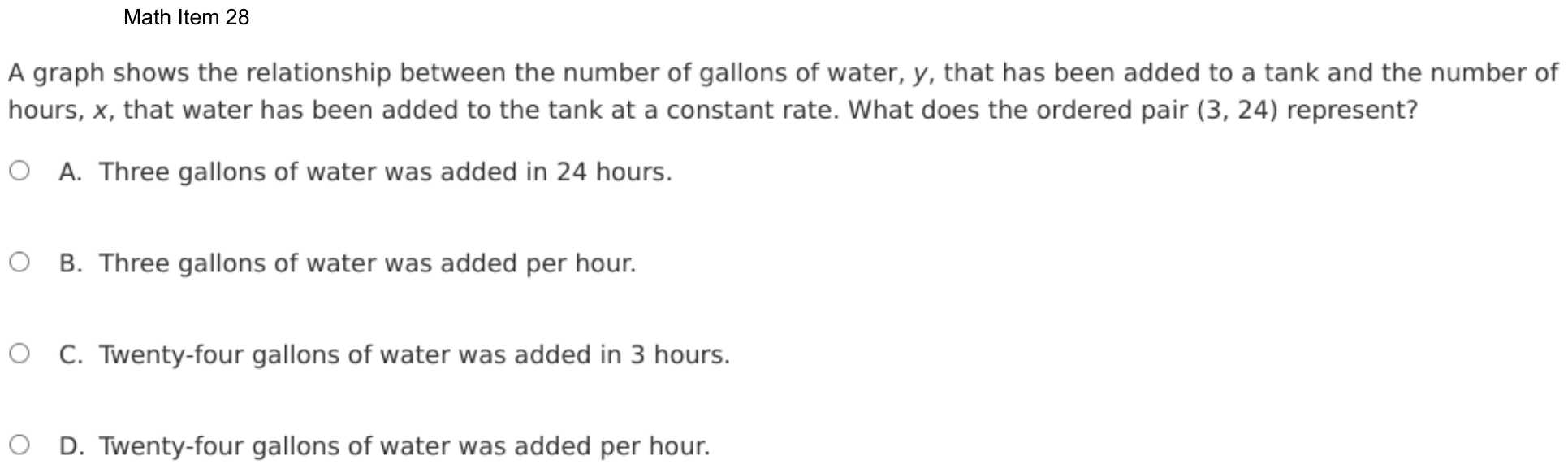
A graph shows the relationship between the number of gallons of water, y, that has been added to a tank and the number of hours, x, that water has been added to the tank at a constant rate. What does the ordered pair (3, 24) represent?
- AThree gallons of water was added in 24 hours.
- BThree gallons of water was added per hour.
- CTwenty-four gallons of water was added in 3 hours.
- DTwenty-four gallons of water was added per hour.
Show the answer
Correct answer: C
It is given that x-values on the graph represent the numbers of hours for which water was added to the tank, and the y-values represent the numbers of gallons of water added in x hours. In the ordered pair (3, 24), 3 represents an x-value and 24 represents a y-value.
Therefore, (3, 24) represents a data point for 24 gallons of water being added to the tank in a 3-hour period.
Question analysis
A graph relates the gallons of water added to a tank, y, to the hours it has been filling at a constant rate, x. Students choose what the ordered pair (3, 24) means in the situation. It tests interpreting coordinates in context, and the four statements mix totals with rates and switch the two numbers around.
- Grade level
- Grade 7 content, by NYS standard
- Compared with grade 7
- At grade 7 Explaining what a point on the graph of a proportional relationship means is named in the grade 7 standards. This is a direct case with no graph to read, though the stem introduces the two quantities in an order that needs care.
- Estimated difficulty
- Straightforward: two steps or one careful reading.
- Thinking it demands
- Depth of knowledge 2, skills and concepts · mainly understand
- What makes it hard
- Solution
- 1 step
- Reading level
- Question and choices: about grade 5, 76 words.
- Students, last 30 days
- Not enough answers yet to show (it takes 10).
Why it is hard, traps and wrong answers (shows the answer)
Why it is hard
One fact decides the question: an ordered pair lists x first. The choices then test two confusions, which number is the gallons and whether a point is a rate. Reading the pair aloud as “after 3 hours, 24 gallons”, and noting that 24 ÷ 3 gives a rate of 8 gallons an hour that no choice states, rules out all three wrong statements.
Reading a figure, table or graph minor Understanding the question
No graph is drawn, and the stem names y, the gallons, before x, the hours, so the pair (3, 24) has to be matched to its letters, not to the order the quantities were mentioned. (Lesh, Post & Behr, 1987; Kirsch & Mosenthal, 1990)
A very close wrong answer minor Choosing the answer
The four statements reuse 3 and 24 in two frames, a total added “in” some hours and an amount “per hour”, so the right statement and its swapped twin differ only in which number counts gallons. (Embretson & Wetzel, 1987; Gorin & Embretson, 2006; Ascalon et al., 2007)
Strategy: Recall that an ordered pair lists x first and y second, write down what x and y measure here, and read the pair as one sentence about hours and gallons.
Traps
- Misreads the question: Misses or misreads a condition or a word in the question: "at least", "each", "remaining", "not".
- Misunderstands the concept: A wrong belief about a concept: that percents can be added, that area grows like length, that averages can be averaged, that a bigger denominator means a bigger fraction.
The wrong answers, classified
A Misreads the question (Hegarty, Mayer & Monk, 1995)
Pairs the numbers with the quantities in the order the stem names them, gallons first, so reads (3, 24) as 3 gallons in 24 hours.
B Misunderstands the concept (Smith, diSessa & Roschelle, 1993; De Bock et al., 1998; Ni & Zhou, 2005)
Takes the first coordinate for a rate and pins it to gallons, mixing up one point on the graph with the constant rate, which is 8 gallons an hour.
D Misunderstands the concept (Smith, diSessa & Roschelle, 1993; De Bock et al., 1998; Ni & Zhou, 2005)
Reads the 24 gallons as the amount added each hour, taking a point’s y-value for the rate, though 24 is the total after 3 hours.
Worked solution, step by step
Formulas used
- An ordered pair
- An ordered pair names one point on a graph. The first number is always the x-value. The second number is always the y-value. Here x counts hours and y counts gallons. So a pair tells how many gallons were added after that many hours.
- Rate from a point
- When water is added at a constant rate, divide the y-value by the x-value. The result is the rate: gallons added in 1 hour. A point itself shows a total, not a rate.
Sort out the question
The graph links two amounts:
- x is the number of hours water has been added.
- y is the number of gallons added.
You need to say what the point (3, 24) means. No graph is drawn, so you work from the words.
Match each number to its letter
In an ordered pair, x always comes first and y second. So in (3, 24):
- x = 3, which means 3 hours.
- y = 24, which means 24 gallons.
Watch out: the question names gallons first and hours second. Do not match the numbers to the words in that order. That mistake reads 3 as gallons and 24 as hours, choice A.
Read the pair as a sentence
Put the two meanings together: after 3 hours, 24 gallons have been added in all. The 24 is a total for the whole 3 hours.
Watch out: 24 is not the amount for each hour. The rate per hour is gallons. So choice D, 24 gallons per hour, is wrong. Choice B, 3 gallons per hour, is also not the rate.
So the answer is C, twenty-four gallons of water was added in 3 hours.
Check your answer
Use the rate of 8 gallons each hour. In 3 hours, gallons go in. That matches choice C. No choice says 8 gallons per hour, so both “per hour” choices must be wrong.
More questions like this
The original DOE question
Question 3 of 3
2026 Practice Test D Math, question 46Question
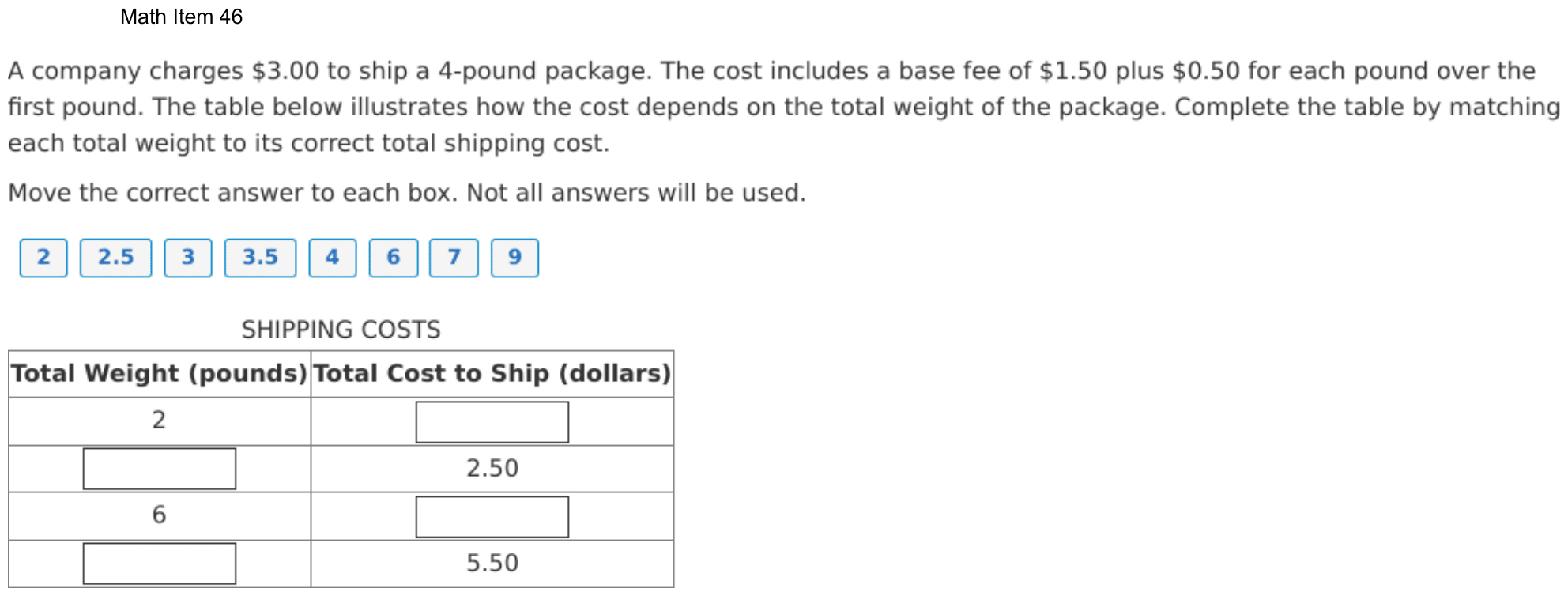
A company charges $3.00 to ship a 4-pound package. The cost includes a base fee of $1.50 plus $0.50 for each pound over the first pound. The table below illustrates how the cost depends on the total weight of the package. Complete the table by matching each total weight to its correct total shipping cost.
Move the correct answer to each box. Not all answers will be used.
SHIPPING COSTS
| Total Weight (pounds) | Total Cost to Ship (dollars) |
|---|---|
| 2 | |
| 2.50 | |
| 6 | |
| 5.50 |
On the test you drag tiles into the boxes; here, choose each box’s tile from its menu. Each tile can be used once. The DOE has not published how answers with several parts are scored; this site counts one right only when every part is right.
Show the answer
Correct answer: blank 1: 2; blank 2: 3; blank 3: 4; blank 4: 9
| Total Weight (pounds) | Total Cost to Ship (dollars) |
|---|---|
| 2 | 2 |
| 3 | 2.50 |
| 6 | 4 |
| 9 | 5.50 |
Let x represent the weight of the package in pounds. The first pound is included in the base fee of $1.50, so represents the number of pounds that cost $0.50 each.
The cost equation can be written as
- The cost for a 2-pound package is
- The cost for a 6-pound package is
-
The weight of a package that costs $2.50 to ship can be found by solving
-
The weight of a package that costs $5.50 to ship can be found by solving
To check:
Given that the total cost is $3.00 for the initial package
pounds fits the linear pattern of the table
Question analysis
A shipping company charges a base fee plus 50 cents for each pound over the first, and a 4-pound package costs $3.00. Students drag number tiles into a table to complete two costs and two weights, with some tiles left unused. It tests building and using a linear rule, and the wording about the first pound must be applied in every row.
- Grade level
- Grade 7 content, by NYS standard
- Compared with grade 7
- At grade 7 Grade 7 students solve word problems with equations like p(x + q) = r. This table needs that rule four times, twice run backward from a cost to a weight, and the phrase about the first pound must be applied every time.
- Estimated difficulty
- Moderate: several steps, or a close reading with one strong distractor.
- Thinking it demands
- Depth of knowledge 2, skills and concepts · mainly apply
- What makes it hard
- Turning words into math moderate
- Many steps minor
- Solution
- 4 steps
- Reading level
- Question and choices: about grade 4, 75 words.
- Students, last 30 days
- Not enough answers yet to show (it takes 10).
Why it is hard, traps and wrong answers (shows the answer)
Why it is hard
The rule is stated in words and confirmed by the 4-pound example, so the work is applying it consistently in both directions. Charging every pound breaks the $3.00 example at once, since 4 pounds would cost $3.50, and models that ignore the wording leave costs or weights with no matching tile. A shortcut helps: each extra pound adds $0.50 to the $3.00, so the table can be filled by counting up or down from 4 pounds.
Turning words into math moderate Understanding the question
The phrase “$0.50 for each pound over the first pound” means the first pound is covered by the $1.50 fee, so a package of x pounds pays for only x − 1 of them. (Hegarty, Mayer & Monk, 1995; Koedinger & Nathan, 2004)
Many steps minor Working it out
Four boxes must all be right, two found forward from a weight and two backward from a cost, and the backward rows need the first pound added back. (Daniel & Embretson, 2010; Enright, Morley & Sheehan, 2002)
Strategy: Write the rule as the base fee plus $0.50 times the pounds after the first, check it against the 4-pound example, then use it forward for the costs and backward for the weights.
Traps
- Misreads the question: Misses or misreads a condition or a word in the question: "at least", "each", "remaining", "not".
- Misunderstands the concept: A wrong belief about a concept: that percents can be added, that area grows like length, that averages can be averaged, that a bigger denominator means a bigger fraction.
- Stops one step early: A choice is a number from partway through the solution.
The wrong answers, classified
BAEH Misreads the question (Hegarty, Mayer & Monk, 1995)
Charges $0.50 for every pound, first included, so 2 pounds cost $2.50 and $2.50 ships 2 pounds; no tile fits its $4.50 or 8, so it settles for 4 and 9.
ACFH Misunderstands the concept (Smith, diSessa & Roschelle, 1993; De Bock et al., 1998; Ni & Zhou, 2005)
Triples the 2-pound cost for the 6-pound package, $2 × 3 = $6, treating the cost as proportional to weight though the base fee is paid only once.
ACBH Stops one step early (King et al., 2004; Gierl et al., 2017)
Charges $0.50 for each of the 5 pounds over the first for the 6-pound package but stops there, leaving out the $1.50 base fee and entering 2.5.
Worked solution, step by step
Formulas used
- Shipping cost
- C is the total cost in dollars, and w is the weight in pounds. The $1.50 base fee is paid once, and it covers the first pound. Each pound after the first costs $0.50. There are w − 1 of those pounds.
Sort out the question
The base fee of $1.50 covers the first pound. Each pound over the first adds $0.50. A 4-pound package costs $3.00.
You fill four boxes: the costs for 2 and 6 pounds, and the weights that cost $2.50 and $5.50. Each tile is used once at most, and four tiles are not used.
Test the rule on 4 pounds
Check the rule with the example. A 4-pound package has 3 pounds over the first:
That is $3.00, so the rule fits.
Watch out: charging $0.50 for every pound, the first one too, gives $3.50 for 4 pounds. That does not match.
Find the two costs
For 2 pounds, 1 pound is over the first:
For 6 pounds, 5 pounds are over the first:
The costs are the tiles 2 and 4.
Watch out: 6 pounds is 3 times 2 pounds, but the cost is not 3 times $2. The base fee is paid once. Tripling gives the tile 6. Leaving out the base fee gives the tile 2.5.
Work back to the two weights
For $2.50, take off the base fee: . At $0.50 a pound, $1.00 pays for 2 extra pounds. Add the first pound: pounds.
For $5.50: . $4.00 pays for 8 extra pounds. Add the first pound: pounds.
Watch out: forgetting to add back the first pound gives 2 and 8.
Fill in the four boxes
From top to bottom, the boxes get 2, 3, 4 and 9. The tiles 2.5, 3.5, 6 and 7 are not used. On the test, you drag each tile into its box. On this site, you choose it from the box’s menu.
Check your answer
Each extra pound adds $0.50, so count from 4 pounds at $3.00. Going down: 3 pounds cost $2.50 and 2 pounds cost $2.00. Going up: 5 pounds $3.50, 6 pounds $4.00, 7 pounds $4.50, 8 pounds $5.00 and 9 pounds $5.50. All four boxes match.
More questions like this
The original DOE question