6.EE.3 generating equivalent expressions
Question 1 of 3
2026 Practice Test C Math, question 5Question
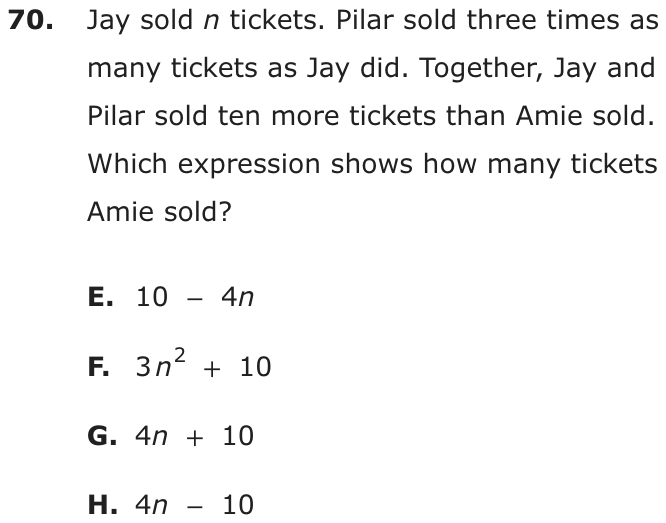
Maya read n pages for her English homework. Trevor read three times as many pages as Maya. Together, Maya and Trevor read 12 more pages than Ali read. Write an expression that shows how many pages Ali read, in terms of n.
Enter your answer in the space provided. Enter only your answer.
On the test you build the answer on an on-screen keypad; here, type it. Use ^ for a power, sqrt( ) or √ for a root, pi for π, and <= or >= for ≤ and ≥.
Show the answer
Correct answer: 4n – 12
Let n represent the number of pages that Maya read.
Trevor read three times as many pages as Maya: Trevor’s pages
To find how many pages they read together, add Maya’s and Trevor’s pages:
This means that together, they read pages.
Ali read 12 fewer pages than Maya and Trevor read together. So 12 should be subtracted from the total:
Ali’s pages
Question analysis
Maya reads n pages, Trevor reads three times as many, and together they read 12 more pages than Ali. Students type an expression in n for the number of pages Ali read. It tests writing and simplifying expressions from words, and the comparison with Ali has to be translated with care.
- NYS standards
- Grade level
- Grade 6 content, by NYS standard
- Compared with grade 7
- At grade 7 Writing an expression from words is grade 6 content, but this chains three relationships, and the last compares the pair with Ali rather than describing Ali directly. Typing the answer with no choices to compare adds risk.
- Estimated difficulty
- Moderate: several steps, or a close reading with one strong distractor.
- Thinking it demands
- Depth of knowledge 2, skills and concepts · mainly apply
- What makes it hard
- Turning words into math moderate
- Variables instead of numbers minor
- An answer in an unexpected form minor
- Solution
- 3 steps
- Reading level
- Question and choices: about grade 3, 52 words.
- Students, last 30 days
- Not enough answers yet to show (it takes 10).
Why it is hard, traps and wrong answers (shows the answer)
Why it is hard
Building the pair's total, n + 3n = 4n, is quick; the question turns on the direction of the last comparison. The pair read more than Ali, so Ali's count is the smaller one, yet the word more pulls toward adding 12. Testing n = 10 settles it: Maya and Trevor read 40 pages together, so Ali must have read 28, not 52.
Turning words into math moderate Understanding the question
“Together, Maya and Trevor read 12 more pages than Ali read” compares the pair with Ali, so Ali read 12 fewer than 4n, though the word more invites adding 12. (Hegarty, Mayer & Monk, 1995; Koedinger & Nathan, 2004)
Variables instead of numbers minor Understanding the question
Every count is written in terms of n, so there is no page total to check an expression against unless the student picks a value for n and tests it. (Koedinger & Nathan, 2004; Enright, Morley & Sheehan, 2002)
An answer in an unexpected form minor Choosing the answer
The expression is typed into a box with no choices to compare, so an entry such as 4n + 12 gets no warning that the comparison was read backward. (Enright, Morley & Sheehan, 2002)
Strategy: Write Trevor's pages and the pair's total in terms of n, then test your expression with a value such as n = 10 to check that the pair really read 12 more than Ali.
Traps
- Follows a key word: Picks the operation from a single word rather than the situation: "removed" so subtract, "of" so multiply, "more" so add, when the situation needs something else.
- Answers a different question: A choice is right for another quantity: the other unknown, the rest instead of the part, the part instead of the whole.
- Negatives and direction: Arithmetic with negative numbers, the order of a subtraction, or direction on a number line. (Moving a term across the equals sign without changing its sign is a faulty procedure.)
The wrong answers, classified
4n + 12 Follows a key word (Hegarty, Mayer & Monk, 1995)
Follows the word more and adds 12 to the pair's 4n, though the sentence says the pair read 12 more than Ali, so Ali read fewer.
3n – 12 Answers a different question (King et al., 2004; Hegarty, Mayer & Monk, 1995)
Takes Trevor's 3n as the pair's total, leaving out Maya's own n pages, then subtracts the 12 correctly.
12 – 4n Negatives and direction (Brown & Burton, 1978)
Sees that 12 and 4n must be subtracted but writes the subtraction in the wrong order, 12 − 4n, which is negative for most values of n.
Worked solution, step by step
Formulas used
- Adding like terms
- n is the number of pages Maya read. Terms with the same letter are called like terms. Add them by adding the numbers in front: 1 n plus 3 n is 4 n. It works because 1 group of n pages and 3 more groups make 4 groups.
- Turning a more-than fact around
- T is the pages Maya and Trevor read together. A is the pages Ali read. The pair read 12 more than Ali, so Ali read 12 fewer than the pair. Subtracting 12 undoes adding 12.
Sort out the question
Maya read n pages. n is a variable, a letter that stands for a number you don’t know. Trevor read 3 times as many pages as Maya. Together they read 12 more pages than Ali. You need Ali’s pages, written with n.
Write Trevor’s pages
Three times as many as n is 3 times n:
A number written next to a letter means multiply. So 3n means 3 × n pages.
Add Maya’s and Trevor’s pages
Together means add. Maya read 1 group of n, and Trevor read 3 groups:
Together they read 4n pages.
Watch out: do not leave Maya out. Using only Trevor’s 3n gives 3n − 12, which is wrong.
Decide who read more
The pair read 12 more than Ali. So Ali read 12 fewer than the pair. Take 12 away from their total:
Watch out: the word more tempts you to add 12. But 4n + 12 would mean Ali read more than the pair. And 12 − 4n subtracts in the wrong order.
Enter the expression
On the test, the keypad has an n key. Press 4, then n. Then press the minus key beside the plus key, then 1 and 2. You don’t need a times sign. On this site, type 4n-12.
So you would enter 4n − 12. Any expression equal to it, such as −12 + 4n, is also right.
Check your answer
Pick a number for n, such as 10. Maya read 10 pages and Trevor read 30, so together they read 40. Your expression gives Ali pages. Is 40 twelve more than 28? Yes, . So the expression works.
More questions like this
The original DOE question
Question 2 of 3
2024 Test A Math, question 10Question
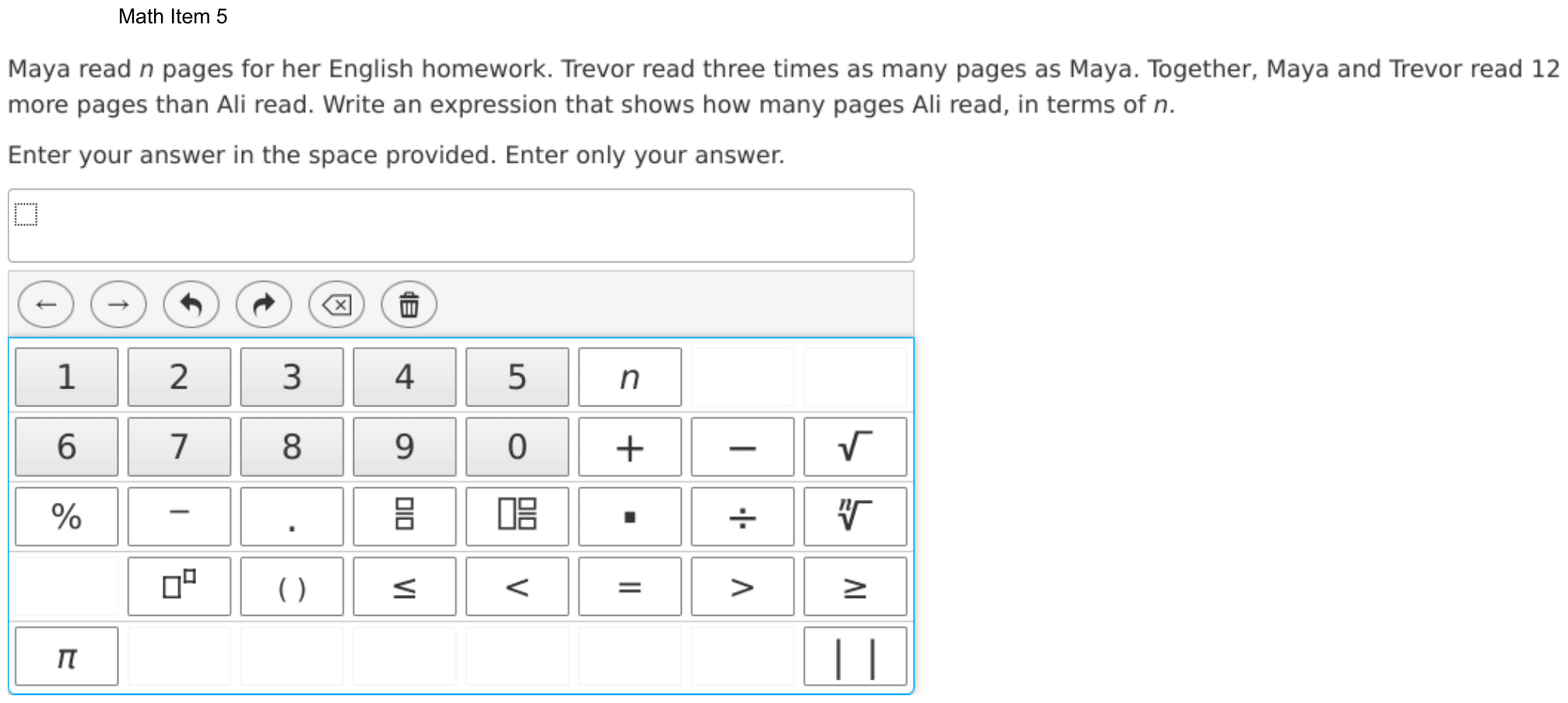
Simplify:
- A
- B
- C
- D
Show the answer
Correct answer: A
Divide the first 39 by 3.
Distribute 13 through .
In the numerator, the terms −39 and 39 cancel out.
Finally, divide the numerator and denominator by 13 to get x.
Question analysis
An algebra question that asks students to simplify a stacked fraction: 39 times (x − 3) over 3, plus 39, all divided by 13. It tests dividing, distributing and combining like terms in the right order. The nested fraction bars make it easy to divide only some of the terms or to distribute to only one.
- NYS standards
- Grade level
- Grade 7 content, by NYS standard
- Compared with grade 7
- At grade 7 Grade 7 students expand and simplify linear expressions such as 13(x − 3) + 39. This wraps that work inside two fraction bars, which adds reading load and chances to misstep but no new mathematics.
- Estimated difficulty
- Straightforward: two steps or one careful reading.
- Thinking it demands
- Depth of knowledge 1, recall and reproduction · mainly apply
- What makes it hard
- Error-prone arithmetic moderate
- Many steps minor
- Solution
- 3 steps
- Reading level
- Question and choices: about grade 16+, 6 words.
- Students, last 30 days
- Not enough answers yet to show (it takes 10).
Why it is hard, traps and wrong answers (shows the answer)
Why it is hard
The expression looks heavier than it is: every number is a multiple of 13, and the constants cancel to leave a single term. What makes it risky is scope, knowing which terms each fraction bar and each multiplier covers. Each wrong choice comes from stretching or shrinking that scope by one term, so working outward from the innermost parentheses, one line per step, is the safe way.
Error-prone arithmetic moderate Working it out
Two fraction bars are nested: 39 ÷ 3 applies only to the first term, the 13 must reach both x and −3, and only then does the whole numerator divide by 13. (Brown & Burton, 1978; Junker & Sijtsma, 2001)
Many steps minor Working it out
Four moves come in a fixed order, divide 39 by 3, distribute 13, cancel −39 with +39, divide by 13, and each is a chance to apply a step to the wrong terms. (Daniel & Embretson, 2010; Enright, Morley & Sheehan, 2002)
Strategy: Work from the inside out: divide 39 by 3, distribute through the parentheses, combine the constants in the numerator, and only then divide everything by 13.
Traps
- A faulty procedure: A systematic but wrong procedure: adding fractions straight across, applying an exponent to each term of a sum, dropping a sign when moving a term.
- Order of operations: Working left to right, or distributing a minus sign wrongly, gives a choice.
The wrong answers, classified
B Order of operations (Brown & Burton, 1978)
Reads the inner fraction bar as covering the added 39 too, so the numerator becomes 13(x − 3) + 13 = 13x − 26, and dividing by 13 gives x − 2.
C Order of operations (Brown & Burton, 1978)
Divides only the last 39 by 13, leaving 13(x − 3) + 3 = 13x − 36, as if the outer fraction bar covered a single term.
D A faulty procedure (Brown & Burton, 1978; Tatsuoka, 1983)
Distributes the 13 to x but not to −3, so the numerator becomes 13x − 3 + 39 = 13x + 36, and dividing by 13 leaves a fraction.
Worked solution, step by step
Formulas used
- Distributive property
- a is the number outside the parentheses. b and c are the terms inside. Multiply a by each term inside, and keep the minus sign between them. It works because a groups of (b − c) are a groups of b, take away a groups of c.
Sort out the expression
You need to simplify the big fraction, which means write it in its shortest form. It has a small fraction inside its top. The top is , and the bottom is 13. Work from the inside out, one step at a time.
Divide the first 39 by 3
The small fraction bar is only under . So divide just that 39 by 3.
Now the top is . Watch out: the small bar does not reach the added 39. Dividing that 39 by 3 as well leads to , choice B.
Multiply out the parentheses
Watch out: multiply the 3 by 13 too, not just the x. Leaving −3 as it is leads to choice D.
Combine the plain numbers on top
−39 and 39 add up to 0, so they cancel. The top is now just 13x, which means 13 times x.
Divide by the bottom
Now divide the whole top by 13. Dividing by 13 undoes times 13.
Watch out: the long bar is under the whole top. Dividing only the last 39 by 13 gives , choice C. So the answer is A, .
Check your answer
Try x = 5. Then and . Next, and . Last, . You get back 5, the same as x. So x is right.
More questions like this
The original DOE question
Question 3 of 3
2022 Test A Math, question 13Question
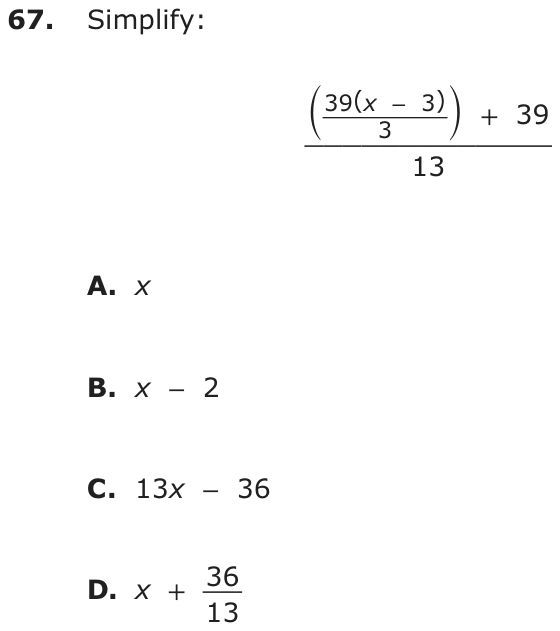
Jay sold n tickets. Pilar sold three times as many tickets as Jay did. Together, Jay and Pilar sold ten more tickets than Amie sold. Which expression shows how many tickets Amie sold?
- A
- B
- C
- D
Show the answer
Correct answer: D
Since Jay sold n tickets and Pilar sold 3 times the number of tickets Jay sold, Pilar sold tickets.
Then, since together Jay and Pilar sold 10 more tickets than Amie, subtract 10 from to get the expression that shows how many tickets Amie sold.
Then combine like terms.
Question analysis
Jay sells n tickets, Pilar sells three times as many, and together they sell ten more tickets than Amie. Students choose the expression in n for the number of tickets Amie sold. It tests writing and combining algebraic expressions from words, and the last sentence needs a careful reading, because it describes Amie only through the other two.
- NYS standards
- Grade level
- Grade 6 content, by NYS standard
- Compared with grade 7
- At grade 7 Writing an expression from words is grade 6 content, but this one links three people in a chain, and the last sentence compares the pair's total with Amie instead of describing Amie directly, which grade 7 students often misread.
- Estimated difficulty
- Moderate: several steps, or a close reading with one strong distractor.
- Thinking it demands
- Depth of knowledge 2, skills and concepts · mainly apply
- What makes it hard
- Turning words into math moderate
- Variables instead of numbers minor
- Solution
- 3 steps
- Reading level
- Question and choices: about grade 5, 37 words.
- Students, last 30 days
- Not enough answers yet to show (it takes 10).
Why it is hard, traps and wrong answers (shows the answer)
Why it is hard
Building the pair's total, n + 3n = 4n, is routine; the question is decided by which way the last comparison runs. Because the pair sold more than Amie, her expression must come out smaller than 4n, yet the most tempting choice adds the 10. Trying n = 5 settles it: the pair sold 20 tickets, so Amie sold 10, and only one expression gives 10.
Turning words into math moderate Understanding the question
“Together, Jay and Pilar sold ten more tickets than Amie sold” compares the pair's 4n with Amie, so her count is 10 less, though the word more suggests adding. (Hegarty, Mayer & Monk, 1995; Koedinger & Nathan, 2004)
Variables instead of numbers minor Understanding the question
Every count is written in terms of n, so no ticket total can be checked unless the student substitutes a value such as n = 5 into each expression. (Koedinger & Nathan, 2004; Enright, Morley & Sheehan, 2002)
Strategy: Write Pilar's tickets and the pair's total in terms of n, then test each choice with a small value such as n = 5 against the sentence comparing the pair with Amie.
Traps
- Follows a key word: Picks the operation from a single word rather than the situation: "removed" so subtract, "of" so multiply, "more" so add, when the situation needs something else.
- Negatives and direction: Arithmetic with negative numbers, the order of a subtraction, or direction on a number line. (Moving a term across the equals sign without changing its sign is a faulty procedure.)
- Wrong operation: Adds instead of multiplying, divides the wrong way round, turns a ratio or rate upside down, or undoes a step in the wrong direction (subtracts what should be added back).
The wrong answers, classified
A Negatives and direction (Brown & Burton, 1978)
Sees that 10 and the pair's 4n must be subtracted but writes them in the wrong order, 10 − 4n, which is negative once n is 3 or more.
B Wrong operation (Hegarty, Mayer & Monk, 1995; King et al., 2004)
Multiplies Jay's n by Pilar's 3n instead of adding them, getting 3n², and then adds the 10 as the word more suggests.
C Follows a key word (Hegarty, Mayer & Monk, 1995)
Follows the word more and adds 10 to the pair's 4n, though the pair sold 10 more than Amie, so Amie sold fewer.
Worked solution, step by step
Formulas used
- Combining like terms
- n is the unknown number. a and b are the numbers that multiply it. Like terms are terms with the same letter. Add the numbers in front: one n plus three n’s is four n’s, just as 1 apple plus 3 apples is 4 apples.
- Ten more than
- A and B are two amounts. If A is 10 more than B, A is the bigger one. To get the smaller amount, B, take 10 away from A. The words more than tell you which amount is bigger. They don’t always mean add.
Sort out the question
Jay sold n tickets. The letter n stands for a number you don’t know. Pilar sold three times as many as Jay. Jay and Pilar together sold ten more than Amie. You need an expression for Amie’s tickets. An expression is a math phrase with numbers and letters, like 2n + 1.
Write Pilar’s and the pair’s tickets
Three times as many as n is 3n. So Pilar sold 3n tickets. Together, Jay and Pilar sold n + 3n. Combine like terms:
So the pair sold 4n tickets.
Turn the last sentence into math
The pair sold ten more than Amie. So the pair has the bigger number. Amie’s tickets plus 10 make the pair’s 4n.
To find Amie’s tickets, take 10 away from 4n.
Watch out: the word more tempts you to add 10. That gives , choice C. But Amie sold fewer tickets than the pair, not more.
Rule out the other choices
Choice A, , subtracts in the wrong order. It is negative once n is 3 or more. Choice B, , multiplies n by 3n instead of adding them. So the answer is D, .
Check your answer
Try n = 5. Jay sold 5 and Pilar sold 15, so together they sold 20. Amie sold 10 fewer, which is 10. Choice D gives . That matches. Choice C gives 30, more than the pair sold.
More questions like this
The original DOE question