7W1b supporting claims with evidence
Question 1 of 4
2024 Test B English, question 7Passage Find Time to Volunteer
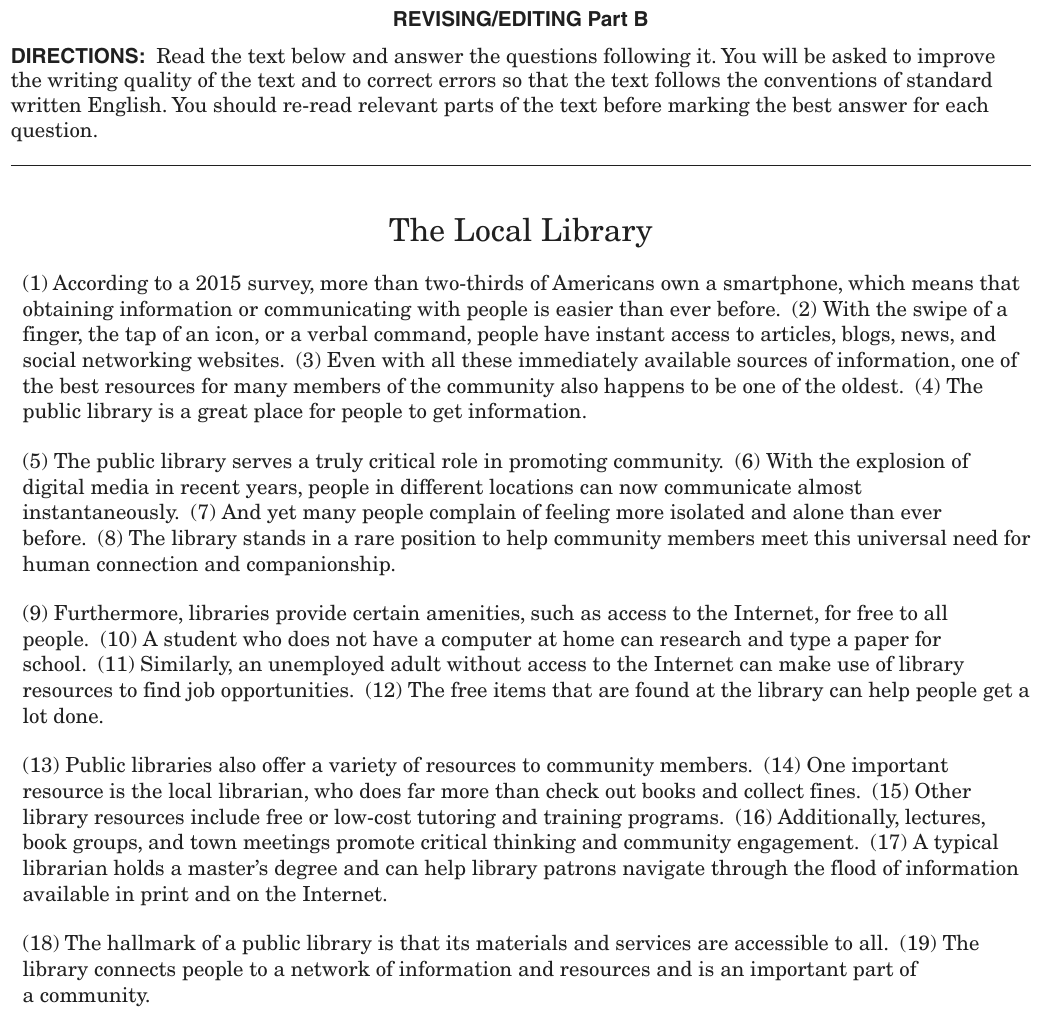
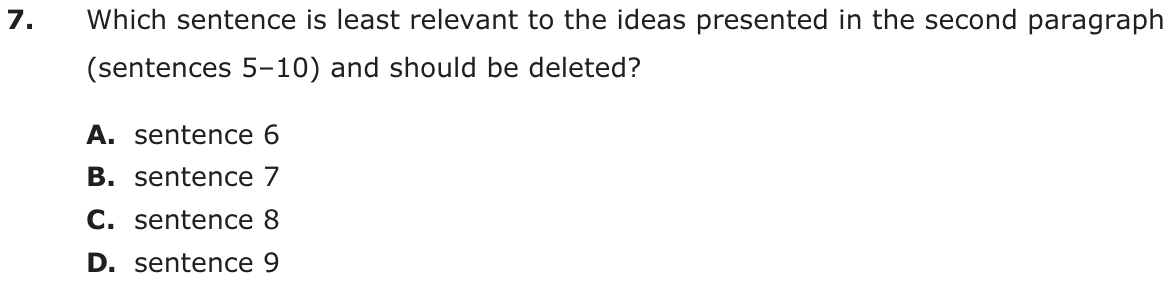
Find Time to Volunteer
(1) Many people believe that they gain a greater sense of purpose by giving their time to serve others. (2) These are the people who spend their free time volunteering at various places within the community. (3) Those who are served benefit from the work of these volunteers. (4) However, research shows that those who volunteer also receive benefits.
(5) For many students, this proposition may sound impossible. (6) Schoolwork can require hours of study each week. (7) Volunteering at a retirement center or homeless shelter requires both time and energy. (8) Extracurricular activities fill up after-school time. (9) Family obligations and part-time jobs often have to be worked into the schedule, too. (10) However, if students can find time to volunteer, even for a few hours a month, they may find that the benefits outweigh the scheduling difficulties.
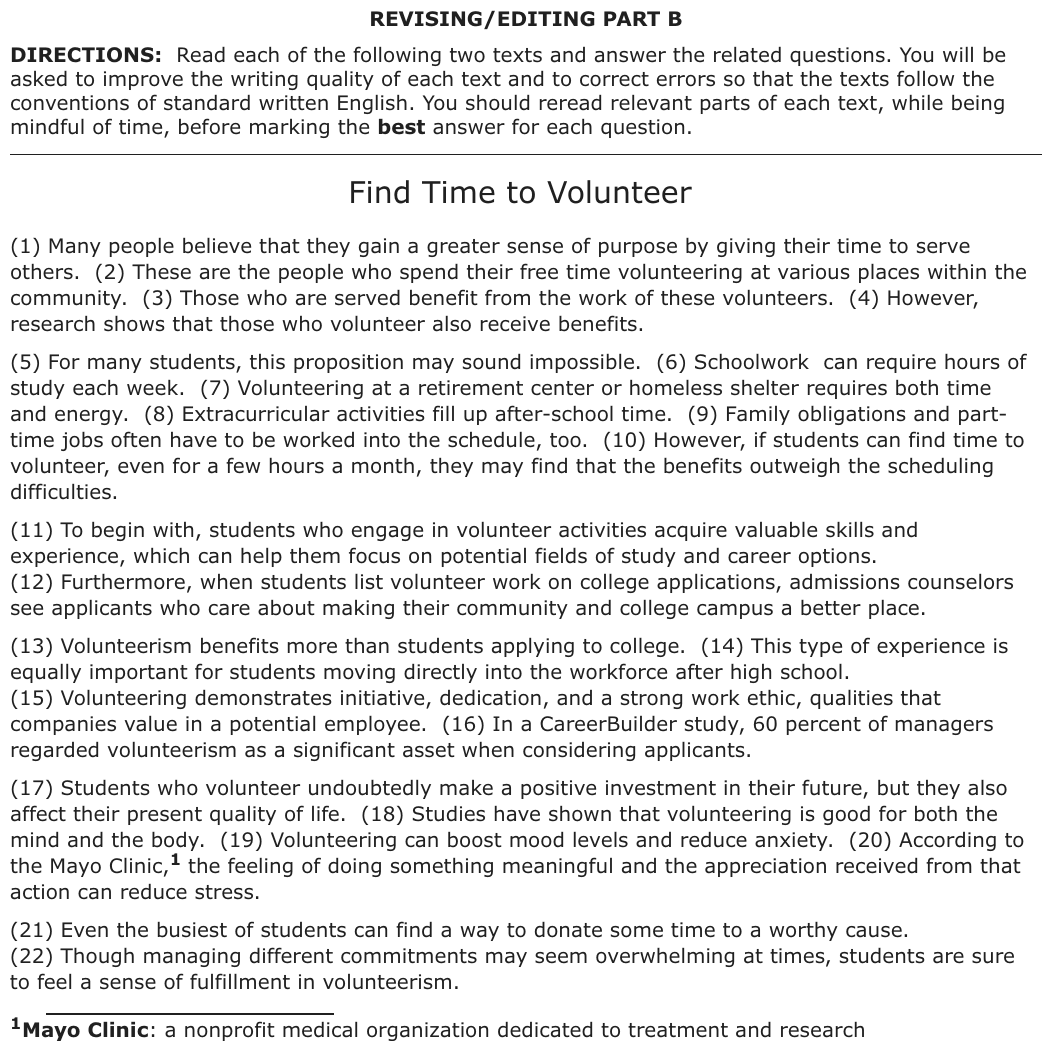
(11) To begin with, students who engage in volunteer activities acquire valuable skills and experience, which can help them focus on potential fields of study and career options. (12) Furthermore, when students list volunteer work on college applications, admissions counselors see applicants who care about making their community and college campus a better place.
(13) Volunteerism benefits more than students applying to college. (14) This type of experience is equally important for students moving directly into the workforce after high school. (15) Volunteering demonstrates initiative, dedication, and a strong work ethic, qualities that companies value in a potential employee. (16) In a CareerBuilder study, 60 percent of managers regarded volunteerism as a significant asset when considering applicants.
(17) Students who volunteer undoubtedly make a positive investment in their future, but they also affect their present quality of life. (18) Studies have shown that volunteering is good for both the mind and the body. (19) Volunteering can boost mood levels and reduce anxiety. (20) According to the Mayo Clinic,1 the feeling of doing something meaningful and the appreciation received from that action can reduce stress.
(21) Even the busiest of students can find a way to donate some time to a worthy cause. (22) Though managing different commitments may seem overwhelming at times, students are sure to feel a sense of fulfillment in volunteerism.
1Mayo Clinic: a nonprofit medical organization dedicated to treatment and research
Question
Which sentence is least relevant to the ideas presented in the second paragraph (sentences 5–10) and should be deleted?
- Asentence 6
- Bsentence 7
- Csentence 8
- Dsentence 9
Show the answer
Correct answer: B
The question asks which sentence is least relevant to the ideas presented in the second paragraph (sentences 5–10) and should be deleted.
A. Incorrect. Sentence 5 introduces the topic of the second paragraph, which is that finding time to volunteer “may sound impossible” for many students. Sentence 6 logically follows this idea because it provides one reason why students might hesitate or be unable to volunteer. Therefore, sentence 6 is relevant to the ideas presented in the second paragraph and should not be deleted.
B. CORRECT. Sentence 7 states that “time and energy” are required for volunteering, which partially addresses the topic of the second paragraph about the various commitments that fill high school students’ schedules. However, sentence 7 interrupts the flow of the paragraph by interjecting specific examples (“volunteering at a retirement center or homeless shelter”) into a general list of activities and commitments. Thus, the sentence is the least relevant to the paragraph and should be deleted.
C. Incorrect. In the second paragraph, the author discusses why some high school students may hesitate to volunteer. In sentences 6 and 9, the author points out that “schoolwork” and “family obligations and part-time jobs” are activities that require students’ time and may cause them to hesitate taking on any additional activities. Sentence 8 contributes to this idea by stating that “extracurricular activities” also require a time commitment from students. As a result, sentence 8 contributes to the ideas in the second paragraph and should not be deleted.
D. Incorrect. In the second paragraph, the author acknowledges that some high school students may hesitate to volunteer because of “schoolwork” and “extracurricular activities.” Sentence 9 contributes to this idea by stating that “family obligations and part-time jobs” also require a time commitment and may cause students to hesitate to volunteer. Therefore, sentence 9 contributes to the ideas in the second paragraph and should not be deleted.
Question analysis
This revising question focuses on the second paragraph of the volunteering essay, which explains why students may think they have no time to help others. Students pick the one sentence that is least relevant and should be deleted. Since every sentence touches on how students spend their time, the challenge is seeing which one breaks the paragraph’s line of thought.
- NYS standards
- 7W1b supporting claims with evidence
- Grade level
- Grade 7 reading and task
- Compared with grade 7
- At grade 7 Spotting a sentence that does not belong is regular grade 7 revision work. The paragraph is short and plain, but every candidate is loosely tied to students’ busy lives, so students must pin down the paragraph’s exact point first.
- Estimated difficulty
- Moderate: several steps, or a close reading with one strong distractor.
- Thinking it demands
- Depth of knowledge 2, skills and concepts · mainly analyze
- What makes it hard
- How sentences fit together moderate
- Every choice must be checked minor
- Evidence
- Answered from one paragraph or stanza
- Reading level
- Passage: about grade 11, 354 words; question and choices: about grade 5, 22 words.
- Students, last 30 days
- Not enough answers yet to show (it takes 10).
Why it is hard, traps and wrong answers (shows the answer)
Why it is hard
The sentence to delete is the only one in the paragraph that mentions volunteering, so students who test each sentence against the essay’s topic keep it and cut one of the others. The paragraph’s point is narrower: sentence 5 says volunteering “may sound impossible” for many students, and sentences 6, 8 and 9 list what already fills their schedules. Sentence 7 is loosely related, which is why the stem asks for the least relevant sentence rather than an irrelevant one.
How sentences fit together moderate Working it out
Sentences 6, 8 and 9 list the commitments that already fill students’ time, schoolwork, activities, family and jobs, while sentence 7 turns to what volunteering itself demands and breaks that list. (Halliday & Hasan, 1976)
Every choice must be checked minor Choosing the answer
Every candidate touches on students’ busy lives, and sentence 7 is the only one that mentions volunteering, so each must be tested against the paragraph’s exact point rather than the essay’s topic. (Embretson & Wetzel, 1987)
Strategy: Say in a few words what sentences 5 and 10 tell you the paragraph is about. Then test each listed sentence: does it add to that point, or does it shift to a different one?
Traps
- Fixes what isn't broken: Changes a part of the sentence that was already correct, while the real error stays; or, where the question asks which sentence has an error or should go, picks one that is correct and belongs.
The wrong answers, classified
A Fixes what isn't broken (Connors & Lunsford, 1988)
Cuts sentence 6 because schoolwork says nothing about volunteering, judging by the essay’s topic word, though schoolwork is the first commitment on the paragraph’s list.
C Fixes what isn't broken (Connors & Lunsford, 1988)
Treats extracurricular activities as a separate subject, though sentence 8 adds another after-school demand to the list explaining why volunteering seems impossible.
D Fixes what isn't broken (Connors & Lunsford, 1988)
Senses that the paragraph lists school pressures and cuts family obligations and part-time jobs as outside school, missing that “too” adds them to the same list of demands.
Working it out, step by step
Figure out what the question asks
You need the sentence in paragraph 2 that fits least and should be cut. Every sentence in a paragraph should support its main point. Example: My dog loves the park. He chases balls. Cats sleep a lot. He rolls in the grass. The cat sentence doesn’t fit. So first find the paragraph’s point. Then test each listed sentence against it.
Find the paragraph’s main point
Sentence 5 says “For many students, this proposition may sound impossible.” The proposition is the idea of volunteering. Sentence 10 says the benefits may “outweigh the scheduling difficulties.” So the paragraph is about why students feel too busy. The sentences in between should list what already fills their time.
Test each listed sentence
- Sentence 6: “Schoolwork can require hours of study each week.” That is one thing that fills their time.
- Sentence 7: “Volunteering at a retirement center or homeless shelter requires both time and energy.” This is about volunteering itself. It names two places, and it breaks the list.
- Sentence 8: “Extracurricular activities fill up after-school time.” These are things like sports and clubs. That is another item on the list.
- Sentence 9: “Family obligations and part-time jobs” fill time “too.” The word too adds them to the same list.
Read the paragraph without it
Try reading sentences 6, 8 and 9 in a row. Schoolwork, activities, family and jobs make one smooth list of things that fill a student’s week. Then sentence 10 answers that worry. Nothing is missing when sentence 7 is gone. That shows it is the least relevant.
Pick the answer
Watch out: Sentence 9 can seem off topic, because family and jobs are outside school. That makes D tempting. But the paragraph is about everything that fills a student’s time. So the answer is B, sentence 7.
Why this answer and not the closest wrong one
Sentence 9 is the closest wrong answer, because family and jobs are not schoolwork. But its last word, “too,” adds them to the same list as schoolwork and activities. Sentence 7 is the only one about what volunteering takes, not what already fills the week. So B is the one to cut.
More questions like this
The original DOE question
The passage “Find Time to Volunteer” as printed (page 163)
Question 2 of 4
2024 Test B English, question 8Uses the passage above: “Find Time to Volunteer”.
Question
Which of these would best follow sentence 12 and support the ideas presented in the third paragraph (sentences 11–12)?
- AThese students show that they are likely to be responsible, reliable, and helpful young adults. Admissions counselors know that character traits like these will benefit the applicants as well as whomever they interact with.
- BVolunteering can help students meet new people who can provide references and advice to the students when they are applying to colleges. It can also be an invaluable opportunity for students to meet possible future employers.
- CThe counselors hope that young adults who demonstrate this behavior will go on to volunteer during their college years, working on campus in student government and leadership programs or serving in the community at hospitals, schools, and homeless shelters.
- DMany colleges are looking for students who are not just academically successful but who also work well with others and care about improving and serving surrounding communities.
Show the answer
Correct answer: D
The question asks which option would best follow sentence 12 to support the ideas presented in the third paragraph (sentences 11–12).
A. Incorrect. The subject of the main clause in sentence 12 is “admissions counselors.” Although the second sentence in the option mentions “admissions counselors,” it does not support the ideas in the paragraph, because the statement that “admissions counselors know that character traits like these will benefit the applicants” focuses on how students benefit, while sentence 12 focuses on how these traits benefit the community.
B. Incorrect. While sentence 11 discusses the potential academic and professional connections that can be made through volunteering, sentence 12 moves on to the topic of college admissions. Since the sentences in the option revert back to the topic of connections, they do not support and logically follow a sentence about how college admissions counselors view students with volunteering experience.
C. Incorrect. Although the sentence in the option continues on the subject of admissions counselors and follows the idea in sentence 12 that these counselors tend to favor students who “care about making their community and college campus a better place,” the sentence focuses on what students will do while in college rather than on how volunteering helps them get into college. Therefore, the sentence does not best follow sentence 12 and support the ideas presented in the third paragraph.
D. CORRECT. In sentence 12, the author states that college admissions counselors view students who list volunteer work on admissions applications as “applicants who care about making their community and college campus a better place.” The sentence in the option best follows sentence 12 and supports the ideas in the third paragraph because it provides additional details about why admissions counselors look beyond academics when considering students for admissions and the positive qualities assigned to those who have volunteering experience.
Question analysis
This supporting-details question asks which addition would best follow the volunteering essay’s sentence about how college admissions counselors view applicants who list volunteer work. Every option mentions college and sounds reasonable on its own, so students must decide which one develops the paragraph’s point rather than drifting to a related idea.
- NYS standards
- 7W1b supporting claims with evidence
- Grade level
- Grade 8 reading and task
- Compared with grade 7
- Above grade 7 Grade 7 students choose evidence that supports a claim. Here the options are one or two full sentences, all of them about college, and the right fit depends on the precise idea in sentence 12, a finer judgment than usual.
- Estimated difficulty
- Hard: combines ideas, needs a plan, and has more than one tempting wrong answer.
- Thinking it demands
- Depth of knowledge 2, skills and concepts · mainly evaluate
- What makes it hard
- A very close wrong answer major
- How sentences fit together moderate
- A lot to read minor
- Evidence
- Answered from one paragraph or stanza
- Reading level
- Passage: about grade 11, 354 words; question and choices: about grade 13, 153 words.
- Students, last 30 days
- Not enough answers yet to show (it takes 10).
Why it is hard, traps and wrong answers (shows the answer)
Why it is hard
Every option stays on the subject of college, so the work is matching sentence 12’s exact idea: counselors see applicants who care about making their community a better place. The near miss also explains what counselors value, but it swaps caring for the community for a new set of traits and ends on what those traits do for the applicants. Students who restate sentence 12 before reading the options can hear that the right one simply widens it, from community service to what colleges want beyond grades.
A very close wrong answer major Choosing the answer
The right sentence and the two-sentence option about responsible, reliable, helpful students both explain why volunteers impress admissions; only the right one keeps sentence 12’s point, caring about improving communities. (Embretson & Wetzel, 1987; Gorin & Embretson, 2006; Ascalon et al., 2007)
How sentences fit together moderate Working it out
The new sentence must extend sentence 12’s specific idea, what admissions counselors see in volunteers, rather than return to sentence 11’s skills and careers or move on to college life. (Halliday & Hasan, 1976)
A lot to read minor Understanding the question
The options run 27 to 39 words, two of them two sentences long, and all four are about college, so topic alone rules none of them out. (Kintsch, 1998; Gorin & Embretson, 2006; Freedle & Kostin, 1993)
Strategy: Restate sentence 12 in your own words, then ask of each option whether it explains or extends that exact point about what admissions counselors value.
Traps
- Off the point: Adds or keeps something that does not support the paragraph's or the passage's focus, or an introduction or conclusion that misses the main point.
The wrong answers, classified
A Off the point (Halliday & Hasan, 1976)
Follows the admissions counselors from sentence 12 but replaces caring for the community with new traits, responsibility and reliability, and turns to how those traits help the applicants.
B Off the point (Halliday & Hasan, 1976)
Is drawn by “applying to colleges,” but networking for references and future employers is a new benefit that neither sentence 11 nor sentence 12 develops.
C Off the point (Halliday & Hasan, 1976)
Stays with the counselors and picks up “college campus” from sentence 12, but jumps ahead to what students might do in college instead of explaining admission decisions.
Working it out, step by step
Figure out what the question asks
You need the sentence that best follows sentence 12. A good next sentence adds to the same idea. It does not jump to a new point. Example: after Dogs make loyal pets, the sentence They stay by their owners’ side fits. Dogs come in many colors drifts away. So first put sentence 12 in your own words.
Restate sentence 12
Sentence 12 says that “when students list volunteer work on college applications, admissions counselors see applicants who care about making their community and college campus a better place.” Admissions counselors are the people who choose which students get into a college. So the idea is this: colleges like volunteers because volunteers care about their communities.
Check each choice
- D says colleges want students who are “not just academically successful.” That means more than good grades. They also want students who “care about improving and serving surrounding communities.” That explains sentence 12 and builds on it.
- A swaps in new traits: “responsible, reliable, and helpful.” Then it says those traits help the applicants and the people around them. It drops caring for the community.
- B brings in a new benefit: meeting people who can give advice or jobs. Neither sentence 11 nor sentence 12 talks about that.
- C jumps ahead to what students might do in college. It doesn’t explain how volunteering helps them get in.
Pick the answer
Watch out: A is the most tempting. It is about what counselors value, just like the right answer. But it changes the reason they value it. Only D keeps sentence 12’s idea of caring for the community. So the answer is D.
Why this answer and not the closest wrong one
A is the closest wrong answer. Like D, it explains why admissions counselors like volunteers. But A’s reasons are new ones, such as being responsible and reliable. D keeps sentence 12’s exact idea, caring about the community, and adds that colleges want more than good grades. So D supports the paragraph best.
More questions like this
The original DOE question
Question 3 of 4
2022 Test A English, question 9Passage Cracking the Code
Cracking the Code
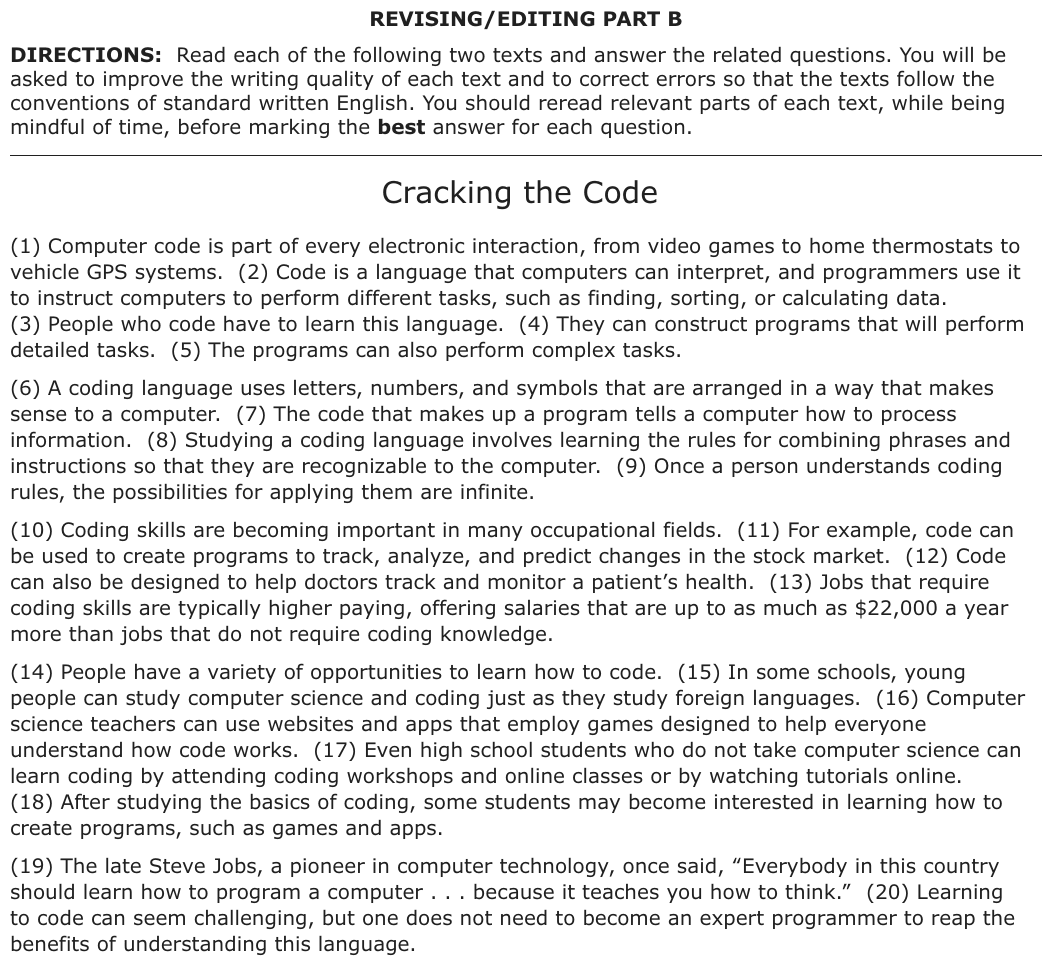
(1) Computer code is part of every electronic interaction, from video games to home thermostats to vehicle GPS systems. (2) Code is a language that computers can interpret, and programmers use it to instruct computers to perform different tasks, such as finding, sorting, or calculating data. (3) People who code have to learn this language. (4) They can construct programs that will perform detailed tasks. (5) The programs can also perform complex tasks.
(6) A coding language uses letters, numbers, and symbols that are arranged in a way that makes sense to a computer. (7) The code that makes up a program tells a computer how to process information. (8) Studying a coding language involves learning the rules for combining phrases and instructions so that they are recognizable to the computer. (9) Once a person understands coding rules, the possibilities for applying them are infinite.
(10) Coding skills are becoming important in many occupational fields. (11) For example, code can be used to create programs to track, analyze, and predict changes in the stock market. (12) Code can also be designed to help doctors track and monitor a patient’s health. (13) Jobs that require coding skills are typically higher paying, offering salaries that are up to as much as $22,000 a year more than jobs that do not require coding knowledge.
(14) People have a variety of opportunities to learn how to code. (15) In some schools, young people can study computer science and coding just as they study foreign languages. (16) Computer science teachers can use websites and apps that employ games designed to help everyone understand how code works. (17) Even high school students who do not take computer science can learn coding by attending coding workshops and online classes or by watching tutorials online. (18) After studying the basics of coding, some students may become interested in learning how to create programs, such as games and apps.
(19) The late Steve Jobs, a pioneer in computer technology, once said, “Everybody in this country should learn how to program a computer . . . because it teaches you how to think.” (20) Learning to code can seem challenging, but one does not need to become an expert programmer to reap the benefits of understanding this language.
Question
Which sentence would best follow sentence 13 and support the ideas in the third paragraph (sentences 10–13)?
- AExperienced programmers, software engineers, and system administrators at large companies can earn well over $100,000 a year.
- BHospitals, physicians’ offices, and pharmaceutical companies are frequently looking to hire people who code to help with a variety of tasks.
- CMany companies are eager to hire employees who have experience in a specific industry as well as knowledge of basic coding.
- DAccording to a report from a job market analytics firm, almost half of today’s jobs paying more than $58,000 a year call for some level of coding ability.
Show the answer
Correct answer: D
The question asks which sentence would best follow sentence 13 and support the ideas in the third paragraph.
A. Incorrect. While this sentence provides an example of a high salary, which is mentioned in the paragraph (sentence 13), the reference to “Experienced programmers, software engineers, and system administrators at large companies” focuses on specific occupations that may use coding, as opposed to the range of diverse occupations discussed in the third paragraph.
B. Incorrect. While sentence 12 does mention coding skills in the medical field as an example, the information provided in this answer supports only that idea and not the other ideas expressed in the third paragraph.
C. Incorrect. This sentence generally discusses employers looking for two things: “experience in a specific industry” and “knowledge of basic coding.” The third paragraph, however, discusses the possibilities of using coding skills in a variety of occupations. The words “experience in a specific industry” do not connect to the idea the paragraph develops.
D. CORRECT. This sentence provides specific evidence of the job market favoring potential employees who have coding ability. It supports what is stated in sentence 13, that “jobs that require coding skills are typically higher paying.”
Question analysis
This supporting-details question asks which sentence would best follow sentence 13 of “Cracking the Code,” which says jobs requiring coding skills tend to pay more, and support the ideas of the third paragraph. All four options are plausible facts about coding and work, from salaries to hiring, so students must judge which one backs up the paragraph as a whole.
- NYS standards
- 7W1b supporting claims with evidence
- Grade level
- Grade 7 reading and task
- Compared with grade 7
- Above grade 7 Choosing relevant evidence for a claim is grade 7 argument work. Here all four options are believable facts about coding and jobs, and the best one must fit both sentence 13 and the paragraph’s larger point, a finer judgment than usual.
- Estimated difficulty
- Hard: combines ideas, needs a plan, and has more than one tempting wrong answer.
- Thinking it demands
- Depth of knowledge 2, skills and concepts · mainly evaluate
- What makes it hard
- Every choice must be checked moderate
- How sentences fit together moderate
- Reading between the lines minor
- Evidence
- Answered from one paragraph or stanza
- Reading level
- Passage: about grade 10, 357 words; question and choices: about grade 12, 100 words.
- Students, last 30 days
- Not enough answers yet to show (it takes 10).
Why it is hard, traps and wrong answers (shows the answer)
Why it is hard
The paragraph makes two claims, that coding matters in many fields and that coding jobs pay more, and the best addition must serve both while following the sentence about pay. The $100,000 figure is the main trap, since it seems to back the pay claim but turns attention to computing careers, the opposite of the paragraph’s point. The hospital and industry-experience options each touch one idea of the paragraph and drift away from the rest.
Every choice must be checked moderate Choosing the answer
All four options are believable facts about coding and work, two of them with salary figures, so each must be tested against sentence 13’s pay comparison and sentence 10’s claim about many fields. (Embretson & Wetzel, 1987)
How sentences fit together moderate Working it out
The added sentence comes right after sentence 13, so it should carry on the point that coding jobs pay more while still serving the paragraph’s opening claim that coding matters in many occupations. (Halliday & Hasan, 1976)
Reading between the lines minor Working it out
Seeing why the job-market statistic fits takes a step of reasoning: if almost half of jobs paying over $58,000 call for coding, coding is both widespread and tied to better pay. (Graesser, Singer & Trabasso, 1994; Kintsch, 1998)
Strategy: Restate sentence 10 and sentence 13 in your own words, then ask of each option whether it is evidence for what those two sentences claim, not just a fact on the same topic.
Traps
- Off the point: Adds or keeps something that does not support the paragraph's or the passage's focus, or an introduction or conclusion that misses the main point.
The wrong answers, classified
A Off the point (Halliday & Hasan, 1976)
Matches sentence 13’s talk of pay with a striking salary, but it turns to computing careers such as software engineering instead of the many fields the paragraph describes, and compares nothing.
B Supports only part of the claim (King et al., 2004; Thissen, Steinberg & Fitzpatrick, 1989)
Extends sentence 12’s point about doctors to hospitals and drug companies, but it backs only the medical example and says nothing about pay, so it does not build on sentence 13.
C Off the point (Halliday & Hasan, 1976)
Sees support for coding’s value in companies wanting “knowledge of basic coding,” but the sentence adds a second demand, experience in one industry, which the paragraph never discusses.
Working it out, step by step
Figure out what the question asks
You need a sentence to add after sentence 13. It must support the third paragraph. To support means to give evidence: facts that back up a point. So first find the paragraph’s points. Then test each choice against them.
Find the paragraph’s two points
Sentence 10 says “Coding skills are becoming important in many occupational fields.” That means many kinds of jobs. Sentences 11 and 12 give examples: the stock market and doctors. Sentence 13 says “Jobs that require coding skills are typically higher paying.” So the paragraph makes two points. Coding matters in many kinds of jobs. And jobs that need coding tend to pay more.
Test each choice against both points
- A gives a big salary. But it names only computer jobs, like programmers and software engineers. The paragraph is about coding in many other fields.
- B is only about hospitals and drug companies. It repeats the doctor example and says nothing about pay.
- C brings in a new idea: “experience in a specific industry.” The paragraph never talks about that, and C says nothing about pay.
- D says “almost half of today’s jobs paying more than $58,000 a year call for some level of coding ability.”
See why D supports both points
D is about jobs that pay well, so it backs up sentence 13 on pay. It also says almost half of those jobs need some coding. Half of all well-paying jobs covers many kinds of work, not just computer jobs. That backs up sentence 10. D also names where its facts come from, a report, which makes it stronger evidence.
Choose the answer
Watch out: A is the most tempting. Its $100,000 salary seems to match sentence 13. But of course computer experts need coding. That doesn’t show that coding matters in other fields. So the answer is D.
Why this answer and not the closest wrong one
A is the closest wrong answer, since it talks about high pay. But it is about programmers and other computer jobs. The paragraph’s point is that coding helps in many fields beyond computers. D shows that almost half of all well-paying jobs call for some coding. It supports both the pay and the many fields.
More questions like this
The original DOE question
The passage “Cracking the Code” as printed (page 40)
Question 4 of 4
2018 Test B English, question 6Passage The Local Library
The Local Library
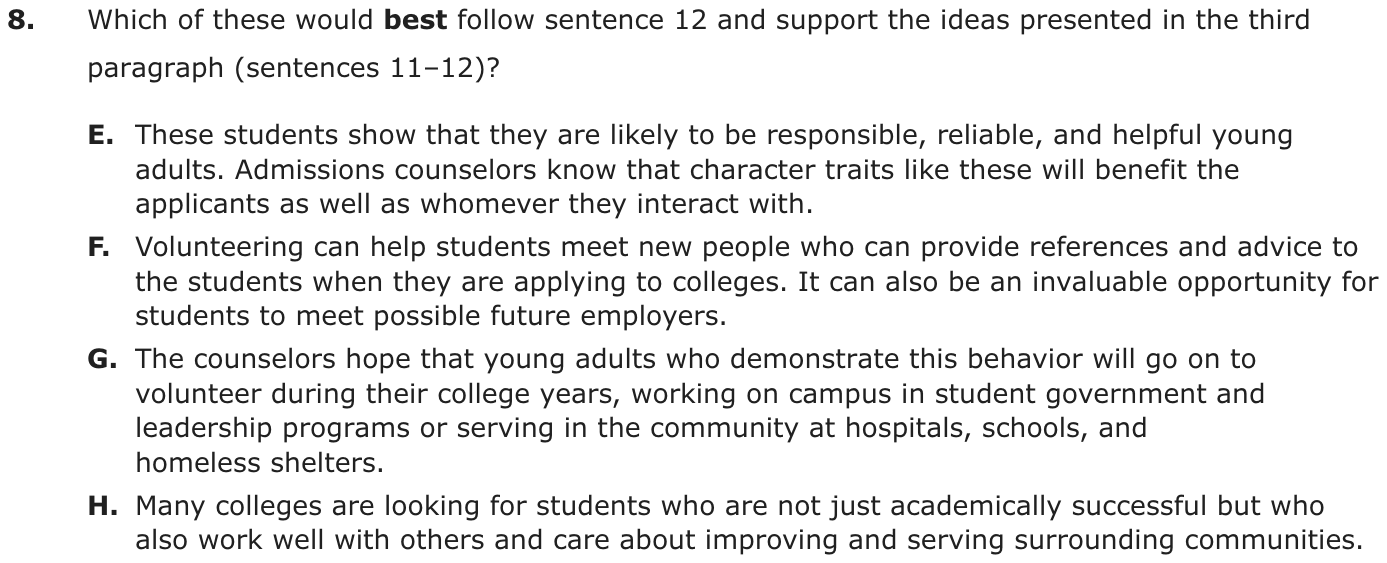
(1) According to a 2015 survey, more than two-thirds of Americans own a smartphone, which means that obtaining information or communicating with people is easier than ever before. (2) With the swipe of a finger, the tap of an icon, or a verbal command, people have instant access to articles, blogs, news, and social networking websites. (3) Even with all these immediately available sources of information, one of the best resources for many members of the community also happens to be one of the oldest. (4) The public library is a great place for people to get information.
(5) The public library serves a truly critical role in promoting community. (6) With the explosion of digital media in recent years, people in different locations can now communicate almost instantaneously. (7) And yet many people complain of feeling more isolated and alone than ever before. (8) The library stands in a rare position to help community members meet this universal need for human connection and companionship.
(9) Furthermore, libraries provide certain amenities, such as access to the Internet, for free to all people. (10) A student who does not have a computer at home can research and type a paper for school. (11) Similarly, an unemployed adult without access to the Internet can make use of library resources to find job opportunities. (12) The free items that are found at the library can help people get a lot done.
(13) Public libraries also offer a variety of resources to community members. (14) One important resource is the local librarian, who does far more than check out books and collect fines. (15) Other library resources include free or low-cost tutoring and training programs. (16) Additionally, lectures, book groups, and town meetings promote critical thinking and community engagement. (17) A typical librarian holds a master’s degree and can help library patrons navigate through the flood of information available in print and on the Internet.
(18) The hallmark of a public library is that its materials and services are accessible to all. (19) The library connects people to a network of information and resources and is an important part of a community.
Question
Which sentence would best follow and support sentence 8?
- ALibraries, which have been around for centuries and are found throughout the world today, help preserve the history of a community.
- BThe public library is often used as a place for community leaders and organizers to host community events, such as hearings or town halls.
- CLibraries rely on a combination of local, state, and federal dollars to provide the kinds of services and programs that community members have come to expect.
- DAt a public library, people can interact with others through a variety of programs, including teen book clubs, toddler story times, and senior-citizen exercise classes.
Show the answer
Correct answer: D
The question asks which option would provide the best support for sentence 8. Sentence 8 expresses the idea that the library helps community members meet their need for human connection and companionship.
Option D is correct because it provides support for sentence 8 and strengthens the connection between the information in sentence 8 and the main claim of the passage by listing examples of how people can connect at the library.
Option A is incorrect because it references the history of the library, which does not support the idea in sentence 8 or the main claim of the passage.
Option B is incorrect because, although it introduces the idea of community meetings, it does not support the idea in sentence 8.
Option C is incorrect because it mentions expectations by the community members and brings up a new idea that is unrelated to the main claim of the passage and that does not provide support for sentence 8.
Question analysis
This supporting-details question returns to the library essay and its point that people feel isolated in a digital world. Students pick the sentence that would best follow sentence 8 and back it up. Each option sounds like a fair statement about libraries, which is what makes the choice harder than it first looks.
- NYS standards
- 7W1b supporting claims with evidence
- Grade level
- Grade 7 reading and task
- Compared with grade 7
- At grade 7 Choosing evidence that fits a claim is standard grade 7 argument work. This item sharpens it: all four sentences are believable facts about libraries, so students must match the specific idea in sentence 8 rather than the general topic.
- Estimated difficulty
- Moderate: several steps, or a close reading with one strong distractor.
- Thinking it demands
- Depth of knowledge 2, skills and concepts · mainly evaluate
- What makes it hard
- How sentences fit together moderate
- Evidence
- Answered from one paragraph or stanza
- Reading level
- Passage: about grade 11, 341 words; question and choices: about grade 12, 104 words.
- Students, last 30 days
- Not enough answers yet to show (it takes 10).
Why it is hard, traps and wrong answers (shows the answer)
Why it is hard
Every choice says something favorable about libraries, so a student who asks only whether a sentence fits the essay will find all four acceptable. The question rewards narrowing the test to sentence 8’s own idea, the loneliness of a digital age and the need for company. The teen book clubs, toddler story times and exercise classes for seniors are what make the right sentence a support rather than a new topic.
How sentences fit together moderate Working it out
Sentence 8 ends on “human connection and companionship,” so the sentence after it must give an example of people meeting each other, not just another good thing about libraries. (Halliday & Hasan, 1976)
Strategy: Restate sentence 8 in a few words, then ask of each choice whether it gives a concrete example of that exact idea or just says something good about libraries.
Traps
- Off the point: Adds or keeps something that does not support the paragraph's or the passage's focus, or an introduction or conclusion that misses the main point.
- Wrong part of the text: A choice is true of another paragraph, stanza or speaker than the one asked about.
The wrong answers, classified
A Off the point (Halliday & Hasan, 1976)
Offers a pleasant general fact about libraries preserving community history, which matches the word “community” but says nothing about loneliness or human connection.
B Wrong part of the text (Kirsch & Mosenthal, 1990)
Describes hearings and town halls, which belong with paragraph 4’s “town meetings” and civic engagement, and concern leaders running events rather than people finding companionship.
C Off the point (Halliday & Hasan, 1976)
Brings in funding from local, state and federal dollars, a new topic that neither illustrates sentence 8’s need for connection nor advances the essay’s claim.
Working it out, step by step
Figure out what the question asks
You need the sentence that would come right after sentence 8 and back it up. To support a sentence means to give an example or a reason that proves it.
Read sentence 8 closely
Sentence 8 says: “The library stands in a rare position to help community members meet this universal need for human connection and companionship.” Just before it, sentence 7 says people feel “more isolated and alone than ever before.”
Put sentence 8 in plain words
“Isolated” means cut off from other people. “Companionship” means having friends and people around you. So sentence 8 says: people feel lonely, and the library can help them spend time with others. The next sentence should show how people meet each other at the library.
Check each choice
- A is wrong. It is about saving a community’s history, not about people meeting.
- B is wrong. Hearings and town halls are about leaders running community business. They are not about lonely people finding company.
- C is wrong. Money for libraries is a new topic. It says nothing about human connection.
- D is right. Book clubs, story times and exercise classes are real ways people “can interact with others.”
Watch out: B mentions community events, so it seems to fit. But its point is public meetings, not friendship. It fits better with the “town meetings” in sentence 16.
Choose the answer
D gives clear examples of people meeting and spending time together. So the answer is D.
Why this answer and not the closest wrong one
B is the closest wrong answer, because it also shows people gathering at the library. But hearings and town halls are public business, run by leaders. Sentence 8 is about loneliness and companionship. D shows people of every age, from toddlers to seniors, meeting and doing things together.
More questions like this
The original DOE question
The passage “The Local Library” as printed (page 120)