Slow to do carefully
Question 1 of 2
2023 Test A Math, question 17Question
A customer wants to buy a pair of hiking boots.
- The original price of the boots is $85.75.
- The store is offering a 15% discount on all boot purchases.
- The customer has a coupon for an additional 25% off the sale price.
- The tax rate is 8.5%.
What is the final cost of the boots, including the tax, to the nearest cent?
- A$55.82
- B$59.08
- C$59.32
- D$63.17
Show the answer
Correct answer: C
First, determine the sale price after the 15% discount is applied.
Since the customer is saving 15%, this means they are paying 85% , so multiply the original price by 85% (0.85) to find the discounted price:
Next, find the price after the 25% coupon has been applied:
Since the customer is saving 25% off the sale price, this means they are paying 75% , so multiply the price found in the first step by 75% (0.75) to find the second discounted price:
Last, find the final cost after an 8.5% tax is added to the second discounted price.
Since the customer is paying 8.5% tax, this means they are paying 108.5% , so multiply the second discounted price by 108.5% (1.085) to find the final cost:
Question analysis
A pair of hiking boots costs $85.75, goes on sale at 15% off, gets an extra 25% off with a coupon, and is then taxed at 8.5%. Students find the final cost to the nearest cent. Each percent applies to the price left after the step before, so the discounts cannot simply be added, and the decimals call for careful multiplication.
- NYS standards
- Grade level
- Grade 7 content, by NYS standard
- Compared with grade 7
- Above grade 7 A discount followed by sales tax is standard grade 7 percent work. This item stacks two discounts and a tax, with cents to keep at every stage, so it takes about twice the steps and decimal multiplication of a typical problem.
- Estimated difficulty
- Hard: combines ideas, needs a plan, and has more than one tempting wrong answer.
- Thinking it demands
- Depth of knowledge 2, skills and concepts · mainly apply
- What makes it hard
- Error-prone arithmetic major
- Turning words into math moderate
- Slow to do carefully moderate
- Solution
- 3 steps
- Reading level
- Question and choices: about grade 4, 58 words.
- Students, last 30 days
- Not enough answers yet to show (it takes 10).
Why it is hard, traps and wrong answers (shows the answer)
Why it is hard
The question tests whether students treat successive percents as successive multipliers, and then holds them to three long multiplications. Adding the 15% and 25% into one discount is the tempting shortcut, and a tax read as a dollar amount is the other. The key rounds to the cent at each stage, as a register would; carried exactly, the result is $59.31, so the nearest choice, $59.32, still stands.
Error-prone arithmetic major Working it out
Three products of cents and decimals are worked by hand: 85.75 × 0.85 = 72.8875, then 72.89 × 0.75 = 54.6675, then 54.67 × 1.085 ≈ 59.32, each rounded to the cent. (Brown & Burton, 1978; Junker & Sijtsma, 2001)
Turning words into math moderate Understanding the question
The phrase "an additional 25% off the sale price" means 25% of the already discounted $72.89, not of the $85.75 original, so the two discounts multiply rather than add. (Hegarty, Mayer & Monk, 1995; Koedinger & Nathan, 2004)
Slow to do carefully moderate Choosing the answer
A reliable method needs three long decimal multiplications without a calculator, well past the minute and a half a question allows, which tempts students to combine the percents. (Lu & Sireci, 2007)
Strategy: Multiply by 0.85 for the sale, by 0.75 for the coupon on the sale price, and by 1.085 for the tax, rounding to the cent at each stage as a register would.
Traps
- Percent of the wrong amount: Finding the whole from a part, or a percent change measured from the wrong starting amount.
- Misunderstands the concept: A wrong belief about a concept: that percents can be added, that area grows like length, that averages can be averaged, that a bigger denominator means a bigger fraction.
The wrong answers, classified
A Percent of the wrong amount (Parker & Leinhardt, 1995)
Takes the 25% coupon off the original $85.75 instead of the sale price, so the discounts add to 40%: 85.75 × 0.60 × 1.085 ≈ $55.82.
B Little reason to choose it (Haladyna & Downing, 1993; Rodriguez, 2005)
No common working gives $59.08; it sits 24 cents below the right total and matches no discount or tax mistake, so it mostly catches guesses.
D Misunderstands the concept (Smith, diSessa & Roschelle, 1993; De Bock et al., 1998; Ni & Zhou, 2005)
Applies both discounts correctly, reaching $54.67, but adds $8.50 as the tax, reading 8.5% as a dollar amount instead of a percent of the price.
Worked solution, step by step
Formulas used
- Price after a discount
- p is the percent off. A discount is money taken off the price. If you save p percent, you pay the rest, 100 − p percent. For 15% off you pay 85%, so multiply by 0.85.
- Price with tax
- The price is the cost before tax. t is the tax rate, a percent. Tax is extra money added on top. You pay the whole price, 100%, plus t percent more. So for 8.5% tax you multiply by 1.085.
Sort out the question
The boots cost $85.75 at first. The store takes 15% off. Then a coupon takes 25% off the sale price. The sale price is the price after the first discount. Then 8.5% tax is added. You need the final cost to the nearest cent. A cent is $0.01, the second place after the decimal point.
Take off the 15% discount
You save 15%, so you pay 85%. That is 0.85 of the price.
A price can’t have part of a cent, so round to two decimal places. The third digit is 7, which is 5 or more, so round up.
The sign ≈ means about. The sale price is $72.89.
Take 25% off the sale price
The coupon takes 25% off $72.89, so you pay 75% of it.
The price is now $54.67. Watch out: take the coupon off the sale price, not the first price. Adding 15% and 25% to get 40% off $85.75 leads to $55.82, choice A.
Add the 8.5% tax
You pay the price plus 8.5% more, which is 108.5% of it.
Watch out: 8.5% is a percent of the price, not $8.50. Adding $8.50 gives $63.17, choice D.
See why rounding each time matters
A store rounds to the cent after each step, as you just did. The test’s answer is worked the same way. Keep every digit and round only at the end, and you get this:
That is $59.31, which is not a choice. The first two roundings each went up by a tiny part of a cent. That was just enough to push the total from $59.31 to $59.32. So here, round at each step, as a store would. So the answer is C, $59.32.
Check your answer
Check the tax a second way. 8.5% of $54.67 is , about $4.65. Then . Also estimate: two discounts leave a bit less than two-thirds of $86, near $55. Tax adds under $5, so about $59 or $60 makes sense.
More questions like this
The original DOE question
Question 2 of 2
2023 Test B Math, question 22Question
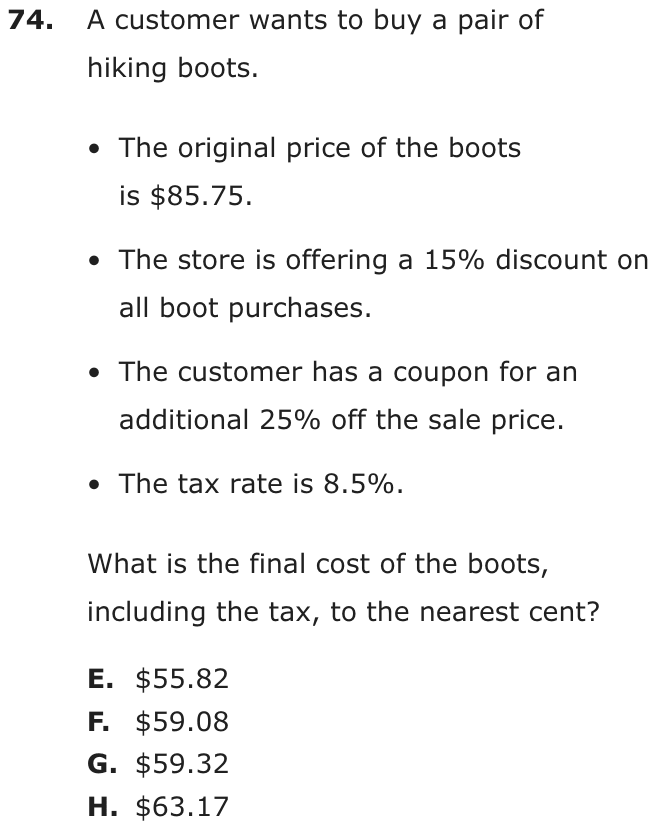
A vendor is selling 10 packages of homemade fudge at a bake sale. The vendor weighed and labeled each package. The package weights are given in ounces:
| 4.6 | 6.0 | 3.8 | 3.5 | 4.5 |
| 5.4 | 3.9 | 6.5 | 4.8 | 6.2 |
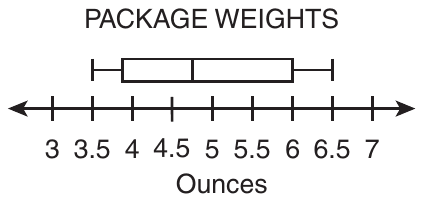
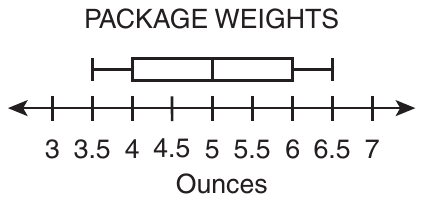
The vendor created a box plot of the package weights. Which box plot best represents the data?
- A
- B
- C
- D
Show the answer
Correct answer: C
A set of 10 data points is given. The first step for determining the quartiles and minimum and maximum values of the box plot is to order the data from smallest to greatest value. For this data set the order is:
| 3.5 | 3.8 | 3.9 | 4.5 | 4.6 |
| 4.8 | 5.4 | 6.0 | 6.2 | 6.5 |
The minimum value is the smallest decimal, 3.5, and the maximum value is the greatest decimal, 6.5.
To determine the median in a set with an even number of values, locate the two middle values (5th and 6th in this case): 4.6 and 4.8. Determine the mean, or average, of the two middle numbers by adding them together and dividing the sum by 2:
To determine the value of the first quartile (Q1), locate the middle value of the 5 terms to the left of the median:
| 3.5 | 3.8 | 3.9 | 4.5 | 4.6 |
To determine the value of the third quartile (Q3), locate the middle value of the 5 terms to the right of the median:
| 4.8 | 5.4 | 6.0 | 6.2 | 6.5 |
Box plot C identifies the correct minimum, maximum, median, and quartiles of the data set.
Question analysis
A vendor weighs 10 packages of homemade fudge, from 3.5 to 6.5 ounces, and makes a box plot of the weights. Students choose the box plot that matches the data. They must sort the decimals, find the median of an even number of values and both quartiles, then compare plots that differ only slightly.
- Grade level
- Grade 7 content, by NYS standard
- Compared with grade 7
- Above grade 7 Building a box plot from data is grade 7 content. This version needs all five summary values from ten unsorted decimals, including a median between two values, then a close comparison of plots, longer and finer than typical.
- Estimated difficulty
- Hard: combines ideas, needs a plan, and has more than one tempting wrong answer.
- Thinking it demands
- Depth of knowledge 2, skills and concepts · mainly apply
- What makes it hard
- Many steps moderate
- A very close wrong answer moderate
- Reading a figure, table or graph moderate
- Slow to do carefully minor
- Solution
- 4 steps
- Reading level
- Question and choices: about grade 4, 43 words.
- Students, last 30 days
- Not enough answers yet to show (it takes 10).
Why it is hard, traps and wrong answers (shows the answer)
Why it is hard
Most of the work happens before the plots are even read: the weights must be sorted, and the median of ten values is the average of two of them. After that, three plots look almost identical, so a careless median, taken from the unsorted list or placed halfway between the extremes, settles on a wrong one. The careful student checks the median line and the box’s left edge against values that fall between the tick marks.
Many steps moderate Working it out
Ten unsorted decimals must be ordered, then five values found: the median as the mean of the fifth and sixth, 4.6 and 4.8, and each quartile as the middle of its half. (Daniel & Embretson, 2010; Enright, Morley & Sheehan, 2002)
A very close wrong answer moderate Choosing the answer
Three plots share whiskers at 3.5 and 6.5 and a box ending at 6; they differ only in the median line, at 4.5, near 4.75 or at 5, and in where the box starts. (Embretson & Wetzel, 1987; Gorin & Embretson, 2006; Ascalon et al., 2007)
Reading a figure, table or graph moderate Understanding the question
The axis is ticked every half ounce, and the correct plot’s median, 4.7, and lower quartile, 3.9, both fall between ticks, so each line’s position must be judged by eye. (Lesh, Post & Behr, 1987; Kirsch & Mosenthal, 1990)
Slow to do carefully minor Choosing the answer
Sorting ten decimals, computing a five-number summary and comparing four plots takes well over a minute and a half when done carefully. (Lu & Sireci, 2007)
Strategy: Sort the ten weights, then find the least and greatest, the median as the mean of the fifth and sixth values, and each quartile as the middle of its half.
Traps
- Wrong formula: Uses a related but wrong formula: perimeter for area, diameter for radius, area for volume, or a misremembered one.
- A faulty procedure: A systematic but wrong procedure: adding fractions straight across, applying an exponent to each term of a sum, dropping a sign when moving a term.
The wrong answers, classified
A Little reason to choose it (Haladyna & Downing, 1993; Rodriguez, 2005)
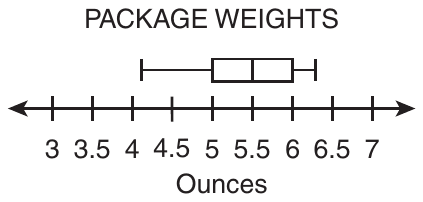
No working from these weights gives whiskers near 4.1 and 6.3 or a median of 5.5, since the data run from 3.5 to 6.5, so it mostly draws guesses.
B A faulty procedure (Brown & Burton, 1978; Tatsuoka, 1983)
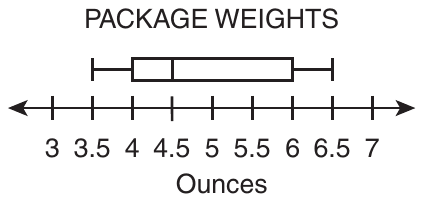
Skips sorting and takes 4.5, the fifth weight as printed, for the median, so the plot with its median line on 4.5 seems to fit.
D Wrong formula (King et al., 2004)
Finds the median with the midrange formula, (3.5 + 6.5) ÷ 2 = 5, halfway between the lightest and heaviest packages instead of the middle of the sorted weights.
Worked solution, step by step
Formulas used
- Median of an even number of values
- First put the values in order. With an even number of values, two sit in the middle. The median is their mean, or average: add them and divide by 2. The median splits the data in half.
- Quartiles
- Q1 is the first quartile and Q3 is the third quartile. Split the ordered data in half at the median. Q1 is the middle of the lower half, and Q3 is the middle of the upper half. A box plot’s box runs from Q1 to Q3.
Sort out the question
The vendor weighed 10 packages of fudge, in ounces. You need the box plot that matches the weights. A box plot is built from five numbers. They are the minimum (least), the first quartile Q1, the median, the third quartile Q3 and the maximum (greatest). So find those five numbers first.
Put the weights in order
List the 10 weights from least to greatest.
3.5 3.8 3.9 4.5 4.6 4.8 5.4 6.0 6.2 6.5 Watch out: you must sort first. The fifth weight as printed is 4.5. Using it as the median points to choice B.
Find the least and greatest
The minimum is 3.5 ounces and the maximum is 6.5 ounces. So the whiskers must run from 3.5 to 6.5. Plot A’s whiskers run from about 4.1 to about 6.3, so A is out.
Find the median
With 10 weights, the two middle ones are the 5th and 6th: 4.6 and 4.8.
The median is 4.7 ounces. Watch out: the median is not halfway between the least and greatest. That gives and points to choice D.
Find the two quartiles
The lower half is the 5 weights below the median: 3.5, 3.8, 3.9, 4.5 and 4.6. Its middle value is .
The upper half is the 5 weights above the median: 4.8, 5.4, 6.0, 6.2 and 6.5. Its middle value is .
Match the summary to a plot
The five numbers are 3.5, 3.9, 4.7, 6.0 and 6.5. Plots B, C and D all run from 3.5 to 6.5, and their boxes end at 6. They differ in the median line and where the box starts.
- B: the box starts at 4, and the median line is at 4.5.
- D: the box starts at 4, and the median line is at 5.
- C: the box starts just left of 4, and the median line is between 4.5 and 5.
C is the closest match to a Q1 of 3.9 and a median of 4.7. So the answer is C.
Check your answer
A median splits the data in half. Five weights, 3.5 to 4.6, are below 4.7. Five, 4.8 to 6.5, are above it. A median line at 5, as in D, would have six weights below it. A line at 4.5, as in B, would have only three below it.
More questions like this
The original DOE question