Question
WINTER TEMPERATURES IN CHICAGO
| Day | 1 | 2 | 3 | 4 | 5 | 6 | 7 |
|---|---|---|---|---|---|---|---|
| Temperature (°F) | 17 | 7 | 2 | 4 | −3 | −5 | 1 |
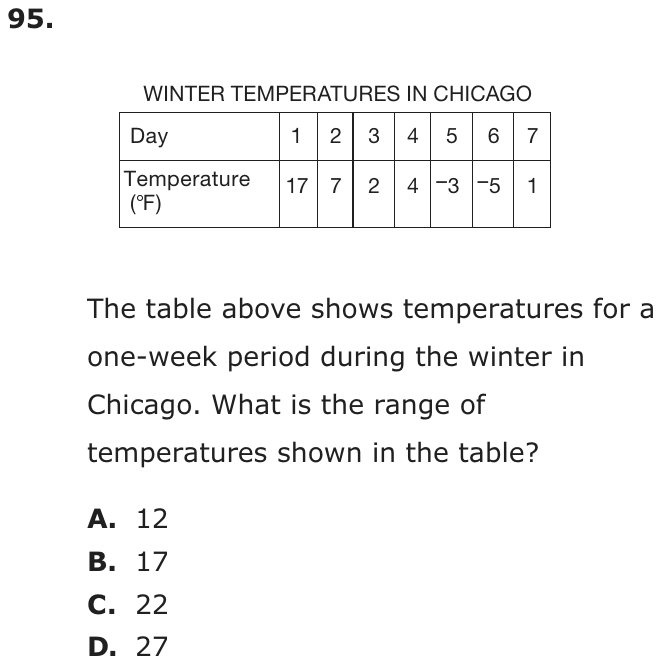
The table above shows temperatures for a one-week period during the winter in Chicago. What is the range of temperatures shown in the table?
- A12
- B17
- C22
- D27
Show the answer
Correct answer: C
Range is the difference between the largest and the smallest values in a given set of data. In this case, the highest temperature is 17 and the lowest temperature is −5. Therefore, the range is .
Question analysis
A table gives Chicago's temperatures in degrees Fahrenheit for seven winter days, some above zero and some below. Students find the range of the temperatures. It tests the meaning of range and subtracting a negative number, and treating a below-zero reading as if it were positive gives a wrong spread.
- Grade level
- Grade 7 content, by NYS standard
- Compared with grade 7
- At grade 7 Range is a grade 6 idea, and subtracting a negative number is grade 7. Here they meet in a single subtraction from a short table, typical grade 7 practice with integers rather than anything longer.
- Estimated difficulty
- Straightforward: two steps or one careful reading.
- Thinking it demands
- Depth of knowledge 2, skills and concepts · mainly apply
- What makes it hard
- Solution
- 2 steps
- Reading level
- Question and choices: about grade 8, 31 words.
- Students, last 30 days
- Not enough answers yet to show (it takes 10).
Why it is hard, traps and wrong answers (shows the answer)
Why it is hard
Finding a range is routine, but the lowest reading is below zero, so the subtraction crosses zero: from −5 up to 0 is 5 degrees, and from 0 up to 17 is 17 more. Students who treat −5 as 5 find a smaller gap that is listed. Picturing a thermometer, or a number line, shows the full spread at a glance.
Error-prone arithmetic moderate Working it out
The lowest reading is −5°F, so the range is 17 − (−5), and subtracting a negative number means adding 5, the step where a gap of 12 appears instead. (Brown & Burton, 1978; Junker & Sijtsma, 2001)
Reading a figure, table or graph minor Understanding the question
The seven readings run across one table row in day order, 17, 7, 2, 4, −3, −5, 1, so the extremes have to be picked out, including the lower of the two below zero. (Lesh, Post & Behr, 1987; Kirsch & Mosenthal, 1990)
Something you must already know minor Working it out
The word range is not defined in the question; students must know it means the highest value minus the lowest, not the highest value alone. (Anderson & Krathwohl, 2001)
Strategy: Pick out the highest and the lowest temperature in the table, then subtract the lowest from the highest, writing the subtraction of a negative as an addition.
Traps
- Negatives and direction: Arithmetic with negative numbers, the order of a subtraction, or direction on a number line. (Moving a term across the equals sign without changing its sign is a faulty procedure.)
- Answers a different question: A choice is right for another quantity: the other unknown, the rest instead of the part, the part instead of the whole.
The wrong answers, classified
A Negatives and direction (Brown & Burton, 1978)
Subtracts 5 from 17 as if −5 were 5, so the range comes out 12, missing that a reading below zero lies further from 17, not closer.
B Answers a different question (King et al., 2004; Hegarty, Mayer & Monk, 1995)
Gives the highest temperature, 17°F, as the range, taking the top of the readings for the spread between the highest and the lowest.
D Little reason to choose it (Haladyna & Downing, 1993; Rodriguez, 2005)
No common working gives 27: it is 5 more than the true spread and matches no sign or subtraction mistake with these readings, so it mostly draws guesses.
Worked solution, step by step
Formulas used
- Range
- The range tells how spread out the data are. Find the highest value and the lowest value, then subtract. It is the distance between the two ends of the data on a number line.
- Subtracting a negative
- a is any number, and −b is a negative number. Taking away a negative is the same as adding the positive number b. On a number line, the gap from −5 up to 17 is 5 to reach 0, then 17 more.
Sort out the question
The table gives seven temperatures, in degrees Fahrenheit (°F): 17, 7, 2, 4, −3, −5 and 1. A minus sign means below zero. You need the range, the highest temperature minus the lowest.
Find the highest and lowest
The highest is 17°F, on day 1. For the lowest, look at the numbers below zero: −3 and −5. −5 is colder, since it is further below zero. So the lowest is −5°F, on day 6.
Subtract the lowest from the highest
Subtracting a negative is the same as adding. The range is 22 degrees Fahrenheit.
Watch out: −5 is not 5. Doing 17 − 5 = 12 gives choice A. And 17 alone is just the highest temperature, choice B. So the answer is C, 22.
Check your answer
Picture a thermometer. From −5°F up to 0°F is 5 degrees. From 0°F up to 17°F is 17 more. In all, degrees. That matches.
More questions like this
The original DOE question