Question
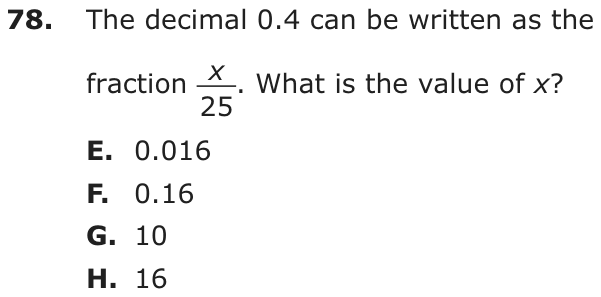
The decimal 0.4 can be written as the fraction . What is the value of x?
- A0.016
- B0.16
- C10
- D16
Show the answer
Correct answer: C
First, convert the decimal 0.4, which is read as four-tenths, to the fraction , and then set up a proportion to solve for x using cross products.
Or, reduce the fraction to before setting up the proportion and then use proportional reasoning.
Therefore, .
Question analysis
This question asks students to write the decimal 0.4 as an equivalent fraction whose denominator is 25 and to choose the missing numerator. It tests converting between decimals and fractions. Tenths do not turn into twenty-fifths in one obvious step, so the numerator has to be scaled with care, in the same way as the denominator.
- Grade level
- Grade 6 content, by NYS standard
- Compared with grade 7
- Below grade 7 Rewriting a decimal as an equivalent fraction is upper elementary and grade 6 work. It is one conversion with no context, and the friendly denominator keeps it well below the demand of typical grade 7 problems.
- Estimated difficulty
- Routine: one familiar step, little to misread.
- Thinking it demands
- Depth of knowledge 1, recall and reproduction · mainly apply
- What makes it hard
- Error-prone arithmetic minor
- Solution
- 2 steps
- Reading level
- Question and choices: about grade 5, 15 words.
- Students, last 30 days
- Not enough answers yet to show (it takes 10).
Why it is hard, traps and wrong answers (shows the answer)
Why it is hard
A single conversion: 0.4 is 4/10, or 2/5, and 2/5 renamed over 25 is 10/25. The only risk is the direction of the step, since x/25 = 0.4 means multiplying 0.4 by 25, and dividing instead leads to the small decimals among the choices. Any choice can be checked by dividing it by 25, and only one gives back 0.4.
Error-prone arithmetic minor Working it out
Four tenths has to be renamed in twenty-fifths, and 10 does not divide 25, so the numerator is reached through 2/5 = 10/25 or by multiplying 0.4 by 25. (Brown & Burton, 1978; Junker & Sijtsma, 2001)
Strategy: Write the decimal as a fraction in tenths, simplify it, then multiply the numerator and denominator by the same number until the denominator is 25.
Traps
- Wrong operation: Adds instead of multiplying, divides the wrong way round, turns a ratio or rate upside down, or undoes a step in the wrong direction (subtracts what should be added back).
The wrong answers, classified
A Wrong operation (Hegarty, Mayer & Monk, 1995; King et al., 2004)
Divides 0.4 by 25 instead of multiplying, undoing the division by 25 with another division, which gives 0.016.
B Wrong operation (Hegarty, Mayer & Monk, 1995; King et al., 2004)
Divides by 25 instead of multiplying and also drops the decimal point of 0.4, so 4 ÷ 25 = 0.16, ten times 0.016.
D Little reason to choose it (Haladyna & Downing, 1993; Rodriguez, 2005)
No single mistake gives 16; it is 4 ÷ 25 = 0.16 with the decimal point moved two places, a chain with no reason behind it, so it mostly draws guesses.
Worked solution, step by step
Formulas used
- Equal fractions
- a is the top number of the fraction, and b is the bottom number. n is any number except 0. Multiplying the top and the bottom by the same number gives an equal fraction. It is like cutting every piece into n smaller pieces.
Sort out the question
You need a fraction with 25 on the bottom that equals 0.4. Its top is x. So you need the x that makes the same amount as 0.4.
Write the decimal as a fraction
0.4 is read four tenths, so it is 4 over 10. Simplify it by dividing the top and the bottom by 2.
Rename the fraction over 25
To turn the bottom 5 into 25, multiply it by 5. Do the same to the top, so the fraction keeps its value.
So x = 10.
Give the answer
Another way: x/25 = 0.4 means x divided by 25 is 0.4. Undo the division by multiplying: .
Watch out: dividing 0.4 by 25 instead gives 0.016, choice A. Dropping the decimal point as well gives 0.16, choice B. So the answer is C, 10.
Check your answer
Divide the answer by 25 and see if you get 0.4. , because 25 × 0.4 = 10. It works. Choice D fails: 16 ÷ 25 = 0.64, not 0.4.
More questions like this
The original DOE question