Question
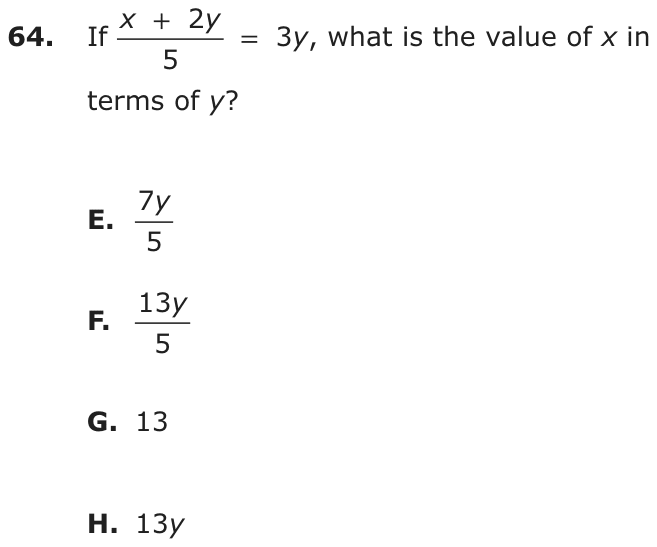
If , what is the value of x in terms of y?
- A
- B
- C13
- D
Show the answer
Correct answer: D
The goal is to isolate the variable x by using inverse operations. First, multiply both sides by 5 and then subtract from both sides.
Another approach is to make the right side of the equation a fraction and then use cross multiplication for the first step.
Question analysis
An equation says that x plus 2y, all divided by 5, equals 3y, and students choose the expression for x in terms of y. This multiple-choice algebra question tests solving a literal equation with inverse operations. Because the 5 divides the whole left side, clearing the fraction first and keeping track of the y terms is the tricky part.
- Grade level
- Grade 8 content, by NYS standard
- Compared with grade 7
- Above grade 7 Grade 7 students solve two-step equations with numbers, such as (n + 4)/3 = 6. Solving for one letter in terms of another, with a fraction to clear first, is grade 8 work and a step beyond.
- Estimated difficulty
- Moderate: several steps, or a close reading with one strong distractor.
- Thinking it demands
- Depth of knowledge 1, recall and reproduction · mainly apply
- What makes it hard
- Variables instead of numbers moderate
- Error-prone arithmetic minor
- Solution
- 2 steps
- Reading level
- Question and choices: about grade 5, 15 words.
- Students, last 30 days
- Not enough answers yet to show (it takes 10).
Why it is hard, traps and wrong answers (shows the answer)
Why it is hard
Two inverse operations solve it, but the fraction bar spans the whole sum x + 2y, so multiplying both sides by 5 has to come first. Students who split the fraction and stop at x/5 find a matching choice, and those who divide 3y by 5 instead of multiplying end up with fifths of y as well. Substituting y = 1, which makes x + 2 equal 15, checks any choice in seconds.
Variables instead of numbers moderate Understanding the question
Both sides hold y, so the result must stay a multiple of y: after clearing the 5, the like terms 15y and 2y are combined, and there is no number to check against. (Koedinger & Nathan, 2004; Enright, Morley & Sheehan, 2002)
Error-prone arithmetic minor Working it out
Multiplying the whole of 3y by 5 gives 15y, but dividing it by 5 or splitting the fraction into x/5 + 2y/5 leaves fifths of y in the working. (Brown & Burton, 1978; Junker & Sijtsma, 2001)
Strategy: Multiply both sides by 5 to clear the fraction, then subtract 2y from both sides; check by putting y = 1 into both the equation and the chosen expression.
Traps
- Stops one step early: A choice is a number from partway through the solution.
- Misunderstands the concept: A wrong belief about a concept: that percents can be added, that area grows like length, that averages can be averaged, that a bigger denominator means a bigger fraction.
- Wrong operation: Adds instead of multiplying, divides the wrong way round, turns a ratio or rate upside down, or undoes a step in the wrong direction (subtracts what should be added back).
The wrong answers, classified
A Wrong operation (Hegarty, Mayer & Monk, 1995; King et al., 2004)
Divides 3y by 5 instead of multiplying, so x + 2y = 3y/5 and x = −7y/5, then takes 7y/5, the choice that matches its size.
B Stops one step early (King et al., 2004; Gierl et al., 2017)
Splits the fraction and subtracts 2y/5 from 3y, reaching x/5 = 13y/5, then stops without multiplying both sides by 5.
C Misunderstands the concept (Smith, diSessa & Roschelle, 1993; De Bock et al., 1998; Ni & Zhou, 2005)
Reaches x = 15y − 2y but drops the letter, as if subtracting like terms cancelled the y, and gives the number 13 instead of 13y.
Worked solution, step by step
Formulas used
- Do the same to both sides
- a and b are two equal amounts, and c is any number. If you do the same thing to both sides of an equation, they stay equal, like a balanced scale. Use it to undo each step until the letter you want is alone.
Sort out the question
The equation says: take x plus 2y, divide the whole sum by 5, and you get 3y. You need x “in terms of y.” That means x alone on one side, with an expression using y on the other. An expression is a math phrase with no equal sign.
Clear the fraction first
The fraction bar divides the whole top, x + 2y, by 5. To undo dividing by 5, multiply both sides by 5.
Watch out: multiply 3y by 5. Don’t divide it by 5. Dividing leaves fifths of y, as in choice A.
Get x alone
Now 2y is added to x. To undo adding, subtract 2y from both sides.
15y − 2y means 15 y’s take away 2 y’s. That leaves 13 y’s, so the y stays.
Give the answer
Watch out: you might split the fraction into x/5 + 2y/5 instead. Then you reach x/5 = 13y/5. Stopping there gives choice B, but you still have to multiply by 5. Dropping the y gives 13, choice C. So the answer is D, .
Check your answer
Pick y = 1. Then x = 13 × 1 = 13. Put both into the equation: . And 3y = 3 × 1 = 3. Both sides match, so x = 13y works.
More questions like this
The original DOE question