Passage Excerpt from “The World Has an E-Waste Problem”
Excerpt from “The World Has an E-Waste Problem”
by Alana Semuels
As a tech-hungry nation . . . gets ready to upgrade to the next generation of lightning-fast 5G devices, there is a surprising environmental cost to be reckoned with: a fresh mountain of obsolete1 gadgets. About 6 million pounds of discarded electronics are already processed monthly at recycling giant ERI’s Fresno plant. Pallets2 of once beloved but now outdated devices . . . arrive here daily. Workers with hammers hack at the bulkiest devices, while others remove dangerous components like lithium-ion batteries. The scene is like a twisted . . . movie, with doomed gadgets riding an unrelenting conveyor belt into a machine that shreds them into piles of copper, aluminum and steel.
“In our society, we always have to have the new, best product,” said Aaron Blum, the co-founder and chief operating officer of ERI, on a tour of the facility. Americans spent $71 billion on telephone and communication equipment in 2017, nearly five times what they spent in 2010 even when adjusted for inflation, according to the Bureau of Economic Analysis. . . . When we buy something new, we get rid of what’s old. That cycle of consumption has made electronics waste the world’s fastest-growing solid-waste stream.
That stream is expected to turn into a torrent3 as the world upgrades to 5G, the next big step in wireless technology. 5G promises faster speeds and other benefits. But experts say it will also result in a dramatic increase in e-waste, as millions of smartphones, modems and other gadgets incompatible with 5G networks are made obsolete. “I don’t think people understand the magnitude of the transition,” says ERI co-founder and executive chairman John Shegerian. “This is bigger than the change of black-and-white to color, bigger than analog to digital, by many multitudes.”
. . . Less than a quarter of all U.S. electronic waste is recycled, according to a United Nations estimate. The rest is incinerated or ends up in landfills. That’s bad news, as e-waste can contain harmful materials like mercury and beryllium that pose environmental risks.
Part of the problem is regulatory. Only 19 states have laws banning electronics from the regular trash. In states without such rules, like Nevada, electronics often end up in garbage and recycling bins, said Jeremy Walters, a community-relations manager for waste collector Republic Services. Environmental concerns aside, compacting flammable lithium-ion batteries with paper recycling can be dangerous; recycling centers have reported an uptick in fires.
Even when e-waste rules exist, it’s left up to consumers to handle their old devices properly. But recycling them can be a pain. Rather than just drop a used phone in a bin outside their homes, lots of people have to take their electronics to a store, which may pay them for it but could also charge them to get rid of it. Many consumers, paralyzed by the hassle or put off by the expense, simply throw their devices into the trash or stash them in a drawer, hoping they’ll just disappear. “We don’t necessarily have the measures to make sure people aren’t throwing it away,” Walters said.
One solution is to make electronics last as long as they once did. At ERI’s facility, Shegerian showed TIME [magazine] dozens of televisions from the 1970s and 1980s that stopped working only recently. Yet instead, technology companies are speeding the pace of obsolescence. Most smartphone batteries can’t be easily replaced when they stop holding a charge, new laptops don’t accept old cables, and software companies push upgrades that won’t run on old devices. “Our products today don’t last as long as they used to, and it’s a strategy by manufacturers to force us into shorter and shorter upgrade cycles,” said Kyle Wiens, the founder of iFixit, which publishes do-it-yourself repair guides. . . .
Some environmental groups say multibillion-dollar companies . . . should pick up the cost of recycling the devices they sell. Lawmakers in parts of Europe and Canada and in some U.S. states have passed so-called Extended Producer Responsibility (EPR) laws, which require manufacturers to establish and fund systems to recycle or collect obsolete products. . . .
. . . Some companies are increasing their recycling efforts on their own, whether for the economic benefit or the public relations boost.
From “The World Has an E-Waste Problem” by Alana Semuels from TIME Magazine, June 3, 2019. Copyright © 2019 TIME USA, LLC.
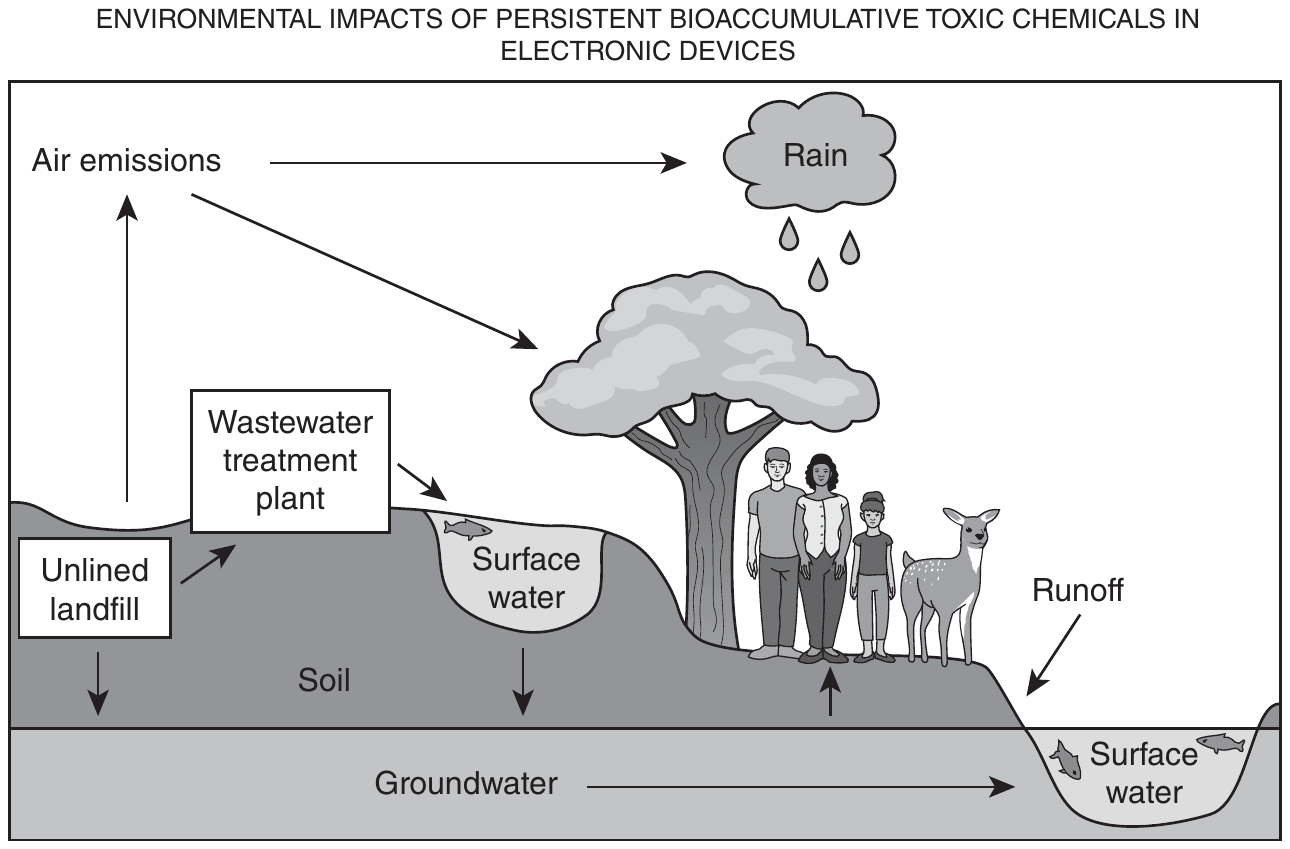
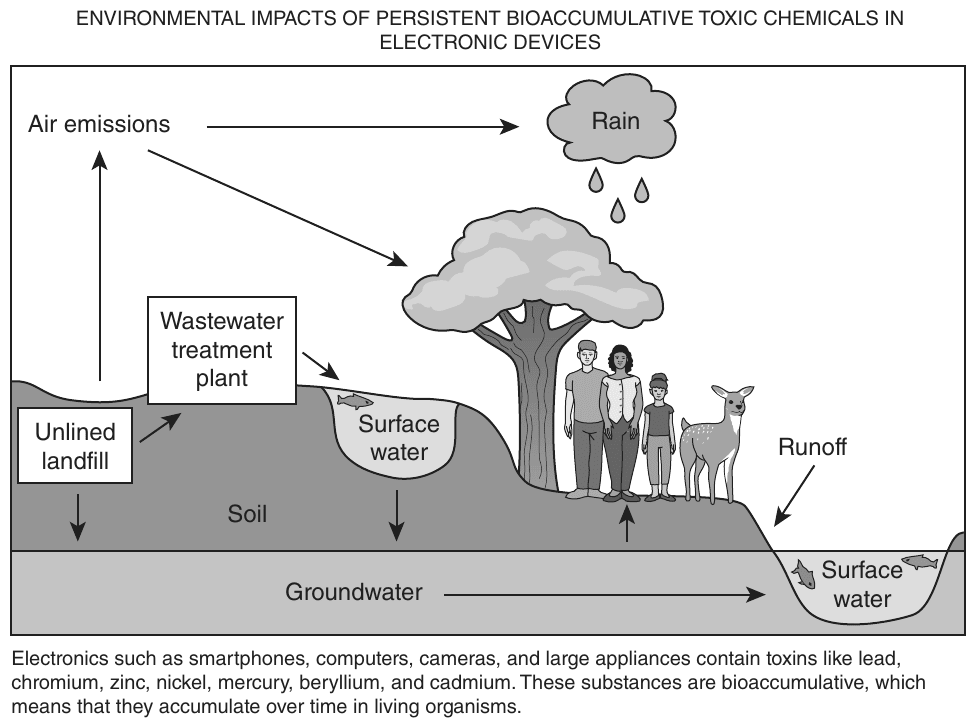
Electronics such as smartphones, computers, cameras, and large appliances contain toxins like lead, chromium, zinc, nickel, mercury, beryllium, and cadmium. These substances are bioaccumulative, which means that they accumulate over time in living organisms.
1obsolete: outdated and no longer useful
2Pallets: wooden platforms used to store or transport materials in a warehouse
3torrent: an outpouring
Question
What is the role of paragraphs 7–9 in the organization of the excerpt?
- AThey emphasize the contrast between successful and unsuccessful efforts to regulate electronic waste.
- BThey suggest that the electronic devices that were manufactured in the past created less pollution.
- CThey imply that manufacturers are willing to comply with regulations that protect the environment.
- DThey shift the focus from a discussion of individual behavior to a discussion of corporate responsibility.
Show the answer
Correct answer: D
The question asks about the role of paragraphs 7–9 in the overall organization of the excerpt.
A. Incorrect. These paragraphs make proposals for new efforts to regulate electronic waste, such as producing devices that last longer and having device-producing companies pay to have the devices recycled; however, no claims are made about these efforts being successful.
B. Incorrect. Paragraph 7 does suggest that today’s devices do not “last as long as they once did,” but it does not indicate that in the past electronic devices led to less pollution. Presumably, technology related to electronics recycling has improved in recent years.
C. Incorrect. While it is true that paragraphs 8 and 9 suggest that electronics manufacturers, who are part of the problem, will also need to be part of the solution, there is no call for regulations in these paragraphs, as it was previously established in paragraph 5 that such regulations do not yet widely exist.
D. CORRECT. Paragraph 6 references consumers who may be “paralyzed by the hassle or put off by the expense” and thus do not recycle their devices correctly. Paragraphs 7–9 then shift the focus from individual consumer behaviors to the responsibility of the manufacturers of these devices, who might take action either by making their devices “last as long as they once did” (paragraph 7) or by making efforts to “recycle or collect obsolete products” (paragraph 8).
Question analysis
This organization question asks what role paragraphs 7–9 play in the structure of “The World Has an E-Waste Problem.” The closing paragraphs cover longer-lasting electronics, recycling laws in Europe, Canada and some states, and companies’ own recycling efforts, so students must see how they fit with the paragraphs before them and describe their job in the excerpt rather than their details.
- Grade level
- Grade 8 reading and task
- Compared with grade 7
- Above grade 7 Grade 7 students describe how a section fits a text’s organization, but this question covers three paragraphs at once, its choices are worded in abstract terms, and judging the section’s role means keeping the earlier paragraphs in mind.
- Estimated difficulty
- Hard: combines ideas, needs a plan, and has more than one tempting wrong answer.
- Thinking it demands
- Depth of knowledge 3, strategic thinking · mainly analyze
- What makes it hard
- How, not what moderate
- Evidence in several places moderate
- The right answer is reworded minor
- Evidence
- Answered from several paragraphs or stanzas
- Reading level
- Passage: about grade 10, 760 words; question and choices: about grade 13, 70 words.
- Students, last 30 days
- Not enough answers yet to show (it takes 10).
Why it is hard, traps and wrong answers (shows the answer)
Why it is hard
The three paragraphs make different points, longer-lasting devices, producers paying for recycling and companies acting on their own, and the thread joining them is who bears the responsibility. That thread shows only against paragraph 6, which leaves old devices to consumers, so students who look at paragraphs 7–9 alone tend to pick a choice that fits one of them. The choice about manufacturers complying with regulations draws most, because paragraphs 8 and 9 do talk about manufacturers, laws and recycling.
How, not what moderate Working it out
The stem asks for the job paragraphs 7–9 do in the excerpt’s organization, so a summary of long-lived televisions, EPR laws and voluntary recycling is not enough; their role shows only against what came before. (Anderson & Krathwohl, 2001)
Evidence in several places moderate Working it out
The shift starts from paragraph 6, where consumers “paralyzed by the hassle” toss devices in the trash, so a role that fits paragraphs 7, 8 and 9 must also be set against that paragraph. (Kirsch & Mosenthal, 1990; Gorin & Embretson, 2006)
The right answer is reworded minor Choosing the answer
The right choice turns paragraph 6’s hassled consumers into “individual behavior,” a label students must supply themselves, while a wrong choice repeats paragraph 8’s manufacturers and laws and so looks better grounded. (Freedle & Kostin, 1993; Kirsch & Mosenthal, 1990)
Strategy: Sum up paragraphs 7, 8 and 9 in a phrase each and compare them with the paragraphs that come before, then pick the role that fits all three paragraphs, not just one.
Traps
- Wrong purpose or structure: Names a purpose, structure or effect that the part does not serve, or describes what a part says when the question asks what it does.
- Twists what the text says: Uses the text's topic and ideas but changes what it says: who did it, how much, when, or why.
- Reads too much in: A reasonable-sounding conclusion that goes further than the text allows.
The wrong answers, classified
A Wrong purpose or structure (Anderson & Krathwohl, 2001)
Sets paragraph 8’s EPR laws beside paragraph 5’s 19 states and sees a contrast of working and failing regulation, a structure the excerpt never builds and a success it never claims.
B Twists what the text says (King et al., 2004)
Takes the 1970s and 1980s televisions that worked until recently and turns their long life into less pollution, a claim paragraph 7 never makes, while ignoring paragraphs 8 and 9.
C Reads too much in (Graesser, Singer & Trabasso, 1994)
Reads paragraph 9’s companies recycling “on their own” as willingness to obey paragraph 8’s laws, though they act for profit or publicity and paragraph 7 shows them speeding obsolescence.
Working it out, step by step
Know what the question asks
This asks about structure: the job paragraphs 7–9 do in the excerpt. To see a job like this, compare the paragraphs with what comes just before them. Ask whose actions each part is about.
Look back at paragraph 6
Paragraph 6 is about consumers, the people who buy and use devices. It says it is “left up to consumers” to get rid of old devices the right way. Many of them are “paralyzed by the hassle or put off by the expense.” So paragraph 6 is about what single people do.
Sum up paragraphs 7, 8 and 9
- Paragraph 7: companies build devices that wear out sooner, and the founder of a repair-guide company says it is on purpose.
- Paragraph 8: some groups say companies should pay for recycling. Some places have laws that make manufacturers set up recycling systems.
- Paragraph 9: some companies are recycling more “on their own.”
All three paragraphs are about companies. Corporate means having to do with companies.
Spot the shift in focus
Up to paragraph 6, the excerpt asks what people do with old devices. From paragraph 7 on, it asks what companies do and should do. Responsibility means the duty to deal with a problem. The last three paragraphs move that duty onto the businesses that make the devices.
Test each choice
- A does not fit. Paragraph 8 says some laws were passed. It never says they worked, and no failed rules are set beside them.
- B does not fit. Old TVs lasted longer, but paragraph 7 never says they caused less pollution. B also skips paragraphs 8 and 9.
- C does not fit. Paragraph 7 shows companies cutting devices’ lives short. The laws in paragraph 8 “require” action, which says nothing about willingness. In paragraph 9, companies recycle for money or good publicity.
- D fits. The focus moves from what buyers do to what companies owe.
Choose the answer
Watch out: C is tempting because paragraphs 8 and 9 mention laws and companies that recycle. But no paragraph shows companies agreeing to follow rules. So the answer is D.
Why this answer and not the closest wrong one
C pulls hardest of the three wrong choices. It names the right group, manufacturers. But it claims they are willing to obey environmental rules, and the excerpt never shows that. D fits all three paragraphs at once. Each one turns from single buyers to the companies that make and sell the devices.
More questions like this
The original DOE question
The passage “Excerpt from “The World Has an E-Waste Problem”” as printed (pages 164–166)