Question
| Report | Subject | Topic Choices |
|---|---|---|
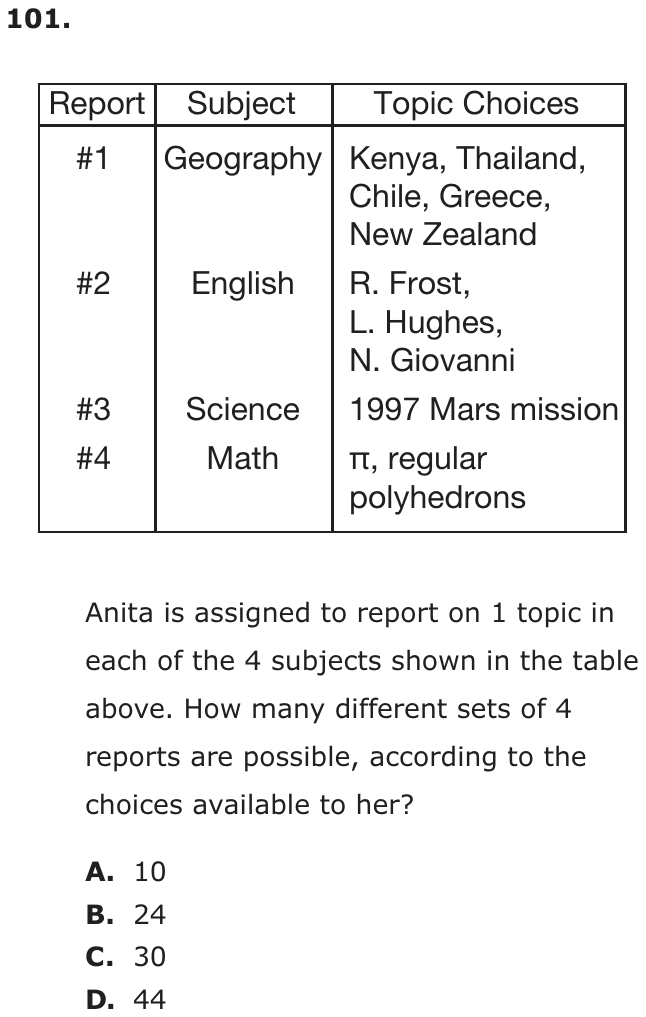
| #1 | Geography | Kenya, Thailand, Chile, Greece, New Zealand |
| #2 | English | R. Frost, L. Hughes, N. Giovanni |
| #3 | Science | 1997 Mars mission |
| #4 | Math | π, regular polyhedrons |
Anita is assigned to report on 1 topic in each of the 4 subjects shown in the table above. How many different sets of 4 reports are possible, according to the choices available to her?
- A10
- B24
- C30
- D44
Show the answer
Correct answer: C
One report is assigned for each of 4 subjects, and each subject has a specified number of topic choices:
- 5 choices for Geography
- 3 choices for English
- 1 choice for Science
- 2 choices for Math
The basic counting principle (product rule) applies since the number of choices for each subject is independent of the choices for the other subjects. The number of different sets of 4 reports possible is the product.
Question analysis
A table lists the topics Anita may choose from for reports in geography, English, science and math. She reports on one topic in each subject, and students count how many different sets of four reports are possible. It tests the counting principle; reading how many topics each row offers, including a row with only one, comes first.
- NYS standards
- 7.SP.8b sample spaces for compound events
- Grade level
- Grade 7 content, by NYS standard
- Compared with grade 7
- At grade 7 Counting the outcomes of several independent choices is grade 7 work, usually done with a tree diagram or a list. Four subjects make a full tree impractical, so a counting shortcut is needed, but each count is small and read from the table.
- Estimated difficulty
- Straightforward: two steps or one careful reading.
- Thinking it demands
- Depth of knowledge 2, skills and concepts · mainly apply
- What makes it hard
- Solution
- 2 steps
- Reading level
- Question and choices: about grade 7, 52 words.
- Students, last 30 days
- Not enough answers yet to show (it takes 10).
Why it is hard, traps and wrong answers (shows the answer)
Why it is hard
Once the four counts are read from the table, the question is a single product, so the real test is recognizing that independent choices multiply. Students who add the counts get 11, which is not offered, a useful signal that the method is wrong. Science's single topic multiplies by 1 and changes nothing, but it still has to be read as one choice, not as none.
Something you must already know moderate Working it out
The counting principle is not stated: choosing one topic from each subject means multiplying the numbers of choices, 5 × 3 × 1 × 2, not adding them. (Anderson & Krathwohl, 2001)
Reading a figure, table or graph minor Understanding the question
The topic lists must be counted by their commas, and two rows mislead: Science offers a single topic, and Math's “π, regular polyhedrons” is two topics, not one. (Lesh, Post & Behr, 1987; Kirsch & Mosenthal, 1990)
Strategy: Count the topic choices in each row of the table, reading the commas carefully, then apply the counting principle, since Anita picks one topic from every subject.
Traps
- Wrong operation: Adds instead of multiplying, divides the wrong way round, turns a ratio or rate upside down, or undoes a step in the wrong direction (subtracts what should be added back).
- Misunderstands the concept: A wrong belief about a concept: that percents can be added, that area grows like length, that averages can be averaged, that a bigger denominator means a bigger fraction.
- Numbers taken from the question: Combines the numbers in the question without a model of the situation, or is simply a number that appears in the question.
The wrong answers, classified
A Wrong operation (Hegarty, Mayer & Monk, 1995; King et al., 2004)
Adds the topic counts instead of multiplying and leaves out Science's single topic as no real choice, 5 + 3 + 2 = 10.
B Misunderstands the concept (Smith, diSessa & Roschelle, 1993; De Bock et al., 1998; Ni & Zhou, 2005)
Counts the orders in which four reports could be written, 4 × 3 × 2 × 1 = 24, instead of the ways to choose one topic per subject.
D Numbers taken from the question (Hegarty, Mayer & Monk, 1995)
Multiplies the 4 subjects by the 11 topics listed in all, 4 × 11 = 44, combining numbers without a model of the choices.
Worked solution, step by step
Formulas used
- Counting principle
- a, b, c and d are the numbers of choices for each separate pick. When you make one pick from each group, and the groups don’t affect each other, multiply the numbers of choices. Each choice in one group can go with every choice in the others.
Sort out the question
Anita writes 4 reports, one for each subject. For each subject she picks 1 topic from that row of the table. A set of 4 reports is one full pick: one topic for each subject. You need how many different sets are possible.
Count the topics in each row
Use the commas to count the topics.
- Geography: Kenya, Thailand, Chile, Greece, New Zealand. That is 5.
- English: Frost, Hughes, Giovanni. That is 3.
- Science: only the 1997 Mars mission. That is 1.
- Math: π and regular polyhedrons. That is 2.
New Zealand is two words but one country, so it is one topic.
Multiply the choices
Use the counting principle. Each of the 5 geography topics can go with each of the 3 English topics, and so on.
Science has just one topic, so every set has it. Multiplying by 1 changes nothing. Watch out: don’t add the counts. Adding them without Science, , gives choice A.
Rule out the other choices
counts the orders for writing 4 reports. The question does not ask about order, so 24, choice B, is wrong. multiplies the subjects by all the topics. That is choice D, and it has no meaning here. So the answer is C, 30.
Check your answer
Build it up. Geography and English alone give pairs, such as Kenya with Frost. Science adds only one topic, so there are still 15. Math doubles it, π or polyhedrons, so sets.
More questions like this
The original DOE question