Question
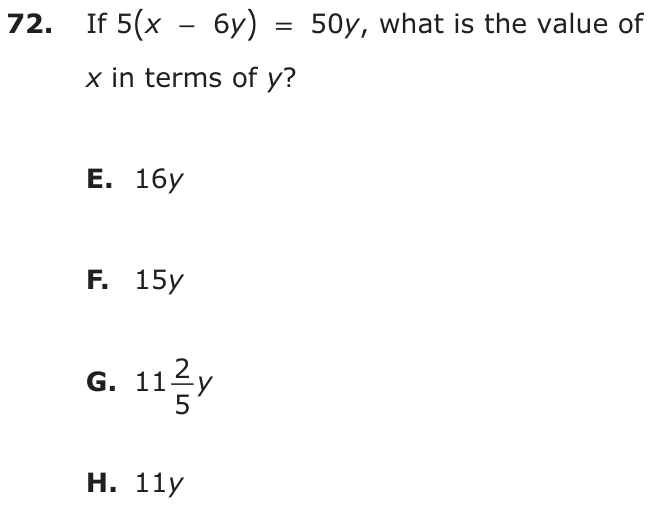
If , what is the value of x in terms of y?
- A
- B
- C
- D
Show the answer
Correct answer: A
To find the value of x in terms of y, solve for x. Begin by distributing 5 on the left side of the equation:
Solve for the value of x:
Question analysis
This algebra question gives the equation 5(x − 6y) = 50y and asks for x in terms of y. Students use the distributive property, or divide both sides by 5, and then solve a literal equation with inverse operations. Forgetting that the 5 multiplies both terms inside the parentheses is the classic slip here.
- Grade level
- Grade 8 content, by NYS standard
- Compared with grade 7
- Above grade 7 Grade 7 students solve equations such as 5(x − 6) = 50 with numbers. Solving for x in terms of another letter, through the distributive property, is grade 8 algebra, though the choices can be checked by substitution.
- Estimated difficulty
- Moderate: several steps, or a close reading with one strong distractor.
- Thinking it demands
- Depth of knowledge 1, recall and reproduction · mainly apply
- What makes it hard
- Variables instead of numbers moderate
- Error-prone arithmetic minor
- Solution
- 3 steps
- Reading level
- Question and choices: about grade 6, 16 words.
- Students, last 30 days
- Not enough answers yet to show (it takes 10).
Why it is hard, traps and wrong answers (shows the answer)
Why it is hard
The equation needs only three moves, distribute or divide by 5, add the y term, divide, so the risk lies in the first move. Multiplying only the x by 5 is the classic slip, and it gives 56/5 y, a value that is not listed but sits between two of the choices. Substituting y = 1 and the chosen x back into 5(x − 6) = 50 checks any choice in seconds.
Variables instead of numbers moderate Understanding the question
Both sides hold y and the result must be a multiple of y, so there is no number to check against unless the student substitutes, for instance y = 1. (Koedinger & Nathan, 2004; Enright, Morley & Sheehan, 2002)
Error-prone arithmetic minor Working it out
The 5 has to multiply both terms in the parentheses, giving 5x − 30y, and then 80y ÷ 5 must come out exactly; dividing both sides by 5 first keeps the numbers small. (Brown & Burton, 1978; Junker & Sijtsma, 2001)
Strategy: Distribute the 5 to both terms in the parentheses, or divide both sides by 5 first, then add the y term to both sides; substitute your choice back for x to check.
Traps
- A faulty procedure: A systematic but wrong procedure: adding fractions straight across, applying an exponent to each term of a sum, dropping a sign when moving a term.
The wrong answers, classified
B Little reason to choose it (Haladyna & Downing, 1993; Rodriguez, 2005)
No common working gives 15y; it sits one y below the correct value and would need a slip such as 80 ÷ 5 = 15, so it mostly draws guesses.
C Little reason to choose it (Haladyna & Downing, 1993; Rodriguez, 2005)
No common working gives 57/5 y; multiplying only the x by 5 leads to 56/5 y, or 11 1/5 y, so this mostly draws students who land near it.
D A faulty procedure (Brown & Burton, 1978; Tatsuoka, 1983)
Multiplies only the x by 5, so 5x − 6y = 50y and 5x = 56y, then drops the remainder of 56 ÷ 5 = 11 R1, keeping 11y.
Worked solution, step by step
Formulas used
- Distributive property
- a is the number outside the parentheses. b and c are the terms inside. A term is a number, a letter, or a number times a letter. Multiply each term inside by a. Use it when a number multiplies a whole sum.
- Keeping an equation balanced
- a and b are the two equal sides. c is any number, but not 0 when you divide. Doing the same thing to both sides keeps them equal, like a balanced scale. Use it to get the unknown by itself.
Sort out the question
The equation is . It has two letters, x and y. In terms of y means get x alone on one side. The other side may still have y in it. So the answer will look like a number times y.
Multiply out the parentheses
Use the distributive property. The 5 multiplies both terms inside.
Watch out: the 5 must multiply the 6y too. Multiplying only the x gives . Then x is . That is not a choice, but it sits close to C and D. Don’t pick one of them just because it is close.
Get the x term alone
Add 30y to both sides. This keeps the equation balanced.
Like terms add: 50 y’s plus 30 y’s is 80 y’s.
Divide by 5
5x means 5 times x. Divide both sides by 5 to get x by itself.
So the answer is A, .
Check your answer
Pick y = 1. Then x = 16. Put both into the first equation: . The right side is . Both sides match. A faster route: divide both sides by 5 first. Then , so x = 16y.
More questions like this
The original DOE question