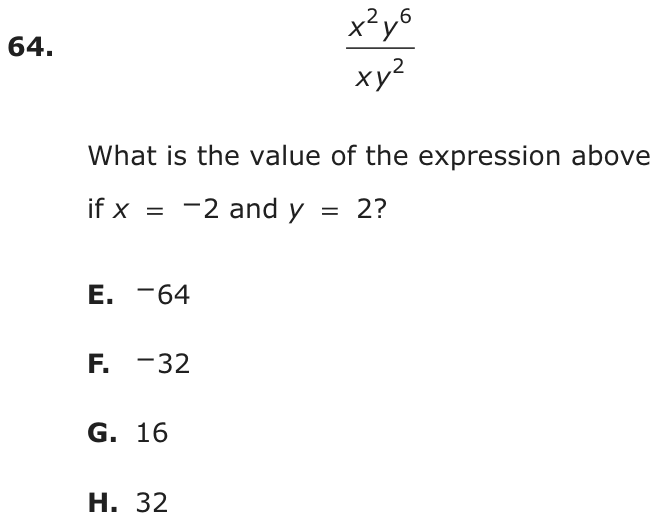
Question
What is the value of the expression above if and ?
- A−64
- B−32
- C16
- D32
Show the answer
Correct answer: B
First, substitute −2 for x and 2 for y.
Then, simplify.
Question analysis
This question asks for the value of a fraction built from powers of x and y when x is −2 and y is 2. Students evaluate an expression with exponents and a negative number, or simplify it first by cancelling common factors. Keeping track of the negative sign through the squaring and the division is the tricky part.
- NYS standards
- Grade level
- Grade 7 content, by NYS standard
- Compared with grade 7
- At grade 7 Grade 7 students evaluate expressions with negative values and whole-number exponents. This one is a single fraction of powers, routine in method, but raising a negative base to powers and then dividing leaves several chances to lose the sign.
- Estimated difficulty
- Straightforward: two steps or one careful reading.
- Thinking it demands
- Depth of knowledge 1, recall and reproduction · mainly apply
- What makes it hard
- Error-prone arithmetic moderate
- Something you must already know minor
- Solution
- 3 steps
- Reading level
- Question and choices: about grade 8, 13 words.
- Students, last 30 days
- Not enough answers yet to show (it takes 10).
Why it is hard, traps and wrong answers (shows the answer)
Why it is hard
Two routes work: substitute and compute 256 ÷ (−8), or simplify to xy⁴ first and evaluate (−2)(16). Simplifying first is safer, because it leaves a single negative factor to track. Substituting first brings in (−2)², where treating the minus sign as outside the parentheses flips the final sign, and each listed wrong value comes from an exponent or a sign handled wrongly.
Error-prone arithmetic moderate Working it out
Substituting first gives (−2)²(2)⁶ over (−2)(2)², so the work runs through a squared negative, 2⁶ = 64 and a negative divisor, and one factor of −2 decides the sign. (Brown & Burton, 1978; Junker & Sijtsma, 2001)
Something you must already know minor Working it out
The quotient rule for powers is not stated; students who know that x²/x = x and y⁶/y² = y⁴ can reduce the expression to xy⁴ before any number goes in. (Anderson & Krathwohl, 2001)
Strategy: Cancel the factors of x and y that the top and bottom share before substituting, so there is less to compute, and track the sign of every factor of −2 through to the end.
Traps
- Order of operations: Working left to right, or distributing a minus sign wrongly, gives a choice.
- A faulty procedure: A systematic but wrong procedure: adding fractions straight across, applying an exponent to each term of a sum, dropping a sign when moving a term.
The wrong answers, classified
A A faulty procedure (Brown & Burton, 1978; Tatsuoka, 1983)
Drops the square on y in the denominator, dividing 4 × 64 = 256 by (−2)(2) = −4 instead of by (−2)(4) = −8, giving −64.
C A faulty procedure (Brown & Burton, 1978; Tatsuoka, 1983)
Cancels x² against x as if x²/x were 1 rather than x, so only y⁶/y² = y⁴ = 16 is left, with no factor of −2.
D Order of operations (Brown & Burton, 1978)
Squares as if the minus sat outside the parentheses, taking (−2)² as −4, so −4 × 64 = −256 and −256 ÷ (−8) = 32.
Worked solution, step by step
Formulas used
- A power
- a is the base, the number being multiplied. The small number is the exponent. It says how many times the base is used as a factor, a number being multiplied. So y⁶ means six y’s multiplied together. It does not mean y times 6.
- Dividing powers with the same base
- a is the base. m and n are exponents. The top has m factors of a and the bottom has n. Each matching pair cancels, because a ÷ a = 1. So m − n factors are left. A letter with no exponent, like x, has exponent 1.
Sort out the question
You need the value of when x = −2 and y = 2. The top means . The bottom means . You could put the numbers in right away. But simplifying first is safer. It leaves only one negative number to track.
Simplify the x part
Use the rule for dividing powers. The x on the bottom has exponent 1.
You can see it by writing it out: leaves one x. Watch out: x² ÷ x is x, not 1. If you cancel every x, you lose the −2 and get 16, choice C.
Simplify the y part
So the whole fraction becomes a simpler expression:
Watch out: the bottom has y², not y. Using y leaves y⁵ and leads to −64, choice A.
Put in the numbers
Now substitute x = −2 and y = 2.
A negative times a positive is negative. So the answer is B, −32.
Check your answer
Substitute first, the long way. Top: . Bottom: . Then . Watch out: (−2)² is +4, since two negatives multiply to a positive. Writing −4 leads to 32, choice D.
More questions like this
The original DOE question