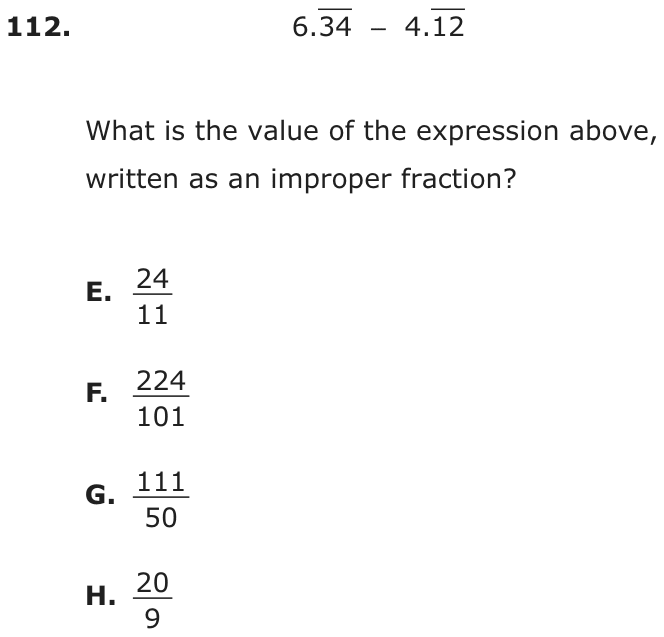
Question
What is the value of the expression above, written as an improper fraction?
- A
- B
- C
- D
Show the answer
Correct answer: D
| Set x equal to the repeating decimal. | |
| Multiply both sides by 10. | |
| Subtract 10x and x. | |
| Apply the multiplicative inverse property; divide both sides by 9. | |
Question analysis
Two repeating decimals are subtracted, and students write the difference as an improper fraction. It tests subtracting repeating decimals and converting a repeating decimal into a fraction, a grade 8 skill. The repeating part has to be handled exactly, so a careful method matters more than speed.
- NYS standards
- Grade level
- Grade 8 content, by NYS standard
- Compared with grade 7
- Above grade 7 Grade 7 students change fractions into repeating decimals by long division. Going the other way, from a repeating decimal to a fraction, is grade 8 work, though the subtraction that comes first here is simple.
- Estimated difficulty
- Moderate: several steps, or a close reading with one strong distractor.
- Thinking it demands
- Depth of knowledge 1, recall and reproduction · mainly apply
- What makes it hard
- A very close wrong answer moderate
- Something you must already know moderate
- Solution
- 3 steps
- Reading level
- Question and choices: about grade 9, 18 words.
- Students, last 30 days
- Not enough answers yet to show (it takes 10).
Why it is hard, traps and wrong answers (shows the answer)
Why it is hard
The subtraction is easy, since the repeating digits line up and give 2.222…; the conversion is the test. Every choice sits within a few hundredths of the answer, so rounding or estimating cannot separate them, and the exact 2.22 of 111/50 is the strongest pull. Students who know that 0.222… is 2/9 can write 2 2/9 = 20/9 directly.
A very close wrong answer moderate Choosing the answer
All four choices lie between 2.18 and 2.23: 111/50 is exactly 2.22 and 224/101 is about 2.218, so only 20/9 equals the repeating 2.222… exactly. (Embretson & Wetzel, 1987; Gorin & Embretson, 2006; Ascalon et al., 2007)
Something you must already know moderate Working it out
Turning 2.222… into a fraction, by setting x equal to it and subtracting x from 10x, is grade 8 work that the question does not explain. (Anderson & Krathwohl, 2001)
Strategy: Subtract the decimals digit by digit to see which digits repeat, then turn that repeating decimal into a fraction, or divide each choice's numerator by its denominator and compare.
Traps
- A faulty procedure: A systematic but wrong procedure: adding fractions straight across, applying an exponent to each term of a sum, dropping a sign when moving a term.
- Rounds too early: Rounds a value partway through, or rounds the wrong way, so the final answer drifts from the exact one.
The wrong answers, classified
A A faulty procedure (Brown & Burton, 1978; Tatsuoka, 1983)
Sets x = 2.222… but adds 10x and x instead of subtracting, then drops the repeating part as if it had cancelled, so 11x = 22 + 2 = 24.
B A faulty procedure (Brown & Burton, 1978; Tatsuoka, 1983)
Multiplies by 100 for two-digit blocks, then adds x instead of subtracting it and drops the repeating part, so 101x = 222 + 2 = 224.
C Rounds too early (King et al., 2004)
Drops the repeating bar and treats the difference as exactly 2.22, which is 222/100 = 111/50, slightly less than the true repeating value.
Worked solution, step by step
Formulas used
- Repeating decimal to fraction
- x is the repeating decimal. Multiplying by 10 moves the decimal point one place to the right. The endless repeating digits still line up after the point. So when you subtract x from 10x, they cancel, and only whole numbers are left.
Sort out the bars
A bar over digits means they repeat forever. So means 6.343434… and means 4.121212… with no end. You need the difference as an improper fraction. That is a fraction whose top is bigger than its bottom.
Subtract the decimals
Line up the digits. Each block of 34 minus 12 gives 22. The whole numbers give 6 − 4 = 2.
The difference is 2.222…, with the 2 repeating forever. You can write it .
Name the decimal x
Let x be the repeating decimal. Then multiply both sides by 10. This moves the decimal point one place to the right.
Subtract to remove the repeats
Subtract the first line from the second. The repeating 2s after the point match up, so they cancel.
Divide to find x
Divide both sides by 9.
Watch out: is exactly 2.22, which stops. The real difference never stops. That trap is choice C. Every choice is close to 2.2, so estimating won’t help.
So the answer is D, .
Check your answer
Divide 20 by 9. 9 goes into 20 two times, with 2 left over. Each next step leaves 2 again, so you get 2.222… forever. That matches the difference. Choice A, , is 2.1818… instead.
More questions like this
The original DOE question